Western Montana Fair
Missoula, Missoula County, Montana. Fair.
Details

- Where
- 1101 South Avenue West, Missoula, MT 59801. Directions
- When
- August 6-8 and 10-14, 2027.
- Getting there
- All public parking for the Western Montana Fair is now accessed on Stephens Ave.
- Fees
- Free entry.
- Hours
- Office Monday – Friday: 9 a.m. to 5 p.m.
- Access
- All public parking for the Western Montana Fair is now accessed on Stephens Ave.
- Walk-in or reserve
- TICKETS COMING SOON.
- Phone
- (406) 721-3247
- Managed by
- Missoula County Fairgrounds.
- Established
- 1874.
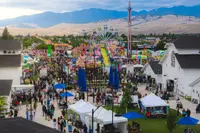
Nobody pays to walk through the gates of the Western Montana Fair. Admission has been free since 2017, paid for by sponsors. By the fairgrounds’ reckoning, every sponsorship dollar returns nearly ten to the region, much of it to the nonprofit groups that depend on fairgoers to meet their yearly budgets. Public parking is now entered from Stephens Avenue. The Mountain Line bus runs to the fair free, and bicycles park free. Pets stay home for the run of the fair, though service animals are allowed in designated areas.
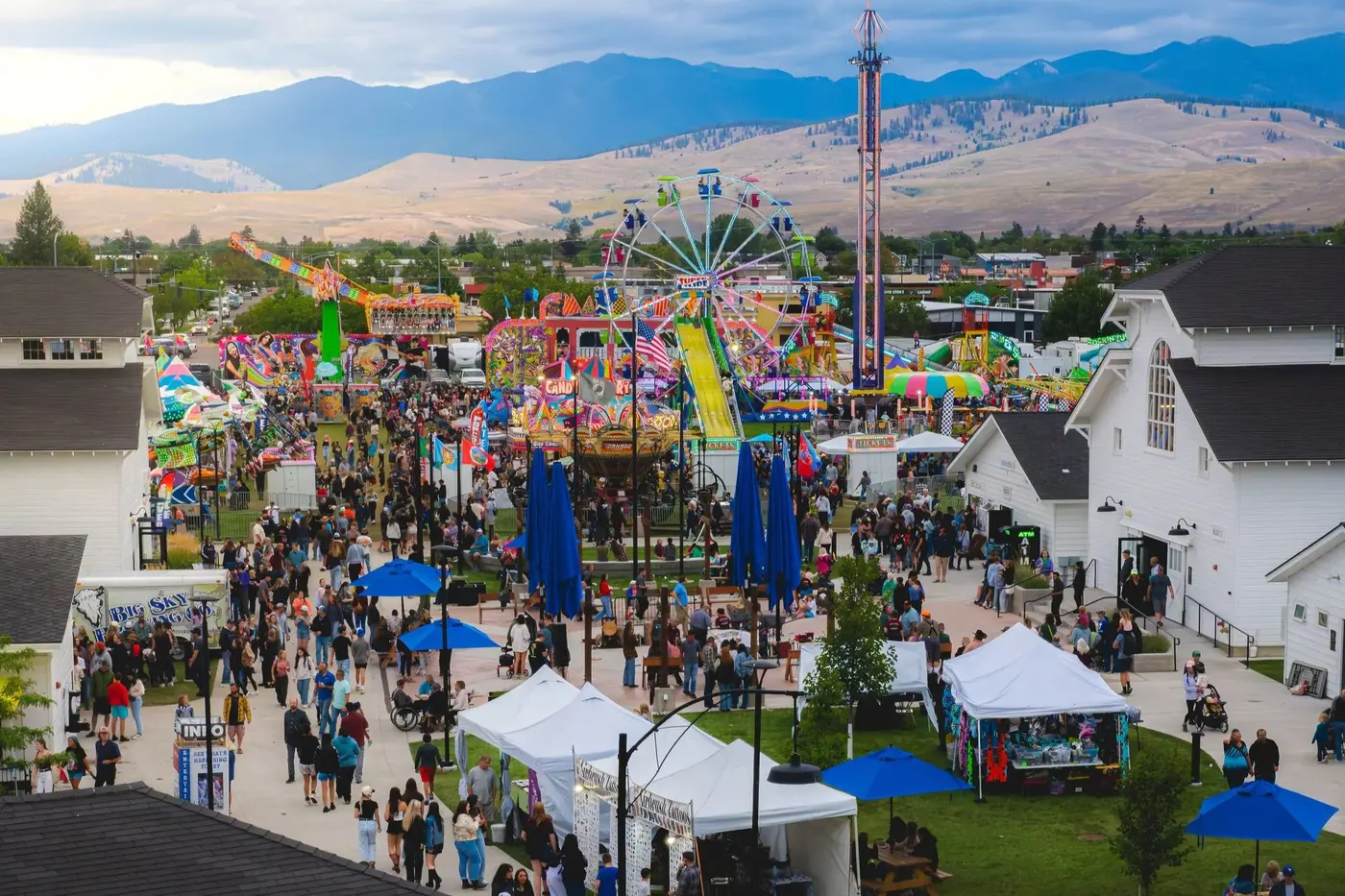
The 2027 fair is set for August 6–8 and August 10–14: two weekends and eight days of food, carnival rides, arena action, live entertainment and what the organizers call community traditions. Arena events are ticketed separately, and a Breakaway Pass moves its holders to the head of the grandstand line. Fans who match the number of a night’s winning racer get bonus chances at that night’s $4,000 cash giveaways. Five ATMs stand on the grounds, since the draw and the parking both take cash. A $1 wristband lets an adult carry a drink through most of the grounds. The fair has joined Missoula’s Zero by Fifty effort, which aims to cut what the city sends to the landfill by 90 percent by 2050.
Grandstands, butterflies and a 1915 hall
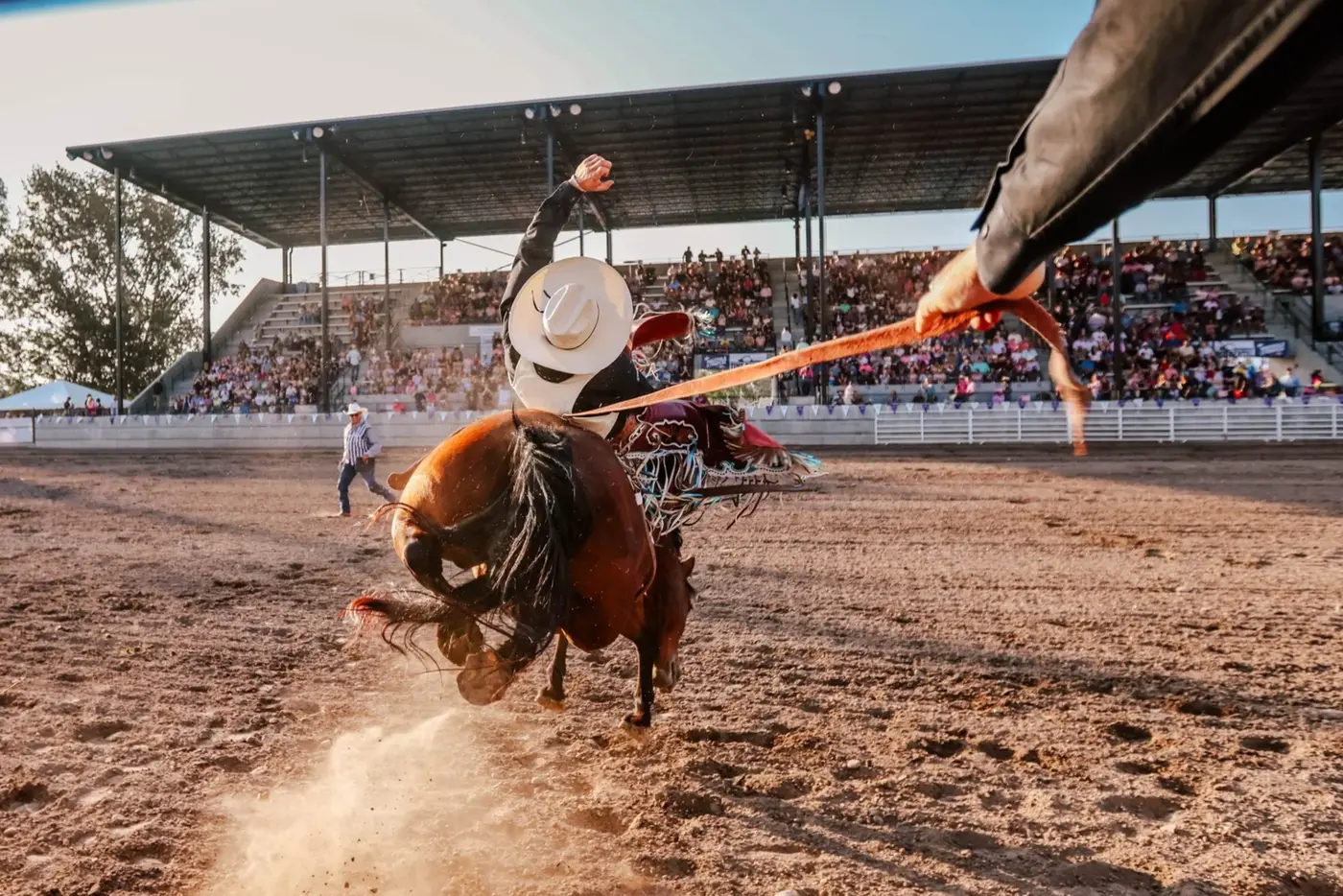
The grandstands went up in less than a year and were finished in 2024. Their concrete risers were formed in molds from Bobcat and Washington-Grizzly stadiums. The aluminum benches are recycled, and much of the wood was salvaged from the grandstands they replaced. Missoula Concrete Construction contributed $1 million in risers, and the stands carry its name. They offer weather protection, more legroom and wider concourses than the old ones.
Beyond them, the Exploration Center and Rocky Mountain Gardens, opened in 2022, keep live butterflies, insects and arthropods. Glacier Ice Rink occupies a steel building put up in 1997 to replace the wooden livestock barns and to serve both skaters and stock. Seven years later it was enclosed and given an open-sided addition on the north. Livestock now use it only 30 days a year. The first phase of redevelopment cost $34 million, drawn from a fairgrounds special district, the Missoula Redevelopment Agency and private donors. It was finished in time for the 2021 fair and brought renovated historic buildings, a Historic Plaza and new concession stands.
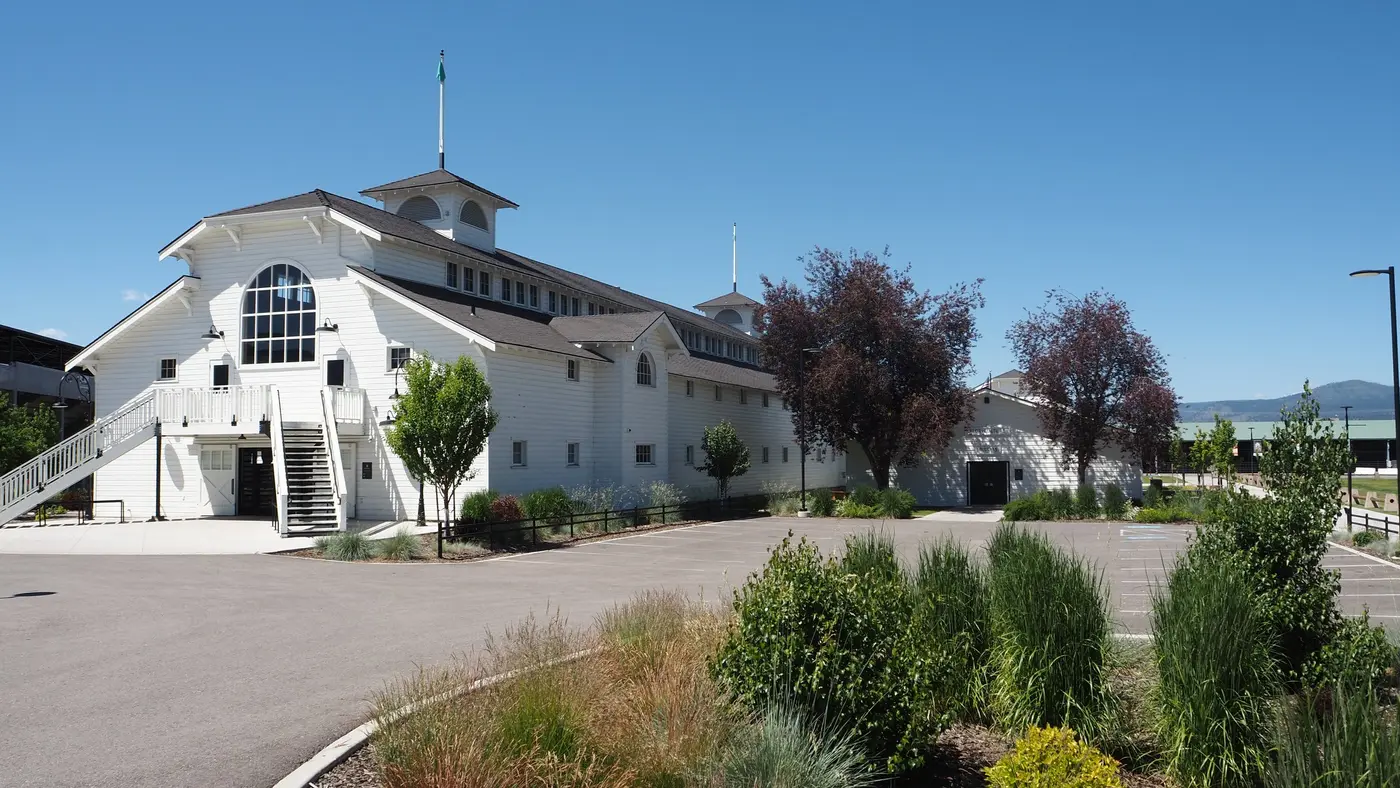
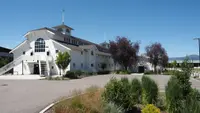
For more than a century the Commercial Building, the largest structure on the grounds, has been the fair’s central hall for farm, ranch and craft exhibits. It was built in 1915 as the Agricultural Building. It and the Agricultural Annex are Craftsman designs by Ole Bakke, protégé and partner of the Missoula architect A. J. Gibson. Preserve Historic Missoula wrote the nomination that placed the fairgrounds in the National Register of Historic Places as a historic district on September 16, 2010. The county runs the grounds through its Lands, Culture and Recreation department, directed by Randy Arnold. Billie Brown, events and operations manager, works from the fair office in Building 12.
A squash, a slab of bacon and three slow starts
The case for a fair was made in a Missoula newspaper in 1874: “People that have no fairs or festival occasions become so insufferably mean in a few generations that they cannot be endured or endure each other. Will not some enterprising individual fence off a patch of ground on the other end of the (Higgins) bridge, and offer a prize for the largest squash or the best slab of bacon?”
That fall organizers canvassed residents. As the local paper put it, a fair “was pretty unanimously admitted to be a public necessity.” By the fairgrounds’ own history, local farmers and ranchers formed the Western Montana Agricultural, Mechanical and Mineral Association in 1874. Citizens taxed themselves more than $6,000. A board of trustees broke ground by early 1875 and set October 6 of that year for the first fair.
The work ran late. Wooden water pipes “two inches square and 640 yards in length” still had to be buried in a foot-deep trench from springs in the hills to the new grounds on Missoula’s south side. Mr. Kron, the architect, did not have the main building framed until early October, and Mr. D. S. Herren was still working on the racetrack. That track was a mile long and 60 feet wide, built for $400 near the present KOA campground, with stables, a restaurant and a saloon for spectators. The fair was put off to September 13, 1876.
The New Northwest in Deer Lodge reported its own county’s people heading down “to enjoy a few days recreation among the watermelon groves.” “Professor Morrow, the world-renowned magician,” was booked, and so was “Taylor, the Wizard,” whose skills included “suspending one of his company in the air without support.” On opening day Cornelius Hedges addressed the crowd. He predicted that Missoula County, which then reached from the Flathead through the Bitter Root, could feed “a population of 1,000,000, and … children now born may live to see that day!”
Mrs. Lulu Weller won $5 for her cornbread. Miss M. A. Ives took the $10 prize for “Best Loaf of Bread by Prettiest Girl.” The Bass brothers of the Bitter Root won for melons, grain and vegetables, and their wives won for preserves, butter, gooseberries and blackberries. Some farmers had stayed out of the judging, sure of losing, and were later overheard saying their crops beat the winners. The organizers broke even.
They decided harvest season had been the wrong time and moved the 1877 fair to mid-October. That year grasshoppers and a hailstorm hit the Bitter Root, and the county lost about six weeks of business to what the account calls “the Indian excitement,” the Nez Perce passage through the valley. In 1878 the Weekly Missoulian judged that “no four days in the month of October could be so cheerless and disagreeable for a festive occasion.” Before the mid-September fair of 1879, financial backers formed a new association. That fair drew a better crowd. Governor Pott’s horse Balaolava won the two-mile dash and $200, and the event was called “the most successful one yet.”
The fair’s birth year depends on who is counting. The fairgrounds dates its organization to 1874. Missoula’s first fair was held in 1876, and newspapers of the day numbered the later ones from it. The officially recognized first Western Montana Fair is said to be 1879, based on reorganization documents. The 2018 fair’s logo read “Pioneering the Future since 1879.” The columnist Jim Harmon notes that by the same logic one could argue for 1914, when the fair became county owned and operated.
Forty acres south of town
A Missoula Fair and Racing Association was formed in 1886 to revive the fair and standardize its races. In 1888 the Northern Pacific Railroad built a spur to carry livestock straight to the fair, and a new site was bought northwest of town. Private land served until 1909, when, by Harmon’s account, the site was sold and the county fair ceased to exist.
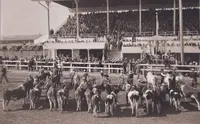
In 1913 the county bought the present South Avenue ground, once one of the city’s early airfields, for $16,000. Harmon writes that residents went into debt by some $50,000 to buy 40 acres and equip them with exhibition halls, a racetrack and a grandstand. The racetrack, built in 1914, was the first structure on the grounds. More than 12,000 people came to the four-day opening fair that fall, the same year the Inland Empire Fair in Spokane lost $30,000. Fruits, vegetables and flowers had been shown in a tent. “Fortunately, the lack of wind which frequently visits us at that time of year saved the exhibit from an inglorious disaster,” said F. M. Lawrence, secretary of the fair commission, and he urged an agricultural building.
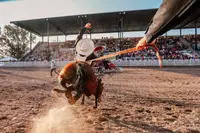
By noon on Tuesday, September 28, 1915, the day before the second fair opened, the Missoulian reported that “the new agricultural building was half filled and the exhibitors were beginning to fight for space.” Vegetables, grains, flowers and flour filled the ground floor. The U.S. Forest Service explained itself along one side. At the north end the Northern Pacific promoted its dining-car “Great Big Baked Potato,” and the Missoula Mercantile furnished a row of household rooms. A streetcar extension ran to the gates that year, and owners offered their autos “for hire.” The first Missoula Stampede Rodeo was held that same year, with bull riding, bronc riding, steer wrestling and roping. The National Register nomination calls today’s Commercial Building the original Agriculture Building. Harmon reports that at least one of his sources doubts it is the same structure.
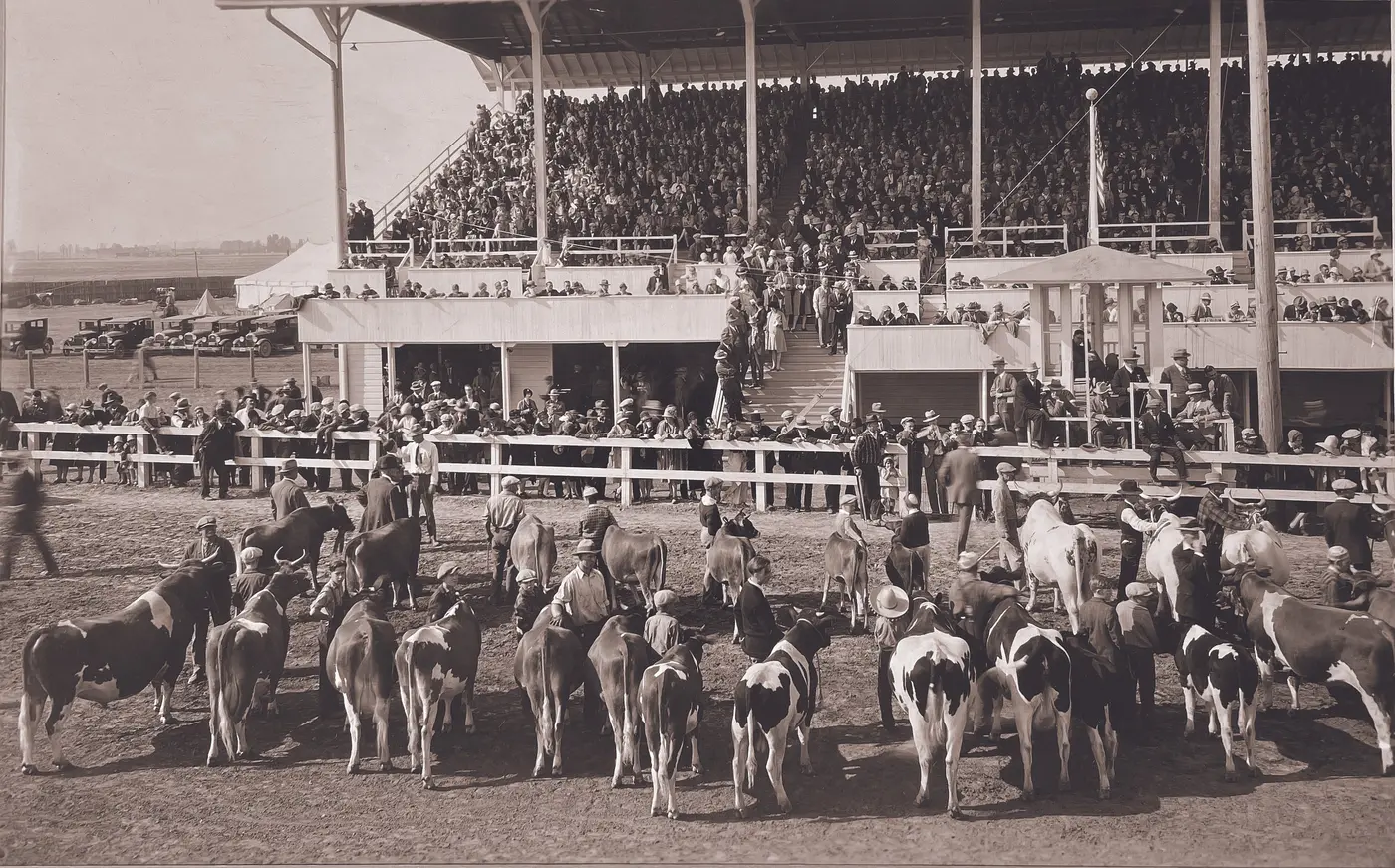
The October 1916 fair was the last before the country entered the First World War. In 1917 and 1918 the grounds served as temporary Army barracks, and the fair returned in 1919. Gate admission in 1920 was 75 cents. In the 1920s an alligator shown in an outdoor tank nearly froze in a cold snap. Workers carried it into the fair office and packed its tank with hot water bottles, and it lived. There were no fairs in 1921 or 1922. The 1923 fair brought the first fireworks, and in 1924 a riderless horse crossed the finish line first and was disqualified. The Golden Jubilee came in 1929. Through the Depression the fair was held only in 1930, 1933 and 1935 through 1937.
Smoke in the smoking section
In 1941, 3,000 people sat in the wooden grandstands for a final afternoon event when smoke rose through the upper seats at the northeast end, then the designated smoking section. That end emptied fast. People in the center seats waited, taking it for a small fire, then left too. In under ten minutes, with everyone out, the grandstand was “a blazing inferno (that) pushed the crowd back hundreds of feet.” Moving at “express train speed,” the fire took the livestock barn and the 1914 4-H show building, twin of the Commercial Building. It also burned concession stands, poultry exhibits and more than a dozen automobiles. The fairgrounds’ account adds stables, hog pens, the race paddock and a Native American tepee village exhibit. A Belgian stallion, pigs and other livestock went out with the crowd that evening.
Many blamed a discarded cigarette. An electrical fuse box had been seen “red hot” just before the fire. Damage ran well over $100,000. Construction crews and WPA workers cleared the rubble and built makeshift bleachers, and Fair Board Chairman John Stahl announced that the championship rodeo would go on Friday night, honoring the previous night’s tickets.
The loss of the grandstand and the country’s entry into the Second World War ended the fair for years. During the war the grounds held demonstrations on Victory Gardens, livestock production and home canning. The fair returned in 1954, after more than a decade, and has been held every year since.
The last race at Missoula
The last horse to win at the Missoula races was Skip’s Star, trained by Parke Edwards on his ranch off Mullan Road. Racing as a regular part of the fairgrounds ended Sunday, August 13, 2006, though a small weekend meet was held in 2010.
On May 22, 2013, the county commissioners took up a plan that dropped the track from future planning. Kimberly Dudek, state legislator and attorney, spoke for keeping it. “Horse racing in Missoula County started in 1876, that’s actually before Missoula was incorporated as a city,” she said. “I stand on the same track that existed in pictures in 1930.” Commissioner Jean Curtiss answered the next day: “In the last 10 years, there have been just seven days of racing on that track.” At the close of the meeting the three commissioners had voted unanimously to end horse racing at the fairgrounds.
Notable Events
- 1874Local farmers and ranchers formed the Western Montana Agricultural, Mechanical and Mineral Association to organize the first fairs, which showcased crops, livestock, and agricultural inventions. missoulacountyfairgrounds.com
- 1874Organizers canvassed residents in fall 1874; the local paper reported it pretty unanimously admitted to be a public necessity. missoulacurrent.com
- 1875Citizens raised over $6,000; a board of trustees was created and ground broken by early 1875. missoulacurrent.com
- 1876The 1876 Fair was one of the first large gatherings in Missoula, featuring horse races, livestock, and agricultural exhibitions, with farmers from across Western Montana bringing animals to compete. missoulacountyfairgrounds.com
- 1876A one-mile horse racing track was constructed 60 feet wide at a cost of $400 near present day KOA Campgrounds, with stables, a restaurant, and a saloon for spectators. missoulacountyfairgrounds.com
- 1876The first county fair was postponed until September 13, 1876. missoulacurrent.com
- 1877Organizers admitted they may have erred by scheduling at harvest's height, and moved the next fair to mid-October. missoulacurrent.com
- 1878Organizers decided to move the fair earlier; October weather was problematic and it was past the harvest's height. missoulacurrent.com
- 1879Financial backers formed a new association before the fourth annual fair; it drew a better crowd and greater racetrack participation. missoulacurrent.com
- 1886The association was created to revive the Fair and improve horse racing events, helping standardize races and attract more participants from across western Montana. missoulacountyfairgrounds.com
- 1888The Northern Pacific Railroad built a spur line to transport livestock directly to the Fair, and a new fairgrounds site was purchased northwest of Missoula. missoulacountyfairgrounds.com
- 1909In 1909 the site was sold, and the county fair ceased to exist – for six years. missoulacurrent.com
- 1913The current Fairgrounds was once Missoula's airfield. The county commissioners bought the current site in 1913 for $16,000. missoulacounty.gov
- 1913County residents indebted themselves by some $50,000 to buy 40 acres of land and equip it with exhibition halls, a racetrack, grandstand and other buildings. missoulacurrent.com
- 1914Over 12,000 people attended the inaugural four-day event in the fall of 1914, making it a smashing financial success. missoulacurrent.com
- 1914According to Kimberly Dudek, the current racetrack was built in 1914 and was the fairgrounds' first structure. newstalkkgvo.com
- 1915The Commercial Building was built as the largest structure on the fairgrounds, housing agricultural exhibits, vendors, and displays. missoulacountyfairgrounds.com
- 1915The first Missoula Stampede Rodeo was held in 1915, just after the fairgrounds opened at their new South Avenue location, and quickly became a highlight of the Fair. missoulacountyfairgrounds.com
- 1915An extension of the streetcar line was laid to the fairgrounds, making it easier for people across Missoula to travel to the Fair and rodeo events. missoulacountyfairgrounds.com
- 1915The day before the opening of the second annual fair at the new grounds, the new agricultural building was half filled and the exhibitors were beginning to fight for space. missoulacurrent.com
- 1916The October 1916 Fair was the last before America entered World War I; no fairs were held in 1917 or 1918, and the fairgrounds became temporary Army barracks and training space. missoulacountyfairgrounds.com
- 1919After a two-year pause during World War I, the Western Montana Fair returned in 1919. missoulacountyfairgrounds.com
- 1923There were no fairs in 1921 or 1922, but when the Fair returned in 1923, visitors were treated to fireworks for the first time. missoulacountyfairgrounds.com
- 1929The Fair celebrated 50 years in Missoula, marking its long-standing importance to the local community and its role as a hub for agriculture, culture, and family gatherings. missoulacountyfairgrounds.com
- 1930sDuring the Great Depression the Fair was only held in 1930, 1933, and 1935–1937, but it still provided the community a place for gatherings, entertainment, and agricultural showcases. missoulacountyfairgrounds.com
- 1940sA devastating fire engulfed the wooden grandstands and barns during the Fair. Thousands of spectators evacuated safely, but the blaze destroyed livestock barns, stables, hog pens, the race paddock, and even a Native American tepee village exhibit. missoulacountyfairgrounds.com
- 1941Many thought a discarded cigarette caused the blaze, but it may have been an electrical fuse box observed red hot; damage was estimated well over $100,000 in 1941 dollars. missoulacurrent.com
- 1941The original grandstands, the twin of the Commercial Building, and a main livestock building were lost in a devastating fire during the 1941 Western Montana Fair. missoulacurrent.com
- 1954The Fair made its long-awaited return in 1954 after more than a decade without one. Since then, it has been held annually. missoulacountyfairgrounds.com
- 1997The original wooden livestock barns at the fairgrounds were replaced with a dual-purpose steel building intended to support both a seasonal ice rink and livestock use; seven years later the structure was enclosed and expanded to the north. missoulacountyfairgrounds.com
- 2006Horse racing as a staple on the fairgrounds ended Sunday, August 13, 2006; the last horse to win at the Missoula races was Skip's Star, trained by Parke Edwards. missoulacountyfairgrounds.com
- 2010The Fairgrounds was entered into the National Register of Historic Places as a historic district on September 16, 2010. preservehistoricmissoula.org
- 2013The three commissioners unanimously voted to end horse racing at the fairgrounds. newstalkkgvo.com
- 2017The Western Montana Fair became a free-admission fair for the first time, making it more accessible to the entire community, and remains free admission. missoulacountyfairgrounds.com
- 2019Fairgoers could see improvements to the original 1915 Agriculture, now Commercial, Building. missoulacurrent.com
- 2021The first phase renovations were completed in time for the 2021 Fair, a $34 million investment funded through a Fairgrounds special district, the Missoula Redevelopment Agency, and significant private support. missoulacountyfairgrounds.com
- 2022The Exploration Center and Rocky Mountain Gardens opened, providing an interactive science and education space with live butterflies, insects, and arthropods. missoulacountyfairgrounds.com
- 2024Built in less than a year, the new grandstands reused molds, benches and salvaged wood: concrete risers were formed using molds from Bobcat and Washington-Grizzly stadiums, aluminum benches were recycled, and much of the original grandstand wood was salvaged. missoulacountyfairgrounds.com
People
- Parke Edwards, trainer of Skip's Star, the last horse to win at the Missoula races (2006).
- F. M. Lawrence, Western Montana Fair Commission Secretary.
- John Stahl, Fair Board Chairman.
- Bass brothers, Bitter Root supporters who won melon, grain and vegetable competitions.
- Cornelius Hedges, Western Montana Agricultural Society representative who addressed the opening-day crowd.
- Governor Pott, His horse Balaolava won the two-mile dash and $200.
- Miss M. A. Ives, Won the $10 Best Loaf of Bread by Prettiest Girl prize.
- Mr. D. S. Herren, Worked on the early fairgrounds racetrack.
- Mr. Kron, Early fairgrounds architect; framed the main building.
- Mrs. Lulu Weller, Won a $5 cornbread premium.
- Professor Morrow, Magician booked to perform at the fair.
- Taylor, the Wizard, Booked performer whose act suspended a person without support.
- Dale Mahlum, Former state senator who supported an events center but questioned fairgrounds access.
- Harvey Hergett, Missoula Area Youth Hockey Association board president supporting the proposed multi-events center.
- Jean Curtiss, Commissioner who said retaining the racetrack was unsustainable.
- Kimberly Dudek, State legislator and attorney who gave a racetrack history during the planning debate.
- Steve Earle, Fairgrounds manager who briefed commissioners on the advisory committee's five-year plan.
- Ole Bakke, Designed the original fairgrounds buildings.
Sources
- missoulacountyfairgrounds.com
- missoulacountyfairgrounds.com/2027fair
- missoulacountyfairgrounds.com/free-admission
- missoulacountyfairgrounds.com/history
- missoulacountyfairgrounds.com/fair-office-contact
- rmaf.net/businessesPrint.aspx?c=28&co=2
- missoulacurrent.com/commercial-building
- preservehistoricmissoula.org/missoula-county-fairgrounds.html
- missoulacounty.gov/departments/lands-culture-and-recreation/fairgrounds
- ci.missoula.mt.us/DocumentCenter/View/41249/Missoula-County-Fairgrounds-District-Nomination?bidId=