

Western Idaho Fair
Boise, Ada County, Idaho. Fairground.
Details

- Where
- 5610 Glenwood St., Boise, ID 83714. Directions
- When
- August 13-29, 2027.
- Fees
- General admission: Adult ages 12-61 $13; Youth ages 6-11 $11; Senior 62 and over $12; Child 5 and under FREE.
- Hours
- Friday Aug 21: 12pm-11pm; Saturday Aug 22: 11am-11pm; Sunday Aug 23: 11am-11pm; weekdays Mon-Thu Aug 24-27: 12pm-11pm; Friday Aug 28: 12pm-11pm; Saturday Aug 29: 11am-11pm; Sunday Aug 30: 11am-10pm.
- Access
- August 21-29: No tickets sold or hand stamps after 9:00pm. No entry after 10:00pm. August 30: No tickets sold, hand stamps, or entry after 8:00pm.
- Walk-in or reserve
- Online or at the gate.
- Phone
- (208) 287-5650
- Website
- idahofair.com
- Managed by
- Expo Idaho.
- Established
- 1897.
At the Darigold Milking Parlor on the Expo Idaho grounds, cows are milked live in front of fairgoers. Down the barn aisles, 4-H and FFA exhibitors stand by their animals. During the 2026 fair the fair’s own camera followed Declan, eight years in 4-H and heading into his second year in FFA, as he readied his dairy cow, Tinley, for the show ring. The fair still calls agriculture its foundation. Its history page promises chickens hatching, a top livestock show, and the latest organic produce. Its competitions run on two tracks: 4-H and FFA livestock and home arts, and an Open Class for exhibitors outside 4-H. The 2026 program added a 4-H and FFA Dog Show and a Trail & Versatility Ranch Show. Morning judging starts before the rest of the grounds open, and spectators come in through the CWI Livestock Gate on Backstretch Boulevard.
The fair runs ten days in late August on the 240-acre Expo Idaho property at Glenwood Street and Chinden Boulevard, which Ada County owns. The mailing address says Boise. According to Wikipedia the grounds sit in unincorporated Ada County, wholly surrounded by Garden City, and the fair’s own news page places Expo Idaho in Garden City. The fair counts more than 250,000 visitors. Another 750,000 come through in the other months for trade shows, auctions, car shows, ski swaps, and livestock events. Helen Baker directs both the fair and Expo Idaho. The longest-serving fair director, Bob Batista, held the post for more than 25 years.
Pronto Pups, the Skyride, and swing dancing
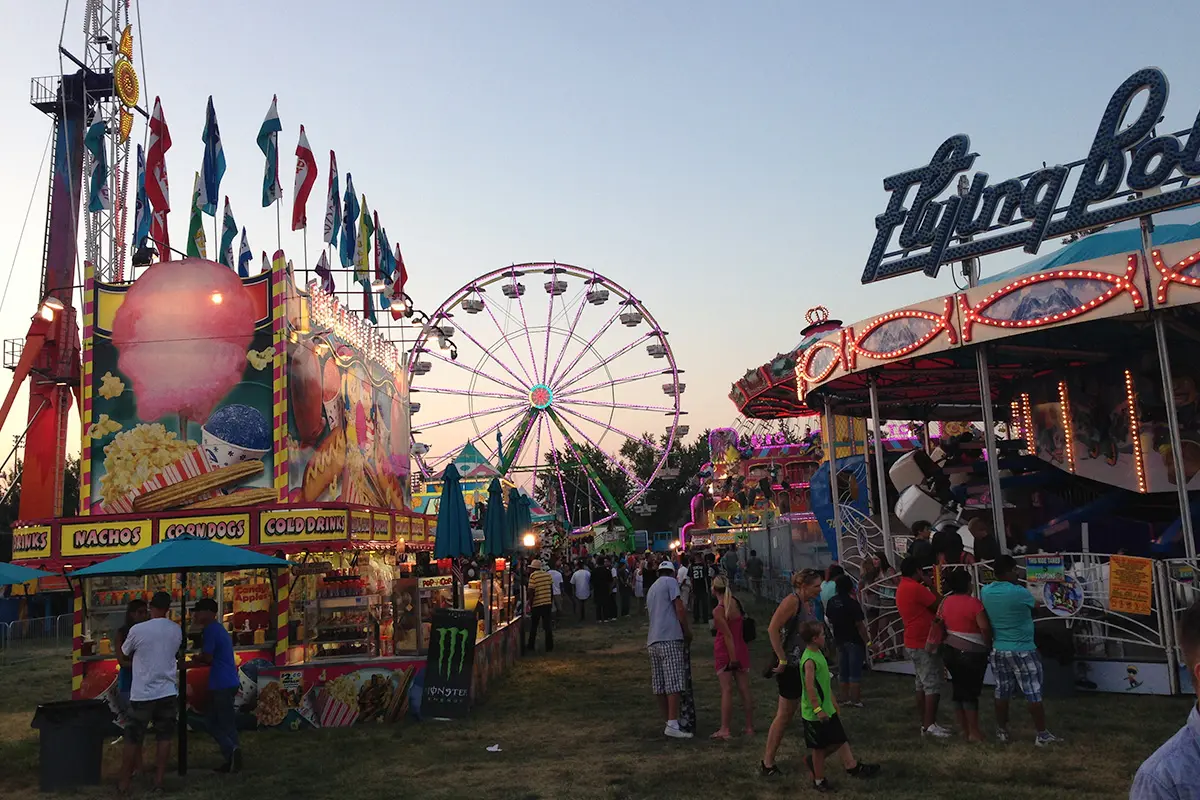
The fair’s food runs to Pronto Pups and the ice cream potato from the Westside Drive-In. One Meridian writer, posting from the 2026 fair, called the ice cream potato one of her favorite summer traditions and paired hers with a Mother Earth Brew Co. Cali Creamin’. Another stand sold baked potato tots. In 2026 Idaho News 6 held its first Fair Food Eating Relay, with teams from local companies racing through that same menu. Five technicians from Kendall Ford’s commercial and RV service center narrowly missed first place. On Clock Out for Lunch Day, when admission was free from noon to two, the Fair Food Eating Contest went to Idaho Central Credit Union.
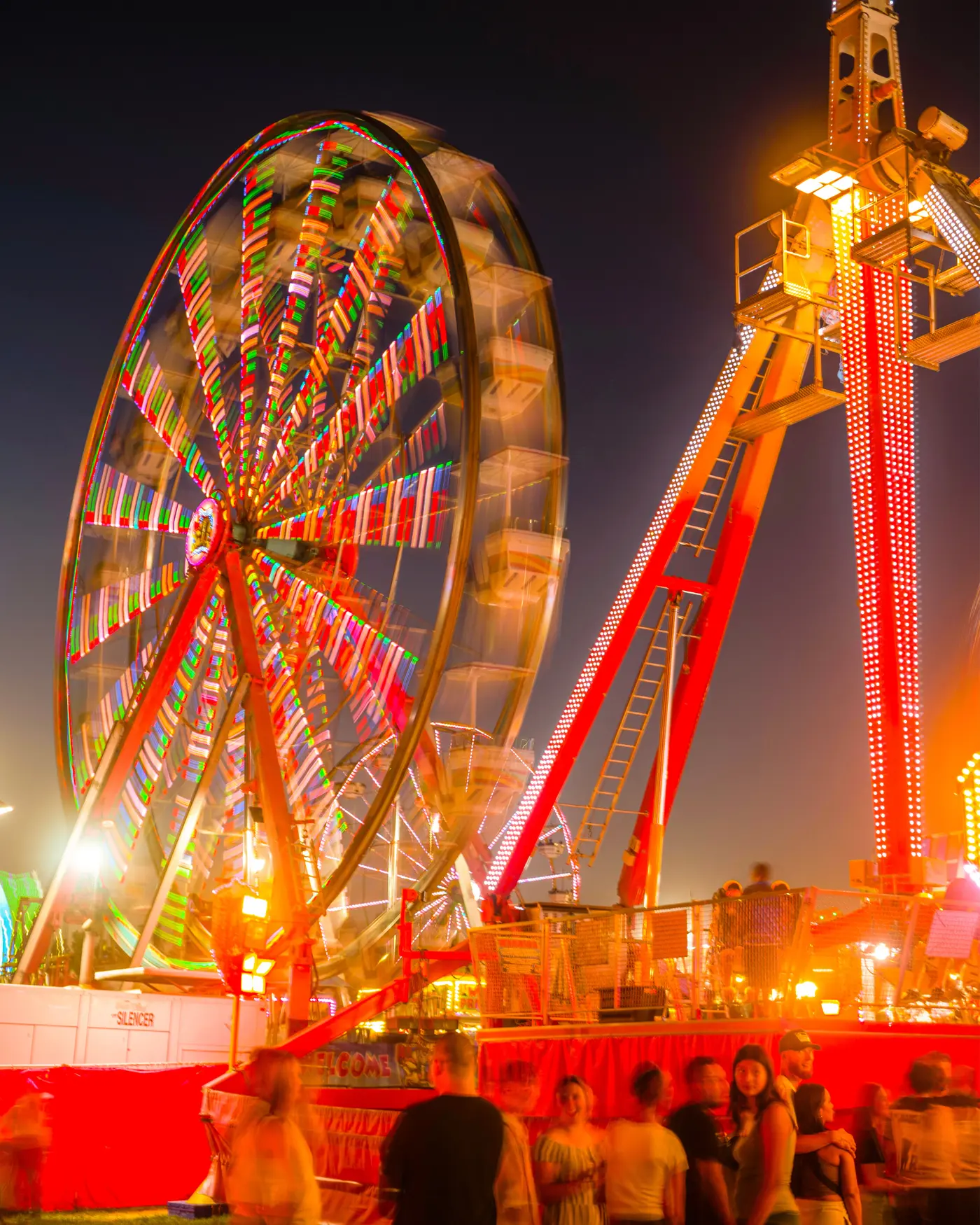
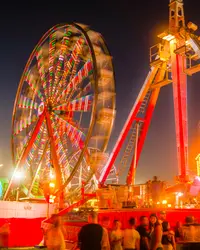
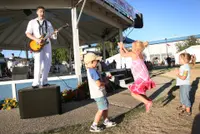
Past the food stands, Butler Carnival covers more than seven acres, and a day wristband takes in every ride, the Skyride included. In 2026 the Off Axis stunt show worked trampoline walls, BMX, and teeterboard at the Carnival Gate. The hypnotist Chris Mabrey played the Commercial Tire Stage, and Rebecca “Fireplug” roamed the grounds on stilts, posing for photographs. On the last Friday, Dirt Road Dancing Country taught steps at the Western Town Stage before the night’s concert. The group’s tenth Country Swing Dance Competition went to Markus and Kenzie. On STEM Day, sponsored by Micron, children built with LEGO, watched 3D printers, and tried robotics north of the Expo Building.
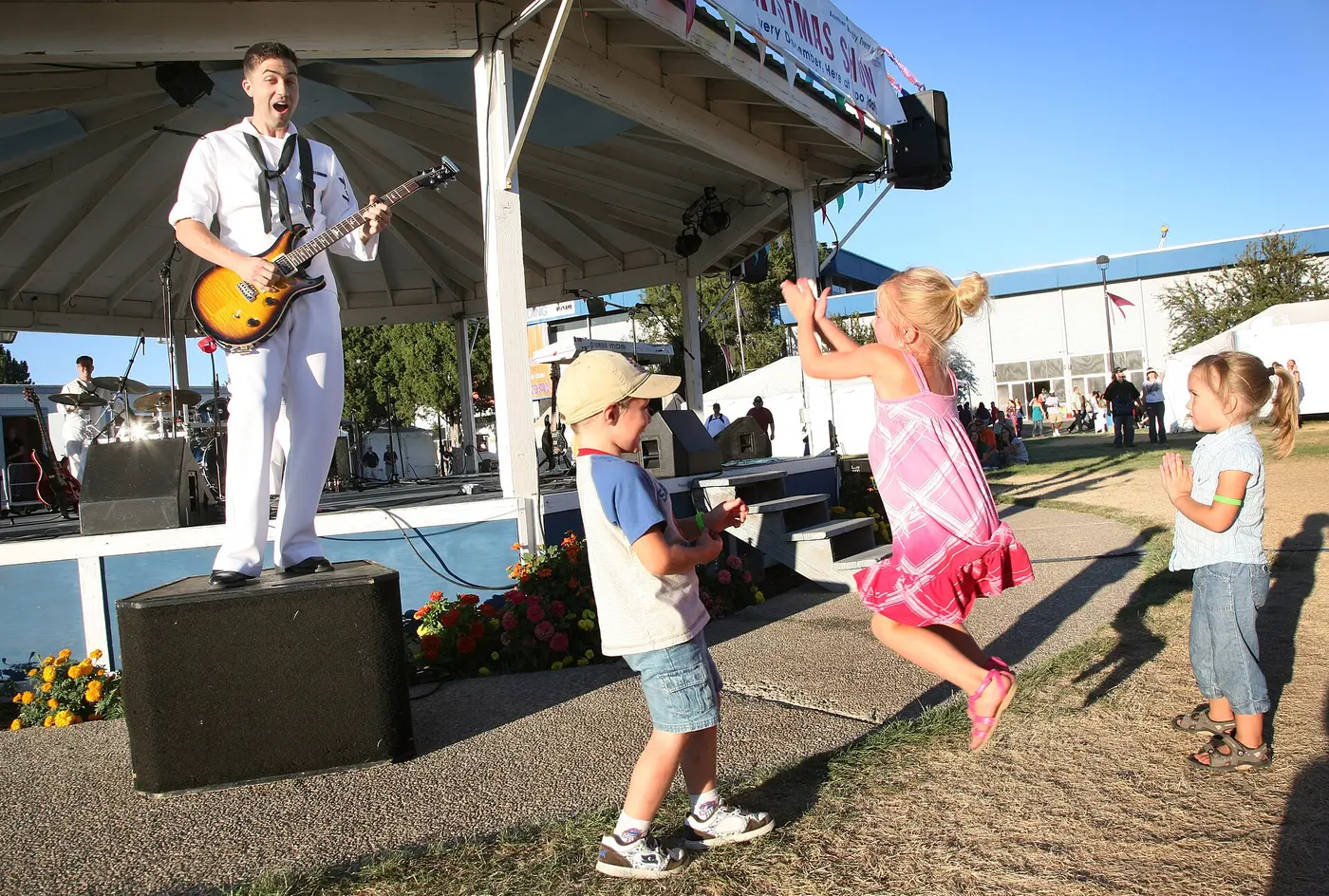
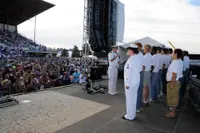
Grandstand concerts are free with fair admission. The gates open at 6 p.m. and the music starts at 7:30. The 2026 bill ran Brantley Gilbert, Skillet, Third Eye Blind, The Art of Rap with Ice-T and Sir Mix-A-Lot, and Lee Brice on the five nights from August 24 to 28.
Queen of the Intermountain Fair
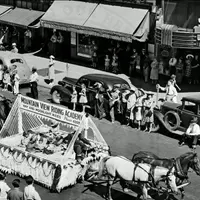
The fair began as the Intermountain Fair. BoiseDev dates its opening to October 12, 1897, at the Idaho Agricultural Park, between 21st and 26th Streets and State and Idaho Streets in Boise’s west end. The fair’s history says it grew from a need to connect Boise with larger cities 300 miles away. It had three departments: livestock (sheep, cattle, horses, and hogs), products of the soil, and domestic manufacturing. Exhibits took in mining, embroidery, preserved fruits, and music. The fair colors were purple, white, and yellow, for fruit, silver, and gold. A grandstand of about 2,000 seats looked out toward the mountains, and the grounds held an exposition building, a small pavilion, horse stalls, livestock sheds, and a track. Daily races were run with the Boise City Jockey Club, and steer roping and bronco riding drew large crowds.
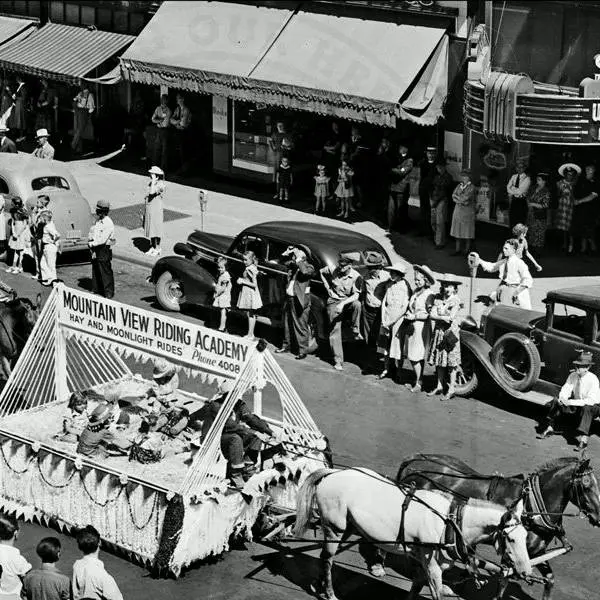
The Idaho Statesman sponsored a contest to crown a queen, the “Queen of Idaho.” Votes came in from all over the state at ten cents apiece, as many as a voter cared to buy, and the money went toward the fair’s costs. The fair’s history says a rambunctious few nominated prominent businessmen for laughs. The winner was 20-year-old Bessie Vollmer of Lewiston, her surname spelled Volmer in the Idaho Press. She polled 3,813 votes, and the Statesman called her “six feet tall and exceedingly graceful.” Teresa O’Farrell, daughter of the family that built Boise’s first permanent structure, came second with 2,002 votes. Her 17-year-old sister, Angela, received 16. The fair opened with the Queen’s Parade, in which 900 children marched. A band played the national anthem, and the mayor presented the queen with gifts.
The first fair lasted four days. On the last of them the Statesman wrote: “The Idaho Intermountain Fair has passed into history. Few events in the annals of the state have equaled it in importance.” The next year the grandstand staged battles, soldiers and explosions included, depicting wars with Germany and even Napoleon.
A racetrack, a saloon, and a Ferris wheel
In the spring of 1902, Wikipedia says, the fair association bought 84 acres at what is now the corner of Fairview and Orchard. The site lay farther from the center of town, but fairgoers came by horse-drawn carriage, train, and car. The association built a one-mile oval track with a grandstand for 2,000 and a main exposition building 150 feet long, with 50-foot wings and a saloon. That year, according to the Statesman, the fair raised a 50-foot steel Ferris wheel, believed to be the first west of the Mississippi. Buffalo Bill’s Wild West Show played on August 18, 1902, and was said to be so big that it was an international show. The First Regiment Band of Utah played the same season.
On April 20, 1911, the Wright Brothers and Glen Curtiss sent planes for an exhibition. From 1912 the children’s department gave awards for vegetables, cookery, sewing, and weaving, the beginning of 4-H at the fair before it carried that name. In later years school-aged children began showing livestock. The 1913 fair held the first full-fledged rodeo, the Boise Stampede, with stock and riders from the Pendleton Round-Up and Cheyenne Frontier Days. On September 4, 1927, Charles A. Lindbergh appeared, by then known for his solo flight from New York to Paris.
Two state fairs and a county board
The fair’s history puts much of the trouble in 1914. That year Canyon County, next door, took the “state fair” title, and Boise volunteers ran an interim fair. Ada County bought the Intermountain grounds for an “old time fair,” the fair work and products without carnival rides. The Canyon County fair ran a week earlier. Canyon County held a Boise day and the Intermountain Fair a Canyon County day, and winners carried their prize goods across the county line to compete again. Volunteers ran short, there was no fair board, and in 1915 the legislature stepped in. Ada County called its event the Gem State Fair that year, and Canyon County named its own the Idaho State Fair. For a time the state backed the Ada fair under the name Idaho State Fair.
In 1922 hard times closed many Boise businesses, and the fair with them, for four years. The state withdrew its support, and Ada County took over the funding. The Depression shut the grounds for another three-year stretch. Wikipedia counts five name changes between 1913 and 1935, a hiatus in 1917 and 1918 during World War I, and eight of those twenty-two years with no fair at all.
In 1936 the Ada County Commissioners appointed a fair board and named the event the Western Idaho State Fair. They made Ed Sproat manager, and after a successful 1936 fair he received $1,000 for a “job well done,” the first money any fair volunteer had been paid. The accounts part over the war years. Wikipedia says World War II cancelled the fair for four years after 1941. The fair’s history records a 1943 benefit rodeo for Gowen Field, and a 1944 fair cut to four days by a new law barring fairs from opening on Sundays and holidays. Slim Pickens entertained in 1946.
The question of the title remains. Wikipedia lists the Western Idaho Fair as one of Idaho’s three state fairs, alongside Blackfoot and Coeur d’Alene. The fair’s own history says it is not the state fair, and that no fair in Idaho receives state money.
The Kent homestead at Glenwood and Chinden
The fair stayed at Fairview and Orchard through 1966. The land at Glenwood and Chinden had been the Kent homestead, with a granary, a barn, and a house. The fair moved there in 1967, the year the Exposition Building went up, and the Les Bois Park horse track followed in 1968. The fair’s history says the event took its present name, Western Idaho Fair, with the move. BoiseDev gives the name at the time of the move as Western Idaho State Fair. Bob Lorimer, the Statesman’s longtime agricultural columnist, wrote of the new grounds: “Even the name is new–and so is everything else except familiar faces and tradition.”
Concerts began in 1971 with Paul Revere & The Raiders, a Boise act. Over the decades the bill has included Pat Benatar, Glen Campbell, Chicago, the Everly Brothers, Willie Nelson, the Temptations, Reba McEntire and Conway Twitty in 1986, and Johnny Cash in 1990. William Shatner visited in 1968, the Doobie Brothers and Ronald Reagan in 1976, and Muhammad Ali in 1985 and 1986. J. R. Simplot, who made his name freezing potatoes for McDonald’s fries, rarely missed a fair in his 99 years. He came for the draft horse and mule show. The fair booked no rodeo at Glenwood until 1988, and later dropped it in the face of the Snake River Stampede and the Caldwell Night Rodeo.
Since the mid-1980s the fair has run as a county enterprise fund, paying its own salaries and improvements without tax money. The fair’s history says officials renamed the property Expo Idaho in 2003 to draw offseason business. BoiseDev gives the year as 2005. The 2020 fair was cancelled for the COVID-19 pandemic, but its 4-H and FFA exhibits, competitions, and sales went on. That year Ada County surveyed residents about the grounds, and in 2021, 84 percent of respondents wanted the fair to stay. In 2025 Les Bois Park was renovated and leased to Boise Professional Soccer. AC Boise played its first professional match there in April 2026, and the grandstand still hosts the fair’s concerts.
The fair has long opened on the third Friday of August. The 2027 fair runs August 13 through 29 in a new three-weekend format, closed Mondays and Tuesdays. From 2028 it opens on the first Friday of August.
Notable Events
- 1897On October 12, 1897, the Intermountain Fair opened at the Idaho Agricultural Park, between 21st and 26th Streets and between State Street and Idaho Street in Boise's west end. boisedev.com
- 1897The first Intermountain Fair was Boise's first big chance to show itself off; the Idaho Statesman sponsored the Queen contest, raising money for the fair by soliciting votes from all over Idaho at ten cents a vote. idahopress.com
- 1898In 1898, battles were replicated complete with soldiers and explosions, while audience members looked on from the safety of their seats. idahofair.com
- 1902In 1902, the fair moved to a much bigger location near the corner of Orchard Street and Fairview Avenue and put up a 50-foot steel Ferris wheel. boisedev.com
- 1902Buffalo Bill's Wild West Show was featured on August 18, 1902 and was said to be so big that it was an international show. idahofair.com
- 1911On April 20, 1911, the Wright Brothers and Glen Curtiss sent their planes for an exhibition at the fair. idahofair.com
- 1912Beginning in 1912, awards were given out in the children's department for things like vegetables, cookery, sewing, and weaving. boisedev.com
- 1912In 1912, 4-H (not called 4-H at the time) began at the fair. idahofair.com
- 1914With a limited supply of volunteers in 1914, the fair board had not yet been created, and there was no one to manage the event. idahofair.com
- 1915In 1915, under Ada County management, officials called the Fair the Gem State Fair while Canyon County named its Fair Idaho State Fair that same year. idahofair.com
- 1922In 1922, the economy strangled the life out of the event for the next four years; the state withdrew its support and Ada County assumed funding support. idahofair.com
- 1927Charles A. Lindberg, famous for his solo flight from New York to Paris, made an appearance at the fair on September 4, 1927. idahofair.com
- 1936Ed Sproat was named fair manager at that time and after a successful 1936 fair a gift of $1,000 was given to him for a "job well done"; this was the first time any money had been given to the fair volunteers. en.wikipedia.org
- 1936Following the economic strife, in 1936 Ada County appointed a regular fair board to organize what they named Western Idaho State Fair. idahofair.com
- 1941After 1941, World War II forced the cancellation of the fair for the next four years. en.wikipedia.org
- 1943Fair income helped supplement the war effort of 1943 through events such as a benefit rodeo supporting Gowen Field. idahofair.com
- 1944A new bill prohibiting all fairs from opening on Sundays and holidays put the fair on shaky ground in 1944; as a result, the 1944 fair opened for just four days. idahofair.com
- 1967In 1967, the fair, which had rebranded to the Western Idaho State Fair, moved to its current location at Glenwood Street and Chinden Boulevard. boisedev.com
- 1967The Exposition Building was constructed in 1967, and the Les Bois Park horseracing track was built in 1968. localwiki.org
- 1980sSince the mid-1980s, Western Idaho Fair has been independent of any taxpayer support, entirely self-funded as an enterprise fund. idahofair.com
- 1988A rodeo was not booked at the new location until 1988, and was later phased out due to local competition by the PRCA rodeos Snake River Stampede and Caldwell Night Rodeo. idahofair.com
- 2003In 2003 officials renamed the property Expo Idaho in order to attract more business to the facility during offseason months. idahofair.com
- 2020The 2020 Western Idaho Fair was canceled due to the COVID-19 pandemic, but returned to its roots with 4-H and Future Farmers of America exhibits, competitions, and sales. en.wikipedia.org
People
- Bessie Vollmer, The very first Queen of Idaho, 20-year-old of Lewiston, honored with The Queen's Parade.
- Ed Sproat, Fair manager named by Ada County Commissioners in 1936 (1936).
- J. R. Simplot, Fan of the draft horse and mule show; rarely missed a fair in his 99 years.
- Johnny Cash, Fair entertainer (1990).
- Muhammad Ali, Fair guest (1985, 1986).
- Slim Pickens, Fair entertainer (1946).
- William Shatner, Fair guest (1968).
- Bob Batista, longest standing Fair Director (over 25 years).
- Charles A. Lindberg, Aviator who made an appearance at the Fair (1927).
- Glen Curtiss, Sent planes for an exhibition with the Wright Brothers (1911).
- Helen Baker, current Fair Director.