Well No. 5 (164th Street Artesian Well)
Lynnwood, Snohomish County, Washington. Artesian well; open year-round.
Details

- Where
- 2331 164th St. SW, Lynnwood, WA 98087. Directions
- When
- twenty-four hours per day.
- Getting there
- On 164th ST SW, west of Highway I-5.
- Fees
- no charge (free).
- Access
- Twenty-gallon maximum per fill, line restarts for more; monthly biological analysis (coliform and other compounds) posted online by AWWD; over 60 years of testing with no failures; expect crowded parking and a wait in line.
- Walk-in or reserve
- walk-in; no reservation required; line up orderly, fill up to twenty gallons per visit, and if you want more than twenty gallons, get to the back of the line and start over.
- Website
- awwd.com
- Managed by
- Alderwood Water & Wastewater District.
- Established
- 1956.
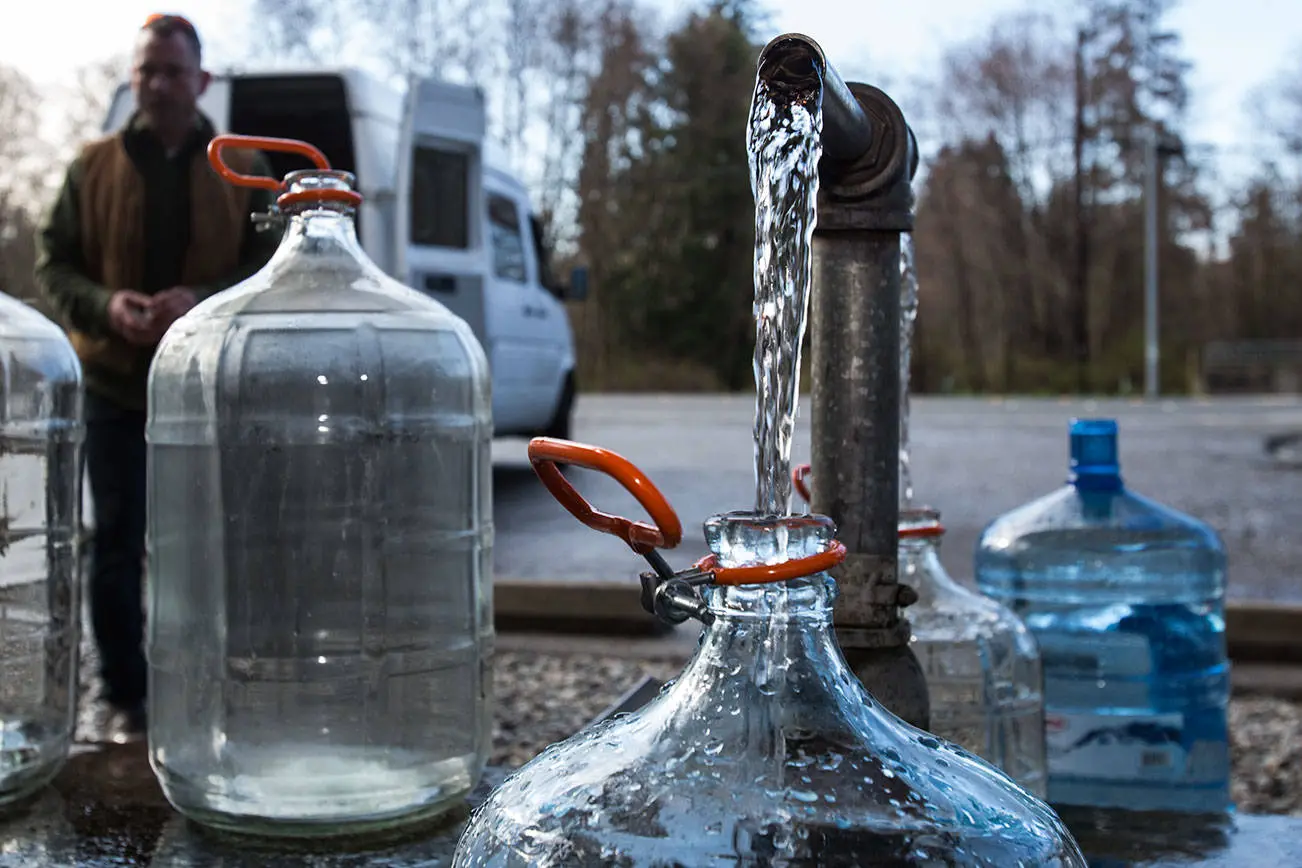
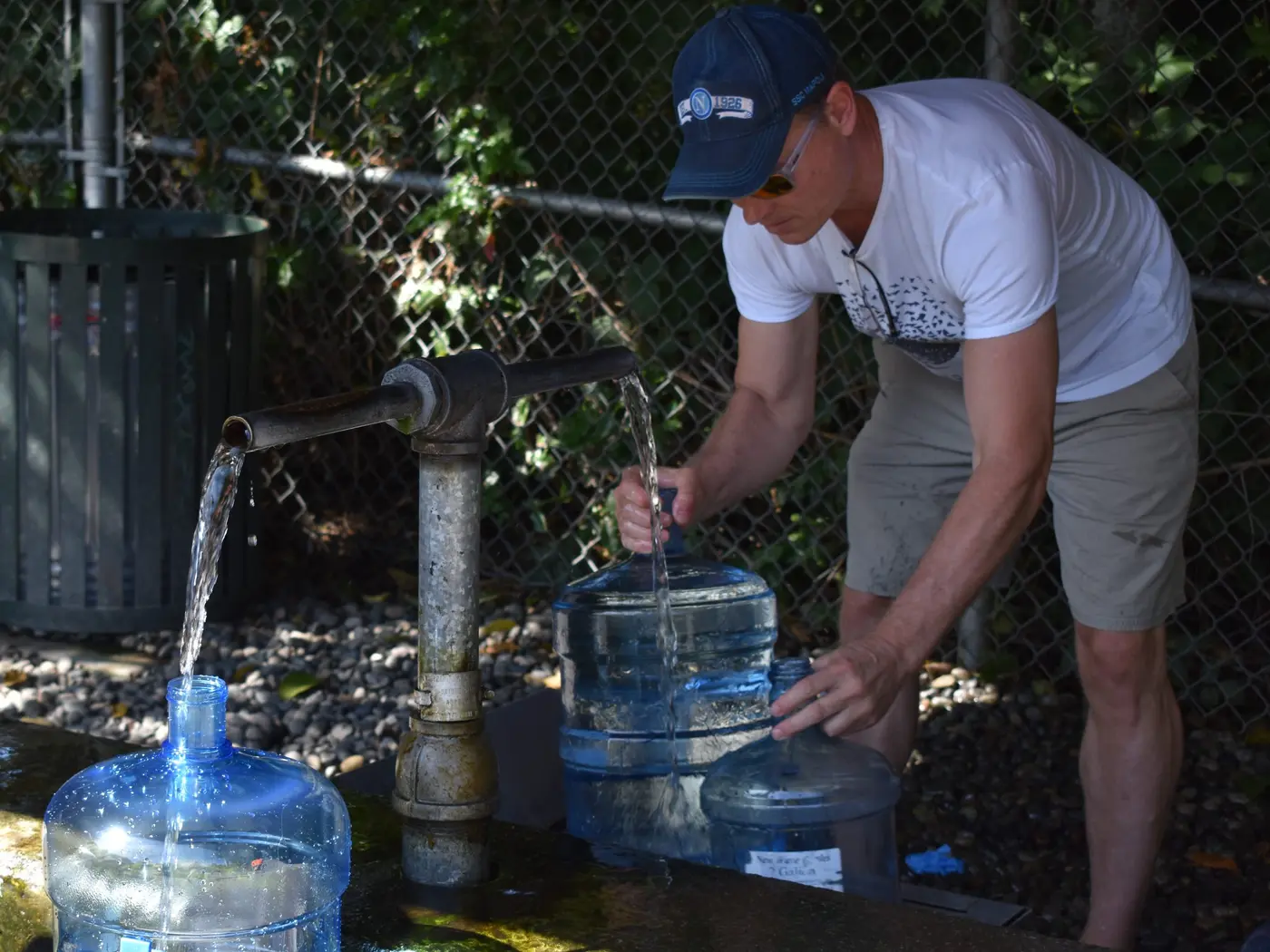
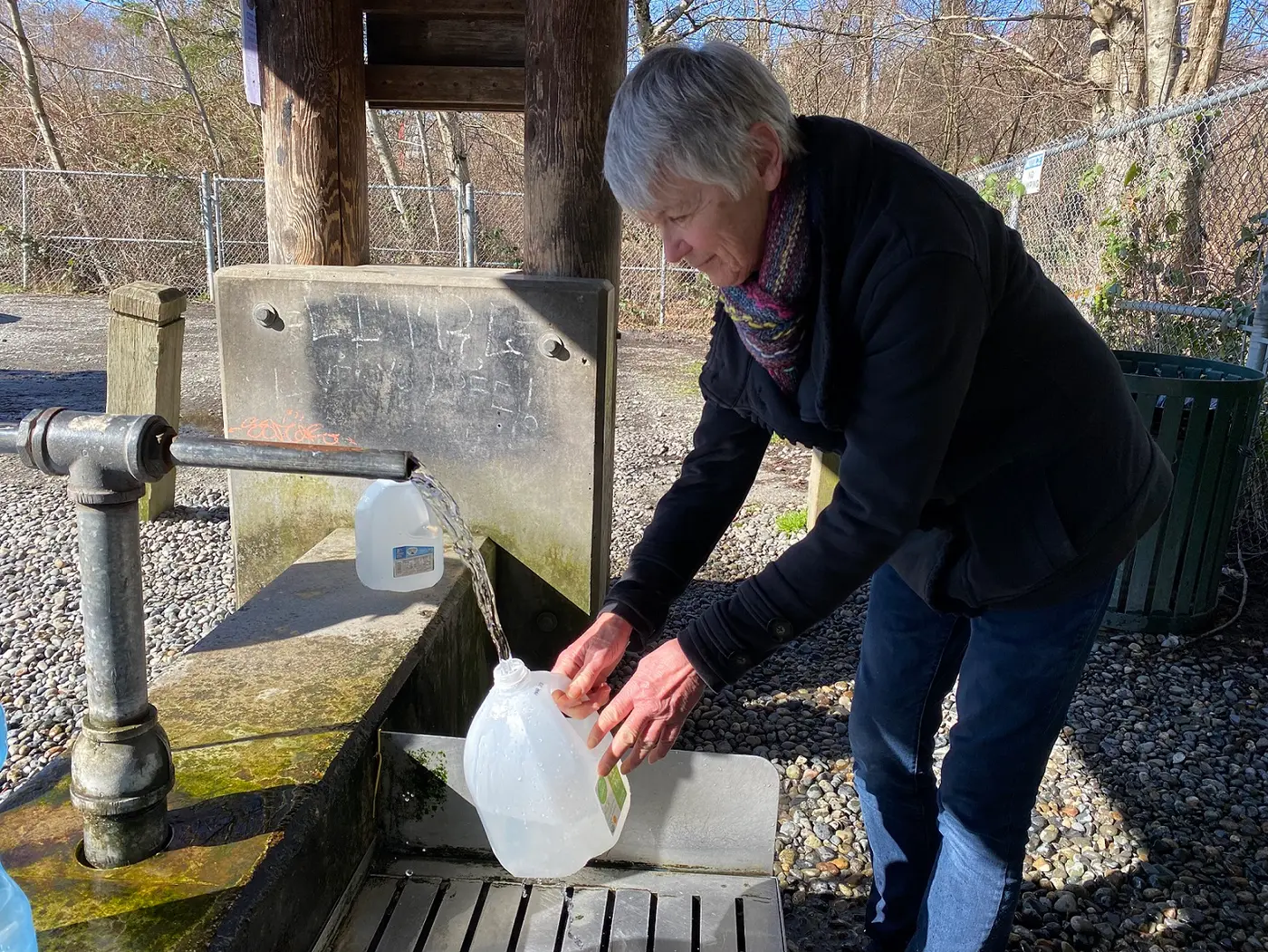
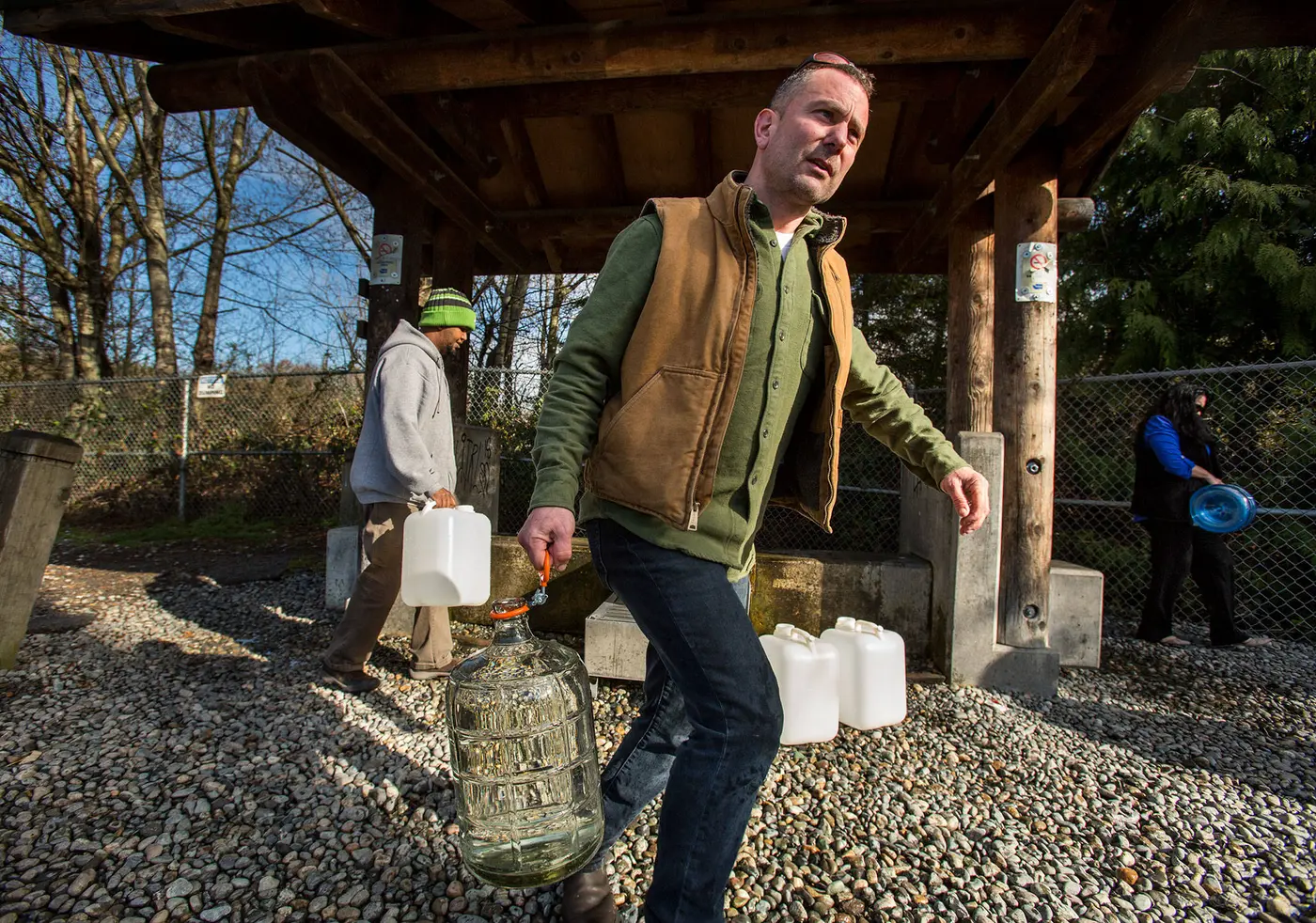
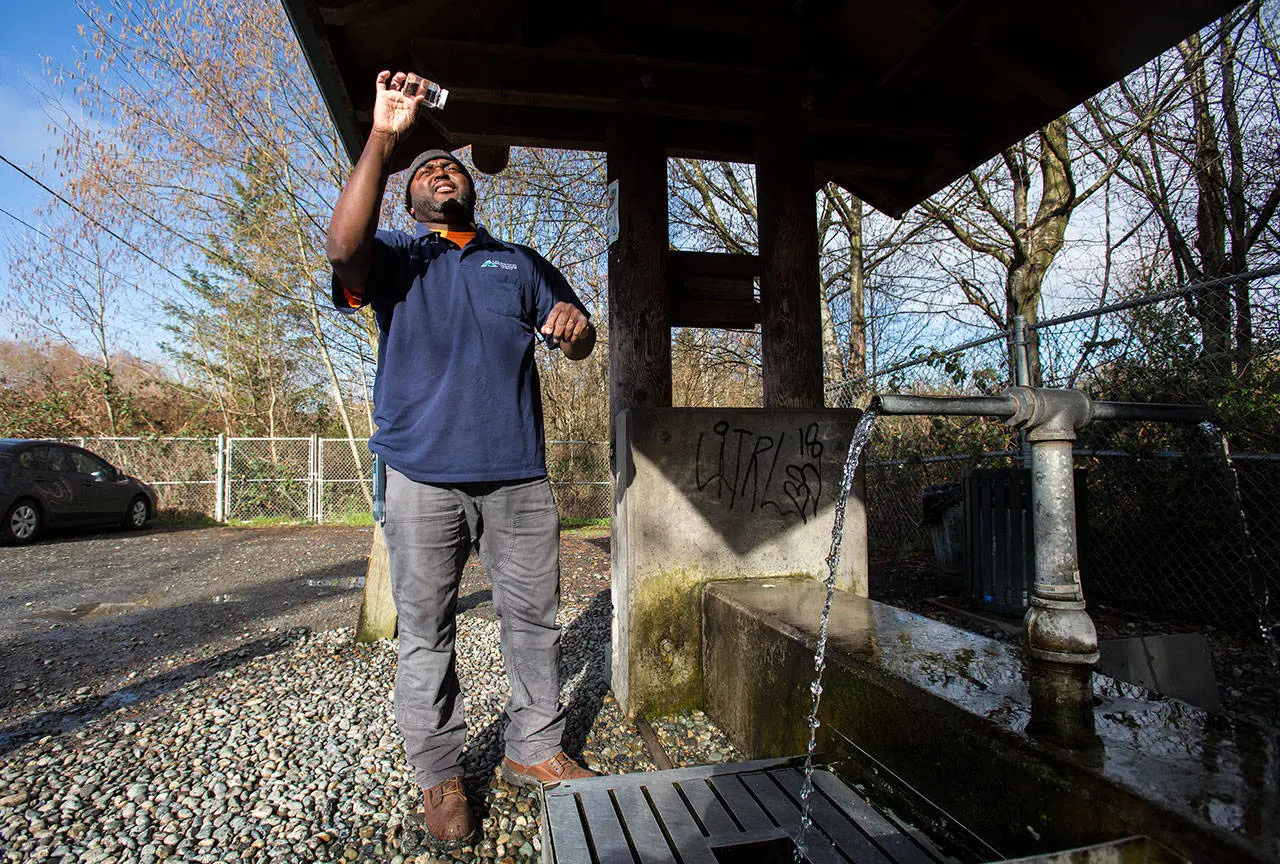
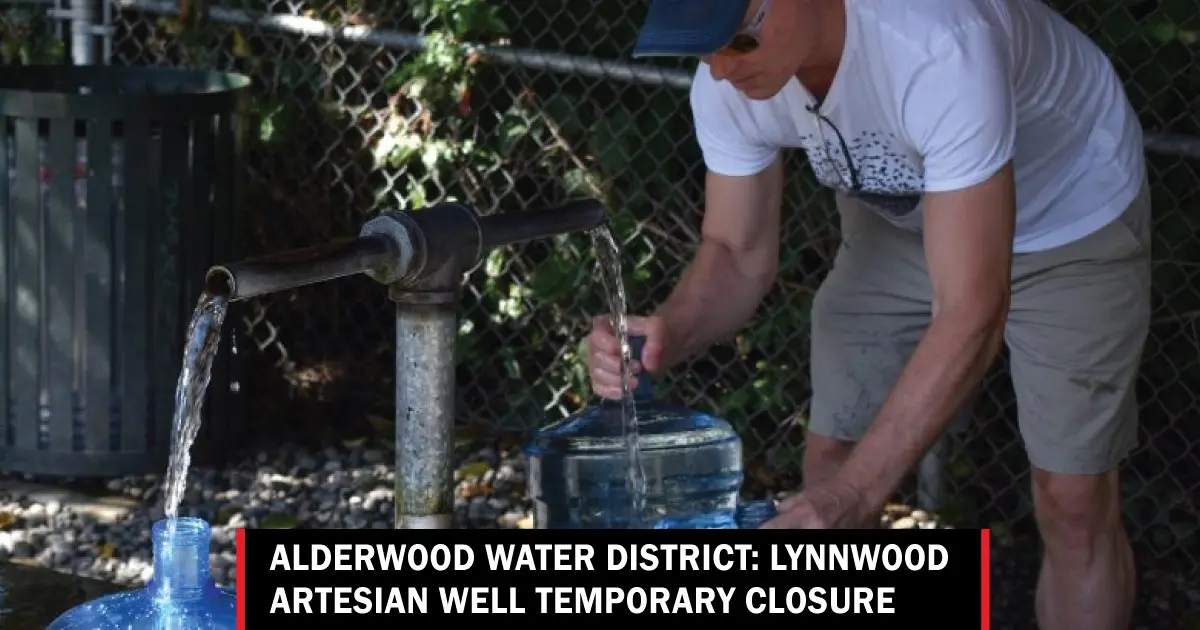
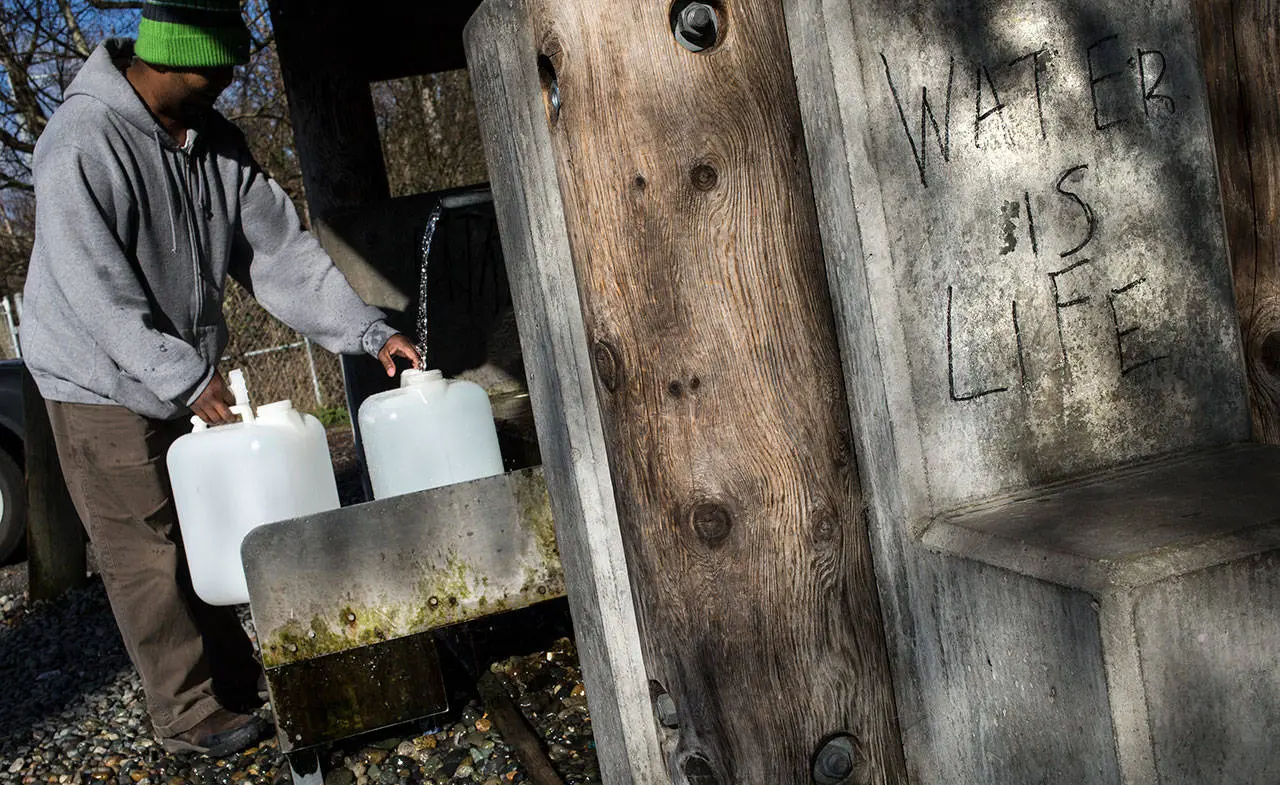
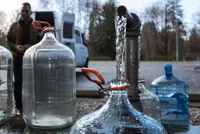
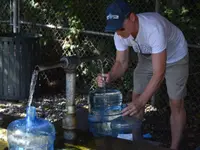
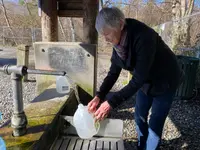
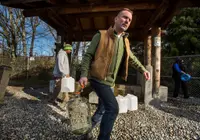
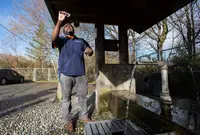
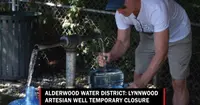
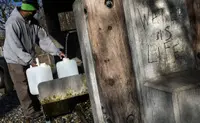
Two spigots, one on each side of the wellhead, run without stopping at about the strength of a garden hose. The wellhead stands under an open shelter at the back of a gravel lot on 164th Street SW in Lynnwood, on a busy stretch midway between Ash Way and Manor Way, near the I-5 exit. In 2018 the Daily Herald found no sign out front, a fence and woods at the rear, potholes, and the words “Water is Life” spray-painted on one of the shelter’s supports. The lot holds about a dozen vehicles and has no room to turn around. Drivers back in toward the well and shuffle past one another, which the Herald compared to “a game of bumper cars.”
The official name is Well No. 5, and it is also called the 164th Street Artesian Well. The Alderwood Water & Wastewater District maintains it as a community source of water for people who prefer their water untreated. It runs twenty-four hours a day, all year, at no charge.
The line at the spigots
At 9:30 on a Monday morning in April 2018, Dallas Watson backed a white cargo van toward the well after a 40-minute drive from West Seattle. He unloaded nine empty 5-gallon jugs while his golden retriever, Cosmo, stayed in the passenger seat with its snout at the cracked window. Only one other person was there. “I’ve waited a half hour,” Watson said of earlier trips. By the time he had filled two jugs, eight cars stood in the lot. The water was for the workers at his flooring business in south Seattle and for his family. The Herald described him as inspired by the “raw water” movement, which holds untreated water to be healthy and even a healing tonic. “Cosmo only drinks this water,” he said.
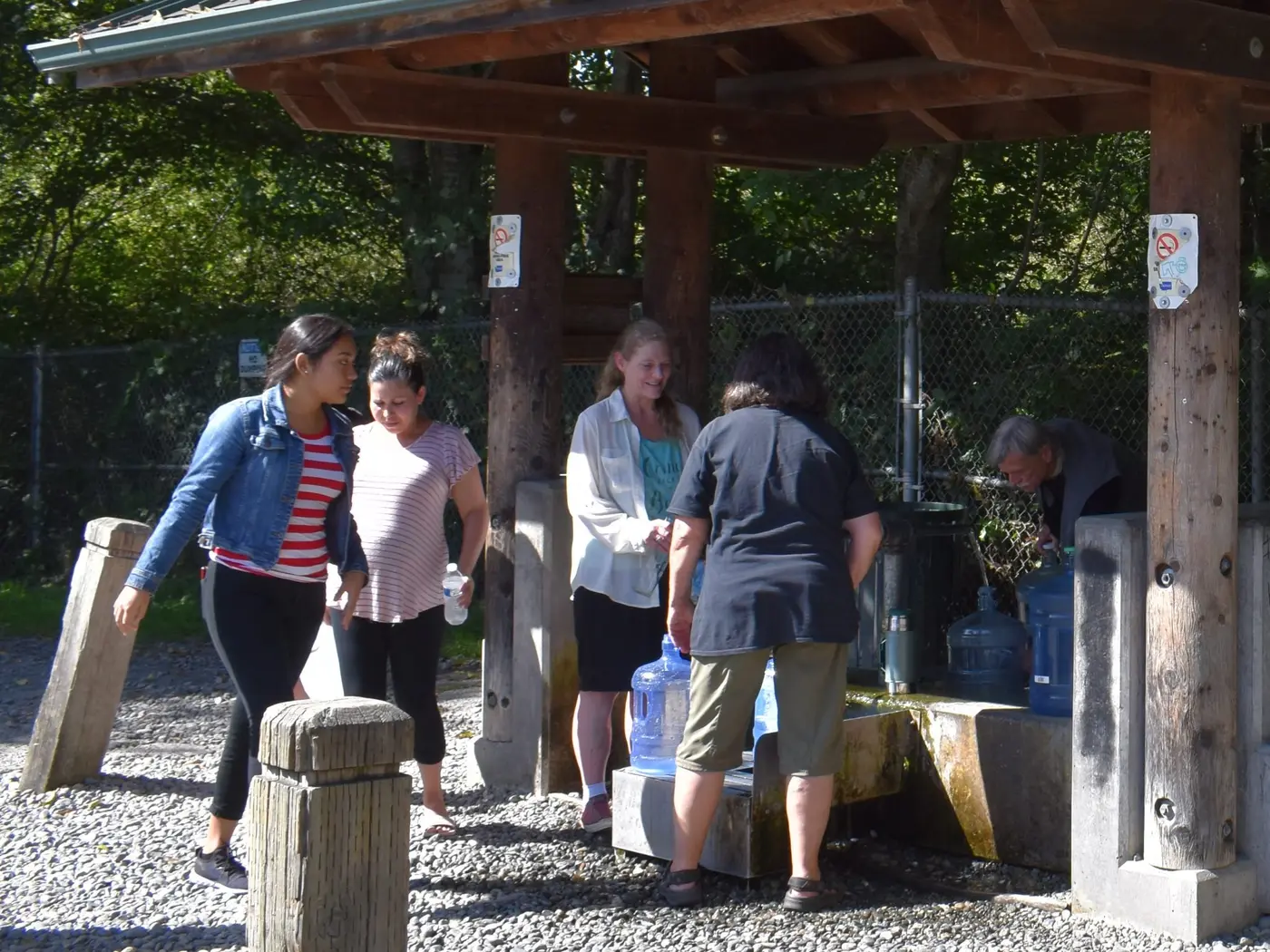
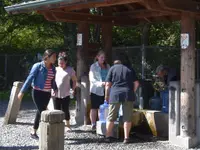
District staff told the Herald that hundreds of people fill up daily and thousands monthly. Todd Ronson, in line on August 28, 2019, told the Lynnwood Times that the wait can run 45 or 60 minutes but is more often 20 or 25. A 2022 SnohomishTalk article advised coming mid-day during the week. Visitors bring their own jugs, and some bring a wheelbarrow.
The line governs itself. Nobody calls “Next,” and there is no express lane. People with two Nalgene bottles stand behind people with wagons of 10-gallon jugs, and the wagon owners often let them go ahead. Darren DeMontes, a field operations manager for the district, said a Buddhist temple fills many jugs, and when the well is busy its monks fill a few bottles and then go to the back of the line. Barb Drake, who has come from Seattle since 2003, said she had seen monks take the water for holy water. The district once posted a sign asking people to limit themselves to 20 gallons. Spokesman Mike Pivec said the sign came down: the people filling jugs took it down. In 2026 Michael Kundu, the district’s communications and resiliency planner, told KIRO 7 that the district hopes people will fill “up to twenty gallons at the maximum amount” and that anyone who wants more is welcome to rejoin the line at the back.
The containers vary as much as the reasons for them. Julio Diaz of Tulalip bought three orange 10-gallon thermal coolers with lids for the well. “It weighs 80 pounds when full,” he said, and in line, “I can sit down.” Brian Dotson of Everett makes mead with it. “Hippie booze. You can’t do that with chemicals,” he said. Betty Bowie of Green Lake has made coffee with it for more than 15 years, and Hiroko Kunimitsu of Mukilteo makes green tea with it: “We pour this water, this color more vivid.” Andrew Kearns drives from Bellingham every ten days. “I jokingly call it God’s water,” he told KIRO 7, “but I don’t really know if that’s a joke.” Ronson said he once kept a pet frog in the water, a kind that usually lives four or five years. That frog lived eleven.
Regulars have long asked reporters to stay away. “Don’t put this in the paper,” one woman told the Herald. In 2013 Bowie asked a Seattle Times sketch artist, “Are you going to advertise this in the newspaper?”
A jar of 3.38 ounces
Once a month a district worker joins the line with the smallest container at the well. In 2018 that worker was Matt Williams, a water-quality technical assistant, and his jar held 3.38 ounces. When the well is busy, people let him go first. He records the time and the bottle number and packs the sample in a cooler for a laboratory in Bellingham, which tests it for bacteria. The water is also tested yearly for nitrates and other inorganic contaminants. The district posts the results online, and in 2026 its page listed monthly biological analyses through August 2026 along with a 2026 inorganic compounds report. “We have never failed a water quality test,” Pivec said.
The well goes down more than 400 feet and is cased to about 120. At about 200 feet it taps the Intercity Aquifer, a water-bearing layer of permeable rock, sand, and gravel. The water is under enough pressure to rise to the surface without a pump. In 2002 the Seattle Times described a pipe in the well punctured with small holes, through which the water enters and gushes upward. It flows at about 10 gallons per minute. The word artesian comes from the former French province of Artois, where Carthusian monks drilled wells a thousand years ago. Rob Turner, who teaches classes on water at the University of Washington Bothell, said the water “might have seeped into the ground from rain hundreds and hundreds of years ago, maybe even thousands.” Turner drinks tap water and has driven past the well many times without stopping for a sip.
Opinions on the taste differ. DeMontes said, “It tastes like dirt,” and that he prefers city water. Kundu said the water lacks the iron and manganese that make some natural sources taste bad. In the 2017 American Water Works Association Pacific Northwest competition, which also included Oregon and Idaho, the well’s water placed second, and it took first for Northwest Washington. It also beat the district’s own tap water in a blind test. “We don’t put that on our site because that would prompt more people to go get it,” Pivec said.
Bottling companies have offered to sell the water. The district declined, and Pivec said the flow is too slow for commercial quantities. Upkeep cost about $25,000 a year as of 2018. The buildings and grounds crew picks up garbage every morning, and the district regularly buys and spreads gravel on a lot worn down by cars leaving with full jugs. Shutting the well is not planned. “Nobody wants to take the heat on that,” DeMontes said. “Our phones would blow up.”
Ten wells, then one
The sources disagree on when the well was made. The 2018 Herald, a 2013 Seattle Times report citing the district’s website, and SnohomishTalk give 1956. A 2002 Herald article says 1958. The 2002 Seattle Times says only the 1950s. All agree it was one of a system of district wells, ten of them by the 2018 Herald’s count. In 1961 the district began taking piped water from Everett. The 2002 Herald says that water was cheaper than running a well system, and the 2018 Herald says the change met a growing population’s demand. The district plugged the other nine wells. According to the Seattle Times, it left the artesian well intact and decreed its waters free for the taking. Kundu, in 2026: “It was free when it was first discovered, and Alderwood’s keeping it free.”
For decades, people kept the location to themselves. Aimee Morehart’s uncle showed her the well when she was 8. At 20 she was filling a small bottle there every afternoon on her break from Nordstrom at the nearby Alderwood Mall. “It’s been hidden over there for so long, it’s our little secret water deal,” she said in 2002. That year the well was to move. The state Department of Health objected to people and vehicles standing directly above it, and the gravel lot lay 15 feet east of Swamp Creek. Opus Northwest, which was building a business park nearby, agreed to pay the $100,000 cost as part of a $1.2 million wetlands mitigation package. The plan was to seal the outlet and pipe the water about 100 feet to a gazebo-like well house in plain sight of 164th Street, with a paved lot for six cars.
In February 2002 the new well house stood finished behind a chain-link fence. The move had been scheduled for the previous October, and property transfers had delayed it. “It will be about as exciting as watching the plumber work in your bathroom,” district manager Arden Blackledge said. By July the Seattle Times reported the move set for early August. Morehart objected: “It kind of makes it more commercialized.”
The Seattle Times also noted that the crowd had changed by then, as word spread through immigrant communities. Petre Olanu, who had drunk well water in his native Romania, learned of the well through his church. His wife, Celest, came from Guatemala City, where bottled water had been delivered to her home twice a week. Their daughter Ivanca, 11, tried her first sample: “kind of like ice melted.” Her brother Ed, 14, held a Taco Bell cup under the flow and drank it through a straw. “This doesn’t have a taste, and it’s cold,” he said.
Ruby Ranch and Swamp Creek
According to Betty Lou Gaeng of the Snohomish County Women’s Legacy Project, the well stands on the south end of what was once Ruby Ranch, the home of Lillie and Charles Breed. The Breeds filed their homestead claim for 160 acres of timber land in 1888 and received a land patent on June 18, 1890, after paying $200, or $1.25 an acre. The family came ashore at Mosher, now Meadowdale. From there they drove wagons of children, goods, and grain along a narrow trail through forest so thick that little light reached the ground, herding their cows ahead of them. In 1903 Charles deeded 80 acres to Lillie. She died in 1934 and Charles in 1946. Their youngest daughter, Bessie Alice Cornell, told the family stories before her death in 1973, and her daughter, Betty Alys Morgan, typed them.
One of those stories is titled “Five Bullets for a Christmas Present, but Only One Struck Home.” Shortly before one Christmas in the family’s early years at the ranch, Lillie walked two miles to visit her friend Elizabeth Morrice, whose place stood where the Alderwood Mall stands now. She stayed late and walked home in the dark, wearing a dark full-length cape and a black scarf over her head. Two boys who had gotten lost while hunting were following Swamp Creek, knowing it would take them past the Breed ranch. About a quarter mile from her house, they saw the cape moving on the hill above them and fired five shots. Lillie fell behind a log beside the road and called out, “I guess you are trying to kill me.”
One boy ran to the Breed house and the other to the Morrices’. William Morrice, Jr. went four miles west to Harry Reid’s place, and Reid went on to Edmonds for Dr. Smith. Charles Breed hitched the horse to a sled and brought Lillie home. The bullet had entered her instep as she took a step and come out through her heel. The boys paid the doctor’s bill. Lillie spent years on crutches and a cane and walked with a limp for the rest of her life.
Notable Events
- 1888The Breeds filed a homestead claim for 160 acres of timber land in south Snohomish County with the Seattle Bureau of Land Management office. snohomishwomenslegacy.org
- 1890Following a cash payment of $200 ($1.25 per acre), a land patent was issued. snohomishwomenslegacy.org
- 1903The page cites a quitclaim deed from Charles B. Breed to Lillie C. Breed for 80 acres in Snohomish County. snohomishwomenslegacy.org
- 1950sThe Alderwood Water District dug the well in the 1950s. archive.seattletimes.com
- 1956The well was drilled as one of 10 supplying consumers of the utility. heraldnet.com
- 1958The well was built as part of a system of wells in the Lynnwood area. heraldnet.com
- 1961The district contracted with Everett for piped water, plugged its other nine wells, and left this artesian well intact with its water free for the taking. archive.seattletimes.com
- 1961The wells were capped when the district began purchasing Everett water, which was less expensive than maintaining a well system. heraldnet.com
- 2017The artesian water placed second in the Pacific Northwest American Water Works Association competition including Oregon and Idaho, and first for Northwest Washington. heraldnet.com
- The district plans to seal the well outlet and reroute the water to a new kiosk about 100 feet away, visible from 164th Street; the new parking lot is paved and pipes installed. archive.seattletimes.com
- The scheduled move was delayed by transferring ownership of the property and associated paperwork. heraldnet.com
People
- Aimee Morehart, Daily well visitor who fills a bottle on her afternoon break from work at nearby Alderwood Mall; objected to the more visible outlet.
- Celest Olanu, Petre Olanu's wife, from Guatemala City, described in the family's well visit.
- Ed, Ivanca's brother who sampled the well water in a Taco Bell cup and approved.
- Greg Williamson, District project engineer who explained that health and environmental rules forced the outlet move.
- Hiroko Kunimitsu, Mukilteo well patron who praised its effect on her tea while her husband filled bottles.
- Ivanca, Daughter of the visiting Olanu family who compared her first sample to melted ice.
- Maureen Copenhaver, Local well patron whose children helped fill the family's jugs.
- Mike Ruhl, Opus real-estate director commenting on the well's popularity.
- Petre Olanu, Well patron who learned about the artesian well through his church.
- Susan Danese, Longtime well patron who continued visiting even while living in Bellevue (discovered the well 21 years ago).
- Arden Blackledge, Manager of the Alderwood Water District, which maintains the well; explained the delay in moving the outlet.
- Brian Dotson, Everett well patron drawn by beer-making, camaraderie and his wife's cooking preferences.
- Cathy Lukehart, Lynnwood well patron for whom the visit recalls childhood water-drinking experiences in Idaho.
- Dallas Watson, Regular well-water collector for drinking, visiting at least monthly.
- Darren DeMontes, Utility field-operations manager commenting on the well's future and maintenance.
- Faisal Warsame, Well patron photographed filling water containers.
- Julio Diaz, Tulalip well patron using the water for drinking, cooking, cleaning and plants.
- Marti Michaelson, Well patron who first used the water while living in Shoreline and now drives from La Conner.
- Matt Williams, District water-quality technical assistant who samples the well.
- Mike Pivec, District spokesman who discussed declined offers to bottle the well water.
- Paul Jung, Oak Harbor resident who stops at the well when in the area.
- Rob Turner, University of Washington Bothell teacher explaining the well's groundwater history.
- Betty Bowie, Green Lake resident and longtime well-water collector (more than 15 years of visits).
- Peter Monsaas, Lake Stevens resident whose family drinks the well water; learned about it from friends who recommended it for brewing beer.
- Bessie Alice (Breed) Cornell, Youngest daughter of Lillie and Charles; narrated the family's wilderness history and stories (died in 1973).
- Betty Alys (Schoppert) Morgan, Bessie's daughter, who collected and typed her mother's stories for the family-history collection.
- Charles Bradley Breed, Lillie's husband and fellow Ruby Ranch homesteader (died in 1946).
- Dr. Smith, In the family story, treated Lillie's wound until it healed.
- Elizabeth Morrice, Lillie's friend and neighbor visited before the narrated shooting mishap near Ruby Ranch.
- Ethel Mary, Child of Lillie and Charles Breed, the future Ruby Ranch family (born in 1886).
- Flora Pearl, Child of Lillie and Charles Breed, born before the family moved to Ruby Ranch (born in 1888).
- Harry Reid, In the family story, was sent to Edmonds for Dr. Smith after Lillie was shot near her home.
- John Amos, Child of Lillie and Charles Breed, the future Ruby Ranch family (born in 1884).
- Laura Fern, Child of Lillie and Charles Breed, the future Ruby Ranch family (born in 1882).
- Lillie Cordelia Breed, Homesteader at Ruby Ranch, on land later occupied by the well (died in 1934).
- William Morrice, Jr., In the family story, went to Harry Reid's place to have him fetch a doctor for Lillie.
Sources
- awwd.com/impact/community/artesian-well
- heraldnet.com/2018/04/21/its-the-water-lynnwoods-artesian-well-draws-fans-from-miles-around
- lynnwoodtimes.com/2019/09/05/did-you-know-about-lynnwoods-artesian-well
- lynnwoodtimes.com/2023/11/07/lynnwood-artesian-well-231107
- snohomishtalk.com/2022/03/15/artesian-well-in-lynnwood-quenches-the-thirst-of-snohomish-county
- kiro7.com/news/local/gods-water-crowds-fill-their-thirst-lynnwoods-artesian-well/TG33XAHYX5EH7HJORA6LIXELIA
- seattletimes.com/seattle-news/worlds-best-drinking-water-some-say-its-in-lynnwood
- myedmondsnews.com/2016/01/happening-nearby-artesian-wellness
- heraldnet.com/2002/02/12/gusher-of-red-tape-delays-wells-move
- archive.seattletimes.com/archive/20020720/well20m/move-to-blow-cover-of-artesian-well
- snohomishwomenslegacy.org/2020/03/20/lillie-cordelia-nairn-breed