Warm Springs National Fish Hatchery
Warm Springs, Jefferson County, Oregon. National fish hatchery.
Details

- Where
- 1 Fish Hatchery Road, Warm Springs, OR 97761. Directions
- When
- Daily 6:30am-3:30pm.
- Season
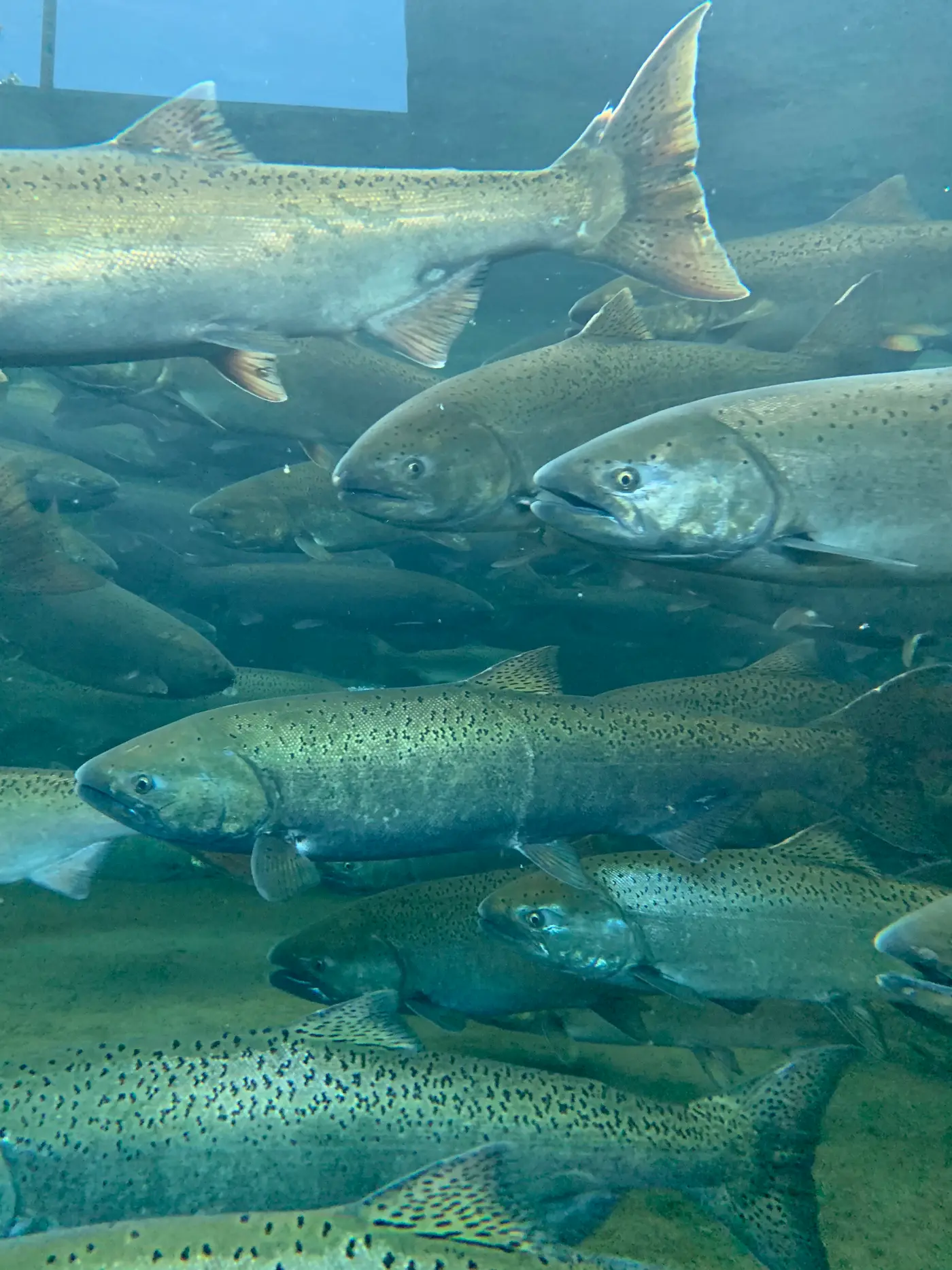
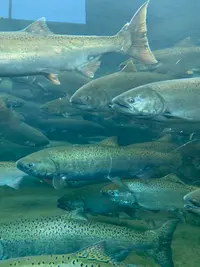
- Adult spring Chinook salmon return in the spring of the year; fish ladder opens in early May; juvenile spring Chinook can be seen all year in the rearing ponds.
- Access
- Tours require calling ahead to (541) 553-1692 so staff can make time in the daily project list.
- Walk-in or reserve
- Call ahead to schedule a tour so staff can make time in the daily project list.
- Phone
- (541) 553-1692
- Website
- fws.gov
- Managed by
- U.S. Fish and Wildlife Service.
- Established
- 1978.
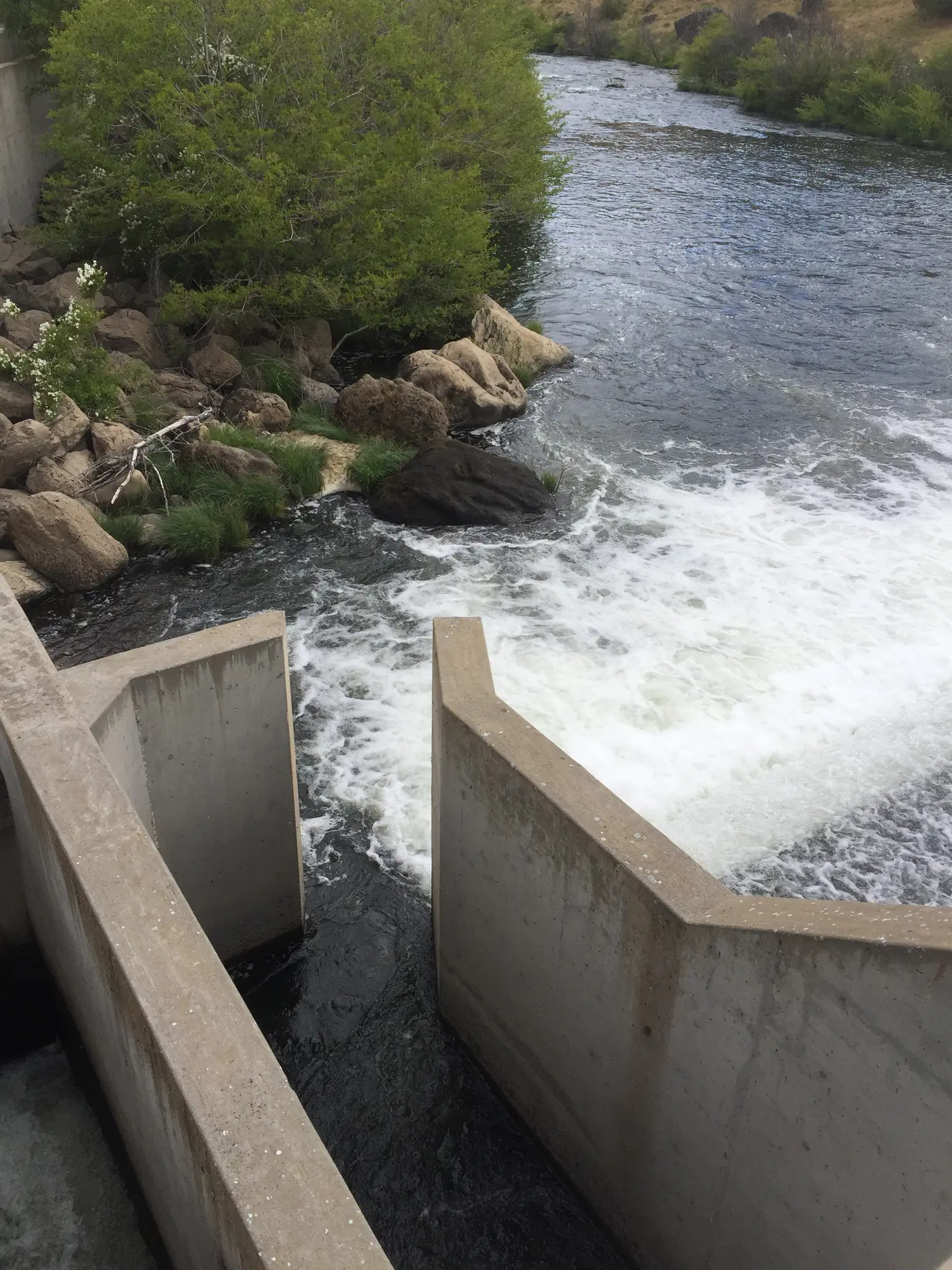
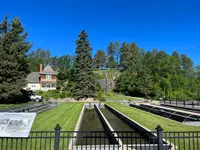
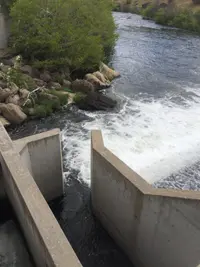
The fish ladder at Warm Springs National Fish Hatchery opens in early May. Every fish coming up the Warm Springs River climbs it. Some are spring Chinook raised in the hatchery’s own ponds. Others are wild spring Chinook, coho, steelhead and Pacific lamprey bound for the river’s upper reaches. At the top the fish are sorted: hatchery fish stay, and wild fish are passed through the facility to continue upstream. A visitor who comes outside the run still finds salmon, because juvenile spring Chinook fill the outdoor rearing ponds all year.
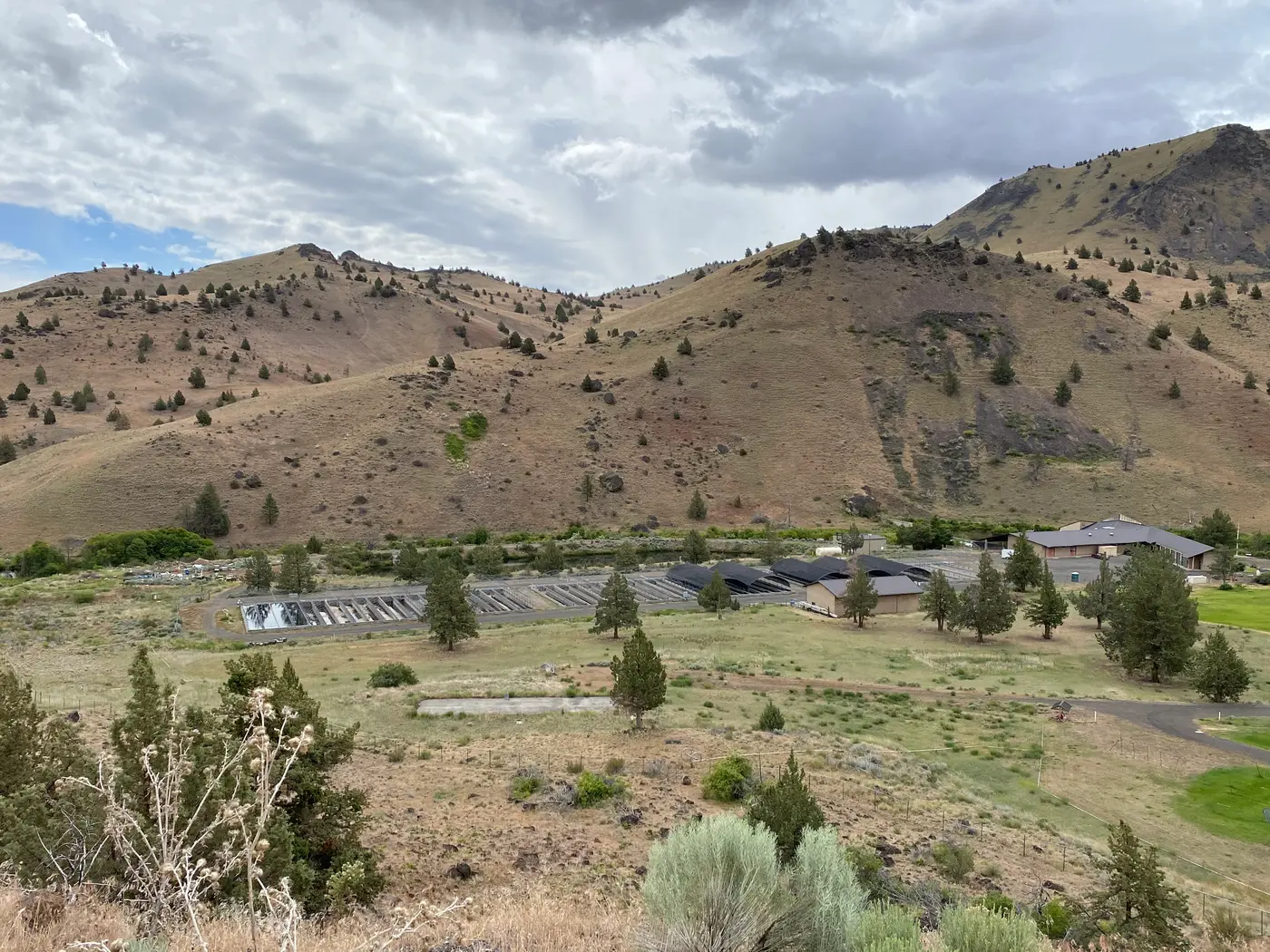
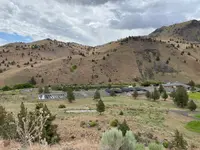
The hatchery stands at river kilometer 16 of the Warm Springs River, in a deep valley on the Warm Springs Reservation about 23 kilometers north of the town of Warm Springs. The U.S. Fish and Wildlife Service operates it on land and water leased from the Confederated Tribes of the Warm Springs Reservation of Oregon until February 1, 2043, and the Service and the Tribes manage it together. A barrier dam crosses the river beside the grounds, and the water intake sits just upstream of it. The Service calls the river home to the largest wild run of Mid-Columbia spring Chinook.
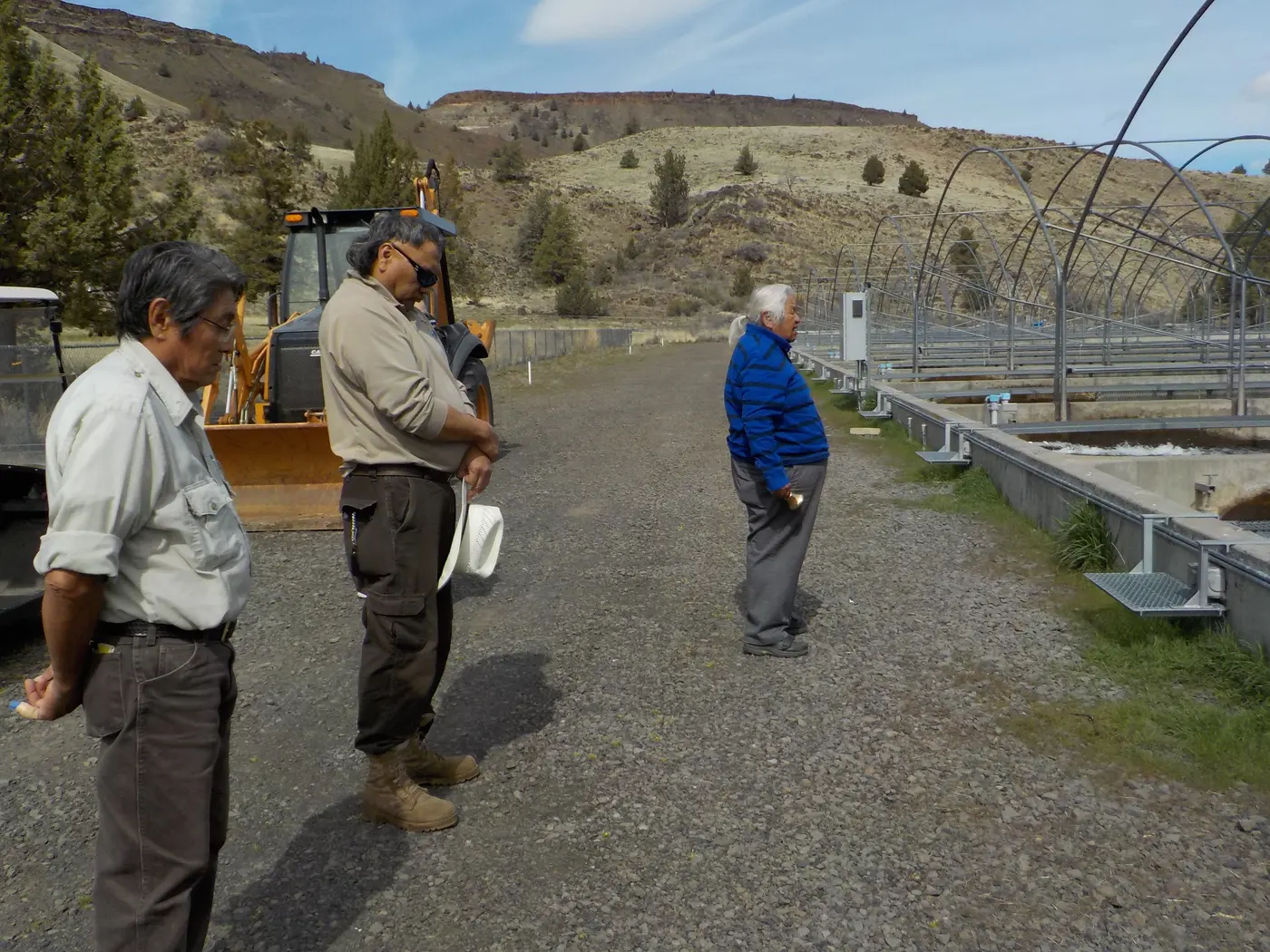
Visitors see the place on a short walk-around tour. Staff ask that tours be scheduled by telephone so they can fit one into the day’s list of work. The walk takes in the Visitor Center, the adult holding ponds and the rearing ponds. It also looks down into the Boiler/Chiller Room, a set of machinery that warms the hatchery’s water in winter and chills it in the hot, dry summer. The Service also lists picnicking, birding, wildlife watching and photography on the grounds.
The year in the ponds
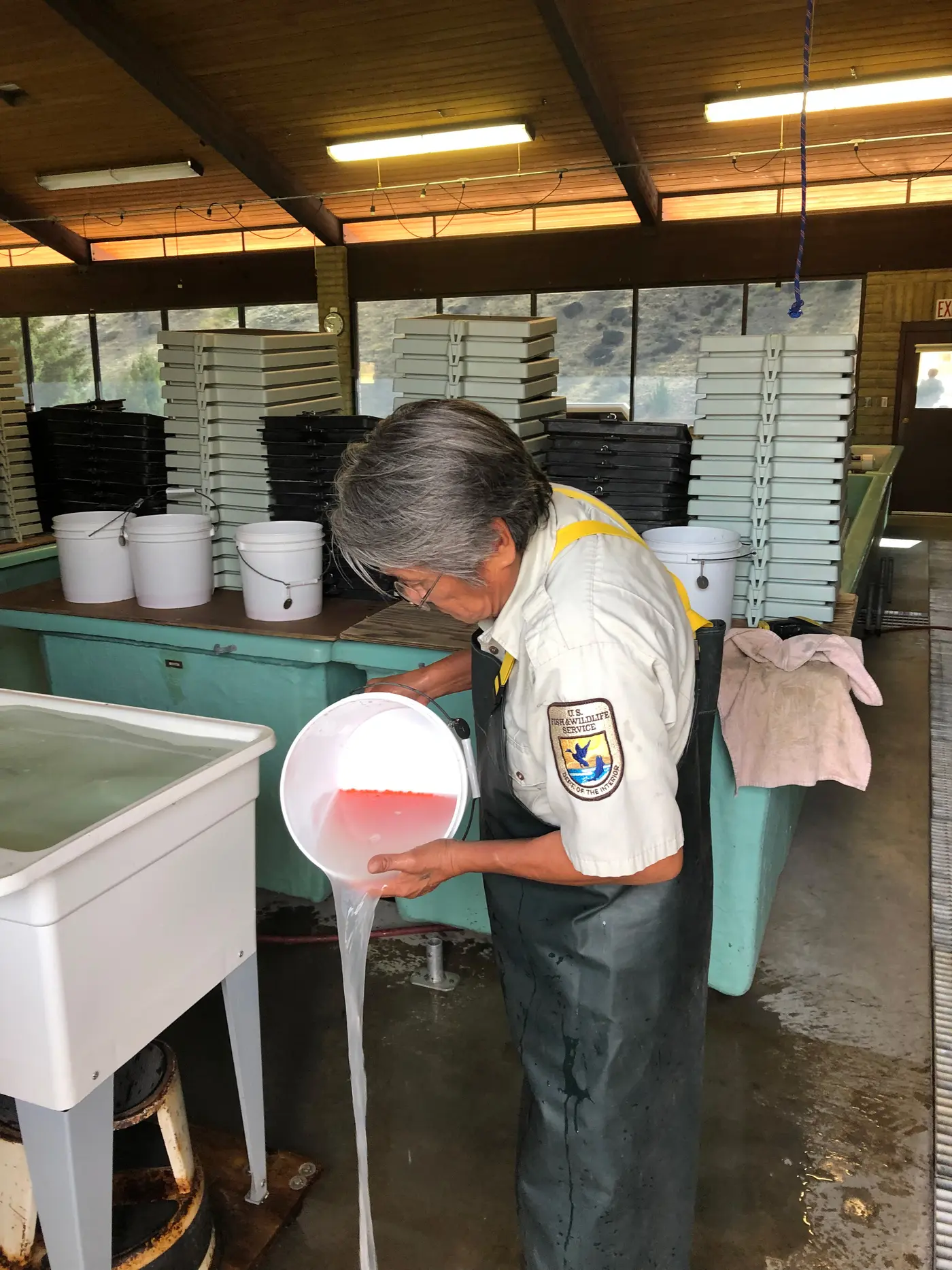
The hatchery’s calendar follows the fish. In April the smolts are released into the river, the holding ponds are cleaned, and the ladder is readied, since adults can return as early as April. In summer the adults are sorted and spawned. The fertilized eggs go into the hatchery building, and the spawned fish are sampled for disease and their coded-wire tags recovered. The eggs hatch in October after two months of incubation, and through the fall they are sorted, counted and treated while the previous year’s fry are marked and tagged. In winter the new fry move to outdoor raceways once they have absorbed their yolk and begun to feed, and the yearlings start to smolt for the ocean.
Each spring about 750,000 spring Chinook go directly into the Warm Springs River, the release goal held steady since 1992. The fish are raised for tribal harvest on the Deschutes and Columbia and for distribution to tribal members, and surplus brood stock goes to the Tribes. Every fish released carries a coded-wire tag and a clipped adipose fin so it can be told from a wild one at the ladder. Known hatchery steelhead are not passed upstream; they are killed and given to the Tribes. Wild fish enter the brood stock only when more than 1,000 wild adults return, which is the minimum the managers want spawning above the hatchery. Their long-term goal is a run of 2,800. At the Tribes’ request the hatchery has also begun spawning and rearing wild-origin fish to bolster a declining population. As of July 29, 2024, 317 adult spring Chinook had come back to the hatchery.
Kevin Blueback and the first foods
The 2022 annual report lists five full-time Service employees: the manager, three animal caretakers and a maintenance mechanic.
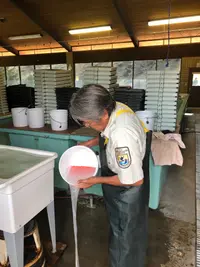
- Kevin Blueback, an animal caretaker with more than 27 years in the Service, came to the work after the Tribal Elder Hamilton Greely reached him through a workforce-development program and explained that the job raised ceremonial first foods. Blueback describes his work as raising food for ceremonial traditional meals and for the Warm Springs Wasco Piute way of life.
- Joe Badoni worked for the Tribes and started at the hatchery as temporary help before becoming a full-time caretaker.
- Andrea Sapuay, a biological science technician, helped with daily hatchery work for the Tribes before joining the Service.
- James Sapuay, her husband, found his Service career through her. He is the maintenance mechanic and calls Warm Springs the most rewarding job he has held.
“From time immemorial, salmon have been intrinsically linked to the Warm Springs tribes who lived here,” hatchery manager Terry Freije said in 2021. “They have ceremonies when the fish come back, and they give a blessing to the fish when they’re released.”
From a 1959 request to a 1978 egg take
The hatchery began with a request from the Tribes. In 1959 they asked the Service to investigate salmon and steelhead enhancement on the reservation. The investigation found wild spawning grounds going unused because of dam passage problems. In 1963 the Tribe asked for a hatchery feasibility study. On May 31, 1966, Federal Statute 184 authorized a hatchery to stock salmon and trout within the reservation and increase tribal harvest. Other hatcheries in the Service’s Columbia River Gorge complex, such as Carson, were built to offset fish losses from hydroelectric dams. The Service says Warm Springs was built specifically for supplementation.
Money came slowly. In 1971 Senator Bob Packwood asked a Senate subcommittee to speed construction of the $3.2 million hatchery in Wasco County, since only $425,000 had been appropriated since its authorization. He also asked the subcommittee to give special consideration to Indian fishing rights under existing treaties. A master plan was drawn up that year, and by 1975 monitoring and evaluation were already a regular part of the budget. On May 13, 1977, the tribal newspaper Spilyay Tymoo reported that a House subcommittee had approved $1.2 million to complete the hatchery, against a budget request of only $100,000. Congressman Al Ullman had asked for the money and credited Congressman Robert Duncan, a subcommittee member, with getting it approved.
The first operating plan followed that year. In 1978 production began with eggs taken from wild spring Chinook and steelhead caught from the runs passing the site, and rainbow trout were raised as well. Steelhead were dropped in 1981 because of disease, poor growth and the physical limits of the facility. Rainbows were dropped in 1999 because they were thought to limit the native redband rainbows. In 1984 the Tribes proposed the two-stock concept that still governs the ladder: hatchery and wild fish kept apart, with only unmarked wild fish passed above the hatchery. An automated system installed in 1996 separated tagged hatchery fish to reduce handling of wild ones. It was decommissioned in 2014, and staff have sorted the trapped fish by hand since.
Lean runs and good ones
On September 21, 1988, Darrell Joseph Calica died at Simnasho. He had been responsible for the hatchery’s water, electricity and emergency backup systems.
The run of 1995 was the lowest the hatchery had recorded. Only 471 spring Chinook came up the river:
- 90 hatchery adults and 146 hatchery jacks
- 160 wild adults and 75 wild jacks
At the request of the Tribes’ Fish and Wildlife Committee, Round Butte State Fish Hatchery donated 121 females and 128 males. Round Butte’s stock had itself been started from Warm Springs River fish years earlier. That winter the fry in the ponds were about one-third Warm Springs stock and two-thirds Round Butte stock, kept in separate ponds. The same year’s count at the hatchery also logged 86 wild and 110 hatchery steelhead, 5 bull trout, 4 coho, 1 fall Chinook, 21 rainbow trout, 232 suckers and 103 whitefish.
The return of 1996 was the best since 1992. That year 1,245 wild fish were passed above the hatchery and 749 hatchery fish came back, numbers that state, federal and tribal biologists considered the minimum needed to sustain the run. The spawned hatchery fish yielded about 850,000 eggs. The same autumn Julie Sheldon arrived from Colorado as program assistant, filling a job vacant for almost two years. She lived on the hatchery grounds with two dogs and two cats.
In 2006 the Service’s Columbia River hatchery review team used Warm Springs as a “pilot” to test its procedures. The team judged its operations a model for integrated fishery, hatchery and natural population management. At a stakeholder forum someone asked whether an in-house review was “the fox guarding the hen house.” The Tribes objected to the team’s recommendation to phase out erythromycin-medicated feed against bacterial kidney disease, which they credited with keeping survival up. That disease returned in February 2022, when rising deaths led the Service and the Tribes to release the fish early, in March, on the theory that lower density would reduce its effects.
Fire, then heat
On July 25, 1994, the LeClaire Fire broke out and threatened the hatchery at its onset. It burned 33,000 acres, but the hatchery took no damage. In 1995 the Interior Department gave its Exemplary Act Award to eight people for prompt and courageous action during the fire: Mavis Shaw, Nat Shaw, Bodie Shaw, Robert Smith, Oswald Tias, Dave Simmons, Troy Kaska and Steven Joe.
Heat has proved the harder threat. The river is fed by snowpack around Schoolie Flats and Schoolie Springs and from the foothills of Mount Jefferson. “We’re 100% dependent on the Warm Springs River and the last several years we’ve had very low snowpack, which means that our water temperatures rise more quickly in the summer,” Freije said in 2021. In 2015, facing dangerously warm water, the hatchery moved its entire salmon population to the Columbia River Gorge, and it moved fish again in 2016 and 2017. The fish stayed home from 2018 through 2020.
In June 2021 the forecast for a heat dome climbed from 104 degrees toward 117. Fish health specialists David Thompson and Katie Royer had already written triggers for moving fish into the hatchery’s operating plan.
- June 22. An evaluation team met with the Tribes, and together they approved moving the salmon.
- June 24. The Service’s fish health program recommended that every juvenile leave at once.
- June 25, 3 a.m. Two trucks filled with cool water at Little White Salmon National Fish Hatchery and drove 101 miles to Warm Springs.
- The move. It took about seven truck trips to carry 348,000 fish. Hatchery stock, wild genetic stock and hybrid stock all had to stay separate. When one truck developed electrical trouble, Thompson called Yakama Nation Fisheries, which sent two trucks and two more drivers for Sunday.
- June 27, 1:30 p.m. The last truck was loaded with the air at 114 degrees and the water at 71.
That evening the water in the Warm Springs raceways topped 77 degrees, a temperature the salmon likely would not have survived overnight. The fish spent the summer in 48-degree water at Little White Salmon, were scheduled to return in October, and were to be released from Warm Springs in April 2022. In 2022 the United States v. Oregon Policy Committee added a footnote to the hatchery’s production table: in summers of high water temperature, the juveniles go to Little White Salmon.
Notable Events
- 1959The Confederated Tribes asked the Service to investigate salmon and steelhead enhancement on the Reservation. fws.gov
- 1963The Tribe requested a Service hatchery feasibility study on the reservation. fws.gov
- 1966Congress authorized construction of the Warm Springs Hatchery. fws.gov
- 1971Senator Bob Packwood asked a Senate subcommittee to speed construction of the hatchery; only $425,000 had been appropriated since its authorization. bendbulletin.com
- 1971A master plan was developed in 1971, the first operational plan in 1977, and production began in 1978. fws.gov
- 1975Monitoring and evaluation became a regular and substantial component of the budget before production began. fws.gov
- 1977The subcommittee approved $1.2 million to complete the hatchery, compared with a budget request of only $100,000 for the Service project. oregonnews.uoregon.edu
- 1978Production began with eggs from wild spring Chinook and steelhead captured from natural runs passing the site. fws.gov
- 1979A graded fall release strategy was employed. fws.gov
- 1981Steelhead production was dropped because of disease, growth and physical limitations of the facility. fws.gov
- 1984The Tribes proposed separating hatchery and naturally producing fish, with only wild unmarked fish passed above the hatchery. fws.gov
- 1988Darrell Joseph Calica, responsible for the hatchery's water, electricity and emergency backup systems, died at Simnasho. oregonnews.uoregon.edu
- 1992The juvenile release goal was consistently set at 750,000 from this year onward. fws.gov
- 1993A fall volitional release strategy was used at the hatchery between these brood years. fws.gov
- 1994The hatchery sustained no damage. oregonnews.uoregon.edu
- 1995The run totaled 471 spring Chinook salmon, the lowest recorded by the source. oregonnews.uoregon.edu
- 1995At the Fish and Wildlife Committee's request, Round Butte State Fish Hatchery donated 121 females and 128 males to Warm Springs. oregonnews.uoregon.edu
- 1995Mavis Shaw, Nat Shaw, Bodie Shaw, Robert Smith, Oswald Tias, Dave Simmons, Troy Kaska and Steven Joe received Interior's Exemplary Act Award for prompt and courageous actions during the fire. oregonnews.uoregon.edu
- 1996An automated system was installed to minimize handling of natural fish and reduce pre-spawn mortality by separating returning coded-wire-tagged hatchery spring Chinook. fws.gov
- 1996The salmon return was the best to the Warm Springs River since 1992. oregonnews.uoregon.edu
- 1999Rainbow production was dropped, thought to limit native red-band rainbows. fws.gov
- 2000sSize at spring release was reduced from 10-15 fish per pound to 20-30 fish per pound. fws.gov
- 2006The Service stated that the Warm Springs review would be a pilot to test and evaluate its procedures. fws.gov
- 2008A spring-only release has been used since this brood year. fws.gov
- 2014The system was decommissioned and hatchery personnel manually sort trapped fish. fws.gov
- 2015Warm Springs was forced to transfer salmon. fws.gov
- 2015Faced with dangerously warm temperatures, the hatchery moved its entire salmon population to the Columbia River Gorge. pdxmonthly.com
- 2017The hatchery requested surplus eggs because of concerns about another year of high egg loss. fws.gov
- 2019A one-time release of 65,000 extra spring Chinook juveniles was determined not to have a substantial additional effect on ESA-listed species. fws.gov
- 2021The 348,000 spring Chinook were successfully delivered to the 48-degree water at Little White Salmon; the source planned their transfer back in October. fws.gov
- 2022The United States v. Oregon Policy Committee approved incorporating wild supplementation into the hatchery program and footnoting summer juvenile transfer to Little White Salmon because of high water temperatures. fws.gov
- 2022Fish Health staff documented increased mortality from BKD; the Service and Tribes decided on early March release on the theory that lower density would reduce disease impacts. fws.gov
- Wild-origin adult returns began to be held and spawned at the hatchery. fws.gov
People
- Bob Packwood, Senator who asked a Senate subcommittee to speed hatchery construction (1971).
- Jeremy Voeltz, Named on the memo to NOAA concerning the early-release decision and anticipated lack of impacts to listed species (3/8/2022).
- Rich Turner, Cited for the determination that the one-time extra juvenile release would not have a substantial additional effect on ESA-listed species (3/18/2019).
- Bill M. Bakke, Native Fish Society Director who provided comments on the hatchery assessment.
- Mike Gauvin, Tribal Fisheries Management Supervisor who provided co-manager comments on the hatchery review.
- Peter F. Galbreath, Conservation Fisheries Scientist who provided CRITFC comments on the hatchery review.
- Richard Turner, Provided NOAA Fisheries comments on the hatchery review, from the Hatchery and Inland Fisheries Branch.
- Rod French, ODFW District 7 Biologist who provided co-manager comments on the hatchery review.
- Bob Turik, Little White Salmon hatchery manager discussing fish-temperature decisions during the emergency involving Warm Springs salmon.
- David Thompson, Fish health expert who helped modify the hatchery Annual Operating Plan with criteria triggering off-station fish movement.
- Katie Royer, Fish health expert who helped modify the hatchery Annual Operating Plan with criteria triggering off-station fish movement.
- Mike Clark, Columbia River Gorge National Fish Hatchery Complex manager involved in protecting salmon during the heat wave.
- Terry Freije, Warm Springs hatchery manager, explaining the dependence on river water and low snowpack.
- Andrea Sapuay, Biological Science Technician; previously helped with daily hatchery activities for the Tribes before joining the Service.
- Hamilton Greely, Tribal Elder who contacted Kevin Blueback through a workforce-development program and explained the job's role in raising ceremonial first foods.
- James Sapuay, Maintenance Mechanic; found his Service career through his wife Andrea and describes work at Warm Springs as his most rewarding job.
- Joe Badoni, Animal Caretaker; worked for the Tribes and began as temporary help before becoming a full-time caretaker.
- Kevin Blueback, Animal Caretaker, raising food for ceremonial traditional meals and the Warm Springs Wasco Piute way of life (27+ years with the Service).
- Cheri Anderson, Information and education specialist providing education and outreach for the six-hatchery Columbia River Gorge complex, which includes Warm Springs (1998).
- Julie Sheldon, Joined the hatchery staff as Program Assistant; the job had been vacant for almost two years (1996).
- Al Ullman, Asked for funding omitted from the federal budget in testimony before the subcommittee (1977).
- Robert Duncan, Oregon congressman whose efforts in getting approval of the money Ullman praised; a subcommittee member (1977).
- Darrell Joseph Calica, Responsible for overall hatchery operation, including water, electricity and emergency backup systems, at his death (1988).
- Bob Smith, Named in the caption among those honored by Interior at a recent luncheon.
- Bodie Shaw, Recipient of Interior's Exemplary Act Award for prompt and courageous actions during the fire.
- Dave Simmons, Recipient of Interior's Exemplary Act Award for prompt and courageous actions during the fire.
- Mavis Shaw, Hatchery employee among the team that prevented fire damage; recipient of the Exemplary Act Award.
- Michael Paiya, Named in the caption among those honored by Interior at a recent luncheon.
- Nat Shaw, Recipient of Interior's Exemplary Act Award for prompt and courageous actions during the fire.
- Oswald Tias, Recipient of Interior's Exemplary Act Award for prompt and courageous actions during the fire.
- Robert Smith, Recipient of Interior's Exemplary Act Award for prompt and courageous actions during the fire.
- Steven Joe, Recipient of Interior's Exemplary Act Award for prompt and courageous actions during the fire.
- Troy Kaska, Recipient of Interior's Exemplary Act Award for prompt and courageous actions during the fire.
- Mark Ahrens, Pacific Region Chief of Fisheries Operations, interviewed about moving the hatchery's salmon and the effects of warm temperatures.
Sources
- fws.gov/fish-hatchery/warm-springs/visit-us
- fws.gov/fish-hatchery/warm-springs
- fws.gov/fish-hatchery/warm-springs/about-us
- oregonnews.uoregon.edu/lccn/sn93050507/1977-05-13/ed-1/seq-1/ocr
- bendbulletin.com/2021/04/04/yesteryear-surprise-snow-in-1996-buries-golf-not-fun
- oregonnews.uoregon.edu/lccn/sn93050507/1995-08-03/ed-1/seq-8/ocr
- oregonnews.uoregon.edu/lccn/sn93050507/1988-10-07/ed-1/seq-8/ocr
- oregonnews.uoregon.edu/lccn/2026234357/1996-11-01/ed-1/seq-17/ocr
- fws.gov/fish-hatchery/warm-springs/what-we-do
- fisheries.warmsprings-nsn.gov/2018/09/spring-chinook-fighting-future
- pdxmonthly.com/news-and-city-life/2015/08/how-one-hatchery-moved-160-000-baby-salmon
- fws.gov/story/2021-07/fisheries-professionals-partners-work-together-save-salmon-extreme-heat