

Wanapum Heritage Center
Mattawa, Grant County, Washington. Heritage center.
Details

- Where
- 29086 Hwy 243 South, Mattawa, WA 29086. Directions
- When
- Live demonstrations of weaving, bead working, string making and more, daily.
- Fees
- FREE ADMISSION.
- Hours
- Mon, Tues, Thur, Fri 8:30 am - 4:30 pm; Wed CLOSED; Sat, Sun 9:00 am - 5:00 pm.
- Phone
- 509-766-3461
- Website
- wanapum.org
- Managed by
- Wanapum and Grant PUD.
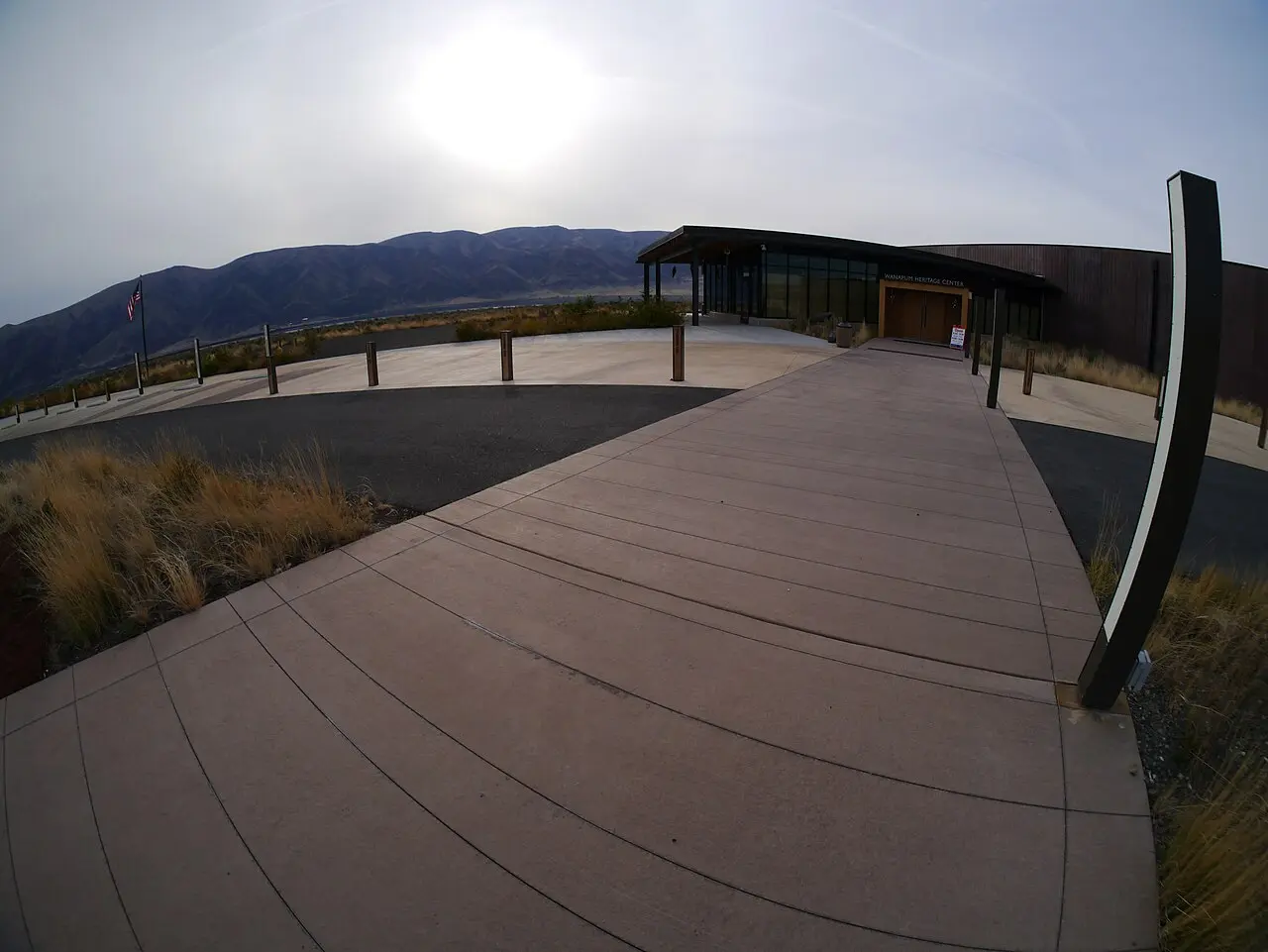
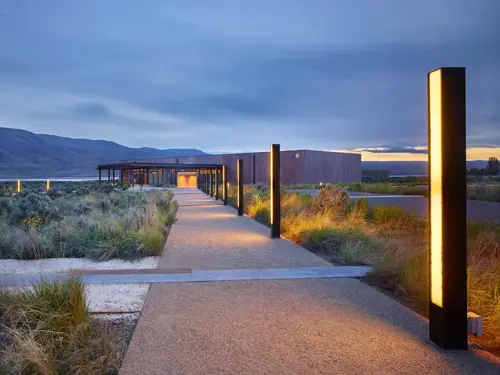
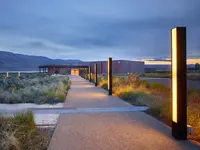
The path to the Wanapum Heritage Center comes in from the east. The Seattle firm Mithun designed the building and laid the walk on the line of the equinox sunrise. Along it stand interpretive signs, plantings of useful native plants, and lighted markers for the six Wanapum seasons. Rex Buck Jr., leader of the Wanapum, said at the 2015 opening that the main entrance faces due east on purpose: the Wanapum want the light of the sun to shine on visitors as they approach and enter. Beside the path, a plate of etched steel carries Wanapum text and white clay gathered by the tribe. Behind it rise the folded basalt cliffs of Umtanum Ridge. The center greets its visitors with the words kw’ áłanam wyánawi, which its own pages pair with the English “welcome.”
Concrete, glass, and a dugout canoe
The center stands about five miles south of Mattawa, off Highway 243, on the eastern shore of the Columbia at Priest Rapids Dam. The Seattle Times, writing in 2012, called the site the Wanapums’ “front yard,” an isolated expanse of desert sage and scrub. Wanapum Village lies on the western shore and is reached by crossing the dam. The native sage steppe grows slowly, and Mithun limited the construction areas to protect the plants around the site. The center and Grant PUD give the building as 50,000 square feet. The architect and the builder, Corp Inc Construction, list 49,000, and Mithun counts 175 acres in the project.
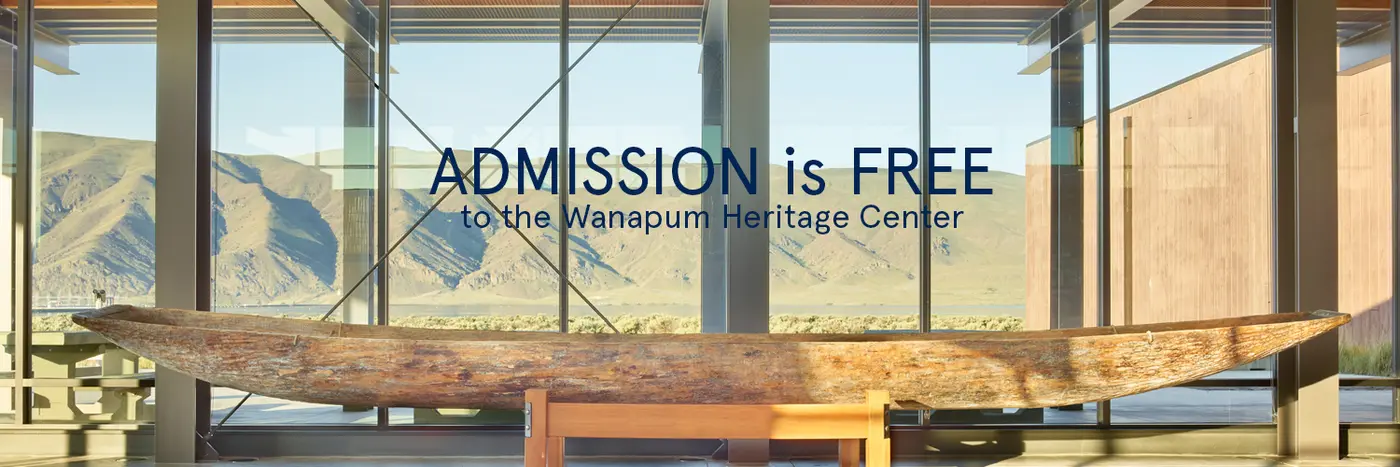
The low building is made of vertically lined concrete. The architects took their cues from the basalt cliffs nearby. A solid concrete block holds the permanent exhibit and the repository, and it refers, in Mithun’s words, to “traditional cliffside cave storage spaces.” A frame of wood and steel holds the active and community rooms. The glazed welcome area is meant to recall the lanterns used in traditional fishing. A traditional Wanapum dugout canoe rests at one edge of it. In the past the Wanapum kept watch for logs drifting down the Columbia and pulled them out for many uses, canoes among them. A porch on the southeast side gives shade and a view of the dam. Rich Franco, a partner in Mithun’s Seattle office, called the place “a welcoming repository that is both immersive and protective.”
The permanent exhibit fills 10,000 square feet. Its gallery has no windows until the route ends in the Chiawana Gallery, the only viewpoint in the exhibit space. The Seattle Times described large west-facing windows there, looking onto the river, the village, and the mountains beyond. Chiawana is the river’s older name, and the center’s welcome text begins: “Before the Columbia, there was Chiawana.” The text goes on to say that Coyote created the river in his efforts to care for the Wanapum.
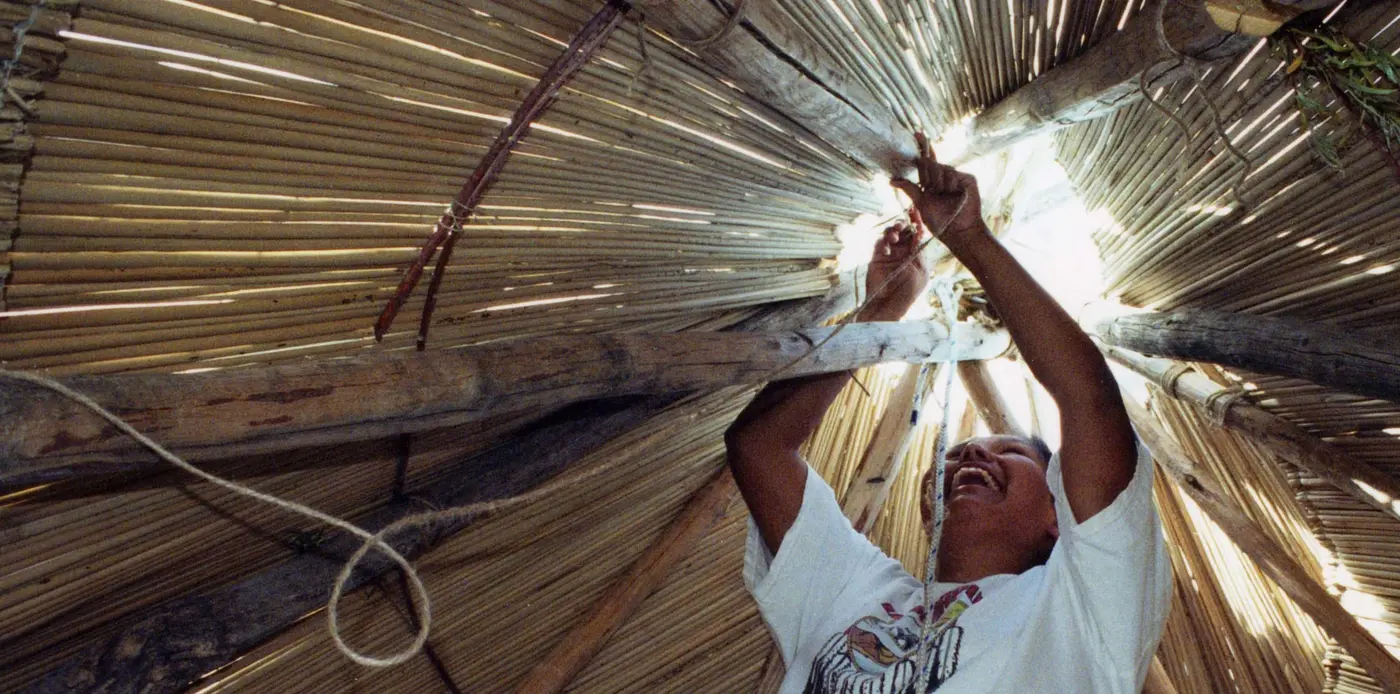
Inside the gallery are interactive monitors, dioramas, and a life-size tule mat lodge. There are audio interviews with Wanapum about gathering, fishing, hunting, trading, and healing, and a 45-seat theatre that shows the film Life as a Wanapum. The grand-opening flyer adds that visitors can steer a steamboat. The exhibit Tamanwit: Unwritten Laws and Beliefs, Wanapum of Priest Rapids features the 19th-century spiritual leader Smowhala, sometimes spelled Smohalla. He rejected the settlers’ ways and refused to move to a reservation. At the opening, the Columbia Basin Herald singled out a round television screen set high on a wall. Every few seconds it shows a member of the Wanapum, from the past or the present. Two Wanapum women at the screen that first day spoke to each other each time they recognized a face. “Yes we know them,” one said. “They’re family.”
A separate room of 2,000 square feet holds rotating shows. The Herald found it “rather large and somewhat empty” at the opening. It later held Patriot Nations: Native Americans in Our Nation’s Armed Forces, a 16-panel traveling exhibition from the Smithsonian’s National Museum of the American Indian. The center added photographs of the Wanapum Band’s own veterans. “We’re very grateful to share this exhibition with our community,” said Lela Buck, the center’s director and a member of the band. The center describes its exhibits as dedicated to the children of today and of the future, “because you can’t grow unless you know who you are.”
Weaving, string, and a river patrol
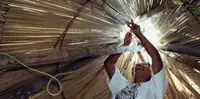
Grant PUD reopened the center in 2022. It had been closed since March 2020 because of the COVID-19 pandemic. With the reopening came an announcement that the public could visit Wanapum artists as they demonstrated weaving, bead working, string making, and other crafts daily. This work belongs to the center’s Living Culture Program. In it, participants learn flint knapping for arrowheads and projectile points, the making of fish traps, beadwork, weaving, and when, where, what, and how to gather traditional foods. Larger projects have built a tule mat lodge and a canoe and followed the life cycle of the salmon. Mithun’s plan adds rooms for meeting, cooking, and gathering. It also includes recording studios for oral history and archival storage for repatriated objects and new acquisitions, held in a climate-controlled repository. The Seattle Times reported in 2012 that the repository would hold Wanapum artifacts unearthed during construction of the Priest Rapids and Wanapum dams.
The Wanapum River Patrol, run from the center, works through the band’s traditional areas by boat and four-wheel-drive vehicle all year. Its members train under the Archaeological Resources Protection Act and in crime scene investigation. They learn to spot looters and to document a looting crime in progress, and they assist law enforcement.
The center also travels. The Wanapum Native American Discovery Unit, known as the WNADU, is a customized motor home 38 feet long and 8 feet wide. It carries a miniature of the old Priest Rapids Wanapum Village and artifacts from the homeland: stone tools, mortars, hemp string, greasewood, beaded bags, buckskin hides, cedar baskets, and tule mat. Wanapum representatives ride along to answer questions. On October 22, 2024, the band showed a replacement unit to Grant PUD commissioners. Clayton Buck, the Wanapum liaison, thanked the board for supporting the preservation and perpetuation of the Wanapum. Commission president Tom Flint recalled the original federal-license commitment to help the Wanapum preserve and perpetuate their culture.
Archaeology Days in October
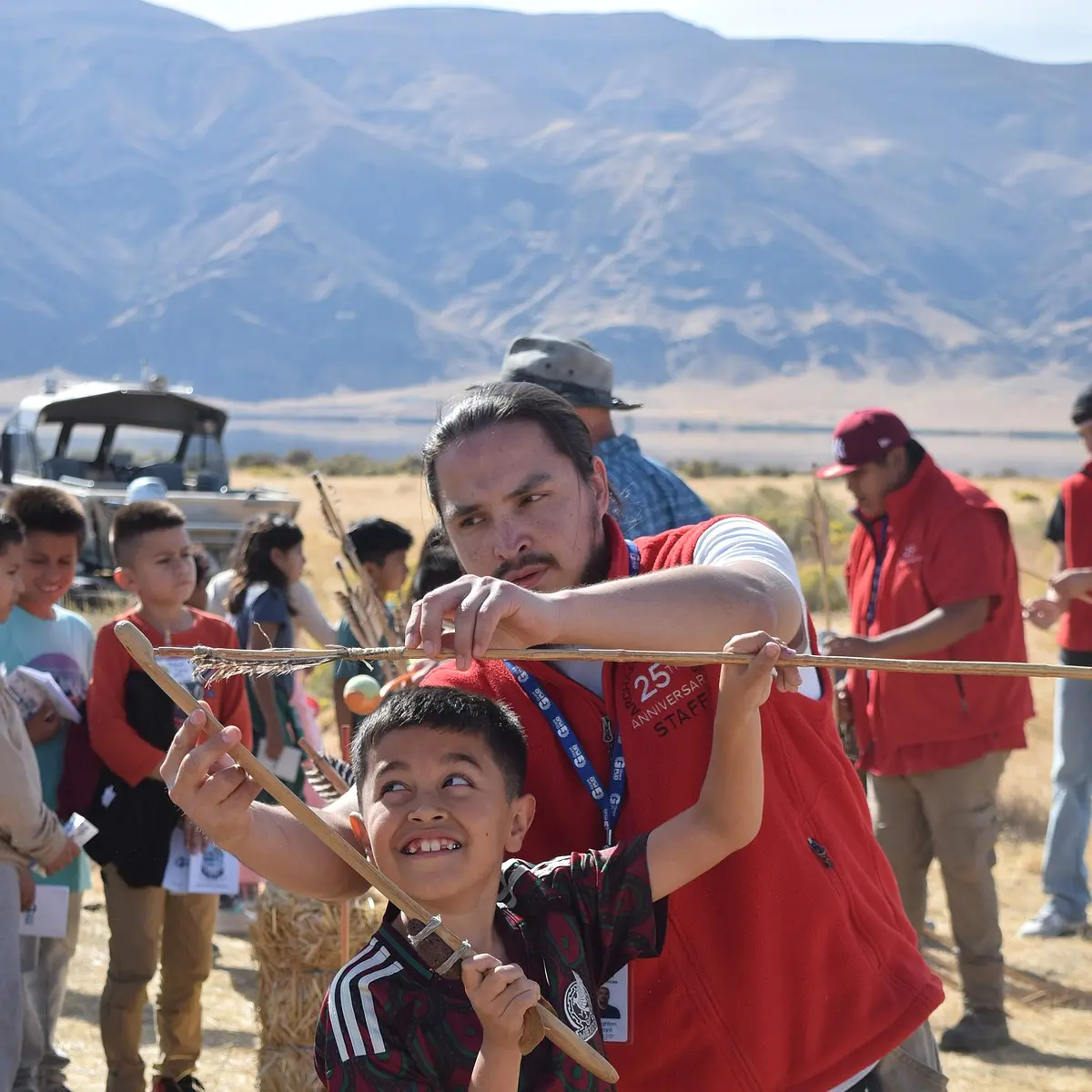
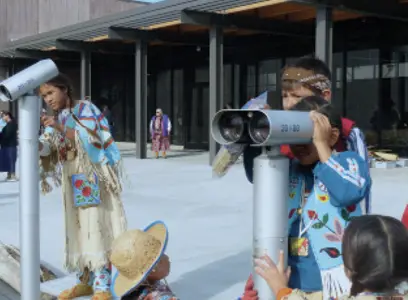
Each October, for Washington State Archaeology Month, the Wanapum and Grant PUD hold Archaeology Days at the center. The 2026 program sets a Youth Day for Wednesday, October 7, and an Adult Day for Thursday, October 8, from 9 a.m. to 4:30 p.m. Listed demonstrations include hide processing, weaving, beadwork, basket weaving, flint knapping, the atlatl, the Wanapum canoe, the River Patrol, and the Tamanwit exhibit. Children get storytelling, skits, crafts, plants, a bird of prey, and a lineman’s demonstration.
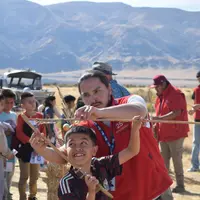
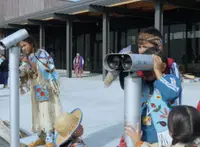
The 25th annual edition ran October 9 and 10, 2024. Students came from the Wahluke School District, the Yakama Nation Tribal School, Connell Elementary, and other schools. For the first time they carried “passport books” to be stamped at each station. They dug for “bones,” and Leighton Boyd helped them throw atlatl spears. They looked at Wenas mammoth fossils from the Wenas Mammoth Foundation and at a Pacific lamprey brought by Yakama Nation Fisheries. In a Grant PUD lineman test, they saw why a kite should not be flown near power lines.
Thomas Morning Owl of the Umatilla Tribe Language Program came for his third year in a row. He told the story of the grasshopper who danced and the ant who stored food for winter. In the story, the ant sends the hungry grasshopper away: “Oh, go and dance. Go dance. Go on. Go dance. You’ll get full.” Morning Owl then turned the story toward the children: “So remember, be an ant when you’re at school.” Lloyd Barkley, a Yakama Nation member who volunteered that year, gave his reason for coming. “The people, the Wanapum who invited us, that’s why it’s important,” he said. “It’s important to them. It’s important to me.”
A promise made for two dams
Wanapum means River People. The band’s account of itself holds that the Columbia has been its home from time immemorial. The Wanapum believe they were put there to protect and preserve the land and river for themselves, their children, and those not yet born. The Seattle Times put the band’s tenure on the ancestral grounds at between 700 and 800 generations. Tony Webb, Grant PUD’s general manager, said the history in the exhibits reaches back 12,000 years. The Wanapum are not a federally recognized tribe. They resisted resettlement and stayed out of the 1855 Fort Walla Walla treaty. The Tri-City Herald reported that the band lived at what is now the Hanford site until the land was seized during World War II. The Wanapum were then forced to resettle at their winter campsite at Priest Rapids. The National Park Service says that the village at Priest Rapids was in turn relocated during construction of Wanapum Dam.
In the 1950s the young utility sought a federal license to build two dams in the Wanapum homeland, and its officials approached the band. The Federal Power Commission issued the license in 1955. The Seattle Times reported that the Wanapum agreed not to oppose the dams, and in exchange they remained on their land. Grant PUD tells it this way: the Wanapum “stood in support of the utility,” and in return they keep their traditional culture and religious ways at their ancestral home. The grand-opening flyer dates the agreement to 1956. In it, the PUD promised to maintain and protect the Wanapum way of life. Priest Rapids Dam began generating power in 1959. In 2012, about 60 to 75 people lived in the village year-round, and more than 100 during the fishing and food-gathering seasons.
The first heritage center opened in 1966 at the dedication of Wanapum Dam, before about 1,900 people. By 2012 the PUD called it small, and Mithun called it outmoded. Ground was broken that August on the new center. The Seattle Times gave the cost as $20 million and expected an opening in mid-2014. Rex Buck Jr. was already looking ahead: “We’re all looking forward to that big day, the ribbon cutting, when all we all come together as a Plateau people with all of our friends and visitors who may come.” Building the exhibits began in November 2014 and cost $4 million. The architect and builder both list 2014 as the year the building was completed. The Columbia Basin Herald put the center’s cost at $11.35 million, and the builder gives a project value of $11.3 million. The PUD owns the center, and the Wanapum band operates it.
Opening day, October 15, 2015
About 400 people came to the opening at 10 a.m. on Thursday, October 15, 2015. Seven speakers were on the program, which was scheduled for an hour. Five spoke briefly, and the ceremony ended by about 10:35. Rex Buck Jr. and his wife, Angela, led the opening and closing songs of faith. Rex reminded the crowd that a week earlier six workers had been burned in an explosion at Priest Rapids Dam. He set aside time to give thanks that all six had survived. He said the center was built for the Wanapum of the past and of today, for the children, and for the yet to be born. Webb said that he and Rex had met monthly over the project, and that the PUD had worked by one rule: “Do the right thing and do things right.”
Angela Buck spoke last. She had been given the job of building the center. She said she first became aware of the dream 37 years earlier, and that it had become a vision about 17 years before. At least three times she had thought about quitting. “But that man (husband Rex Buck Jr.) wouldn’t let me quit,” she said. “’Remember the children,’ he said. Yes, the children.” She stepped back from the microphone at times to keep from crying. Then she repeated the words she had said earlier to Rex: “We’re here. We’re here.”
In 2016 and 2017 the building, its landscape, and the Tamanwit exhibition received honors from the American Institute of Architects, the Washington Museum Association, the Washington chapter of the American Society of Landscape Architects, and the American Alliance of Museums. Rex Buck Jr. had been given the leadership of the Wanapum while still in his 20s. He worked with the Burke Museum in Seattle to repatriate hundreds of ancestors, including the remains known as Kennewick Man, whom Native Americans call The Ancient One. His obituary described the center as a place where the Wanapum pass on their language and traditional life to new generations. He died on February 11, 2022, at 66, at his ancestral village of P’na at Priest Rapids.
Notable Events
- 1950sBrought together in the 1950s with the federal licensing of Priest Rapids and Wanapum dams, Grant PUD and the Wanapum Band of Native Americans committed to a long-lasting relationship built on mutual trust and respect. grantpud.org
- 1950sThe relationship behind the new center began when the newly formed utility sought to develop two dams along the Wanapum homeland. yakimaherald.com
- 1956The Grant County PUD promised to maintain and protect the Wanapum way of life; today this agreement is alive through the Wanapum Heritage Center. dahp.wa.gov
- 1966At the Wanapum Dam dedication, activities focused around the new heritage center, which opened to the public for the first time; about 1,900 people attended the ceremony. grantpud.org
- 2012Building and site construction began in August of 2012. columbiabasinherald.com
- 2012Grant PUD and the Wanapum broke ground on the new Wanapum Heritage Center. grantpud.org
- 2014Construction of the exhibits, which cost $4 million, began in November of 2014. columbiabasinherald.com
- 2014Mithun lists the project's completion date as 2014. mithun.com
- 2015The grand opening ceremony was set to begin at 10 am on Thursday, October 15, 2015, at 29082 Highway 243 South, Mattawa. dahp.wa.gov
- 2015The new Wanapum Heritage Center opened in October on the ancestral grounds of the Wanapum Band; the 50,000 square-foot facility protects, preserves and perpetuates Wanapum culture, traditions and identity. grantpud.org
- 2016Received an ASLA Washington Chapter Professional Awards Honor Award for General Design. mithun.com
- 2017The exhibition Tamanwit: Unwritten Laws and Beliefs, Wanapum of Priest Rapids received an Excellence in Exhibition Awards honorable mention. mithun.com
- 2020The Wanapum Heritage Center and Grant PUD Visitor Center had been closed since March 2020 in response to the COVID-19 pandemic. grantpud.org
- 2022Grant PUD reported that its Visitor Center and the Wanapum Heritage Center near Priest Rapids Dam had reopened to the public. grantpud.org
- 2024The Wanapum Band introduced a new mobile museum to commissioners on Tuesday, to travel the region telling their story. grantpud.org
- Rex Buck Jr., 66, died at his ancestral village of P’na at Priest Rapids, according to an obituary distributed by Grant County PUD; no cause of death was listed. knkx.org
People
- Angela Buck, Project leader assigned to build the center; considered quitting but was encouraged to remember the children.
- Judy Warnick, State representative from Moses Lake pictured viewing the first exhibit at the center.
- Tony Webb, Grant County PUD general manager who met monthly with Rex Buck Jr. about the center's progress and needs.
- Clayton Buck, Wanapum liaison who thanked commissioners for supporting preservation and perpetuation of the Wanapum.
- Tom Flint, Commission president who recalled the original federal-license commitment to help the Wanapum preserve and perpetuate their culture.
- Lela Buck, Heritage Center director and member of the Wanapum Band.
- Rex Buck Jr., leader of the Wanapum.
- Rich Franco, Partner in Mithun's Seattle office who explained the center's landscape-responsive architectural design.
- Sarah Morford, PUD spokeswoman who said the old heritage center would close when the new one opened; plans for the old space were not final.
- Chuck Allen, PUD spokesman who described the center as fulfillment of the utility's heritage-protection promise.
- Smowhala, Spiritual leader, sometimes spelled Smohalla, featured in the center's displays; rejected settlers' ways and refused relocation to a reservation (1800s).
Sources
- yakimaherald.com/news/local/wanapum-heritage-center-displays-history-in-the-making/article_fe77b950-7235-11e5-a91e-a777b87bd4b5.html
- columbiabasinherald.com/news/2015/oct/26/wanapum-heritage-center-2
- nps.gov/thingstodo/hanford-visit-the-wanapum-heritage-center.htm
- mithun.com/project/wanapum-heritage-center
- corpincconstruction.com/project/wanapum-heritage-center
- knkx.org/2022-02-16/longtime-leader-of-native-american-wanapum-band-dead-at-66
- grantpud.org/templates/galaxy/images/images/Downloads/Publications/2015_Annual_Report_grantpud.pdf
- rcwr.org/wp-content/uploads/2016/02/RCWR_2016-Winter.pdf
- grantpud.org/blog/commission-recap-10-22-2024-new-rolling-museum-tells-the-wanapum-story-more
- wanapum.org/about
- grantpud.org/the-wanapum
- grantpud.org/history
- dahp.wa.gov/sites/default/files/WanapumHeritageCenter_Ellensburg_0.pdf
- seattletimes.com/seattle-news/grant-county-pud-building-huge-wanapum-cultural-center
- kxly.com/news/regional-news/new-wanapum-heritage-center-opening-october-15/article_f6f0fc0f-3378-5ee8-8ac8-612e58f59cea.html