



Umatilla Landing Days
Umatilla, Umatilla County, Oregon. Family fun festival; Annual in June.
Details

- Where
- 1710 Quincy Ave, Umatilla, OR 97882. Directions
- When
- always in June.
- Getting there
- From I-82 take exit 1 toward Umatilla; at the bottom of the hill merge onto US-730/6th St; turn right onto Brownell Blvd.
- Fees
- Event and parking free.
- Hours
- Saturday 11am-10:30pm.
- Access
- Designated handicap parking area and ADA restrooms.
- Phone
- (541) 922-3226 x120
- Website
- umatillalandingdays.org
- Managed by
- City of Umatilla.
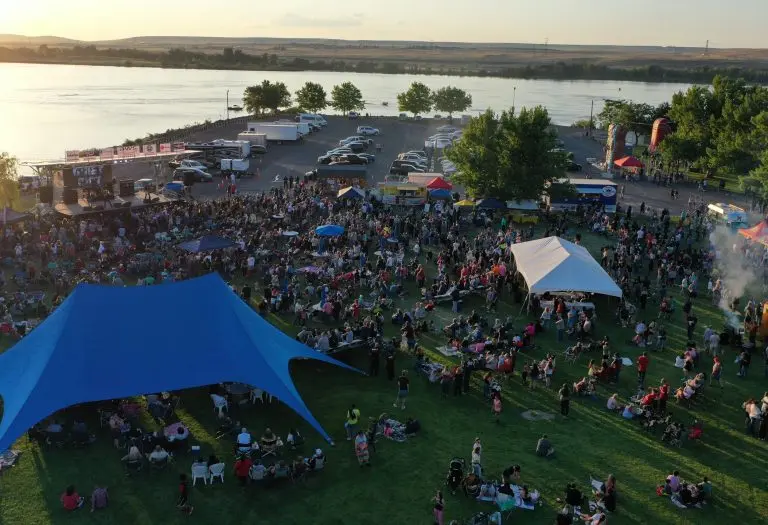
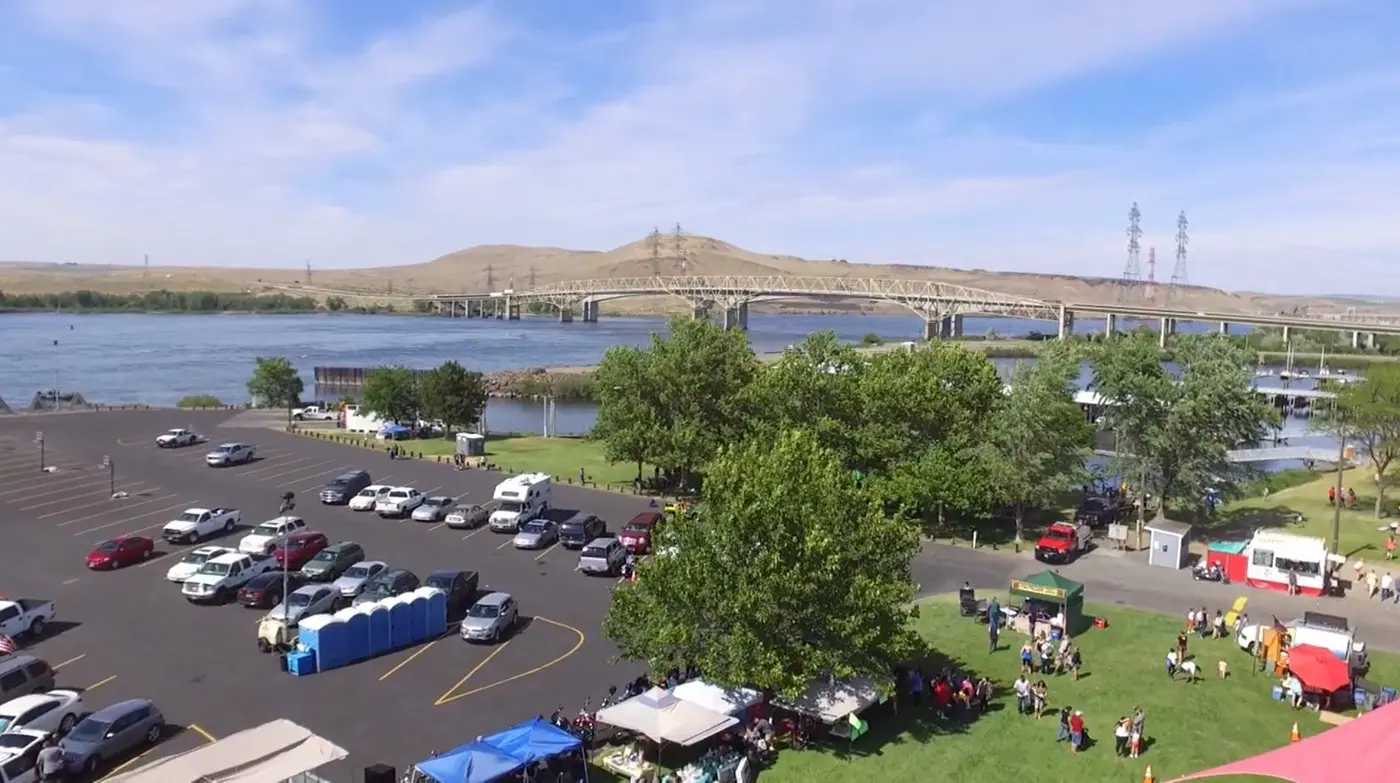
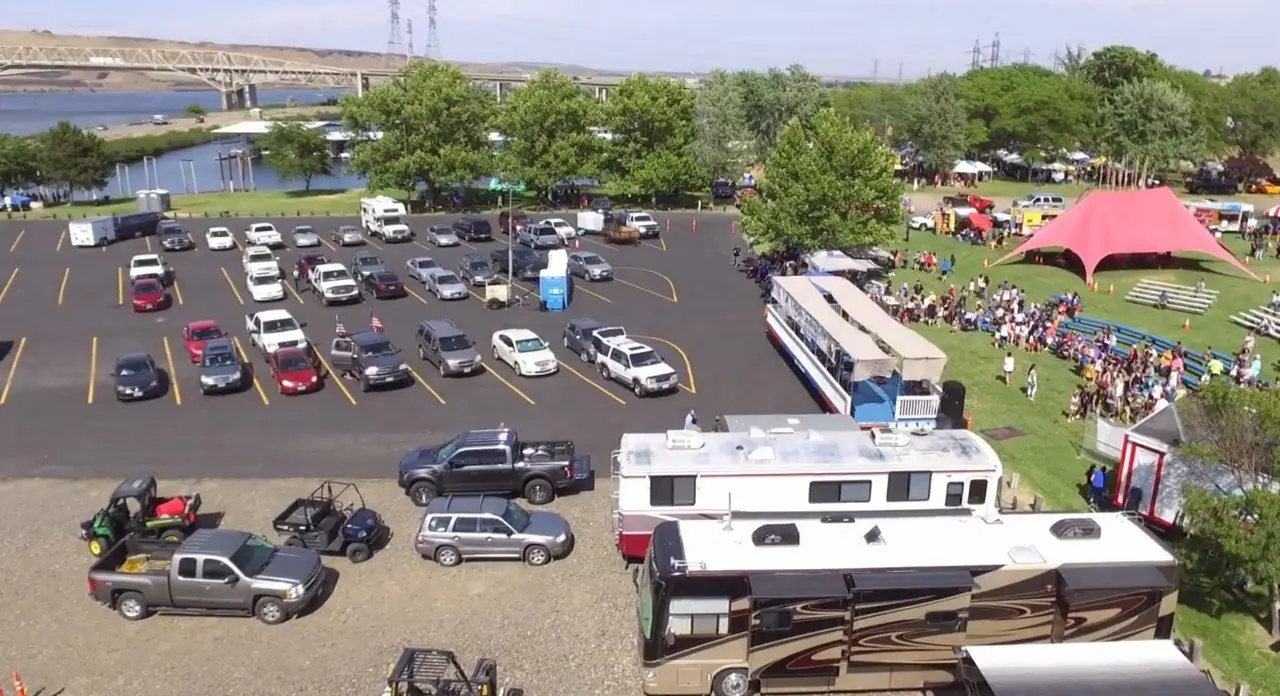
Umatilla Marina Park lies at 1710 Quincy Avenue, on the Columbia River where the Umatilla River comes in. Each June the City of Umatilla fills it with food and craft vendors, two stages, a car show and a Kid Zone. The festival bills the town as “the oldest community in Eastern Oregon still in existence.” Admission and parking are free. “This is celebrating Umatilla Landing’s founding,” said Esmeralda Perches, the city’s Parks & Recreation director, before the 2026 edition. “It’s a festival for the community, so we keep it free.”
Noche de Música and the Sixth Street parade
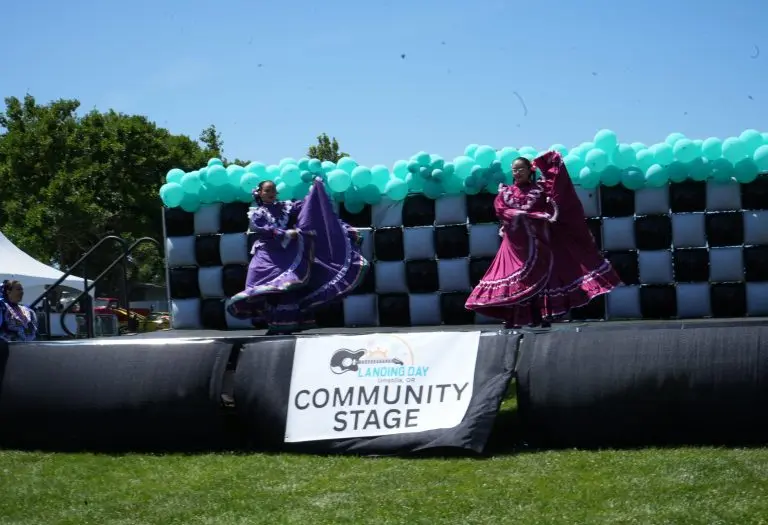
The 2026 festival ran June 26 and 27. It opened at 5 p.m. Friday with Noche de Música, an evening of regional Mexican music. Banda La Palmera played first on the Main Stage. Ballet Folklorico Estrellas de Mexico, a troupe of dancers aged 5 to 18, performed regional dances at 6 and again at 8 on the Community Stage. Grupo Viajero, a Hermiston band, followed at 6:30. Los Morros Del Norte closed the night at 8:30 with norteño music built on accordion and bajo sexto. The festival’s own notes list a mechanical bull-riding competition for Friday night, and carnival rides for children ran free from 5 to 8.
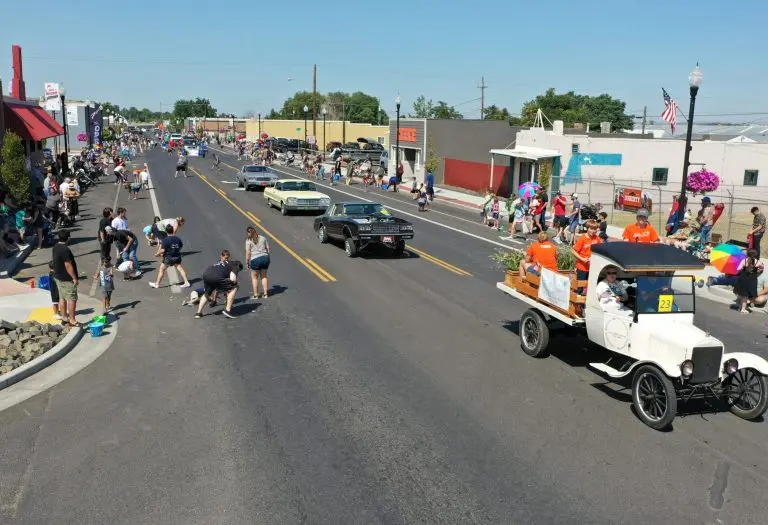
Saturday began at 10 a.m. with the parade down Sixth Street, the downtown main street. Festival-goers can leave their cars at the marina and walk a short distance to watch it. The 2026 theme was America’s 250th birthday. Prizes went to the Stars, Stripes and Sparkles entry for patriotic flair, the Spirit of 1776 entry for best colonial theme, and the All American Show Stopper for the liveliest entry. Fifty Jeeps from the PNW Jeep Girl Tribe drove the route, along with floats, classic vehicles, and local businesses and clubs.
Saturday at the marina
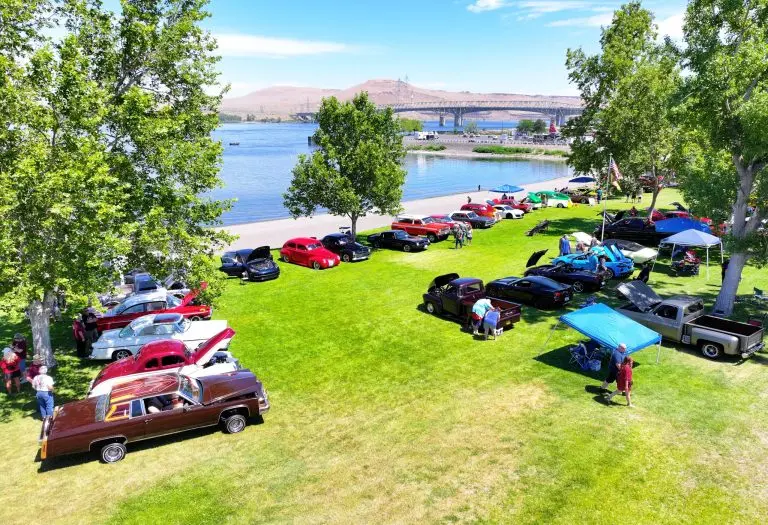
The park reopened at 11. The Kid Zone had water play and bounce houses. The Umatilla County Sheriff’s Marine Unit took visitors out on boat rides. The Umatilla Sweet Rides Car Club ran the Marina Motors Car Show, with hot rods, muscle cars, trucks, imports and lowriders, and trophies in 13 classes. The salsa contest is for the eaten kind. Cooks bring in homemade salsa by noon, visitors taste the entries at the salsa booth and vote, and the top three win prizes. Booths sold raffle tickets. “There’s a whole bunch of things, from TVs, overnight stays to a grill,” Perches said. “They’ve done a really good job of getting donated items.”
The Community Stage ran all afternoon. Big Top the Clown, a former clown with the Ringling Brothers and Barnum & Bailey Red Unit, opened at noon. A Zumba session and Miguel the Mysterious Magician came next. The Miss Landing Days Pageant for girls and young women of the town followed at 2:30, then the parade and salsa awards, Girl Scout Troop 22024, and at 7:30 the Rocky Ridge Native Drum and Dance Troupe with Native American traditional dances and songs.
The Main Stage played rock into the night. Blue Tattoo, an Eastern Oregon classic-rock cover band that the East Oregonian says “could be considered Umatilla’s house band,” went on at 4. Paper Flowers, a Fleetwood Mac tribute band, played at 6. Spin Doctors, the band behind “Two Princes,” headlined at 8:30. There are bleachers near the music stage, but seats are few, and many people bring chairs or blankets. Two beer gardens sell drinks. Coolers are not allowed. Asked what happens if it rains, the festival answers: “The show will go on!” At 10 p.m. the fireworks went off over the river. Festival organizers call them the first fireworks of the season.
Imatalam and the landing
Long before the landing, the place had another name. Imatalam, named for its many rocks, was settled more than 10,000 years ago where the two rivers meet. “For the tribe, this is a village site that is dated, I believe, 13,000 years of occupation in the archeological record and oral history,” Bambi Rodriguez of the Confederated Tribes of the Umatilla Indian Reservation told the Hermiston Herald in 2012. People gathered berries and roots there, fished, and kept a memorial site. Trails led in from the mountains, and later the ground was used for grazing and breeding horses. Lewis and Clark referred to it as a village in 1806.
In 1855 the Umatilla Indian Reservation was established southeast of Pendleton, and members of the Umatilla, Walla Walla and Cayuse tribes were moved there. Settlers and traders came in through the 1850s. On Aug. 2, 1862, Jesse Lurchin applied for pre-emption of 120 acres above the mouth of the Umatilla River for a townsite. The city counts that year as its founding. The post office opened in 1863, the same year the first plat was filed.
Umatilla Landing was the transfer point where miners and freight bound for the Idaho gold fields left the river for the overland road. According to the East Oregonian, the town grew to 1,500 to 1,800 permanent residents, with as many transients or more passing through. Between 1863 and 1867 it had hotels, dance halls, feed stables, barber and blacksmith shops, a drug store and 22 saloons. Six stores averaged $200,000 a year in sales, and about 95 percent of payments were made in gold dust. From 1864 a stage line hauled goods to the foot of the Blue Mountains. From there John Hailey and his partner William Ish carried them by saddle train to Boise, supplying 15,000 miners. Chinese travelers set up a village two or three miles below the town. In winter, when the Columbia iced over, residents skated, danced and played practical jokes until the steamboats came back. The first steamers each spring were so crowded that the crews could hardly move about to work.
The town was incorporated as Umatilla City on October 24, 1864, with a mayor, five aldermen, a recorder, a marshal and a treasurer. George Coe was the first mayor. An 1865 election made Umatilla the county seat, and the first school was built that year. In 1866 the citizens disincorporated, the city says, because they found a municipal government an unnecessary burden. That same year new routes to the gold fields opened and the trade drained away. The county seat went to Pendleton in 1868, and when the Central Pacific and Union Pacific railroads met in 1869, traffic on the Portland-Umatilla-Boise route stopped. The travel writer Theodor Kirchhoff got off a steamboat at Umatilla in 1872 and found about 100 people, empty buildings with broken windows, and blowing sand. “From the opposite shore of the river, a few miserable Indian tents glumly watch the city sink into ruin,” he wrote. In the 1880s competition from the Oregon Railway and Navigation Company cut into the port’s river trade. The town reincorporated in 1906 as the City of Umatilla.
The Petticoat Revolution
By 1916 the town was small. TIME puts the population at 198, and the Oregon Secretary of State’s archives at about 300, with some 200 voters. The women of Umatilla were unhappy with a council that had cut city services. According to TIME, a group of them decided at a card party to vote themselves into office. Candidates did not have to declare, and voters wrote names on a secret ballot. On December 5, 1916, women won four council seats and the posts of recorder and treasurer, and Laura Starcher beat her husband, the incumbent mayor E.E. Starcher. The Oregon History Project and TIME give the vote as 26 to 8. The state archives give it as 101 to 73. The new council members were Gladys Spinning, Anna Means, Florence Brownell and Stella Paulu, with Lola Merrick as treasurer and Bertha Cherry as recorder. E.E. Starcher and C.G. Brownell, two of the town’s leading politicians, later said they had known nothing of their wives’ plans. TIME reports that E.E. Starcher demanded a recount, and that he later described his wife to The Oregonian as “the best housekeeper in the United States.”
Newspapers across the country called it the “Petticoat Revolution.” One newly elected woman told reporters, “One thing is sure, we can’t do any worse than the men have done.” When she took office in January 1917, Starcher answered the talk about “the so-called petticoat government” directly: “we will manage the affairs of this municipality and do it with a creditable manner without a shadow of a doubt.” The two men who kept their council seats got no committee assignments. The new council chose not to hire a marshal. Starcher said the $57 a month was unnecessary, because a deputy sheriff was on the streets every day and the charter let any council member make an arrest. The women improved the water and electric service, paid for streets and sidewalks, held Cleanup Weeks, put up railroad crossing signs, founded a library, replaced the town’s American flags, started monthly garbage collection, and appointed a health official during the 1918 smallpox epidemic.
Starcher left after eight months for health reasons. Mrs. H.T. Duncan was appointed in her place, went on leave a month later, and resigned. Stella Paulu was appointed next, and in 1918 she won election with about 80 percent of the vote. When the original women stepped down, no new women ran, and the 1920 election returned an all-male government. Bertha Cherry, the 1916 recorder, was elected mayor in 1933. Laura Starcher moved to Parma, Idaho, died in 1960, and is buried there. For the 2012 festival, Umatilla High School staged a readers theater play about the election, Operation Clean Sweep, and the proceeds went to the fireworks fund.
Old Town above the waterline
The 2012 festival also marked the town’s 150th anniversary. That year’s visitors could take a 45-minute bus tour, at a suggested $2 donation, of the Old Town site. The site had been closed for decades. During construction of the John Day Dam, officials predicted the river would flood the townsite, and between 1965 and 1968 every resident and business moved to higher ground. “Some of the homes were moved, many destroyed,” said Larry Nelson of the Umatilla Museum. “Many of them were just knocked down, and there’s been no development there since.” The water never rose that high. The Army Corps of Engineers holds the riverfront land, which the city gives as 130 acres and the 2012 Herald as 80. It is on the National Register of Historic Places, and an old Indian burial ground there is protected from relic collectors.
Digging began in 1965, when a University of Oregon crew found thousands of relics. Those relics remain in storage until there is funding to date and identify them. The Mid Columbia Archeological Society excavated from 1970, and the Washington Archeological Research Center in the spring of 1979. The city calls it the largest existing prehistoric site reported in Oregon.
The festival grounds share the same date as the move. The Port of Umatilla, created in 1940 to bring river commerce to the county, opened its recreational boat marina in 1968. The city owns it now. During the 2022 festival, boats went out from there along the Old Town shore, where much of the land stays dry and empty, with paved roads and some foundations still in place.
Notable Events
- 1862Jesse Lurchin applied for pre-emption of 120 acres above the mouth of the Umatilla River to establish a townsite, the year the city recognizes as its founding; the first post office opened in 1863, the same year the first city plat was filed. hermistonherald.com
- 1864The City of Umatilla was first incorporated as Umatilla City with a mayor, five aldermen, recorder, marshal and treasurer. umatillalandingdays.org
- 1865By 1864 the town had a mayor, a marshal and a town council, and Umatilla was designated the county seat in 1865, when the first school was also built. eastoregonian.com
- 1868With the establishment of other, larger cities the county seat was moved to Pendleton in 1868. And when the Central Pacific and Union Pacific railroads linked in 1869, the Portland-Umatilla-Boise route traffic dried up. Umatilla’s population dropped precipitously. eastoregonian.com
- 1916Laura Stockton Starcher defeated the incumbent, her husband E. E. Starcher, by a vote of twenty-six to eight. oregonhistoryproject.org
- 1916The City of Umatilla elected an all-woman slate of candidates and received national newspaper coverage as the first all-female city administration in the United States. sos.oregon.gov
- 1917Over the next four years the council improved water and electrical services, approved funds for street and sidewalk projects, and organized city Cleanup Weeks. oregonhistoryproject.org
- 1920No new women came forward to take their places; the election of 1920 returned an all-male city government. oregonhistoryproject.org
- 1933Bertha Cherry, one of the original Petticoat Revolutionaries, was elected mayor in 1933. time.com
- 1940One of the state's 23 port districts, the Port of Umatilla was created in 1940 to bring water-borne commerce to Umatilla County. In 1968, the Port of Umatilla opened a recreational boat marina. umatillalandingdays.org
- 1962120 acres of land at the mouth of the Umatilla River became the townsite of Umatilla Landing; within five years the town became the county seat of Umatilla County. hermistonherald.com
- 1965Officials predicted the John Day Dam would flood the town, and all residents and businesses of Umatilla were relocated; buildings were moved or demolished and the Old Town site was closed. hermistonherald.com
- 1965The first archeological dig was conducted in 1965 by a crew from the University of Oregon. Thousands of relics were found and are now stored until eventual funding is available to continue dating and identifying the historic treasures. umatilla.gov
- 1968When the John Day Dam was built in the late 60s, the city was moved to higher ground due to expected flooding of the townsite in 1968. umatillalandingdays.org
- 2012During the summer's Umatilla Landing Days and 150th Anniversary Celebration, the Umatilla Museum hosted bus tours of the Old Town property owned by the U.S. Army Corps of Engineers. hermistonherald.com
People
- John Hailey, freighter who hauled goods by saddle train from the Blue Mountains to Boise (1864).
- Theodor Kirchhoff, travel writer who described Umatilla's ruin in 1872 (1872).
- Esmeralda Perches, Umatilla Parks & Recreation director.
- Bambi Rodriguez, assistant program manager for the Confederated Tribes of the Umatilla Indian Reservation, on the Old Town village site.
- Jesse Lurchin, Applied for pre-emption of 120 acres above the mouth of the Umatilla River to establish the townsite (1862).
- Larry Nelson, Umatilla Museum representative on the Old Town relocation.
- Karen Hutchinson-Talaski, Umatilla Chamber executive director; festival contact.
- C.G. Brownell, leading town politician; had no prior knowledge of his wife's council candidacy.
- Laura Stockton Starcher, elected mayor of Umatilla on December 5, 1916, defeating her husband, the incumbent (served eight months of her two-year term).
- Anna Means, elected to the council.
- Bertha Cherry, elected recorder.
- Florence Brownwell, elected to the council.
- Gladys Spinning, elected to the council.
- Lola Merrick, elected treasurer.
- E.E. Starcher, incumbent mayor ousted by his wife Laura J. Starcher in the Petticoat Revolution election (1916).
- H.T. Duncan, appointed female mayor after Starcher; went on leave and resigned after a month.
- Nanci Sandoval, Umatilla's City Recorder who points out Bertha Cherry's 1933 mayoralty.
- Stella Paulu, appointed mayor after Duncan; won the 1918 election (1918).
- George Coe, first mayor of Umatilla City (1864).
Sources
- umatillalandingdays.org
- facebook.com/UmatillaORLandingDays
- oregonhistoryproject.org/articles/historical-records/laura-stockton-starcher
- sos.oregon.gov/archives/exhibits/pages/suffrage-petticoat.aspx
- time.com/4583710/umatilla-100-years
- umatillalandingdays.org/history
- umatilla.gov/186/History
- eastoregonian.com/2019/07/27/out-of-the-vault-umatilla-from-boom-to-bust-and-back
- hermistonherald.com/2022/06/21/celebrate-towns-history-at-umatilla-landing-days
- eastoregonian.com/2026/06/20/umatilla-reels-in-community-fun-with-landing-days
- hermistonherald.com/2012/06/16/umatilla-old-town-has-long-history
- hermistonherald.com/2012/06/20/landing-days-takes-over-this-weekend