Tuscarora Pottery School
Tuscarora, Elko County, Nevada. School.
Details

- Where
- 138 Main Street, Tuscarora, NV 89834. Directions
- When
- Two week summer workshop intensives as well as weekend workshops.
- Season
- Summer months, staffing and availability permitting.
- Getting there
- An hour north of Elko.
- Fees
- Book a Room $40.00; Book a Campsite $20.00.
- Access
- Near-ghost town with one year-round resident; smaller than it has ever been.
- Walk-in or reserve
- Lodging by request form; application reviewed and availability confirmed.
- Phone
- (323) 636-6262
- Website
- tuscarorapottery.com
- Managed by
- Board-run: president Cody Breese Thomas, secretary Allison Ingles, treasurer Ben Parks, board member Gail Rappa; instructor Jerry Hendershot.
- Established
- 1966.
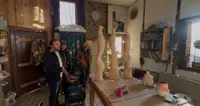
In the middle of Tuscarora, in Elko County, an hour north of Elko, stands a two-story, wood-paneled rooming house built in 1877. Called the Zweifel Rooming House, it is the home of the Tuscarora Pottery School. On Jan. 21, 2025, the Elko Daily reporter Lydia Snow watched three potters and a small, energetic dog walk down the snow-covered dirt road to open the gate. Inside she found rugs, flowery wallpaper and colored tiles. Twisted vases and earthy bowls sat around a shop in the front entrance, with snug living spaces farther back.
The house is the student residence, and the school calls it the Tuscarora Hotel. It has a gallery, a library, seven private rooms, a full kitchen and a bathroom, on a campus of one acre. In summer, visitors may stay in the hotel or camp on the grounds, as staffing allows. Near the front door lies the guestbook, a 19th-century ledger that, by Nevada Magazine’s account in its Spring 2024 issue, never leaves its place. Its hundreds of pages carry thousands of signatures and comments.
The barn, the kilns and the red dome
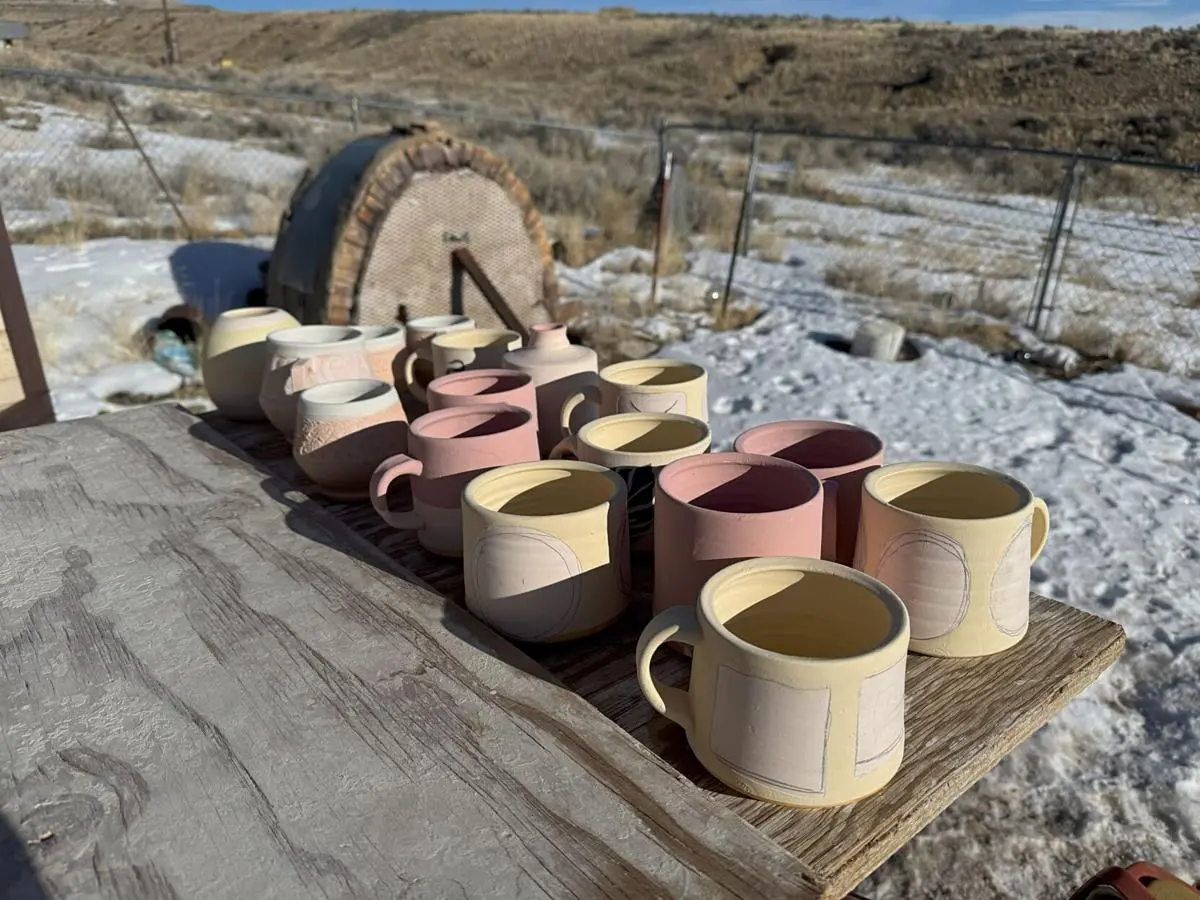
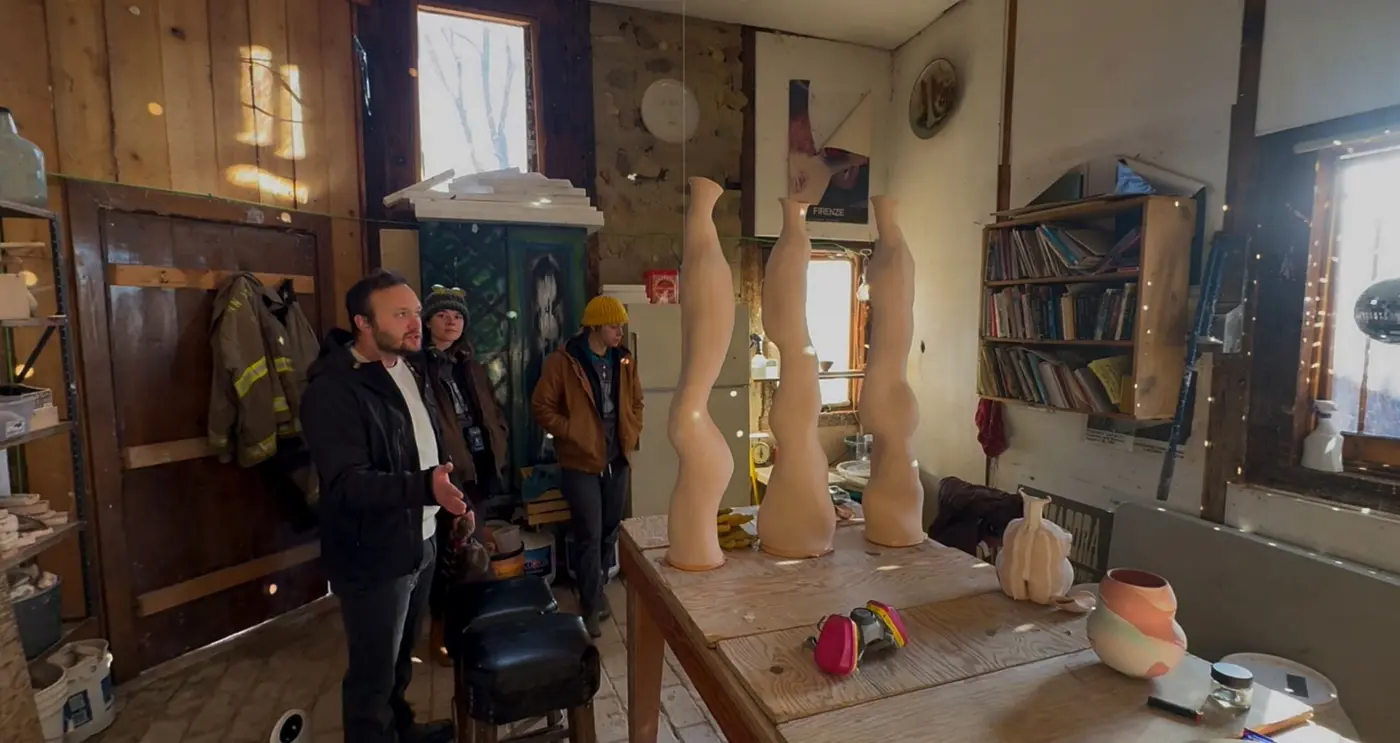
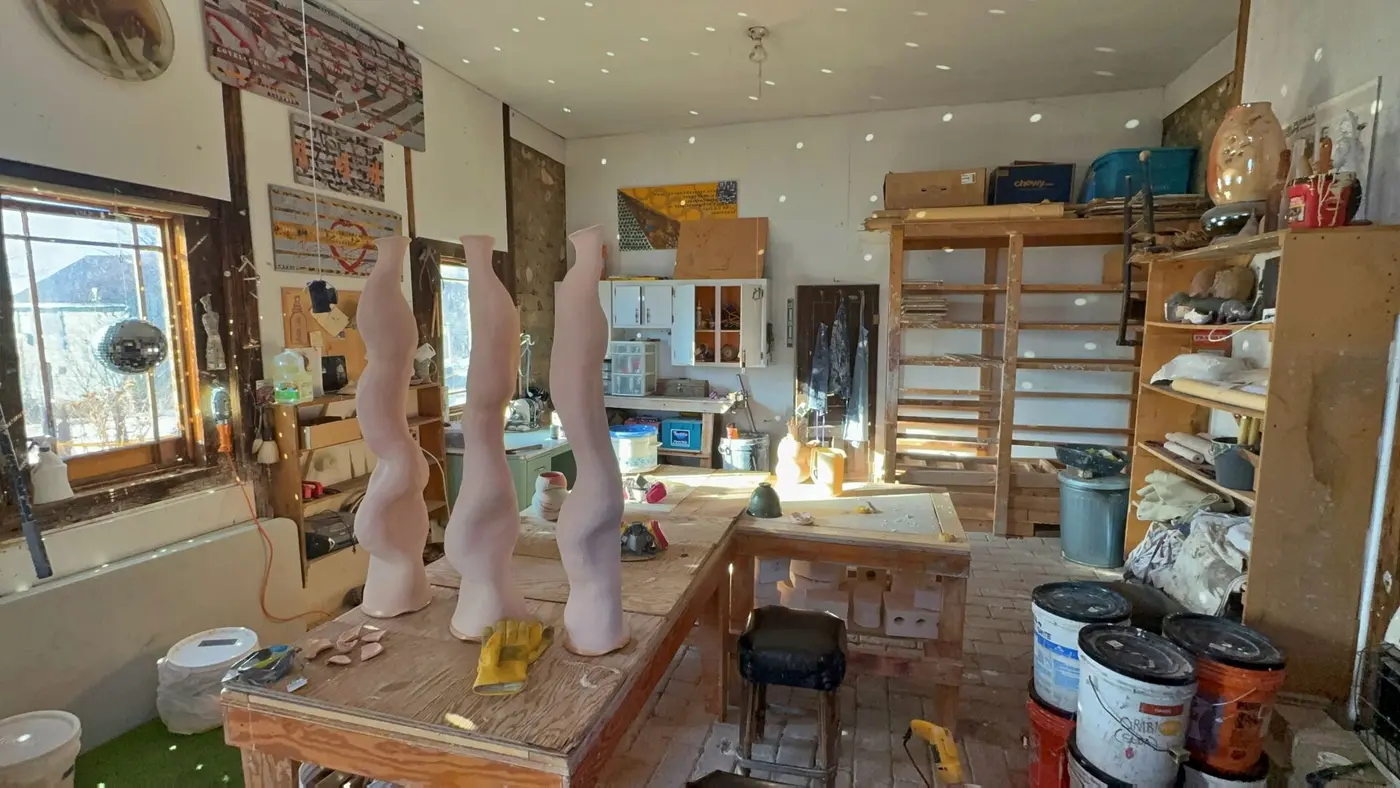
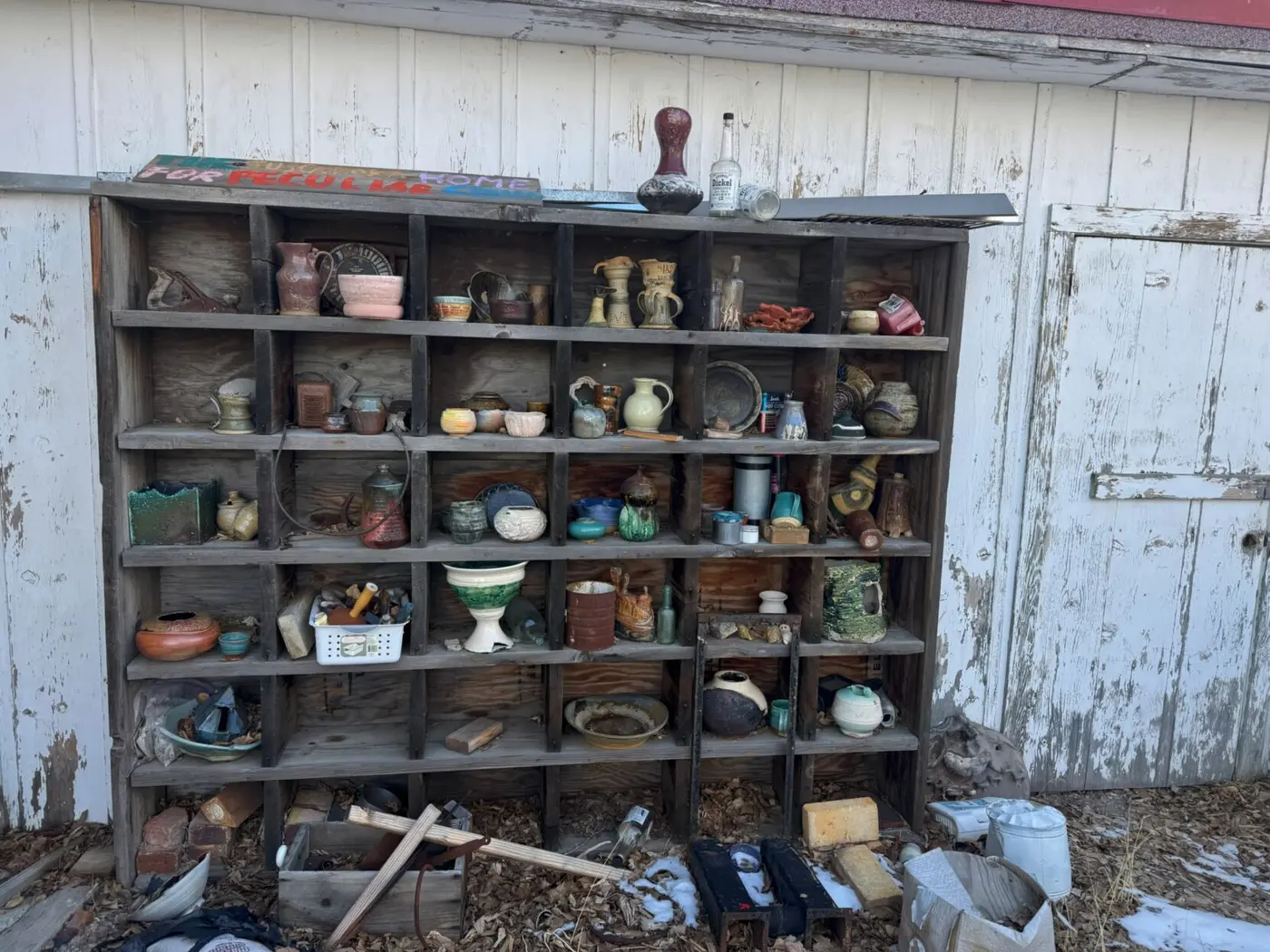
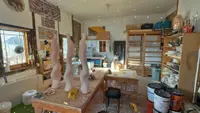
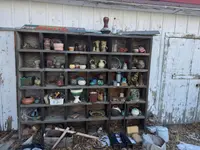
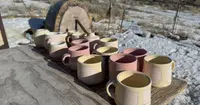
The main workspace is a barn with wide wooden tables, racks of drying pottery and jars holding many colors of glaze. In January 2025, the instructor Cody Thomas had tall, curvy bottle forms of his own on the tables, some as tall as a child. “This place allows us to scale up quite a bit, rather than just dealing with little functional piecework,” he said.
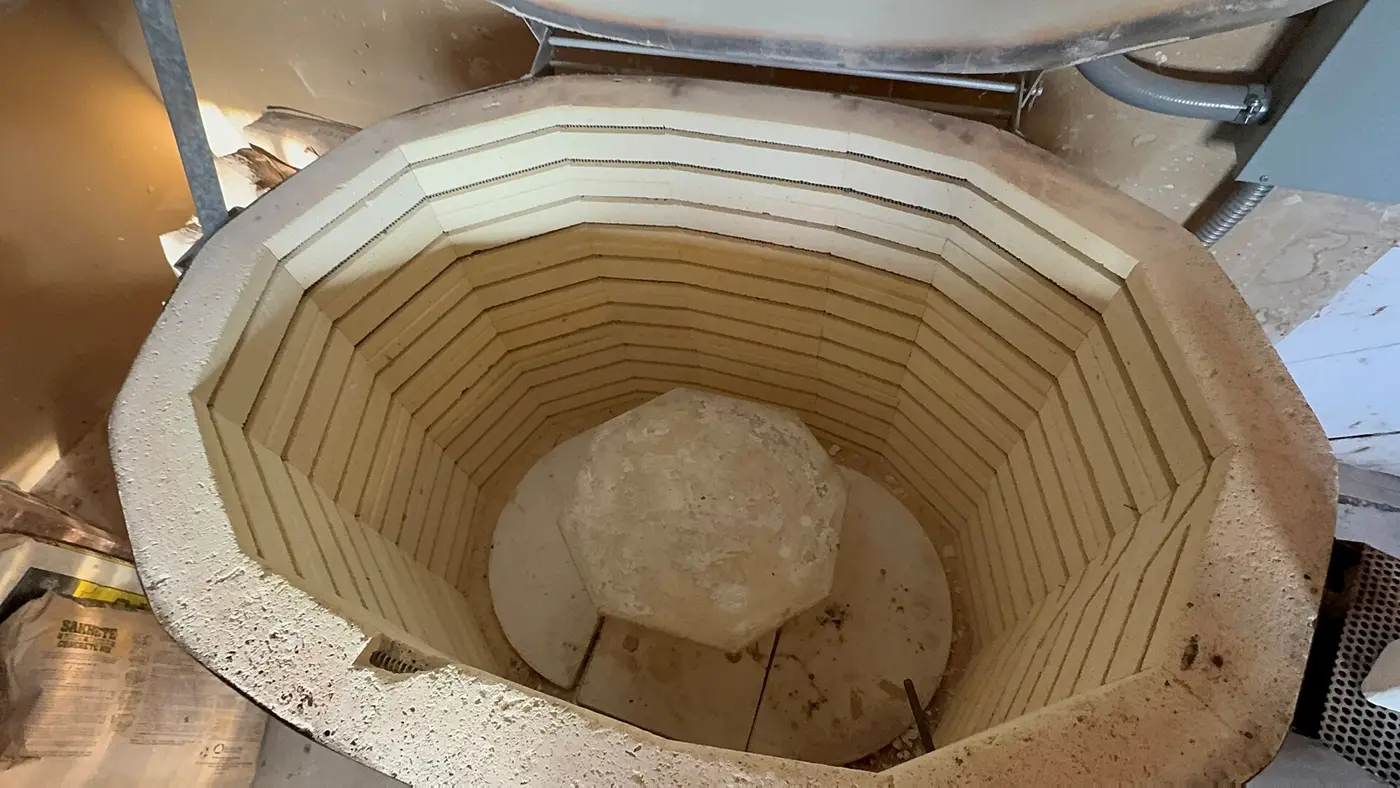
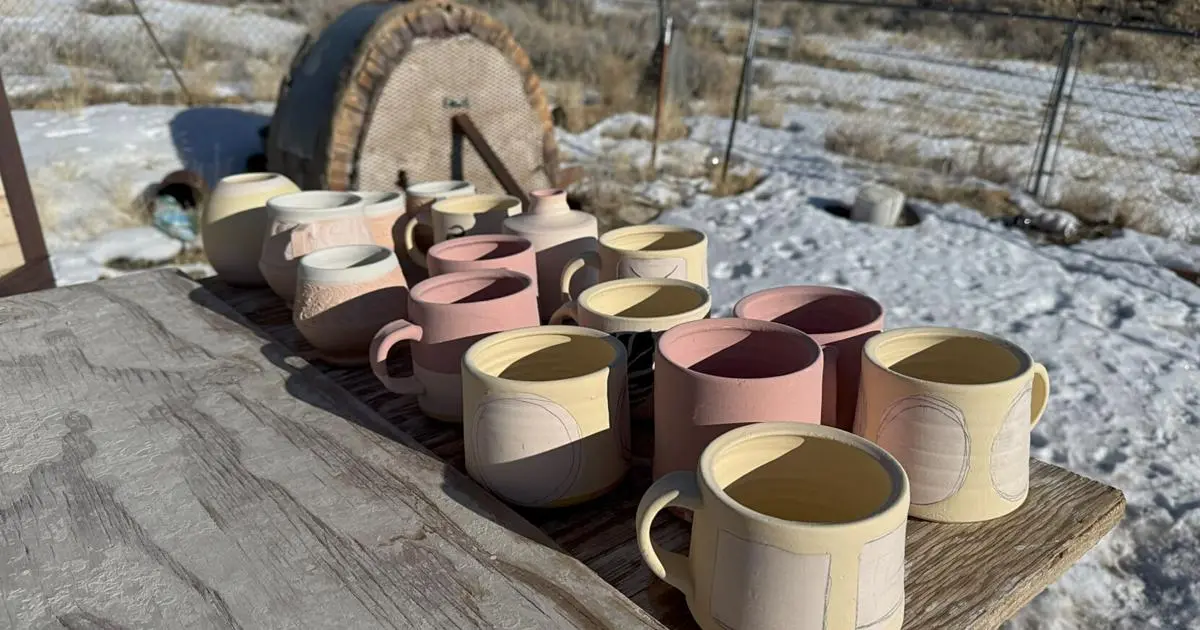
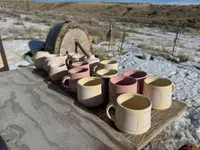
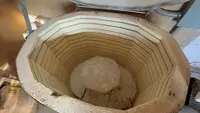
At the back of the building, shelves of chemical powders flank a kiln of about 120 cubic feet. The school soda-fires, heating its ware to around 2,400 degrees Fahrenheit. Thomas explained that the method arose in the 1970s as an answer to salt firing, “which has kind of a nasty burnoff of chlorine gas.” The soda ash and sodium bicarbonate volatilize in the chamber, which turns “really turbulent.” The glazes include Leach Celadon, a muted bluish gray made with silica and feldspar, and Malcolm Davis Shino, a matte black that contains soda ash. A few electric kilns handle the bisque firing at around 1,800 degrees.
A rickety wooden staircase rises from the workspace to a loft gallery of work by the founder, Dennis Parks. It holds pottery shaped like human arms and heads, clay belts and neckties, and pieces with letters and words stamped into the surface.
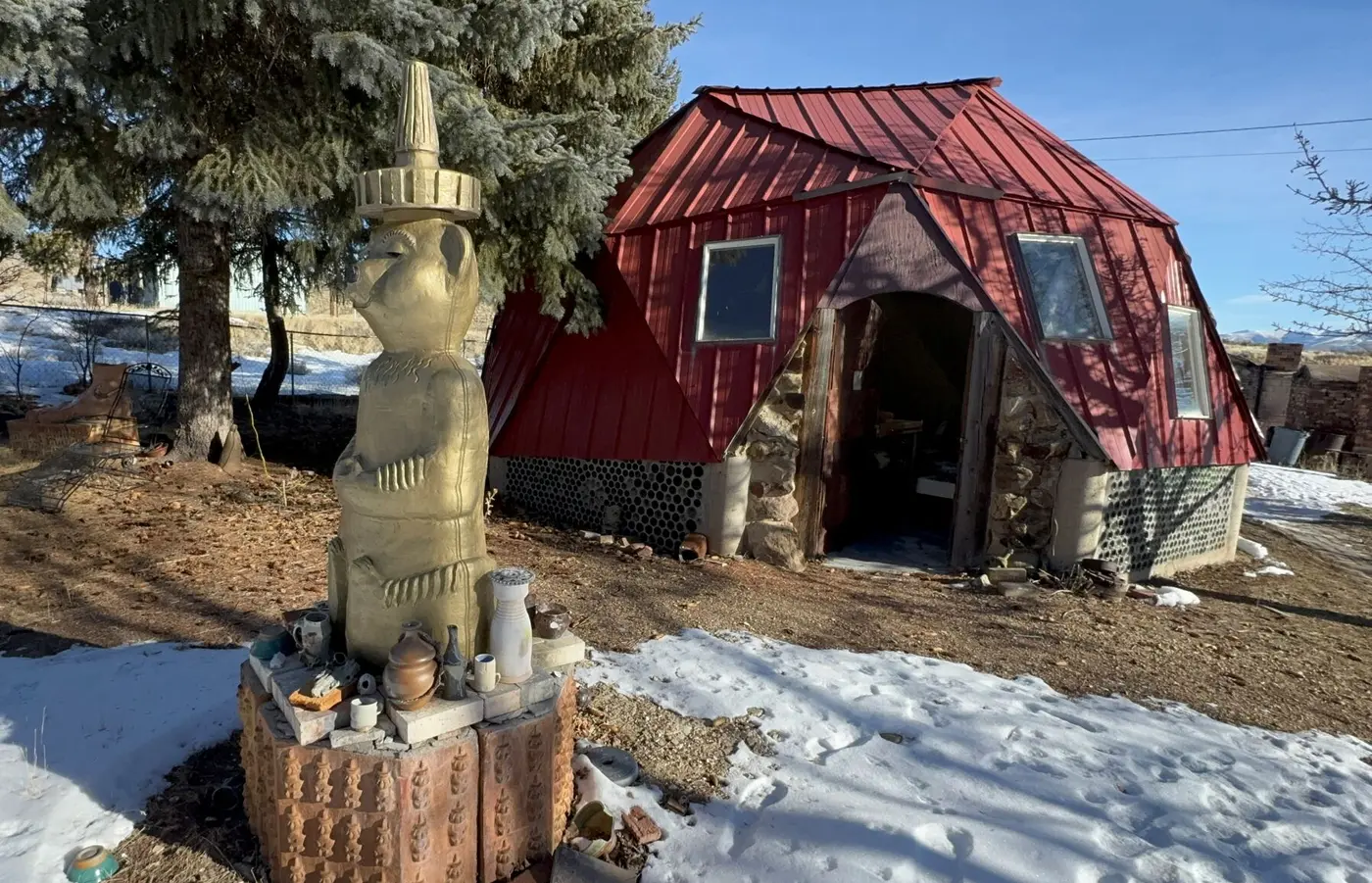
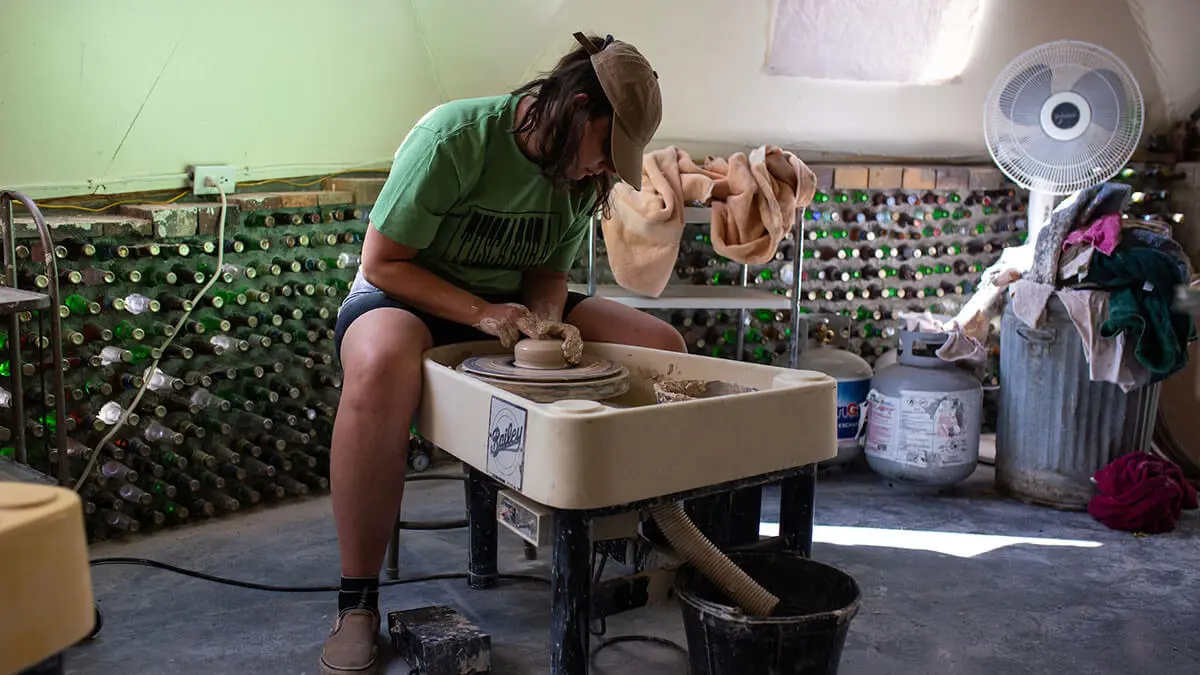
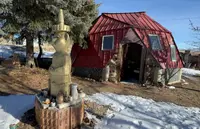
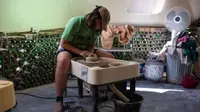
Across the yard stands a bright red geodesic dome, completed in 1972 and set aside for wheel throwing. The school describes it as the first structure built in town since the mines dried up. Sun comes through walls made from recycled bottles and through sheet-covered windows set in the triangular faces. “We run these two-week workshops where it’s just a week straight of between three and eight people crammed in this room making stuff and talking about process,” Thomas said. The dome stays open 24 hours a day. “I’ll come out here and find people in the middle of the night and bats will fly in.” Beside it stands a building made of bricks pressed from Tuscarora’s own soil. The school says that each summer the yard turns green and fills with sculptural memorabilia. A short walk away, a flooded mining pit serves as a swimming pond on warm summer days.
Workshops, firings and a honey bear sticker
Classes have become retreat-style workshops lasting from several days to two weeks, with a cap of about 12 students. The school’s Facebook page lists two-week summer intensives and weekend sessions. Nevada Magazine reported a raku course and a two-week class in high-temperature firing, as well as a whole high school art class from Idaho that camps on the grounds for a week. “The students make pots for six or seven days and then do the glazing and then load the kiln and fire it off. That’s always a big fun night,” said Elaine Parks, an artist and instructor who is Dennis Parks’s former daughter-in-law. The school closed its 2026 season with “Thanks for a great season y’all!” and says the 2027 offerings will be posted by the new year.
A passerby may find someone free to show the boarding house or the studio. The gallery and gift shop sell pottery by instructors and friends of the school, along with branded apparel, books and a honey bear sticker. Travel Nevada advises visitors to ask about the sticker. The town’s only business is a post office, staffed daily, that serves the ranches across the valley. The 1878 tavern, now a community center, holds exhibits on the town’s past.
A road trip in 1962
According to Travel Nevada, Dennis Parks was a potter based in Washington, D.C., when he stopped in Tuscarora on a cross-country road trip in 1962. A friend had recommended the town as an artist’s retreat. He found crumbling brick chimneys and weathered homesteads, with about half a dozen residents living among the ruins. The town sits partway up Mt. Blitzen, where a silver strike was made in 1871. By the early 1880s it had more than 3,000 people and was the largest town in Elko County. The bonanza ended in the mid-1890s, and by 1920 about 240 people remained.
Parks had studied English at Rutgers, where he read poetry with John Ciardi. He also studied at the University of North Carolina and attended the Writers’ Workshop at the University of Iowa. At Claremont Graduate School he studied with the ceramists Paul Soldner and John Mason. He went on to start ceramics and sculpture departments at Knox College and Pitzer College.
In 1966 Parks, then 30 years old, came to Tuscarora with his wife, Julie, and some friends to test a summer program. They had little money and no supplies. A carriage shop became the studio. Bricks from abandoned mills went into the firing, and clay came out of the mine tailings. They built the first kiln from homemade clay mixed with sand and sawdust. The first wheel was a cement cast of a rusted steering wheel. Nevada Magazine says seven students came for a few weeks; the Elko Daily calls it a two-month workshop. In 1969 the program grew to nine weeks for 14 students. The town’s residents, by then in their 60s and 70s, helped repair the school’s leaning boarding house. In return, students did chores and kept the town generator running. The students also tended a vegetable garden and raised chickens, goats, ducks and rabbits for food.
Staying on, by several accounts
The sources disagree about when the family moved for good. Nevada Magazine says that after the 1969 classes the Parkses withdrew their life savings, bought the boarding house and two other properties, and settled permanently. The Elko Daily says Pitzer offered Parks a tenure post in 1967, which he turned down to teach in Tuscarora. It adds that he and Julie ran workshops from 1967 to 1969 out of newly purchased campus space. Both the paper and the school date the purchase of the rooming house to 1972. A Nevada Museum of Art wall text opens with Parks moving to Tuscarora in 1966. Later in the same text, it says a family trip during his 1971 sabbatical led him to resign from Pitzer, and that he founded the school in 1972. The University of Nevada Press, describing his memoir, also gives 1972. It says he and his wife were drawn by the town’s isolation and setting, and believed it might be a healthy place to raise their two small sons.
To get by with what the place offered, Parks fired his work once instead of twice. He fueled his kilns with crankcase oil collected free from local ranches, “a really economic, kind of clever way to deal with a fuel source,” Thomas said. Parks’s book A Potter’s Guide to Raw Glazing and Oil Firing came out in 1980 and, by Nevada Magazine’s count, sold more than 10,000 copies. He was elected to the International Academy of Ceramics in 1983 and received Nevada’s Governor’s Arts Award in 1990. The museum counts over 1,000 students from around the world in the school’s first 40 years. His memoir, Living in the Country Growing Weird, appeared in 2001. The poet Coleman Barks wrote of it: “Dennis Parks lives without television, and he doesn’t miss a sunrise.”
Julie Parks came from Gastonia, North Carolina. She was the first nursing student at Duke University to graduate magna cum laude on a merit scholarship, and she married Dennis in 1959. At the school she ran the day-to-day work and was praised as “the best cook ever.” After retiring she served as the town’s postmaster. She died in 2018, and Dennis died in 2021.
A beautiful burden
“We call it a beautiful burden,” Elaine Parks said of carrying on the school. Like the other instructors, she lives elsewhere and makes the long drive when classes are in session. The school receives support from the Nevada Arts Council and the National Endowment for the Arts. A board and volunteers do most of the work. The board president is Cody Breese Thomas, a ceramicist from Muskegon, Michigan, who came as a student in 2022 and returned to teach the next year. The treasurer is the Parkses’ son Ben, a nurse who, the Elko Daily reports, still lives in Tuscarora and has run the school before. Katie Sparhawk of Boise has come since her high school years in the mid-2010s and has kept house for the school. Taylor Ford, a 2024 graduate of the University of Nevada, Reno, stayed for a three-month residency. “Coming out here full time would be like a completely different lifestyle shift,” Sparhawk said.
Travel Nevada counts a single year-round resident, fewer people than the town has ever had. “At this point, we’re hoping to get somebody who could live here at least six months out of the year,” Elaine Parks said. “Someone who is a ceramist and knows how to work on the equipment and tools. Someone who’s kind of handy and can maintain the old boarding house.”
Thomas called Dennis Parks “the glue that holds us all together,” and recalled him as “a poet and conscientious objector from the East Coast.” Of the people he has met through the school, Thomas said: “This is my ilk. We’ve grown really close.”
Notable Events
- 1877The school occupies the building identified by the newspaper as the 1877 Zweifel Rooming House. elkodaily.com
- 1962Dennis Parks stopped in Tuscarora during a cross-country road trip and came to see it as the place where he would build a school. travelnevada.com
- 1966Dennis Parks started the Tuscarora International School of Pottery. nevadaart.org
- 1966The first program drew seven students for a few weeks. travelnevada.com
- 1969After the summer classes, Dennis and Julie Parks bought the boarding house and two other properties and moved to Tuscarora permanently. travelnevada.com
- 1969The school expanded to a nine-week program for 14 students. travelnevada.com
- 1971The museum also says a family trip during Parks's sabbatical led him to resign from Pitzer and move to Nevada. nevadaart.org
- 1972The school's geodesic dome was built. elkodaily.com
- 1972The museum's later paragraph dates Parks's founding of Tuscarora Pottery School to 1972. nevadaart.org
- 1972The Parks family acquired the historic Zweifel Rooming House, now the student residence. tuscarorapottery.com
- 1972Dennis Parks decided to move to the near-abandoned mining town despite a promising academic career. unpress.nevada.edu
- 2001University of Nevada Press published Dennis Parks's memoir Living in the Country Growing Weird about settling in Tuscarora and establishing the pottery school. tuscarorapottery.com
- 2018Julie Parks's life ended in 2018. tuscarorapottery.com
- 2021Dennis Parks died, and the school continued through the work of instructors and volunteers. travelnevada.com
People
- Cody Thomas, Led a tour of the pottery school (Jan. 21, 2025).
- Dennis Parks, Established the pottery school and wrote a memoir of its establishment (1936-2021).
- Allison Ingles, Secretary.
- Ben Parks, Treasurer.
- Cody Breese Thomas, President.
- Gail Rappa, Board member.
- Jerry Hendershot, Instructor at Tuscarora Pottery School.
- Julie Parks, Helped establish the school and managed day-to-day necessities; acclaimed as the best cook ever (1935-2018).
- Katie Sparhawk, Student, caretaker and steward of the school for several years.
- Taylor Ford, Artist in the school's community; skilled tattoo artist.
Sources
- tuscarorapottery.com
- tuscarorapottery.com/about
- tuscarorapottery.com/workshops
- tuscarorapottery.com/lodging
- tuscarorapottery.com/the-people
- facebook.com/TuscaroraPS
- travelnevada.com/arts-culture/tuscarora-pottery-school
- elkodaily.com/news/local/article_669ce234-d9e3-11ef-b083-03265849fef3.html
- nevadaart.org/wp-content/uploads/2016/07/Dennis-Parks-wall-text.pdf
- nevadaart.org/art/collections/the-archive/CAE1216/finding-aids
- unpress.nevada.edu/9780874174847/living-in-the-country-growing-weird
- travelnevada.com/nevada-magazine/tuscarora