Tumbleweed Music Festival, Howard Amon Park
Richland, Benton County, Washington. Free, open-air, community acoustic music festival.
Details

- Where
- Howard Amon Park, 500 Amon Park, Richland, WA. Directions
- When
- Last held September 4–6, 2026; next year’s date not yet stated.
- Getting there
- Just off 182 in southeastern WA; Howard Amon Park sits along the bank of the Columbia River in Richland.
- Fees
- Saturday Benefit Concert tickets $15.
- Hours
- Saturday and Sunday 11am to 6pm.
- Access
- Howard Amon Park has picnic shelters, restrooms, a river beach area, and a paved walking trail on the Richland Riverfront Trail.
- Walk-in or reserve
- Saturday Benefit Concert tickets are sold at the festival, at both Info Booths, and from roving ticket sellers.
- Phone
- (509) 587-3060
- Website
- tumbleweedfest.com
- Managed by
- Three Rivers Folklife Society.
- Established
- 1997.
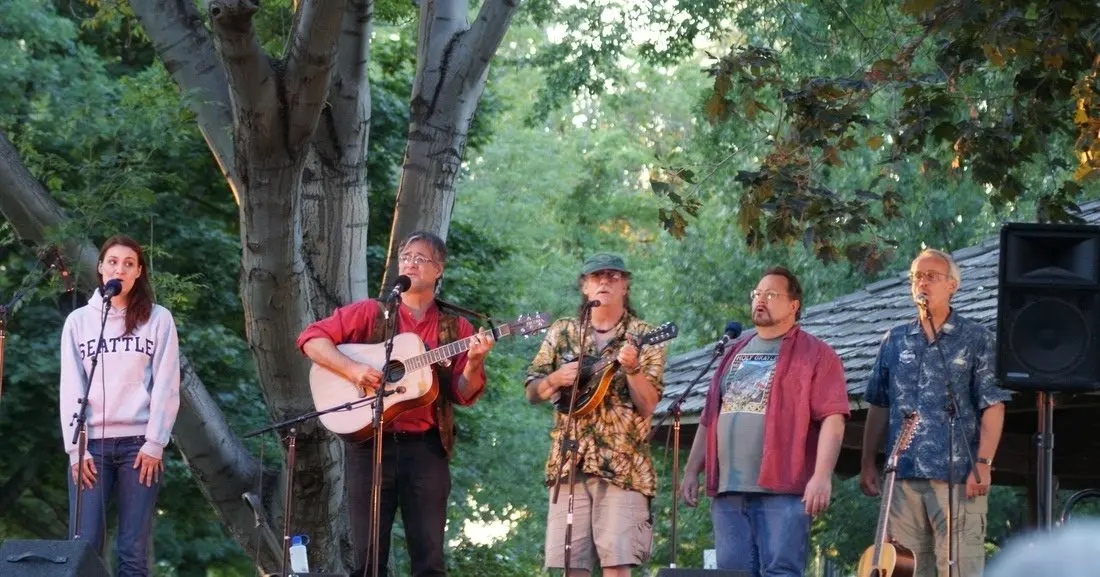
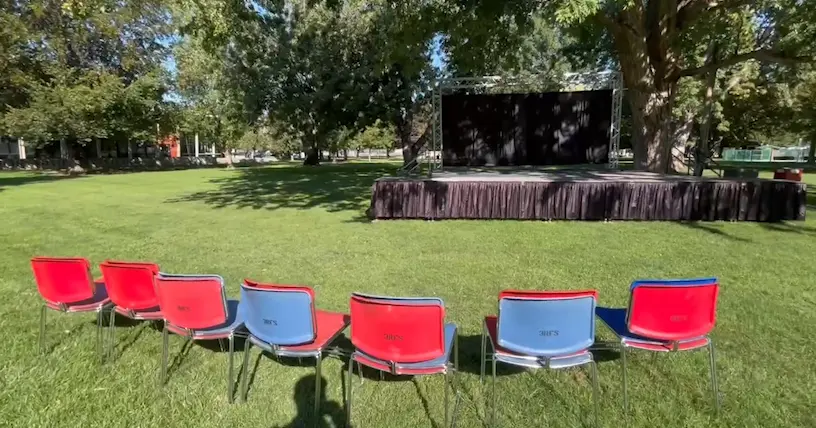
On Labor Day weekend the Tumbleweed Music Festival spreads through Howard Amon Park, on the bank of the Columbia River in Richland, just off Interstate 182. From 11 a.m. to 6 p.m. on Saturday and Sunday, a new performance or workshop begins every 45 minutes on each of four outdoor stages, two indoor stages, and two workshop rooms. At 2:00 p.m. one stage turns into an open-mic stage and keeps its own schedule from then on. Nearly all of it is free. The park stays open to the public through the weekend, and picnickers go about their holiday with the music behind them.
Stages along the Columbia
The stages carry names. Among them are the Dan Maher North Stage, the Jim Honeyman South Stage, the West Stage, the River Stage, the Art Gallery Stage, and a stage in the Richland Community Center, which adjoins the park. The festival describes its music as many kinds of acoustic music, “primarily folk, blues, bluegrass, etc.,” and Visit Tri-Cities adds sea chanteys and Celtic music. Micki Perry, one of the festival’s founders, has defined folk music as “a huge umbrella that embraces blues to bluegrass, Celtic to old-time, and singer-songwriters writing their own stuff.”
The 2026 festival was the thirtieth, held September 4 to 6. On Saturday afternoon Peter Rothbart and Kristin Clarke played the Jim Honeyman South Stage, Sue Schnitzer played the West Stage, and Helen Gilbert played the Community Center Stage. Schnitzer also taught a Sunday ukulele workshop titled “Beginner (Not for Beginners Only) Ukulele.” On the River Stage, Matthew Snare, from Georgia, played a guitar and dulcimer that, according to the festival’s own post, he “built ... in front of the stage.” On Sunday the North Stage carried Wes Weddell, Tom Rawson, Spanaway Bay, the shantywoman Aubrey Gallegos, and Strikes A Bell. Hammers and Strings and Kirk Miller played into the evening on the Art Gallery Stage. For the first time, the festival livestreamed the Dan Maher North Stage in 2026.
The weekend opens on Friday evening, at 6 p.m. in 2026, with a free “Alternative Folk” concert. The festival says the concert presents “(euphemistically) ‘higher energy’” performers playing kinds of acoustic music its regular audience may not be used to. In 2026 the festival called it the “Expanding Horizons” concert, and Sasha Mae and Vic Williamson and The Generations took the North Stage. In 2019 Micki Perry explained the Friday show: “It’s why we started having Friday night concerts about four years ago.” She said it then as organizers were trying to draw a younger crowd. That same year she said students from the Tri-Tech Skills Center ran the open-mic stage, handled sound and emcee work, and helped in the kitchen.
A Richland real-estate blog describes the rest of the scene. Visitors bring a lawn chair or blanket to the grass, and food and craft vendors set up along the paths. Several hours each day go to music and storytelling for children. Inside the air-conditioned Community Center there are dance performances and dance lessons. The blog’s author, Colleen Lane, wrote that her family could not go to the festival without getting a few Philly cheesesteak sandwiches from one of the food vendors to share.
The sources disagree on the size of the crowd. The festival’s history estimates more than 4,000 attendees per year. A 2019 article in the Tri-Cities Area Journal of Business gave an estimate of 4,000 per day. In 2026 Apple Valley News Now reported about 4,000 people through the park over the weekend. David Carson, a volunteer since about 2003 and the festival’s coordinator in 2019 and 2026, put it this way in 2019: “If you come to Tumbleweed, you’re sure to find some music that you will love and not know you needed in your life.”
Saturday night on the North Stage
Each year has a theme. The theme for 2026 was “Tumbleweed – Thirty Years By The River,” and it set the year’s logo, the Sunday “Theme Concert,” and the Jane Titland Memorial Songwriting Contest. Songwriters submit songs on the theme, and ten finalists perform them on Saturday afternoon before an audience and a panel of judges. The 2026 finalists’ songs included “Green Bull Frogs” by Teale Love, “Labor Day Weekend” by Mike Votava, “Tumbleweed Troubadors” by Kay Miracle, and “Roll On, Tumbleweed, Roll On” by Michael “Hawkeye” Herman.
The results came that evening, between the first and second headliners of the Saturday benefit concert. The benefit begins at 7:00 p.m. on the Dan Maher North Stage, and it and the Sunday contra dance are the only ticketed events. Tickets cost $15 in 2026, sold at the info booths and by roving sellers, “folks in aprons carrying a sign.” Rob Pratt took second place with “30 Years,” and David Pablo Cohn took third with “The River Again.” Arbielle, Rachel Jumago, won both first place and the audience’s People’s Choice for her song “Tumbleweed,” and then sang it from the stage.
The 2026 headliners were the duo Reggie Garrett and Christine Gunn; Great Aunt, the Australian duo of Megan Bird and Chelsea Allen, named Folk Alliance Australia’s Duo of the Year in 2024; and the Whateverly Brothers. The Whateverly Brothers, Dan Roberts and Chris Glanister, began as a maritime music group and were joined that year by Bill Murlin. The headliners, the contra band, and the caller are the only paid performers. Everyone else gets a travel stipend based on distance, which tops out at $150.
The festival closes with the Sunday evening contra dance. In 2026 the music came from Def Sturgeon, a group of Tri-Cities musicians who play Appalachian-style old-time fiddle tunes. They had played together for almost five years. Their name joins the rock band Def Leppard with the fiddle tune “Jeff Sturgeon.” During the Sunday evening concert, the raffle drawings were held. A Cort guitar went to Chris Pinney of Walla Walla. A quilt went to Kip McGilliard of Richland. Micki Perry had made the quilt for the thirtieth festival. It was nine feet tall and carried all thirty of the festival’s logo T-shirts.
From the Hudson Valley to Howard Amon Park
John and Micki Perry came to the Tri-Cities in 1976 from the Hudson Valley of New York. The Journal of Business names Beacon as their town, and says John, who worked in the nuclear field, took a job with the Washington Public Power Supply System. In New York the Perrys had been close friends of Pete and Toshi Seeger and active in the Hudson River Sloop Clearwater, the campaign to clean up the heavily polluted Hudson River. The Seegers and the Clearwater organization started an annual environmental music festival, later called the Great Hudson River Revival. The festival’s history dates its start to 1976, and the Journal gives 1966. “It was such a magical time to get to know someone that we had always admired and looked up to and whose music we loved,” Micki Perry said in 2019.
In the 1980s an organization called SunFest staged summer events at Howard Amon Park. The Perrys helped produce several of them, including an International Festival, a Children’s Festival, a Chautauqua, and the first Ye Merrie Greenwood Faire. In 1987 they produced the Down River Bluegrass Festival with help from Jim Honeyman, “who knew much more about bluegrass than they did,” in the words of the festival’s history. That first one fell on Labor Day weekend in the same park. It had folk acts on Saturday and regional bluegrass bands on Sunday, and it ended with a Sunday evening concert by The Seldom Scene. It ran two more years.
The folk society grew up around the same time. Bret Cannon had been producing contra dances, and Honeyman had been producing bluegrass concerts. The Perrys opened for a Dan Maher concert produced by Patty Stratton, and a brunch afterward brought together people who wanted a folk society. Crystal Midnight, the sound company from that concert, gave $150 as start-up money. The festival’s history says an informal group had begun to form by 1987. The society’s own site gives 1988 as its founding, and the Journal credits the Perrys with founding it that year. The first two concerts of the Three Rivers Folklife Society featured Utah Phillips and John Gorka. Monthly concerts, contra dances, coffeehouses, and a newsletter, Folk Talk, followed. Under Mark Horn the society gained Washington nonprofit status in 1990 and federal status in 1991. By the late 1990s it was holding two concerts a month.
In 1997 the society started a festival of its own. It wanted a place for the regional performers its audiences had come to know, and SunFest had gone bankrupt, by the society’s account “due to over-extension of promises to some of the national acts they booked.” The founders took three lessons from that failure, modeled partly on Seattle’s Northwest Folklife Festival: book regional acts who can play for nominal travel costs, rely on community sponsors including the City of Richland, and staff the festival with volunteers. The steering committee was John and Micki Perry, Perry and Liz Campbell, Dave Oestreich, Theresa Grate, Gary White, Harry Babad, Jim Mock, Robin Hill, Mickie Chamness, Frank Cuta, and Robert Phillips. Janet Humphrey chaired the festival for its first three years. For the tenth anniversary, Teresa Grate designed the tumbleweed logo the festival still uses between yearly designs. Hank Cramer III has played since the first festival and has called it “…the best folk festival in the country.” The festival puts its yearly cost at about $35,000.
Wind, Silver Linings, and a lull in 2021
The 2019 festival honored Pete Seeger in what would have been his hundredth year, with the theme “Power of Song.” Its workshops included “For Pete’s Sake: Singalong” and “Pete Seeger Kids Songs.” In May 2020, with COVID-19 spreading, the planning committee had to choose between canceling the 24th festival and holding it online on Labor Day weekend. It chose the virtual festival, under the theme “Wind.” Performers the organizers called “wild-caught” asked to join. They included bands from the Northwest, a performer from Indiana, and two bands from Ireland. Tom Lewis, a longtime Tumbleweed regular then living in Ireland, also played a set. The organizers wrote that they were “tempted to begin calling ourselves the ‘Tumbleweed International Music Festival!’”
The 2021 festival, the silver anniversary, was themed “Silver Linings” and stayed virtual. It grew to more than 100 performances, with acts from Ireland, Scotland, England, Canada, and Germany. During a lull in the Tri-Cities’ COVID rates, the organizers put on one live concert in Howard Amon Park. Badger Mountain Dry Band, Cecilia Eng, and Hank Cramer III and Friends played to an audience that reached more than 300, and Tom Reitter filmed it. The next year the festival returned to the park. The organizers chose “Dear Friends” as the 2022 theme.
Notable Events
- 1987The informal group that became the Three Rivers Folklife Society began to form. tumbleweedfest.com
- 1990Under Mark Horn, the society obtained Washington nonprofit status in 1990 and federal nonprofit status in 1991. tumbleweedfest.com
- 1997The Tumbleweed Music Festival began. tricitiesbusinessnews.com
- 2019The festival honored Pete Seeger in what would have been his 100th year with the theme Power of Song. tumbleweedfest.com
- 2020The planning committee chose to hold the 24th annual festival virtually over Labor Day weekend rather than cancel it. tumbleweedfest.com
- 2021Tumbleweed remained virtual-only and grew to more than 100 performances from six countries. tumbleweedfest.com
- 2022The festival returned to a live event in the park. tumbleweedfest.com
- 2026The festival marked three decades at Howard Amon Park and had grown from a small gathering into a regional event drawing thousands. applevalleynewsnow.com
- 2026The festival returned over Labor Day weekend for its 30th year. nbcrightnow.com
People
- David Carson, event coordinator (2026).
- John Perry, founding steering committee member (1997).
- Micki Perry, founding steering committee member (1997).
- Janet Humphrey, Tumbleweed chair for the first three years.
- Teresa Grate, designer of the generic Tumbleweed logo for the 10th anniversary (10th anniversary).