Trinity River Hatchery
Lewiston, Trinity County, California. Hatchery.
Details

- Where
- 1000 Hatchery Road, Lewiston, CA 96052. Directions
- When
- Open 8:00 a.m. to 3:00 p.m. daily.
- Getting there
- Off Highway 299, go toward the town of Lewiston. Take Trinity Dam Blvd through the town of Lewiston heading north. Make a right hand turn onto Hatchery Road and continue to hatchery grounds.
- Access
- An underwater viewing window allows visitors to watch migrating fish.
- Phone
- (530) 778-3931
- Website
- wildlife.ca.gov
- Managed by
- California Department of Fish and Wildlife.
- Established
- 1963.
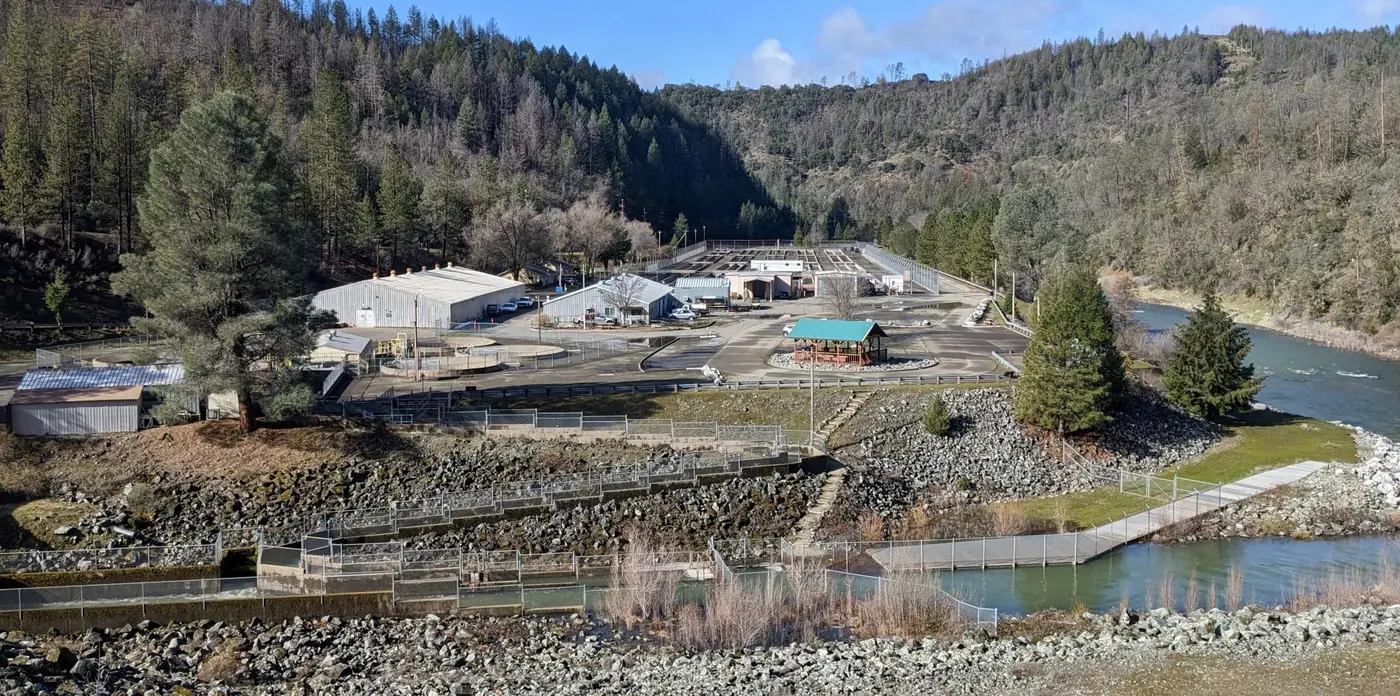
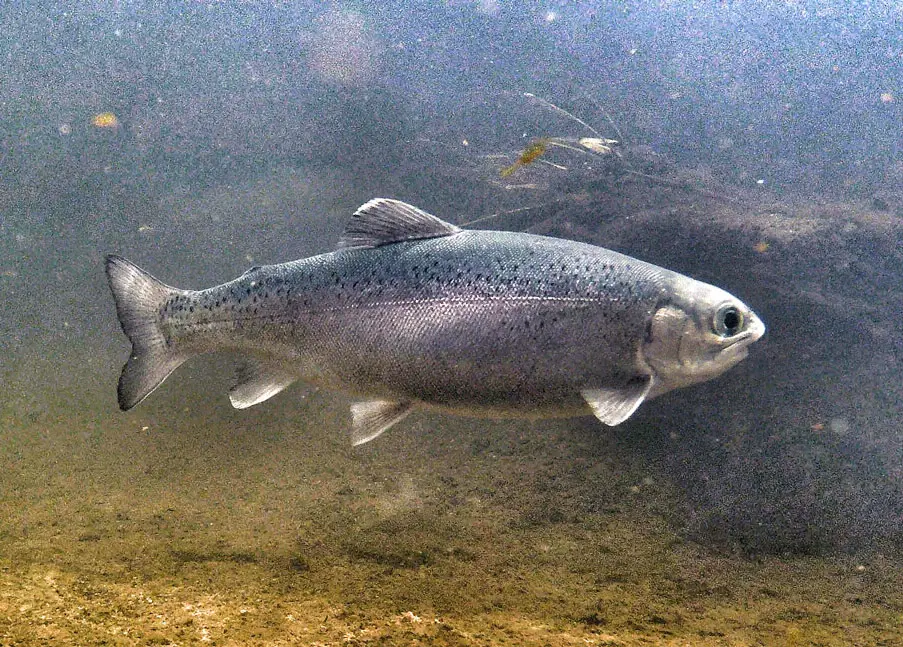
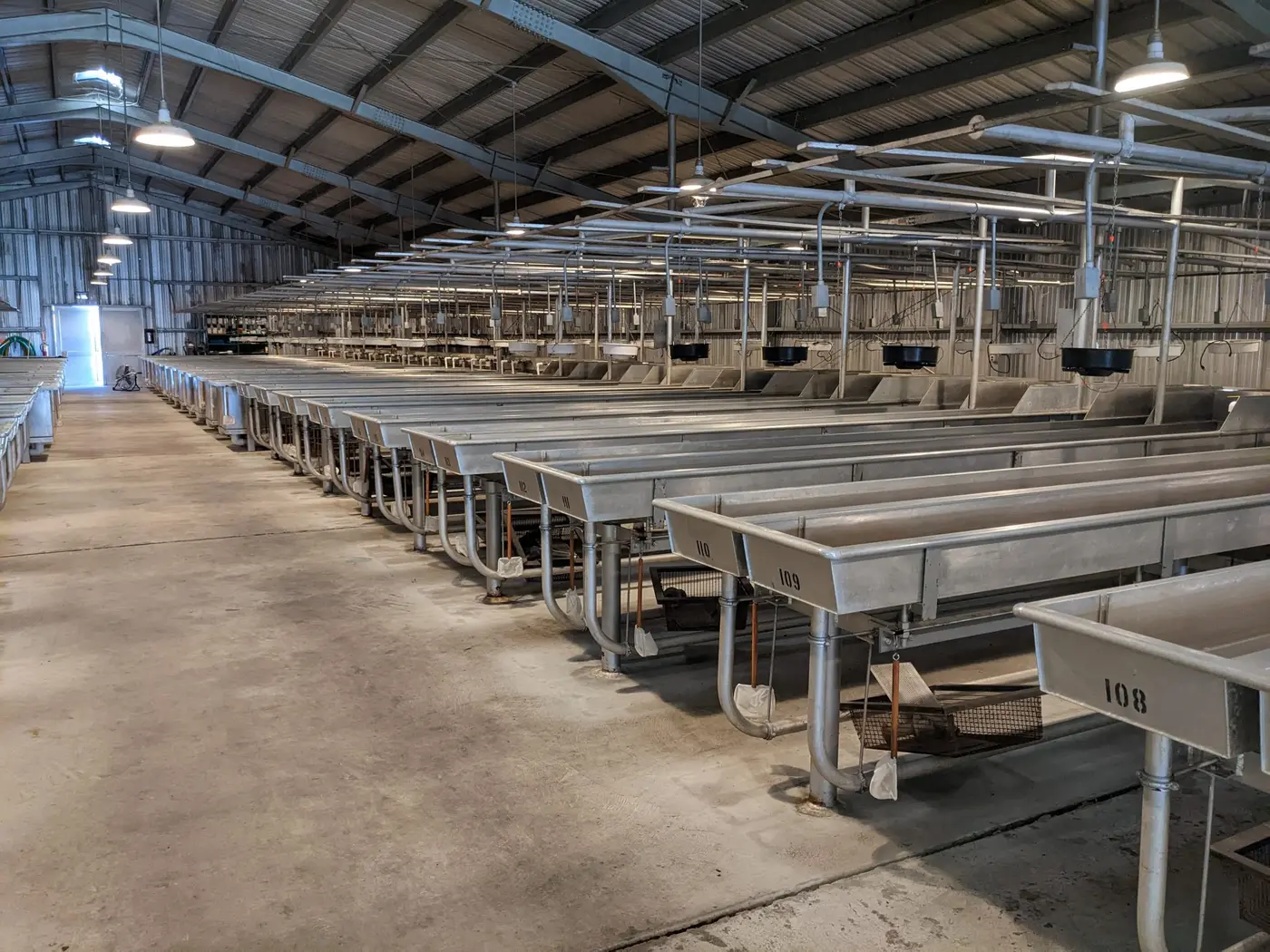
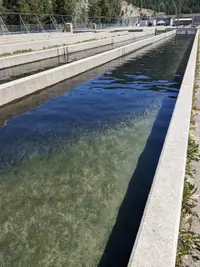
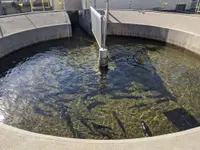
At the end of Hatchery Road, north of the town of Lewiston, the Trinity River leaves Lewiston Dam and runs past a set of ponds, raceways, and low buildings. An underwater viewing window lets visitors watch the migrating fish. The hatchery stands at river mile 110, at the base of the dam, which is now the upstream limit for salmon and steelhead on the Trinity.
The ladder and the spawning days
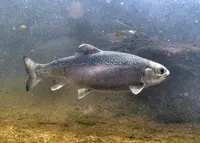
The fish ladder operates from the first week in September through the second week of March. Spring-run Chinook reach the upper river between the middle of May and the first part of July. The hatchery keeps its ladder shut until after Labor Day, because the fish hold better in the large deep pool below Lewiston Dam than in the holding ponds. Fall-run Chinook enter the Klamath estuary in mid to late August and arrive at the hatchery in early October. Coho appear about mid-October and spawn through December. Steelhead come from about the first of November through March, and after spawning they are returned to the river.
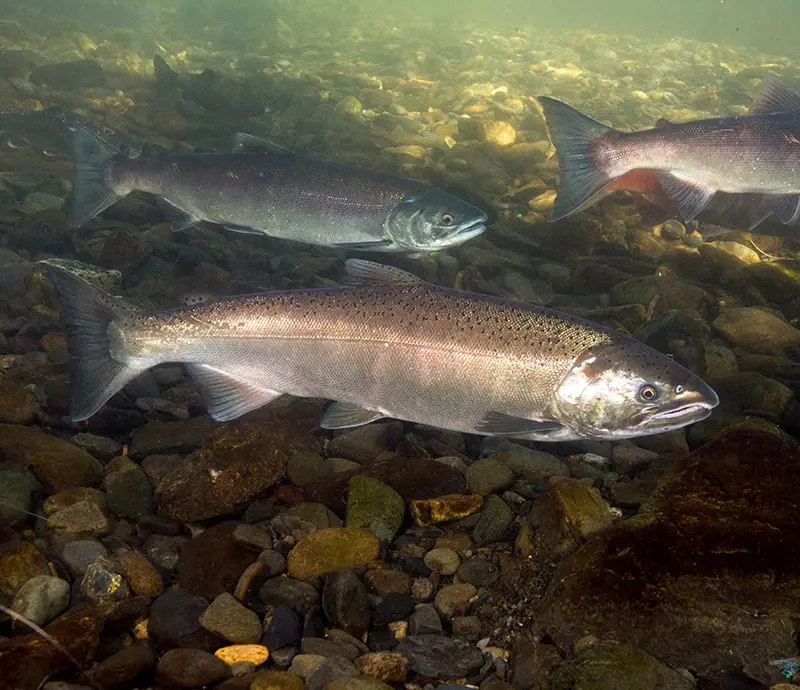
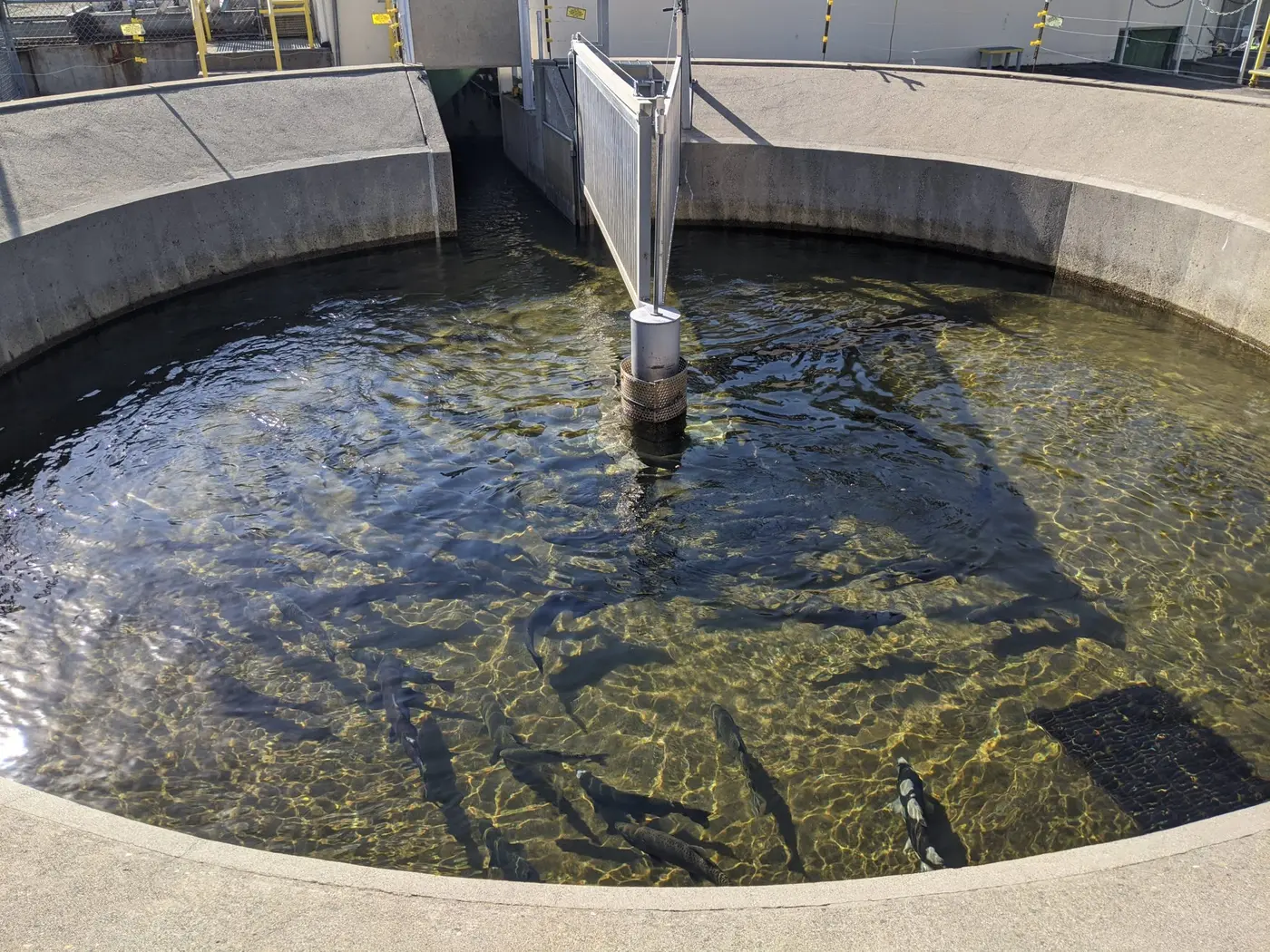
Salmon are spawned on Mondays and Thursdays from the first week of September through the second week of December. Steelhead are spawned on Tuesdays from the last week of December through the second week of March. The California Department of Fish and Wildlife, which runs the hatchery, tells visitors to arrive early. Work starts around 7:30 a.m., and if few fish are in the trap it may end before noon. A December 2019 photograph shows hatchery worker Steve Strite setting aside a coho salmon to be spawned later. California prohibits recreational angling for coho. The surest way to identify one is the black jaw with white or grey gums.
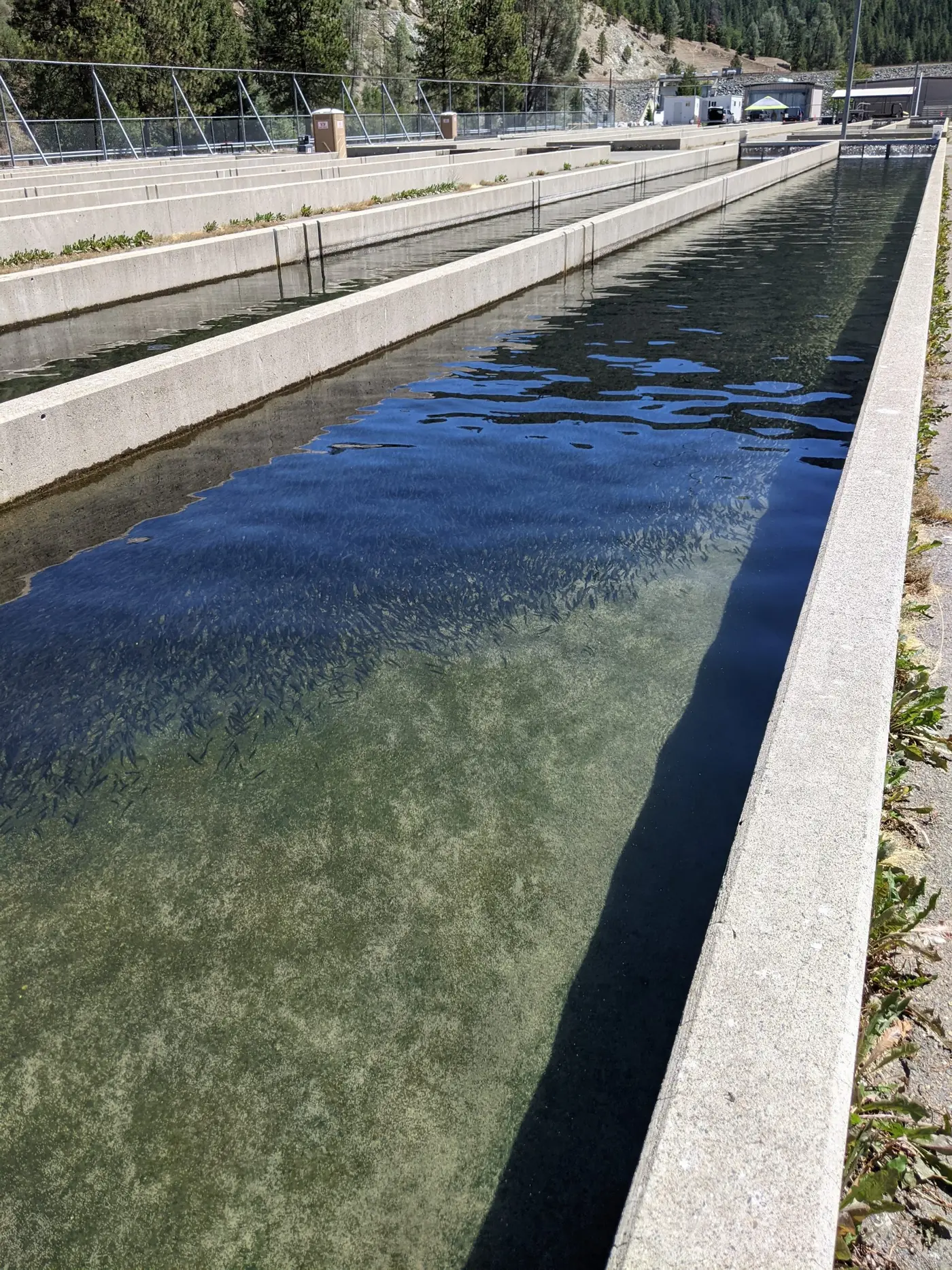
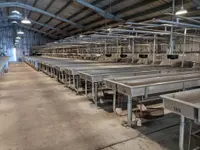
Fertilized eggs incubate for about 50 to 60 days, depending on water temperature. When the young fish are ready to eat, they go to troughs or to the juvenile raceways. Once reared, they are released into the Trinity and migrate to the ocean. The annual goal is about 5 million juveniles: spring-run and fall-run Chinook, steelhead, and the federally threatened coho. These fish support tribal, recreational, and commercial fisheries on the Trinity, the Klamath, and the Pacific.
The U.S. Bureau of Reclamation owns the hatchery and its land and has paid the state to operate it since 1963. The Hoopa Valley and Yurok Tribes also support the work. Reclamation counts thousands of local visitors, school groups, and tourists each year.
A weir, a truck, and an escalator
The hatchery exists because of the dams above it. Congress authorized the Trinity River Division of the Central Valley Project in August 1955 to send a substantial part of the river’s flow to the Central Valley. Lewiston Dam, completed in 1963, blocked 109 miles of salmon and trout spawning and rearing habitat. In 1956, federal and state biologists had estimated how many fish passed above the dam site: 5,000 coho, 3,000 spring Chinook, 8,000 summer Chinook, 24,000 fall Chinook, and 10,000 steelhead.
While Trinity Dam was under construction, the fish were carried around it. On September 29, 1958, the Lewiston Fish Trapping Facilities began trapping in a narrow, rocky stretch about a mile below the planned Lewiston Dam. Reclamation had built the facility, and the California Department of Fish and Game ran it under contract.
The trapping worked in stages:
- A concrete weir stopped all upstream migration, and a ladder led the fish into a 70-foot holding tank.
- An engine-powered sweep crowded the fish to the upper end of the tank. There they could jump through an artificial waterfall into a smaller tank, and the sweep lifted over those that did not jump.
- The second tank held the anesthetic quinaldine. After about five minutes, the fish rode an escalator into a tank truck.
- The truck hauled them 12 miles to the mouth of the Stuart Fork, about a mile above the dam works.
The department reported that the fish were normally active when released.
The permanent hatchery cost more than first planned. In January 1960 the project budget included $321,286 for it, and by September 1961 the figure had risen to $1.2 million. An interim hatchery lost large numbers of eggs and small fish in 1961 and 1962, mainly to high water temperatures. Reclamation finished the permanent plant at the base of Lewiston Dam on May 15, 1963. The Department of Fish and Game’s annual report says the state began operating it that day. The attorney Dane Durham, in his history How the Trinity River Lost Its Water, dates the turnover to the department to June 15, 1963.
White spot and the first run
The first season began with heavy losses. Just before the opening, white-spot disease killed the fry from more than 90 percent of the 1962–63 steelhead egg take. Water analysis showed heavy metals building up as water passed through the hatchery, and zinc and copper were suspected. In January 1964 white spot struck the king salmon eggs as well. The department never determined the cause.
The salmon arrived anyway. The ladder around the old trapping weir was finished on September 27, 1963, and king salmon began entering on September 30. When the run ended on November 29, 6,735 had been trapped, 2,539 of them grilse. A few brown trout came in with them, very silvery and resembling sea-run fish. D. P. Borgeson of the department’s Sacramento Field Station read scales from eight females. He found that five appeared to have spent two to three years in the ocean, though he suggested the growth could have been acquired in the very fertile Klamath.
The native coho did not survive. A few hundred had been trapped for the first fish-cultural work during dam construction, and water quality problems and disease killed them. The hatchery’s coho stock was instead founded on eggs from Cascade Hatchery in the Columbia basin and from the Eel and Noyo rivers. Steelhead returns ran very low, so eggs were imported from the Eel River, three Oregon hatcheries, and Skamania Hatchery in Washington. Many of the young steelhead released never migrated to the ocean.
The hatchery adjusted its program over the next decade:
- In 1964 it began marking fish to learn the best size, time, and place for release.
- In 1967 it began raising steelhead to maturity at the hatchery, producing about a million eggs a year.
- In 1971, after poor results from the imported strains, it stopped importing coho.
The 1968–69 operating budget was $204,000, and that year every fish was reared on Oregon Moist Pellet.
A coffin in Weaverville
Below the dam, the river was declining. With nearly 90 percent of the natural runoff diverted, winter storms no longer flushed out silt and sand from the tributaries, which buried spawning areas and filled resting pools. A 1982 speech to the Klamath-Trinity River Salmon Restoration Advisory Committee in Eureka describes a protest from about 1969. A conservation class at Weaverville High School, taught by Roger Hardison, put up a sign and held a mock funeral for the “Dead Trinity River.” The sign read: “Entering the home of the Trinity River, studied to death, ruined through neglect and mismanagement by the Bureau of Reclamation.” A coffin holding dead fish and silt was buried at the site, and members of the class went to Washington, D.C., to plead for help.
The same speech said the hatchery’s early problems with disease, diet, and cold water had been “pretty well worked out.” It also noted that all the raceways were still earth rather than concrete-lined, and it estimated modernization at about $3 million.
The following decades brought these events:
- 1973: More than 900,000 spring Chinook juveniles from the hatchery were planted in the South Fork Trinity at Forest Glen to restore a run devastated by the 1964 flood. This seems to have led to larger returns in 1976.
- 1980: Annual adult production goals, catch plus escapement, were set at 7,500 coho, 6,000 spring Chinook, 70,000 fall Chinook, and 22,000 steelhead.
- Late 1980s: According to Bill Wingfield, the IHN virus killed one to two million juvenile Chinook each year. The cold water drawn from deep behind Lewiston Dam likely made the disease worse.
- Summer 1992: The chairpersons of the Klamath River Task Force, the Klamath Fisheries Management Council, and the Trinity River Task Force requested a production review. The state agreed to release only the fish required for mitigation.
- 1997: The hatchery’s coho program was classified as threatened, along with the naturally spawning coho of the southern Oregon and northern California coast.
Sinkholes and a rebuilt plant
In June 2023, Reclamation fish biologist Derek Rupert wrote that after 60 years of continual use the hatchery’s infrastructure had worn out. He listed broken valves that could not be shut, limited space for holding adult fish, and sink holes. A 2022 review put the cost of the preferred repairs at $65.9 million. In early 2023, officials announced that the Bipartisan Infrastructure Law would fund the work, including the water intake, water treatment and distribution, the hatchery building, adult holding ponds, the spawning building, and offices. Representative Jared Huffman announced the award, and CDFW director Charlton H. Bonham said the modernization would dramatically improve operations. Rupert expected the project to take several years.
The aging plant has also failed in service. State and federal officials said that on a November 7 a trash rack collapsed and blocked most of the water supply. The hatchery had to release hundreds of thousands of juvenile fish and thousands of adult salmon on an emergency basis. Rupert first disclosed the incident publicly on December 10, at a quarterly meeting of the Trinity Management Council, describing it as a rare and serious operational emergency. CDFW information officer Peter Tira said he had initially been unaware of it.
Since 2022, researchers have tested remote site incubation under the re-colonization phase of the hatchery’s management plan, which focuses on reintroducing salmon to restored habitat. Zac Reinstein, a Yurok Tribe fisheries biologist, has presented the tribe’s work on coho supplementation in Trinity River tributaries.
Notable Events
- 1958The Lewiston Fish Trapping Facilities, built by the U.S. Bureau of Reclamation and operated under contract by the California Department of Fish and Game, trapped salmon and steelhead and trucked them above the Trinity Dam site until the hatchery became operative. nrm.dfg.ca.gov
- 1960It was announced that the budget for completion of the project included $321,286 for construction of a permanent fish hatchery. waterboards.ca.gov
- 1961The interim hatchery lost significant numbers of eggs and small fish due primarily to high water temperatures. waterboards.ca.gov
- 1961The construction budget figure increased to $1.2 million. waterboards.ca.gov
- 1963The fish ladder constructed to pass fish around the weir at the former Lewiston Trapping Facilities was completed on September 27. nrm.dfg.ca.gov
- 1963An outbreak of white spot caused an almost complete loss of steelhead trout fry shortly after the hatchery began operation; mortalities dropped to normal after the fry stage. nrm.dfg.ca.gov
- 1963The California Department of Fish and Game began operation of the permanent installation on May 15, 1963, with operation and maintenance funds supplied by the Bureau of Reclamation. nrm.dfg.ca.gov
- 1963King salmon started entering the hatchery on September 30, 1963. nrm.dfg.ca.gov
- 1963The USBR turned the hatchery over to the CDFG. waterboards.ca.gov
- 1963Lewiston Dam became the upstream limit of anadromy, blocking access to 109 miles of salmon and trout spawning and rearing habitat. wildlife.ca.gov
- 1964A marking program was initiated at Trinity River Hatchery to help determine planting size, release timing and release location for maximum catch plus return of spawners. nrm.dfg.ca.gov
- 1967The hatchery began raising enough steelhead from each brood year to maturity to produce about 1 million eggs annually, spawned at the hatchery. waterboards.ca.gov
- 1971Because of poor results from releases of exotic coho strains from the Eel, Cascade and Noyo Rivers, the hatchery stopped importing coho. waterboards.ca.gov
- 1971The hatchery had another white-spot outbreak in winter 1971-72, among other diet, predation and growth problems. waterboards.ca.gov
- 1973Over 900,000 spring chinook juveniles were transplanted at Forest Glen in an attempt to restore the run devastated by the 1964 flood; this seems to have led to increased returns in 1976. krisweb.com
- 1980sOne to two million juvenile chinook salmon were lost annually due to IHN, according to Bill Wingfield's personal communication. krisweb.com
- 1980Total annual adult production goals, catch plus escapement, were further defined as 7,500 coho, 6,000 spring Chinook, 70,000 fall Chinook and 22,000 steelhead. wildlife.ca.gov
- 1983Escapement goals were further defined as 2,100 coho, 3,000 spring Chinook, 9,000 fall Chinook and 10,000 steelhead. wildlife.ca.gov
- 1992Chairpersons of the Klamath River Task Force, Klamath Fisheries Management Council and Trinity River Task Force requested a production review at Iron Gate and Trinity River hatcheries. krisweb.com
- 1997The Southern Oregon / Northern California Coasts coho salmon ESU, including the Trinity River Hatchery coho program, was classified under the ESA as threatened. wildlife.ca.gov
- 2022The research aligns with the re-colonization phase in the Biological Opinion for the Trinity River Hatchery Management Plan, focused on reintroducing salmon to restored habitats. trinityjournal.com
- 2023In early 2023 it was announced that the Bipartisan Infrastructure Law would provide funding to modernize the Trinity River Hatchery. trrp.net
- The incident was disclosed publicly for the first time at the Trinity Management Council quarterly meeting, when Derek Rupert briefed council members on what he described as a rare and serious operational emergency. trinityjournal.com
- According to state and federal officials, a sudden infrastructure failure forced emergency release of hundreds of thousands of juvenile fish and thousands of adult salmon after a trash rack collapsed and blocked most of the water supply. trinityjournal.com
People
- Charlton H. Bonham, California Department of Fish and Wildlife director who said modernization would dramatically improve operations at the hatchery.
- Jared Huffman, Representative who announced the hatchery modernization and repair award.
- President Joe Biden, President whose modernization investment was thanked by the CDFW director.
- Foott, Investigated hatchery disease problems and noted that disease may be influencing smolt survival in several Trinity River stocks (1991).
- D. P. Borgeson, Read scale samples and suggested that apparent ocean-type growth could have been acquired in the very fertile Klamath River.
- Derek Rupert, Bureau of Reclamation Northern California Area Office fish biologist who briefed the Trinity Management Council about the hatchery emergency.
- Peter Tira, CDFW Information Officer contacted about the hatchery failure; said he was initially unaware of it.
- Steve Strite, Trinity River Hatchery worker shown setting aside a coho salmon to be spawned later (December 2019).
- Zac Reinstein, Yurok Tribe fisheries biologist presenting coho salmon supplementation in Trinity River tributaries (past two and a half years as Yurok Tribe fisheries biologist; about 11 years working with California Salmon Recovery).