
Trinity County Fair
Hayfork, Trinity County, California. County fair.
Details

- Where
- 6000 Highway 3, Hayfork, CA. Directions
- When
- July 22-25, 2027.
- Fees
- Free gate admission; $20.00 amusement wristbands.
- Hours
- Office hours Monday-Thursday 10:00am-3:00pm; Friday by appointment; Saturday and Sunday closed.
- Access
- Food & Drinks Available; Onsite Parking; Family Friendly Events.
- Walk-in or reserve
- Camping is available at the fairgrounds by reservation.
- Phone
- (530) 628-5223
- Website
- trinitycountyfair.com
- Established
- 1921.
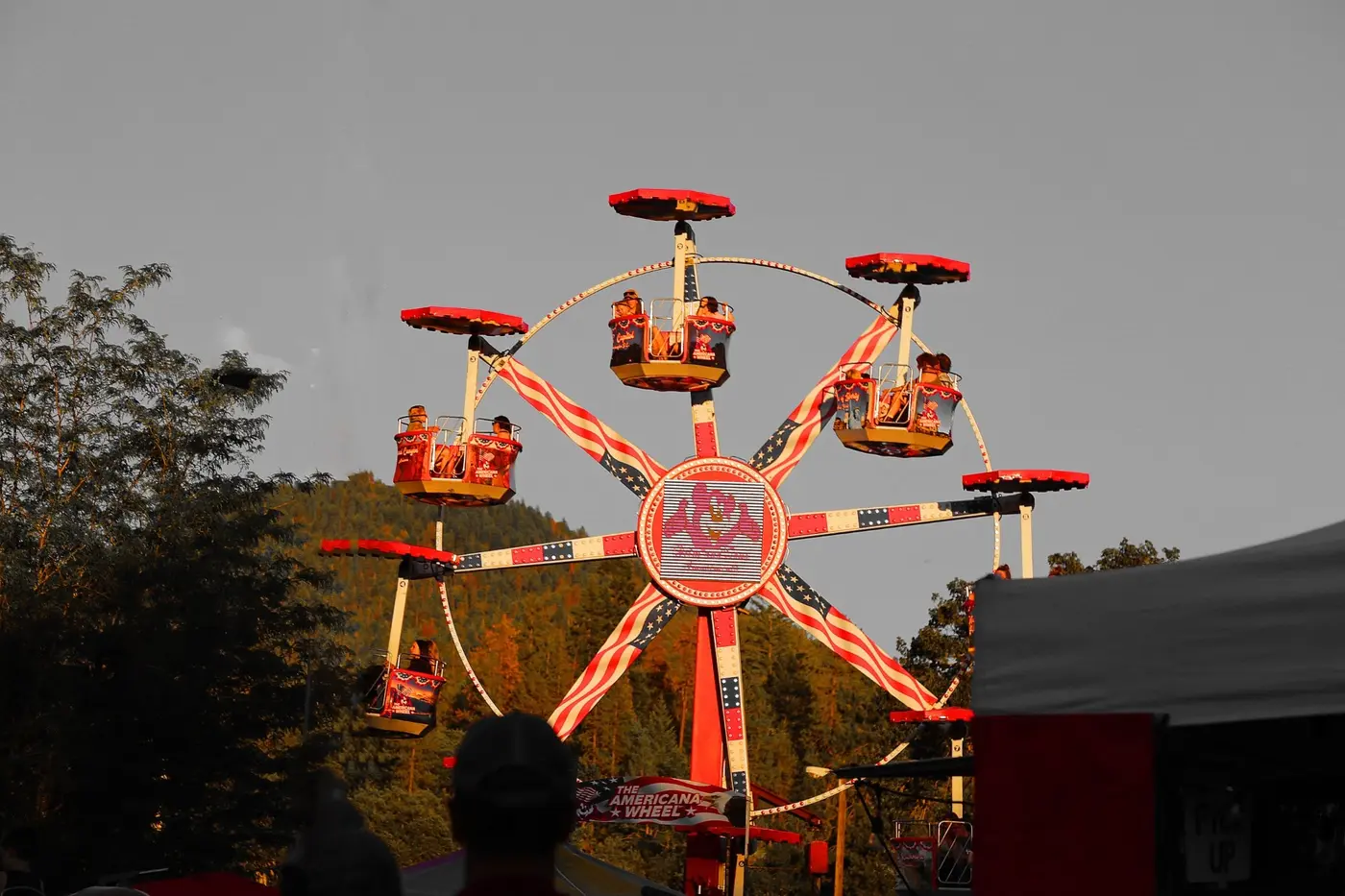
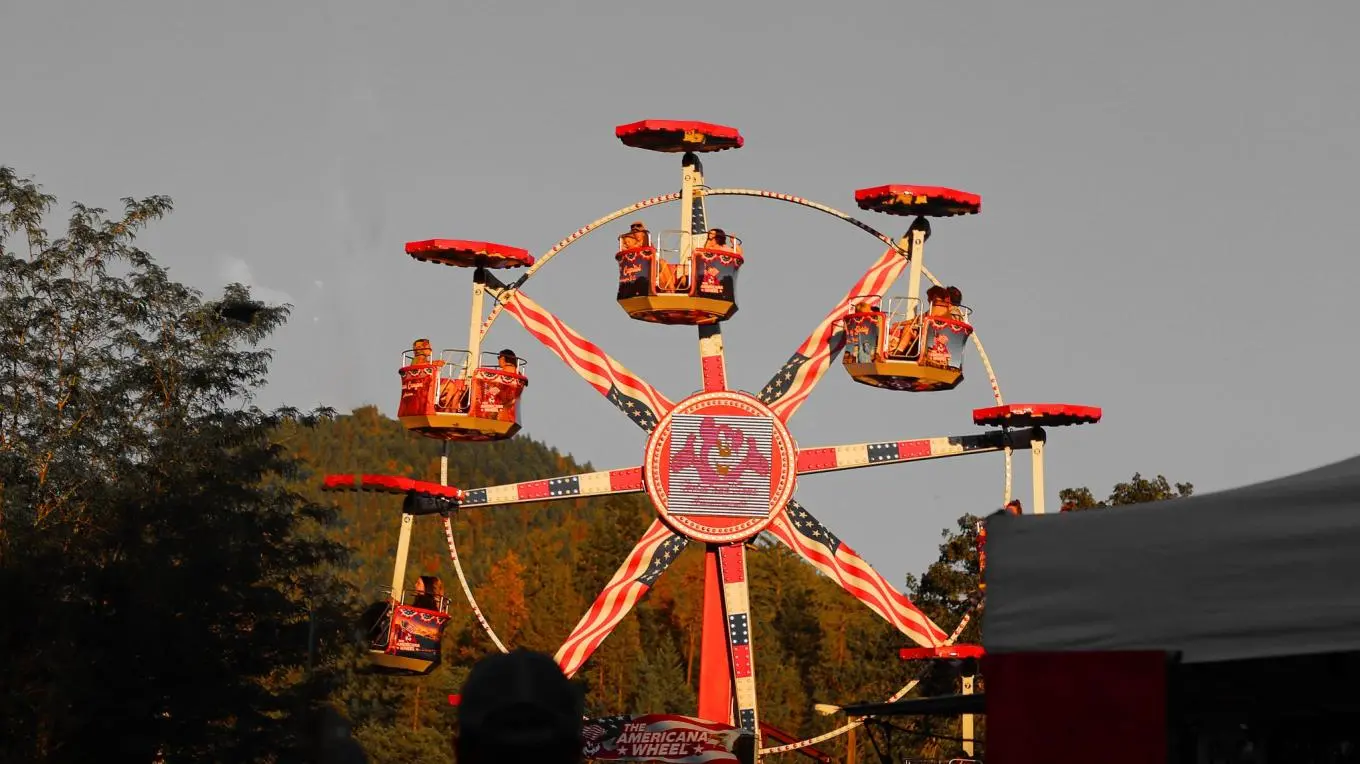
On the Thursday evening of the 2026 Trinity County Fair the parade stepped off at 6 o’clock and went through downtown Hayfork. Afterward the crowd returned to the fairgrounds at 6000 Highway 3 for the Annual Fair Pie and Quilt auction on the fair lawn stage. Admission at the gate was free, and a $20 wristband covered the amusements. The fair’s own notice that weekend offered horse events and “good fair eats.” The state’s fair calendar lists the 2026 fair as July 9 through 12. The Trinity Journal gave the dates as July 8 to 12.
Inside the Exhibit Hall the still exhibits were set out for viewing: baked goods, quilts, woodwork, art, textiles, flowers and produce. The Journal describes the fair as a place for “challenging each other to bake the best blackberry pie, display the best collection, showcase the biggest blooms.” In the livestock barns the junior livestock show ran all week. Trinity County school children showed the animals they had raised as agribusiness projects, and visitors could walk through and watch the showmanship classes. The Junior Livestock Auction was held Saturday, July 11, at 10 a.m. The date was fixed only after a printing error in the buyers’ book was corrected.
Mutton bustin’, log rolling, and the derby
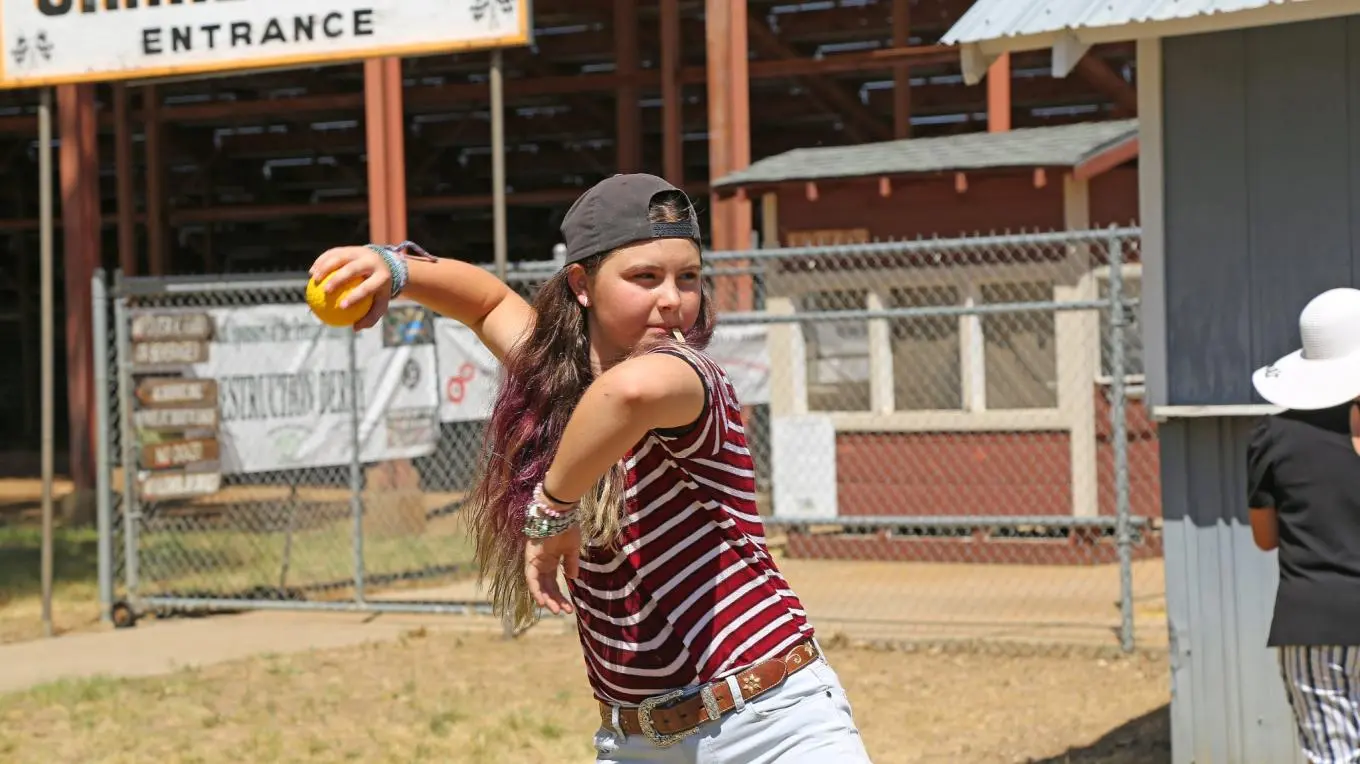
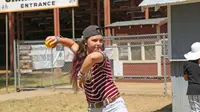
The program ran from early morning into the night. The Homestead, a shaded gathering spot with historic exhibits and a theatre, served hot breakfasts each morning of the fair. The Rotary held its watermelon eating contest on July 10 at 4 p.m. Parents and grandparents cheered the children’s stick horse races and the contest for the titles of Little Mr. and Little Miss Trinity. Trinity Horses and Long Ears hosted the junior rodeo: mutton bustin’, mini bull riding, critter catch, boot scramble and barrel racing. These events were open to any aspiring cowgirl or cowboy, with or without experience, and the general public was encouraged to enter. There were also Texas Hold’em, cornhole and horseshoe tournaments, pinewood derby races, cowboy poetry, a talent show and live music.
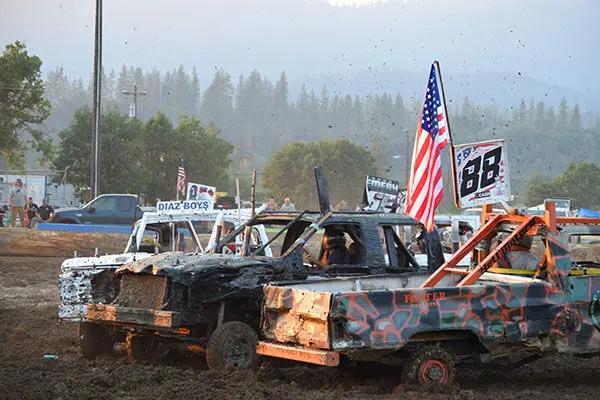
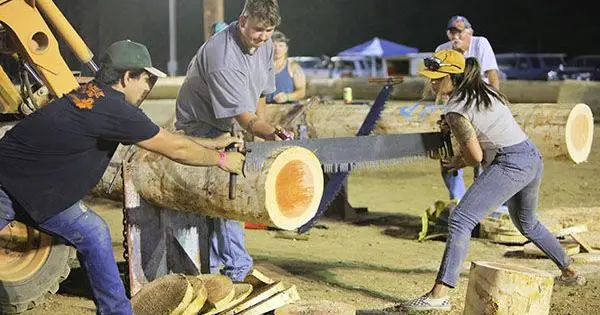
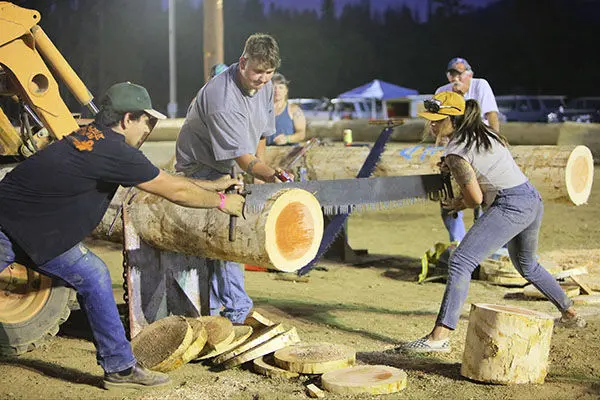
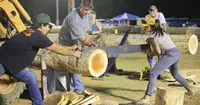
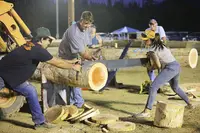
At the logging show fairgoers enter nail pounding races, log rolling over water, chainsaw events, pole climbing, bucking and ax throwing. Shawn Patton owns a logging company in Hayfork, and his family settled in the area in the late 1800s. He remembers coming to the fair as a boy, when logging crews crowded the beer stands and the chainsaw competitions. The destruction derby runs in the motorsports arena and was slated for the Saturday night of fair. Before the 2026 fair the board sold raffle tickets for the chance to drive a derby car, at $25 apiece or five for $100. It also approved Adam Garrison to direct an enduro.
The Journal reported in June 2026 that the logging show, the demolition derby and the junior livestock auction still drew large crowds. Attendance and entries in the rest of the fair, however, had dwindled over the past decade, to the point where board members had asked whether the fair could continue. The Fair and Event Center had been without a CEO for nearly a year. A mostly new board of directors went into the 2026 fair with one message for current and past residents of the county, in the Journal’s words: “the Trinity County Fair is your fair.” Camping is available on the grounds by reservation, with showers and laundry.
A booth from one ranch at Anderson
The fair’s own compiled history begins with mining. Trinity County’s early days turned on gold, it says, and fairs grow out of agriculture, so interest in a county fair came long after the gold rush. Between 1910 and 1919 the idea was discussed “somewhat indifferently.” The consensus seemed to be that there was nothing in Trinity County worth exhibiting. County people sometimes went to the Shasta District Fair in Anderson, where they were eligible to enter, but none of them ever had. The answer, the history says, was always the same: Trinity County “couldn’t compete with ‘The Valley.’”
H. C. Smith, a Hayfork rancher, thought this attitude unfortunate. He had tried for years to persuade friends and neighbors to back a local fair, or at least to enter at Anderson, and had gotten nowhere. When the premium list for the 1920 Anderson Fair came out, he sent in an entry blank for a Special Feature Booth representing Trinity County. The Anderson management assumed he spoke for a group drawn from all over the county and accepted the entry. He was doing it entirely on his own. He built the booth from produce and materials grown only on his own ranch, and it won a blue ribbon. Visitors from Trinity County walked into the Anderson Fair and found their county represented and holding a first prize.
Within weeks of the close of the Anderson Fair, according to the history, the county was “buzzing with plans.” John Donald Rourke was the son of Dennis Rourke, one of the original Hayfork Valley settlers. He asked the Board of Supervisors to authorize a county fair for 1921. The request was granted on the condition that a site be found, preferably in the Hayfork Valley, the agricultural center of the county. Rourke, Harry Everest, Clarence Maxon, John Enos and John Coumbs formed a committee to find one. They rented the Hoyt Ranch, later known as the Lem Jackson place, and put up temporary structures. They also built a large gate at the ranch entrance naming it the home of the first Trinity County Fair. The committee was then appointed in toto as the first Board of Directors, with an operating budget of $200.00.
From the Hoyt Ranch to the high school grounds
The county historical society’s timeline puts the first fair at Hayfork on Sept. 20–22, 1921, with Governor Stephens as guest speaker. The history calls it a spectacular success that drew visitors from outside the county. Rented land would not serve a permanent fair, so the 1922 fair moved to county-owned land beside Highway 3. The Hayfork Valley Union Elementary School now stands on that site. Builders put up a livestock barn, a shop area, a large exhibit hall and a large arena, and later a wooden grandstand. As the single hall filled, smaller structures went up, with exhibit booths open to the outdoors. Conditions were sometimes “slightly primitive,” the history allows, but for a few days late every summer the fair was the center of activity in the county. In 1928 the parade moved to the last day of the fair. For a few years before that it had been held on Thursday morning.
By 1936 the budget had grown to several thousand dollars and become a burden on county government. The state created a Trinity County Agriculture Association and took over the budget, while the county went on running the fair, with the county auditor acting as its business manager. In 1942, with the country mobilized for war, the fair was cancelled.
The war reached Hayfork once. A marker in front of the Fair Office, erected in 1978 by E Clampus Vitus, Trinitarianus Chapter 62, records the event. On the afternoon of February 1, 1945, a Japanese paper balloon came down in a tree near the Charles Lafffranchini Ranch, 2½ miles northwest. “After time” it exploded, leaving gas valve lines, ballast, four bombs, sandbags and the bomb carriage unit. The balloon was made of paper and glue and launched into the jet stream by the Japanese Army. The marker calls such incidents “the best kept secrets of W.W. II.”
When the war ended the state disbanded several District Agricultural Associations, Trinity County’s among them. The Board of Supervisors voted to hold a 1946 county fair anyway and won state financing without reconstituting the association. The compiled history says this left Trinity County “nearly unique in the state” with a true county fair that used no county funds. At the time of writing it named Lassen as the only other fair so structured, with the money coming from the State Horse Racing Tax.
Don Berry, the first manager of the reorganized fair, moved the fairgrounds to its present site, which it then shared with Hayfork High School. Attendance was under 6,000, so the grounds could be used in summer without much disturbance to the school. Berry stayed nineteen years. Under his successor, Ron Maraviov, the fair grew from three days to four. Maraviov left in 1968 for the Yolo County Fair in Woodland. After him came Duane Foster, who stayed until June 1973, then Tom Brazil, then Max Forbes in 1975, then Len Bassham. Sam Rose arrived as head maintenance man in 1966. By the time the history was compiled, under Bassham, the budget had gone from $200 a year to $130,000 and attendance had grown from a few hundred to nearly 30,000. Among the photographs printed with it are the entrance gate at the 1921 grounds, a horse show being readied in the 1920s, and Lin Campbell with his Blue Mammoth Jack mule, “weight 900 lbs.” The history closes by restating H. C. Smith’s creed: “have something worth showing off!”
The third week of August
For more than 50 years the fair was held in the third week of August, according to the Trinity Journal’s past reporting. In the mid-2010s it began moving earlier in August, and by 2022 it had settled in mid-July. Directors gave several reasons. Carnival companies were unavailable in August. The Junior Livestock Committee strongly preferred July, though not so early that animals would miss their minimum weights. Late-August fairs had also been cancelled by wildfires, or smoked out when headlining bands backed away from the fire risk and poor air. Fair Association director Jenny Millsap explained at a town hall that July was the only time the fair could get a carnival company willing to come to Hayfork. After the 2022 fair, held a month earlier than normal, many fairgoers called it the best they had seen in years. Others blamed the July dates for the falling numbers in the agriculture, horticulture and still exhibits.
The board met again on Sept. 17, 2026. A bat flew circles over the 20-plus people in the room for the last half hour, and leaders and residents ducked beneath it. After seating new members Roger Freer and Jim Baley, the board went on with its business in hoodies and darkness. The motion on the table would have moved the fair to the first week of August in two years. The audience objected loudly, the motion was amended, and it passed unanimously. The 2027 fair had already been set for July 22 to 25. The 2028 Trinity County Fair will be held Aug. 17 to 20.
One attendee said, “I never thought we’d be able to make it happen, but now I can enter my vegetables and flowers again. I quit the fair when the dates changed because nothing was ripe yet mid-July, plus it was just too darn hot to go.”
Notable Events
- 1910During that decade the idea of a Trinity County Fair was discussed somewhat indifferently, but the consensus seemed to be that there was nothing in Trinity County worth exhibiting. nebula.wsimg.com
- 1920Using produce and materials only from his own ranch, Mr. Smith set up a Special Feature Booth representing Trinity County at Anderson; it won a blue ribbon. nebula.wsimg.com
- 1921The committee learned the Hoyt Ranch (now known as the Lem Jackson place) was available; the space was rented and temporary structures were put up. nebula.wsimg.com
- 1921The county historical society timeline puts the first Trinity County Fair in Hayfork on Sept. 20-22, 1921, with Governor Stephens as guest speaker. trinitymuseum.org
- 1922Rented land was judged inadequate for a permanent fair, so it was decided to move the fair to county-owned land and build a more permanent fairgrounds. nebula.wsimg.com
- 1922Construction began at the selected site, where the Hayfork Valley Union Elementary School now stands next to Highway 3: a livestock barn, a shop area and a large exhibit hall, plus a large arena. nebula.wsimg.com
- 1928In 1928, the current practice of having a parade the last day of the fair was instituted. nebula.wsimg.com
- 1936Because the fair budget had become a burden to county government, application was made to the state for financing; the state created a new Trinity County Agriculture Association and took over the budget. nebula.wsimg.com
- 1942With the entire country mobilized for war the fair was cancelled. nebula.wsimg.com
- 1945When the war ended the state had made District Agricultural Associations part of state government with governor-appointed boards, and several, including Trinity County's, were disbanded. nebula.wsimg.com
- 1946The Board of Supervisors voted to hold a county fair that year and obtained state financing without reconstituting the District Agricultural Association, and the history says Trinity County was then and is now nearly unique in the state in having a truly county fair that uses no county funds to operate. nebula.wsimg.com
- 1968Maraviov was manager for four fair years, leaving in 1968 to go to Woodland, where the compilation says he still manages the Yolo County Fair. nebula.wsimg.com
- 1969Maraviov was succeeded in 1969 by Duane Foster, who stayed until June 1973. nebula.wsimg.com
- 1975Foster was followed by Tom Brazil, then Max Forbes in 1975, then Len Bassham, who the compilation says has been manager since February of this year. nebula.wsimg.com
- 1977The Fair Advisory Board, whose members the Board of Supervisors appointed and which met monthly with the fair manager, was temporarily dissolved in late 1977. nebula.wsimg.com
- 1978The marker was Erected 1978 by E Clampus Vitus, Trinitarianus Chapter 62; its text tells of a Japanese paper balloon, made of paper and glue and launched into the jet stream by the Japanese Army, and says these balloon incidents were the best kept secrets of W.W. II. hmdb.org
- 1989The Trinity County Fair Association Inc of Hayfork, the nonprofit that carries the fair, had its tax exemption issued May 1989. projects.propublica.org
- 2010sStarting then the fair began being held earlier in August than the third week it had kept for more than 50 years. trinityjournal.com
- 2022The decision to hold the fair a month earlier than normal appears to have been the best course of action, and many fairgoers commented it was the best they had seen in years. trinityjournal.com
- 2022From then the fair started taking place in mid-July; directors pointed to the unavailability of carnival companies during August and an overwhelming preference by the Jr. Livestock Committee for July, and fairs late in August have also been cancelled or smoked out by wildfires. trinityjournal.com
- The new fairgrounds served the county for many years with a few later additions including a wooden grandstand, and smaller structures were added as the single exhibit hall became inadequate, with exhibit booths open to the outdoors. nebula.wsimg.com
- Don Berry, the fair's first manager, retired after nineteen years, and the Board selected Ron Maraviov to succeed him at the time the fair was changed from three to four days. nebula.wsimg.com
People
- Mary Rubio, Hayfork resident who has been coming to the fair since she was a child and speaks for keeping small town fairs going.
- Shawn Patton, Hayfork logging company owner whose family settled in the area in the late 1800s; he remembers coming to the fair as a kid when logging crews crowded the beer stands and chainsaw competitions, and is quoted on the fair's place in the town.
- Ann Franke, secretary of the fair who succeeded Glenda Harrison (1968).
- Carole Lucan, secretary of the fair at the time of the compilation and acting manager during the two months between Max Forbes' departure and Len Bassham's appointment (came on board in October 1977).
- Clarence Maxon, member of the committee formed to find a fairgrounds site and of the first Board of Directors.
- Dennis Rourke, Board President of the Trinity County Fair Association, listed among the key employees and officers in the association's tax filings.
- Don Berry, first manager of the newly organized Trinity County Fair, whose early jobs included moving the fairgrounds to its present site shared with Hayfork High School; retired after nineteen years of service (nineteen years of service).
- Duane Foster, fair manager who succeeded Ron Maraviov (1969 until June 1973).
- Glenda Harrison, secretary of the fair during most of Don Berry's regime, succeeded by Ann Franke and back again for one more year (succeeded in 1968, returned in 1976).
- H. C. Smith, Hayfork rancher who thought the county's unwillingness to exhibit unfortunate, tried for years to convince friends and neighbors to back a local fair, and started the county fair movement by entering the Anderson Fair booth entirely on his own.
- Harry Everest, member of the committee formed to find a fairgrounds site and of the first Board of Directors.
- John Coumbs, member of the committee formed to find a fairgrounds site and of the first Board of Directors.
- John Donald Rourke, asked the Trinity County Board of Supervisors to authorize a county fair and sat on the committee formed to find a site, which became the fair's first Board of Directors.
- John Enos, member of the committee formed to find a fairgrounds site and of the first Board of Directors.
- Lem Jackson, named as the later owner of the first fairgrounds site, the Hoyt Ranch, described as now known as the Lem Jackson place.
- Len Bassham, fair manager who the compilation says has been manager since February of this year, following Max Forbes' departure.
- Max Forbes, fair manager who followed Tom Brazil (1975).
- Ron Maraviov, selected by the Board to succeed Don Berry as fair manager, the time the fair was changed from three to four days; left after four fair years (four fair years, leaving in 1968).
- Sam Rose, the fair's head maintenance man (arrived in 1966).
- Tom Brazil, fair manager who followed Duane Foster.
- Carrie Miller-bayley, CEO of the Trinity County Fair Association, listed among the key employees in the association's tax filings, its paid head of day-to-day operation.
- Marjie Watkins, director of the Trinity County Fair Association board for District 1.
- Michael Thompson, president of the Trinity County Fair Association board, for District 2.
- Mike Fillette, Fair Manager who brought the Brass Ring Amusements midway back and pointed to the logging show as a demonstration of local skills.
- Adam Dummer, fair director promoted to vice president of the board, who explained why meetings in other communities were discontinued.
- Adrien Keys, a former fair director who brought up the idea of a Stakeholder's Committee and volunteered to be a part of it.
- Krista Hymas, current fair board director who volunteered to chair the committee that would oversee all other fair committees.
- Jerry Hlavac, kept charge of equestrian events on the fair board and is described as an active member of the Trinity County Fair Association for decades who has worked for the fair for many years.
- Ryan Rourke, voted into an empty Trinity County Fair board seat, asking for it on many years of experience with livestock and facilities management.
- Carrie Bayley, Fair CEO who ran the fairgrounds operation, judged the effect of the moved dates on the livestock show and horticulture contests, and set the next year's planning (at the 2022 fair).
- Jenny Millsap, a Fair Association director present at the town hall who explained that July was the only time a carnival company willing to come to Hayfork could be got, which is why the fair's dates changed.
- Jim Baley, new board member seated at the fair association board meeting that approved moving a future fair to the third week of August.
- Margie Watkins, director who projected that the fair financial statement would be in the black by spring owing to organizational changes already taking place.
- Roger Freer, new board member seated at the fair association board meeting that approved moving a future fair to the third week of August.
- Governor Stephens, guest speaker at the first Trinity County Fair held in Hayfork (1921).
Sources
- cdfa.ca.gov/FairsAndExpositions/Fair_Information/Fair_Dates_and_Information.asp
- visittrinity.com/county-fair
- facebook.com/trinitycountyfair
- trinityplaces.org/entries/trinity-county-fair-hayfork/588df063-0ed3-4086-91d8-1c64d8419b11
- trinityjournal.com/entertainment/article_a54eab51-e631-4deb-a67a-281137447eb8.html
- trinityjournal.com/news/local/article_df0aab84-1f5c-49c4-a95f-a458f6ca90ce.html
- trinitymuseum.org/new-page-3
- nebula.wsimg.com/2cf86e9389987cfe90f34e9000fbd9f8?AccessKeyId=9B8A6EA12E368C56FECD&disposition=0&alloworigin=1
- instagram.com/trinitycountyfair
- cdfa.ca.gov/FairsAndExpositions/Fair_Dates_and_Information.asp