Topanga Banjo Fiddle Contest and Folk Festival
Calabasas, Los Angeles County, California. Music festival and competition.
Details

- Where
- 26800 Mulholland Highway, Calabasas, CA 26800. Directions
- When
- Annual; held on a Sunday in May.
- Fees
- Kids 9 and under are free for basic admission.
- Managed by
- We are a non-profit and 100% volunteer driven.
- Established
- 1961.
- Coordinates
- 34.1047, -118.7091.
Five stages at King Gillette Ranch
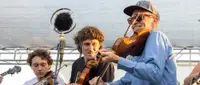
At nine o’clock on a Sunday morning in May, the contests begin at King Gillette Ranch on Mulholland Highway, in the Santa Monica Mountains above Calabasas. Advanced fiddlers, banjo players and string bands compete on the Main Stage until one. Beginning and intermediate players compete on the Tiny Porch Stage over the same hours, and singers compete on the Dance Stage until noon. The printed schedule for the 2026 festival ran on what it called “bst (banjo standard time)” and was marked subject to change.
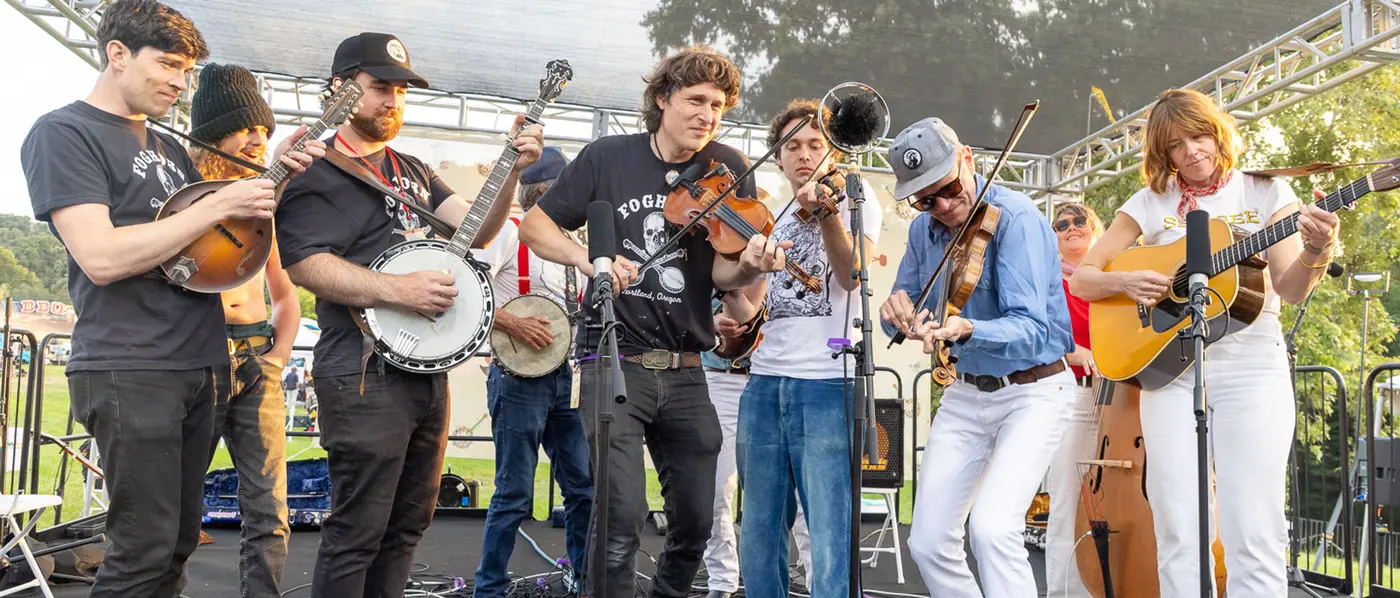
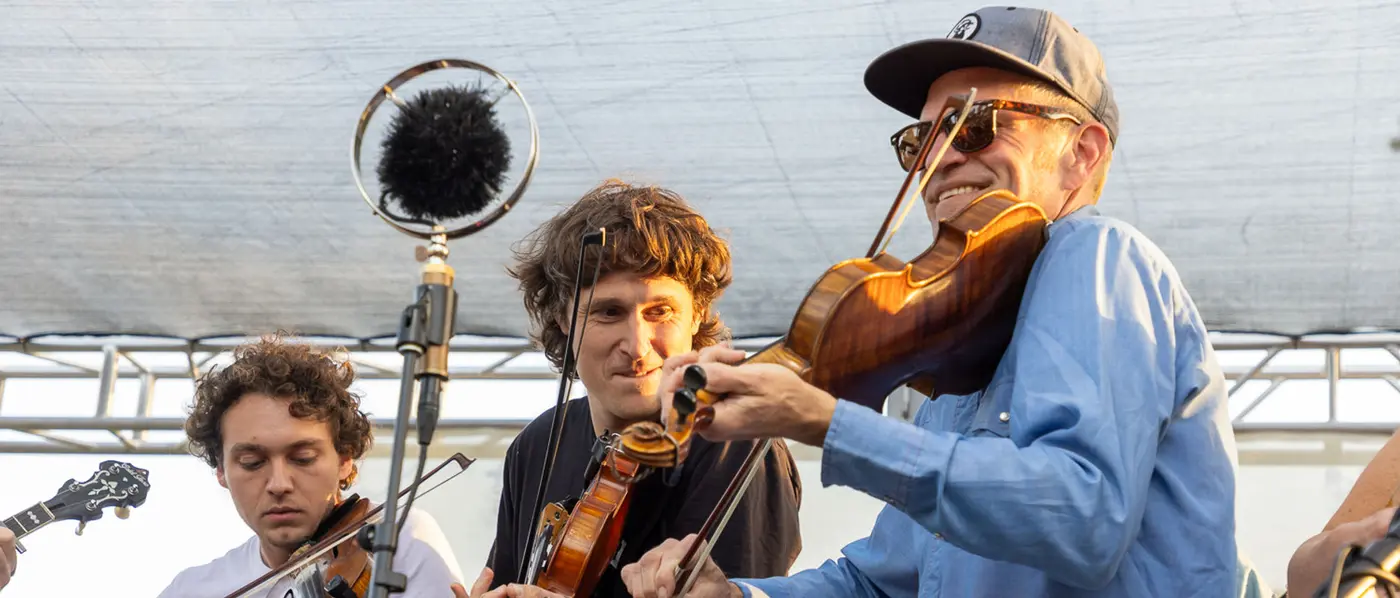
The featured performances start at noon. The 2026 festival was held May 17. JB Barton and Kenny Feinstein were masters of ceremonies on the Main Stage, where the afternoon passed from Water Tower to Sweet Megg, Jordan Tice, cowboy poetry by Jessica Schley and Zane York, and Jake Blount. Foghorn Stringband played at six. The Dance Stage, under Larry Wines and Steve Werner, opened with a flatfoot workshop led by Afton Coombs and a step dance competition. A square dance with Lindsey Ford and the Persimmon Pluckers followed, then English country dance with James Hutson and Green Willow, contra dance with Jeremy Korr and Stepwise, and a closing waltz with Werner & White. Gregory Hollow Tree was master of ceremonies on the Family Stage. It opened at ten with a fiddle workshop on kickoffs, backup and jamming hosted by Shelah Spiegel. Next came a beginning fiddle class and jam with Molly White and Natalie Brejcha, and the stage closed with the Santa Monica Ballet Folklorico and Mariachi Ritmo Latino. The Tiny Porch and the Music Box Micro Stage carried acts such as Banjo Kitty, Whole Hog, The Prairie Moons and Guitarras Hermanas through the afternoon.
Away from the stages, the jams go on all day, open to anyone who brings an instrument. Food trucks sell food, with vegan options, and craft beer is for sale. Visitors may also bring picnics and coolers, and blankets or beach chairs for the Main Stage lawn. Artisans sell crafts, and children have a craft area and an instrument petting zoo. Most of the grounds are grass, and golf carts wait at the entrance for those who need help getting in. The ranch asks visitors to leave dogs and their own alcohol at home. The county fire department permits no smoking, because the ranch lies in a very high fire hazard severity zone. A non-profit runs the festival, and by its own account the work is done entirely by volunteers. The 2027 festival is set for Sunday, May 16.
A banjo contest for a church building fund
A contest program printed after the move out of Topanga, now held by the Library of Congress, gives the beginning. Peg Benepe and Margot Slocum, housewives, started the contest in 1961 “to raise money (in a fun way) for their church building fund.” They also wanted to encourage people to play the banjo and fiddle music they had come to love. Bess Hawes, Sam Hinton and Frank Hamilton gave their time. According to the program, 500 people came to the first contest, held at Ian Thiermann’s home in a wooded canyon in Topanga. There were 26 banjo players and 5 fiddlers, and the winners were Don Parmalee, Stu Jamieson and Richard Greene.
Other accounts differ in the particulars. Wikipedia names the first event the “Banjo Pickers and Open Fiddling Contest,” counts four judges, and places the gathering amid the California scrub oak of the Santa Monica Mountains. The festival’s own history counts 30 contestants. A 1989 Los Angeles Times article dates the start to 1960.
The festival’s history says the contest moved the following year to Camp Wildwood in Topanga Canyon, a camp Wikipedia dates to the 1920s. At Camp Wildwood the program widened to folk singing, old-time music and bluegrass. Mary Ellen Clark and Dorian Keyser joined the team. The program notes that his name is pronounced “Kaiser.”
Exile after Altamont
The festival’s history tells what happened in December 1969 at the Altamont rock festival near Oakland. During the Rolling Stones’ set, “somebody from the audience jumped on stage and was fatally stabbed by a Hell’s Angel.” The Los Angeles County supervisors then restricted outdoor music. The festival’s history says the restriction stopped both the Topanga contest and a Mozart festival. The Times calls it a county ordinance. Wikipedia calls it a city ordinance and dates it to 1969.
Outdoor music was still legal in Santa Barbara County. Peter Feldmann persuaded the University of California at Santa Barbara to hold the 1970 contest on its campus. The festival records that it took place without riots, drug arrests or motorcycle gangs. It also left Santa Barbara wanting a festival of its own, and in 1972 Feldmann started the Santa Barbara Old Time Fiddlers’ Convention.
The contest itself went back to Los Angeles County and moved from campus to campus. It was at UCLA in 1971 and 1972, Santa Monica Community College from 1973 to 1977, UCLA again until 1985, and El Camino Community College near Torrance from 1986 through 1989. By then it was too large for any place in Topanga Canyon. The program from those years kept the old name: “It would be nice to have it in Topanga again when the County Supervisors relax their restrictions on outdoor music festivals, but until that happy time, we’ll continue to call it the Topanga Banjo Fiddle Contest, and enjoy it as it is.”
The same program set out the contest’s terms. Backers donated small prizes, so that “nobody can get very mad if they don’t win. It’s all in fun.” All proceeds went to charity, at that time the American Friends Service Committee and the John Edwards Memorial Folk Archive at UCLA. Volunteers put it on. Dorian Keyser was manager, Dalia Keyser secretary-treasurer, and Mary Ellen Clark prize and music chairman. Ian Thiermann, the first host, kept the gate, and The Guitar Shop in Pasadena lent the sound system.
In 1990 the contest settled at Paramount Ranch in the Santa Monica Mountains, not far from Topanga Canyon. Wikipedia cites a 2019 Southern California Public Radio report titled “After Woolsey Fire, age-old music competition scrambles for new location,” and the festival is now held at King Gillette Ranch. A virtual contest was held in 2020. Writing in 2000, the Times reported that the event had never missed a beat, and that it went on as scheduled the weekend after the 1992 riots.
Contestants who stayed
The 1989 contest was the 29th. That year the Times told how Gabe Whitcher, at age 6, climbed onto a chair to play the Texas swing tune “Take Me Back to Texas--I’m Too Young to Marry.” He took third place in intermediate fiddle in 1986, a year after winning the beginners’ category at 5. In 2000 his father, Dennis, whose surname that article spells Witcher, said Gabe first won advanced fiddle at 11 and won it twice more. “The tradition of this event is that people start as kids and stay with (the contest) for years and years,” Dorian Keyser told the Times. Stuart Duncan started coming at 11. In 1989 his bluegrass fiddle could be heard on four of the five Grammy-nominated bluegrass albums.
Keyser also explained the categories. A traditional song, he said, is one that has been in the “oral pipeline” since at least 1940. Traditional banjo is the old frailing or clawhammer style, in which the hand is held like a claw and the fingernails strike down on the strings. Bluegrass banjo is the finger-picked style popularized by Earl Scruggs. On the dance stage that year, Mary Ellen Clark, a kindergarten teacher and Scottish country dancer, said a contra dance “can go on for a long, long time, depending on how enthusiastic the dancers are and how long the musicians want to play.” Keyser described the idea in one line: “Our whole idea is to bring a picnic basket, spread your blanket out and enjoy the music.”
The contest has also started groups of its own. In 1981 several musicians who met there formed the Scottish Fiddlers of Los Angeles, the first Strathspey and Reel Society in the United States. Years later the Los Angeles Old Time Social grew out of friends jamming the day before the contest. Its members finished their own festival each year by heading to Paramount Ranch, where some played on the stages or in the dance barn and others jammed under the old oak tree. Contestants have ranged in age from 4 to 98. Among those who have competed or performed are Jackson Browne, Taj Mahal, Ry Cooder, John Hartford, Byron Berline, Dan Crary, Peter Tork and Steve Martin.
The Times reported in 2000 that Dorian and Dalia Keyser, then in their seventies, had told the board three years earlier that they wanted to retire. Under them the contest had added dancing, folk arts, cowboy poetry and storytelling. In 2002 the couple received the first Music Legend Award, given for 36 years of leading the contest. For the fifty-first contest, in 2011, the Main Stage was dedicated to them. “It’s all about the music,” said Chuck Tipton, a member of the board, in 2000. “We’re not in it for the money.”
One story from the 1960s concerns David Lindley, later a recording artist. While still in his teens he won the fiddle competition four years straight. It has been reported that contest officials then made him a judge, to give other fiddlers a chance.
Notable Events
- 1961500 people attended the first contest at Ian Thiermann's home in a wooded canyon in Topanga. There were 26 banjo players and 5 fiddlers. tile.loc.gov
- 1970The contest was forced out of its home in Topanga in 1970 by an L.A. County ordinance, passed soon after Altamont in late 1969, that severely restricted outdoor music events. latimes.com
- 1970The festival experienced its first crisis in 1970, caused by the Altamont rock festival near Oakland in December 1969. topangabanjofiddle.org
- 1970The relocation in 1970 was disruptive and the contest bounced around different locations for 15 years without finding an ideal home. topangabanjofiddle.org
- 1986The annual event, which began in Topanga Canyon, moved to various locations before arriving at El Camino in 1986. latimes.com
- 1990In 1990 the contest moved to its home at the Paramount Ranch in the Santa Monica Mountains, not far from its Topanga Canyon roots. topangabanjofiddle.org
- 1992Even the weekend after the L.A. riots in 1992, the event went on as scheduled. latimes.com
- 2002In 2002, the first Music Legend Award winners were Dorian and Dalia Keyser, who provided leadership and vision to the contest for 36 years. topangabanjofiddle.org
- 2011For 2011, the fifty-first contest, the Main Stage was dedicated to Dalia and Dorian Keyser. topangabanjofiddle.org
People
- Dorian Keyser, chief organizer of the event (since 1969).
- Chuck Tipton, a member of the contest's board of directors.
- David Lindley, recording artist who won the fiddle competition four years straight while still in his teens (1960s).
- Dalia Keyser, The Secretary-Treasurer.
- Ian Thiermann, host of the first contest at his home in a wooded canyon in Topanga.
- Margot Slocum, organizer of the 1961 event (1961).
- Mary Ellen Clark, joined the team and eventually steered the festival through the next 20 years.
- Peg Benepe, organizer of the 1961 event (1961).
- Peter Feldmann, convinced UC Santa Barbara to move the festival onto its campus.
Sources
- topangabanjofiddle.org
- en.wikipedia.org/wiki/Topanga_Banjo_and_Fiddle_Contest
- topangabanjofiddle.org/2020-performers
- topangabanjofiddle.org/legacy-award
- latimes.com/archives/la-xpm-2000-may-19-me-31685-story.html
- latimes.com/archives/la-xpm-1989-07-08-vw-2701-story.html
- tile.loc.gov/storage-services/service/afc/afc2014008/afc2014008_ms0201/afc2014008_ms0201.pdf