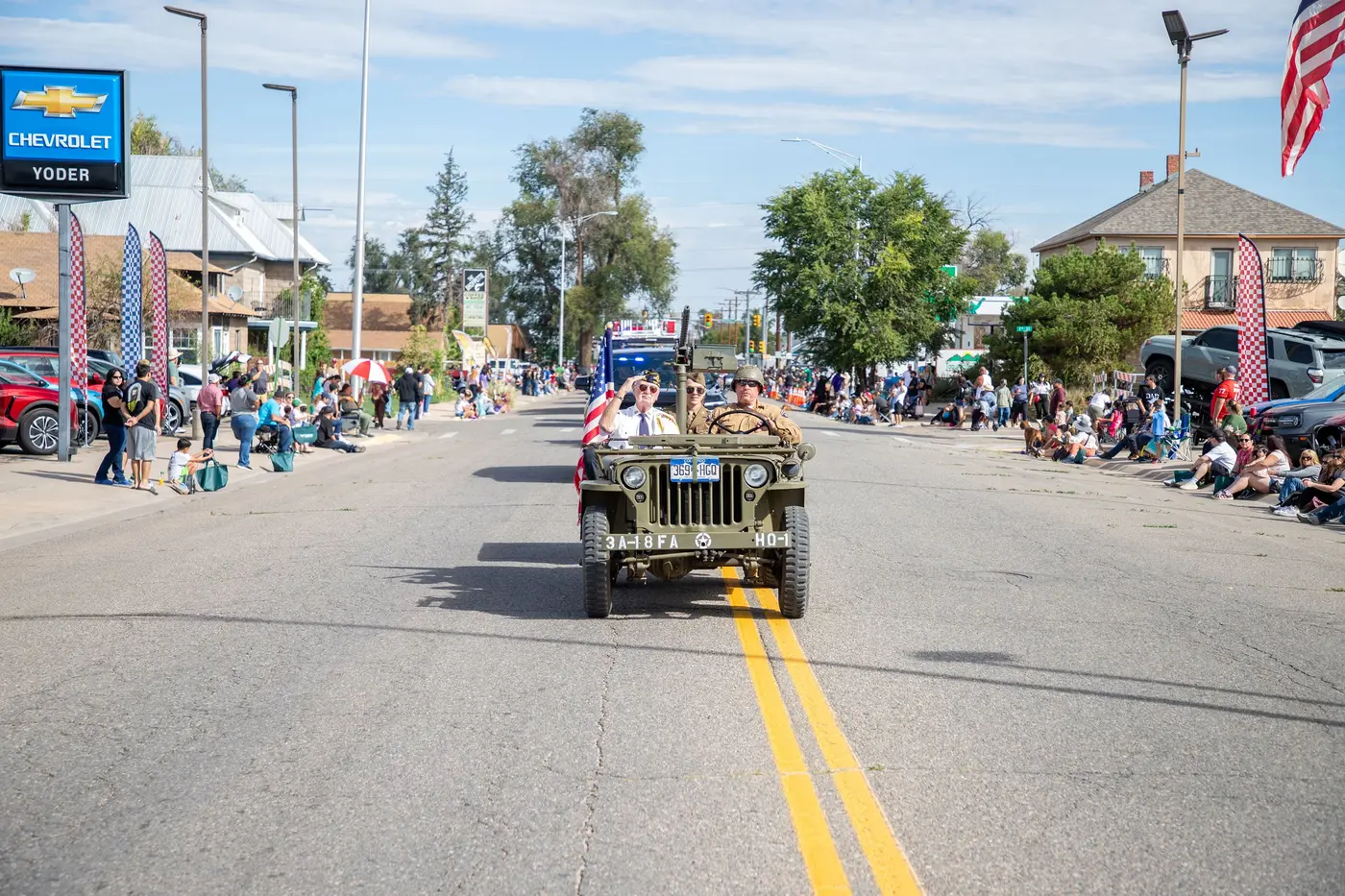
Tomato Festival at Trapper Days
Fort Lupton, Weld County, Colorado. Tomato Festival at Trapper Days!
Details

- Where
- 4th Street and Pacific Avenue, Fort Lupton, CO 80621. Directions
- When
- Last held September 11–12, 2026; next year’s date not yet stated.
- Getting there
- Parade down Denver Avenue starting at 11th Street and ending on 2nd Street.
- Fees
- Free.
- Hours
- Public Park that is open Sunrise to Sunset.
- Access
- Event street closures and No Parking zones; consult the city notice for dates and areas.
- Walk-in or reserve
- Parade participation, pickleball tournament, cornhole tournament and cooking contest require registration.
- Phone
- 720.928.4071
- Website
- fortluptonco.gov
- Managed by
- The parade is organized by the Fort Lupton Chamber of Commerce.
- Established
- 1908.
On the Friday evening of the weekend after Labor Day, Fort Lupton gives the corner of 4th Street and Denver Avenue, in its historic downtown, over to a street dance. In 2026 it ran from 6:00 to 8:00 p.m. on September 11, with live music and dinner, free and open to whole families. The dance opens the Tomato Festival at Trapper Days, which the city calls one of Colorado’s longest running community celebrations.
Saturday on Denver Avenue and at Railroad Park
Saturday starts with a pancake breakfast. At 10:00 a.m. the parade, organized by the Fort Lupton Chamber of Commerce, comes down Denver Avenue from 11th Street to 2nd Street. A city post afterward called it “one of the trademarks of our City.” The 2026 program also included an aerial flyover.
From 11:00 a.m. to 3:00 p.m. the festival moves to Railroad Park. The park covers 8.6 acres from Highway 52 north to Ninth Street and holds ball fields, horseshoe pits, and sand volleyball courts. Food trucks and local vendors lined up around it in 2026. The day also had a petting zoo, pickleball and cornhole tournaments, Lucha Libre wrestling matches, and the Rumble at the Park Car Show. The Roughcuts Car Club organized the show, which the city described as “an impressive lineup ranging from classics to hot rods.” Weld County Public Health brought its mobile unit, offering immunizations for children and adults, blood pressure and diabetes screenings, and other free and low-cost services without appointment.
The vendor list ran long. Kanom LLC, a Thai-Lao influenced bakery based in Fort Lupton, sold Asian-inspired baked goods. Other tables held Bauer’s Premium Jerky, Darbees Honey Products, and TLC Plants & Poultry. Textile Style had handmade quilts and embroidered patches. Joyas de Mexico sold jewelry, and Sav and Ry, a western boutique out of Fort Lupton, sold clothing. A young entrepreneur sold homemade candles and clay art under the name Le Garcon Francais. Crochet Creations offered crocheted towels and stuffed toys alongside salsa and apple butter. The Fort Lupton Metro Wrestling Club brought a prize wheel.
Green chili, menudo, and Black Forest pumpernickel
Community panelists judge the annual cooking contest. In 2026 they were SuZann M., Jay B., Francis L., Toni A., and Tori G. Matthew Fields took four firsts, for a lemon basil cheese scroll, an apple strudel, a Castilla-inspired levain, and a Black Forest pumpernickel. He also placed second with blackberry caramel honey buns. Nancy Hanna won sweet breads with cinnamon rolls and took both places in jams and jelly, with a Mexi bell pepper jam and a spiced peach.
Ashley Sandoval’s green chili placed ahead of Cody LeBlanc’s. LeBlanc won red chili, and he won the vegetable side dish with corn and zucchini. Jorge Guerrero’s menudo won main dish, and Cindy Bunning’s peach salsa won canned fruit. In the tomato-based category, Jacob Chavez placed first with a green chili tomato salsa, ahead of Jack Stieber’s salsa.
A merchant’s feast, 1908
In 2006 Rosalie Everson, then administrator of the Fort Lupton Chamber of Commerce, told the Greeley Tribune that Trapper Days started in 1976. By her account the original celebration began in 1908 as Tomato Days, when a local merchant invited everyone in the area out for a feast of beef.
That year the trappers were at the center of the weekend. “We really, really tried to bring in the Trappers,” Everson said. A rendezvous site off U.S. 85 and Weld County Road 14 1/2, northwest of town, held re-enactors of the fur traders and mountain men, with traders selling period-correct goods. There were demonstrations of fire-making with flint and steel, blacksmithing, and period music.
The Saturday program in 2006 ran from the pancake breakfast at Fire Station No. 1 to pie- and hot-dog-eating contests, a chili cook-off, and a black powder shoot open to the public. Northern Colorado Antique Tractor Pullers performed at the historical site. Visitors could take guided tours of the late-1860s Donelson House, the Independence School House of 1875, and the fort, which was then under construction. At 5 p.m. two-person teams cooked hard-boiled eggs over fires they lit with their own flint and steel. A pig roast and an old-fashioned Fandango at the reconstruction site followed. On Sunday there was a duck race. “It’s like a big party,” Everson said.
A Trapper Days cookbook of more than 250 recipes sold for $10 that year, with $1 from each copy going toward rebuilding the fort at the historical park. The South Platte Valley Historical Society still lists a Trapper Days Rendezvous among its annual events.
Lupton’s adobe on the South Platte
The town takes its name from the fort. Lancaster Lupton was a West Point graduate and a lieutenant in the U.S. Dragoons. According to the historical society, he first came to the area with a military expedition in 1835. Wikipedia names it the Dodge-Leavenworth Expedition under Col. Henry Dodge. By 1836 Lupton had resigned his commission, and the society says he was bringing skilled craftsmen and laborers north from the Mexican village of Taos to build a trade fort. Wikipedia says he built it with the help of Mexican and Native American men.
The post was first called Fort Lancaster. It had 15-foot walls of adobe brick around an enclosure of about 125 by 150 feet. A tower overlooked the countryside, and holes on the second floor allowed rifles to fire at attackers. It stood on the Trapper’s Trail between Laramie and Santa Fe. It was one of several posts along a 13-mile stretch of the South Platte in the late 1830s, and the society describes it as a competitor to the Bent and St. Vrain Fur Company. By 1837–38 Lupton was trading with the Arapahoe and Cheyenne.
Trappers and Native Americans brought buffalo hides and beaver pelts and took away food staples, cloth, blankets, pots, pans, knives, and guns. As many as 40 people may have lived at the post, many of them Spanish-speaking employees. Rufus Sage, Kit Carson, and John C. Frémont visited. The society dates its operation from 1836 to 1844. Wikipedia gives 1836 or 1837 to 1844, closing when the fur trade collapsed in the early 1840s.
The fort stood empty until 1859, when it served as a stage station during the gold rush. Then a family named Ewing lived in it for a number of years. By the 1920s only a wall remained. In 1926 the Territorial Daughters of Colorado put a wrought iron fence and historical marker at the site. An oil rig later stood on the land before the historical society acquired it.
According to the society, a group began reconstructing the fort in 2003 and completed and dedicated it in 2011. Wikipedia dates the reconstruction to 2009. The new fort stands in the South Platte Valley Historical Park, a few yards from the original site, which is now an archaeological site. Its inner plaza opens onto blacksmith and carpenter shops, living quarters, a kitchen, trade rooms, and a cantina. Some of the adobe in its walls came from the original fort.
Notable Events
- 1929The old public library was built in 1929 by architect John J. Huddart. fortluptonco.gov
- 1982In September of 1982 a room at newly built City Hall became the city's museum, providing space for the Haynes arrowhead collection. fortluptonco.gov
- 1993In 1993 the city needed more office space and the Fort Lupton Museum Committee, headed by town historian Nancy Penfold, moved the museum to the lovely old historic library building across the street from City Hall. fortluptonco.gov
- 2003A dedicated group of individuals began in 2003 to reconstruct the fort. spvhs.org
- 2009In 2009, the fort was reconstructed a few yards from the site of the trading post using some of the original adobe bricks. en.wikipedia.org
- 2011The reconstructed Fort Lancaster, as it was known in its original period of operation 1836-1844, was completed and dedicated in 2011. spvhs.org
People
- John C. Fremont, Visitor at Fort Lupton during the fur-trade era.
- Kit Carson, Visitor at Fort Lupton during the fur-trade era.
- Lancaster Lupton, Founder of Fort Lupton, a former lieutenant, dragoon soldier, and West Point graduate.
- Rufus Sage, Visitor at Fort Lupton during the fur-trade era.
- John J. Huddart, Architect who built the 1929 Fort Lupton Carnegie library.
- Nancy Penfold, Fort Lupton town historian, heading the Fort Lupton Museum Committee.
- Ralph Haynes, One of the first mail carriers, who in the 1950s donated his arrowhead collection to start the Fort Lupton Museum.
Sources
- fortluptonco.gov/472/Tomato-Festival-Trapper-Days
- weld.gov/Government/Departments/Health-and-Environment/Weld-County-Public-Health-Mobile-Unit/Mobile-Unit-Events/Trapper-Days-Tomato-Days-Festival-Fort-Lupton-2026
- fortluptonco.gov/facilities/facility/details/Railroad-Park-4
- facebook.com/CityofFortLupton
- instagram.com/cityoffortlupton/?hl=en