Tierra Wools
Chama, Rio Arriba County, New Mexico. Workshop and gallery.
Details

- Where
- 2540 US HWY 64/84, Chama, NM 87520. Directions
- When
- Mon - Sat 9am - 5pm.
- Getting there
- About 105 miles from Santa Fe, 95 miles from Taos, 110 miles from Farmington, and 110 miles from Durango, CO.
- Access
- Pets are not allowed on the grounds except assistance animals; visitors should give advance notice of special needs access or assistance animals (stated for class students).
- Phone
- (575) 588-7231
- Website
- handweavers.com
- Managed by
- Owner Molly Manzanares, who runs the shop with her sister and master dyer Toni Boyd Broaddus.
- Established
- 1983.
Rugs under the eaves
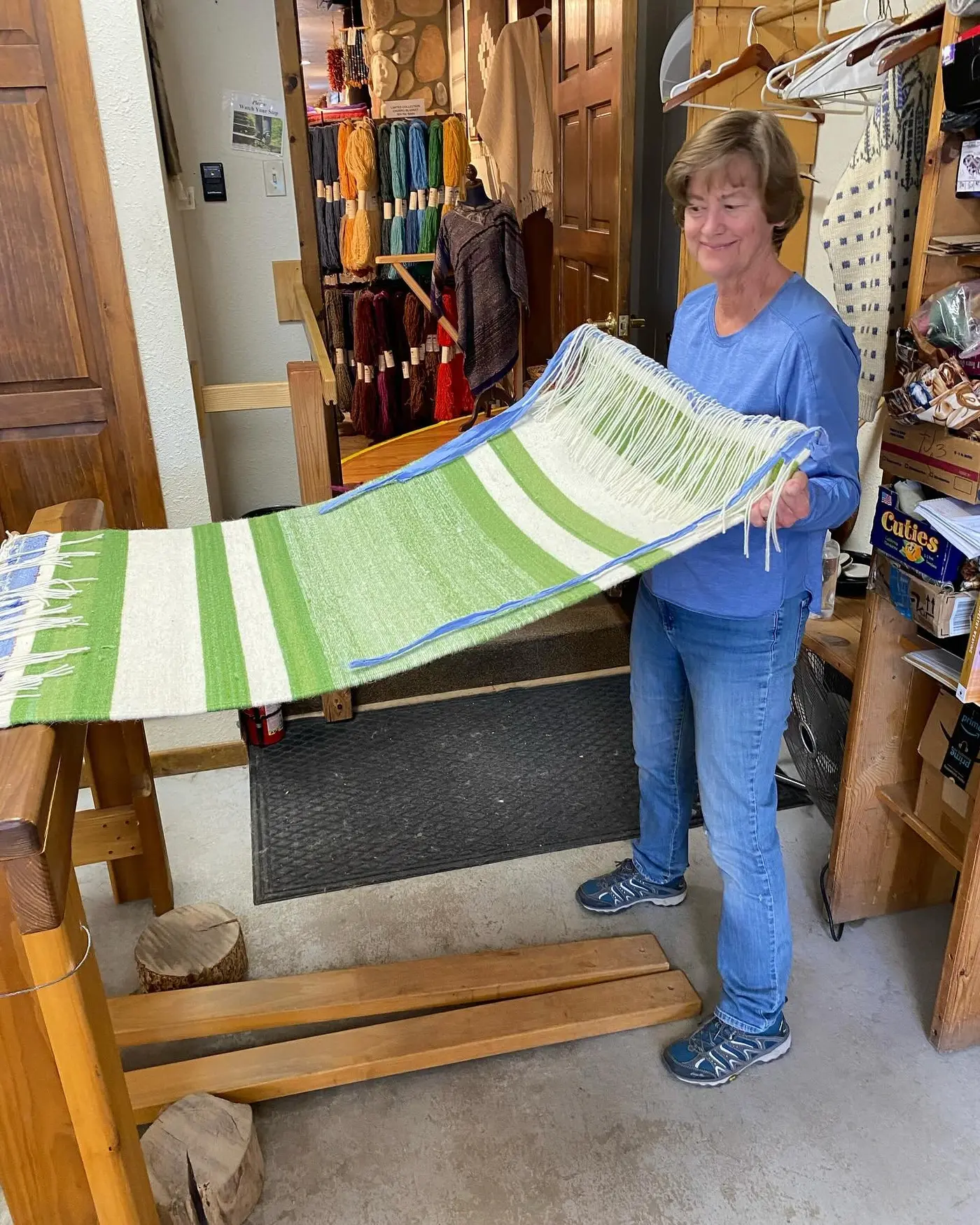
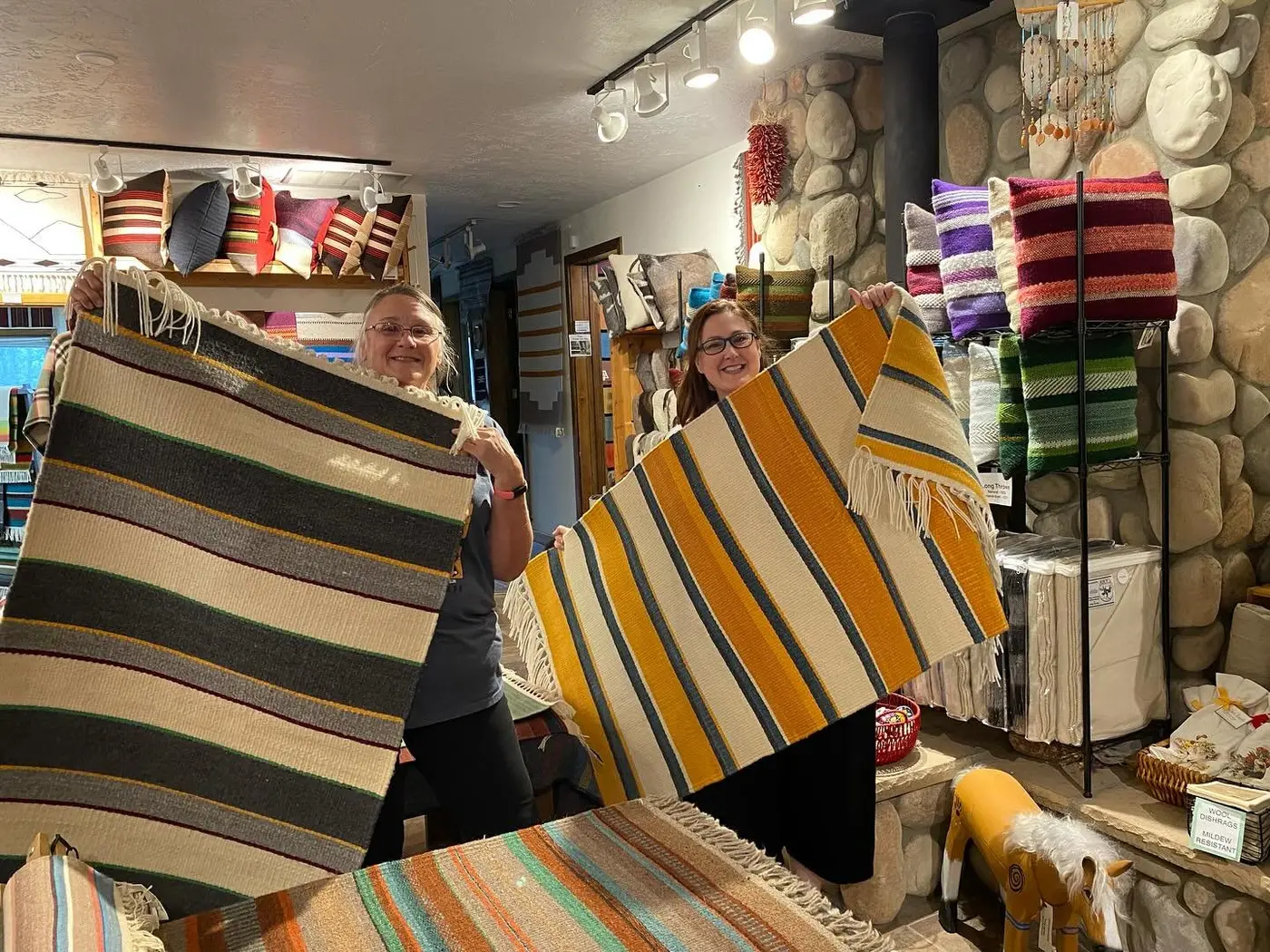
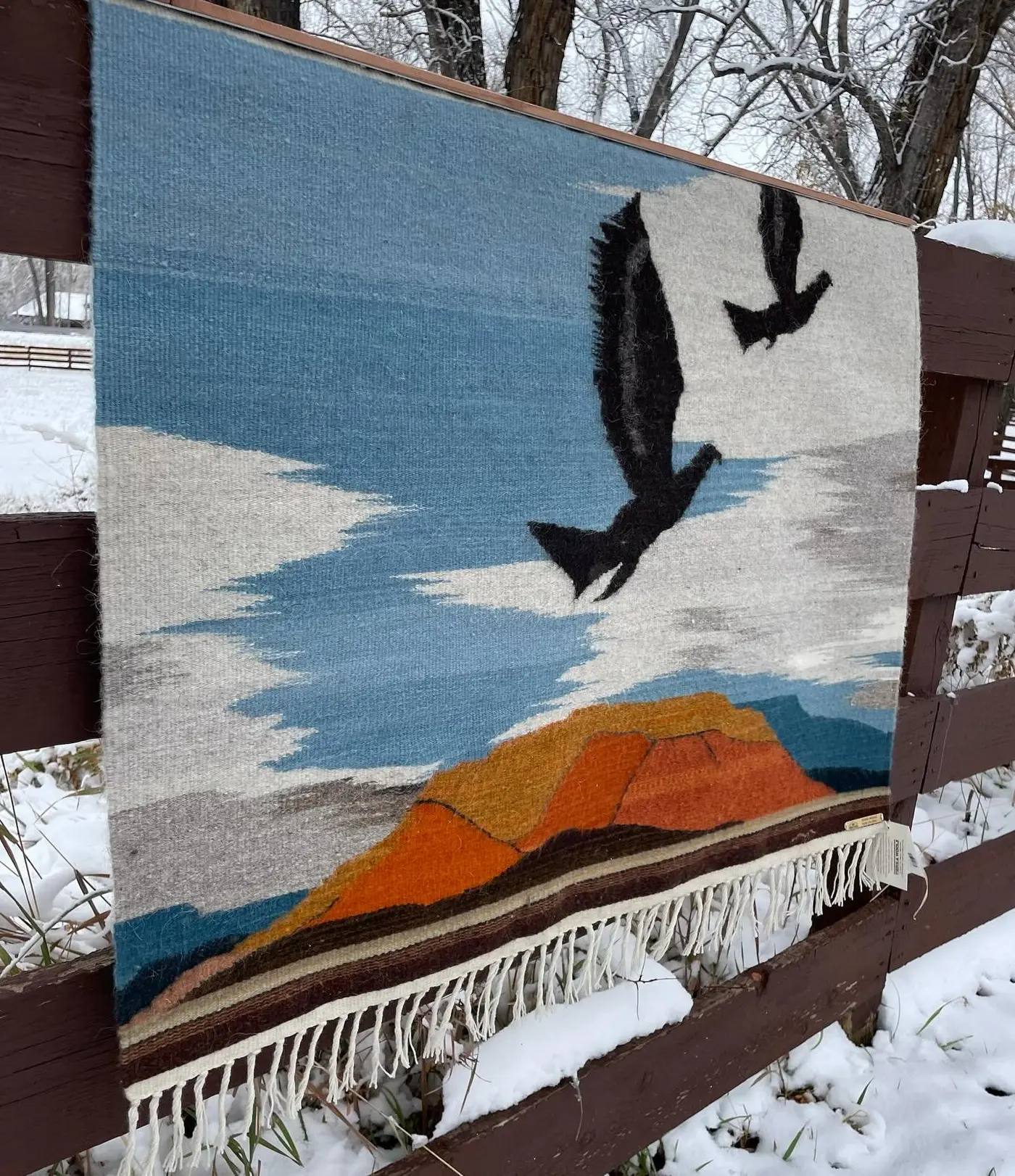
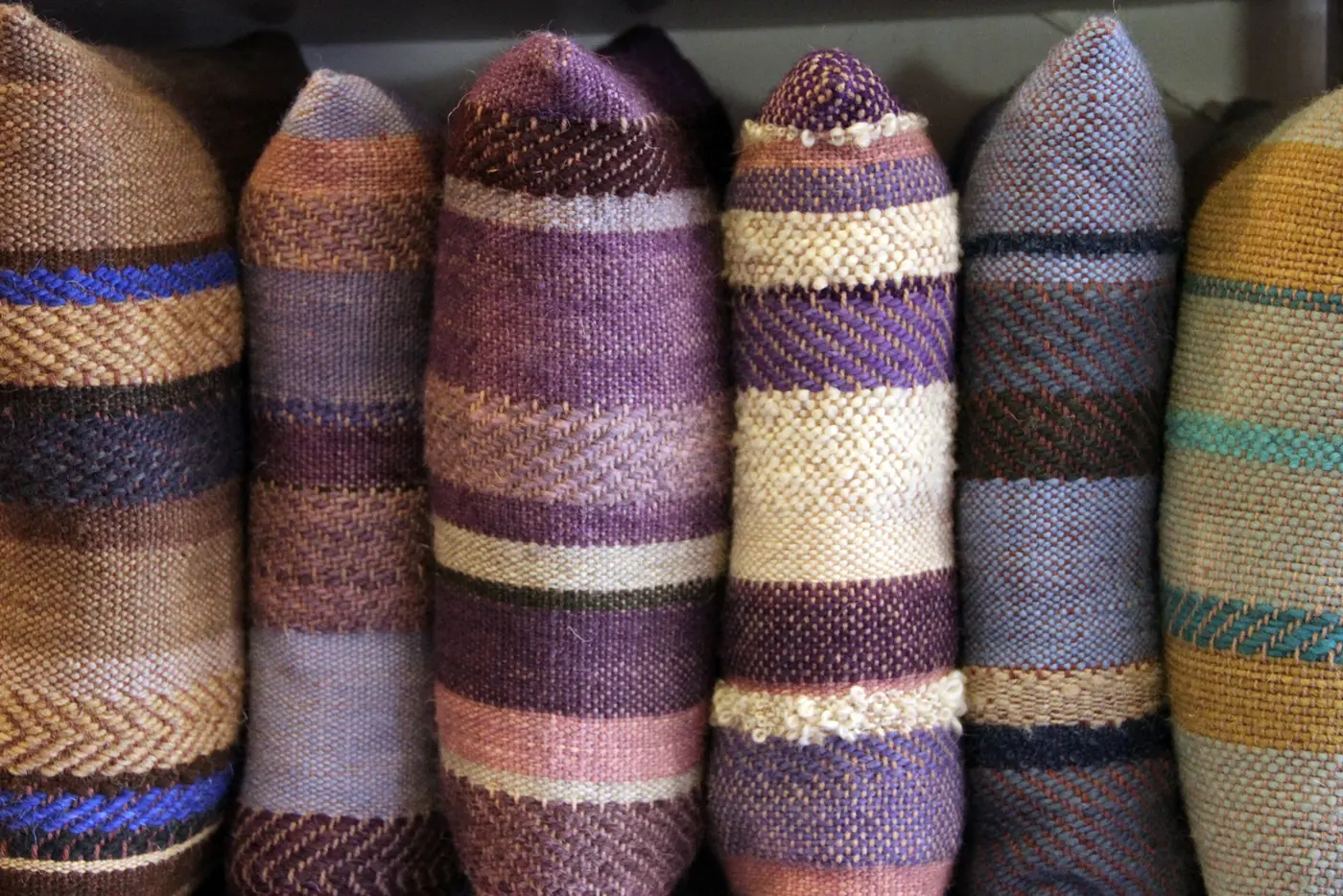
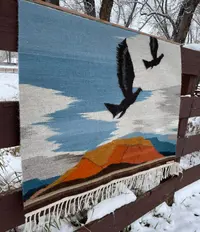
Handwoven rugs hang from the eaves of a farmhouse porch just south of Chama on US Highway 64/84, behind a wooden sign and a stand of trees. Inside are five rooms. Yarns dyed with native New Mexico plants line the walls under names such as Lamb’s Nose, Green Chile, and Sangre de Cristo. Tables hold rugs, tapestries, scarves, mittens, and fiber and folk art by local makers. Other colors in the house Churro line, worked out by Molly Manzanares and Sophia DeYapp, carry Spanish names: maiz, a yellow; pollo, a lighter one; anochecer, a purplish shade that Lara Manzanares compares to the sunset there.
Molly Manzanares owns the place and runs it with her sister, the master dyer Toni Boyd Broaddus. “It’s a community project,” Molly told New Mexico Magazine in 2024. She and her husband, Antonio, raise about 700 Navajo-Churro and rambouillet sheep whose wool comes to the store, and Antonio sells their meat under the name Shepherd’s Lamb at the Santa Fe Farmers’ Market. The core weavers are Molly; the store manager, Nathaniel Chavez; his mother, Sophia DeYapp; and his sister, Savannah. Nathaniel gets on a loom every day, “at least for half an hour,” and Antonio has said his pieces are the first to sell. Asked what he likes best about the work, Nathaniel said: “Being creative, especially with the weaving. You get to make something, like, whatever you can come up with out of your head.” His grandmother, Francisquita “Kika” Chavez, worked closely with Molly while Molly was learning to weave. His grandfather, Leandro Chavez, was the first shepherd to show Antonio how to live on the summer range with the flock. Lara Manzanares, a musician and songwriter named with Molly as an owner in a Bard Graduate Center interview, began learning to weave from her mother at about eight and grew up in the workshop.
The shop keeps a rancher’s calendar. Shearing comes in April and lambing in May. By June classes and tours are under way while the flock summers in the high country. In October the sheep come down to their winter feeding grounds. Each spring a festival brings the community in to see what the weavers made over the winter. The 2013 Spring Harvest Festival fell on the last Saturday in April. Classes run four days for four to five students at a time, in beginning weaving and in tapestry. There is also a one-day workshop on warping a Rio Grande loom, and Toni teaches a two-day natural dyeing class once a month from June through September.
Piñon fires and five hardwood looms
Both acid dyes and natural plant dyes are used. The pots sit over piñon wood fires. Undyed yarn soaks in cold water overnight. Early the next morning the fires are built, the pots are brought to a boil, and the color goes in. The yarn boils until it has taken up all the dye and the water runs clear. By the end of a dye day the skeins hang in row after row to dry in the sun. The acid dyes need a small amount of sulfuric acid to strike the wool, and Nathaniel and Sophia do all of that work.
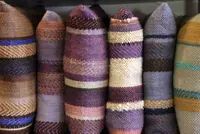
Toni handles the plants. She has dyed long skeins of grey Churro with black walnut husks to get a deep brown. Madder root gives salmons, corals, and vermilions. Dock root gives red brown if the root is red and coffee brown if it is not. Chamisa and cota give soft yellows, and indigo laid over red turns it purple and over yellow turns it green. A natural dye bath weakens with each batch of wool run through it. Most of the plants near Chama, Molly says, give gray, green, and yellow, so the shop buys indigo, cochineal, and madder for a wider range.
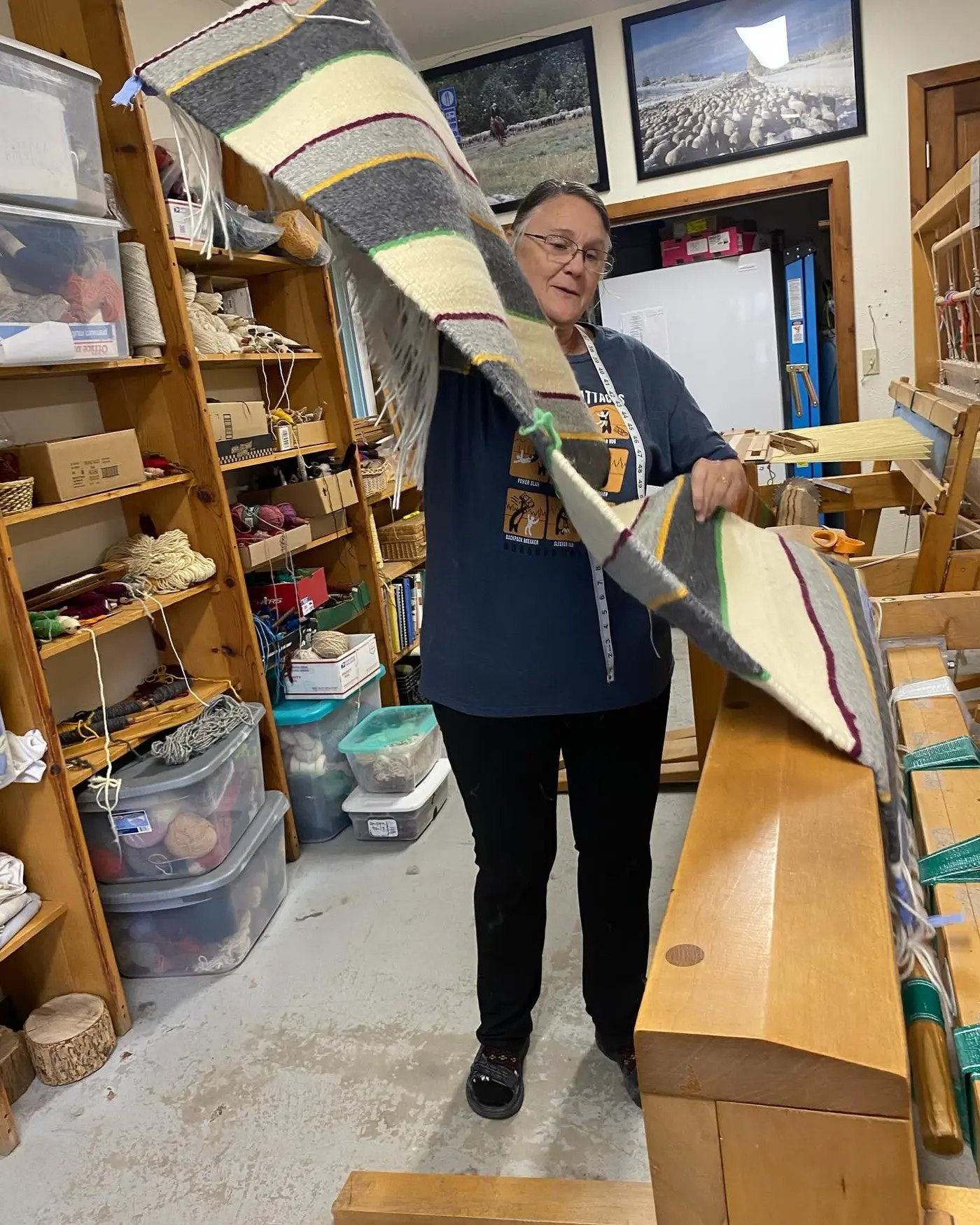
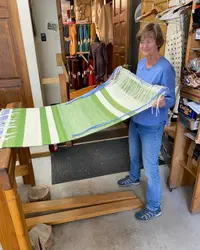
The weaving room is a former garage, and its looms are Rio Grande walking looms. This is a counter-balance floor loom whose ancestors came from Spain in the 1500s. The weaver stands at it and works the warp with her feet. Five of the looms were built by Hans Leitner, a craftsman from Austria who was married to a weaver named María from Chimayó. Leitner came to the workshop and stayed a while. He watched the weavers, mostly women at the time, asked questions, and took measurements. Then he built five large hardwood looms with thick beams and rounded corners. Each has a huge square back beam that holds dozens of yards of warp and heavy “x” braces that keep it rigid under a high-tension warp. They arrived more than 30 years ago and are still in use.
Before them came a set of pine looms made by a local craftsman, Cruz Aguilar. The soft wood did not hold up in a production shop where weavers worked five days a week, six to eight hours a day. A few looms were then bought from Weaving Southwest, the Taos company of the weaver Rachel Brown. One of hers remains, and the shop invites visitors to pick it and the Leitner looms out from the rest. Other looms in the room were made by Dave Baber, Lawrence Dilka, Lawrence Carrillo, an unknown maker from Canjilón, and a loom-building class at a community college.
Warps are wound 30 yards at a time. One weaver holds the tension while two others turn the drum. Lara grew up weaving a series of pieces on each warp so no thread went to waste. Later, as a teaching assistant in graduate school, she watched a class wind a whole warp for a single weaving: “I was just kind of like, whoa.” Every piece comes off a walking loom with fringe. “These will always have fringe,” Molly said, and the fringe is what sets a Rio Grande weaving apart from a Navajo one.
A kitchen table in Los Ojos
The enterprise began in 1981 at a kitchen table in Los Ojos, about fifteen miles south. María Varela, a veteran of the Student Non-Violent Coordinating Committee, had come to northern New Mexico in 1969 to work with the land grant leader Reies López Tijerina. She married a villager and lived with him in a trailer at the edge of Los Ojos. The school teacher and part-time sheep rancher Gumercindo Salazar called the meeting. According to María Ochoa’s study of the venture, the sheep rancher Antonio Manzanares still thought of Varela as an “outside agitator.” The three kept meeting informally. Between 1981 and 1983 they brought back communal shepherding in the area, and out of that work came Ganados del Valle. Molly translates the name as “Flocks of the Valley”; Ochoa gives it as “Livestock Growers of the Valley.” Antonio and Gumercindo ran the sheep, and Varela headed the wool side, a committee that became Tierra Wools. “We didn’t actually talk about the meat right away,” Molly recalled. A separate account, from Renewing the Countryside, dates Ganados to 1989 and names Antonio and Molly, with Varela and Rachel Brown, as its founders.
Brown met Varela through a member of the Mountain and Valley Wool Association. “We met for lunch one time and we just got along great immediately,” she said. When she reached Los Ojos in 1983, she found the region’s wool “lustrous, long-stapled” and well suited to hand spinning. Local spinners had worked on a hand spindle called a malacate, and more than fifteen people came to her first spinning-wheel workshop. At an exhibition of local weavings at the community health center, she asked to meet the makers. She was taken to a former convent, where several elder women were working on looms crammed together in a tiny room.
Varela raised money for Brown’s consulting fee from progressive funds, among them the Shalan Foundation. The two accounts of Brown’s commute differ. Ochoa says she drove a 160-mile round trip every Tuesday for the first year and added 100 miles each way when snow closed the pass. Tierra Wools’ own history says she crossed 70 miles of mountains once a week for about three years. Her curriculum ran to fifty lessons, and those who finished it earned the title Maestra and went on to teach the next class. Kika Chavez was among the first graduates. Joanna Terrazas joined the first class with seven others after Antonio mentioned the venture to her husband. Molly remembers an early sales trip to New York, where a buyer told Brown, “Oh, no, you need to tell people what designs they need to do.” Brown’s answer, as Molly tells it: “No, that’s not going to happen.”
The Burns store years
Tierra Wools opened in July 1983 in the T.D. Burns Mercantile building in Los Ojos. The store dates from about 1880 and is built of adobe under stucco, mud plaster, and brick veneer. Inside are a hardwood floor, the original shelves, a pressed metal ceiling, and wool sorting rooms. It had been the area’s leading mercantile from the 1870s to the 1930s, and later Wheeler’s Hardware and General Store. Over the years it also housed a post office and an automobile garage and held dances. The weavers started there with two spinning wheels, four looms, and an $18,000 loan from Ganados. A 2013 visitor described a bell at the door and women sitting around the woodstove telling stories.
By 1992, Ochoa counted thirty workers, twenty-nine women and one man, aged eighteen to sixty. She called it a quarter-million-dollar operation and said its annual budget had grown from zero to $225,000. Another account puts gross sales at $250,000 a year by the end of the first decade, with original pieces selling for up to $3,000 and eight of 23 women weavers holding a share of ownership. The best-paid weaver earned no more than $17,000. Winter snow closed the mountain roads and kept tourists away. The 1992 annual meeting was the first held by the member-owners alone, without Varela, Brown, or the San Francisco consultant Robin Collier. That spring the member-owners stopped allowing preschool children in the weaving room. They also turned down outside wholesalers and asked any vendor who carried the work to tell the Tierra Wools story.
In the early 1990s Tierra Wools broke from Ganados and became a for-profit, worker-owned business. It stopped paying weavers upfront and moved to consignment. Some weavers, Molly said, “were not excited about that idea of weaving and then waiting for the product to sell before they could get paid.” In 1995 High Country News reported that the Ganados enterprises supported 100 families, directly or indirectly. Through the 1980s and 1990s, members of Ganados and Dr. Lyle McNeal of Utah State University bred Navajo-Churro sheep and built a sizable local flock. Teri García of Tierra Amarilla was hired as a finisher in 1992, entered the apprenticeship two years later, and was recognized as a Master Weaver in 1998. The member-owners later set up a separate nonprofit, the School of Río Grande Weaving Traditions, under Sophia DeYapp. A writer who stopped by in late September 2014 found the loom room empty. Since the recession, staff told her, weavers had mostly come in only when they had an order to fill.
Up the road to Chama
Molly and Antonio took over ownership in 2012, ending the collectively governed employee ownership. Rachel Brown died the same year. The rented building in Los Ojos was, in the shop’s words, “literally falling down around their ears.” It also sat down a small winding road that many travelers on the highway never took. Molly puts the stay in Los Ojos at 34 years, and the shop’s page on its looms gives 36. Nathaniel packed the old store and Molly set up the new one. The move meant downsizing, and two storage lockers now stand beside the dye shops. “It’s made it all possible,” Molly said. With the shop visible from the highway, “we’re actually getting a lot of people, and we’re making sales, and it’s, it’s kind of frightening.” At 62 she had begun pricing weavings as art.
Antonio has his own way of describing the work. “La borrega es muy agradecida; the sheep is a grateful animal. She’ll give you her wool, she’ll give you her lamb for meat, and then when she’s old she’ll sacrifice herself too.”
Notable Events
- 1980sThe aspiring weavers put a local wool source, a building and teaching in place, then employed local craftsman Cruz Aguilar to fashion a set of pine looms for the workshop; the soft wood did not withstand full-time use. handweavers.com
- 1980sA local Navajo-Churro breeding program by members of Ganados del Valle and Dr. Lyle McNeal of Utah State University left a substantial flock of Navajo-Churro sheep in the area and a steady supply of wool for the weavers. handweavers.com
- 1980sThe National Register nomination records the Burns mercantile building in Los Ojos as a leading commercial and social center used variously for the T.D. Burns store, Wheeler's Hardware and General Store, and Tierra Wools weaving cooperative work and showrooms. npgallery.nps.gov
- 1981Gumercindo, Antonío and María launched their program by reinstituting communal shepherding practices; Antonío and Gumercindo coordinated the sheep ranching while María headed the wool production component that became Tierra Wools. culturalstudies.ucsc.edu
- 1981María Varela sat down for a kitchen table meeting with two other Northern New Mexican villagers, sheep rancher Antonío Manzanares and school teacher Gumercindo Salazar, who had called the meeting; the three then held a series of informal sessions. culturalstudies.ucsc.edu
- 1983Joanna Terrazas, with seven others, became the first students of Rachel Brown's training program after Antonío Manzanares mentioned the new weaving enterprise to her husband. culturalstudies.ucsc.edu
- 1983Rachel Brown came to Los Ojos, found the local wool perfect for hand spinning and a strong local interest in spinning and weaving, and was hired as a consultant with money María Varela raised, commuting weekly from Taos to teach. culturalstudies.ucsc.edu
- 1983Tierra Wools was founded in New Mexico in 1983 as an economic development cooperative built around local control of land and resources, reviving the Rio Grande weaving tradition and rescuing the almost extinct Navajo-Churro sheep. festival.si.edu
- 1983Tierra Wools first opened the doors to its workshop and retail outlet in the historic T.D. Burns Mercantile building. handweavers.com
- 1989Renewing the Countryside says Antonio and Molly Manzanares, with Maria Varela and Rachel Brown, founded Ganados del Valle, and that the most prominent result of their efforts was the establishment of Tierra Wools. stories.renewingthecountryside.org
- 1992The cooperative was turning down all requests from outside wholesale vendors, and its terms asked any vendor to tell the story of Tierra Wools. culturalstudies.ucsc.edu
- 1992The 1992 Tierra Wools annual meeting was held without María Varela, Rachel Brown or Robin Collier, the first ever comprised solely of Member-owners; the study describes the venture then as a quarter million dollar operation of thirty workers. culturalstudies.ucsc.edu
- 1992The weekly management meetings that directed day-to-day affairs included Nena Russom as Treasurer, Sophie Chávez as Production Manager and Cindy Friday as Marketing Manager. culturalstudies.ucsc.edu
- 1992Until the spring of 1992 weavers brought their children to the weaving room at the outlet; the member-owners then barred pre-school children from the work site, a ban still in effect as of that summer. culturalstudies.ucsc.edu
- 1995High Country News reported that Ganados ran a wool-processing business, a general store promoting local artisans and organic mutton, and Tierra Wools, a cooperative of spinners and weavers that markets expensive tapestries, directly or indirectly supporting 100 families. hcn.org
- 1998Teri García of Tierra Amarilla was hired as a finisher at Tierra Wools in 1992, enrolled in its apprenticeship weaving program two years later, and was recognized as a Master Weaver in 1998. festival.si.edu
- 2012Molly and Antonio took over ownership of Tierra Wools in 2012; before that it was run as an employee-owned gallery and shop, governed collectively. ediblenm.com
- 2012Rachel Brown, the Taos weaver who trained countless New Mexico weavers and wrote the standard weaving, spinning and dyeing guide, died in 2012. newmexicomagazine.org
- 2013In 2013 Tierra Wools celebrated its thirtieth anniversary, keeping to its mission of buying local wool, training and hiring local people, and carrying on the Rio Grande weaving tradition. ediblenm.com
- 2014The visiting writer found the loom room empty: since the recession, staff said, the weavers had mostly worked on consignment, coming in when they had an order to fill. newmexicomercury.com
- Tierra Wools separated from Ganados del Valle and became a for-profit worker owned business, and it changed from paying weavers upfront to consignment, which changed the face of the business. bgc.bard.edu
- In the ten years that Tierra Wools has existed the annual operating budget grew from zero to $225,000, with most sales made at the isolated rural outlet. culturalstudies.ucsc.edu
- The shop announced it was moving to Chama, to a new location just south of Chama on US Highway 64/84, because the old rental location was old and literally falling down around their ears. handweavers.com
- The shop's own spotlight, written by Molly Manzanares, describes Tierra Wools's new location in Chama as open and far easier for customers to find than the old building. handweavers.com
- The production manager had been at Tierra Wools for over seven years and an instructor for three, and he learned to weave a couple of months after starting work, from his mother at the shop; he says weaving 'has been in my family for generations'. handweavers.com
- Hans Leitner designed and built five large hardwood Rio Grande walking looms for Tierra Wools, which have been a fixture and a weaver favorite since their arrival. handweavers.com
- The New Mexico tourism article reported that Tierra Wools relocated its studio and classroom space to Chama the year before, expanding its offerings of Rio Grande-style weavings, equipment, fiber arts and workshops. newmexico.org
- By the end of its first decade Tierra Wools was grossing $250,000 a year, selling original pieces for up to $3,000 each, and employing 23 women, eight of whom became part owners. newmexicomercury.com
- After ten years of teaching classes in the history of weaving and the craft of dyeing, spinning and weaving, the member-owners decided it was time to form a separate nonprofit school, the School of Río Grande Weaving Traditions, directed by master weaver Sophia DeYapp. taosnews.com
People
- Lara Manzanares, Weaver, musician and songwriter who with Molly Manzanares owns the retail store, workshop and gallery Tierra Wools (her mother started teaching her to weave when she was about eight).
- Cindy Friday, Marketing Manager for Tierra Wools, who described the revival of business on the main street of Los Ojos (as of 1992).
- Gumercindo Salazar, Named with Maria Varela and Antonio Manzanares among those who provided crucial support in the early years.
- Irma Martínez, Named among the six Member-owners of Tierra Wools as of the summer of 1992 (as of the summer of 1992).
- Joanna Terrazas, Member-owner of Tierra Wools and a Maestra who trained other weavers, one of the first students of Rachel Brown's training program; formerly Marketing Manager (affiliation began in 1983).
- Kika Chavez, Wove an early Tierra Wools weaving illustrated on the History page.
- María “Nena” Russom, Bookkeeper for Tierra Wools who became one of its most esteemed weavers, and treasurer of its board (as of 1992).
- Maria Varela, Provided crucial support in the early years among the founding members of Ganados del Valle.
- Robin Collier, Listed among the later owners of Tierra Wools.
- Sophie Chávez, Production Manager of Tierra Wools, who assigned weaving tasks and production goals to all weavers including the Member-owners.
- Leandro Chavez, Nathaniel Chavez's grandfather; the first shepherd to show Antonio Manzanares how to be on the range with the sheep during the summer months.
- Molly Manzanares, Original member-owner of Tierra Wools.
- Nathaniel Chavez, Production manager of Tierra Wools: teaches the weaving classes, hand-dyes yarns with his mother Sophia DeYapp, stocks the showroom and does maintenance, and weaves Rio Grande-style pieces the shop sells (at Tierra Wools for over seven years, an instructor for three).
- Sophia, Nathaniel Chavez's mother and a core 'house weaver' of Tierra Wools; with Nathaniel she does all of the chemical dyeing for the shop (started coming to weaving classes in 1986).
- Teri García, Weaver of Tierra Wools from Tierra Amarilla: hired as a finisher, then an apprentice in its weaving program, recognized as a Master Weaver, and commissioned by the Smithsonian for a Rio Grande weaving (1992 to 1998).
- Angie Serrano, Original member-owner of Tierra Wools.
- Antonio Manzanares, Husband of owner Molly Manzanares; with her he raises about 700 Navajo-Churro and rambouillet sheep that contribute their wool to the store.
- Carla Terrazas, Original member-owner of Tierra Wools.
- Johanna Terrazas, Original member-owner of Tierra Wools.
- Karen Casías, Original member-owner of Tierra Wools.
- Lupe Valdez, Listed among the later owners of Tierra Wools.
- Maria Elena Garcia Russom, Original member-owner of Tierra Wools; the photo caption on the same page names her Nena Russom.
- Norma Martinez, Original member-owner of Tierra Wools.
- Rachel Brown, Buffalo-born weaver who moved to Taos, a self-taught modernist weaver who rekindled weaving traditions throughout New Mexico and wrote The Weaving, Spinning and Dyeing Book (died in 2012).
- Sophia DeYapp, Master weaver and director of Tierra Wools' new School of Río Grande Weaving Traditions, which the member-owners formed as a separate nonprofit so it could offer scholarships and reduced class fees to young students (with the workshop for 21 years).
- Tina Ulibarri, Listed among the later owners of Tierra Wools.
- Cruz Aguilar, Local craftsman employed by the group to fashion a set of pine looms for use in the workshop.
- Dave Baber, Listed among the makers of the Tierra Wools looms.
- Hans Leitner, Craftsman from Austria, married to a weaver named María from Chimayó, who designed and built five large hardwood Rio Grande walking looms for Tierra Wools (the looms have been in the workshop over 30 years).
- Lawrence Carrillo, Listed among the makers of the Tierra Wools looms.
- Lawrence Dilka, Listed among the makers of the Tierra Wools looms.
- Lyle McNeal, Of Utah State University; with members of Ganados del Valle embarked on the local Navajo-Churro breeding program that now supplies Tierra Wools wool (in the 1980's and 1990's).
- Annalysse Salazar, Los Ojos resident and Tierra Wools-trained artist whose weavings the shop sells.
- Toni Boyd Broaddus, Molly Manzanares's sister and the master dyer of Tierra Wools, who runs the shop with her.
- Rini Templeton, Artist born in Australia who lived in Mexico and Cuba and spent many years in northern New Mexico; her art was sold on notecards at Tierra Wools.
- T.D. Burns, Merchant whose Los Ojos store, the area's leading mercantile, became the building Tierra Wools opened in (1870-1930's).
Sources
- handweavers.com
- newmexicomagazine.org/blog/post/chama-shop-tierra-wools
- facebook.com/tierrawools
- handweavers.com/contact
- handweavers.com/our-story
- handweavers.com/blog/2020/2/16/tierra-wools-spotlight-nathaniel-chavez-tierra-wools-production-manager
- npgallery.nps.gov/GetAsset/00597b1f-303c-48f9-9acd-2cde32164166
- noehill.com/nm_rioarriba/nat1985000828.asp
- repository.arizona.edu/bitstreams/193a407f-dc82-40ae-b602-e42f637ae586/download
- culturalstudies.ucsc.edu/inscriptions/volume-7/maria-ochoa
- ediblenm.com/the-giving-sheep
- bgc.bard.edu/storage/uploads/BGCPodcast_S2E7_Transcript_Manzanares.pdf
- taosnews.com/news/business/tierra-wools-the-color-and-texture-of-tradition/article_b803573e-e16c-50b7-8cb6-69914b92635e.html
- handweavers.com/the-looms
- smithsonianeducation.org/scitech/impacto/text2/rio/english/sustainable_tierrawools.html