
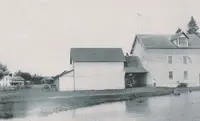
Thompson's Mills State Heritage Site
Shedd, Linn County, Oregon. State Heritage Site.
Details

- Where
- 32655 Boston Mill Drive, Shedd, OR 32655. Directions
- When
- Guided tours Monday-Thursday at 11 a.m, 1 p.m., 2 p.m. and 3 p.m.; Friday-Sunday on demand 9 a.m.-4 p.m.
- Season
- Open daily except Thanksgiving, Christmas and New Years Day.
- Getting there
- Just off state Highway 99 West, about six miles south of the town of Tangent.
- Fees
- Free.
- Hours
- Open daily, 9:00 a.m. - 4:00 p.m.
- Access
- Flash photography and tripods allowed inside; follow safety barriers and ropes.
- Walk-in or reserve
- Walk-in; groups of 10 or more call in advance.
- Website
- oregonstateparks.org
- Managed by
- Oregon State Parks & Recreation Department.
- Established
- 1858.
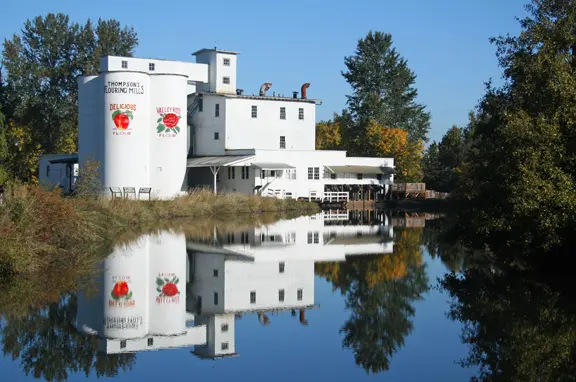
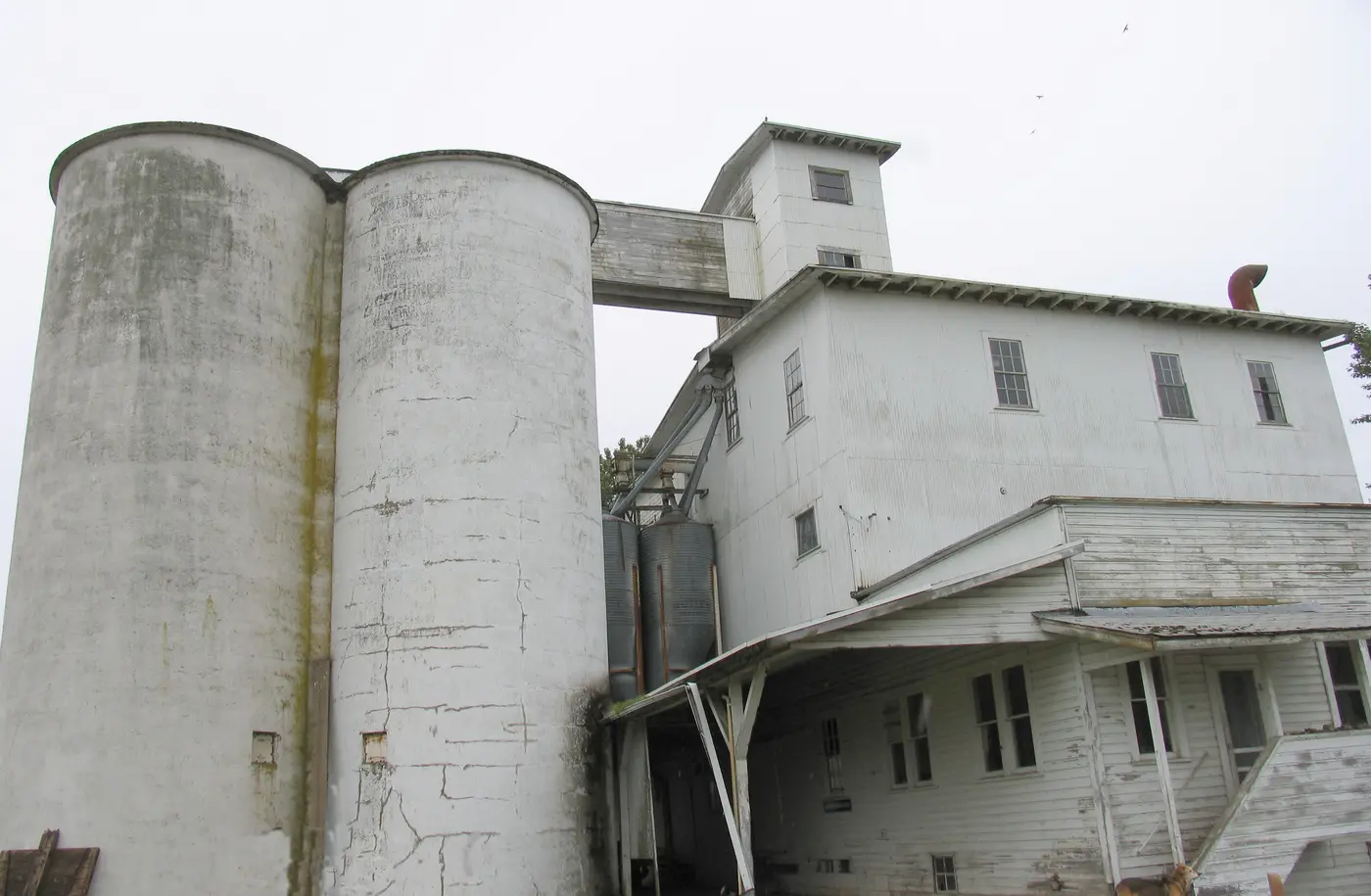
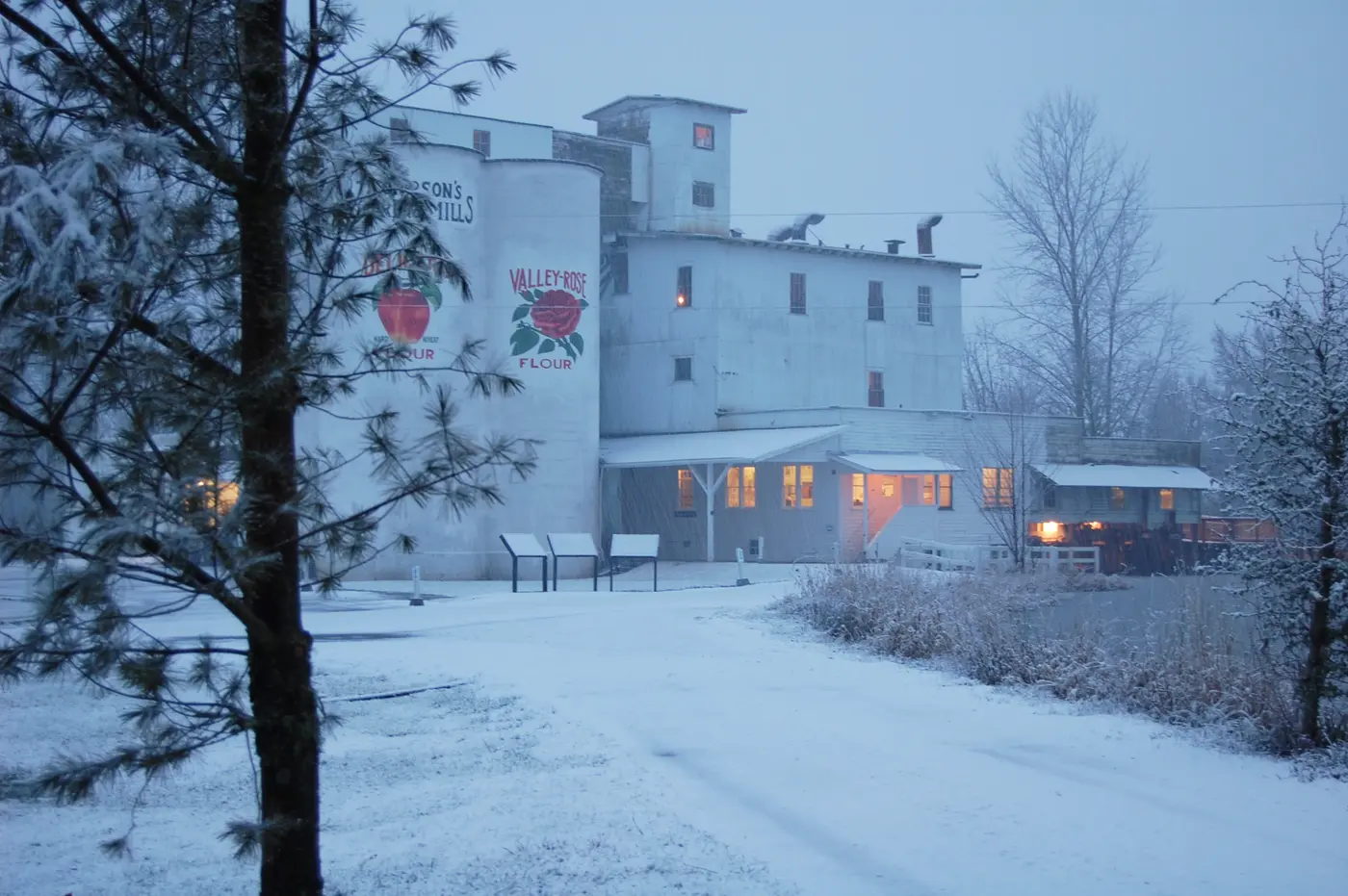
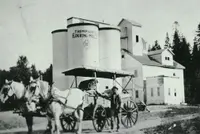
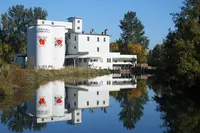
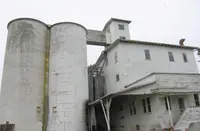
Four concrete silos, each 50 feet tall, rise above the farm fields of Linn County east of Shedd. A giant apple and a giant rose are painted on them. Below the silos the Calapooia River runs past Thompson’s Mills, a six-floor, 23,000-square-foot mill building on a 20-acre site that the Oregon Parks and Recreation Department keeps as a State Heritage Site. Beside the mill stand the 1904 Queen Anne house, a carriage house, a hay barn, a service bay, and a garage and shop.
On guided tours the interpreters let the water in. A water right that predates statehood sends the river rushing into the flume to the turbines, and the machinery starts its clanging and hammering. The mill runs empty and makes no product. On most tours it is shown running both ways, on water and on electric power. The main frame is hand-hewn timber, raised one story at a time with mortise and tenon joints and wooden pegs. The interior walls are unfinished studs with the backs of the siding showing, and they are painted white. “Reach over and put your hand on that beam,” Park Ranger Tom Parsons writes that guides tell visitors. “It was installed when Abraham Lincoln was president.” By Parsons’s count, Thompson’s Mills is one of three water-powered mills on the West Coast and the only one that is largely original. A case holds some of the mill’s old products, Thompson’s Best flour among them. Maps inside carry pins for visitors’ homes. By May 2014 they marked every state, Washington, D.C., and 41 foreign countries.
Photographers bring tripods inside, and painters set up easels on the grounds. The mill race in front of the building and the tail race and river behind it are open to fishing under state rules, and the race banks serve for practicing fly casting. Children, Parsons writes, see the apple and rose on the silos, “but then notice the poultry and get distracted.” The mill keeps flocks of chickens, turkeys and geese.
Parsons’s own reports run to smaller things. On the third floor the mill’s original north wall meets two later additions and forms a dark, formerly damp pocket that he calls “The Nook.” Over several summers he worked there with Park Ranger Assistants Matt Moritz and Thonni Morikawa. They scraped, primed and painted the old-growth siding, which was 99 percent intact, and hung gutters to stop the water splashing from the roofs above.
Cider days on the mill grounds
The geese eat well in the fall. The Thompson’s Mills Preservation Society held its first public apple pressing on a Sunday in early November 2017. Before then, the society’s Don Lyon told the Albany Democrat-Herald, an average Sunday might bring three or four tourists. That afternoon cars jammed the small parking lot. The society had bought a Correll cider press from a family in Veneta that builds them. Volunteers washed the apples in a mild bleach bath and rinsed them over a metal screen. Visitors then threw them into the grinder until the wooden bucket below was full, and Lyon slid the bucket under the press for others to turn the crank. The squashed apple bits went to the poultry. Lyon filtered the juice through a colander, and longtime volunteer Carl Browning pumped it into half-gallon jugs. “Liquid gold,” Lyon said as he poured. “It’s amazingly successful,” Browning said. “I’ve never seen the parking lot that full.”
The society scheduled three pressings for 2026: September 5, October 10 and October 24. The September day used about 1,200 pounds of apples, mostly Smitten, Initial and Honeycrisp. That was half again the usual single bin of 800 pounds, swelled by a surplus left over from an earlier event in Brownsville. Pressing starts at 11 a.m. and goes until the apples run out. The October newsletter puts that at about 2 p.m., the society’s website at about 3. Tastings are free, and jugs go for a $5 donation. Volunteers help the children turn the press while docents give tours of the mill.
Savage’s water and Finley’s mill
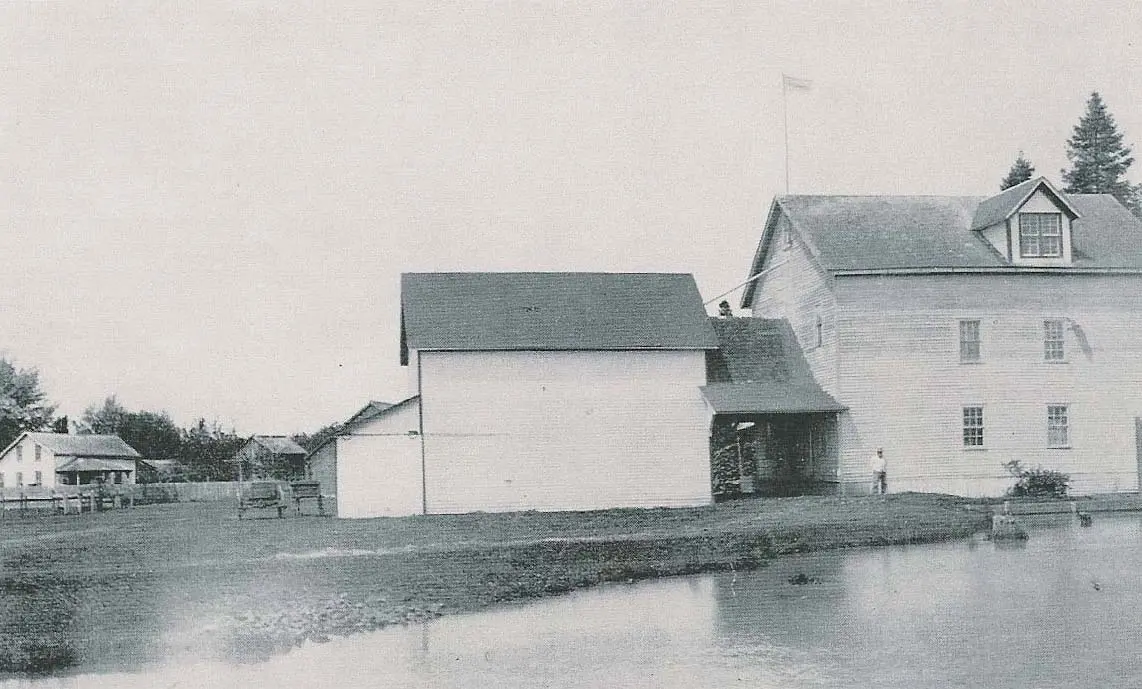
The water came before the mill. Americus Savage was living in Maine when he learned of the Oregon Donation Land Claim Act. He crossed the Missouri with his pregnant wife, Mary Ann, and five children, and the wagon stopped on the trail for the birth of a son, Columbus. Savage chose an L-shaped lot on the Calapooia and built a cabin. In the family’s account they “finally landed at [the] little cabin home, with a puncheon floor, a dirt fireplace, on the 25th day of December.” They grew wheat. In 1858 financial hardship forced the Savages to sell to Richard Finley “three and a half acres of land more or less and also the privilege of using all the water that may run or that they may cause to run through our land claim.” Finley also bought water rights from Robert Elder, who owned land on the far bank. The 1858 territorial right was for 35 cubic feet per second.
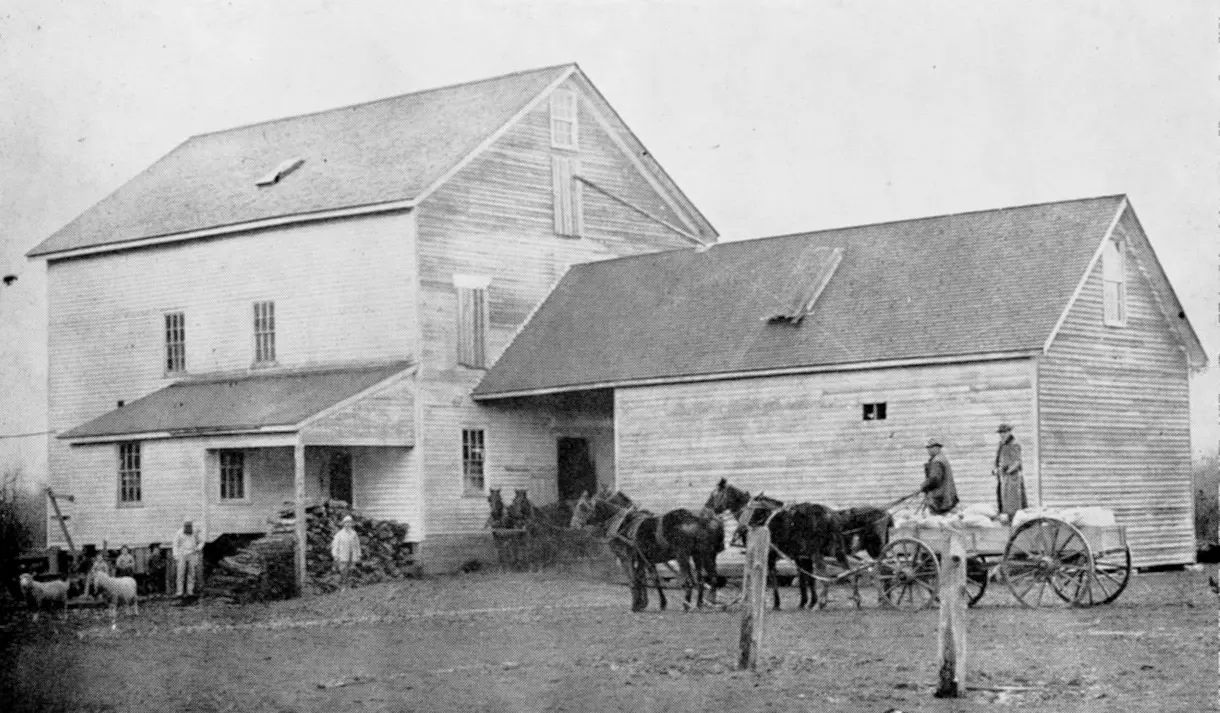
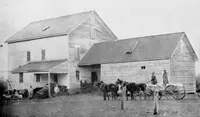
Finley had come to Oregon by wagon train in 1846 and had built two mills near Crawfordsville. His partners were Alexander Brandon, a carpenter, and Philemon Crawford, whom the 1979 National Register nomination names as the founder of Crawfordsville. The beams are said to have been hand hewn in Crawfordsville and floated down the Calapooia to the site. The partners placed the mill on the valley floor, near the farms that grew the grain. That location meant a five-mile water course was needed to get enough drop, with three dams, a millrace, headgates, a flume and turbines.
They called it Boston Mills, and nobody is sure why. In a 1939 Works Progress Administration interview, farmer John Cornett said the name followed a dispute that ended in a fistfight on top of a butte, a fight known afterward as “the battle of Bunker Hill.” The WPA interviewer added: “Whether Boston was named because it was near Bunker Hill, or Bunker Hill because it was near Boston, this field worker has been unable to definitely learn from any source.” Oregon Geographic Names guessed that a proprietor came from Massachusetts. Historian Kristine Deacon calls that unlikely, since Finley came from Tennessee and Brandon and Crawford from Indiana.
The mill sold flour to neighboring farmers and to miners headed for the California gold fields. Deacon writes that Crawford ran it south on pack trains and cleared a thousand dollars a trip. On the evening of October 25, 1862, by Deacon’s date, Boston Mills burned to the ground. One account puts the start of the fire in a separate wool-carding building, another puts the carding machine inside the mill. A University of Oregon archaeology team later found no sign of a separate carding building. The present 45-by-60-foot core went up in 1863 with two Perfection water turbines.
The town the railroad passed
The partners laid out the town of Boston about 75 feet west of the mill. The Oregon Encyclopedia and the preservation society date the plat to 1861, the National Register nomination to 1862. In 1866 miller William Simmons bought out Brandon and Crawford, and Internal Revenue tax stamps from the Civil War are still affixed to the handwritten contract. By 1869 Boston had a post office with Simmons as postmaster, two general stores and a blacksmith. The society counts about eighty people in the vicinity. Deacon describes about twenty families, a stagecoach stop, a school and a brick factory.
Then Ben Holladay built the Oregon and California Railroad up the valley. Deacon writes that citizens of Albany and Eugene paid to bring the line through their towns, and Boston could not or would not pay. In August 1871 Chinese laborers laid track a mile and a half to the west. Boston’s residents moved to the new Shedd’s Station and took their houses with them, and the Shedd’s Station post office opened on August 28. Only the mill was left. It survived by hauling its flour to a warehouse beside the tracks. The panic of 1873 cut into its trade, and ownership changed hands several times.
In 1891 Volquart (Martin) and Sophia Thompson, German immigrants, arrived with their children. The Oregon Encyclopedia counts six children and Deacon seven. Martin had worked at mills in Champoeg and Turner. The sources disagree about one piece of paper from that year. Finn J.D. John writes that staff at the mill point out the 1891 deed by which the Oregon Land Co. sold the mill. One of its witnesses was a 17-year-old office boy who signed “Bert Hoover,” and since he was a minor, John writes, the deed’s legality “is a bit questionable.” Deacon describes the deed as Thompson’s purchase of a lot in Salem. In her account it was signed by company president H.J. Minthorn and witnessed by his nephew and clerk, the future president.
Thompson bought a half interest in 1891 and became full owner in 1897. He replaced the French buhr stone with steel roller mills, renamed the place Boston Roller Mills, and printed the name on his flour sacks. An 1899 advertisement in The Brownsville Times announced “’pride of oregon’ flour, ‘white corn meal,’ Bran, Shorts, Chop. Graham flour a specialty.” Days after the 1906 San Francisco earthquake he gave ten barrels of flour to the relief effort. In 1904 he built the Queen Anne house on a dry-laid foundation of stone quarried in the Cascades. It has a square tower over the entry porch and hand-turned porch posts. The house served as both the family home and a rooming house for mill hands, and a 1910 addition took it from four bedrooms to eight. Under its wallpaper the shiplap walls were lined with flour sacks, which park staff found when they stripped the paper.
Silos, a war, and feed
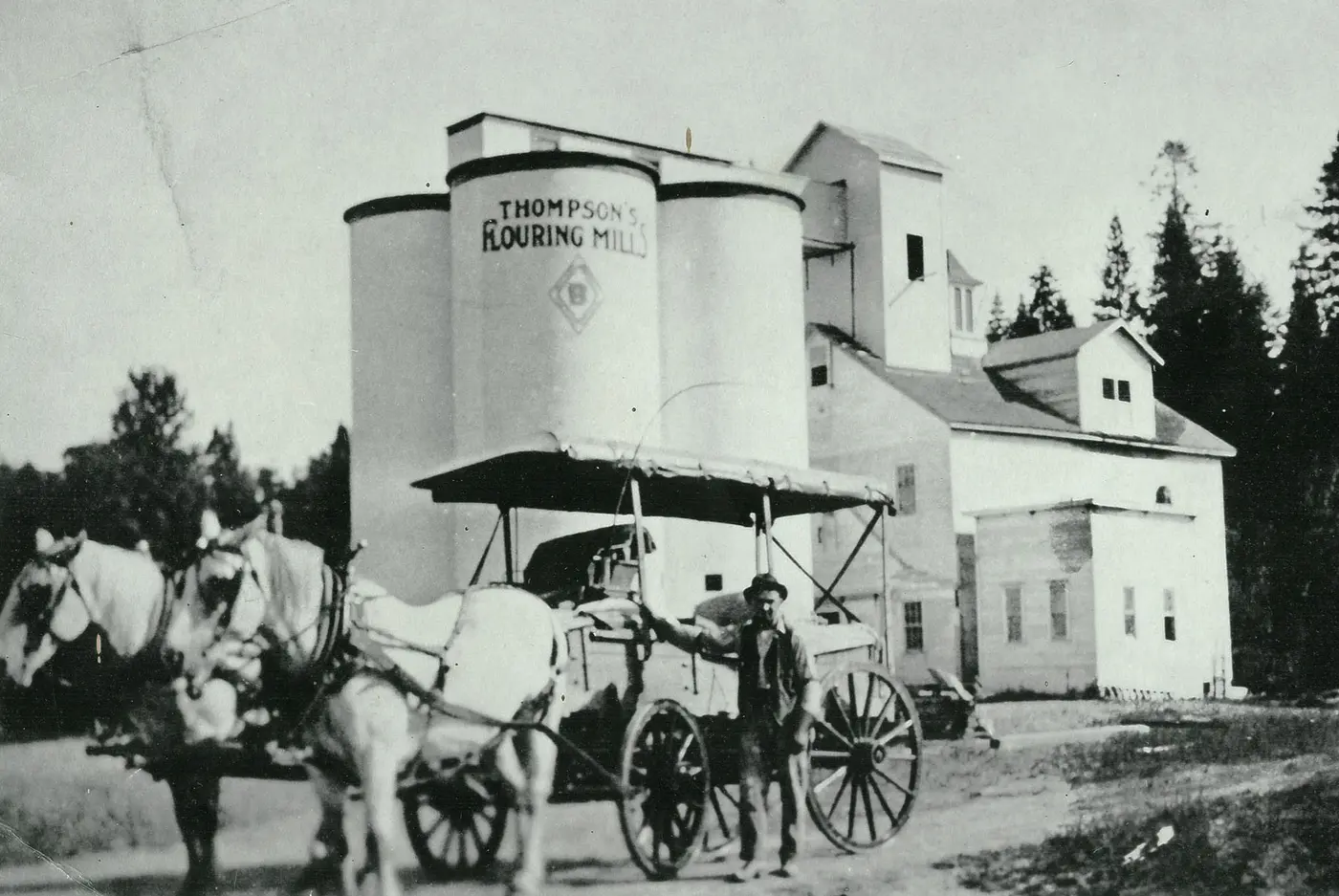
Martin Thompson died in 1910. The Oregon Encyclopedia says Sophia and their sons Otto, called Ott, and Leo inherited the mill and named it Thompson’s Flouring Mills. Deacon says Ott and Leo got it and called it Thompson Bros. & Co. The society’s timeline has Ott adopting the Thompson’s Flouring Mills name in 1918. The flour went out as Valley Rose, Thompson’s Best and Cream of the Valley.
In the spring of 1917 Ott hired the Burrell Construction Company to build the four silos, with six-inch walls and room for 40,000 bushels. Merle Thompson said they were the first concrete silos in the central Willamette Valley. They let the mill store hard winter wheat from eastern Oregon and run all twelve months. That same year the United States entered World War I, and Herbert Hoover’s Food Administration bought flour for relief in Europe. “The place was running 24 hours a day,” John writes. The ledgers show it was the mill’s most profitable period.
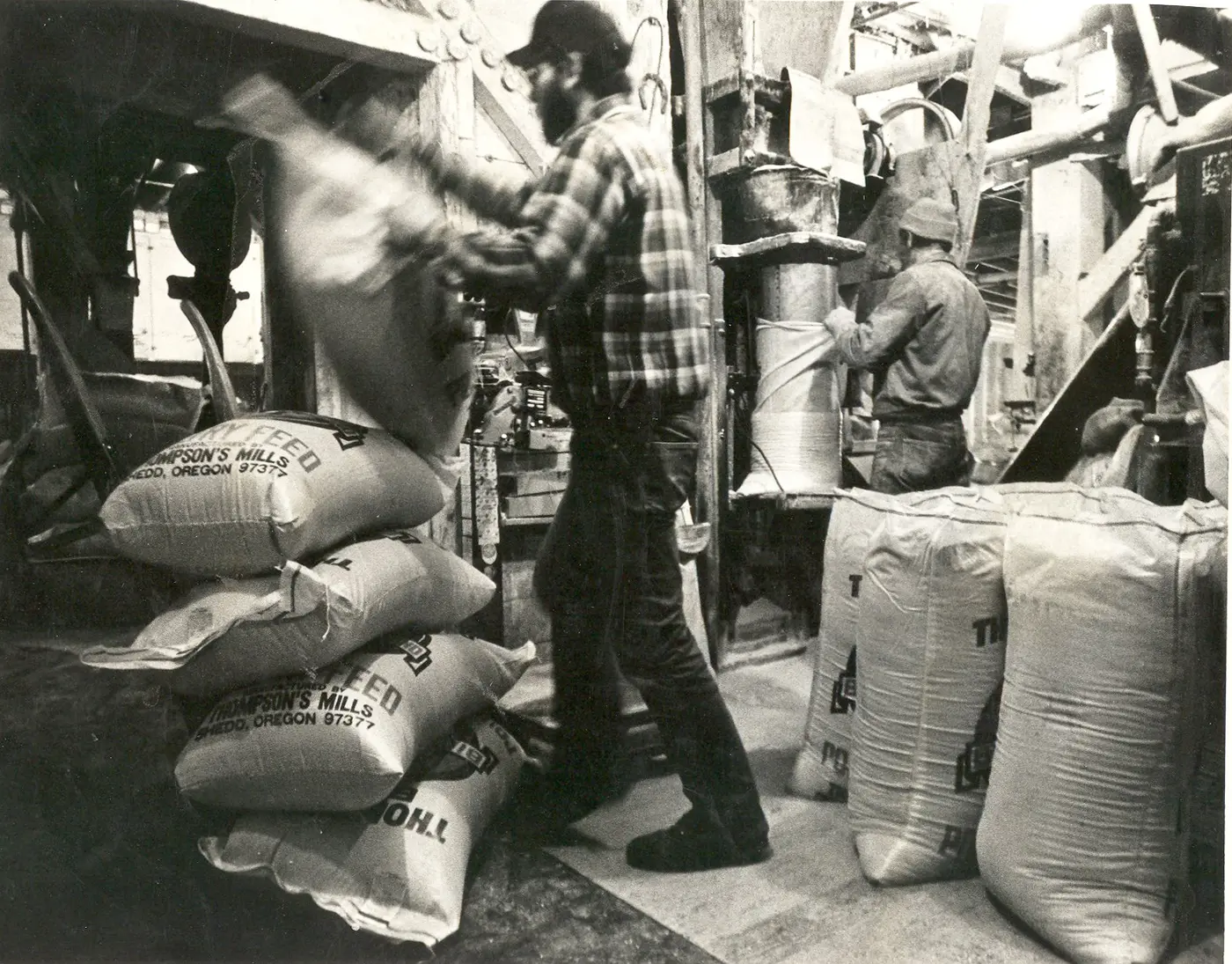
The mill ran on water alone until 1941. The sources date the end of flour differently. The Oregon Encyclopedia says the mill had turned to animal feed by 1940. The society’s timeline says wheat flour stopped in 1946, when a fully water-powered pellet mill was bought. The 1979 nomination says flour milling ended in 1955. Interstate 5 went through less than a mile east in 1959. After Ott died in 1965 his son Myrle ran the business as Thompson’s Mills Inc. In 1974 the family sold to Merlene and Jim Danaher, after about eight decades.
On June 22, 1979, a section of concrete flume wall gave way. The nomination says the wall had little iron reinforcement and stood on improper footings, and the society’s timeline blames water mismanagement. About a quarter of the mill’s floor space fell into the water and production dropped by about half. The mill went onto the National Register on August 21 of that year, and repairs were made the same year.
From power sales to a state park
In 1986 the owners, by then David and Merlene Babits, put a generator online and began selling the mill’s waterpower to Pacific Power and Light. The 20-year agreement made up for failing feed sales. Floods in 1996 damaged the gates and the 1916 Leffel turbine, which was replaced with a Thomas Bros. turbine. In those years the science-fiction film Timescape, starring Jeff Daniels, was filmed at the mill.
In the fall of 1993 Bill and Ellen Lilja called a meeting titled “Beyond the Ruts” on saving Linn County’s old buildings. Some who came stayed afterward to talk about the mill, whose owners could not afford its repairs and wanted to sell. Among them were Martin Thompson, a family descendant, and Glenn Harrison of the county historical society. They incorporated the Boston Mill Society on June 6, 1994. County Commissioner Richard Stach found grant money for a feasibility study on heritage tourism. Peter Jensen attended the meetings for the farmers along the river, and the group followed the governor’s efforts on what Harrison calls the “fish problem” in the Calapooia.
In May 2004 the state bought the property for $856,547, plus $15,000 for artifacts and equipment. The mill opened as a park after three years of safety and structural work. In 2005 the power agreement ended, the old Thompson warehouse in Shedd was torn down, and the state sold 12 of the 1858 water right’s cubic feet per second to help the river. Sodom Dam and Shearer Dam have since been removed. In 2013 an adjustable dam was installed, which lets fish pass and the river drain after winter rains while keeping the mill race full enough to demonstrate milling year round.
Notable Events
- 1856Finley partnered with Philemon V. Crawford and Alexander Brandon to build Boston Mills. tmpsonline.org
- 1858Finley bought dam-building rights and Territorial Water Rights; Boston Mills opened. tmpsonline.org
- 1861The town of Boston was platted. tmpsonline.org
- 1862Fire is said to have originated in the adjoining carding factory; the mill was soon rebuilt with hand-hewn beams. npgallery.nps.gov
- 1862The first mill burned down. tmpsonline.org
- 1863The present building was built after the original burned the previous year. npgallery.nps.gov
- 1863The mill was rebuilt with two Perfection water turbines; William Simmons built the keeper's house. tmpsonline.org
- 1866Crawford and Brandon sold their shares to William Simmons. tmpsonline.org
- 1869Simmons became Boston's postmaster; approximately eighty people lived in the vicinity. tmpsonline.org
- 1871The post office move dealt the death blow to Boston. npgallery.nps.gov
- 1871Oregon and California Railroad established a new stop at Shedd's Station. tmpsonline.org
- 1872The mill opened a warehouse adjacent to the railroad. tmpsonline.org
- 1875Simmons sold shares to Al and Ed Simmons. tmpsonline.org
- 1887Simmons bought back his shares. tmpsonline.org
- 1890sThompson supplemented light mill stones with steel roller mills. tmpsonline.org
- 1891The newspaper identifies a mill deed witnessed by the minor office boy Bert Hoover, saying legality is a bit questionable. mckenzieriverreflectionsnewspaper.com
- 1891A steel roller mill capable of white flour was installed. npgallery.nps.gov
- 1891Finley sold shares to Stan and Alice Noel, who sold them to Martin Thompson three months later. tmpsonline.org
- 1897Martin Thompson bought out William Simmons. tmpsonline.org
- 1900A small south dormer was added for sifting equipment. tmpsonline.org
- 1903A turbine-powered DC generator was installed in a fire-proof room on the first floor. tmpsonline.org
- 1904The Queen Anne house was built next to the mill for its owning family. npgallery.nps.gov
- 1907The old Simmons house came down. tmpsonline.org
- 1910A west addition increased bedrooms from four to eight. npgallery.nps.gov
- 1910Sophia, Otto and Leo formed a partnership after Martin died; the name eventually changed to Thompson's Flouring Mills. tmpsonline.org
- 1910The dormer enlarged, a north loading extension and cupola were added, and a water tower built. tmpsonline.org
- 1914The mill operated around the clock during World War I, with peak flour production. tmpsonline.org
- 1916A Leffel turbine was installed. tmpsonline.org
- 1917Storage moved northwest, four silos replaced it, and the mill roof was raised with a tower added. npgallery.nps.gov
- 1918Ott renamed the mill Thompson's Flouring Mills; a Shedd shipping warehouse was built. tmpsonline.org
- 1930Ott's son Myrle became a partner. tmpsonline.org
- 1930sTransport switched from horses and wagons to steam and then gas-powered trucks. tmpsonline.org
- 1930sConcrete replaced the wooden flume to increase power capacity; tail-race walls and foundation piers were added. tmpsonline.org
- 1933Concrete replaced the rotted flume, gates were added, and the mill raised for a concrete foundation. npgallery.nps.gov
- 1933The warehouse expanded, a flume-side office was built, the roof elevated for a third floor, and water rights secured. tmpsonline.org
- 1940A small one-story flat-roofed storage building was added over the floodgate and race. npgallery.nps.gov
- 1946The mill ceased producing wheat flour and bought a fully water-powered pellet mill. tmpsonline.org
- 1955Competition from larger companies ended flour milling; livestock feed expanded. npgallery.nps.gov
- 1957All Calapooia water rights were formally adjudicated. tmpsonline.org
- 1959Interstate-5 was constructed less than a mile east of the mill. tmpsonline.org
- 1965Myrle assumed management under a corporation with Sylva and Orval; the name became Thompson's Mills Inc. tmpsonline.org
- 1973Martin's heirs conveyed the entire mill to James and Merlene Danaher. npgallery.nps.gov
- 1977Merlene Danaher became sole owner. npgallery.nps.gov
- 1979The property was individually listed on the National Register. heritagedata.prd.state.or.us
- 1979A load-bearing wall collapsed and approximately a quarter of the floor space fell into water. npgallery.nps.gov
- 1986David and Marlene Babits installed a generator and began selling the mill's waterpower to Pacific Power and Light Company. oregonencyclopedia.org
- 1986A generator went online and a twenty-year agreement supplemented failing feed revenues. tmpsonline.org
- 1993Beyond the Ruts meeting led to organizing to preserve Thompson's Mills. tmpsonline.org
- 1994Tax-exempt recognition became effective. tmpsonline.org
- 1994The preservation organization incorporated with the state. tmpsonline.org
- 1996Floods damaged gates and a turbine; a Thomas Bros. turbine replaced the Leffel and repairs began. tmpsonline.org
- 2004OPRD bought the property in May 2004 and opened Thompson's Mills State Heritage Site after three years of safety and structural upgrades. stateparks.oregon.gov
- 2004Oregon Parks and Recreation purchased the site for rehabilitation and care. storymaps.arcgis.com
- 2005The power agreement ended, the Shedd warehouse was demolished, and OPRD sold part of the old water rights for river health. tmpsonline.org
- 2009Society hosted SPOOM conference including a refurbished roller-mill workshop. tmpsonline.org
- OPRD commissioned an appraisal, then bought the site and water rights the following year. ohs.org
- Staff learned to operate machinery and catalogued artifacts while converting the site. ohs.org
- A university team could not find signs of a separate wool-carding building. ohs.org
- Park staff found flour sacks used as wallpaper lining. ohs.org
- The mill opened to the public as a state park. ohs.org
- The partners renamed the company Thompson's Flouring Mills. ohs.org
- Merlene Manning Danaher and Jim bought the mill compound. ohs.org
- The retaining wall collapsed, destroying part of the first floor. ohs.org
- Ott connected to Mountain States Power Company's grid. ohs.org
- William Simmons bought Brandon's and Crawford's shares. ohs.org
- The mill burned to the ground; its cause is unclear. ohs.org
- Voters authorized the Calapooia Irrigation District. ohs.org
- Financial hardship forced the Savages to sell land and water-use privileges to Finley. ohs.org
- Savage chose a Calapooia lot, built a cabin, and brought his family there. ohs.org
- The firm's later letterhead claimed a first premium at Goldendale. ohs.org
- The mill's advertising claimed a diploma at the Oregon Industrial Exposition. ohs.org
- Martin and Sophia arrived with their children as Oregon entered the Asian Rim flour trade. ohs.org
- Thompson became sole owner; the family held the company for three generations. ohs.org
- The mill was also processing corn, oats and barley. ohs.org
- Sophia Thompson died. ohs.org
- Orval became the mill's lawyer and worked for J.K. Weatherford. ohs.org
- Depression-era ledgers increasingly noted sacks sold at cost. ohs.org
- Stricter requirements led to the mill ending flour manufacturing. ohs.org
- Orval proposed farmers pay the mill's electricity bill in return for summer river water. ohs.org
- Dave Babits signed a power-sale contract; it later expired while fish-safety verification was delayed. ohs.org
- All full-time staff were laid off. ohs.org
- The science-fiction film starring Jeff Daniels was filmed at the mill. ohs.org
- The Babitses sought acquisition through a feasibility study and senate bill without success. ohs.org
- Measure funds increased OPRD funding before later mill acquisition. ohs.org
- Governor Kitzhaber encouraged a Thompson's Mill Working Group to plan Calapooia water use. ohs.org
- Thompson's Queen Anne house was both family home and employee rooming house. ohs.org
- Leo left his half to Ott's oldest son Myrle. ohs.org
- Ott hired Burrell to build four concrete silos, enabling year-round operation and eastern Oregon wheat purchases. ohs.org
- Merlene married Dave Babits; they were the last private owners. ohs.org
People
- Carl Browning, Longtime mill volunteer who filtered pressed cider.
- Don Lyon, Filtered pressed cider with Carl Browning.
- Herbert Hoover, Food Administration head organizing allied food relief.
- Alex Brandon, Partner in building buhr mill.
- James Danaher, Received ownership with Merlene (1973).
- Martin Thompson, Descendant in founding preservation group; later society president (12 years as president).
- Merle Thompson, Reported silos were the central Willamette Valley's first concrete silos.
- Merlene Danaher, Sole owner (1977).
- Philemon B. Crawford, Partner in building buhr mill; founder of Crawfordsville.
- Richard C. Finley, Mill builder.
- Americus Savage, Earlier holder of mill land who learned of the Donation Land Claim Act.
- Benjamin Holladay, Railroad builder whose line bypassed Boston (8).
- Bert Hoover, Office clerk who witnessed Martin's Salem land deed.
- Caddie Thompson, Ott's sister-in-law; died of influenza-related heart failure.
- Charles Stricklin, State Engineer who suggested an irrigation district.
- Charles, Caddie Thompson's husband in Shedd.
- Columbus, Savage son born during the family's journey before settling mill land (85).
- Dave Babits, Last private owner with Merlene, whom he married (99).
- H.J. Minthorn, Oregon Land Company president who signed Martin's Salem deed.
- Jeff Daniels, Star of Timescape, filmed at mill (992).
- John A. Crawford, Financial backer of partnership; Philemon's brother.
- John Cornett, Farmer and source of speculative mill-name account.
- John Kitzhaber, Governor encouraging mill working group.
- Kees Ruurs, Park staffer stripping keeper's-house wallpaper (2).
- Leo, Martin's son; operating partner with Sophia and Otto (1910).
- Margriet, Park staffer stripping keeper's-house wallpaper (2).
- Martin E. Thompson, Grandson of mill patriarch who assisted the history article.
- Mary Ann Savage, Sold mill property and water privileges with Americus (858).
- Merlene Manning Danaher, Bought mill with Jim (July 94).
- Myrle, Ott's son who became partner (1930).
- Orval, Member of corporation managing mill (1965).
- Otto (Ott), Inherited company with Leo and renamed it (9).
- Polly Ann Kirk, Richard Finley's daughter who gave a WPA account of the mill.
- Robert Elder, Sold Finley water rights from across the Calapooia.
- Ron Townsend, Ott's son-in-law and beneficiary of mill interest (95).
- Roy McNeil, Former employee who recalled Ott's reluctance to pay an electric bill (94).
- Sophia Thompson, Mill operator in partnership with sons Otto and Leo (1910).
- W.K. Caldwell, Boston plat owner (8).
- Woodrow Wilson, Created Food Administration whose relief program brought mill business.
- David Babits, Owner who installed a generator and sold the mill's waterpower (1986-2004).
- Marlene Babits, Owner who installed a generator and sold the mill's waterpower (1986-2004).
- Al Simmons, Buyer of Simmons's mill shares (1875).
- Alexander Brandon, Partner in building Boston Mills (1856-58).
- Alice Noel, Bought Finley's shares, then sold to Martin Thompson (1891).
- Ed Simmons, Buyer of Simmons's mill shares (1875).
- Jim Danaher, Purchased mill with Merlene (1974).
- Ott Thompson, Renamed mill Thompson's Flouring Mills (1918).
- Otto, Martin's son; operating partner with Sophia and Leo (1910).
- Philemon V. Crawford, Partner in building Boston Mills (1856-58).
- R.C. Finley, Miller whose Crawfordsville mill preceded the Boston Mills partnership (1847-48).
- Sophia, Martin's wife; formed operating partnership with Otto and Leo (1910).
- Stan Noel, Bought Finley's shares, then sold to Martin Thompson (1891).
- Sylva, Member of corporation managing mill (1965).
- William Simmons, Builder of keeper's house (1863).
- Anne Catlin, Preservation-board standout and Albany historic-resources staff member.
- Bill Lilja, Initial society president (2 years).
- Brooks Cavin, Society president involved with historic architecture and university field school (2 years).
- Connie Petty, Participant in initial preservation meeting.
- Ellen Hamill, Preservation-board standout providing photographic art cards.
- Ellen Lilja, Co-convened meeting that led to preservation organizing (1993).
- George Pugh, Area farmer and longtime board member.
- Glenn Harrison, Historical Society president in founding group; later BMS president (3 years as president; board/officer through 2014).
- Kent Hickham, Attorney who drafted initial bylaws.
- Peter Jensen, Represented farmers' concerns at society meetings.
- Richard Stach, Commissioner helping secure feasibility-study funding.
- Roy Thompson, Thompson family member and society president.
- Roz Keeney, Historic-architecture expert on preservation board.
Sources
- stateparks.oregon.gov/index.cfm?do=park.profile&parkId=186
- tmpsonline.org
- oregonencyclopedia.org/articles/thompson_s_mills
- centraloregondaily.com/destination-oregon/thompsons-mills-oregon-oldest-grain-mill-tour/article_98724f04-98e8-41f6-b5e6-73a0c69cc22b.html
- tmpsonline.org/history
- npgallery.nps.gov/GetAsset/80a923eb-da45-4399-89b3-814356f94641
- heritagedata.prd.state.or.us/historic/index.cfm?do=v.dsp_printRecord&resultDisplay=44258
- ohs.org/oregon-historical-quarterly/back-issues/upload/Deacon_Oregon-Places_Thompson-s-Mill_spread.pdf
- tmpsonline.org/welcome/boston-mill-society-a-brief-history
- storymaps.arcgis.com/stories/064c3205f1884aac80aabc42c8a6bc9d
- mckenzieriverreflectionsnewspaper.com/story/2026/07/02/history/oregon-helped-hoover-prevent-mass-starvation/9497.html
- democratherald.com/article_60fd4e0d-46fe-5afa-a7c9-40a07e8670a6.html
- oregonencyclopedia.org/articles/thompson_s_mills