This Is The Place Heritage Park
Salt Lake City, Salt Lake County, Utah. Living-history state park; Open year-round.
Details

- Where
- 2601 E. Sunnyside Avenue, Salt Lake City, UT 84108. Directions
- When
- Remaining 2026 bonus events: Little Haunts Oct. 9-10, 16-17, 23-24, 30-31; Christkindlmarkt Dec. 2-5; Candlelight Christmas Dec. 8-23 (Monday-Saturday, evenings).
- Fees
- No fee to enter the Utah State Park; Daily Experience Pass $25 per person (ages 2+), all-inclusive with train ticket; Fall Fun Pass $15 per person (ages 2+).
- Hours
- 9 a.m. - 5 p.m. daily; limited programming on Sundays.
- Access
- Free on-site parking; all events and demonstrations are family-friendly; plan at least a few hours.
- Phone
- 801-582-1847
- Website
- thisistheplace.org
- Managed by
- This Is The Place Foundation, a nonprofit organization.
A bronze rider swings from one horse to the next at the entrance to This Is The Place Heritage Park, on Sunnyside Avenue at the base of Emigration Canyon in Salt Lake City. The sculpture, by Avard T. Fairbanks, is the National Pony Express Monument. A replica Pony Express station and several wayside exhibits stand beside it. The riders it honors carried the U.S. Mail nearly 1,900 miles between St. Joseph, Missouri, and Sacramento, California, for 18 months, from April 1860 to October 1861. The park’s page reprints an advertisement it credits to an 1860 San Francisco paper: “Wanted: Skinny, young, wiry fellows not over eighteen, must be expert riders willing to risk death daily, orphans preferred.”
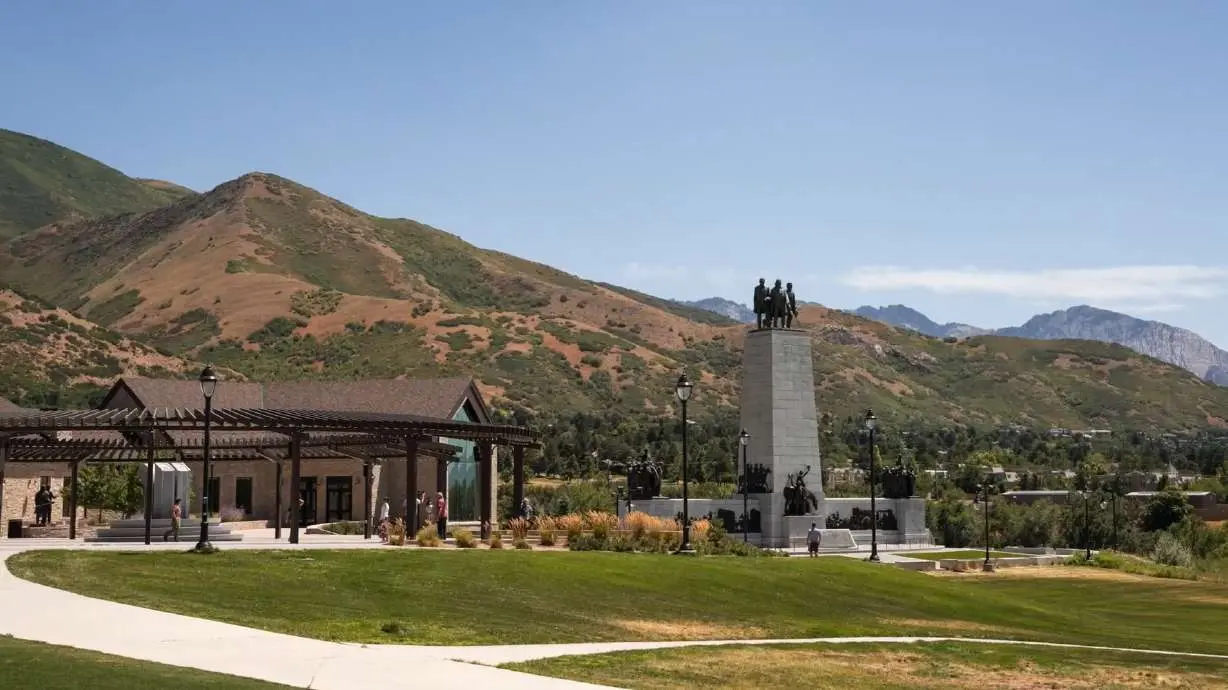
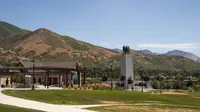
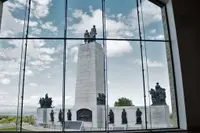
East of the rider, the Statuary Walk climbs toward the 60-foot This Is the Place Monument. Beyond the visitor center lies Heritage Village. The park covers 450 acres. It is a Utah state park, and since 1998 the nonprofit This Is The Place Foundation has run it. In the fall season of 2026, which ran from September 9 to October 31, the monument and grounds were open dawn to dusk every day with no fee to enter. The village experiences ran 10 a.m. to 5 p.m. Monday through Saturday and were closed Sunday. Utah State Parks counts over 60 original or replica structures in the village. The park’s own page says more than 50 shops, homes, and buildings.
Forge, press and spinning wheel
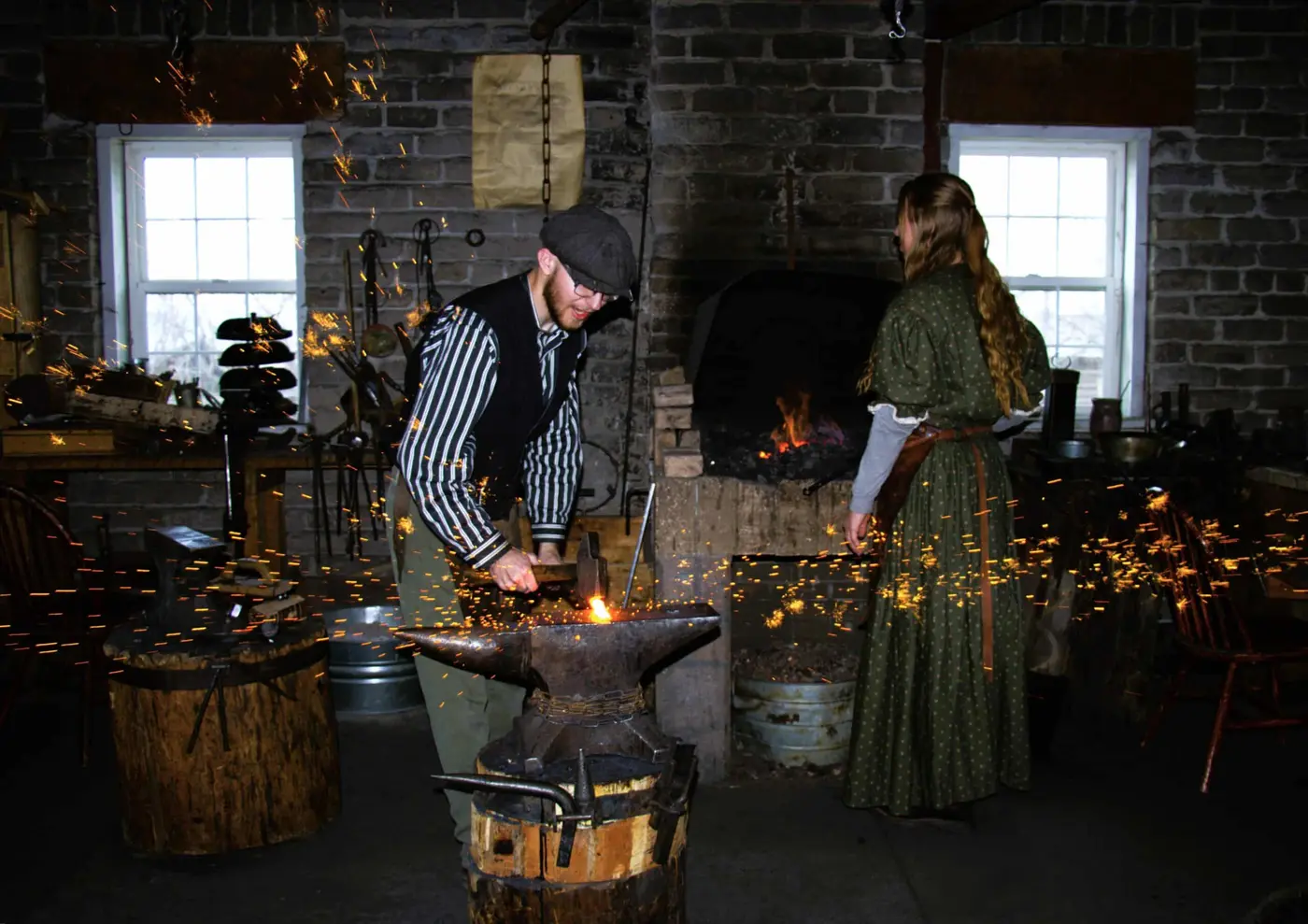
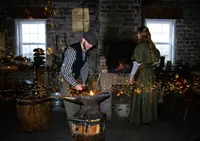
Costumed interpreters work the village’s shops. The blacksmith demonstrates forge, anvil, and hammer, and explains how pioneer smiths made and repaired farm equipment and tools. The park’s page warns visitors not to ask him about shoeing horses: “Blacksmiths didn’t shoe the horses; they left that job to the farmers!” At the Dinwoodey Furniture Shop, marked by a chair on its roof, a woodworker explains why settlers built furniture from local soft wood. Most furniture was too heavy to haul across the plains, so they painted the soft wood to look like eastern hardwood. At the Jewkes Home visitors card wool while a spinner turns it into yarn and describes the native plants used for dyes. The Deseret News Press prints a newspaper one page at a time on a sheet-fed press. In the Saddlery, a leatherworker shows how a deer or cow hide becomes a pouch or a saddle, and visitors stamp a leather piece to take home. A tinsmith works in the Staker Cabin.
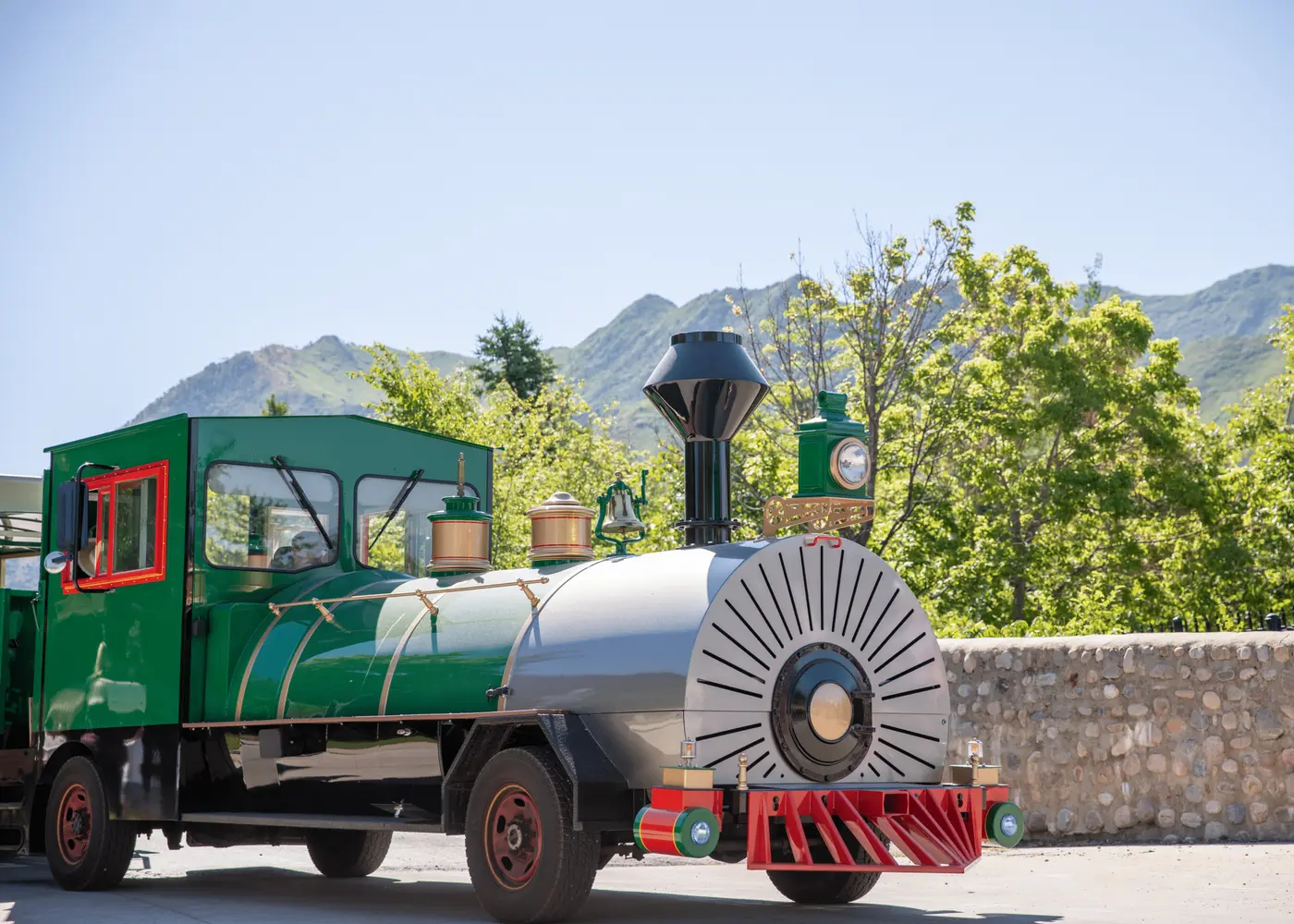
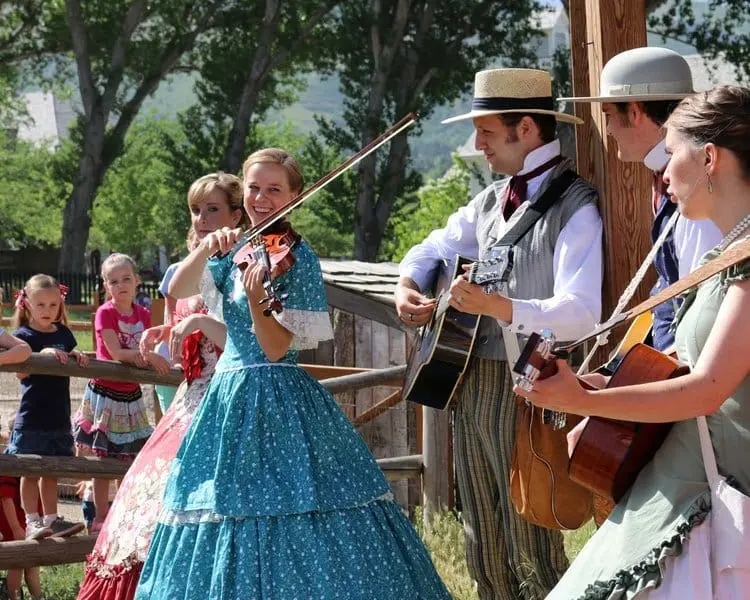
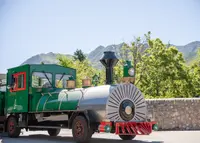
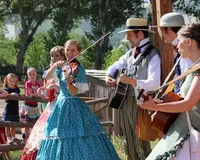
The rest of the village is built for hands. Visitors make rope, dip candles, pan for gold, and join a bucket brigade. Musicians play in the streets, and a train robbery is staged now and then. Four trains circle the park while conductors tell the history of Utah railroading. Children ride ponies and feed goats, sheep, pigs, and chickens in the petting corral. At the end of August 2026 the park offered six of its goats for sale, two doelings born that spring and four yearlings. On a hillside apart from the town, Navajo hogans and Shoshone teepees stand in a circle in the Native American Village. There visitors grind corn, string arrowhead necklaces, and watch Native American dancers. The park also lists demonstrations of weaving and pottery there.
At the Heritage Grill, Chef Todd Leonard serves locally sourced meat and produce, smoked and grilled on site, with salads, slaws, and fresh-baked treats. Brigham’s Donuts is open year-round. The village also has an Ice Cream Parlor and a ZCMI Kid & Candy Shop. In winter, hot cocoa is served at the Huntsman Hotel. The Gift Shop stocks handmade crafts and old-fashioned candies. Below it, the Mormon Battalion Museum is open daily with free admission.
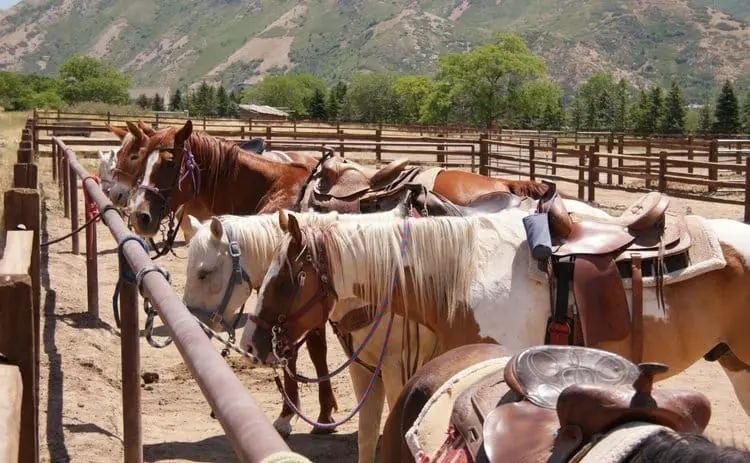
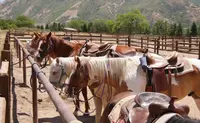
The calendar changes the sounds. On October 10 and 24, 2026, the band Halo Aura is booked for the Social Hall Stage at 12:30 and 2:30 p.m. Little Haunts runs Fridays and Saturdays from October 9 through 31, 2026, with trick-or-treating through the village, a costume parade, a Storytelling Witch, and Creature Encounters on Saturdays. At special events the Candy Cannon fires salt-water taffy. A German-style Christkindlmarkt is set for December 2–5, 2026, and Candlelight Christmas for evenings December 8–23, Monday through Saturday, with carolers in the streets and visits from Father Christmas. Guided horseback rides go out from the park into the foot of Emigration Canyon. In September 2026 the park urged riders to call “Cowboy James” while the leaves turned.
Bronze along the Statuary Walk
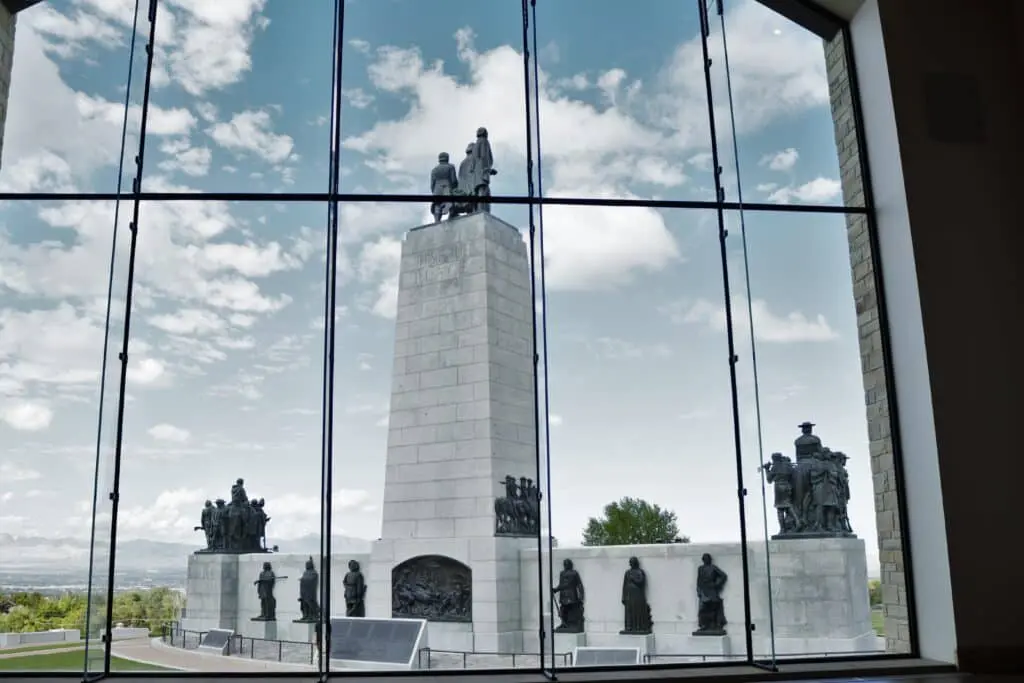
Brigham Young stands atop the center pedestal of Mahonri M. Young’s monument, with Heber C. Kimball to his north and Wilford Woodruff to his south. Orson Pratt and Erastus Snow appear at the base of the center column. They were the first of the scouting party to enter the valley, on 21 July 1847. Willard Richards leads the first wagon train on the north wing. Clarissa Decker Young, Ellen Saunders Kimball, and Harriet Page Wheeler Decker Young ride with the company, along with the boys Isaac Perry Decker and Lorenzo Sobieski Young. Horsemen flank the wings, among them Orrin Porter Rockwell on the north and John Pack and Jesse C. Little on the south. Other figures are carved in high relief on the east wings: Chief Washakie, Father Jan DeSmet, Peter Skene Ogden, Etienne Provost, Captain Benjamin Bonneville, and John C. Frémont. William Ashley of the Rocky Mountain Fur Company sits a horse. The Spanish expedition of Dominguez and Escalante, 1776, has its own group on the south pedestal. In 2004 foundation chairman Randon Wilson described the monument this way: “Of course the monument itself has the religious leaders on the top, but it also has miners, explorers and Indians at other places on it. Even the monument intended to portray a broader message.”
Smaller memorials line the walk. Duty Triumphs, by Steven L. Neal of Pendleton, Oregon, honors the Latter-day Saint men who enlisted in 1846 for the War with Mexico and marched 2,100 miles from Council Bluffs, Iowa, to Southern California. M. Russell Ballard dedicated it on August 21, 2010. The park quotes the battalion’s commander, Lt. Col. Philip St. George Cooke: “history may be searched in vain for an equal march of infantry.” Angels Are Near Us is a boulder from the original Salt Lake Temple quarry, given by the Sons of Utah Pioneers. Its bronze plaques name the people who re-enacted the 1847 trek at the sesquicentennial in 1997. There is a scaled copy of downtown’s Eagle Gate. On the west side of the Pioneer Center, the sculpture Eyes Westward shows Joseph Smith and Brigham Young talking over the move west. The Pioneer Children’s Memorial, dedicated in 2019, is a set of seventeen large stones engraved with more than six hundred names of children who died on the trail. Stefanie and Roger Hunt made more than 25 of its sculptures. A 2004 Deseret News account says the park’s children’s cemetery holds remains first buried near Pioneer Park downtown. Crews found the graves while digging for housing, and the remains were reinterred at the park.
A slab, a cross, an obelisk
The park tells its founding moment this way. On July 24, 1847, the first company of Mormon pioneers reached the mouth of Emigration Canyon. Brigham Young lay sick in a carriage. He raised himself on his elbow, looked west for several minutes, and said: “It is enough. This is the right place. Drive on.” The National Park Service adds that Mormon tradition holds he had a heavenly vision there. The words rest on Wilford Woodruff’s recollection in 1880 that Young spoke them from Woodruff’s carriage. They are not corroborated by the journals of 1847. Wallace Stegner wrote that Woodruff, 33 years later, either “resurrected or happily misremembered” them. The vista above the canyon was early called Pioneer View.
Marking the exact place took decades. In July 1915 a plain wooden slab marked the spot. That year a committee that included George Albert Smith and B.H. Roberts studied the location. A cross taller than a man followed in 1916, though park marketing director Tresha Kramer, who researched the first marker, also calls it the cross of 1915. On July 25, 1921, a 10-foot concrete obelisk was dedicated. The pioneer W.W. Riter spoke at the dedication. Old newspapers quote him remembering that Woodruff brought him to the spot, and he cited William Clayton’s 1848 Emigrants’ Guide in support of the location. For years the obelisk weathered in the weeds on the park’s east side. In 2007 the Mills Chapter of the Sons of Utah Pioneers refurbished it with Zachary Mahoney, a member’s grandson working toward his Eagle Scout award. Boyd K. Packer rededicated it on July 21 that year. The 2007 investigators found no scholarly agreement that the obelisk stands on the actual place, and thought agreement unlikely. A Utah Historical Society essay states that the monument’s site has been determined to be the spot.
The centennial of 1947
A committee of many area religious groups and the artist had worked on a larger monument for more than a decade. In 1937 a state commission representing various faiths chose Mahonri M. Young to design it. Taylor Woolley was the architect and Daniel McCarthy the granite contractor. The monument was dedicated on the pioneer centennial, July 24, 1947. Salt Lake’s Catholic bishop, Duane G. Hunt, first vice chairman of the commission, was the first speaker. Rabbi Alvin S. Luchs of Temple Israel also spoke, and retired Episcopal bishop Arthur W. Moulton gave a eulogy. J. Reuben Clark delivered an address titled “The Pioneers.” Former Salt Lake mayor Ab Jenkins arrived with Lowell Horton, mayor of Nauvoo. A Scout troop from Eureka took part.
Sixty years later Packer described that day. He had come with Donna Smith, the recent Peach Queen of Brigham City, whom he would marry four days later in the Logan Temple. His parents were finishing a Sons of Utah Pioneers automobile trek from Nauvoo that ended that day at the new monument. The cars were fitted on each side with wooden oxen and topped with hoops and covers to look like covered wagons. Before leaving, his father had painted “EJP” on one ox and “IWP” on the other, the initials of Emma Jensen Packer and Ira W. Packer. He pronounced the couple “the best team that ever pulled together this side of eternity.” Packer remembered George Albert Smith, who dedicated the monument, as “a tall, dignified, saintly man whose dream had been to have the monument built.”
A foundation and a wider frame
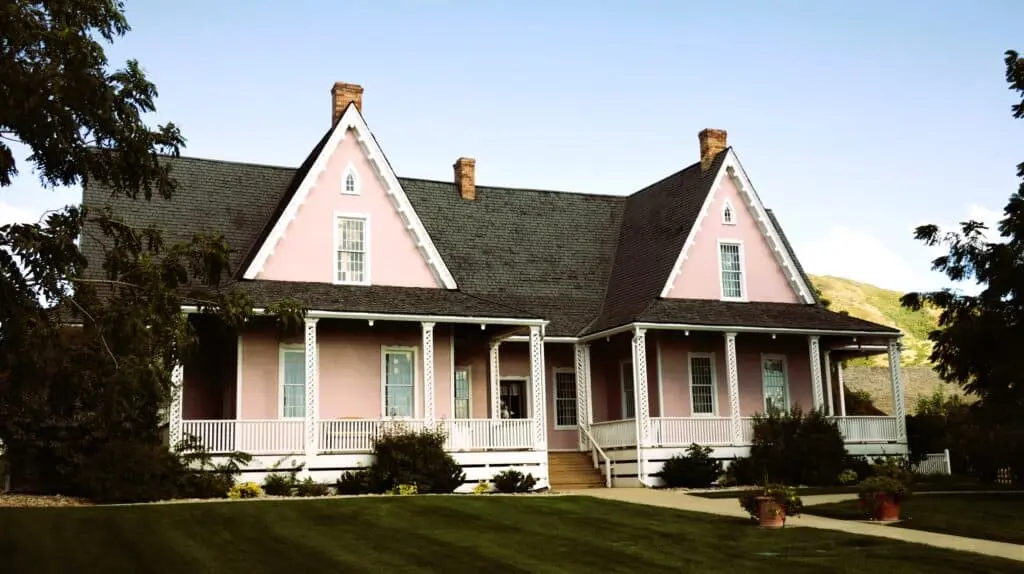
When the monument went up, the 450 acres had been slated for development, and some homes were already built. According to Wilson, LDS Church leaders bought out the subdivision, moved the homes, and gave the land to the state, with the agreement that the Legislature would fund its operation. The park opened in 1957 as Pioneer Trail State Park, a monument and museum dedicated to Mormon pioneers. The Division of Parks and Recreation managed it until 1998. A pioneer village was decided on in 1996, when the grounds held only the Brigham Young home and perhaps a few cabins.
In 1998 operation passed to the This Is The Place Foundation to bring in more private funding. Wilson said the park was “charged with responsibility to portray the heritage of all Utah groups.” By 2004 the Legislature supplied about a third of its budget, some $700,000, and the foundation had to raise up to a million dollars a year from donors. A donation from Khosrow Semnani funded a center for Utah’s cultural and religious heritage. That year Wilson and Bishop George Niederauer chose a hillside site for a planned replica of Eureka’s St. Patrick’s Catholic Church. “The good news is that Latter-day Saints around the country think its primary emphasis is Mormon pioneers,” Wilson said. “The bad news is that everyone else thinks that’s what it is.” In 2006 serious financial problems led to requests for more state money and a restructuring of the foundation’s leadership.
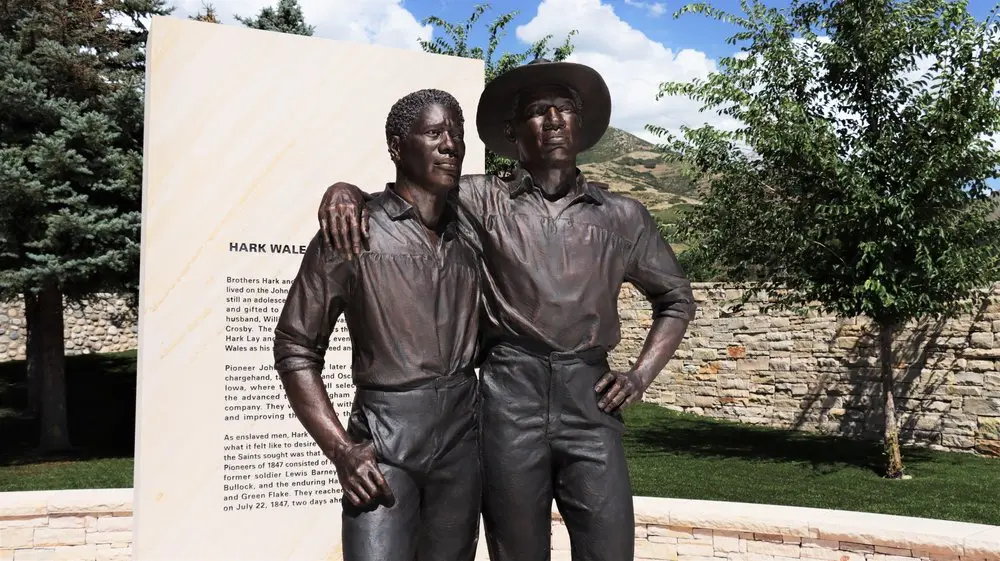
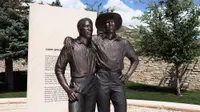
Building continued. The Pioneer Center was dedicated on March 26, 2021, with Gov. Spencer Cox speaking and Ballard offering the prayer. Inside hang Tom Holdman’s stained-glass wagon-wheel chandelier and the Hunts’ bronze Then and Now. In 2022 a crew installed the Pioneers of 1847 monument, announced for dedication on July 22. It honors Green Flake, Hark Wales, Oscar Smith, and Jane Manning James, shown with her sons Silas and Sylvester. Coordinator Mauli Junior Bonner put proceeds from his film toward it. The Hunts sculpted the figures, Metal Arts Foundry cast them, and private donations paid for the work. Their stories are engraved in stone from the Brown’s Canyon quarry.
Notable Events
- 1847The Historical Society essay says the monument's site has been determined to be where Young said This is the Place. history.utah.gov
- 1847Orson Pratt and Erastus Snow, represented at the center-column base, were the first scouting-party members to enter the valley. historytogo.utah.gov
- 1847The first company of Mormon pioneers reached the canyon mouth and viewed the Great Salt Lake valley for the first time. thisistheplace.org
- 1880Woodruff observed that Young had spoken at this location while surveying the valley from Woodruff's carriage in 1847. deseret.com
- 1915A committee including George Albert Smith and B.H. Roberts conducted a location study. deseret.com
- 1915Later in the same feature, Kramer calls the short-lived wooden cross a cross of 1915. deseret.com
- 1915A basic wooden slab marked the spot. deseret.com
- 1916A cross taller than a man was erected. deseret.com
- 1921The original monument was dedicated; old newspaper accounts surrounding the dedication were furnished to the restoration investigators. deseret.com
- 1937A state commission representing various faiths selected Mahonri M. Young to design the monument. historytogo.utah.gov
- 1947The monument was dedicated on the pioneer centennial; a Eureka Scout troop participated. deseret.com
- 1947The marker page states that the monument was erected. hmdb.org
- 1957The park opened as a monument and museum dedicated to Mormon pioneers. storymaps.arcgis.com
- 1996After dialogue and prayer, a decision was made to develop a pioneer village; only the Brigham Young home and perhaps a few cabins were there at the time. deseret.com
- 1998The newspaper says the formerly state park was privatized and charged with portraying the heritage of all Utah groups. deseret.com
- 1998Park operation transferred from the Division of Parks and Recreation to the nonprofit This Is The Place Foundation to generate more private funding. le.utah.gov
- 2006Serious financial problems led to requests for more state funds and restructuring of foundation leadership. le.utah.gov
- 2007The obelisk was refurbished under the direction of the Sons of the Utah Pioneers and rededicated by Boyd K. Packer. deseret.com
- 2019The memorial was dedicated; Stephanie and Roger Hunt created more than 25 of its sculptures. deseret.com
- 2021The new center was dedicated during a ceremony in which Gov. Spencer Cox spoke. deseret.com
- 2022A crew began installation; the article announced that the monument would be unveiled and dedicated on July 22, 2022. deseret.com
People
- George Niederauer, Catholic bishop who helped choose a site for a replica St. Patrick's Church.
- Khosrow Semnani, Donor whose contribution helped broaden interpretation beyond LDS settlers.
- Randon Wilson, Foundation chairman explaining expansion beyond LDS interpretation.
- Boyd K. Packer, Dedicated the refurbished marker (July 21).
- Donna Smith, Packer's fiancee who attended the centennial occasion at the park with him.
- Emma Jensen Packer, Packer's mother, whose commemorative automobile trek ended at the new monument.
- Frank Madsen, Mills Chapter member who renovated the original monument with Bennett.
- Ira W. Packer, Packer's father, whose commemorative automobile trek ended at the new monument.
- Michael Bennett, Actor and park presenter who traced the refurbished marker's history (1998 until last year).
- William Riter, Witness quoted in old newspapers who remembered Woodruff bringing him to the spot.
- Zachary Mahoney, Undertook the obelisk refurbishment as an Eagle Scout project.
- B.H. Roberts, LDS leader on the location-study committee (1915).
- Ellis Ivory, Park executive director and foundation board chair.
- George Albert Smith, Utah Pioneer Trails & Landmarks Association president who petitioned for monument acreage (1915).
- George H. Dern, Secretary of War and former Utah governor petitioned for monument acreage.
- Jay Thompson, Eureka Scout troop member who participated in the monument dedication (July 24, 1947).
- Tresha Kramer, Park public relations and marketing director who researched the first marker.
- W.W. Riter, Pioneer witness and speaker at the obelisk dedication (July 25, 1921).
- William Clayton, Wrote the Emigrants' Guide invoked by Riter to support the obelisk location (1848).
- Antje Uchtdorf Evans, Attended the Center dedication with her mother.
- David Studdert, Gave Center program remarks for his father.
- France A. Davis, Offered a prayer at the Center program.
- Harriet Uchtdorf, Attended the Center dedication with her daughter.
- Kash Lawrence, Visitor pictured examining the park model after the Center dedication (March 26, 2021).
- M. Russell Ballard, Offered the new Pioneer Center's dedicatory prayer (March 26, 2021).
- Roger Hunt, Co-created the Center's Then and Now bronze sculpture.
- Spencer Cox, Governor who spoke at the Center dedication (March 26, 2021).
- Stefanie Hunt, Co-created the Center's Then and Now bronze sculpture.
- Stephen M. Studdert, Center fundraising chair who joined via Zoom.
- Tom Holdman, Created the Center's stained-glass wagon-wheel chandelier.
- Green Flake, Early Black pioneer honored by a monument sculpture.
- Hark Wales, Early Black pioneer honored by a monument sculpture.
- Jane Manning James, Early Black pioneer honored with her sons in the monument (1847; 1908).
- Kellen Perkins, Descendant pictured beside the new Green Flake statue.
- Mauli Junior Bonner, Black pioneer monument coordinator; his film proceeds helped build it (2021).
- Oscar Smith, Early Black pioneer honored by a monument sculpture.
- Silas, Jane Manning James's son depicted with her.
- Stephanie Hunt, Co-sculpted Black pioneer statues and more than 25 Children's Memorial sculptures (2019).
- Sylvester, Jane Manning James's son depicted with her.
- Tamu Smith, Film producer pictured beside the new Green Flake statue.
- Captain Benjamin Bonneville, Regional historical figure portrayed in high relief on the east wings.
- Chief Washakie, Regional historical figure portrayed in high relief on the east wings.
- Dominguez, Spanish expedition leader commemorated in the south-pedestal group (1776).
- Erastus Snow, Scouting-party member, first to enter the valley, represented at the center-column base (21 July 1847).
- Escalante, Spanish expedition leader commemorated in the south-pedestal group (1776).
- Etienne Provost, Regional historical figure portrayed in high relief on the east wings.
- Father Jan DeSmet, Regional historical figure portrayed in high relief on the east wings.
- Heber C. Kimball, Early Mormon Church leader represented north of Young atop the center pedestal.
- John C. Fremont, Regional historical figure portrayed in high relief on the east wings.
- Mahonri M. Young, Designed the monument and sculpted its bronzes (1877–1957).
- Orson Pratt, Scouting-party member, first to enter the valley, represented at the center-column base (21 July 1847).
- Peter Skene Ogden, Regional historical figure portrayed in high relief on the east wings.
- Wilford Woodruff, Early Mormon Church leader represented south of Young atop the center pedestal.
- William Ashley, Rocky Mountain Fur Company figure sitting astride the horse in the monument.
- Clarissa Decker Young, Woman depicted; wife of Brigham Young.
- Ellen Saunders Kimball, Woman depicted; wife of Heber C. Kimball.
- George A. Smith, Horseman depicted on the monument's south side.
- Harriet Page Wheeler Decker Young, Woman depicted; wife of Lorenzo Dow Young.
- Isaac Perry Decker, Boy depicted; son of Harriet Decker.
- Jesse C. Little, Horseman depicted on the monument's south side.
- John Brown, Horseman depicted on the monument's south side.
- John Pack, Horseman depicted on the monument's south side.
- Joseph Matthews, Horseman depicted on the monument's north side.
- Lorenzo Dow Young, Depicted walking beside the carriage with Heber C. Kimball.
- Lorenzo Sobieski Young, Boy depicted; son of Lorenzo Dow Young by Persis Goodall.
- Orrin Porter Rockwell, Horseman depicted on the monument's north side.
- Willard Richards, First wagon-train leader depicted on the north wing; physician, apostle and second counselor to Young (1847–1854).
- Ab Jenkins, Former Salt Lake mayor who arrived at the dedication with the Nauvoo mayor.
- Alvin S. Luchs, Rabbi, Temple Israel pastor and commission fifth vice chairman; dedication speaker.
- Arthur W. Moulton, Retired Episcopal bishop and commission third vice chairman; delivered a eulogy.
- Daniel McCarthy, Monument granite contractor.
- David O. McKay, Second counselor introduced at the monument dedication.
- Duane G. Hunt, Salt Lake Catholic bishop and commission first vice chairman; first dedication speaker.
- J. Reuben Clark, First counselor introduced at the monument dedication; gave The Pioneers address.
- Lowell Horton, Nauvoo mayor who arrived at the dedication with Ab Jenkins.
- Taylor Woolley, Monument architect.
- William H. Reeder Jr, Commission vice president who offered the dedication invocation.
- Brigham Young, Church and journey leader whose pronouncement is commemorated near this site (July 24, 1847).
Sources
- thisistheplace.org/events
- ksl.com/article/51591868/this-is-the-place-heritage-park-is-hosting-a-big-free-weekend-event-here-are-all-the-details
- thisistheplace.org/blog
- thisistheplace.org/general-info/hours-admissions
- thisistheplace.org/pioneer-trades
- thisistheplace.org/about
- deseret.com/2012/7/24/20425786/this-is-the-place-historic-monuments-of-salt-lake-valley-s-pioneer-view
- hmdb.org/m.asp?m=1525
- newspapers.lib.utah.edu/details?id=1356902
- storymaps.arcgis.com/stories/fe6ebdeaeb784e6681606ae27d3ebea2
- nps.gov/places/this-is-the-place-heritage-park.htm
- historytogo.utah.gov/post/place-monument
- le.utah.gov/lfa/LFADocs.jsp?month=6&pubid=6914&year=2015