Teton County 4-H Fair
Choteau, Teton County, Montana. Livestock Auction; last full weekend every June.
Details

- Where
- Choteau, Teton County, MT. No street address stated. Directions
- When
- Last held June 22–28, 2026; next year’s date not yet stated.
- Getting there
- Choteau Pavilion and the Weatherbeater Arena.
- Hours
- 5 p.m.: Meat & Greet and Buyer Registration.
- Access
- This division is open to any resident of the county. You do not need to be a 4-H member to enter this division.
- Walk-in or reserve
- Registration runs from May 1 - May 29, 2026.
- Phone
- 406-466-2491
- Managed by
- Teton County MSU Extension.
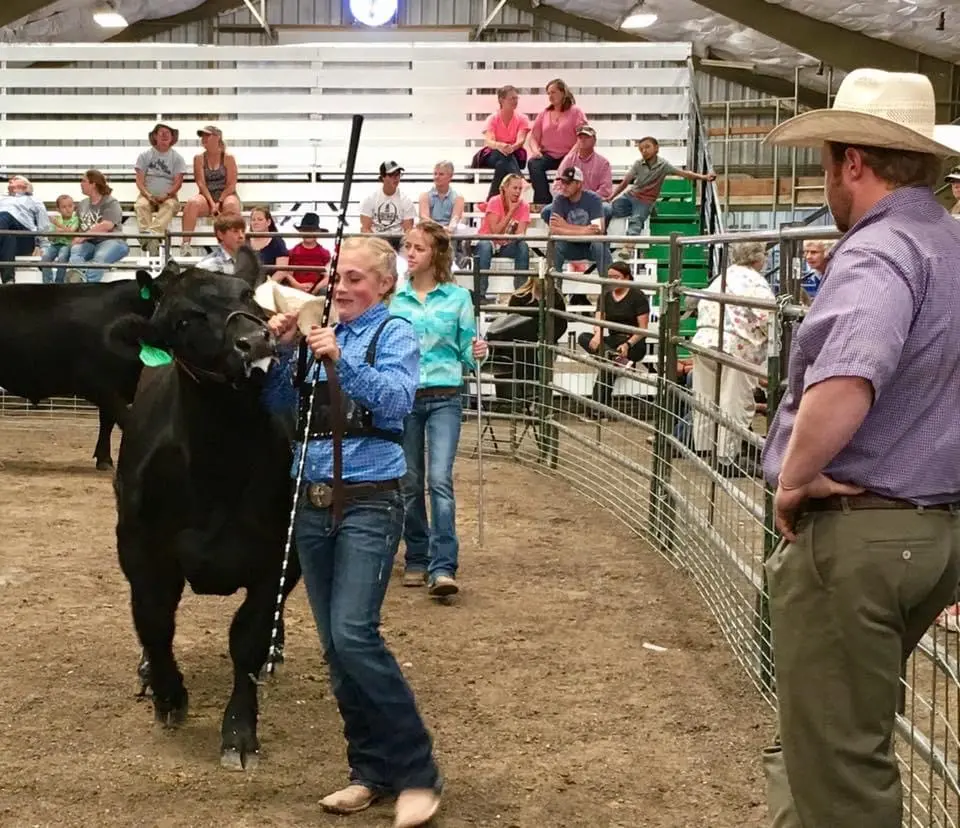
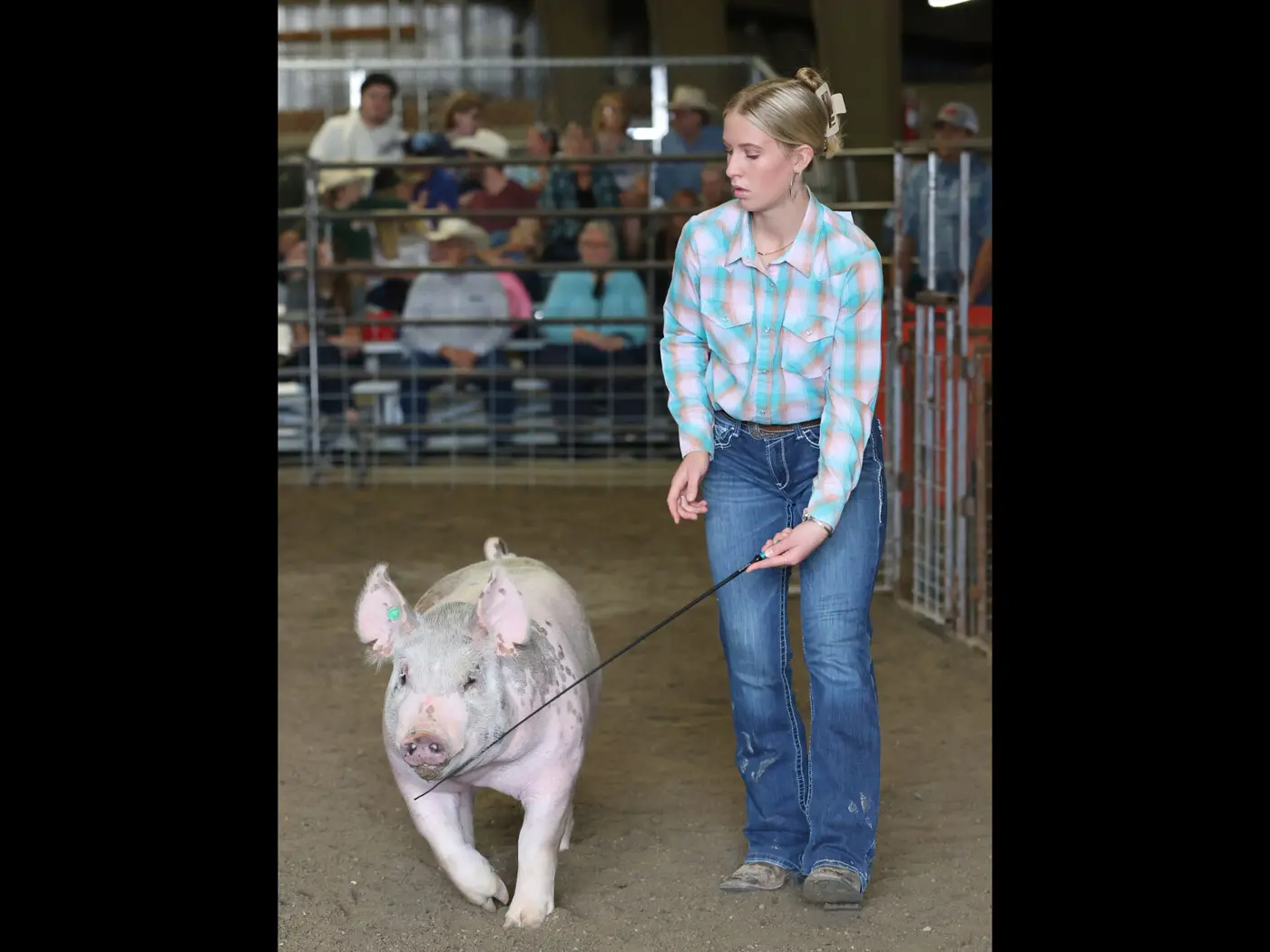
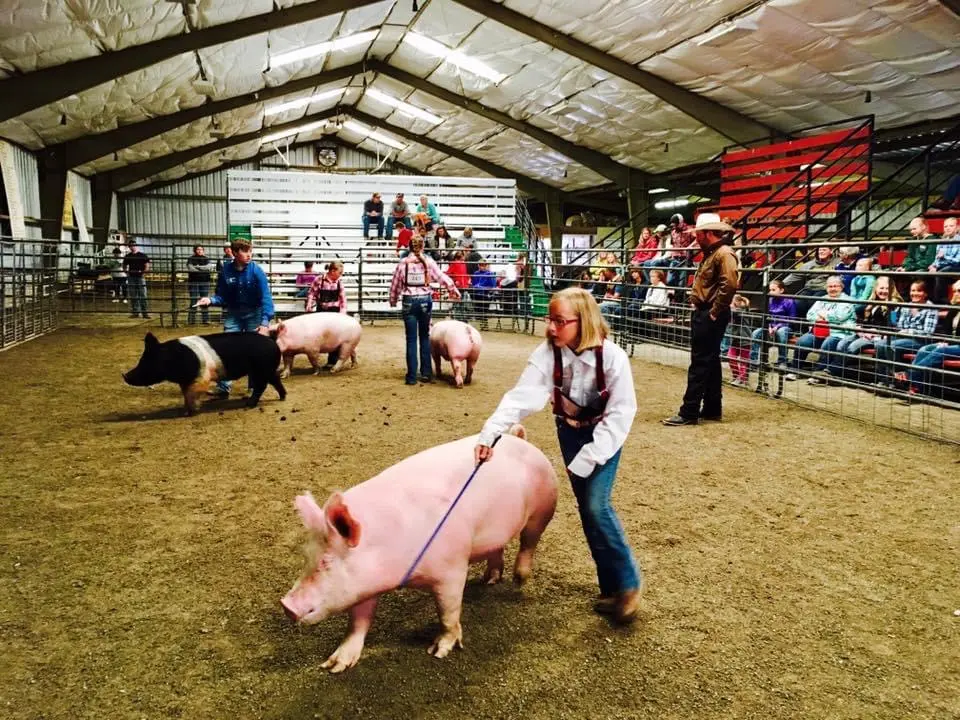
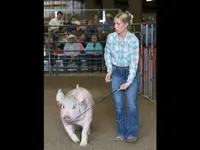
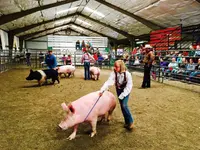
At 8:45 on the Friday morning of the 2026 Teton County 4-H Fair, the flags were presented in the Weatherbeater Arena in Choteau. At nine o’clock the market swine show began. The arena is a steel building owned by a private nonprofit. Together with the Choteau Pavilion, which the city owns, it makes up the whole of the fairgrounds.
Most Montana counties have a designated fairgrounds, a fair board and a fair budget. Teton County has none of these. Its fair has long been run by 4-H members and volunteers, with support from the MSU Extension office in the Teton County Courthouse. The Teton County 4-H Council pays for it, partly with money the Boe Brothers donated years ago and partly with community sponsorship of awards.
The town sits at 3,799 feet, near where the Rocky Mountains rise almost perpendicularly out of the northern plains along the Rocky Mountain Front. The fair falls on the last full weekend of June. For 2026 the Extension office gave the dates as June 23 to 28, counting setup and cleanup days. Its fair book gave June 24 to 27, and the Central Montana tourism office listed June 22 to 28. The office lists June 23 to 27 for 2027.
In 2025 the county had 149 4-H members, and 99 of them took part in the fair. They came from five community clubs: Spring Creek, Old Agency, Challenging Champs, Eager Eagles and Prairie Stars. Four project clubs also took part: Rocky Mountain Archers, Rocky Mountain Top Shots, Sun River Rough Riders and the Teton County 4-H Horse Club. Extension agents Jenn Swanson and Shelby Jones-Dozier and office staff Jamie Smith and Joan McDowell worked with the 4-H Council to put that fair on.
Projects on the Pavilion tables
Fair week opens with interview judging at the Pavilion. In 2026 it ran from 1 to 5 p.m. on Wednesday, June 24. Every exhibitor, whether showing a quilt or a steer, sits one-on-one with an adult judge and explains what the project taught them: the cost in money, materials, time and effort, and what went wrong along the way. Judges score the work and also the member’s answers and demeanor. Market animal exhibitors must bring their paper record books. Their judges are experienced livestock producers, and a member who arrives without the book may neither show nor sell the animal.
The fair book runs to dozens of divisions:
sewing, quilting, crochet, knitting and embroidery baking, cooking, food preservation and cake decorating leathercraft, welding, woodworking and small engines cowboy poetry range, weed and crop science entomology and forestry junk drawer robotics and aerospace babysitting and pocket pets * five levels of horseless horsemanship
An open class takes entries from any county resident, member or not. In 2025, volunteer judges and six Extension agents decided ribbons on close to 400 projects. In 2017 members entered 496, and Extension agent Jane Wolery said that year that more technology exhibits were appearing as a sign of the times.
Once judged, the work goes on display. In 2026 the Pavilion was open to the public from 4 to 7 p.m. on Thursday and Friday and from 9 a.m. to noon on Saturday, before exhibitors carried their pieces home. The program has included a style show. In 2017 it was produced by sewing project members modeling outfits they had built, and it was paired with a quilt show.
The Thursday of the 2017 fair brought the public in for more:
Dave Yerk of Montana Fish, Wildlife and Parks taught fly tying. The agency ran a small-stream fishing clinic on Spring Creek, meeting at the Pavilion’s north entrance. Carrie Krause played “Bach to the Beatles.” Baker Bob and Jona McNamee showed heirloom recipes revised into healthier versions. Madeline Konen, a 13-year-old member, taught the Keys to Crust. The Rat Rod Car Club held a classic car show in the Choteau City Park. * Paul Lachapelle of MSU Extension recorded oral histories for the Montana Community Story Project.
Friday in the Weatherbeater
The animal schedule for 2026 began Thursday with a dog show at the arena, followed by the swine weigh-in that evening. In 2025 the dogs worked in the Choteau Community Dog Park. There, Iris Carlson coached hers through commands while Natalie Hodgskiss waited her turn before judge Asia Bouma.
Friday carried the bulk of the shows:
9 a.m.: market swine 11 a.m.: goat and lamb weigh-in 1:30 p.m.: goats 2:30 p.m.: lambs 4 p.m.: cats, poultry and rabbits 5 to 7 p.m.: beef weigh-in, where owners had to bring ownership papers for the brand inspector at the scale
The Spring Creek 4-H Club and Tin Can Treats ran concessions at the arena. At 5:30 food trucks served dinner for a community social, and a DJ played for dancing from 7 to 9. The schedule put it plainly: “All are invited to tour the Fairgrounds and join the fun!”
Saturday morning belonged to the beef show, with market, showmanship and breeding classes. At noon came the round robin, in which showmen compete across species.
The 2025 barns held 30 market swine, 20 market beef, six breeding beef, 13 market lambs, two breeding lambs, one market goat and nine small animal entries. Bobbi Schmid judged the large animals. Katy Morris took grand in senior showmanship for both beef and swine, grand market swine, and the senior round robin. Frontier Funeral Home sponsored belt buckles for the grand poultry and cat showmen.
Bidding by the live-weight pound
On Saturday evening buyers gather outside the arena for a “Meat & Greet,” a complimentary barbecue hosted by Teton County 4-H, Friends of 4-H. In 2026 it began at 5 p.m., and the sale followed at 6. Cole Morrison of the Western College of Auctioneering calls the sale, and Collins Auction Service clerks it.
Before any of this, members selling market animals take annual Livestock Quality Assurance training in selection, health and nutrition. Bidding is by the live-weight pound. The Extension office’s buyer’s flyer works an example: a $2.50 bid on a 240-pound hog comes to $600.
The winning bidder holds up one of three cards: “Morels,” “Christiaens” or “Opt-out.” The first two name the sale’s processors, Morels Chop Shop in Choteau and Christiaens Meats in Valier, each of which takes half the animals. Both send pork to Jake’s Sausage Shop in Choteau for curing, and the Livestock Committee hauls the animals at no charge. After the sale, anyone may “add on” to a member’s price at a designated table. Early on Sunday the species superintendents organize the shipping.
The 2025 sale, on June 28, drew what former member Rocky Forseth of Fairfield described afterward:
“A packed house for the 4-H sale, a beautiful National Anthem, and the entire building recited the Pledge of Allegiance and the 4-H Pledge verbatim. Several kids well out of their comfort zone shaking hands and talking to prospective buyers.”
Prices that night:
Pigs: averaged 275 pounds and $11.26 a pound, with the top pig at $26. Steers: averaged 1,257 pounds and topped at $10.25. The Acantha reported their average as $4.59 a pound; the Extension flyer gives $4.68. Lambs: averaged $13.92, with a top of $25. Goat: the one market goat, 70 pounds, went for $1 a pound.
Several buyers gave their animals away, to the Choteau Senior Center, the Skyline Lodge, and the Fairfield and Teton County food pantries. The Friends of 4-H award, usually a surprise announced before the sale, went that year to Columbia Grain.
In 2020 the pandemic closed the fair to all but members and immediate family. That year’s theme, chosen the fall before, was “You have to believe it to see it!” The sale moved to the Stage Stop Inn Rocky Mountain Convention Center. Ryan Perry of Western Livestock Auction called it live while Jerry Collins ran simultaneous online bidding.
A steel building by the rodeo grounds
The Choteau Acantha’s 1978 recap, summarized by Nancy Thornton, records that the “first annual” 4-H livestock show and sale in July 1978 was a success, with plans to expand it into a Teton County Fair. The 4-H Market Show sale in 1979 fell on July 23.
The arena came out of the same winter of 1978. A group of residents met then about “getting a large building to serve community needs for livestock shows, livestock production sales, expositions and indoor protection for large events.” The notes are incomplete, but they name Doug Standley, Bert Corey, Lyle Otness, Colonel Bynum, George Ripley, Barney McClue, Dan Weist, Sylvan Susag and Miles Anderson. The city council gave verbal approval to build on city property beside the rodeo grounds.
In May 1979 Bill Richter, the county’s MSU Extension agent, wrote to Mayor Jim Hamilton with a fundraising plan. The building he described was a clear-span steel structure with a dirt floor, 60 feet wide and 220 feet long, with walls at least 14 feet high. Its temporary name was the Teton Livestock Center. That same month a group asked the city to donate the land. By November 1980 plans were under way to raise $40,000 for the all-steel center.
A naming contest settled the rest. The minutes of November 18, 1982, record “the best entry that was chosen: Teton Weatherbeater by Nadelle Forseth, daughter of Mr. and Mrs. Orville Forseth of Fairfield.” The state incorporated the Teton Weatherbeater on March 4, 1983. Its first directors were Denzel Perry, Danny Weist, Marlin Styren, Jim Forseth, Harry Yeager, Roger Weist, Stan Rasmussen and William Richter. By that November the water and sewer permits were secured and $15,000 had been raised toward a down payment, and construction was imminent.
Memberships have since paid for upkeep. Over the years 4-H volunteers working with the elected board have added pens out back for the hogs and sheep, along with chutes and a scale. In 2018 the 4-H program named every past and present Weatherbeater board member and volunteer its Friends of 4-H.
Duke, Big Mac and Poncho
Terry Stephens measures the fair’s changes in steers. Her parents met at a 4-H meeting when they were 8 and 9, in the Nimble Fingers club, which later became Spring Creek. “I have a picture of my dad showing his steer in what looks to be the city park, no fences in sight,” she told the Acantha in 2017. His record book shows a steer named Duke sold in 1958: 900 pounds at 32 cents a pound, for $312.90.
She showed her own steers in the arena at the rodeo grounds. “No one ever thought about making a smaller ring in that big arena,” she said, “so if we had a steer get away from someone, he had a lot of room to run.” Her Big Mac sold in 1983, at 1,180 pounds and 72 cents, for $849.60.
By the time her son Colton showed cattle, the shows had moved into the Weatherbeater and the ring had grown smaller. Quiet time at weigh-in and neck ropes came in for safety. His steer Poncho, sold in 2007, weighed 1,445 pounds and brought $2.80 a pound, $4,046 in all. “Colton signed up to be a leader as soon as he graduated from high school,” she said.
Notable Events
- 1978The first annual 4-H livestock show and sale succeeded; plans were in the works to expand it as the Teton County Fair. canalheritage.com
- 1978During the winter of 1978, a group of interested community members met to discuss the possibility of getting a large building to serve community needs for livestock shows, livestock production sales, expositions and indoor protection for large events. choteauacantha.com
- 1979A group asked the city to donate land beside the rodeo grounds for an agricultural building. canalheritage.com
- 1979In May 1979, MSU Extension agent Bill Richter sent Choteau Mayor Jim Hamilton a letter outlining fundraising for a clear span steel building with a dirt floor, 60 feet wide by 220 feet long with minimum 14-foot walls. choteauacantha.com
- 1980Plans were underway to raise $40,000 for an all-steel livestock center, identified by the recap as today's Weatherbeater. canalheritage.com
- 1982In the Nov. 18, 1982 minutes of the Teton Livestock Center Non-Profit Corporation, the council adopted the best entry from a naming contest: Teton Weatherbeater, by Nadelle Forseth of Fairfield. choteauacantha.com
- 1983On March 4, 1983, the Teton Weatherbeater was incorporated by the state of Montana; by November of 1983 water and sewer permits were secured and $15,000 had been raised for a down payment, with construction imminent. choteauacantha.com
- 2020The fair was held mostly for 4-H members and immediate family; social-distancing and sanitation rules kept the public from attending. fairfieldsuntimes.com
People
- Barney McClue, involved in the early community meetings to plan the building (winter of 1978).
- Ben Neal, member of the Teton Weatherbeater Board of Directors (2018).
- Bert Corey, involved in the early community meetings to plan the building (winter of 1978).
- Bill Richter, MSU Extension agent in Teton County who outlined the fundraising plans for the building (May 1979).
- Brent Roeder, member of the Teton Weatherbeater Board of Directors (2018).
- Brock Hodgskiss, member of the Teton Weatherbeater Board of Directors (2018).
- Chrissy Hodgskiss, member of the Teton Weatherbeater Board of Directors (2018).
- Colonel Bynum, involved in the early community meetings to plan the building (winter of 1978).
- Dan Weist, involved in the early community meetings to plan the building (winter of 1978).
- Danny Weist, member of the initial Board of Directors of the Teton Weatherbeater (1983).
- Denzel Perry, member of the initial Board of Directors of the Teton Weatherbeater (1983).
- Doug Standley, involved in the early community meetings to plan the building (winter of 1978).
- George Ripley, involved in the early community meetings to plan the building (winter of 1978).
- Ginger Weist, member of the Teton Weatherbeater Board of Directors (2018).
- Harry Yeager, member of the initial Board of Directors of the Teton Weatherbeater (1983).
- Jeff Salmond, member of the Teton Weatherbeater Board of Directors (2018).
- Jere Long, member of the Teton Weatherbeater Board of Directors (2018).
- Jim Forseth, member of the initial Board of Directors of the Teton Weatherbeater (1983).
- Jim Hamilton, mayor of Choteau who received the 1979 fundraising letter for the arena.
- Justin Paulson, member of the Teton Weatherbeater Board of Directors (2018).
- Lane Yeager, member of the Teton Weatherbeater Board of Directors (2018).
- Lyle Otness, involved in the early community meetings to plan the building (winter of 1978).
- Marlin Styren, member of the initial Board of Directors of the Teton Weatherbeater (1983).
- Miles Anderson, involved in the early community meetings to plan the building (winter of 1978).
- Nadelle Forseth, won the contest to name the building; her entry Teton Weatherbeater was adopted by the council (November 18, 1982).
- Roger Weist, member of the initial Board of Directors of the Teton Weatherbeater (1983).
- Stan Rasmussen, member of the initial Board of Directors of the Teton Weatherbeater (1983).
- Sylvan Susag, involved in the early community meetings to plan the building (winter of 1978).
- William Richter, member of the initial Board of Directors of the Teton Weatherbeater (1983).
- Baker Bob, Scheduled to teach healthier versions of heirloom recipes during the fair.
- Carrie Krause, Scheduled to present Bach to the Beatles and violin lessons at the fair.
- Colton, Terry Stephens' son, who showed cattle after the animal shows moved to the Weatherbeater.
- Dave Yerk, Montana Fish, Wildlife and Parks instructor scheduled to teach fly tying.
- Jane Wolery, MSU/Teton County Extension agent observing growth of technology exhibits.
- Jona McNamee, Scheduled to teach healthier versions of heirloom recipes with Baker Bob.
- Lena Heuscher, Choteau 4-H alumna reflecting on the projects she completed.
- Madeline Konen, 4-H member scheduled to teach Keys to Crust at the Pavilion.
- Paul Lachapelle, MSU Extension community development specialist scheduled to record oral histories during the fair.
- Rich Lusky, Rat Rod Car Club president and contact for the classic car show.
- Terry Stephens, Competitor at the fair who recalled its evolution.
Sources
- montana.edu/extension/teton/4hfair
- centralmontana.com/events/teton-county-4-h-fair
- montana.edu/extension/teton/4hfair/4HFairSchedule.html
- montana.edu/extension/teton/4hfair/4HFairbook.html
- montana.edu/extension/teton/4hfair/4HFairJudges.html
- montana.edu/extension/teton/4hfair/4-HFairBuyerFlyer.html
- choteauacantha.com/news/article_9d6e7912-55f2-11e7-909d-5fc60e794d1c.html
- canalheritage.com/teton-geneology/teton-pages/1977-78newshighlights.html
- canalheritage.com/teton-geneology/teton-pages/1979-80newshighlights.html
- choteauacantha.com/news/article_17c144a2-6e7e-11e8-a579-03ea6397ab5e.html
- centralmontana.com/events/teton-county-4-h-fair
- choteauacantha.com/news/article_108a186f-aa18-4150-b694-a40c2307d4b1.html
- fairfieldsuntimes.com/news/state/teton-county-4-h-will-have-a-fair/article_e080fc96-a808-11ea-91a6-bf3f8aeb1eff.html