Superior Lions Club Rodeo
Superior, Mineral County, Montana. Rodeo.
Details

- Where
- Superior, Mineral County, MT. No street address stated. Directions
- When
- Last held August 1, 2026; next year’s date not yet stated.
- Fees
- August 5th: Family Night 7:00 pm (Free Admission).
- Hours
- August 5th: Family Night 7:00 pm; August 6th: Rodeo 8:00 pm -10:30 pm; August 7th: Rodeo 8:00 pm -10:30 pm.
- Walk-in or reserve
- Reserved Tickets Go On Sale: July 17th. General Admission can be purchased at 12:00 Noon, The Day Of The Rodeo.
- Website
- superiorlionsclub.com
- Managed by
- Superior Lions Club.
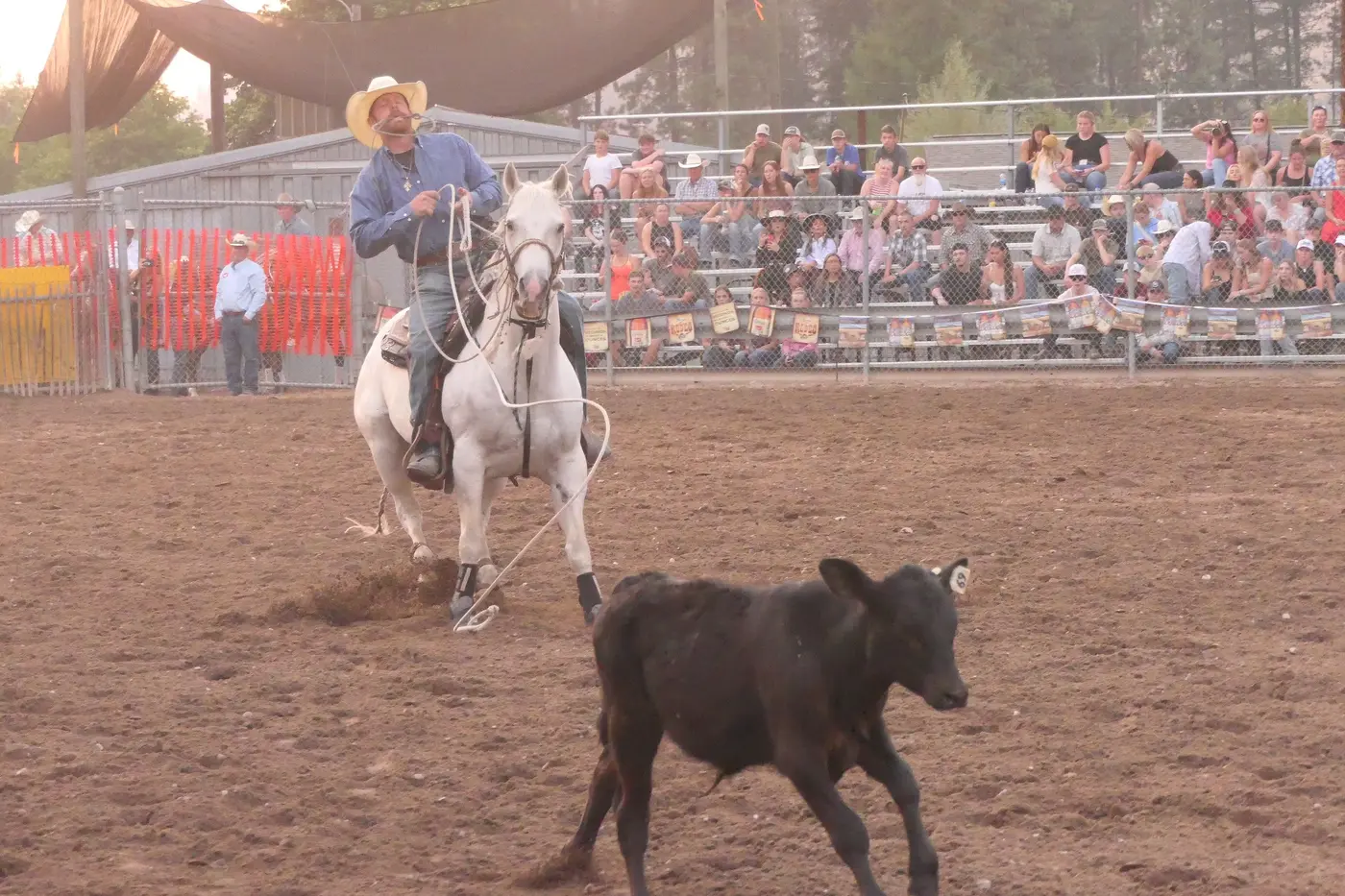
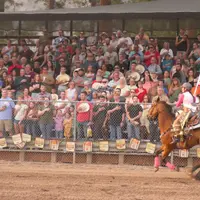
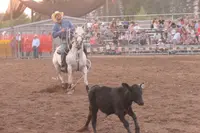
The Superior Lions Club Rodeo runs in a small arena on the Mineral County Fairgrounds, at 701 Pennsylvania Avenue in Superior. The chutes and pens stand inside a chain-link fence, with bleachers along the sides. On the first weekend of August the sun goes down behind the mountains around the arena while the Lions run the stock. The Northern Rodeo Association sanctions the rodeo, and it is the evening show of the Mineral County Fair. Interstate 90 passes close enough that travelers see the fair from the road. A 2006 listing sent them off at Exit 47.
Three nights at the fairgrounds
The 2026 rodeo ran July 31 and August 1, inside a fair that ran July 30 to August 1. The Mineral Independent reported that the fair was marking 80 years along with America’s 250th birthday. Each morning the Methodist Men served pancakes, sausage, bacon, eggs and coffee under a tent at the main entrance. Thursday was Family Night, with jackpot barrel racing in the arena from 7 to 9 p.m. Then the Tamarack Ridge Band played for dancing until midnight.
The Lions’ “Go for the Gold” rodeo took the arena at sundown Friday and again Saturday. The Tanner Laws Band followed on Friday and played until 2 a.m. On Saturday the Mineral County Fair Parade went through downtown at 11 a.m., and the 4-H livestock auction opened at 1 p.m. After the rodeo that night, The Hankers played from 10 p.m. to 2 a.m. to close the fair. The club’s website lists the 2027 dates as a free Family Night on August 5 at 7 p.m. and rodeo performances August 6 and 7, from 8 to 10:30 p.m.
The sources give different counts for the seats. In 2024 Roger Kesting put the bleachers at 860 reserved seats and a little over 1,000 seats in all, counting general admission. In 2023 a Lions spokesman said the arena holds about 1,500 people when the bleachers and “end zone” seats are full. General admission is sold only on the day of the show. “Saturday is pretty well sold out each year,” Kesting said. “Friday, if we sell 75%, we’ve done really good.” In 2022 a Lions member working the grounds reported sellouts on both nights: “People of this area and lots of people passing by love rodeo and coming here to watch it.”
The money goes back into the town. The Mineral Independent called the Lions Beer Booth the club’s big money maker. The club pays for Christmas baskets, school scholarships, Shakespeare in the Park and the Easter egg hunt. Every year before the fair, Lions members go out to the arena on Wednesday evenings to upgrade it and make repairs.
Broncs, wild cows and a clown in a barrel
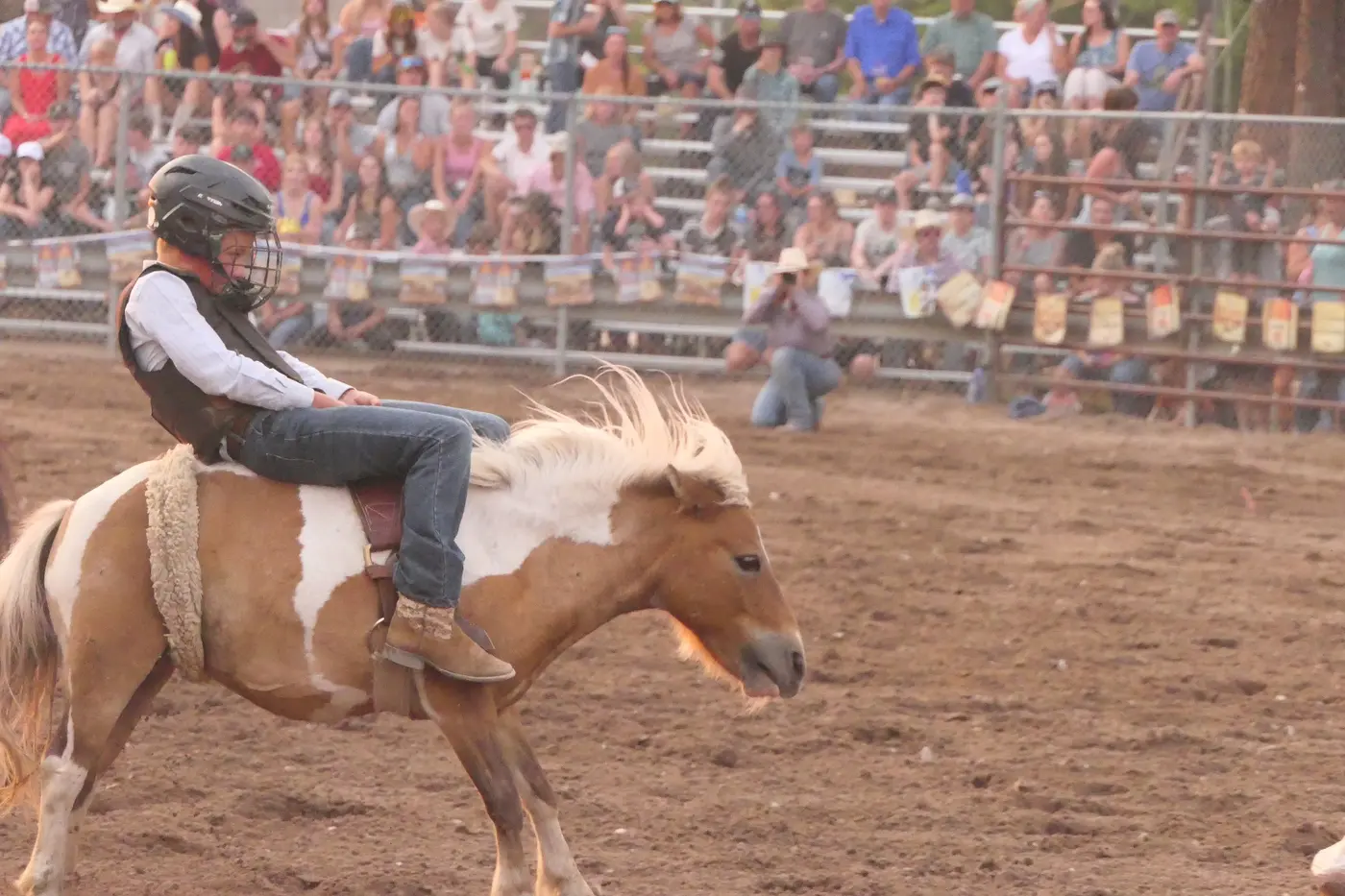
Red Eye Rodeo Company supplied the stock in 2022, 2023 and 2024. The riders and ropers come mostly from the Northern Rodeo Association and the Montana Rodeo Cowboys Association, and many are local.
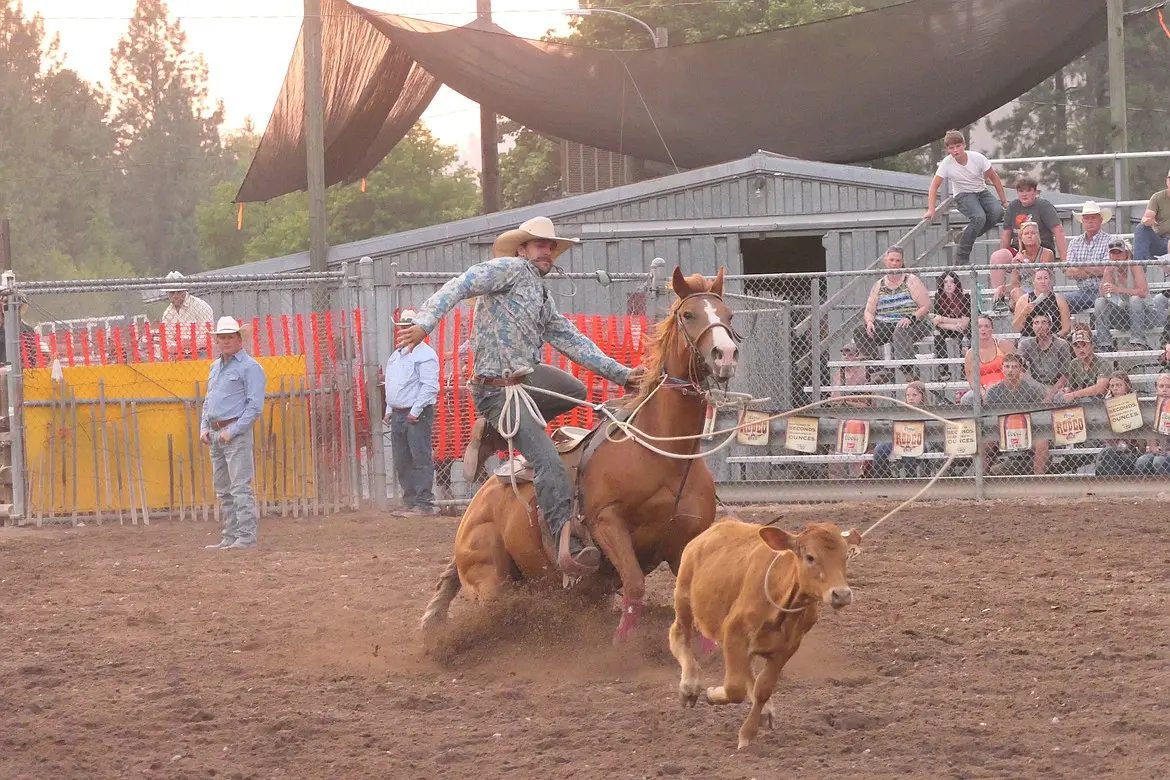
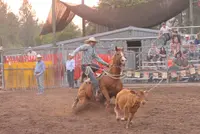
In 2022 Kagen Gooch of Butte rode a bareback bronc for the third time in his life. He was thrown two seconds short of the eight-second mark, got to his feet and pumped his fist at the crowd. Jack McAllister of Hot Springs roped and tied a calf in 12.3 seconds. Between events the clown Dangerous Dan got fans to stand and dance and tossed T-shirts to those who did. Erin and William Crawford of the Seattle area pulled off the interstate on their way to Missoula. “We’ve seen this little fair from the road, but never stopped to check it out,” William Crawford said. “I can’t imagine sitting on top of an animal the size of a bull and trying to hang on.”
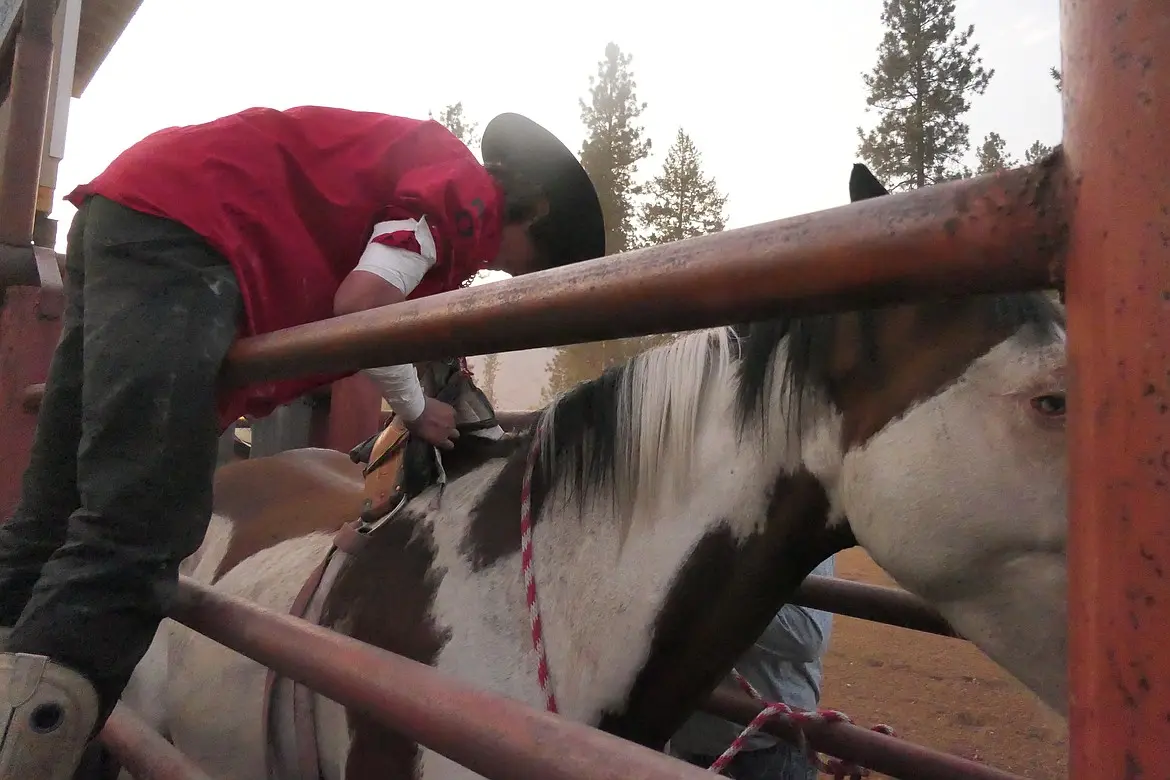
The 2023 show opened after a steady rain. A 51-year-old saddle bronc rider hurt his right wrist on the first ride out of the chute. He asked for a re-ride, saying he would grip the rigging with his left hand, and later withdrew the offer. On Friday a bull caught the clown Dangerous Dave. “The bull got both horns inside the barrel we jump into for protection and raked his horns against my dome (head),” he said. “Thought I was going to need the night off.” On Saturday the hometown rider Hunter Haskins, once a Superior High basketball standout, scored 75 to win the saddle bronc. He beat Jason Colelough of Libby, who scored 73. “It was really great to have a good performance before the hometown crowd,” Haskins said.
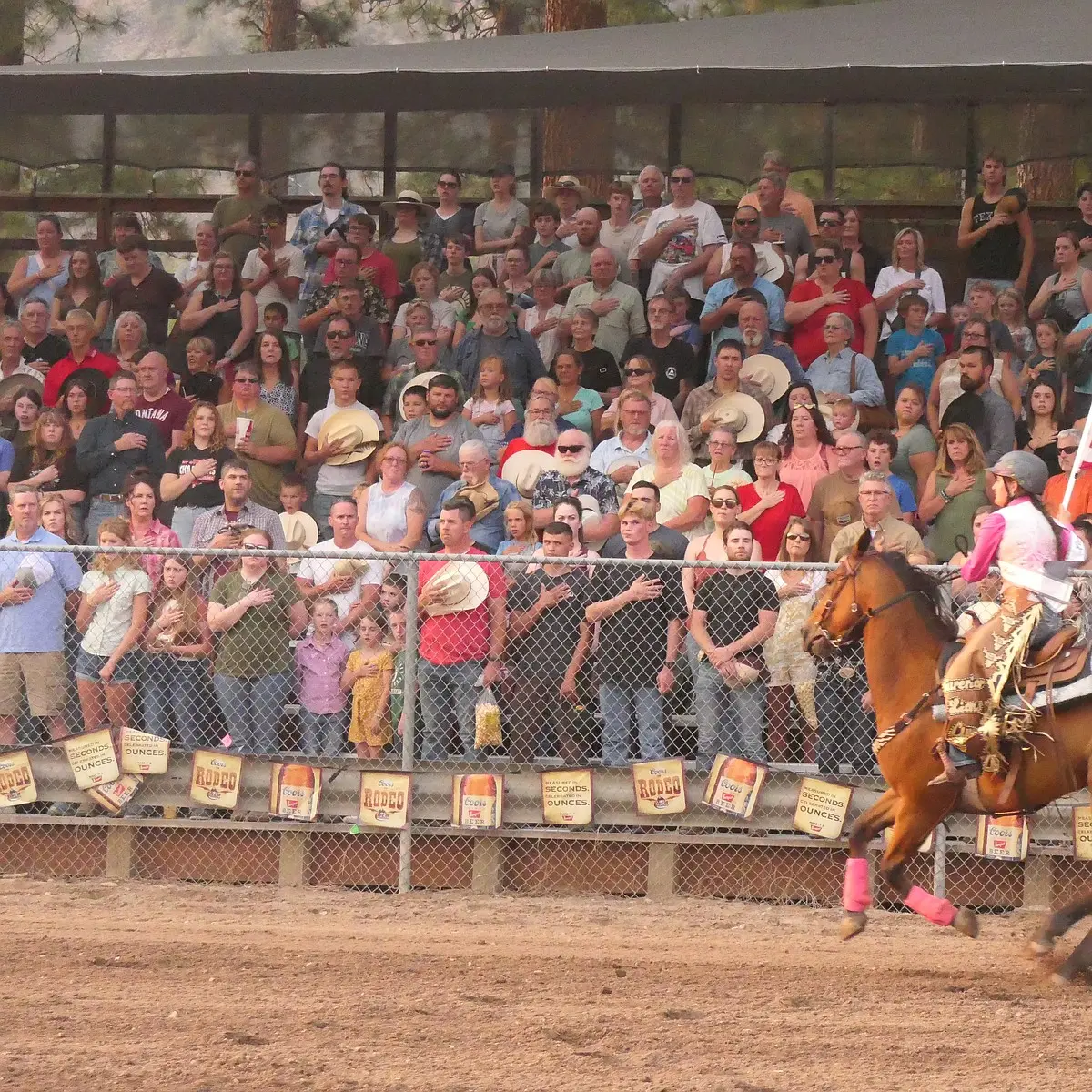
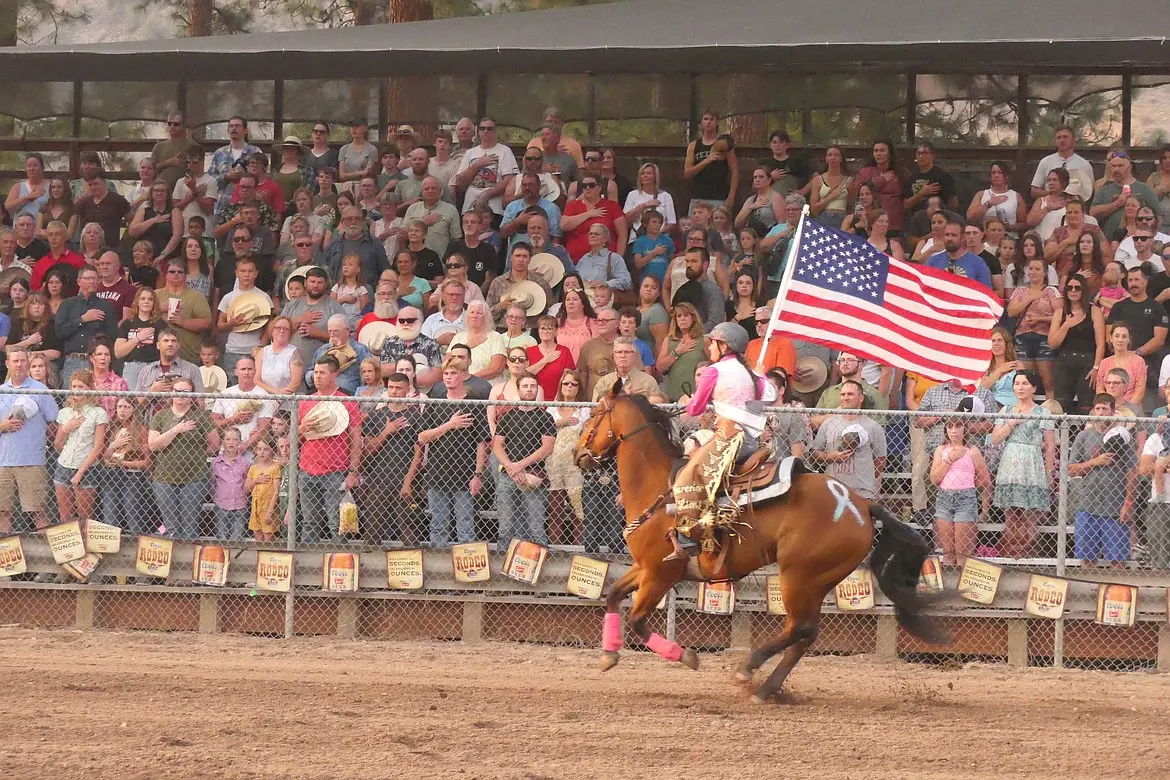
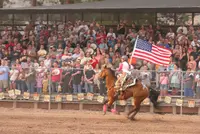
The 2024 rodeo ran through heat and a moderate layer of wildfire smoke. Both nights played to near-capacity crowds. The rodeo queen, Lanie Crabb, had graduated from Superior High that June, and she rode around the arena during the National Anthem. Brothers Jack and Nick McAllister took second in team roping at 8.2 seconds. Caden Fitzpatrick of Polson won the bull riding with a 78. Beau Harrell worked the arena as rodeo clown, or bullfighter, the name his trade prefers.
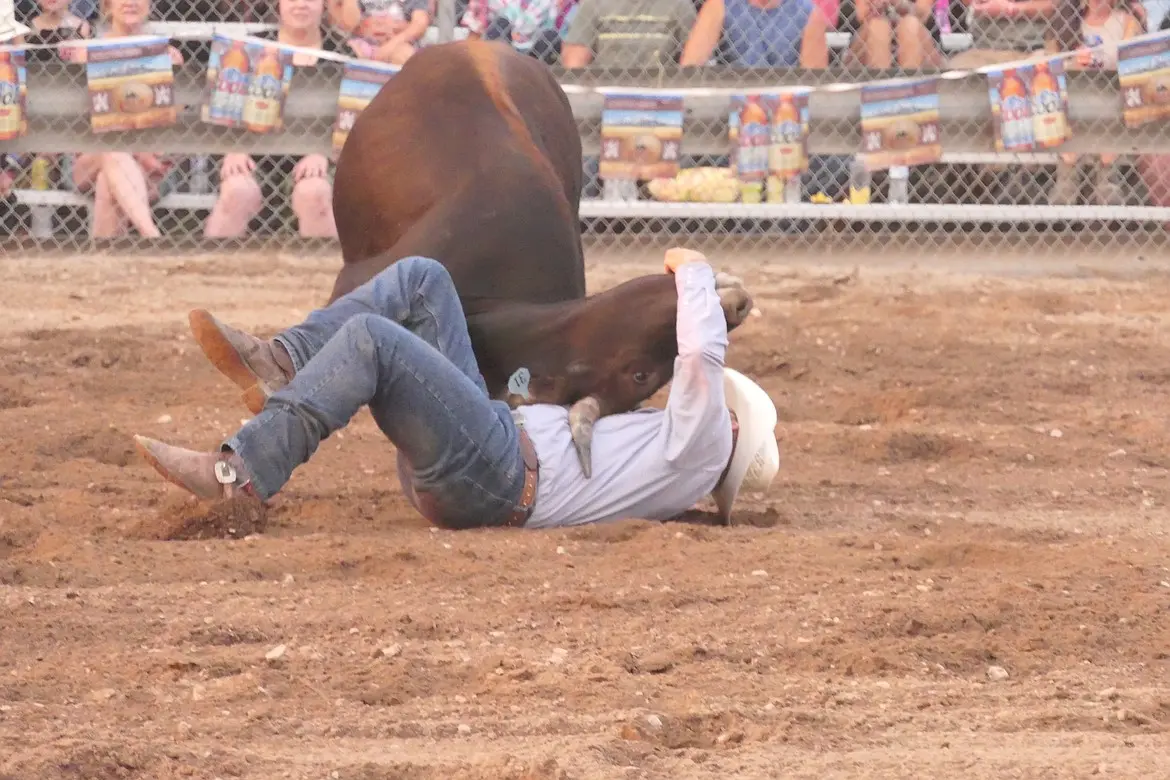
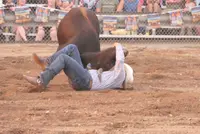
Some years have added a contest for the town. In 2013, on each of the three nights, teams of three signed liability waivers to try milking a wild cow in front of the stands. The Mineral Independent reported that the crowd’s noise built toward that event every night. Competitors said the cows were meaner than the year before. On Friday the cows were released and appeared to bowl the contestants over like pins, and the contestants kept getting back up. Some cows gave no milk. The lucky teams ran to the judge and poured out what they had.
The Lions’ Facebook page says Flint Rasmussen worked the Superior rodeo in its early days. They count it as one of the first chapters of a career that went on to shape rodeo and Western sports for nearly four decades.
Telephone poles from Tarkio to Dry Creek
The rodeo replaced two earlier Lions events, which a group of founders recalled in July 2024 in Dick Feldburgge’s basement, a former ceramic shop. Gary Chambers described the first, the River Derby. A big ball was floated from the Lozeau bridge to Superior, people built “rickety rafts,” and raffle tickets were sold on the ball’s time. “Many of the boats never made it to town, so they were picked up and driven back for the little awards ceremony,” Chambers said.
The second was Logging Days, with chopping, ax throwing, log rolling and sawing. It was held across the river in the parking lot of the Montana Bar, where the Mineral County Food Bank now parks its cars. Insurance would not allow a third year there. The event moved to the present fairgrounds, and it “wasn’t popular at all,” because there were not enough bars nearby. “We had to do something,” Chambers said. “We met in Duff Brockway’s garage and decided what we were going to do.”
“The plan was sorta sketched out on a napkin, but it worked well,” Kesting recalled. Roger Brockway was a bulldogger, and he and Alan Brockway knew how an arena should be laid out. The Mineral County Fair board gave permission, then the county commissioners. The old Logging Days site already had a chain-link fence and bleachers, so the arena went there.
Bell Telephone was replacing its poles and let the Lions take every old one they could get out of the ground. Starting in March they pulled poles with Chambers’ old winch truck. “From Tarkio to Dry Creek,” the Mineral Independent wrote, “the standing telephone poles started disappearing.” The poles became the chutes and corrals. Diamond Match Mill gave lumber, and a Kalispell rodeo outfit gave roping chutes and 3-inch and 6-inch pipe. Wally Zimmer remembered that everything was built in place. The school lent its shop and its metal-cutting band saw, and volunteers split into crews for cutting, welding and boarding. Alan Brockway dug the rocky ground with his backhoe. “There were thousands of donated hours to build that thing,” Chambers said. “We’d have a little BBQ sometimes after we were done.”
“In August, we had a rodeo. That was 1982,” Gary Tourtellotte said. On the first Thursday night, Zimmer recalled, the Catholic booth sold every hamburger it had bought for the whole fair and had to go to Daily’s Meats in Missoula for more. The fair then moved its days to match the rodeo. At first, a Friday roping exhibition paid the insurance for rodeos on Saturday and Sunday. A few years later the schedule shifted to its present days so people could drive home on Sunday. A few years after that, the arena was upgraded, mostly to metal. Roger Billadeau said the materials came from John Carpenter, the Kalispell contractor: “Rocky Mountain Rodeo Company is what I think they were called.”
Eighteen ounces off Exit 47
The rodeo became the Go for the Gold Rodeo in 1988. “We used to give out saddles but they became too expensive so we came up with this idea. Gold was $300 an ounce then,” Kesting said. To claim the gold, a cowboy or cowgirl must be the rodeo’s high-money winner in three different years, not necessarily in a row. The sources describe the prize differently. Kesting’s version adds an ounce to the pot each year. A September 2026 Northern Rodeo Association report says the prize starts at half an ounce and grows by half an ounce for each year it goes unclaimed. Feldburgge said the club stopped adding a full ounce once gold went out of its budget. Guy Gould joined the Lions in 1984 and has chaired the rodeo for 25 years. “We still add gold to it when we can,” he said. “We buy from a local miner and basically, its raw gold being pretty close to 100%.”
Danny Cross won in 1988 and 1989, then was hurt and stayed out of rodeo for more than a decade. In Gould’s telling, Cross was driving I-90 toward the Washington coast in 2005 when he saw a sign that the rodeo was that evening. He pulled off at Exit 47, entered and won, and left with 18 ounces of gold. The Lions presented it to him at the regional finals in Billings, hoping the news would draw contestants to Superior. In the stands that night was Sam Levine of Wolf Creek, then a teenage roper. “I watched him do it and how cool it was,” Levine said.
Nobody claimed the gold again until 2026. Levine had won in 2018 and 2022, and that year, at 39, he took his third. He won the tie-down roping, won the team roping with Gavin Beattie of Helena, and placed third in steer wrestling. He used three horses in the tie-down, one of them, he said, because “I stole my wife’s breakaway horse.” For his only bulldogging run of the season he borrowed Bernie, a former NRA steer wrestling horse of the year. His earnings came to $1,094.16, which beat Molly Salmond of Choteau by $9.31. The NRA reported that the gold was kept in a safety deposit box until the presentation at the association’s finals in Kalispell, scheduled for October 22 to 24. Cally Goyins, with wins in 2008 and 2011, is next on the eligible list. Levine was still deciding what to do with the gold. “I’ll probably just bury it,” he said. “I just hope I remember where I bury it.”
Notable Events
- 1982The first Superior Lions Club Rodeo was held in August 1982 after the Lions decided to add a rodeo to replace the Logging Days; the plan was sketched on a napkin and volunteers built the chutes, corrals, and pens from donated telephone poles, lumber, and pipe. vp-mi.com
- 1988Danny Cross recorded the first of three high-money wins that ultimately earned him the Superior Lions Club's accumulated gold prize. northernrodeo.com
- 2005Cross returned to Superior, recorded his third qualifying win, and left with 18 ounces of gold. northernrodeo.com
- 2006Mineral County Fair and Lions Club go for the Gold NRA-sanctioned rodeo held August 3-5, 2006, with team roping on Thursday and rodeo on Friday and Saturday, food booths, games, talent shows, exhibits, and live music each night. mineralcounty.info
People
- Flint Rasmussen, Worked the Superior Rodeo early in a career that went on to shape rodeo and Western sports for nearly four decades.
- Danny Cross, Three-time Go for the Gold high-money winner who claimed 18 ounces of gold (1988, 1989, 2005).
- Guy Gould, Superior Lions Club rodeo chairman.
- Sam Levine, Go for the Gold competitor and newest gold collector.
- Lanie Crabb, Superior rodeo queen (2024).
- Alan Brockway, Recalled rodeo arena planner; he and his brother Roger Brockway, a bulldogger, knew what an arena should look like, and Alan used his backhoe to dig the rocky dirt for the rodeo grounds.
- Dick Feldburgge, Recalled founder of the Superior Lions Club Rodeo who remains involved with the Superior Lions during the fair.
- Duff Brockway, Recalled Superior Lions Club member who hosted the founding garage meeting where the group decided what to do about the post-Logging Days lull and agreed to put on a rodeo (1982).
- Gary Chambers, Recalled founder of the Superior Lions Club Rodeo; described the pre-rodeo River Derby and Logging Days events and lent his old winch truck to pull Ma Bell telephone poles out of the ground for the rodeo grounds (1982).
- Gary Tourtellotte, Recalled founder of the Superior Lions Club Rodeo; named the year 1982 for the rodeo's first August event (1982).
- Roger Billadeau, Recalled founder of the Superior Lions Club Rodeo; recalled upgrades to the rodeo grounds and donations from John Carpenter and the Rocky Mountain Rodeo Company of Kalispell.
- Roger Brockway, Recalled rodeo arena planner and brother of Alan Brockway; a bulldogger and experienced rodeo hand who helped design the Superior arena with his brother.
- Roger Kesting, Recalled founder of the Superior Lions Club Rodeo; remembered the napkinned plan, the donated telephone poles and lumber, and the Gold for Gold contest idea when saddles became too expensive (1988).
- Wally Zimmer, Recalled founder of the Superior Lions Club Rodeo; described how the school let the volunteers use its shop to cut and weld metal for the rodeo grounds and remembered the Catholic booth running out of hamburgers on the rodeo's first Thursday night.