Sumpter Valley Dredge State Heritage Area
Sumpter, Baker County, Oregon. State Heritage Area; May - October.
Details

- Where
- 441 South Mill St., Sumpter, OR 97877. Directions
- When
- guided tours are held on weekends only.
- Getting there
- Along Highway 7 between Phillips Lake and Sumpter.
- Fees
- Panning lessons free; visitors may purchase gold flakes they find for a small fee.
- Hours
- Daily 7 a.m. - 7 p.m.
- Access
- Hours may vary slightly as the seasons change.
- Phone
- 800-551-6949
- Website
- stateparks.oregon.gov
- Managed by
- Oregon Parks and Recreation Department.
- Established
- Opened to the public in spring 1994.
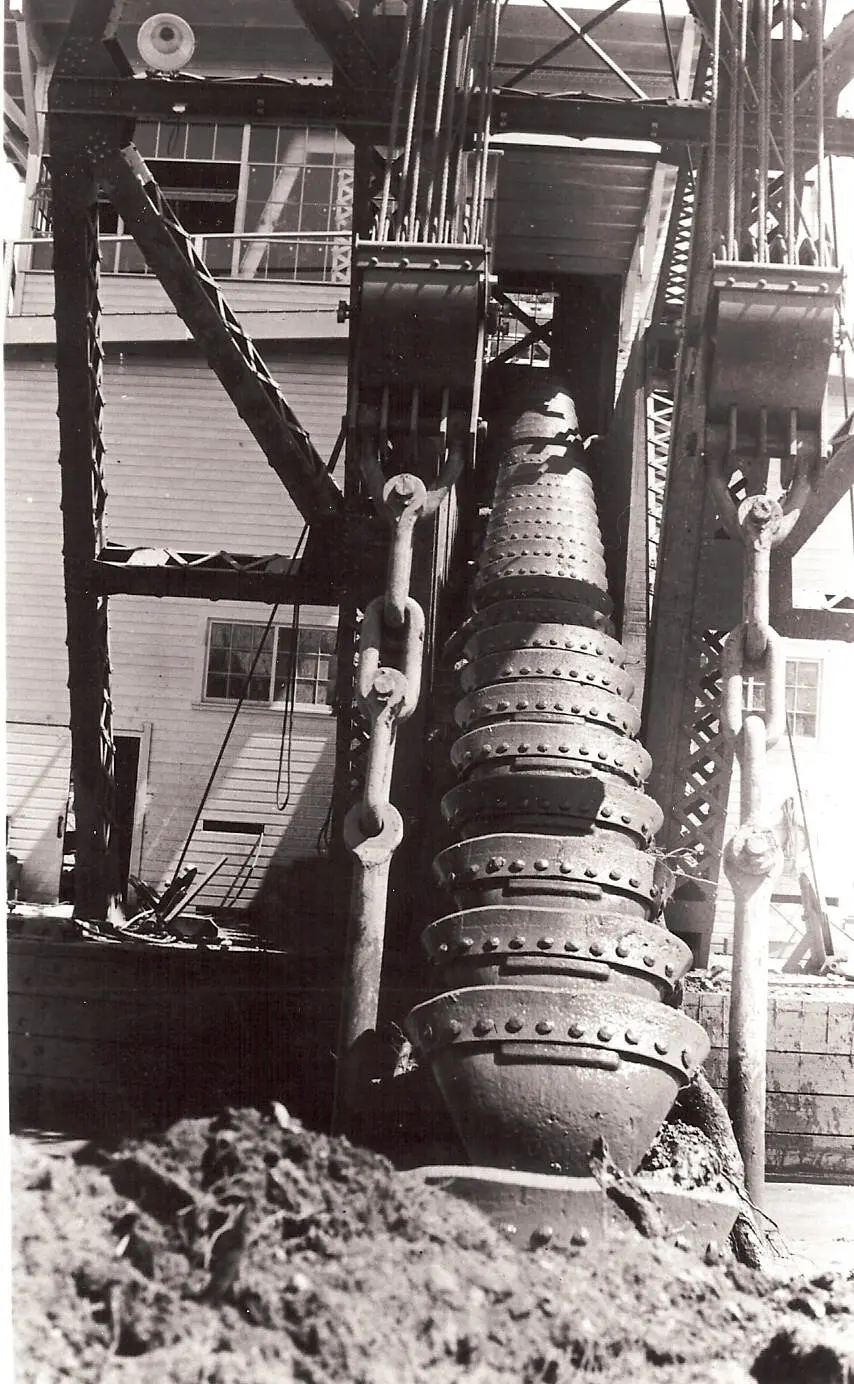
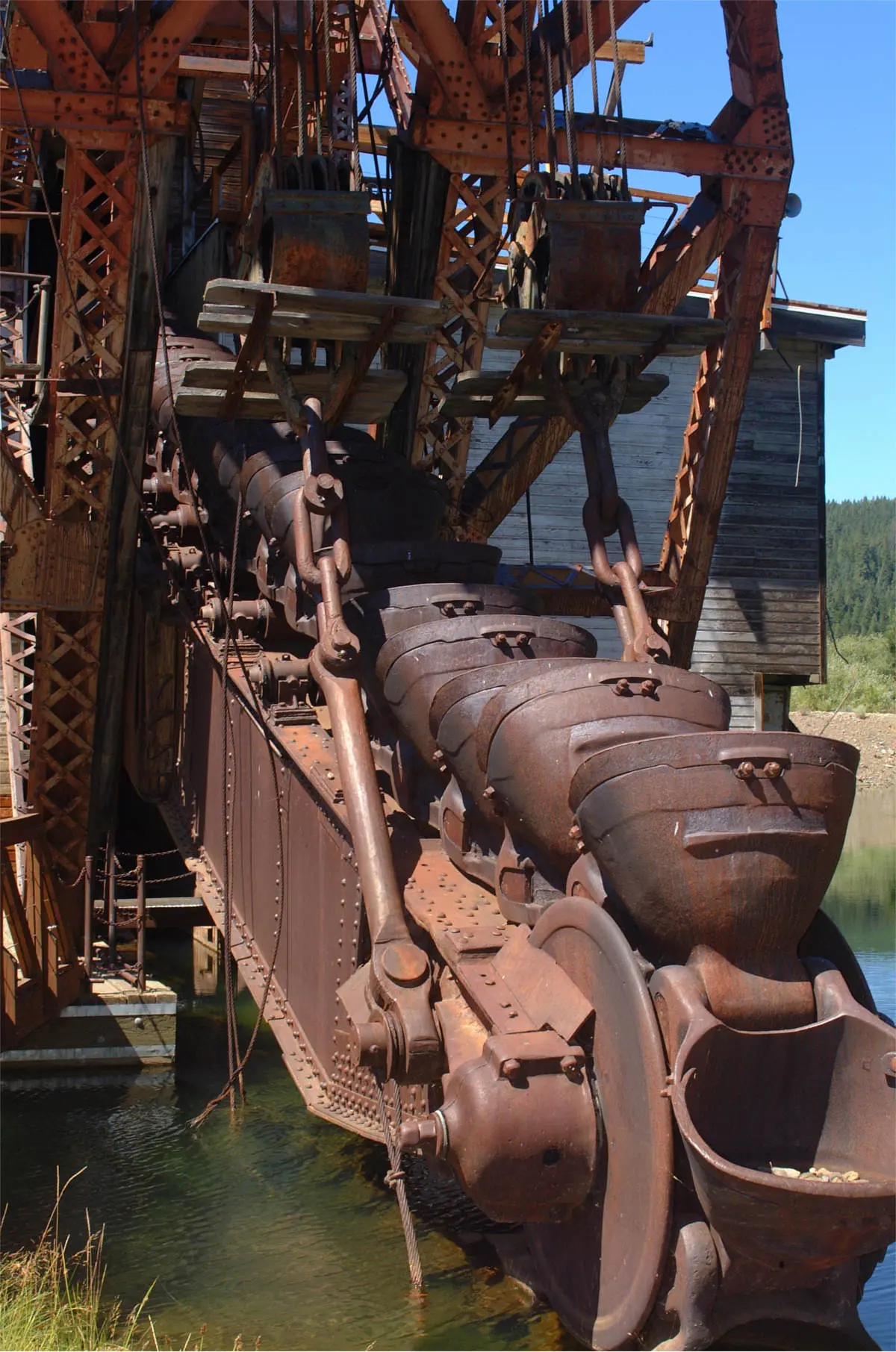
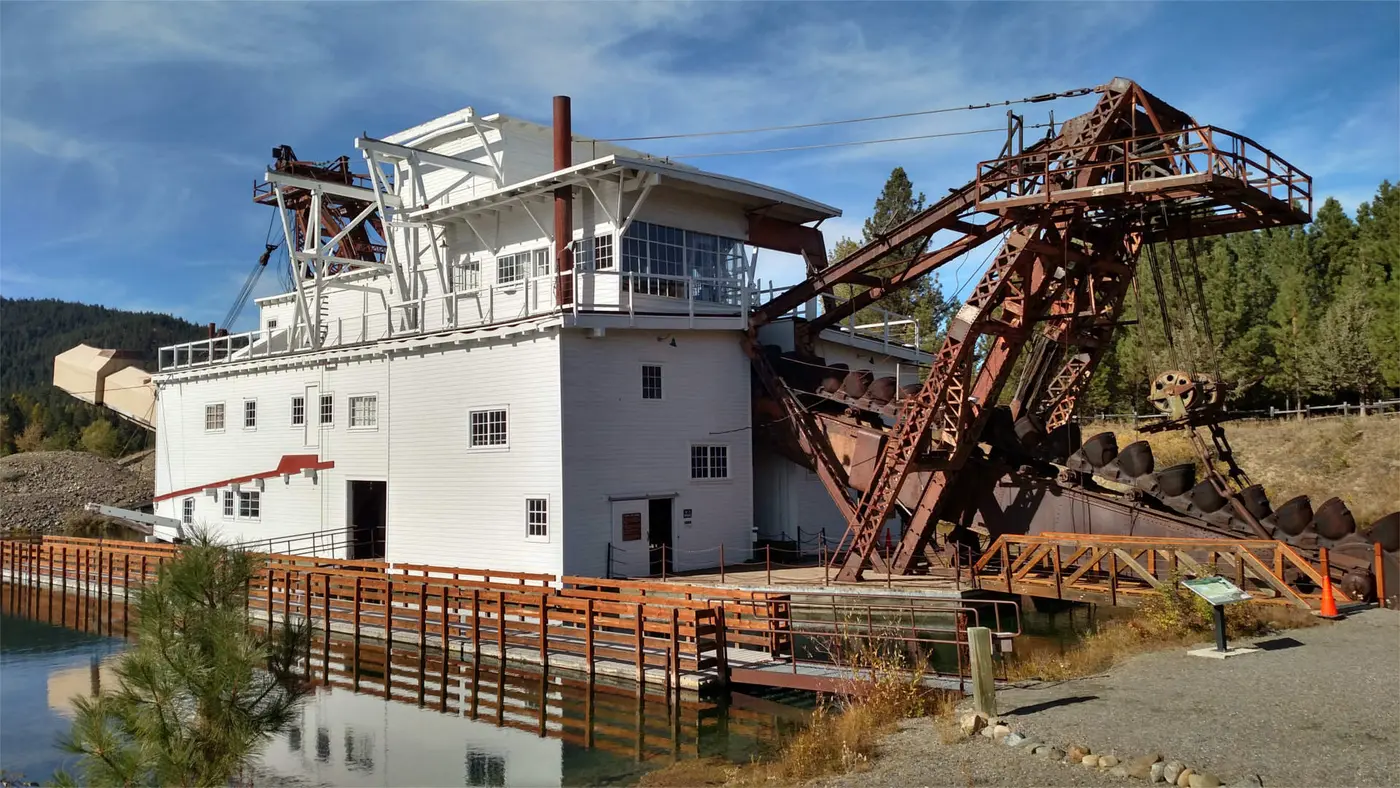
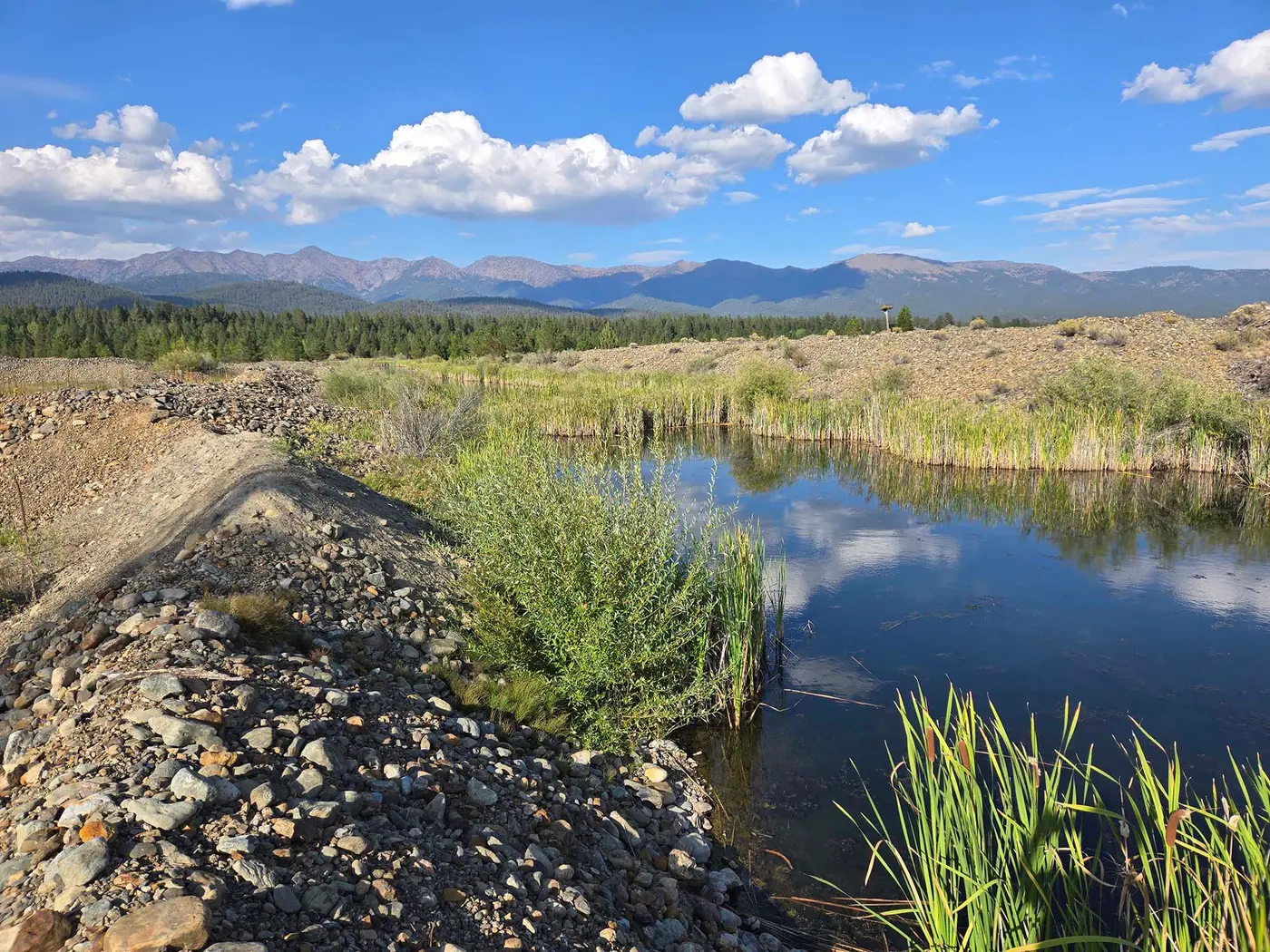
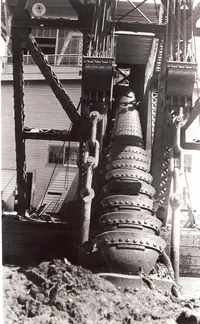
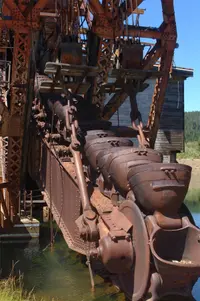
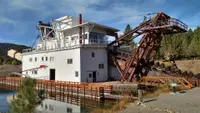
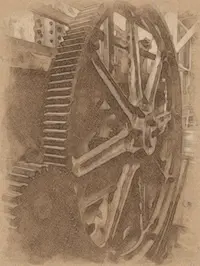
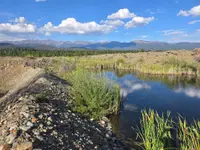
Along Highway 7 between Phillips Lake and Sumpter, the valley floor is heaped with rock. Oregon State Parks’ brochure describes long, narrow water channels cut into the earth, with piles of rock and gravel around them. One of the machines that made them rests at the north end of the valley, just outside the town, at the base of the Elkhorn Mountains. The Sumpter Valley Gold Dredge is a wood-and-steel hull in a pond about 10 feet deep. A boom of buckets juts from its front. Rella Brown, a ranger assistant, told the Baker City Herald in 2016 that it looks like a rusty Ferris wheel, its spoon-shaped buckets weighing a ton each. The state’s own park description calls the dredge “essentially a ship on dry land.”
Aboard the goose
Visitors may board the dredge from May through October. They can walk the decks on their own, or join a ranger-led tour on weekends. Brown explained the machine to children in the body’s terms: mouth, neck and belly. Miners had their own word for it. An Oregon State Parks marker on the short interpretive trail that circles the pond says they called the dredge a “goose”: it was fed at the front, digested the soil inside while keeping the gold, and expelled the rest out the back. The same marker says power came from the Fremont Powerhouse by way of a 19-mile extension cord. Other signs stand along the trails and inside the hull. Among them are “Floating in its own pond,” “Anchoring the Dredge,” and “A Tale of the Tailings.” A hydraulic giant, a nozzle once used to blast gold-bearing hillsides apart, is on display nearby. In 2002 the Herald reported a button that played a recording of a worker telling stories about the machine over the roar of the dredge running.
The upper floors have stayed shut. In 2016 the stairway to the top deck was blocked by locked doors. Brown pointed out the bucket machinery with a laser pointer from below and still sometimes caught people climbing over. “People really want to come up,” she said. “Every day.” In 2018 ranger Garrett Groth said the long-term goal was to open parts of the upper two stories, possibly including the third-floor winch room where a worker controlled many of the machine’s functions. No timeline was set, and safety codes, accessibility and the historic fabric all had to be balanced. “The dredge wasn’t made to give tours in,” Groth said with a chuckle.
The lower decks hold what the maritime archaeologist Jim Delgado noticed in 2019. A spot where a worker kept his oil can and wiping rags. Fir deck planks worn smooth by boots. Words a worker scrawled on a Douglas-fir beam more than half a century earlier. “When I walk through I get a sense of the people working here,” Delgado said. “Even though it’s silent now.”
On weekends rangers give gold-panning demonstrations, and visitors may pan for themselves. The lessons are free, and anyone who turns up gold flakes may buy them for a small fee.
Ponds, tailings and a beaver dam
The park covers several acres. Its map shows an Interpretive Visitors Center, a park office, the Sumpter railroad depot, and the Dredge Loop, North, South, Ridge and McCully Fork trails. About 1.5 miles of trail wind through wetlands along the Powder River and Cracker Creek, with viewing platforms where the brochure points out how nature has reclaimed the ground. Fishing and picnicking are permitted. In 2018 an $8,000 grant was to raise a stretch of trail that a beaver dam floods each season. The park also had abutments for a bridge over Cracker Creek but not yet the money for the bridge.
Before the dredge, Brown said, this was grassland used for crops and grazing. She uses her tours to lay out both sides of dredging. “Do I tear up the land to get the gold — is it worth it?” she asked. “Or is the land more valuable?”
The historic Sumpter Valley Railroad brings passengers to Sumpter Station at the park entrance. The Cracker Creek Museum of Mining is across the street. Beyond the park, Baker County owns 972 acres of the tailings. On January 26, 2026, its parks board voted 4-0 to apply for DarkSky International certification for that county park. “Sumpter’s pretty dark, but out in the tailings it’s really dark,” said board member Matt Armstrong.
Three dredges on the Powder
Gold was found in the Blue Mountains and Sumpter Valley in 1862. Many of the prospectors who came were veterans of the 1848 California rush. The 1971 National Register nomination adds that in 1896 a big lode was found near Bourne, and the narrow-gauge railroad was finished from Baker to Sumpter. That opened a period of hard-rock mining, and Sumpter boomed between 1899 and 1903. By the early 1900s the easy gold was gone, though fine flakes still lay deep in the old riverbed.
Dredges went after them. A row of buckets dug at the front and dumped earth into the hull, where screens and sluices strained out the gold. The rest was dropped behind as tailings. The hulls floated in their own water. As the buckets cut new channels, river water flowed in ahead and carried the dredge forward.
The Powder River Gold Dredging Company built the first in late 1912, south of town below the old smelter. Its wooden hull was 100 by 45 feet. The nomination gives its working years as 1913 to 1924. A second followed in 1915 and worked north up the McCully Fork and Cracker Creek toward Bourne. According to Historic Sumpter, the company dismantled No. 2 in 1923 and shipped everything but the hull to central Washington, where it was rebuilt as the Liberty Dredge. That hull still lies in its pond about two miles up Bourne Road. No. 1 shut down the following year, and its hull remains at McEwen, where the Sumpter Valley Railroad ticket depot and shop now stand.
The valley was quiet for more than a decade. In 1934 President Franklin D. Roosevelt raised the price of gold from $20 to $35 an ounce; the nomination puts the new price at between $34 and $35. That year the Sumpter Valley Dredging Company began a new dredge. The company was based in Portland and largely financed by a family whose shipbuilding firm had flourished during the First World War. W. H. Cullers of the Boles’ shipbuilding firm engineered the dredge, and he served as company president until his death in 1944. Following boatbuilding practice, the hull was built on the bank and launched on 16 April 1935. The earlier hulls had been built in pits that were then flooded.
Accounts differ on the parts. The nomination says the dredge incorporated machinery from the antiquated No. 1. A 2019 Herald account says both earlier dredges were cannibalized for it. Accounts also differ on size. The nomination gives the hull as 52 by 120 feet, with 72 buckets of 9 cubic feet each. Historic Sumpter gives 125 by 52 feet and 10-cubic-foot buckets. The digging line ran on a 250-horsepower electric motor at 20 to 25 buckets a minute and dug 13 to 16 feet down to bedrock or hardpan. In 1938 the dredge was reported to have washed as many as 10 acres of bottomland in a month. The Medford Mail Tribune reported in January 1938 that it appeared to have been Oregon’s largest gold producer in 1937.
Night shifts and Joe Bush
The dredge ran 24 hours a day, every day of the year except Christmas and the Fourth of July. Each shift needed three men: the front oiler, the rear oiler and the winchman. More than twenty others kept the operation going, including a superintendent, a dredgemaster, a bookkeeper, an electrician, a part-time surveyor, a shop foreman, machinists, and a shore crew. The nomination says most of them were local townspeople. In 1947 Wesley R. Dickison, who grew up in the valley, started on the dredge as a winchman before the military called him up. Jo Warnock, whose father was dredgemaster, still lived nearby in 2023. “The guy who ran this dredge probably operated this machine like a virtuoso violinist,” Delgado said.
The two holidays brought the only silence, and with it a ghost. Former workers told of one named Joe Bush, with stories going back to the early 1940s. During the twice-yearly shutdowns they heard thudding footsteps on the upper decks at night and found wet footprints the next day. Some say Joe was a man killed in a 1918 accident on the dredge. Others think he was a wandering soul drawn in from elsewhere. Rangers will talk about him. Each October the park holds a Halloween event. In 2019 local children in costume rode the railroad in to trick-or-treat at the dredge. In 2018 the head ranger led a ghost tour, and the Interpretive Center stayed open late with coffee and hot chocolate.
War stopped the night shifts in 1942, when non-essential mining was ordered to cease. The War Production Board let it resume on 5 July 1945. Historic Sumpter says that restart came under a new owner, the Baker Dredging Company, which replaced the sluice boxes with a jig system and raised gold recovery from 70 to 95 percent. The nomination dates the sale to Baker Dredging to 1948. In 1950 the dredge passed to the Powder River Dredging Company, as the nomination names it; Historic Sumpter gives the name as Powder Dredging Company.
Land for dredging had cost about $50 an acre at first and later $150 to $300. About 2,500 acres of the valley were dug. In 1954 the dredge was reworking old tailings and had reached the edge of Sumpter. The operators reportedly hoped to buy part of the townsite, but rumors inflated land prices and the plan collapsed. The machine stopped for good in August 1954. Oregon State Parks credits mounting pressure from local citizens and soaring operating costs. Historic Sumpter says the company quit $100,000 in debt, with gold still fixed at $35 an ounce. The state estimates the dredge’s lifetime take at more than $4 million; the nomination puts it at $4,500,000. The nomination estimates all the valley’s dredging at about $10 million. Crook County historian Steve Lent gives $10 to $12 million, and says the three dredges traveled more than 8 miles.
A diver under the hull
The dredge stayed where it stopped. By 1971, when it went on the National Register, winters had deteriorated it, and owner Ken Alexander was refurbishing it as a mining museum. In the early 1990s Sumpter residents pressed for its preservation. In 1992–1993 the Oregon Parks and Recreation Department bought the dredge, the tailings and nearby land from the Trust for Public Land and private owners. The park opened in spring 1994. A $250,000 project in 1995 raised the dredge onto the sand pedestal it still sits on. Hull sections that had been underwater dried out in the air and decayed quickly, and workers had to replace some of them. The Friends of the Sumpter Valley Dredge work alongside the state. Their grants paid more than $77,000 to restore rotten roof beams by 2016. That year board member Jack Walls said of the hull supports: “They look like a beaver has been down there and chewing on them.”
In 2019 the state paid SEARCH Inc. $48,380 to examine the hull. On a spring morning Deborah Marx put on a dry suit and slipped into the near-freezing pond, carrying lights and a GoPro. Kyle Lent kept close by in a kayak. Where clearance in the 9-foot-deep hull shrank to a foot, a remote-controlled submersible went in. Delgado, who had seen the Titanic from a Russian submersible, explained that wood lasts longer underwater, and longer still in cold water. “I think she’s in pretty good shape,” he said. “This hull was very solidly built.”
Notable Events
- 1862Gold discovery in Sumpter led to a rush and major mining activity. crookcountyhistorycenter.org
- 1862Gold was discovered in Oregon's Blue Mountains and nearby Sumpter Valley in 1862. stateparks.oregon.gov
- 1900sThe rush significantly diminished. crookcountyhistorycenter.org
- 1912The first of three valley dredges was built. crookcountyhistorycenter.org
- 1913Dredging boomed in Baker County. bakercityherald.com
- 1915The second of three valley dredges was built. crookcountyhistorycenter.org
- 1920sThe two earlier dredges were discontinued and disassembled. crookcountyhistorycenter.org
- 1923Powder River Dredging Company dismantled No. 2 and shipped everything but the hull to Central Washington, where it was rebuilt and renamed the Liberty Dredge. historicsumpter.com
- 1934The Sumpter Valley Dredging Company began work on a new and improved dredge after the gold-price increase. historicsumpter.com
- 1935Dredging boomed again in Baker County; the dredge was responsible for taking more than $4.5 million worth of gold from the valley. bakercityherald.com
- 1935The dredge operated during this period. bakercityherald.com
- 1935Parts of the earlier dredges were used to create the last dredge. bakercityherald.com
- 1935Unlike earlier dredge hulls built in a pit, Dredge No. 3's hull was built on the bank of the pond then launched on 16 April 1935. npgallery.nps.gov
- 1937The connected-bucket dredge of the Sumpter Valley Dredging company appears to have been the state's largest producer. oregonnews.uoregon.edu
- 1942The dredge shut down under the wartime order to cease non-essential mining production. historicsumpter.com
- 1944Company president Cullers remained active in its affairs until his death. heritagedata.prd.state.or.us
- 1945The dredge resumed under a new owner, Baker Dredging Company; a jig system replaced sluice boxes and increased gold recovery from 70% to 95%. historicsumpter.com
- 1950In 1950 the dredge became the property of the Powder River Dredging Company. heritagedata.prd.state.or.us
- 1954Local environmental concerns and skyrocketing operating costs led to operations ceasing. crookcountyhistorycenter.org
- 1954In its last year the dredge reworked old tailings. Operators reportedly intended to purchase part of the townsite, but the plan collapsed when rumors inflated land prices. heritagedata.prd.state.or.us
- 1954Powder Dredging Company ceased dredging, $100,000 in debt. historicsumpter.com
- 1971The Sumpter Valley Gold Dredge was added to the National Register of Historic Places in 1971. stateparks.oregon.gov
- 1990sLocals developed an interest in preserving the dredge as a reminder of local history. crookcountyhistorycenter.org
- 1992The park bought the dredge; its wooden hull support beams have slowly rotted since. bakercityherald.com
- 1992Oregon Parks and Recreation Department purchased the dredge, tailings and nearby property from the Trust for Public Land and private individuals. stateparks.oregon.gov
- 1994The dredge and surrounding area were preserved and opened to the public. crookcountyhistorycenter.org
- 1995A $250,000 project raised the dredge and built a sand pedestal; formerly submerged hull sections exposed to air dried and deteriorated rapidly. bakercityherald.com
- 1995Restoration of the dredge began in the summer of 1995 through the efforts of the Friends of the Sumpter Valley Dredge and the OPRD. npgallery.nps.gov
- The dredge closed down; repairs and improvements were made during the idle period. heritagedata.prd.state.or.us
- No. 1 shut down the following year; its hull remained where it stopped in McEwen. historicsumpter.com
- After opening the dredge to the public in 1994, OPRD began restoring it the following year. stateparks.oregon.gov
People
- Dennis Bradley, Park manager discussing structural assessment and project cost.
- Jack Walls, Friends of the Dredge board member.
- Rella Brown, Oregon State Parks ranger assistant at the dredge.
- Brian McBeth, State Parks Department historic architecture project manager.
- Garrett Groth, Ranger at the Sumpter Valley Dredge State Heritage Area discussing opening the upper stories.
- Jo, Daughter of the Sumpter dredge's dredgemaster.
- Deborah Marx, SEARCH maritime archaeologist who traveled to Sumpter to investigate the dredge.
- Jim Delgado, Maritime archaeologist studying the dredge.
- Kyle Lent, SEARCH maritime archaeologist who traveled to Sumpter to investigate the dredge.
- Franklin D. Roosevelt, President whose increased gold price influenced creation of the new dredge (1934).
- Ken Alexander, Owner named on the nomination form.
- W. H. Cullers, Engineer of the dredge and president of the Dredging Company; of the Boles' shipbuilding firm (until his death in 1944).
- Joe Bush, Ghost in former workers' accounts, associated with thudding footsteps and wet footprints.
- Wesley R. Dickison, Started work as a 'Wenchman' on the Sumpter Valley Gold Dredge before being called into the military (1947).
Sources
- stateparks.oregon.gov/index.cfm?do=park.profile&parkId=174
- stateparks.oregon.gov/index.cfm?do=main.loadFile&load=_siteFiles%2Fpublications%2F%2F44144_OPRD_Sumpter_Dredge_Brochure%28web%29033827.pdf
- stateparks.oregon.gov/index.cfm?do=things-to-do.events&parkId=174
- heritagedata.prd.state.or.us/historic/index.cfm?do=main.loadFile&load=NR_Noms%2F71000676.pdf
- travelbakercounty.com/sumpter-dredge
- eastoregonian.com/2026/01/27/baker-county-seeks-darksky-designation-for-park-in-sumpter-valley-dredge-trailings
- historicsumpter.com
- historicsumpter.com/history
- crookcountyhistorycenter.org/2023/08/sumpter-valley-gold-dredge
- bakercityherald.com/2019/05/07/the-dredge-divers
- myoregon.gov/2019/10/28/spooky-sites-to-see-this-halloween
- hmdb.org/m.asp?m=106890
- oregonnews.uoregon.edu/lccn/2015260133/2015-03-13/ed-1/seq-2/ocr
- oregonnews.uoregon.edu/lccn/sn97071090/1938-01-21/ed-1/seq-7/ocr
- npgallery.nps.gov/GetAsset/7014f72a-eee0-4f63-8b9c-462336ddecea