
Skagit Tours
Newhalem, Washington. Scenic boat tours; Tours run from July to September.
Details
- Where
- Main St., Newhalem, WA. Directions
- When
- Tours run Wednesday - Sunday, July 3 - September 7 (plus Labor Day Monday).
- Getting there
- Along State Route 20.
- Hours
- Check-in begins at 10:15 a.m. for the morning and lunch cruises.
- Access
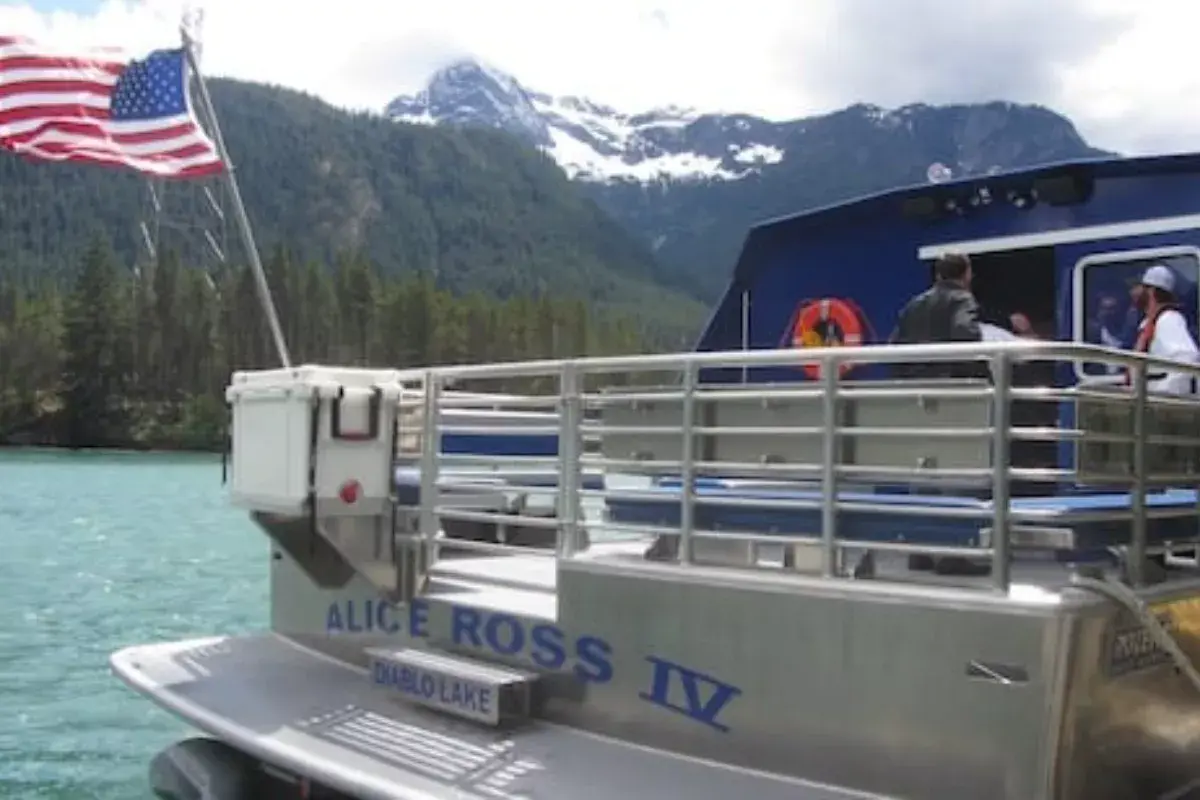
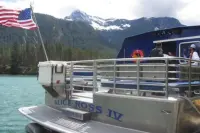
- Diablo Lake Boat Tours are wheelchair accessible! The Alice Ross IV offers wheelchair-accessible boarding ramps, seating and on-board restroom. Please call if additional accommodations are needed.
- Walk-in or reserve
- For personalized assistance, questions or help to make your reservation, contact our friendly Skagit Tours team Monday thru Friday, 8:30 am - 4:30 pm.
- Phone
- (360) 854-2599
- Website
- seattle.gov
- Managed by
- North Cascades Institute.
- Established
- Skagit Tours have connected visitors to the natural and cultural history of the Pacific Northwest and our hydro resources for nearly 100 years.
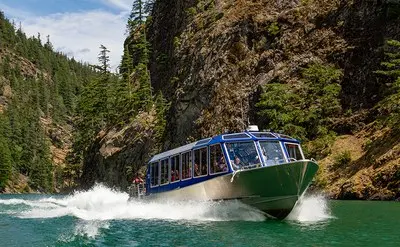
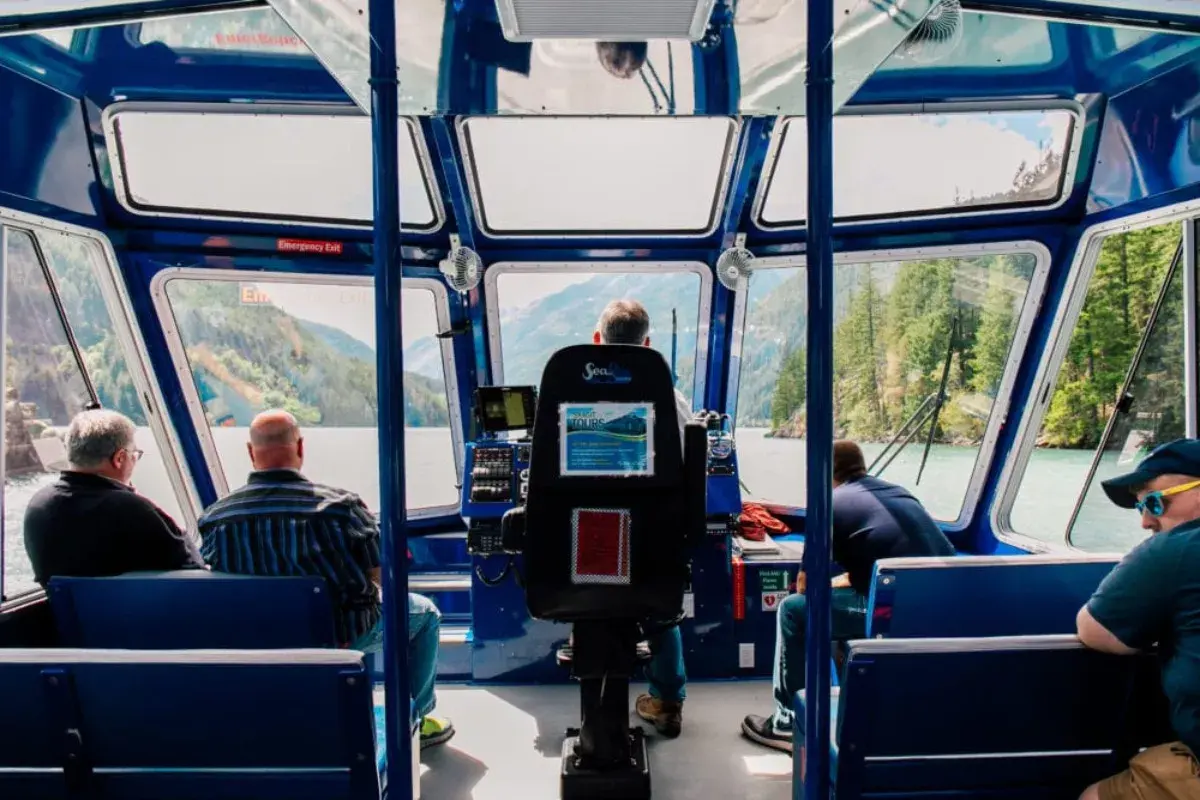
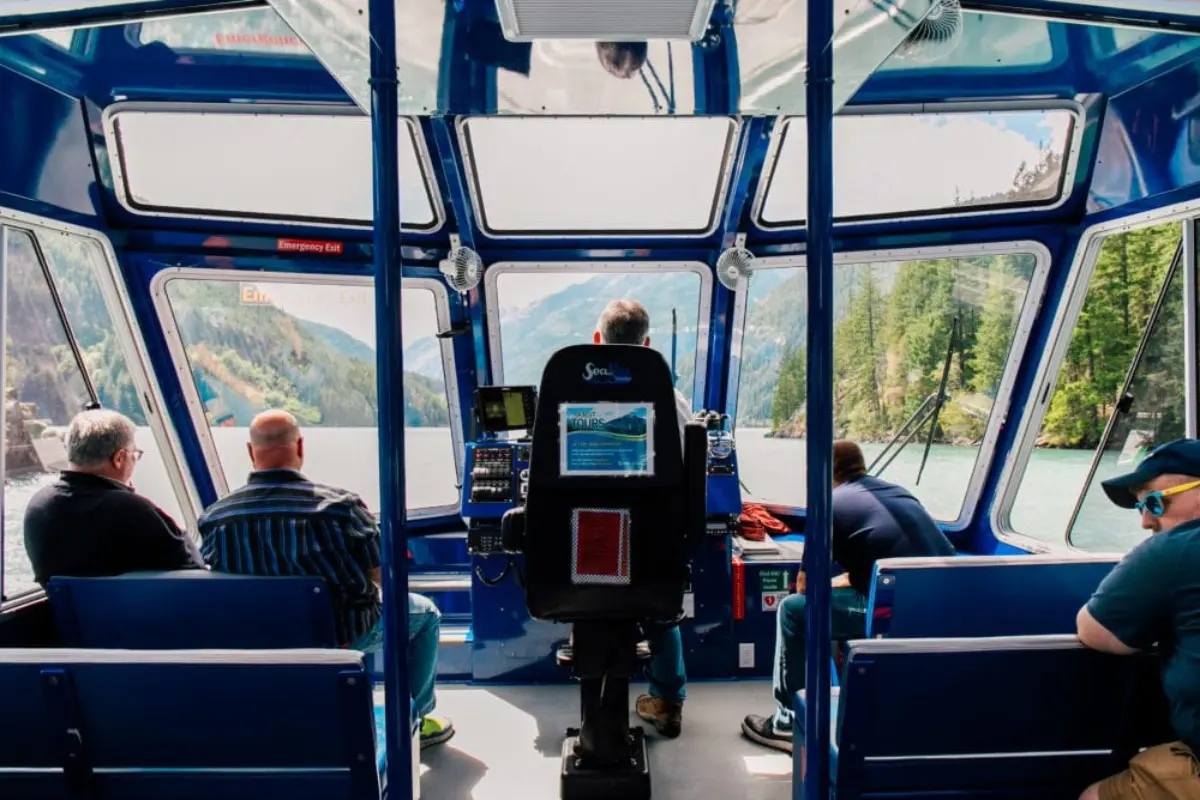
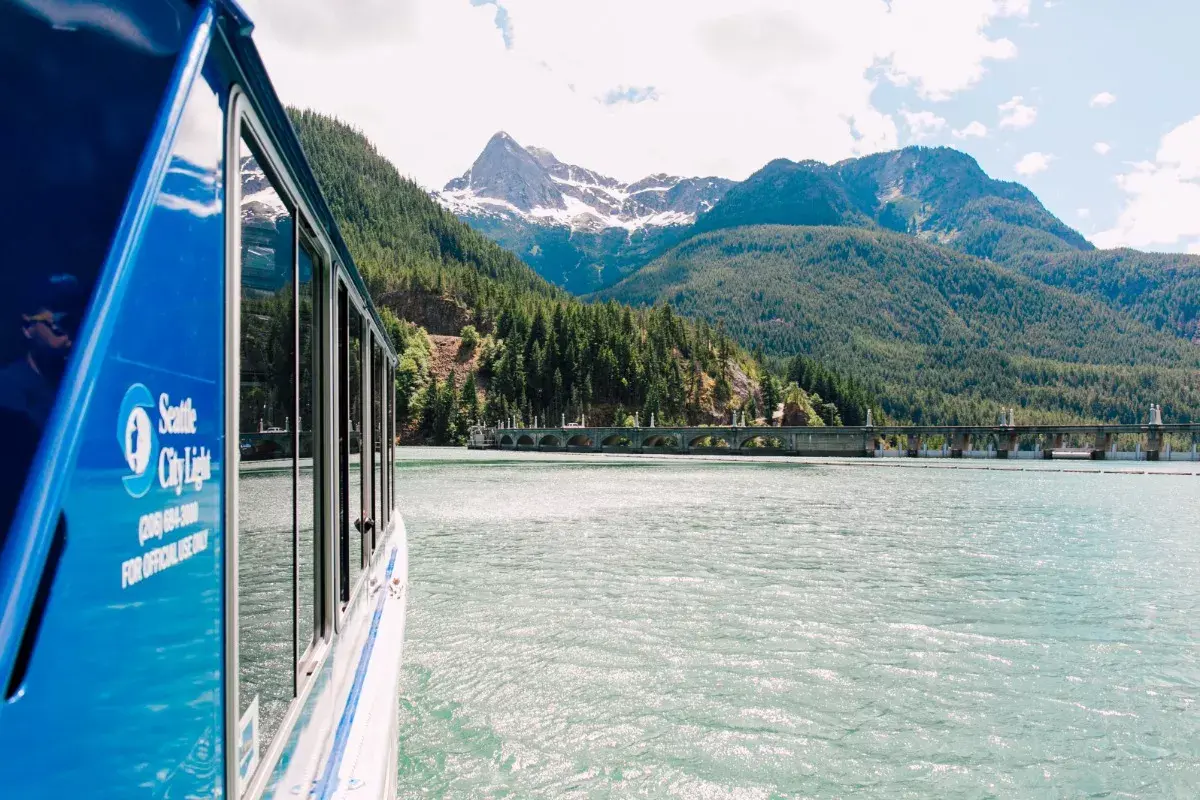
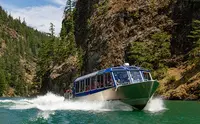
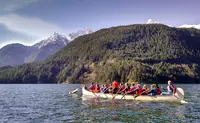
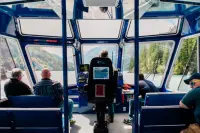
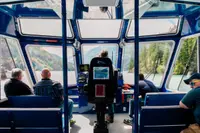
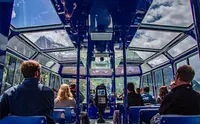
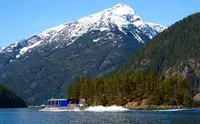
The Alice Ross IV is 55 feet long and carries 49 passengers and crew. Glass runs along the sides and roof of her cabin, so the snow peaks above Diablo Lake can be seen from the heated, air-conditioned seats as well as from the open aft deck. The lake is a reservoir behind Diablo Dam, about 128 miles northeast of Seattle. Its water is jade-turquoise from the glacial flour carried in by the streams that feed it. As the boat cruises, guides from the North Cascades Institute describe the surrounding ecosystem and tell how the dams and powerhouses along the Skagit River came to be built. Boarding ramps, seating, and the on-board restroom are wheelchair accessible.
The Institute runs the tours with Seattle City Light, which owns the dams. In 2026 there were three cruises. The Diablo Lake & Lunch Cruise ran Wednesday through Sunday from July 3 to September 7, plus Labor Day. It checked in at 10:15 a.m. and ended about three hours later with a home-cooked lunch at the North Cascades Environmental Learning Center, a campus of 16 buildings on the north shore of the lake. The Afternoon Cruise ran the same summer days and the weekends of September 12 to 27. The Fall Morning Cruise ran only those September weekends, offered for “the colors and quiet of the Fall season.” City Light says Skagit Tours have connected visitors to the region’s natural and cultural history and its hydro resources “for nearly 100 years.”
Main Street, Newhalem
The tours belong to Newhalem, at milepost 120.5 on State Route 20, where the Skagit leaves its narrow gorge. The National Park Service notes that native peoples have called this place home for millennia and keep a deep and continuing relationship with it. City Light founded Newhalem in 1918, and the utility still owns and operates the town. Its residences are closed to visitors. There is no gas station.
Beside the highway stands “Old Number 6,” a restored Baldwin steam engine. It once ran between Newhalem and Rockport, which was the only way in before the North Cascades Highway was built. The Skagit General Store on Main Street dates from 1922. City Light calls it the original company store and one of four buildings left from the construction camp. A 2003 Seattle Times account says it was built as an employee bunkhouse. Either way, it sells homemade Skagit fudge along with camping supplies. The Gorge Inn, one of the town’s earliest buildings, was the cookhouse that fed City Light’s construction crews. It now holds displays on the Skagit Project and a section on the life of J.D. Ross.
The Trail of the Cedars begins at the foot of Main Street. It is a three-quarter-mile loop under western red cedars and Douglas firs, past ground regenerating from the 2015 Goodell Creek Wildfire, with a spur to the Newhalem Creek Powerhouse. That small plant supplied electricity while the bigger dams were being built. Up the road, a visitor gallery inside the Gorge Powerhouse looks down on the generator floor and lays out the project’s history in photographs. Across the river, a suspension footbridge leads to the Ladder Creek Falls Trail, which climbs through terraced gardens beside the falls and returns over the river on a walkway along an old railroad bridge. From dusk to 11 p.m. the falls are lit in color. A marker on the trail notes that the LED fixtures use 90 percent less energy than the original 1,000-watt lamps.
J.D. Ross takes the Skagit
James Delmage Ross was born in Chatham, Ontario, in 1872. HistoryLink’s biography says he taught himself nearly all he knew of electricity. At 11 he repeated Benjamin Franklin’s kite experiment in a thunderstorm. He went north for the Klondike rush in 1898, came out after a year and a half, and landed in Seattle while the city was arguing over public power. In 1902 voters approved a municipal plant at Cedar Falls. Ross asked City Engineer Reginald H. Thomson for the job of designing it. When Thomson asked what experience he had, Ross answered, “None. But where will you find anybody that has?” Two weeks later he brought back blueprints. In 1911 he became superintendent of the new lighting department, the utility later called City Light.
He turned to the Skagit, where the river drops through a granite gorge. The East Coast firm of Stone and Webster held federal permits there, and its extensions kept the river closed to Seattle. When the permits lapsed again in 1917, Ross lobbied in Washington, D.C., arguing that Skagit power would relieve the electrical shortages of the First World War. Federal officials awarded Seattle the permit on December 22, 1917.
There was no road past Marblemount, only a pack trail. Ross was wary of private power firms getting into the valley, so in 1918 City Light finished a 24-mile railroad from Rockport to Newhalem. By the time the snow melted in 1920, 500 men were at work. Below the powerhouse site stood six bunkhouses, 75 three-room cottages, a cookhouse, and a hospital. Crews spent more than two years driving an 11,000-foot pressure tunnel through solid granite, which the National Register nomination calls the first of its kind in America. The Gorge Dam itself went up as a “temporary” rock-filled timber crib. Masonry replaced it in 1950, and the present concrete arch dates from 1961.
According to HistoryLink, the Gorge generators began sending power 100 miles to Seattle on September 17, 1924, after President Calvin Coolidge started them from the White House by pressing a golden key. The National Register record dates the first Skagit power in Seattle to September 14. Private power interests kept up their attacks, and on March 9, 1931, Mayor Frank Edwards fired Ross. Two months later voters removed Edwards in a special election, and the new mayor rehired Ross that July. Diablo Dam began producing electricity in 1936.
Monkeys, lilies, and a lit waterfall
The public owned the utility, and Ross meant to keep the public watching it. The Ladder Creek marker states that public tours of the Skagit Project began in 1922. By that account the first tour left from Seattle and lasted three days, by automobile, train, and boat. The Seattle Times and City Light date the program to 1928 instead. In that version Ross offered the tour to sell the project to voters, joining the hydro works to the scenery of the North Cascades.
The Times gives the early itinerary. Visitors rode the train from Rockport to Newhalem and slept in bunkhouses and tents. They walked to the powerhouses and Ladder Creek Falls, and the day ended with a dance. Next morning, electric trains took them to Diablo, where Ross had built a small zoo that once held more than 150 exotic birds and animals, an albino deer among them. The Incline Railway, built to haul workers and supplies for Diablo Dam, lifted them 313 feet up Sourdough Mountain. There they boarded the Alice Ross, named for J.D.’s wife, and motored up the lake through the Skagit Gorge. They passed an island where Ross kept monkeys borrowed from Seattle’s zoo to entertain them. Back in Rockport, tourists found their cars had been washed. The two-day trip cost $3.03. At the peak, in the late 1920s and 1930s, more than 21,000 people took it each year.
Ross was a world authority on lilies, and the son of a Scottish horticulturist. Beginning in 1925 he made a garden around the Gorge Powerhouse, with tropical plants and pools stocked with trout and goldfish. In 1929 the U.S. Forest Service let him take charge of Ladder Creek Falls so he could light it in changing colors. By 1930, an account quoted on the trail marker says, the lights were “in all the varying colors of the rainbow — a spectacle never to be forgotten.” Hidden phonographs and amplifiers piped music across the hillsides. The Seattle Municipal Archives still hold the 1938 file of phonograph records played at Ladder Creek, along with Ellen Larson’s Skagit poem, “Day Unto Night.” The tropical plants have since given way to ones better suited to the climate, but the garden’s framework survives, and it is listed in the National Register of Historic Places.
In 1939 Ross went to the Mayo Brothers’ Clinic in Rochester, Minnesota, for an operation. Afterward he and Alice were joking in his room about the trip home when he died of a heart attack. A year later the first phase of the dam at Ruby Creek was finished and named Ross Dam. It stands 540 feet tall and holds back Ross Lake.
The chicken dinner and the lean years
The tours ran every year except during the Second World War. The archives keep a 1942 folder of correspondence about the suspended trips. For decades the tour ended with a chicken dinner and apple pie in the old Diablo cookhouse. City Light dropped it in 2001 to save money. In 2002 the utility canceled the tours outright, citing the energy crisis and the security concerns that followed September 11.
They came back in June 2003, a version the Seattle Times called “Skagit Lite.” The incline railway, the Ross powerhouse, and the town of Diablo were now off-limits. The tour met in Newhalem instead. Six rings of Old Number 6’s brass bell started it, and a bus carried visitors over Diablo Dam to the Alice Ross III. “I like to see all the natural wonders,” said Rosemary Woodward of Tacoma, on the season’s first tour. “I’ve never seen dams like that.” Janice Bowman, who ran the tours, explained that the 1991 federal license for the Skagit Project required recreation and that the boat cruise helped meet it. The chicken did not. City Light had lost 60 percent of its reservations when the dinners ended. “I recognize the importance of it and am doing my best to build the market demand,” Bowman said. “This is the test year.” Melody Miranda, who brought groups up from Centralia, put it plainly: “Anything to support getting the chicken dinner back.”
In 2004 it returned once a month as the Diablo Dam Good Dinner, with baked chicken, mashed potatoes, spaghetti, and homemade pie. In 2010 budget troubles canceled the tours and the Dam Fine Dinner. “We regret having to cancel the tours,” Superintendent Jorge Carrasco said. City Light counted it as only the third cancellation in the program’s history. The tours resumed in 2011 with a new pattern: lunch at the Environmental Learning Center, where the chef worked with organic, local food, followed by a ride on the Alice Ross III with Institute educators aboard.
The Alice Ross IV made a test run in April 2016 and entered service that summer. City Light counts more than 80 years of Alice Ross boats on Diablo Lake, beginning with the Alice Ross I, photographed on the water in 1935. Alice Ross was later laid beside her husband in the granite tomb on Ross Mountain, across from the Gorge Powerhouse. The bronze plate above it reads “James Delmage Ross,” and beneath that, only “J. D.”
Notable Events
- 1917Seattle City Light won approval to build a series of dams and power plants on the Skagit River after a fierce battle with private energy interests. archive.seattletimes.com
- 1918A 24-mile standard-gauge railroad was completed between Rockport and Newhalem to provide access before dam work began. npgallery.nps.gov
- 1918City Light states that it has generated hydroelectric power on the Skagit River since 1918. powerlines.seattle.gov
- 1920sAt the tour's peak, more than 21,000 visitors took it each year. archive.seattletimes.com
- 1920By the time the snow melted, 500 men were at work and a small town had arisen below the Gorge powerhouse site. npgallery.nps.gov
- 1922City Light built the Skagit General Store building as an employee bunkhouse, according to the newspaper's account of the tour's meeting place. archive.seattletimes.com
- 1922The marker states that public tours of the Skagit Project began in 1922. hmdb.org
- 1924Under Superintendent James D. Ross, the Skagit River hydroelectric project began supplying power with completion of Gorge Dam. archiveswest.orbiscascade.org
- 1924The generators began transmitting power 100 miles to Seattle after President Calvin Coolidge started them from the White House by pressing a golden key. historylink.org
- 1925J.D. Ross began creating a wonderland garden around Gorge Powerhouse for visitor enjoyment and entertainment. hmdb.org
- 1928J.D. Ross began tours to showcase the Skagit River and its hydroelectric potential. archive.seattletimes.com
- 1929The US Forest Service granted Ross permission to manage Ladder Creek Falls in order to illuminate the falls with changing colors. hmdb.org
- 1930By 1930, the falls lights were described as being in all the varying colors of the rainbow. hmdb.org
- 1936The Diablo Dam project began producing electricity. historylink.org
- 1942The municipal archive catalogs correspondence about suspended Skagit trips during WWII. archiveswest.orbiscascade.org
- 1950The timber dam was replaced by masonry, the powerhouse was enlarged, and a fourth turbine unit was added. npgallery.nps.gov
- 1961A 300-foot-head concrete diversion thin arch and gravity dam was built, raising the head to 375 feet. npgallery.nps.gov
- 1991Janice Bowman said tours were required under the hydroelectric operating license negotiated with the Federal Energy Regulatory Commission. archive.seattletimes.com
- 1996The National Park Service published the National Register record for the Skagit River and Newhalem Creek Hydroelectric Projects district. npgallery.nps.gov
- 2001City Light stopped serving the traditional chicken dinner as a cost-cutting measure. archive.seattletimes.com
- 2002City Light attributed the cancellation to the financial impacts of the energy crisis and heightened security following the terrorist attack of 9-11. powerlines.seattle.gov
- 2003The tour returned after a yearlong security-related, post-9/11 hiatus. archive.seattletimes.com
- 2003The Skagit Project became the first large hydroelectric facility in the nation certified as a Low Impact Hydropower Project. seattle.gov
- 2004The newspaper reported that the tour would include the famed chicken dinners for the first time in three years, but only once a month. archive.seattletimes.com
- 2010Seattle City Light canceled Skagit Tours and the Dam Fine Dinner program. powerlines.seattle.gov
- 2011City Light announced the tours' return after a one-year hiatus, with enhanced educational opportunities and a new dining component. powerlines.seattle.gov
- 2016A new vessel, the Alice Ross IV, made its debut on the Diablo Lake Boat Tours. powerlines.seattle.gov
- The newspaper says the tours continued annually except during World War II, when security concerns caused suspension. archive.seattletimes.com
- The follow-up newspaper account says the chicken dinners were scrapped again because of expense after the tours resumed the previous year. archive.seattletimes.com
People
- J.D. Ross, Then-superintendent of City Light who began the tours to showcase the Skagit River's hydroelectric potential (28 years heading City Light).
- Janice Bowman, Ran the tours for City Light and explained the redesign under orange-alert security constraints.
- Melody Miranda, Discovery Tours leader who brought a group to the tour and planned further groups after its resumption.
- Michael Kurtz, Seattle Convention and Visitors Bureau tourism-development director who joined a tour and saw potential for Japanese visitors.
- Myla Moody, Tour employee who grew up in Diablo.
- Rosemary Woodward, Tacoma resident who joined the first Skagit Tour of the season.
- Edward M. Kemoe, City Light manager in charge of Skagit Tours whose files are included in the municipal collection.
- Ellen Larson, Author of the Skagit poem "Day Unto Night" cataloged in the tour records (1938-1939).
- James Delmage (J. D.) Ross, Father of Seattle City Light, best known for securing and constructing the hydroelectric project on the Upper Skagit River (1872-1939).
- Colleen McShane, City Light manager of Natural Resources and Environmental Planning who described the tours' educational and recreational purpose.
- Jorge Carrasco, Seattle City Light superintendent who announced regret at canceling the tours.
- Alice Ross, Wife of J.D. Ross and namesake of the Alice Ross tour boats.
Sources
- seattle.gov/city-light/in-the-community/tours-recreation-and-education/skagit-tours-and-recreation
- ncascades.org/signup/programs/skagit-tours
- bellingham.org/get-onboard-with-skagit-tours-in-north-cascades-national-park
- scenicwa.com/story/discover-the-north-cascades-with-skagit-tours
- nps.gov/places/newhalem.htm
- archiveswest.orbiscascade.org/ark:80444/xv689057
- archive.seattletimes.com/archive/20030612/nwwskagit121/canceled-after-911-tour-of-skagit-river-dams-is-back
- archive.seattletimes.com/archive/20040521/chicken21m/city-light-tours-to-offer-chicken-dinners-again
- powerlines.seattle.gov/2010/05/18/popular-skagit-tours-suspended-for-2010
- powerlines.seattle.gov/2011/02/14/skagit-tours-returning-this-summer
- powerlines.seattle.gov/2016/06/30/skagit-tours-new-and-improved-for-2016
- powerlines.seattle.gov/2023/04/03/skagit-tours-and-recreation-2023
- hmdb.org/m.asp?m=129277
- hmdb.org/m.asp?m=129289
- seattle.gov/city-light/energy/power-supply-and-delivery/hydroelectric-resources/skagit-river-hydroelectric-project
- npgallery.nps.gov/GetAsset/4c893d1b-0aa0-45ab-b7d5-c4623681abfb
- historylink.org/File/2557
- npgallery.nps.gov/AssetDetail/be1dadbc-d397-4277-91ab-ee80054ae675