Shasta Dam and Powerplant Tour
Shasta Lake, Shasta County, California. Guided dam tour.
Details

- Where
- 16349 Shasta Dam Boulevard, Shasta Lake, CA 16349. Directions
- When
- Guided tours offered Friday through Tuesday; no tours Wednesday and Thursday.
- Season
- Open Friday through Tuesday; closed Wednesday and Thursday.
- Getting there
- About 9 miles northwest of Redding, California, on the Sacramento River.
- Fees
- Free.
- Hours
- Visitor center open Friday through Tuesday from 8 a.m. to 4 p.m.; closed Wednesday and Thursday.
- Access
- Tour includes a walk across the top of the dam, an elevator ride down 400 feet, and a walk through the dam to the spillway view.
- Walk-in or reserve
- First come, first served; tickets handed out one hour in advance; tours limited to 20 people.
- Phone
- 530-247-8500
- Managed by
- Bureau of Reclamation.
- Established
- 1945 (Shasta Dam and Powerplant completed June 20, 1945; construction began 1938).
Twenty tickets at the visitor center
Tickets for the tour are handed out at the Shasta Dam Visitor Center one hour before each departure, first come, first served, twenty people to a tour. The visitor center stands at the dam, about 9 miles northwest of Redding on the Sacramento River. Its films and displays cover the construction of the 1940s and honor the engineers and workers who built it, among them Frank Crowe. Bureau of Reclamation guides lead the tours Friday through Tuesday, and the tours are free.
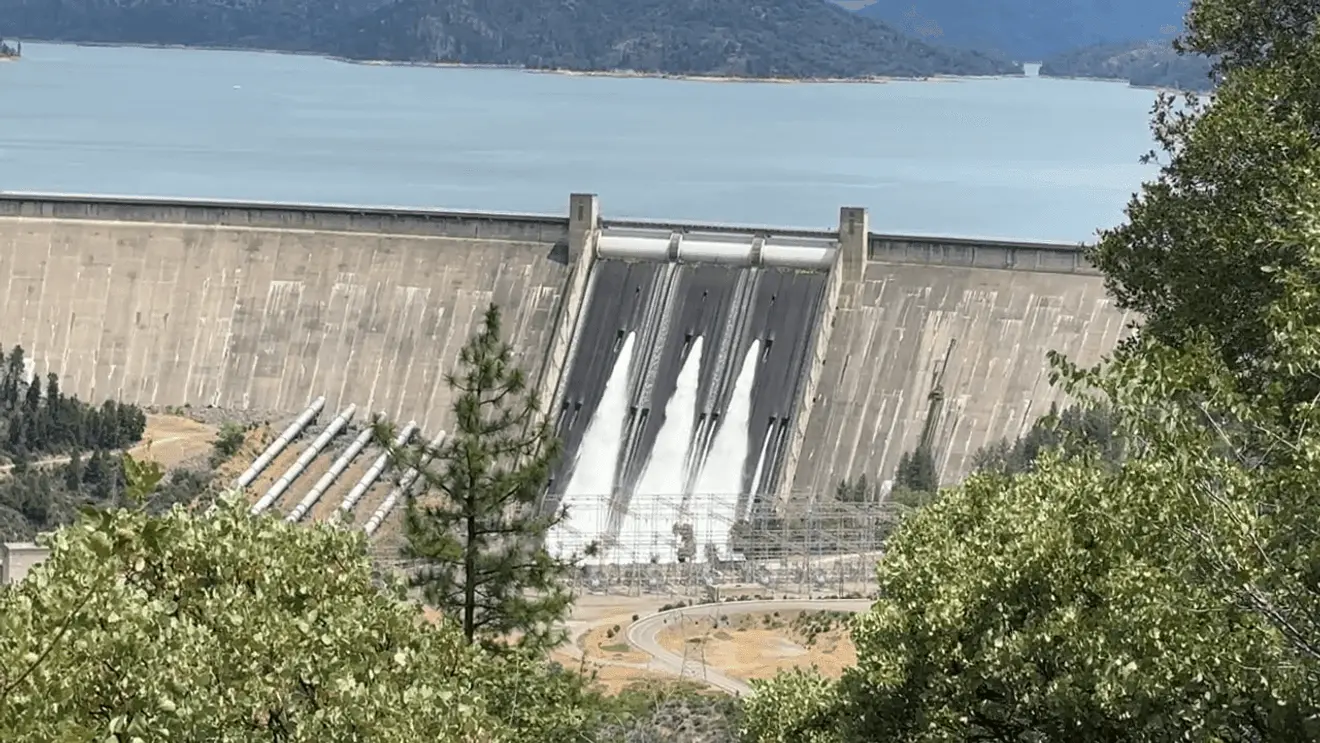
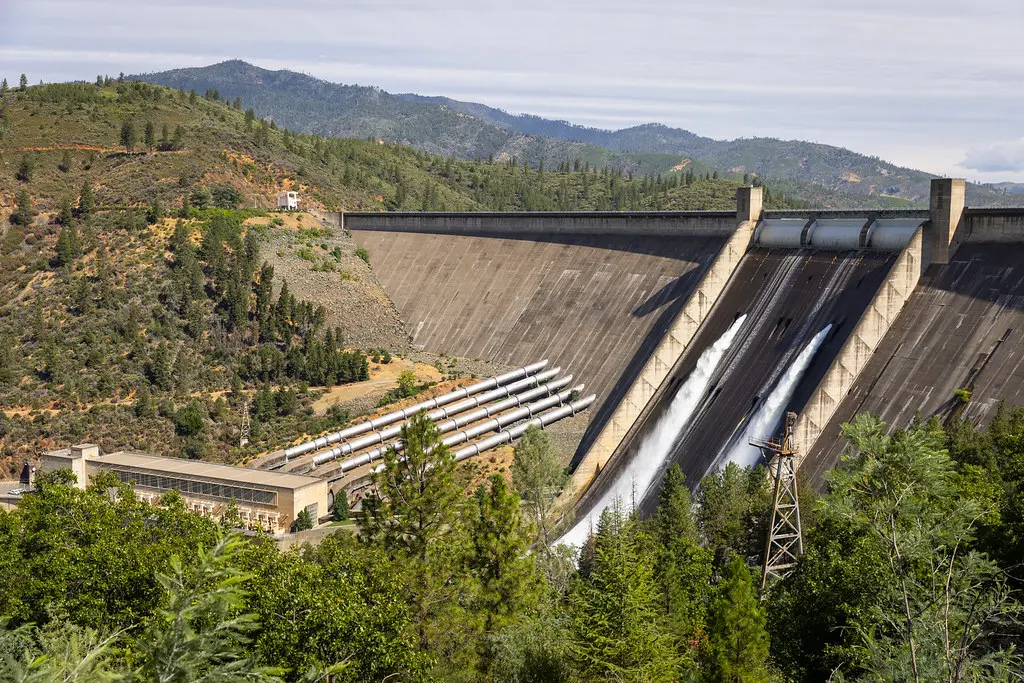
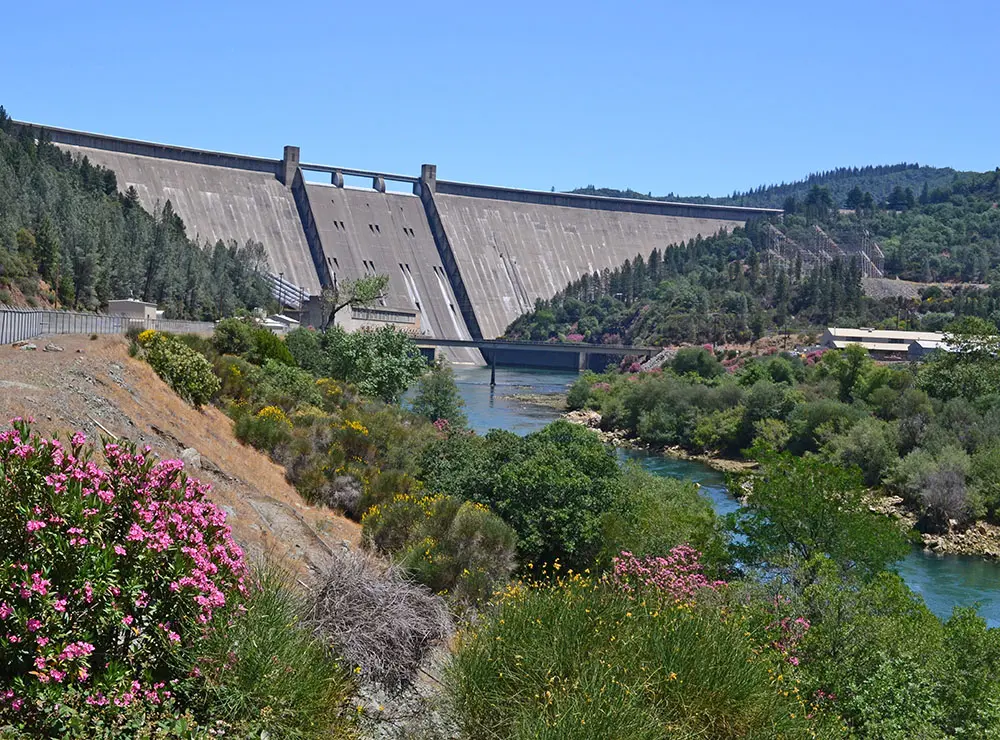
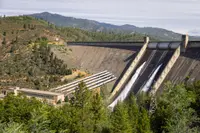
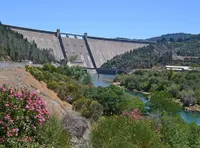
The walk begins on top of the dam. The crest is 30 feet thick and runs 3,460 feet across the river. The base is 883 feet thick, and the structure stands 602 feet high. Reclamation ranks it the second-largest concrete dam in the United States, behind Grand Coulee. From the crest an elevator carries the group 400 feet down. A short walk through the interior follows, past concrete that still holds 1,300 miles of grout-filled cooling pipe, and ends at a viewpoint looking out on the spillway. The spillway is 487 feet long. When the dam was finished it was the largest manmade waterfall in the world, a mark since passed by others, including Three Gorges in China and Itaipu in Brazil.
The last stop is the Shasta Powerplant: five generators, 710 megawatts, the largest federally owned hydroelectric facility in California. Reclamation reckons its output at enough for 355,000 to 710,000 homes. The guides explain how the dam was built and what it does for the Central Valley Project. Behind the dam lies Shasta Reservoir, the largest water storage facility in California, which holds more than 4.5 million acre-feet.
Kennett, under four hundred feet
Before the dam was named Shasta, it was called Kennett. The name came from a railroad way station in Sacramento Canyon just above the site, and Reclamation’s own records call the construction unit the Kennett Division. The town of Kennett lies directly north of the dam, according to the Forest Service, under about 400 feet of water. It was founded during the gold rush of the 1850s and grew to nearly 10,000 residents in the early 1900s on copper. One account credits it with 40 saloons, a hotel, a hospital, and an opera house. Sulphur from its five smelters killed nearly all vegetation within a 15-mile radius. With copper prices falling after World War I, the town declined after 1925. Over a million check dams and millions of trees went into the stripped hillsides afterward. Kennett was one of eight towns submerged when the lake rose in 1944.
The dam itself took decades to arrive. In 1873 President Grant sent Army Engineers to study water control in the Central Valley. In 1919 the idea of damming the Sacramento was put forward, by the United States Geological Survey in one account and in a plan submitted to the governor of California in another. The project began with the State of California. The legislature passed the Central Valley Project Act in 1933, in the depths of the Depression, and voters approved it, but the bonds to pay for construction could not be sold. The state turned to the Bureau of Reclamation, and President Franklin D. Roosevelt approved the Central Valley Project on December 2, 1935. That month drilling at the Kennett site found ancient, re-crystallized volcanic rock for a foundation. At a ceremony on September 12, 1937, Reclamation Commissioner John C. Page named the dam Shasta, after Mount Shasta, citing the geographic and historic significance of the name. Work on the government construction camp, called Toyon, started that year.
Buckets on a cable
Reclamation opened bids on June 1, 1938. The job was so large that contractors pooled their money and skills, as they had for Hoover Dam. Pacific Constructors Inc., led by the Los Angeles firm of L. E. Dixon, won the contract. The National Park Service gives its bid as $36.9 million. Another account puts the award at $35,939,450, made July 6, 1938, to a consortium of twelve companies. Reclamation dates the start of construction to August 21, 1938, though a 2022 Reclamation story gives 1937. Frank T. Crowe, who had run Arrowrock, Hoover, and Parker dams, came on as general superintendent.
For nearly two years crews cleared and excavated down to bedrock and moved 30 miles of Southern Pacific track out of the site. The new line needed bridges, trestles, and tunnels, and one of the tunnels later diverted the river around the work. Early 1940 brought the wettest season on record, 108 inches of rain. Floods in February and March swept away the suspension-and-girder bridge upstream and badly damaged the contractor’s truck and railroad bridge.
The first concrete went in on July 8, 1940, and pouring ran day and night for four and a half years. Twelve million yards of aggregate came from the Sacramento River in downtown Redding on a Goodyear conveyor belt 9.6 miles long, then the longest in the world. Eight-cubic-yard steel buckets rode a cableway out to wooden forms 50 feet square and 5 feet deep. “Great care was taken,” the historian David P. Billington writes, “to ‘vibrate’ the wet concrete to ensure that it completely filled the forms without leaving any voids or airspaces that would tend to weaken the structure.” The cableway’s head tower stood 465 feet from its foundation and 700 feet above the river; Reclamation’s 1996 history gives 460 feet.
On April 5, 1941, the Mutual Broadcasting System carried a coast-to-coast broadcast from the dam. Secretary of the Interior Harold Ickes visited with a group that year. As war came, guards were posted against sabotage. After Pearl Harbor thousands of workers enlisted or left for the naval shipyards, and women and high school students took over non-hazardous jobs. Clearing crews on the upper Pit River also left for the war. That arm was never cleared, and its standing snags are the reason waterskiing is prohibited above Arbuckle Flat.
Water storage began in February 1944, while concrete was still going in. General Electric finished installing the first two generators on June 1, 1944. Reclamation ran one on June 10, shut it down with a bearing problem, and ran it successfully on June 19, and the second followed the next day. Power from the dam reached shipyards and aircraft factories before construction was finished. The final concrete was laid December 22, 1944, by Reclamation’s history; the National Park Service dates the last bucket to January 2, 1945. Reclamation’s construction page says the dam was done 22 months ahead of schedule, and another account says nearly 26. On June 20, 1945, Reclamation accepted the dam and powerplant from Pacific Constructors. The lake filled in 1948, covering 47 square miles. The fifth generator started on April 27, 1949, and Reclamation began guided public tours that July 2. The dam was formally dedicated on June 17, 1950, and it spilled for the first time on May 18, 1952. Seventy-three years later, at the eightieth anniversary on June 20, 2025, Reclamation briefly opened the spillway gates.
The head tower was partly demolished at the end of construction and now stands submerged behind the dam. When the reservoir falls 90 feet below the crest, its foot comes back into view. “I have seen the foot of the head tower rise out of the water many times over the 21 years I have worked here,” said Tami Corn, a Reclamation project coordination specialist at the dam. “It’s an interesting site to see and brings out more visitors, but it also means water users are struggling downstream.” The lowest level on record came in the summer of 1977, 230 feet below the crest. The river below the dam has been managed for the endangered winter-run Chinook salmon since 1992, when Reclamation began bypassing the turbines. A Temperature Control Device for releasing cold water was finished on the dam’s face in 1997.
Hell’s Gulch and Toyon School
Reclamation announced a “large concrete dam” for Shasta County in the summer of 1937, and job seekers arrived by the hundreds, later the thousands. They camped along the new road west from Highway 99 in worn tents, cramped trailers, and their own cars, waiting for hiring to start. By the summer of 1938 three towns had risen along Shasta Dam Boulevard: Project City, developed by William and Gene Hammans; Central Valley, where a sign proclaimed “Boomtown Center” the “hub of commercial activity”; and Summit City. Dam workers spent their off hours in Charley’s Place, The Mint Pool Hall, The Round-Up, and dozens of other beer halls, saloons, and dance halls.
Reclamation donated land for a school, Pacific Constructors donated the materials, and off-duty dam workers raised Toyon School. The students installed its cupboards and shelves and built its fence. “I couldn’t believe it,” the principal, Matt Rumboltz, recalled. “Some classes had over 70 students!”
From 1938 to 1941 the developer Jonathan Tibbitts and others put on a Hell’s Gulch festival, at which a coffin standing for “old man gloom” was burned. Visitors from miles around passed realtors’ signs offering lots for $95, five dollars down and five a month. They ate chicken or beef dinners at the Southern Barbecue and finished with Rudi Raki’s ice cream at The Big Dipper. The war emptied many of the houses until late 1945, when returning servicemen moved in. On July 2, 1993, the three towns incorporated as the City of Shasta Lake.
The Shasta Lake Historical Society was founded there in 2001 by Barbara Cross and Evelyn Hoppes, whose fathers worked on the dam. Its Boomtown Museum has two 14-foot murals, one of the Mammoth Mine above Kennett and one of dam workers arriving. It also keeps a movie projector recovered from the ashes of the Shasta Theatre and sells a book of the workers’ children’s memories called Those Dam Kids. The society records, without vouching for it, that after the dam was finished a “tour boat” called the Joseph L. Green ran on the lake.
The McCloud River and the plaque
In 1942 Reclamation moved 301 remains from twenty-five burial places in the reservoir basin. The 183 Native Americans were reinterred in the United States Shasta Reservoir Indian Cemetery, and the 118 whites in the Central Valley and Redding cemeteries. The Winnemem Wintu lived along 27 miles of the McCloud River that the dam flooded. Florence Jones, their top doctor and spiritual leader, kept the people together afterward. Her journal entry and an oral history she passed down tell that Frank Crowe watched their homes demolished to clear the valley. The Shasta Scout reports the account as alleged. Congress authorized payments and a new cemetery for the Tribe in 1941. In 1943 the federal agent sent to look into compensation wrote that “the interests of many of the Shasta County Indians would be served better if they would leave the county entirely.”
A memorial plaque at the dam dedicates it to the “pioneer mothers and fathers . . . whose courage to overcome hardship opened the unknown West, converting the wilderness into empire.” The Shasta Scout reported in 2022 that the visitor center’s history leaves out the Winnemem Wintu. Donald Bader, then Reclamation’s manager for the Northern California Area Office, called the center “a place for Reclamation to tell its story” and pointed to the Wintu Museum in the City of Shasta Lake. In 2021 tribal members tried to deliver portraits of their McCloud River ancestors to the visitor center. Since 2004 the Tribe has held two H’up Chonas ceremonies, the Dance in the Old Way, at the dam, in opposition to a Reclamation plan to raise it 18 feet. In March 2026 the Department of the Interior set aside $40 million to plan raising the water level, which could add about 600,000 acre-feet of storage. The money is for planning, not construction.
“We have a problem of invisibility,” Chief Caleen Sisk told the Shasta Scout. She repeated what Florence Jones always said of the flooded river: “That was no wilderness, that was our home!”
Notable Events
- 1919The idea of damming the Sacramento River was first proposed by the United States Geological Survey as a solution to chronic water control problems in the Central Valley. storymaps.arcgis.com
- 1933California's Division of Water Resources submitted the State Water Plan in 1931, and the state legislature passed the California Central Valley Project Act in 1933 in the midst of the Great Depression; California voters approved the project, but the bonds needed to finance construction proved impossible to sell. nps.gov
- 1935President Franklin Roosevelt authorized the Central Valley Project as part of the New Deal and Congress began appropriations; in November of 1935 the Bureau of Reclamation officially started on the project. storymaps.arcgis.com
- 1935Reclamation opened its first exploration of the Kennett dam site, where drilling revealed ancient, re-crystallized, volcanic rock. waterboards.ca.gov
- 1936On March 25, 1936 the United States and the California Water Project Authority executed a cooperative agreement to coordinate the Central Valley Project and the California State Water Project. waterboards.ca.gov
- 1937The Bureau of Reclamation's announcement in the summer of 1937 that a large concrete dam would be constructed in Shasta County sent hundreds, later thousands, of hopeful job seekers pouring into the area, hoping to get as close to the Shasta Dam work site as possible. cityofshastalake.gov
- 1937The groundbreaking ceremony took place on September 12, 1937, when the project was officially named after nearby Mount Shasta. storymaps.arcgis.com
- 1937This archived Reclamation news story states that construction of Shasta Dam began in 1937 and was completed in 1945, and that a system of steel cableway towers was erected to carry the concrete-pouring buckets. usbr.gov
- 1937Work crews began experimental washing and grouting of seams in the foundation in 1937, and work started on the government construction camp called Toyon. waterboards.ca.gov
- 1938Boomtown developer Jonathan Tibbitts and others organized a Hell's Gulch community festival to forget the doldrums of the Great Depression and celebrate the success of the new towns, with a coffin signifying old man gloom ceremoniously burned; people came from miles around during the early years from 1938-1941. cityofshastalake.gov
- 1938Three cores of residential and commercial development sprang up along Shasta Dam Boulevard by the summer of 1938, and a wild boomtown atmosphere prevailed as hired dam workers spent their off-duty hours in dozens of beer halls, saloons, taverns, and dance halls. cityofshastalake.gov
- 1938Pacific Constructors Inc. (PCI), led by the prominent Los Angeles outfit of L. E. Dixon, won the job with a bid of $36.9 million; engineer Frank Crowe, of Arrowrock, Hoover and Parker dam fame, later came on board as general superintendent. nps.gov
- 1938Reclamation opened bids on June 1, 1938; the undertaking was so big that groups of contractors pooled their skills and financial resources to land the job, as they had on the Hoover Dam contract. nps.gov
- 1938The Shasta Lake Historical Society preserves a photograph of Mr. Mathew Rumboltz with some of the 'those Dam kids' and the first 7th and 8th grade students at Toyon School in 1938. shastalakehistorical.org
- 1938Construction of major Central Valley Project facilities began in 1938 with the breaking of ground for Shasta Dam on the Sacramento River near Redding; over the next five decades the project grew into a system of 20 dams and reservoirs holding nearly 12 million acre-feet. usbr.gov
- 1938Construction on the dam began August 21, 1938, by Pacific Constructors Incorporated; for nearly two years the emphasis was on clearing and excavating the dam site down to solid foundation bedrock. usbr.gov
- 1938The Civilian Conservation Corps set up its local headquarters at the abandoned Baird Fish Hatchery and established two camps in the area, BR-84 and BR-85, whose enrollees cleared brush and timber from thirty-four acres of the Shasta Lake site and landscaped the government construction camp. waterboards.ca.gov
- 1938Pacific Constructors commenced operations on Shasta Dam before actually receiving the notice to proceed on September 8, 1938. waterboards.ca.gov
- 1940By July 1940 crews were pouring wet concrete from huge buckets into wooden forms that made interlocking 50-foot-by-50-foot blocks for the dam face. nps.gov
- 1940In early 1940 the area was hit with the wettest season on record, with 108 inches of rain in a single year, flooding the dam's aggregate processing plant and damaging critical equipment at the construction site; the first bucket of concrete was poured July 8, 1940. storymaps.arcgis.com
- 1940sA system of steel cableway towers carried the concrete-pouring buckets during construction; the head tower stood 465 feet high from its foundation and 700 feet above the river, and water ran through the generators while the dam was still being built so power would come as soon as possible for the World War II effort. usbr.gov
- 1940Pacific Constructors poured the first concrete on Shasta Dam July 8, 1940, using an elaborate cableway with a 460 foot tall head tower, five tail towers and eight cubic yard buckets. waterboards.ca.gov
- 1940Flooding in February and March of 1940 suspended Pacific Constructors' work temporarily; the rushing water washed away the combination suspension and girder bridge upstream from the dam site and seriously damaged the contractor's truck and railroad bridge. waterboards.ca.gov
- 1941In 1941 Congress passed a law authorizing potential payments, and the establishment of a new cemetery, for Winnemem Wintu people to make amends for their flooded lands. shastascout.org
- 1941After the attack on Pearl Harbor thousands of workers enlisted or left for naval shipyards, creating a severe labor shortage; women and high school students stepped in to fill non-hazardous roles to keep construction moving. storymaps.arcgis.com
- 1941World War II caused the Federal government to disband the Civilian Conservation Corps, and its enrollees stopped work on the Shasta site June 30, 1941. waterboards.ca.gov
- 1941Shasta Dam drew much attention during 1941: the Mutual Broadcasting System made a coast to coast broadcast from the dam on April 5. waterboards.ca.gov
- 1941Reclamation provided funds for a fifth power unit in Shasta Powerplant, and the escalating war brought guards to project structures against possible sabotage. waterboards.ca.gov
- 1942By August 1942 four million cubic yards of concrete had been placed, and by the summer of 1943 the dam was taking final shape. nps.gov
- 1942Reclamation had 301 remains to move from twenty-five burial places, 183 Native Americans and 118 whites; the Native Americans were reinterred in the United States Shasta Reservoir Indian Cemetery and the whites in the Central Valley Cemetery and Redding cemeteries. waterboards.ca.gov
- 1943In 1943 a federal agent who investigated the potential of compensating the Tribe concluded they should leave the area instead, writing that the interests of many of the Shasta County Indians would be served better if they would leave the county entirely. shastascout.org
- 1943Kennett Division contractors employed 2,416 employees in 1943, despite the manpower shortage created by World War II. waterboards.ca.gov
- 1944Water storage began in Lake Shasta in February 1944. nps.gov
- 1944The dam was already generating electricity for California shipyards and aircraft factories before construction was complete, and it was finished on December 22, 1944, nearly 26 months ahead of schedule. storymaps.arcgis.com
- 1944Shasta Power Plant was put in service in 1944, when power generation had become a critical need for the war effort. usbr.gov
- 1944Pacific Constructors laid the final concrete on the dam structure December 22, 1944. waterboards.ca.gov
- 1944General Electric Company concluded installation of two generator units on June 1, 1944; Reclamation ran one unit for testing on June 10, shut it down with a bearing problem, and ran it successfully on June 19, with the other unit succeeding the next day. waterboards.ca.gov
- 1945Scores of men terminated their dam jobs for the service or moved to higher-paying wartime jobs, leaving numerous vacant homes idle until late 1945, when returning servicemen and new job hopefuls moved back into the area. cityofshastalake.gov
- 1945The last bucket of concrete was poured on January 2, 1945, and the dam was completed on the Sacramento River in 1945. nps.gov
- 1945The dam was completed in 1945, 22 months ahead of schedule; the abutments were built first and the massive center spillway completed the dam. usbr.gov
- 1945On June 20, 1945, Reclamation officially took control of the dam and powerplant from Pacific Constructors Incorporated. usbr.gov
- 1946Reclamation established the Sacramento Valley District on December 14, 1945, and abolished the Kennett Division on September 5, 1946. waterboards.ca.gov
- 1948Lake Shasta reached full capacity in 1948, covering 47 square miles of land. storymaps.arcgis.com
- 1949On April 27, 1949, the fifth unit started operation in Shasta Powerplant, five years after the first unit started. waterboards.ca.gov
- 1949On July 2, 1949, Reclamation started guided tours for the public at Shasta. waterboards.ca.gov
- 1950Shasta's five-generator powerplant came online in 1950; with it, the project was complete. nps.gov
- 1950Reclamation formally dedicated Shasta Dam as the key structure of the Central Valley Project on June 17, 1950. waterboards.ca.gov
- 1952Shasta spilled on May 18, 1952, the first time since completion. waterboards.ca.gov
- 1977The lake's historic lowest level came in the summer of 1977, when Shasta Reservoir stood 230 feet below the dam's crest. usbr.gov
- 1992Beginning in 1992, Reclamation bypassed the turbines in Shasta Powerplant and released water directly into the Sacramento River to improve conditions for endangered winter-run Chinook salmon. waterboards.ca.gov
- 1997A multi-faceted Temperature Control Device ensuring the release of cold water for the benefit of winter-run Chinook Salmon was completed in 1997 on the face of the dam. nps.gov
- 2004The Tribe has held H'up Chonas ceremonies at the dam since 2004, as part of their resistance against a Reclamation plan to raise Shasta Dam an additional 18 feet. shastascout.org
- 2014Winnemem Wintu traditional dancers posed at Shasta Dam following a H'up Chonas (Dance in the Old Way, War Dance) ceremony held there in 2014. shastascout.org
- 2021Winnemem Wintu tribal members attempted to deliver portraits of their ancestors, who lived on the McCloud River before it was flooded, to the Shasta Dam Visitor Center. shastascout.org
People
- Jonathan Tibbitts, boomtown developer who organized the Hell's Gulch community festival in the Shasta Dam boomtowns.
- Matt Rumboltz, principal of Toyon School, the school the Bureau of Reclamation and Pacific Constructors Inc. helped provide for the children of Shasta Dam workers, who recalled being overwhelmed with large numbers of students.
- Frank Crowe, engineer who came on board as general superintendent of the Shasta Dam job, having taken charge at other prominent Reclamation dams.
- L. E. Dixon, head of the prominent Los Angeles outfit that led Pacific Constructors Inc., which won the Shasta Dam job with a bid of $36.9 million.
- Caleen Sisk, Winnemem Wintu Chief and Spiritual Leader who has pressed the Bureau of Reclamation to include her people's flooding in the Shasta Dam Visitor Center's history of the dam.
- Donald Bader, Bureau of Reclamation manager for the Northern California Area Office, responsible for the operation and maintenance of Shasta Dam and its Visitor Center.
- Florence Jones, Winnemem Wintu top doctor and spiritual leader at the time Shasta Dam flooded the tribal homes on the McCloud River, who kept the people together afterwards and whose journal entry and oral history document the clearing of their homes.
- Gary Mulcahy, Winnemem Wintu Tribe's government liaison speaking for the Tribe on the dam's history told at the Visitor Center and the plan to raise the dam.
- Franklin Roosevelt, President of the United States who authorized the Central Valley Project, the federal program that built Shasta Dam, as part of the New Deal (1935).
- President Grant, President who sent Army Engineers to investigate water control in the Central Valley, the first federal step toward the project Shasta Dam completed (1873).
- Frank T. Crowe, construction superintendent who headed up the Shasta Dam project from the start of work in 1938.
- Tami Corn, Bureau of Reclamation Project Coordination Specialist at Shasta Dam who watches the construction head tower reappear in dry years (21 years working at the dam).
- Harold Ickes, Secretary of the Interior who visited Shasta Dam with a group during its wartime construction (1941).
- Harry W. Bashore, Reclamation official whose report carried the State Engineer's view that Kennett Reservoir, the future Shasta Lake, was the cornerstone of the whole Central Valley Project.
- John C. Gist, contractor who completed placement of the drum gates on Shasta Dam's spillway (1950).
- John C. Page, Bureau of Reclamation Commissioner who officially named the dam Shasta, after Mount Shasta, at the ceremony of September 12, 1937 (1937).
Sources
- usbr.gov/mp/ncao/dam-tours.html
- usbr.gov/mp/ncao/shasta-dam.html
- shastahistorical.org
- shastahistorical.org/visit/shasta-county-landmarks
- shastalakehistorical.org/about-us
- waterboards.ca.gov/waterrights/water_issues/programs/bay_delta/california_waterfix/exhibits/docs/RestoretheDelta/RTD_106.pdf
- usbr.gov/newsroom/news-release/4268?field_story=1&field_story_archive=Facilities&topic=Facilities
- usbr.gov/mp/cvp/index.html
- storymaps.arcgis.com/stories/0b6233054d714504a9946052e461b16d
- shastascout.org/building-shasta-dam-flooded-out-a-california-tribe-why-arent-they-included-in-the-dams-history
- cityofshastalake.gov/DocumentCenter/View/40/City-History
- shastalakehistorical.org
- fs.usda.gov/sites/nfs/files/legacy-media/shasta-trinity/Sightseeing%20at%20Shasta%20Lake%20ROG.pdf
- usbr.gov/mp/ncao/dam-work.html
- usbr.gov/newsroom/news-release/5187
- nps.gov/articles/california-shasta-dam.htm