Scobey Pioneer Days
Scobey, Daniels County, Montana. Annual Pioneer Days; Memorial Day-Labor Day.
Details

- Where
- 720 2nd Avenue, Scobey, MT. Directions
- When
- June 26-28.
- Getting there
- 7 blocks west of Main Street on Second Avenue.
- Fees
- Friday concert: age 8 and under free with purchase of an adult ticket.
- Hours
- Daily 12:30 p.m. - 4:30 p.m. during Memorial Day-Labor Day.
- Access
- No pets on museum grounds.
- Walk-in or reserve
- Friday concert pre-sale tickets at the museum office, 720 2nd Avenue West.
- Phone
- (406) 487-5965
- Website
- facebook.com
- Managed by
- Daniels County Museum and Pioneer Town.
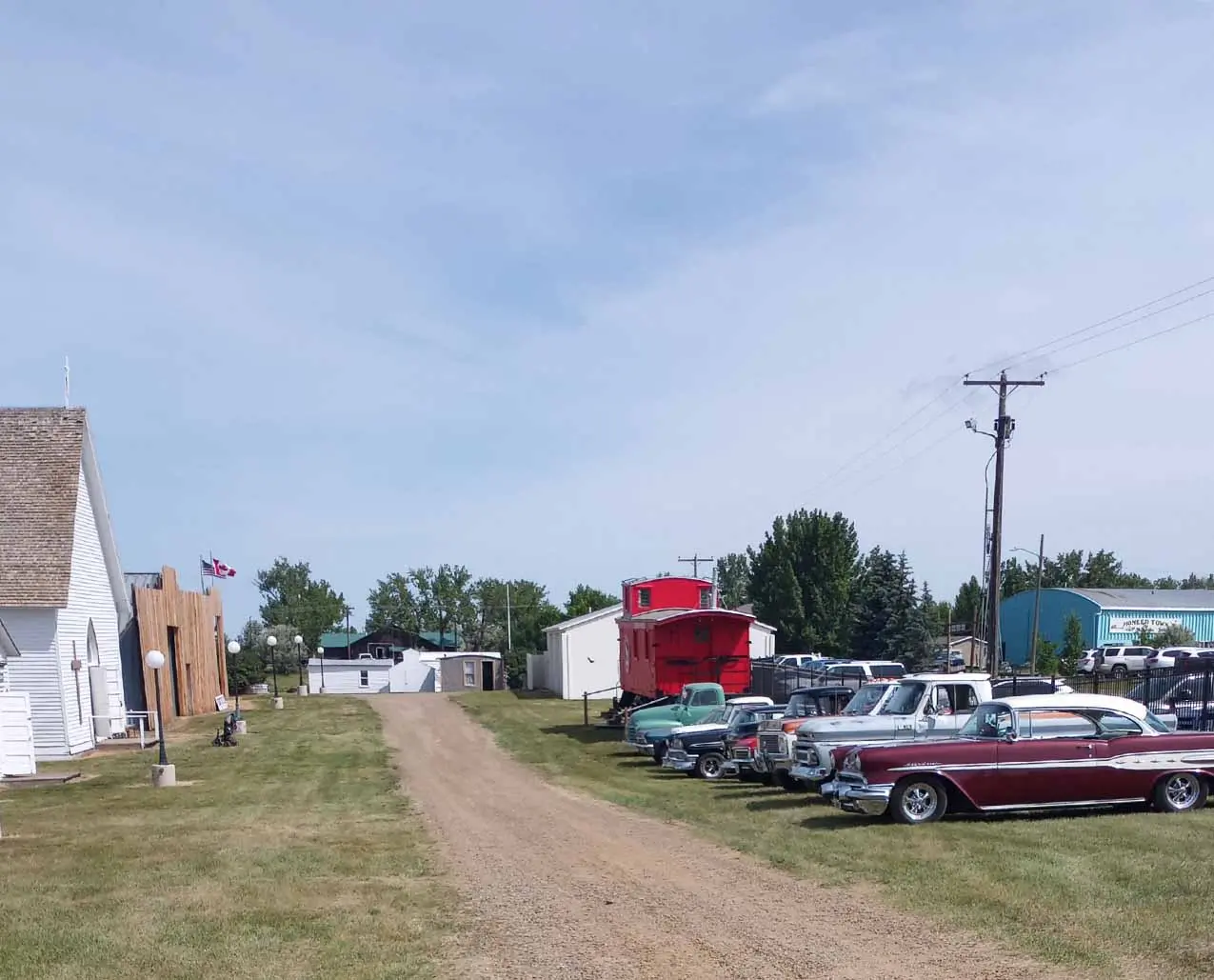
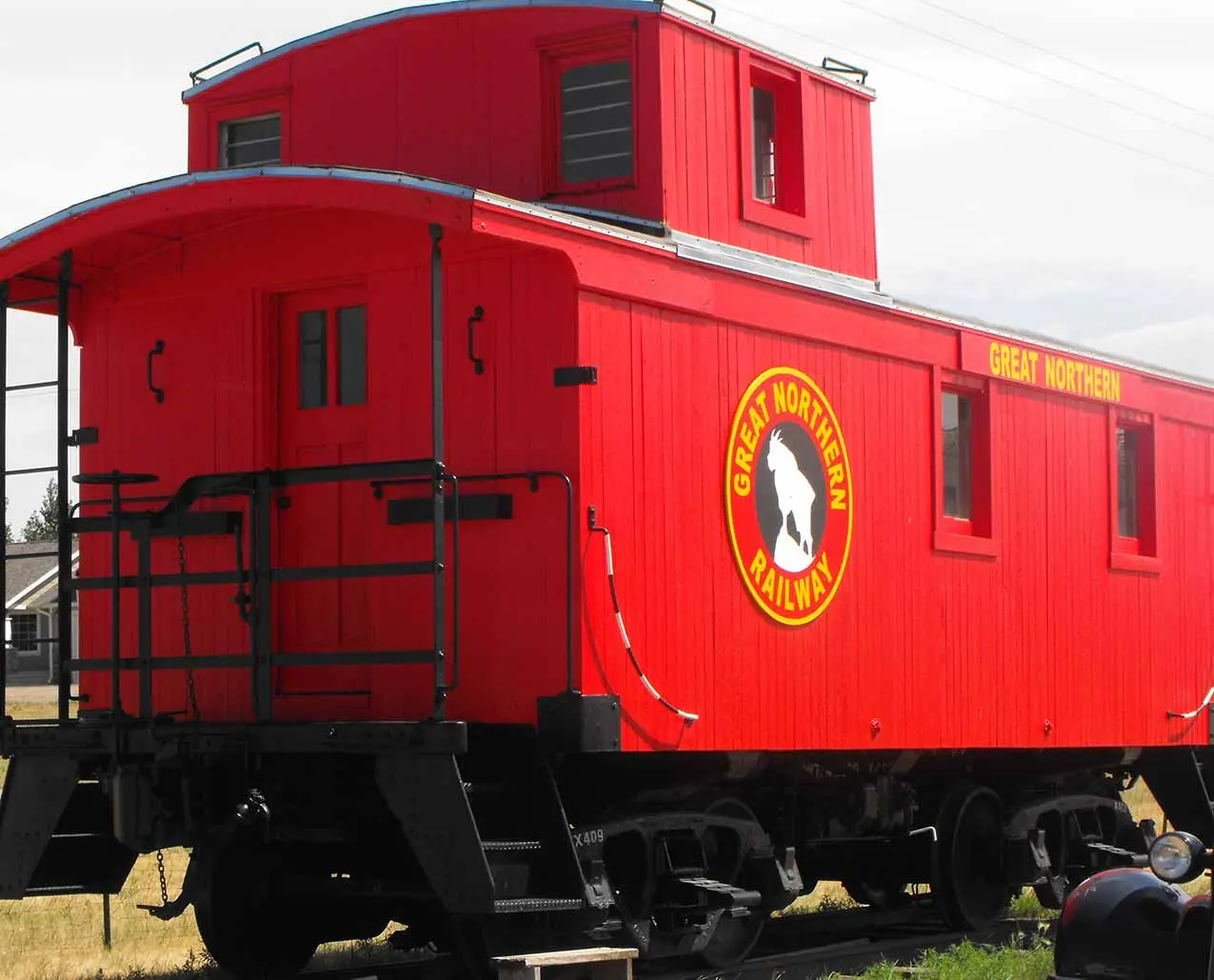
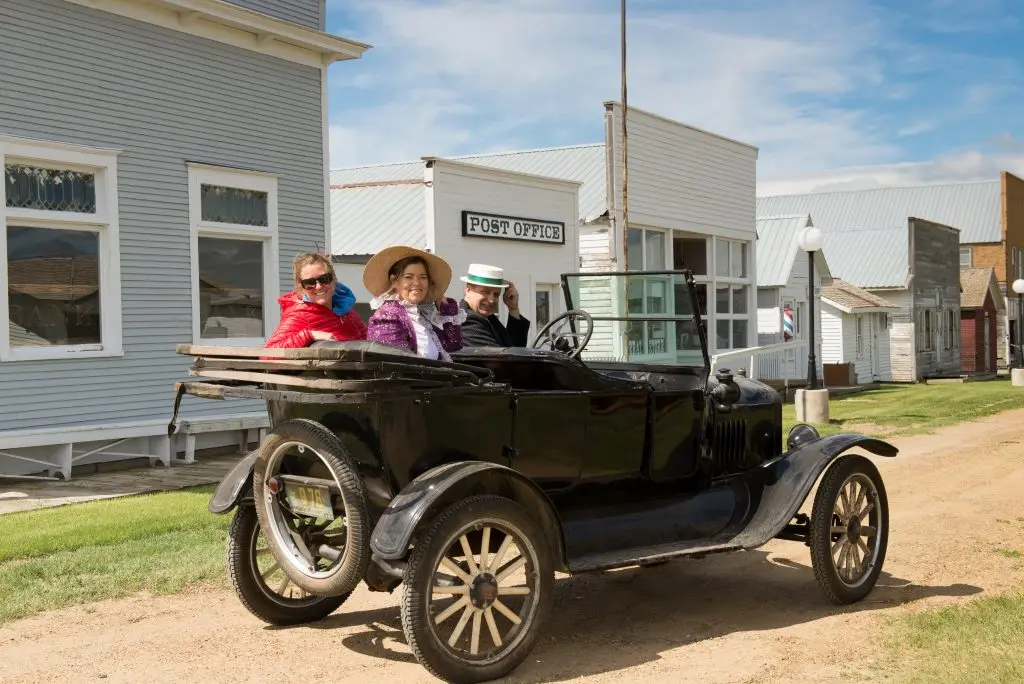
Pioneer Days begins with breakfast at the cook cars. These are the cars that served harvest crews in the wheat fields, and during the celebration they serve a Threshman’s breakfast of pancakes and sausage. Around them stand the thirty-five buildings of Pioneer Town. The Daniels County Museum keeps them on 20 acres at the west edge of Scobey, seven blocks west of Main Street on Second Avenue. The buildings are restored, furnished, and decorated to show a town of the early 1900s.
The City of Scobey gives the date as the last weekend in June. Visit Montana’s listing says the last full weekend and advises calling to confirm. The 2026 edition ran June 26 through 28. The Daniels County Leader counted it as the 60th annual Pioneer Days & Antique Show.
Cook cars, a parade, and a Friday concert
After breakfast the day is given to the town. A printed walking tour is handed out at the entrance, and each building has an informational plaque. The tour covers a one-room country school, a general store, a blacksmith’s shop, a post office, and churches. The museum building holds artifacts and old cars. The tourism office for Montana’s Missouri River Country listed historic demonstrations and a town square for the 2026 event. Booths beyond the cook cars sell hamburgers, Indian tacos, and fry bread.
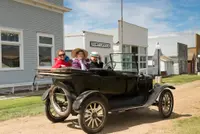
On Saturday afternoon a parade runs through the streets of “downtown” Pioneer Town. It carries antique cars, trucks, and tractors, followed by a wagon train with horses and buggies.
The weekend opens on Friday night with a concert outdoors on the south side of the Rex Theatre. In 2026 the headliner was Bed of Roses, which the Leader billed as “the world’s number one Bon Jovi Tribute band.” Sideways played the opening set when the gates opened at 5:30 p.m. A beer garden and a food wagon were on the grounds. Seating was limited, so concertgoers brought their own lawn chairs. The museum has posted the next one for Friday, June 25, 2027, from 6 to 10 p.m. The headliner is “a high energy, country rock and red dirt touring band.” There will be no opening act, and a QR code will let the audience choose songs. Pets are not allowed anywhere on the museum grounds.
The Rex and the Dirty Shame Show
The Rex Theatre was built in 1913 as a grain storage building. It was moved almost at once to the main street and opened as a movie theater at the end of that year. It keeps its original seats, curtain, walls, and ceilings. The historian Carroll Van West described its front as “a false front in log rustic style for a land that had so few trees.”
During Pioneer Days the Rex hosts the Dirty Shame Show, twice a day. The Dirty Shame Belles dance to numbers played by the Dirty Shame Dixieland Band, with comedy skits and sing-alongs between the dances. Visit Montana calls the show internationally known and says it has been performed for “some dignitaries of note.” The museum’s own page introduces the place as “Home of the Dirty Shame Belles and the Dixieland Band.”
A building zoo on the prairie
Van West uses the term “building zoo” for places like this, where old structures are hauled to one site and kept together. He first saw the Daniels County Museum in 1984: “Here were large buildings moved to a spot in the middle of nowhere.” At that time the museum proper was in an old Quonset hut, “more of a community attic than anything else.”
He took particular note of the churches, which date from the 1910s, when the homestead boom in Daniels County was at its height:
- St. Michaels Ukrainian Greek Orthodox Church
- St. Thomas Catholic Church
- All Saints Episcopal Church, “more stylish in an Arts and Crafts way”
The mercantile buildings, he wrote, are full of artifacts of the past. In a 2024 post about the dwindling railroad town of Whitetail, he mentions a Catholic church that was moved from there to the museum in Scobey. When he returned in the 21st century, the community had built a new museum and community hall, and new exhibits were being installed. He called the place a “building zoo without rival in northern Montana.”
The museum also holds a collection of antique cars, tractors, and machinery. It states its purpose as collecting, preserving, and displaying Daniels County history. Upkeep depends mostly on local talent, volunteer work, and donations. The grounds are open daily from 12:30 to 4:30 p.m. between Memorial Day and Labor Day.
The museum summed up its 2026 season in a Labor Day post. There had been few travelers and so few tours. That left time for archive work, and most donated artifacts were placed in the buildings. The board also had to put up a new shed on the south end of the grounds. The post said it was “not really an expense we had planned, but the wind had other plans.”
Other events used the grounds that fall:
- The Scobey Spartans held a cross-country meet in Pioneer Town in September.
- Brewfest filled the Saloon from 1 to 5 p.m. on October 3, 2026, and the Chamber put on an appreciation feed.
- Construction was under way at the front entrance of the museum building and its Friendship Room.
A town moved to meet the railroad
The buildings in Pioneer Town match the place Scobey itself first was. According to the City of Scobey, the first written record of a white man in the area is Captain Clark’s. The Lewis and Clark expedition traveled up the Poplar River on May 3, 1805, and his account noted bear, elk, and bighorn sheep. Fur trapping and trading became the first businesses.
Settlers arrived around the turn of the century and formed a settlement along the Poplar River. It was the vision of the rancher Mansfield Daniels. The original town site had a post office, a general store, a hotel, a blacksmith shop, a livery stable, a saloon, and a few other small businesses.
In 1913 the Great Northern line from Plentywood ended nearby. The town moved 1.5 miles up from the river bottom to meet it and was incorporated that year. Daniels named the town for his friend Major Charles Richardson Anderson Scobey. Scobey was a cattleman from the Glendive area, a Montana Territory legislator, and an Indian agent at Fort Peck and Poplar.
Homesteaders turned the country into fields, and the town grew on grain. Sources describe its peak differently:
- A historical marker by Skanks Beaverton says that “during the height of the homestead boom in the 1910s,” Scobey “was the largest primary shipping point of grain in the world.”
- The city places the record later, calling Scobey the largest primary wheat market and wheat loading center in North America from 1924 through 1926.
On August 30, 1920, the Montana Legislature created Daniels County from parts of Sheridan and Valley counties, and Scobey became the county seat. The county counted 5,553 residents in 1930. The number has dropped with every census since, to 1,661 in 2020. Scobey sits 14 miles south of the Canadian border, and no federal highway crosses the county. It is sometimes called the most isolated county seat in America.
The town’s early days included outlaws who rode the Outlaw Trail into Canada, and illegal stills and moonshine whiskey during Prohibition. A former hotel and house of pleasure known as One-eyed Molly’s is listed on the National Register of Historic Places. It now houses the Daniels County Courthouse.
Notable Events
- 1805Captain Clark of the Lewis and Clark expedition traveled up the Poplar River on May 3, 1805 and recorded a diverse variety of animals including bear, elk and bighorn sheep. cityofscobey.com
- 1913Due to the end of the line of the Great Northern Railroad coming from neighboring Plentywood, the town site was moved from the river bottom 1.5 miles to the current area of Scobey. cityofscobey.com
- 1920On August 30, 1920, the Montana Legislature took the western part of Sheridan County and the northeastern portion of Valley County to create Daniels County. distinctlymontana.com
People
- Major Charles Richardson Anderson Scobey, cattleman, Montana Territory legislator, Indian agent at Fort Peck and Poplar.
- Mansfield Daniels, local rancher for whom Daniels County is named.
Sources
- missouririvermt.com/blog/travel-back-in-time-at-scobeys-pioneer-days
- cityofscobey.com/2164/Daniels-County-Museum-and-Pioneer-Town
- visitmt.com/listing/daniels-county-museum-pioneer-town-3184
- missouririvermt.com/event/51740
- danielscountyleader.com/2026/06/24/60th-pioneer-days-kicks-off-friday-live-concert
- facebook.com/Daniels-County-Museum-Pioneer-Town-100057434890649
- facebook.com/p/Daniels-County-Museum-Pioneer-Town-100057434890649
- facebook.com/events/1084036430880727