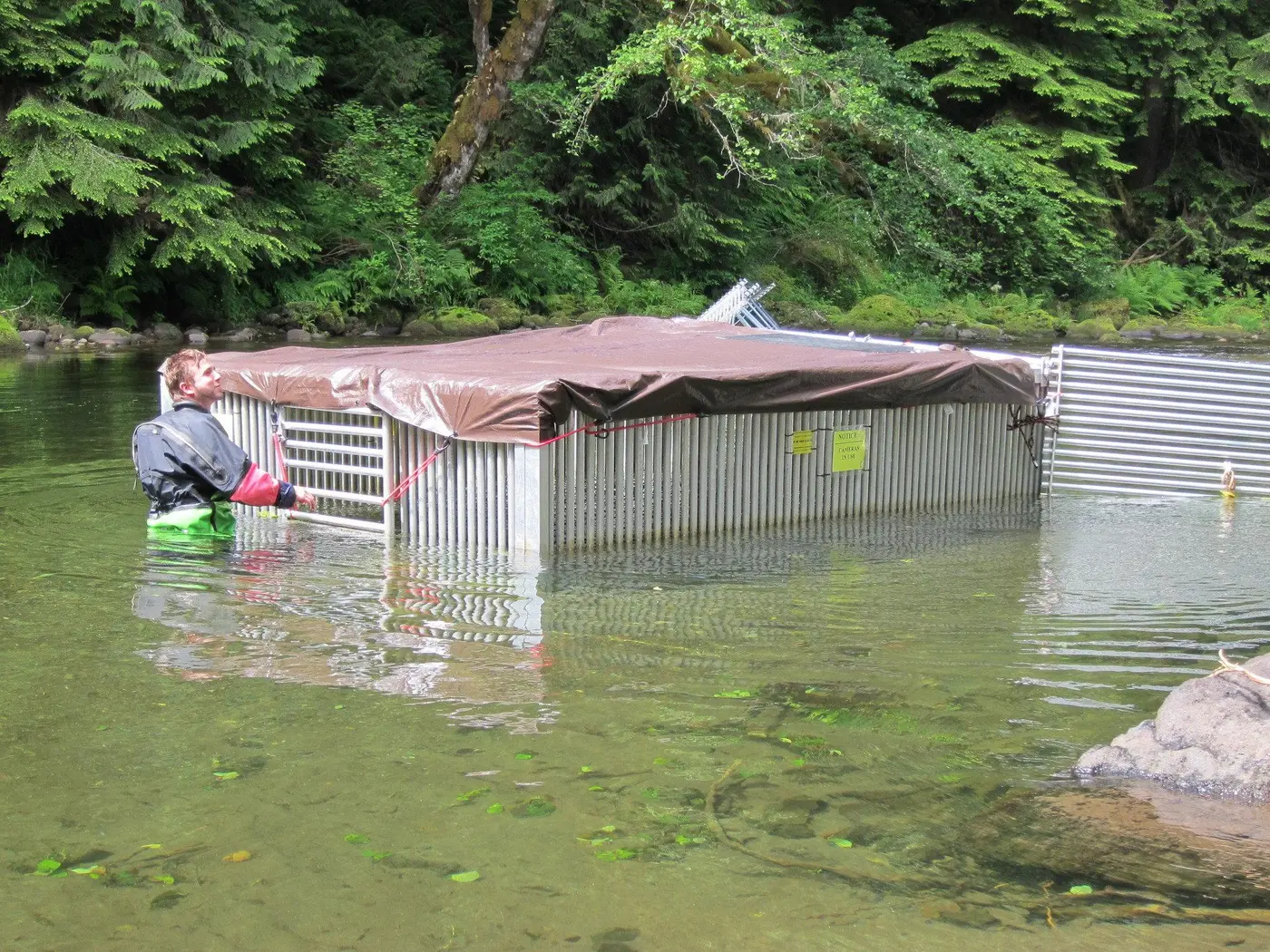
Sandy Hatchery
Sandy, Clackamas County, Oregon. State fish hatchery.
Details

- Where
- 39800 SE Fish Hatchery Road, Sandy, OR 39800. Directions
- When
- 5 a.m. to 10 p.m.; gated entry.
- Season
- October – mid-December for spawning; all year for viewing young fish.
- Getting there
- Take Hwy. 26 east from Portland toward Mt. Hood to Sandy. Go through the town of Sandy to the last traffic light. Turn left onto Ten Eyck Road. Approximately 1/2 mile down the hill is a very sharp left-hand turn. Turn left onto SE Fish Hatchery Road and proceed for one mile to the hatchery.
- Access
- Open entry gate; visiting hours 5 a.m. to 10 p.m.
- Phone
- (503) 668-4222
- Website
- myodfw.com
- Managed by
- Oregon Department of Fish & Wildlife.
- Established
- 1951.
From Highway 26 the way to Sandy Hatchery turns off at the last traffic light in Sandy and runs down Ten Eyck Road. About half a mile down the hill comes a very sharp left onto SE Fish Hatchery Road, and a mile beyond that the hatchery lies along Cedar Creek, a tributary of the Sandy River, 1.5 miles north of town. The site covers 12.34 acres at 500 feet above sea level. A gate stands at the entry, open from 5 a.m. to 10 p.m.
Inside are twenty concrete raceways built in 1966, which the 2024 management plan rates in “poor” condition, and a concrete adult holding pond 78 feet long and 35 feet wide. Young fish can be watched in the rearing ponds in any month. The Oregon Department of Fish and Wildlife keeps a small inside display area. A trail runs through the grounds as a nature hike and gives anglers access to the Sandy River. The department lists freshwater mammals, carnivores and wading birds among the wildlife there. Water reaches the ponds by gravity from Cedar Creek, with flows of 8,000 gallons a minute in April falling to 1,000 in July through September. The station normally has four full-time employees.
Coho at the trap in November
The department gives October to mid-December as the time to see spawning, with coho at their peak in early November. Sandy River coho return from September to mid-December. At the hatchery trap each fish is identified as wild or hatchery in origin. Wild coho are released into Cedar Creek above the weir. Hatchery coho carry a clipped adipose fin, and a share of them, taken throughout the run, become broodstock. Under the 2024 plan they are spawned two males to each female, and no wild fish enter the mix. At least 100 pairs are spawned toward a goal of 200,000 smolts. Surplus adults go to the Oregon Food Bank or are returned to the Sandy basin as stream enrichment.
Eggs incubate in 24 concrete troughs dating from 1966. The fry start out in ten fiberglass troughs added in 2000. The young coho grow until there are fifteen to the pound and are released from the station in mid-April. Every fish is fin-clipped, and 25,000 carry coded-wire tags.
Winter steelhead return between December and April, and visitors can watch their collection and spawning in late February and early March. A portion of the steelhead spawned are wild fish caught by anglers. Each is paired with a hatchery fish, and the hatchery may use 2 percent of the year’s estimated wild return. Smolts with a wild parent get a left maxillary clip. Surplus hatchery steelhead get a hole punched in the right gill plate. Up to February 15 they are taken back downriver to the Lewis and Clark State Park boat ramp so anglers have another chance at them.
Spring Chinook are trapped at the Bull Run River weir and trucked to Sandy for spawning from mid-September to mid-October. Their smolts are reared on site all year. They move to the Bull Run Acclimation site in mid-February and March. Summer steelhead arrive as smolts from Bonneville Hatchery in mid-March. They are released here in mid-April with a right maxillary clip that marks them apart from the winter fish.
The plan calls all of this harvest programs. Their purpose is to make up for fishing lost to the Columbia Basin hydropower system and to add fish for anglers on the Sandy. The spring Chinook work answers for the City of Portland’s dams on the Bull Run River. Portland General Electric’s Marmot Dam was also on that list until it was removed in 2007, and it no longer requires mitigation.
From Boulder Creek to Cedar Creek
The first hatchery on the Sandy stood at the mouth of Boulder Creek on the Salmon River and ran from 1898 to 1912. It was meant for steelhead, but spring Chinook were easier to come by and were raised in greater numbers, according to the state’s production plan.
Cedar Creek had a fire before it had a hatchery. Phil Jonsrud recalled a blaze “somewhere in the vicinity of the present State Fish Hatchery on Cedar Creek just north of Sandy in the early fall of the early 1930s.” His account appears in 80 Years in the Same Neighborhood, published by the Sandy Historical Society. High school boys were called out to help the neighbors fight it. “The east wind was blowing and it was terribly dry,” he wrote, “but fortunately the fire got into an area of maple and alder which doesn’t burn like the pitchy fir, so it was stopped before doing much damage, mostly due to good luck.”
Accounts of the hatchery’s start differ by a year. The department says it began operation in 1951 as a state-funded facility. The production plan says it was built in 1950 under the Columbia River Fishery Development Program, with financing from the U.S. Fish and Wildlife Service. Adult coho were first collected for broodstock in 1952. According to one account, the 12 miles of spawning creek above the hatchery have been closed to wild fish since that year because of the limits of the hatchery’s operations. In 1959 the station joined the Columbia River Fisheries Development Program under the Mitchell Act, a federal effort to enhance declining runs in the Columbia Basin.
The holding pond has two dates as well. The production plan puts it in 1959 and describes a rack across Cedar Creek that turned adults up a 68-foot fish ladder into the pond. The management plans of 2017 and 2024 date it to 1961. From 1961 to 1963 the Oregon Fish Commission trapped and tagged young coho on Cedar Creek, and smolts there averaged 4 inches. The hatchery also helped build fisheries in the Willamette system. In the late 1970s it was turned over entirely to coho.
The same production plan reported that native late-run coho, which once spawned in nearly every tributary of the Sandy, had become nearly extinct there. It named the long release of early-run hatchery coho as one of many causes. Ahead of Marmot Dam’s removal in 2007, the hatchery changed its programs to keep its fish from straying into the basin’s main natural spawning grounds. Federal money for the 2009 fiscal year was uncertain, so the department paid for Sandy with license dollars until word came in early summer of 2009 that Mitchell Act funding had been restored.
By 2010 the hatchery was producing a million smolts a year of coho, spring Chinook and steelhead. That year the record shows $3.7 million from the city of Portland for new holding ponds, diversion weirs and traps, so that wild Cedar Creek coho could be trucked up their native creek.
Save Sandy Salmon in federal court
In 2010 the Native Fish Society began a campaign called Save Sandy Salmon, led by River Steward Spencer Miles. The Pacific Rivers Council, under executive director John Kober, also singled out the hatchery and filed a notice of intent to sue. The society’s own notice is dated April 13, 2011. Its complaint, filed with the McKenzie Flyfishers, is dated March 9, 2012. One Sandy account dates the filing to March 2013. The plaintiffs argued that the yearly release of a million or more hatchery fish took food, habitat and spawning space from wild fish, preyed on them, spread disease and weakened their genetic fitness.
Judge Ancer Haggerty heard the case in U.S. District Court in Portland. In 2013, according to the state’s later brief, he declined to halt releases after Oregon voluntarily cut its spring Chinook release to 132,000 fish. A federal brief said the department had cut juvenile releases that year by roughly 40 percent from historical levels, about 400,000 fish. It also said the share of hatchery fish on the spawning grounds had fallen. In 2010 that share was 77.1 percent for spring Chinook, 12.4 for coho and 28.5 for winter steelhead. The latest figures it cited were 9.3, 2.8 and 6.4.
The society dates the summary judgment opinion to January 17, 2014. The Columbia Basin Bulletin reported that the January ruling faulted NOAA Fisheries under the Endangered Species Act and the National Environmental Policy Act. OPB reported it as finding that the hatchery had violated the Endangered Species Act. Oregon’s brief answered that the plaintiffs “have made clear that they will never be satisfied with any level of hatchery program.”
In March 2014 Haggerty allowed releases to go on at a reduced level: 200,000 coho rather than the 300,000 the managers had planned. Liz Hamilton of the Northwest Sportfishing Industry Association called it “good news for our industry.” Michael Moody of the Native Fish Society said, “We’re disappointed.” In Sandy, business owners and residents had worked through the case to protect the hatchery’s production. Among them were Greg Osburn and John Mayer of the Three Rivers Sportsman’s Alliance. In 2013 the hatchery had returned to state funding as part of the Clackamas Hatchery complex. The 2024 plan sets its coho goal at 200,000 smolts.
Notable Events
- 1898The first hatchery on the Sandy was operated at a facility at the mouth of Boulder Creek on the Salmon River from 1898 to 1912, originally intended as a steelhead hatchery. nrimp.dfw.state.or.us
- 1950Sandy Hatchery was built in 1950, 1.5 miles north of the town of Sandy in Clackamas County, 0.5 miles up Cedar Creek from its confluence with the Sandy River. nrimp.dfw.state.or.us
- 1951Sandy Hatchery began operation in 1951 as a state-funded facility. myodfw.com
- 1952Above the hatchery lies 12 miles of creek-spawning habitat that since 1952 has been inaccessible to wild fish because of the limitations of the hatchery's operations. oregonlive.com
- 1952The first year of adult broodstock collection for the Sandy coho program was 1952. s3-us-west-2.amazonaws.com
- 1959In 1959, the hatchery became part of the Columbia River Fisheries Development Program (Mitchell Act) - a program to enhance declining fish runs in the Columbia River Basin. myodfw.com
- 1959The adult holding pond was constructed in 1959: concrete, 35 feet by 78 feet with a 4.5-foot depth, with a rack across Cedar Creek diverting adults into the ponds through a 68-foot fish ladder. nrimp.dfw.state.or.us
- 1961The plan's rearing-facility table dates the concrete adult holding pond to 1961, in fair condition. digitalcollections.library.oregon.gov
- 1966The plan's rearing-facility table dates the 20 concrete raceways to 1966 in poor condition. digitalcollections.library.oregon.gov
- 1970sUnder the program the hatchery was also used to develop and expand fisheries in the Willamette system. In the late 1970s, production was shifted to exclusively raise coho salmon. nrimp.dfw.state.or.us
- 2000The plan's rearing-facility table lists 10 fiberglass troughs of construction age 2000, in fair condition, used for early rearing of fry. digitalcollections.library.oregon.gov
- 2007Marmot Dam was removed in 2007, and the plan states the spring Chinook mitigation duty from PGE's dam no longer requires mitigation. digitalcollections.library.oregon.gov
- 2007Program changes were implemented at Sandy Hatchery in anticipation of the removal of Marmot Dam in 2007, intended to reduce straying of hatchery fish into the basin's primary natural production areas. s3-us-west-2.amazonaws.com
- 2009Because federal appropriations for the 2009 federal fiscal year were uncertain, ODFW fund shifted and backfilled the Sandy Hatchery with license dollars; in early summer of 2009 the agency was notified that Mitchell Act funding had been restored. dfw.state.or.us
- 2010In 2010 the Native Fish Society began a grassroots campaign, Save Sandy Salmon, which its own update says led to a lawsuit two years later over the hatchery's management. nativefishsociety.org
- 2010Fish and Wildlife officials had improved Sandy Hatchery to reduce impacts on wild fish; the hatchery produced 1 million smolts in 2010, including coho, spring chinook and steelhead. oregonlive.com
- 2010$3.7 million from the city of Portland to construct new holding ponds, diversion weirs and traps at the hatchery, so wild Cedar Creek coho can be trucked up their native creek. oregonlive.com
- 2011The society's record lists a Sandy River 60 Day Notice dated April 13, 2011. nativefishsociety.org
- 2012The Oregon Department of Fish and Wildlife began implementing actions in 2012 such as improved acclimation at Cedar Creek and a new acclimation facility at Bull Run, whose results were expected to fully accrue in 2015 and beyond. columbiagorgenews.com
- 2012The society's legal-document list dates its Complaint for Declaratory and Injunctive Relief to March 9, 2012. nativefishsociety.org
- 2012The society lists the Sandy Hatchery Biological Opinion as dated September 26, 2012, among the ESA documents it sought to have reviewed. nativefishsociety.org
- 2012The water intake screen replacement at Sandy was scheduled for summer 2012 to make it compliant with NOAA Fisheries screening criteria. s3-us-west-2.amazonaws.com
- 2013A federal brief says ODFW reduced the release of juvenile hatchery smolts by roughly 40 percent from historical levels in 2013, about 400,000 fewer juveniles, with the same reduction proposed for 2014. columbiagorgenews.com
- 2013In 2013 the facility was returned to state funding, and is managed as part of the Clackamas Hatchery complex. digitalcollections.library.oregon.gov
- 2013The case against the National Marine Fisheries Service and the Oregon Department of Fish and Wildlife was filed in March 2013, and from that time Sandy business owners and residents worked to protect hatchery production. sandypost.com
- 2014The society's legal-document list dates the Opinion on Summary Judgement to January 17, 2014, the ruling that ended the case over the hatchery releases. nativefishsociety.org
People
- Spencer Miles, Native Fish Society River Steward who spearheaded the Save Sandy Salmon campaign aimed at the hatchery's fish production.
- K. Bourne, Sandy Hatchery manager, Oregon Department of Fish and Wildlife, consulted by the state production plan on the hatchery raceway water supply.
- John Kober, Pacific Rivers Council executive director whose group singled out the Sandy Hatchery and filed a 60-day notice of intent to sue over its impacts on wild fish.
- Tim Foulk, Hatchery Manager of Sandy Hatchery for the Oregon Department of Fish and Wildlife; the plan's hatchery contact.
- Ancer Haggerty, federal Circuit Court Judge whose ruling ended a two-year lawsuit over the Sandy Hatchery and set the hatchery fish released into the Sandy River.
- Greg Osburn, board member of the Three Rivers Sportsman's Alliance, an all-volunteer political action group supporting and promoting hatchery operations in Oregon.
- John Mayer, board member of the Three Rivers Sportsman's Alliance, the Sandy group working to protect hatchery production.
Sources
- oregonlive.com/gresham/2012/10/sandy_river_hatchery_wins_fede_1.html
- nativefishsociety.org/campaigns/savesandysalmon
- oregonlive.com/topic/sandy%20river%20hatchery/index.html
- myodfw.com/sandy-hatchery-visitors-guide
- myodfw.com/visit-odfw-hatcheries
- digitalcollections.library.oregon.gov/assets/displaypdf/265674
- dfw.state.or.us/agency/budget/docs/11-13_GBB/D_Fish_Prop_Narrative.pdf
- sandyhistory.com/blog/forest-fires-make-history-z3dde
- sandypost.com/2014-04-02/sandy-based-group-advocates-for-hatchery
- oregonlive.com/environment/2011/04/sandy_river_hatchery_jumps_to.html
- columbiagorgenews.com/gorge-life/feds-oregon-defend-sandy-river-hatchery-plans/article_61795a8c-7d59-5776-a1ee-72f3e02d1b0f.html
- s3-us-west-2.amazonaws.com/nativefishsocietyauction/Save+Sandy+Salmon+Documents/sandy_co_hgmp_11-6-13_final.pdf
- nrimp.dfw.state.or.us/DataClearinghouse/default.aspx?att=ODFW%2FODFW_41278_2_ProductionPlanPartIV_v1.pdf&pn=ViewFile
- digitalcollections.library.oregon.gov/assets/displaypdf/134273