San Jose Flea Market
San Jose, Santa Clara County, California. Flea Market; year round.
Details

- Where
- 1590 Berryessa Rd, San Jose, CA 95133. Directions
- When
- Friday, Saturday, Sunday.
- Getting there
- BERRYESSA BART STATION, Green & Orange Lines; VTA Routes 61, 77, 70, RAPID 523.
- Fees
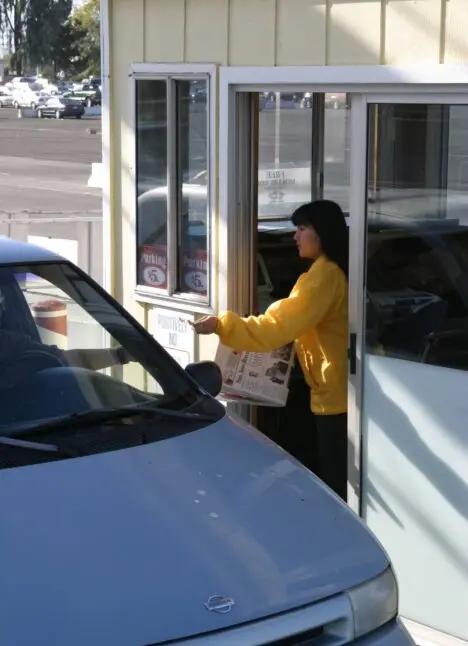
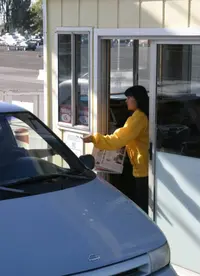
- Parking is FREE on Fridays.
- Hours
- from dawn to dusk (typically 6:00 AM - 5:00 PM).
- Access
- We are open year round, regardless of weather conditions, with the exception of a few holidays. Parking is FREE on Fridays.
- Website
- sjfm.com
- Established
- 1960.
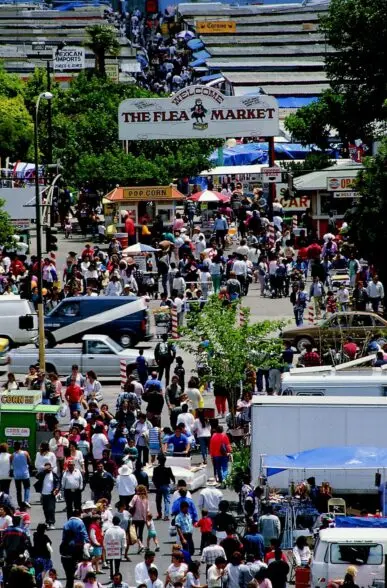
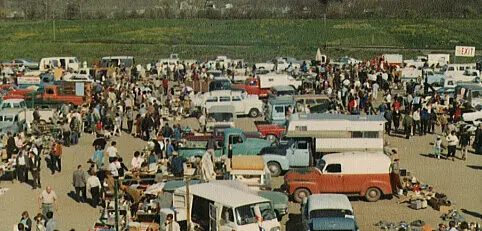
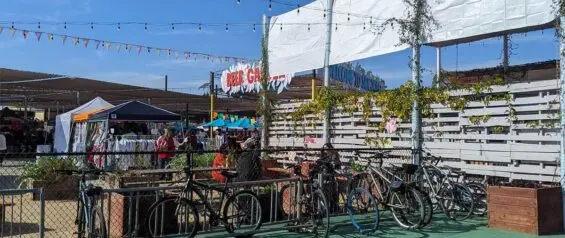
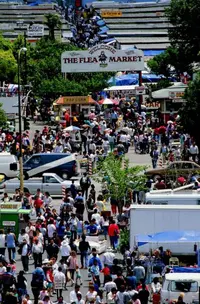
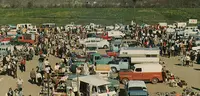
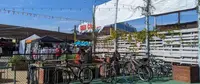
The walk-in gate of the San Jose Flea Market is next to the Berryessa BART station, at the Garden at the Flea entrance, where riders off the Green and Orange lines lock their bicycles at the racks and go in on foot. Beyond the gate the grounds are laid out like a town, with lettered streets crossing numbered ones. Lost parties are sent to the flagpole at 2nd and E. Lost children are taken to the Information Office at 4th and E. Main Street has a playground with shaded slides between 4th and 5th, a fish stand at 6th, the Chuck Wagon between 8th and 9th, and a soft-serve ice cream stand between 9th and 10th. The operator calls the place “a small city with a life of its own.”
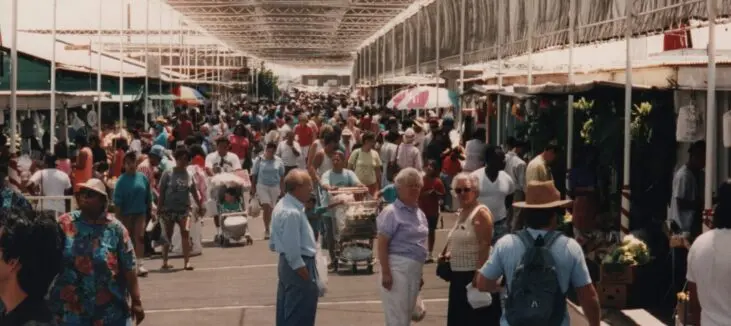
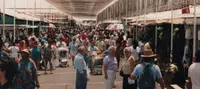
Produce Row is a quarter mile of fruit, vegetables, spices, homemade pastas, and freshly roasted peanuts and pistachios, sold by more than 30 vendors whose stands accept EBT and credit cards. The rest of the market sells, by the operator’s list, antiques, collectibles, books, herbs, plants, flowers, fabric, tools, car accessories, appliances, furniture, clothing, shoes, jewelry, electronics, stereo equipment, religious supplies, and cars. There is also a barber shop. Its largely Latinx vendors and patrons call the market La Pulga, according to San Jose Inside. As of March 2026 it opens Fridays, Saturdays, and Sundays from dawn to dusk, typically 6 a.m. to 5 p.m., rain or shine. Few sellers set up on Fridays, and most are open on weekends.
Three stages and a 1950 carousel
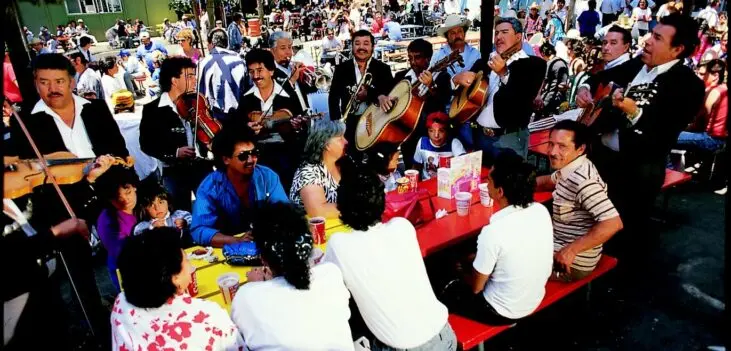
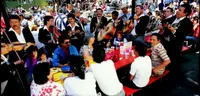
Bands play from noon to 4:30 p.m. on three stages. The Main Street Stage is the largest and is shaded, and it books the biggest acts. The Farmers Market Stage puts live bands beside the fruit and frescas. The Garden at the Flea Stage, the newest, programs salsa, cumbia, oldies, reggae, R&B, and Top 40 dance music. The operator lists mariachis, oldies, and modern cover bands among the free music, and benches in the shade nearby.
The food runs to fair fare: corn dogs, French fries, popcorn, cotton candy, ice cream. There are also nachos, tacos, burritos, and barbecue smoked outdoors, and cart vendors sell churros, fruit cups, and fresh elote. Food trucks work the grounds on Saturday and Sunday afternoons. In early 2026 menudo returned in small and large bowls, served from 10 a.m. at the Chuck Wagon on weekends and at Big Beef on Sundays.
The rides are in the FunZone. It has a mini Ferris wheel, bounce houses, and a vintage Allan Herschell carousel built in 1950. Pony rides start at F and 14th Street, at the south end of the Pavilion. The arcade holds more than 90 video games, among them Pac-Man, Frogger, and Donkey Kong, as well as Skee-Ball, air hockey tables, and Pop-a-Shot basketball.
The garden by the station
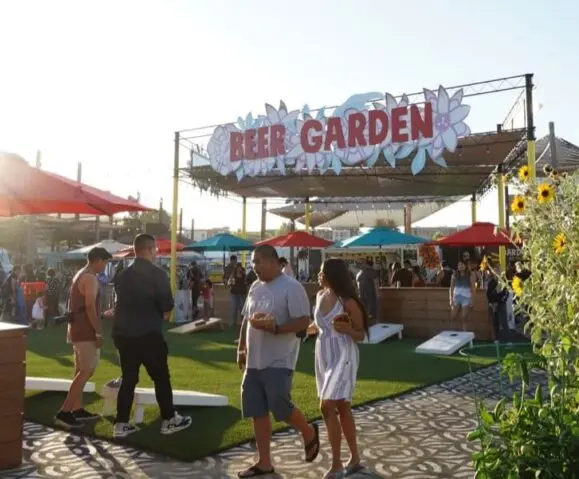
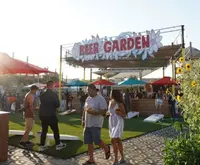
The Garden at the Flea grew out of a four-month study that began in 2017. The market asked attendees and vendors two questions: what they loved about the place, and what they wished to see. Thousands of answers came back. The most common wishes were night-market events, more food, and a beer garden. Attendees valued the farmers market, the live music, and family tradition most. The space that resulted takes its look from San Jose’s old “Valley of the Heart’s Delight.” It has green areas, a sustainable California garden, a beer garden, a food truck park, and a performance space for larger events. From April through October it holds the Berryessa Night Market on Friday evenings, with sellers, food trucks, outdoor dining, and live entertainment. The market also serves as host venue for Hunger at Home, which turns rescued surplus food into meals for people in need.
A landfill, a feed lot, and twenty sellers
The ground was worked long before anything was sold on it. A historical resources assessment prepared in 2005 by Archives & Architecture places George Hobson’s dairy, described as Santa Clara Valley’s first, on part of the later north parking area in the early 1850s. The physicians Amy and Jane Bowen had an early home on the same ground. Their sister Daisy, who also lived on the property, became a pharmacist and an attorney. Giacomo and Isabella Bruzzone long owned a farm complex nearby that was later demolished. A 2003 report for the Santa Clara Valley Transportation Authority says the land had served agricultural and commercial purposes since the 1880s. A two-story slaughterhouse went up at the southeast edge in 1947–48, and an office building near the north entrance in 1952. Both stood before the market did.
The market’s own account begins in 1959. George Bumb, then in the solid waste and landfill business, wanted a profitable way to keep usable discards out of the dumps. He drove south to study the swap meets just getting started in Los Angeles. He then improved on them, adding individual merchant stalls and on-site storage so vendors could leave their goods during the week. San Jose Inside tells it another way: enough people were paying Bumb to pick through his landfill that he started a swap meet to meet the demand, inspired as much by the Saint-Ouen rag-and-bone market outside Paris as by the Los Angeles fairs. The 2005 assessment notes that his wife, Lorraine Allen, went with him on the Paris trip. It also says Bumb is said to have drawn the idea from what he saw at disposal grounds, though its authors could not determine how the market and the disposal-ground business were related in the early years.
In March 1960, Bumb, Joe Kokes, and Larry Headrick leased the site from the Eureka Mining Company while the slaughterhouse and tallow-rendering works were being dismantled. About 20 sellers and 100 customers came on opening day. The market remembers farmland on a narrow country lane among orchards. Its first office was built and staffed by the Bumb family and held the only restroom and a limited snack bar. A San Jose Mercury News article of July 3, 1960, saw it differently: “The former cattle feed lot’s vast spaces of asphalt paving has been cleared of most stalls to make way for a modern-day buy-sell-trade fair …” Bumb and Associates bought the property in 1964. By 1979 Bumb had bought out his two partners.
Four million a year
In 1965 helicopter rides over the market cost $1. The 2005 assessment credits them to George Bumb Jr.’s involvement in aviation, while San Jose Inside credits George Sr.’s aviation hobby. By 1966 Frank Hamburger was managing the snack bars, and the market was drawing 1.5 million visitors a year. That year San Jose began annexing the site. The assessment puts annual revenue then at over a million dollars, and San Jose Inside calls it a multimillion-dollar stream.
The peak came in 1980. A report commissioned by the city counted a record $12 million in revenue that year, from more than 2,400 vendors and four million visitors. The Bumbs employed 500 people for parking, cleanup, security, and concessions. For a time the market was Anheuser-Busch’s top account, pouring up to 250 kegs of beer on busy days, and it was the fifth-largest buyer of Coca-Cola products. People drove hours for the pony rides, the carousel, the slides, the karaoke, and the mariachis.
The assessment found that the market had not grown much in size or attendance since about 1980. In the 1980s most of the open selling areas were replaced with lockable semi-permanent enclosures, and the Bruzzone property was added in 1983. George Bumb Sr. died in 2000. The historians judged the buildings vernacular and undistinguished. They found the original market site, about 40 acres on the south side of Berryessa Road, appeared eligible for the California Register of Historical Resources. In their words, it had allowed “a distinctive economic and social culture to flourish in San José.” The market’s history page adds that Khaled Hosseini, in The Kite Runner, wrote about working there and meeting his future wife.
Notice to the vendors
Around 6 p.m. on a Tuesday in late November 2006, while the market was closed, fire swept through part of the grounds. It destroyed 21 stalls, six of them on Produce Row and the rest selling silk plants, housewares, and other goods. Investigators did not yet know the cause. The next day Chun Mei Chuang, who had flown in from El Paso, watched a bulldozer scrape up her shoe business. Her three stalls had held an estimated $120,000 in uninsured holiday stock. Hector Lopez’s canopy across the lane had only burned at the front edge, but his aunt, uncle, and brother-in-law had businesses inside the fire zone. “What you built all your life – it’s just gone,” he said. “You start from nothing.”
By then the land was already under review. As BART was extended toward San Jose, the Bumb family had plans drawn to build more densely on the site. The city granted a first rezoning in 2002 and a revised one five years later. San Jose Inside reports that vendors had apparently little say in either decision. Rigoberto Gonzalez, who began selling chili-spiced candy and piñatas there after emigrating from outside Mexico City in the early 1990s, said many vendors learned of the plans from newspapers. “We learned a long time ago that we basically have no rights,” he said. Over the following years, condos and a shopping center replaced parking lots on the north side of Berryessa Road. The vendor count fell as the family turned more of the market into parking and leased part of the lot to Amazon.
By 2021 the plan called for 3,450 homes and 3.4 million square feet of commercial space, and its renderings left out the market. Rigoberto’s son Roberto, then 29, helped found a vendors association, and nearly 5,800 people signed its petition. “We’re just trying to fight for what’s fair,” he said. San Jose Inside counted about 750 sellers that year. Among them were Donelia Duarte, whose jewelry stalls supported her family and others in Guatemala and El Salvador. Maria Lourdes employed six people at her stall of embroidered tunics and purses. Daniel Ramirez sold woven-leather chanclas from rural Mexico, and Arajo and Carmen Cayetano had sold fruit, nuts, and snacks for upward of three decades. The same report says the Shoe Palace, Ramos Furniture, and Calderon Tires grew from stalls here. On March 24, 2021, the Planning Commission voted 6–1 to study a community-benefits deal. Erik Schoennauer, the Bumb family’s land-use lobbyist, said, “The flea market is open for business.”
In December 2023 the Bumb family announced that vendors would get a year’s warning of closure, given no sooner than January 1, 2025. At that time Roberto Gonzalez put the count at around 400 vendors, and no relocation agreement had been reached. The market opened its 66th year in 2026 with a line on its home page: “Yes, we are open!”
Notable Events
- 1850sThe site is described as Santa Clara Valley's first dairy site; earlier cattle-raising association is hedged as likely. ceqanet.lci.ca.gov
- 1947A large two-story slaughterhouse at the southeast edge pre-dated the market. ceqanet.lci.ca.gov
- 1952The office building near the north entrance pre-dated market operations. ceqanet.lci.ca.gov
- 1959George Bumb sought a profitable way to keep usable discarded items out of landfills. sjfm.com
- 1960George Bumb, Joe Kokes and Larry Headrick leased the site; opening day had 20 sellers and about 100 patrons. ceqanet.lci.ca.gov
- 196020 sellers and 100 curious customers were present the day the flea market opened in March 1960. sjfm.com
- 1964Bumb and Associates did not purchase the property until 1964. ceqanet.lci.ca.gov
- 1965Helicopter rides over the market were offered for $1.00, described as a by-product of George Bumb Jr.'s aviation involvement. ceqanet.lci.ca.gov
- 1966The city commenced annexation proceedings when the market drew 1.5 million annual visitors and over a million dollars in annual revenues. ceqanet.lci.ca.gov
- 1966The feature says visitation and revenue led the city to annex the site. sanjoseinside.com
- 1979Bumb bought out his other two investors; the market became part of Bumb & Associates and The Flea Market, Inc. holdings. ceqanet.lci.ca.gov
- 1980sThe transformation removed most open seller areas and constructed securable semi-permanent seller enclosures. ceqanet.lci.ca.gov
- 1980The assessment says the market has not grown appreciably in size or attendance since about 1980. ceqanet.lci.ca.gov
- 1980The market raked in a record $12 million from more than 2,400 vendors and four million visitors, according to a city-commissioned report. sanjoseinside.com
- 1983Isabella Bruzzone and her family sold the property to Bumb & Associates, market owner. ceqanet.lci.ca.gov
- 2000George Bumb Sr. passed away. ceqanet.lci.ca.gov
- 2002As BART was extended toward San Jose, the Bumb family had plans drawn to densify the site, and the city granted their initial rezoning request in 2002. sanjoseinside.com
- 2002The city granted the Bumbs' initial rezoning request with apparently little vendor input; a revised proposal followed five years later. sanjoseinside.com
- 2007Analysts in the city's 2007 report found that the market makes a significant contribution to the broad patterns of local and regional history by allowing a distinctive economic and social culture to flourish in San Jose. sanjoseinside.com
- 2018The city revived development outreach; many vendors said they did not know the plans had regained momentum. sanjoseinside.com
- 2025The Bumb family announced vendors would get a one-year closure warning no sooner than Jan. 1, 2025; no final relocation agreement had been made. mercurynews.com
- The fire destroyed 21 stalls, six in Produce Row and others selling silk plants, housewares and other goods; investigators did not yet know the cause. mercurynews.com
- The city granted a revised proposal five years after the initial rezoning request, with apparently little vendor input. sanjoseinside.com
- The commission voted 6-1, with Pierluigi Oliverio dissenting, to study a community-benefits deal. sanjoseinside.com
People
- Amy Bowen, Physician whose early home was on the later north parking site.
- Daisy Bowen, Amy's sister, who lived on the property and established careers as pharmacist and attorney.
- Frank Bumb, Father of market founder George Bumb Sr.
- Frank Hamburger, Managed the snack bars (By 1966).
- George Bumb Sr., Founded the Berryessa Flea as a humble swap meet.
- George Bumb, Jr., His aviation involvement is described as the source of helicopter rides over the market (1965).
- George Hobson, His dairy, described as the valley's first, occupied part of the later north parking area.
- Giacomo Bruzzone, Longtime owner with Isabella Bruzzone of the later-demolished farm complex.
- Isabella Bruzzone, Sold the property with her family to market owner Bumb & Associates (1983).
- Jane Bowen, Physician whose early home was on the later north parking site.
- Joseph Kokes, Investor in The Flea Market Inc.
- Larry Headrick, George Sr.'s business partner at opening.
- Lorraine Allen, George Bumb's wife, who accompanied him on the Paris trip.
- Mary Bumb, Mother of market founder George Bumb Sr.
- Brian Bumb, Co-owner who hoped to find a new home for the market.
- Chun Mei Chuang, Shoe vendor whose business burned.
- Hector Lopez, Vendor whose stall was across from the burned area (16 years at the market; own stall for the past four).
- Jose Guerrero, San Jose fire captain commenting on the market fire investigation.
- Khaled Hosseini, Author whom the operator says wrote about working and meeting his future wife here.
- David Cohen, District 4 councilmember welcoming more time for vendors.
- Erik Schoennauer, Land-use lobbyist for the Bumb family arranging vendor meetings.
- Rigoberto Gonzalez, Roberto's father, who began vending after emigrating from outside Mexico City (early 1990s).
- Roberto Gonzalez, Second-generation vendor lobbying for relocation costs or incorporation into future development.
- Arajo Cayetano, Fruit, nuts and snacks stand operator with Carmen Cayetano (upward of three decades).
- Carmen Cayetano, Fruit, nuts and snacks stand operator with Arajo Cayetano (upward of three decades).
- Chava Bustamante, LUNA treasurer who cosigned an equity letter about displacement.
- Chris Lepe, Veteran vendor advocate who cosigned an equity letter about displacement.
- Daniel Ramirez, Staffs a booth supporting his immigrant parents, wife, children and Mexican artisans.
- Donelia Duarte, Jewelry vendor whose business supported her family and others in Guatemala and El Salvador.
- Jesus Flores, Advocated reconsidering market displacement as an equity issue.
- Joe Kokes, George Sr.'s business partner at opening.
- Kaled Escobedo Vega, Vendor association cofounder whose family's stall helped send her to UC Santa Cruz.
- Karla Coyoc, Vendor whose stand provided a family lifeline; an unassisted forced move would put her out of business.
- Maria Campos, Daniel Ramirez's wife, whose family is supported by his booth.
- Maria Lourdes, Vendor at an embroidered tunics and purses stall, employing six people.
- Mariana Mejia, Launched a flea-market venture after her parents (earlier this year).
- Pierluigi Oliverio, Dissented from the Planning Commission community-benefits study vote.
- George Bumb, Conceived the idea while working in solid waste and landfills (1959).