Stonehenge Memorial & Klickitat County Veterans Memorial
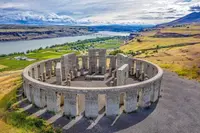
Goldendale, Klickitat County, Washington. Full-scale replica of Stonehenge.
Details

- Where
- 97 Stonehenge Drive, Goldendale, WA 98620. Directions
- When
- Summer-solstice gathering at the memorial each June.
- Season
- Open to visitors from dawn to dusk daily year-round.
- Getting there
- At the original Maryhill town site, three miles east of the Maryhill Museum of Art, just off Highway 14.
- Fees
- Free.
- Hours
- Open daily 7 a.m. to dusk.
- Access
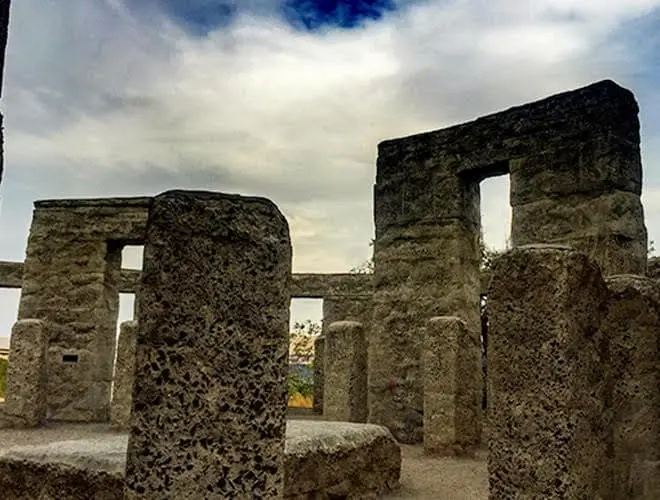
- Visitors today will notice small chunks and pebbles of concrete collecting at the base of the monument's plinths — active deterioration that continues pending the phased conservation work.
- Walk-in or reserve
- None needed to visit the memorial; reservations are required only for the museum's solstice camping, museum access and workshops.
- Website
- maryhillmuseum.org
- Managed by
- Maryhill Museum of Art.
- Established
- 1918-1929.
- Coordinates
- 45.6943, -120.8061.
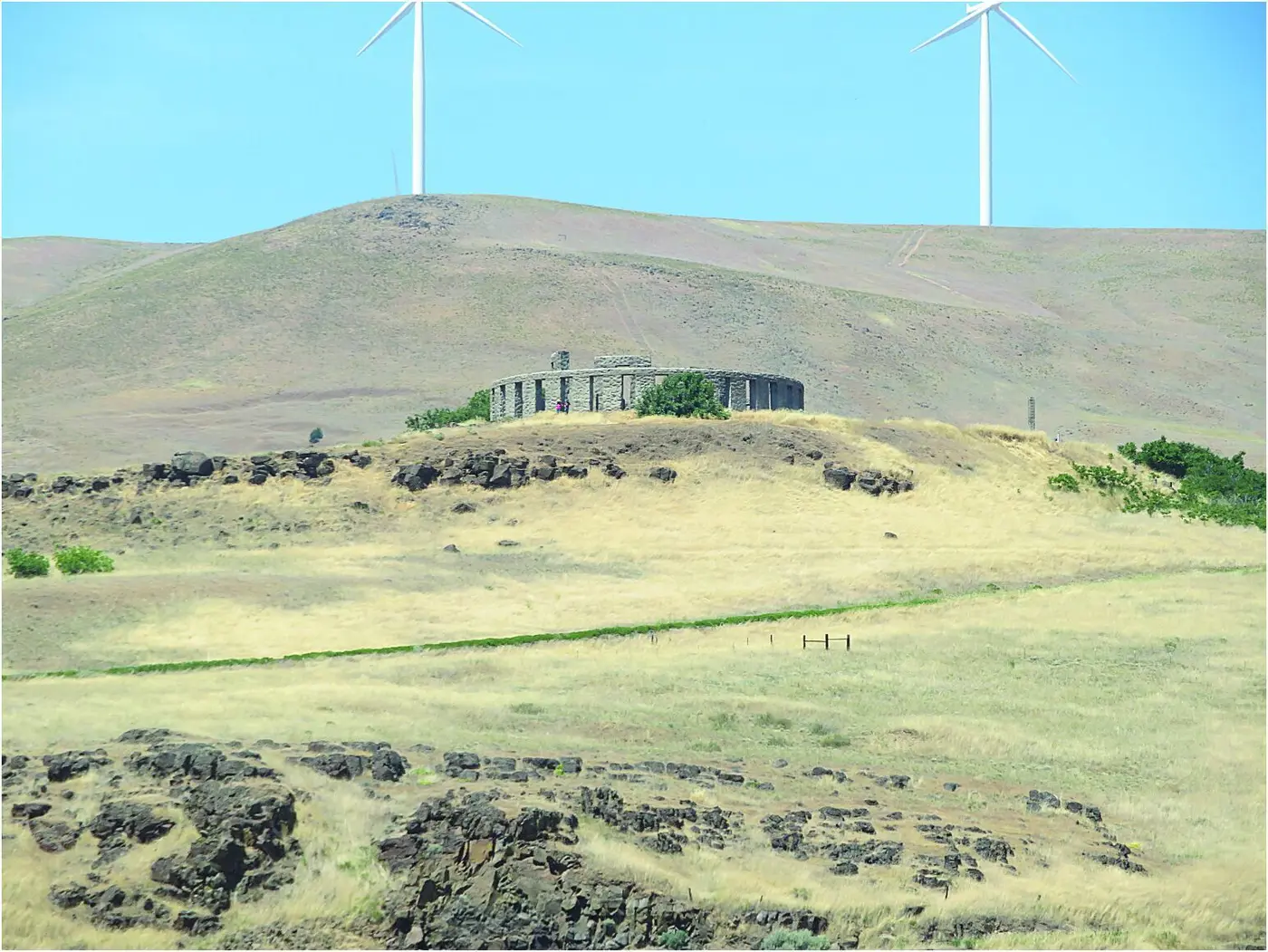
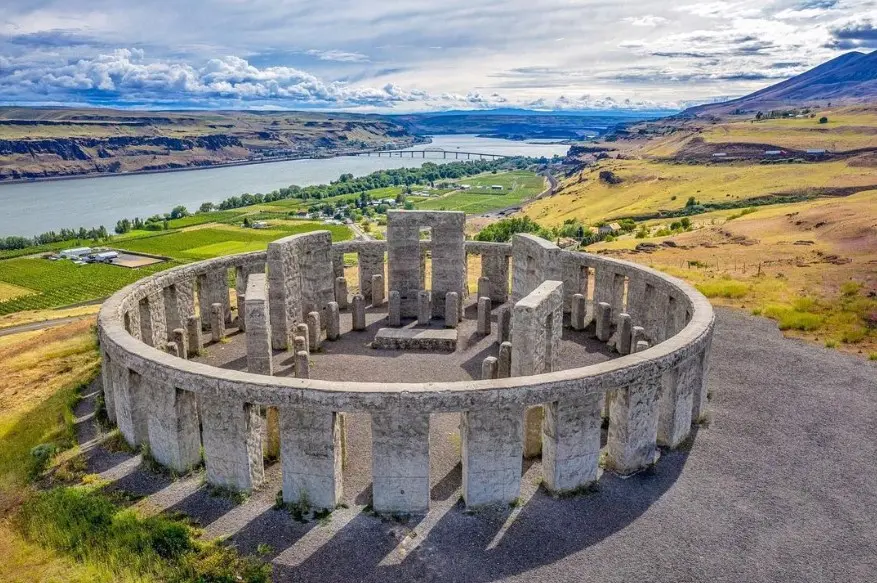
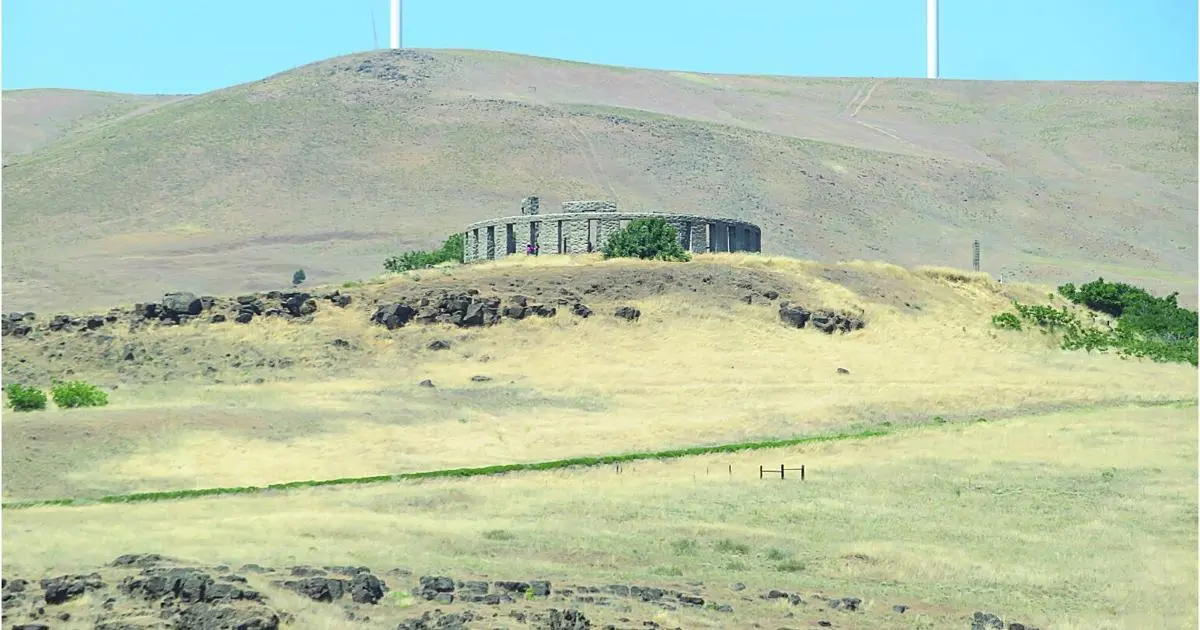
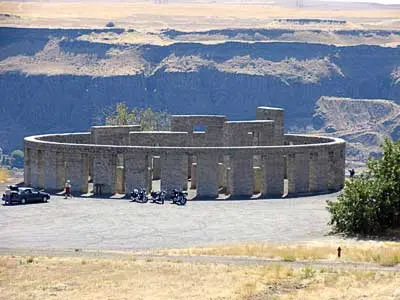
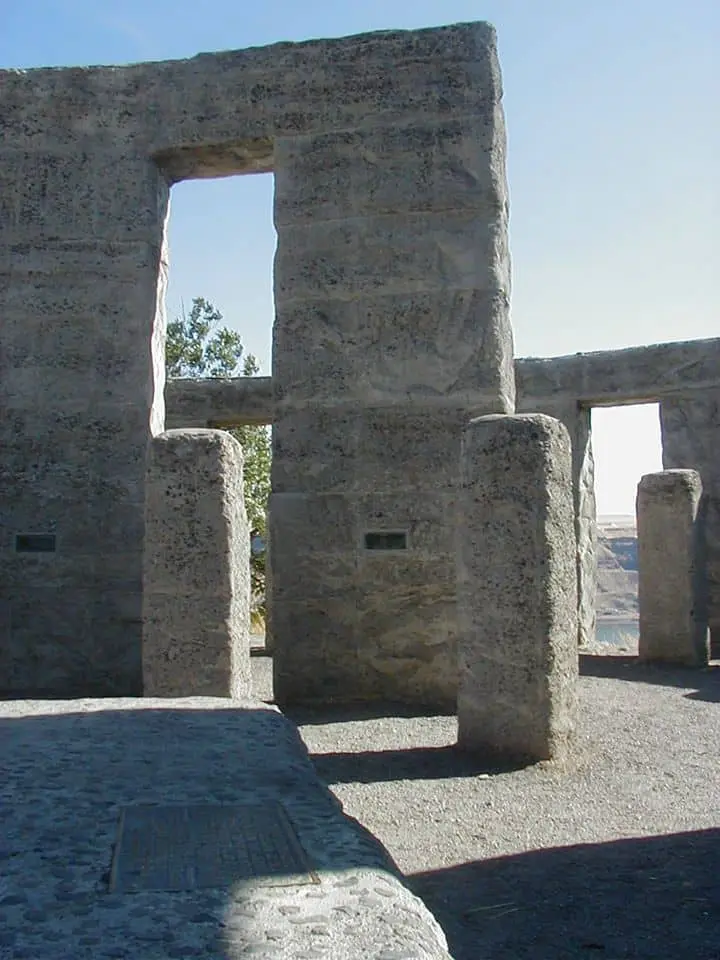
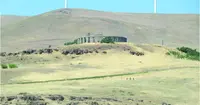
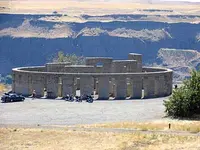
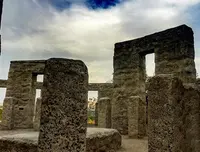
Stonehenge Drive leaves Washington Route 14 three miles east of Maryhill Museum of Art and runs south toward the river. At its end, on a bluff over the Columbia River Gorge, stands a ring of uprights and lintels built to the size and plan of the ancient monument on Salisbury Plain in England. The stones are concrete. Their rough, hand-hewn look came from lining the wooden forms with crumpled tin before the pour. Wind towers now stand on the hills above the ring, and small chunks and pebbles of concrete collect at the base of the plinths. From the river the memorial can be seen for miles, from both the Washington and the Oregon side.
Maryhill Museum of Art keeps the site. It hosts veterans ceremonies, school field trips, weddings, and community gatherings. A Washington State Department of Transportation marker titled “Sam Hill Country” stands north of the parking lot. Colleen Schafroth, a former executive director of the museum, described her own visits: “I feel awe. It’s such a stark landscape, but you can also see the beauty of Mount Hood and the Gorge.”
The altar stone and the names on the columns
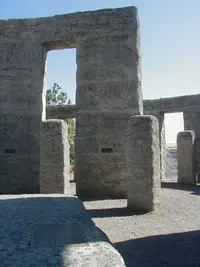
A bronze plaque is set into the top of the altar stone at the center of the ring. It reads: “To the memory of the soldiers and sailors of Klickitat County who gave their lives in defense of their country. This monument is erected in hope that others inspired by the example of their valor and their heroism may share in that love of liberty and burn with that fire of patriotism which death alone can quench.”
Thirteen more bronze plaques are mounted on the inner columns. Each gives one man’s name and his dates of birth and death. Robert F. Venable was born September 27, 1898, and died May 21, 1917. Edward Lindblad was born March 25, 1899, and died September 15, 1918. William O. Clary, born in 1884, was the oldest, and the last to die, on January 4, 1919. The sources do not agree on the count. The roadside marker says 13 men. The museum lists 14 names, adding Robert F. Graham and giving “Harry” Gotfredson where the column plaque reads “Henry.” HistoryLink says Hill dedicated the monument in 1918 to three men and that nine more names were added later. According to the museum, all of the men served in the American Expeditionary Force, in the Army’s cavalry, coast artillery, engineers, and infantry, and in the Marines and the Navy.
Near the ring stands the Klickitat County Veterans Memorial, erected in 1995 by the museum and the Klickitat County Veterans Association for those who have died in service since the First World War. The museum added an accessible ramp to it in 2020. Schafroth said of the place: “It is a sacred space for a lot of veterans. It recognizes the young men that gave their lives. They made the ultimate sacrifice. That takes a strong commitment to the country and the world, and they were mostly very young. So young. So, it’s sad too.”
Sunrise over the heel stone
The original Stonehenge faces the actual midsummer sunrise. The Maryhill copy is aligned to the astronomical horizon instead, which puts it three degrees off from the original. It also sits five degrees of latitude away, and the surrounding hills hide the true horizon. The museum says this makes the memorial difficult to use as an astronomical calendar.
People gather there each June regardless. The museum describes the crowd as an eclectic group from across the Pacific Northwest, many of whom return year after year. On June 20, 2025, the museum held its first overnight Solstice at Stonehenge celebration. Families camped on the Great Lawn at the museum, and the evening offered crafts, meditation, music, and storytelling. At sunrise on June 21 the gathering moved a short drive east to the memorial, where songs, poems, and stories marked the sun’s rise over the heel stone. Breakfast followed at the museum cafe. “I’ve spent many summer solstices over the last 30 years at Maryhill’s Stonehenge Memorial,” said David Lee, the volunteer who produced the event. He shaped it, he said, around “the shortest night of the year.”
Kitchener’s story and a Quaker’s memorial
Samuel Hill was born to Quakers in North Carolina in 1857. He became a railroad lawyer and executive, and in 1888 he married Mary, the eldest daughter of James J. Hill of the Great Northern. In 1905 he began looking at Klickitat County. According to the Sam Hill Country marker, in 1908 he bought 7,000 acres on these slopes. HistoryLink says the land was assembled from 18 farms and ranches. He named it Maryhill Ranch after his wife and daughter. He planned a Quaker farming colony and surveyed a 34-block townsite with a church, a hotel, a store, offices, a garage, and shops. His engineers laid ten miles of experimental roads, which the marker calls the first rural paved roads in Washington. No Quaker farmers took up his offers in 1909. Rainfall on the land averaged 11 inches a year.
In April 1915, eight months into the war in Europe, Hill visited England’s Stonehenge as the guest of Lord Horatio Herbert Kitchener, the British Secretary of State for War. According to the museum, Kitchener purportedly told him: “Here the ancients 4,000 years ago offered bloody sacrifices to their heathen gods of war.” This was a common reading of the monument at the time. The roadside marker gives Hill’s reply: “After all our civilization, the flower of humanity is still being sacrificed to the god of war on fields of battle.” The same marker calls the sacrifice legend generally discredited today, and the museum says Hill’s belief was mistaken. Hill was a Quaker and a pacifist, though he supported the Allied cause. The museum says he meant the replica as a reminder of the dead and of the “incredible folly” of the war.
Hill seems to have conceived the memorial in early 1918. He chose this bluff, the original site of his hotel, which had been built in 1909 and was moved a short distance north to clear the ground. He first planned to use local stone. When that rock proved unsatisfactory, he turned to cast-in-place, steel-reinforced concrete, the same material he had used for his houses in Seattle and at Maryhill. That spring, astronomers had come to the area because Goldendale lay in the path of a total solar eclipse predicted for June 8. Hill asked William Wallace Campbell, director of the University of California’s Lick Observatory, to fix the position of the altar stone, and Campbell made a side trip to Maryhill to measure the site.
The altar stone was dedicated on July 4, 1918, more than four months before the armistice. A photograph from that day shows the Washington historian Edmund Meany standing on a chair to deliver his address. The roadside marker gives May 30, 1929, as the day the full structure was completed and dedicated. HistoryLink says the replica was not finished until 1930.
A crypt below the ring
The townsite was never occupied, and fire eventually destroyed its buildings. What remained were the roads, some stonework, the replica, and the chateau three miles west, which opened as Maryhill Museum of Art on May 13, 1940, Hill’s birthday. Hill did not live to see the opening. He fell ill with what was called “intestinal influenza” while on his way to address Oregon’s governor and legislature, and he died in Portland on February 25, 1931. His ashes were placed in a crypt just below the memorial. The museum puts the grave a short walk southwest of the ring, on a bluff over the river. The marker puts it 50 yards away, on the far side of the monument. The original crypt deteriorated, and in 1955 a granite monument replaced it. It bears his epitaph: “Samuel Hill: Amid nature’s great unrest, he sought rest.”
When Hill was buried, the bluff overlooked Celilo Falls. “It must have been full of sound and fury back then,” Schafroth said. The falls have lain more than 90 feet under Celilo Lake since The Dalles Dam was completed in 1957. HistoryLink cautions that most stories about Hill are apocryphal and that Hill himself started many of them.
Concrete toward a centennial
Concrete repairs made about thirty years before 2026 have failed and are crumbling, and those are the pebbles that gather at the plinths. Preparatory conservation work began after Armistice Day in 2018, the hundredth anniversary of the end of the war. Architectural Resources Group of Portland completed an assessment in early 2020 and wrote the nomination that put the memorial on the National Register of Historic Places on June 28, 2021. A second assessment in 2023 found the structure stable and fit for public use.
In 2026 the museum began raising about $1.5 million for the work. It is planned in three phases: acute remediation, then preventive restoration, then a custom mortar applied to the top of the monument and a water-repellent coating over the whole structure. Amy Behrens, the museum’s executive director, set the target as the memorial’s centennial in 2029. “The goal of this work,” she said, “is to ensure long-term structural stability, one hundred years or more, for the Stonehenge Memorial monument.”
Notable Events
- 1908Samuel Hill bought 7,000 acres on these slopes. hmdb.org
- 1909A small frame hotel built by Hill in 1909 was moved a short distance north at some point to create construction space. maryhillmuseum.org
- 1915Hill visited England's Stonehenge as Lord Horatio Herbert Kitchener's guest and heard the then-common interpretation that it had been a site of sacrifice. maryhillmuseum.org
- 1918Hill selected a Columbia River bluff and planned a near-perfect replica matching Stonehenge's scale, arrangement, and astronomical orientation. maryhillmuseum.org
- 1918With Goldendale in the predicted eclipse path, Hill contacted William Wallace Campbell of Lick Observatory to calculate the altar stone's position. maryhillmuseum.org
- 1918Hill seems to have conceived the idea approximately three years after his visit to England and one year after US entry into World War I. maryhillmuseum.org
- 1929The full memorial structure was completed and dedicated. hmdb.org
- 1930The Stonehenge replica was not completed until 1930. historylink.org
- 1931Hill died in Portland; his ashes were entombed near Stonehenge. historylink.org
- 1955The deteriorated original crypt was replaced by a granite monument bearing Hill's epitaph. maryhillmuseum.org
- 1995Maryhill Museum of Art and the Klickitat County Veterans Association partnered to erect the adjacent memorial honoring those who died in service since WWI. maryhillmuseum.org
- 2018Preparatory work began following Armistice Day in 2018. goldendalesentinel.com
- 2020Architectural Resources Group completed a conservation assessment and issued recommendations for preserving the memorial. goldendalesentinel.com
- 2020Maryhill Museum of Art improved the Veterans Memorial site by adding an accessible ramp. maryhillmuseum.org
- 2021Stonehenge Memorial was added to the National Register of Historic Places. maryhillmuseum.org
- 2021The March 2021 nomination excerpt credits Caitlyn Ewers and Matthew Davis of Architectural Resources Group. maryhillmuseum.org
- 2023Assessments verified the memorial was currently stable and fit for public use, while concrete repairs from some 30 years ago were actively deteriorating. goldendalesentinel.com
People
- Colleen Shafroth, Maryhill Museum of Art executive director discussing the memorial's National Register recognition.
- Amy Behrens, Maryhill Museum of Art executive director and CEO leading the effort to preserve the memorial.
- Mary, Hill's wife; Maryhill Ranch was named after his wife and daughter (Married Sam in 1888.).
- Carl A. Lester, Klickitat County serviceman honored at Stonehenge.
- Charles Auer, Klickitat County serviceman honored at Stonehenge.
- Dewey V. Bromley, Klickitat County serviceman honored at Stonehenge.
- Edward Lindblad, Klickitat County serviceman honored at Stonehenge.
- Evan Childs, Klickitat County serviceman honored at Stonehenge.
- Henry Gotfredson, Honored on an inner-column bronze plaque (Born May 6, 1894; died July 30, 1918.).
- Henry O. Piendl, Klickitat County serviceman honored at Stonehenge.
- James D. Duncan, Klickitat County serviceman honored at Stonehenge.
- James Henry Allyn, Klickitat County serviceman honored at Stonehenge.
- John W. Cheshier, Klickitat County serviceman honored at Stonehenge.
- Louis Leidl, Klickitat County serviceman honored at Stonehenge.
- Robert F. Venable, Klickitat County serviceman honored at Stonehenge.
- William O. Clary, Klickitat County serviceman honored at Stonehenge.
- Samuel Hill, Museum founder, businessman, philanthropist, memorial builder, Quaker, and pacifist (1918–1929).
- Edmund Meany, Washington historian at the altar stone dedication (1918).
- Lord Horatio Herbert Kitchener, British Secretary of State for War; Hill's host at ancient Stonehenge, who purportedly relayed the sacrifice interpretation inspiring the replica.
- William Wallace Campbell, Lick Observatory director asked to position the altar stone; agreed to measure the memorial site, apparently free of charge.
- Harry Gotfredson, One of the men honored at Stonehenge.
- Professor Campbell, Lick Observatory professor who fixed the altar stone's position (1918).
- Robert F. Graham, One of the men honored at Stonehenge.
- Sam Hill, Museum founder and builder of the Stonehenge replica (1918).
- Beth Olson, Memorial improvement donations were made in Beth's memory.
- Bonnie Beeks, Donor making Veterans Memorial improvements possible.
- Colleen Schafroth, Veterans Memorial improvement donor giving in memory of Vincent J. Mangan.
- Constance Olson, Veterans Memorial improvement donor giving in memory of Ray and Beth Olson.
- Dan Gunkel, Provided an in-kind gift for Veterans Memorial improvements; associated with Gunkel Orchards.
- Dustin Conroy, Provided an in-kind gift for Veterans Memorial improvements; associated with Pioneer Surveying and Engineering, Inc.
- Edmond S. Meany, Spoke at the Stonehenge dedication (1918).
- Jim Beeks, Donor making Veterans Memorial improvements possible.
- JoDean Saris, Provided an in-kind gift for Veterans Memorial improvements.
- Juris Saris, Provided an in-kind gift for Veterans Memorial improvements.
- Larry Olson, Veterans Memorial improvement donor giving in memory of Ray and Beth Olson.
- Maya Foty, Architectural Resources Group principal working at Stonehenge Memorial.
- Ray Olson, Memorial improvement donations were made in Ray's memory.
- Ronald Ingraham, Donor making Veterans Memorial improvements possible.
- Steve Schafroth, Veterans Memorial improvement donor giving in memory of Vincent J. Mangan.
- Vincent J. Mangan, Veterans Memorial improvement donations were made in his memory.
Sources
- maryhillmuseum.org/outside/stonehenge-memorial
- maryhillmuseum.org/news/solstice-at-stonehenge
- goldendalesentinel.com/news/stonehenge-memorial-renovation-continues/article_f0142f47-e364-4aaf-9ddd-ffefeab02568.html
- latitude.to/articles-by-country/us/united-states/25098/maryhill-stonehenge
- hmdb.org/m.asp?m=301954
- hmdb.org/m.asp?m=256891
- historylink.org/File/5072
- historylink.org/file/7800
- columbiacommunityconnection.com/the-dalles/stonehenge/maryhill-museum-of-art/national-registry-of-historic-places
- nps.gov/subjects/nationalregister/weekly-list-2021-07-02.htm
- maryhillmuseum.org/wp-content/uploads/2021/05/maryhill_newsletter_spring_2021_web_fnl.pdf
- maryhillmuseum.org/news/stonehenge-memorial-added-to-national-register
- npgallery.nps.gov/GetAsset/99fba680-1ea1-4aaf-a6eb-b95106a04443
- goldendalesentinel.com/news/stonehenge-named-to-national-register-of-historic-places/article_5b64ad26-2158-11ec-a7ff-93df7acb2011.html
- klickitatcounty.gov/598/Museums-Cultural-Attractions