Rubber Chicken Museum
Seattle, King County, Washington. Museum.
Details

- Where
- 1300 N 45th St, Seattle, WA 98103. Directions
- When
- Open every day 11AM-7PM; closed New Year's Day, Memorial Day, Independence Day, Labor Day, Thanksgiving, Christmas Day.
- Getting there
- Just look for the bright red building with the yellow awning on the corner of N. 45th and Stone Way.
- Access
- FREE PARKING (A rarity in Seattle).
- Phone
- (206) 297-0240
- Managed by
- Archie McPhee.
- Established
- 2018.
The building on the corner of North 45th Street and Stone Way in Seattle’s Wallingford neighborhood is bright red with a yellow awning. Its wall carries a mural of a dancing bacon strip, a squirrel wearing underpants, a unicorn and rubber chickens. Inside is Archie McPhee, a novelty store whose stock the owners put at about 10,000 items, priced from one penny to $475. Dogs, cats and ferrets may come shopping. A glass aquarium holds the Wallingford Beast, a cryptid with the limbs of many different creatures. A sign at the rubber-chicken bins asks: “For the sanity of our staff, please only squeak once!”
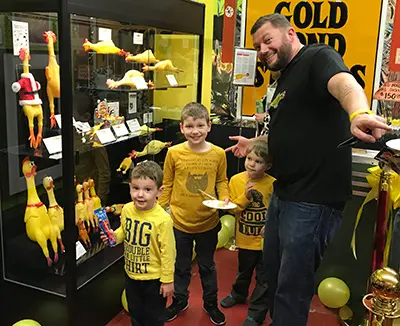
The Rubber Chicken Museum is at the back. Roger Hutchins, the store’s general manager and “duke of doodads,” told the Seattle Times in 2024 that the placement follows grocery-store logic: the milk goes at the back so shoppers walk the whole store to reach it. The museum fills a largish corner behind a velvet rope. The rope replaced a turnstile, which was taken out because people thought they had to pay to get in. Admission is free.
Seventy-seven chickens behind a velvet rope
In 2024 the Times counted 77 rubber chickens, “and counting.” The world’s largest rubber chicken measures seven feet by two and, by the Times’ account, has posed for photographs with thousands of visitors. On April 26, 2018, two weeks before the opening, the store posted that it was “starting to fill out! (Next will be trimming it down.)” The world’s smallest rubber chicken sits in the same display. That June, when a Seattle Refined crew came to film, Hutchins put on sterile gloves so they could examine it closely. The store’s blog called him “the Big Daddy of Doodads.” The world’s second-smallest, 22.5 millimeters, is a little down and in the corner, and it is Hutchins’s favorite. “We actually made the second-smallest, and then an employee said, ‘I can go smaller,’ so we made the smallest,” he told the Times. “I always like an underdog story.”
Every chicken has a small explanatory card. “Some of the rubber chicken stories are true — even most of them are true,” Hutchins says. The haunted chicken was found flattened under a fixture in the company warehouse. “It had been there over 10 years, I think,” he said. “We had some people who were very superstitious, and they said they thought the chicken was haunted.” The MSNBC Chicken came from the network’s newsroom, where it served as a symbol of power: “Whoever had the chicken was the editor.” The company keeps more birds in its warehouse, some donated and some on loan. Its holdings include chickens signed by Svengoolie, the Midwestern TV horror-movie host, and by J.P. Patches, Seattle’s local TV clown. The museum has also served as a wedding venue.
A sign at the front of the museum says the rubber chicken “can trace its lineage back to medieval court jesters.” The Seattle P-I, reporting in May 2018, noted that Wikipedia credited Archie McPhee with placing the origin in the French Revolution. An essay by Kirk Demarais, whom the store calls a renowned rubber chicken expert, sets out the history, and another sign mocks a knock-off chicken. ParentMap reports that the squeaking chicken was first developed as a dog toy. Hutchins puts it this way: “[The rubber chicken] is a quantifiable symbol for comedy. And it’s weird because it shouldn’t be funny because it has death in it, but it is.”
One case changes. It is called the Room 6 collection and holds novelties from owner Mark Pahlow’s own collection, named for the locked room where he keeps them. Above the cases hangs a stained-glass rubber chicken.
A ribbon, giant scissors, May 11, 2018
The museum was announced on April 1, 2018, on the company blog, “instead of an April Fool’s Day prank.” It would open at 3 p.m. on May 11 in the Wallingford store, and the post revealed a logo and a logo shirt. According to the Seattle Times, the idea came from Shana Danger, an employee since retired whose title was “high priestess of rubber chickens.” She had seen old-fashioned cabinets of curiosities while traveling in Europe. Pahlow used the same phrase for his whole enterprise in 2023: “The store has always been a cabinet of curiosities, and we’re glad that people share those sensibilities.”
The company recorded a podcast before the doors opened. Its photograph shows Pahlow, Danger, Demarais and David Wahl posed in front of the cases. On opening day the P-I reported that the curator, Shana Iverson, “High Priestess of the Rubber Chicken,” cut the ribbon with giant novelty scissors on Facebook Live. The store says scholars from more than ten countries have since visited “in a quest to discover what makes rubber chickens funny.” A visitor named Harold Simpkins told Seattle Refined that spring: “I’ve seen the pyramids of Giza, the hanging gardens of Babylon - or at least where they were. I can honestly say I’ve never seen anything as bizarre or wonderful as this.”
A coal stoker on the President Madison
The store’s own history insists the name belongs to a real person. In 1924 a young Archie McPhee of Bismarck, North Dakota, set out to bring jazz to the Orient. He formed a band and booked it passage as the ship’s band on the S.S. President Madison, then docked at the Port of Seattle. When he arrived he found the ship had berths for the band but none for him. One of the coal stokers failed to show, so Archie took the job and managed his band from deep in the hold. The band played hotels and cafes in Shanghai, Kobe and Yokohama, performed at the Governor General’s Ball in Manila, and was offered a six-month contract by the Army & Navy Club there.
The accounts differ on details. The store calls the band the North Star Music Makers. Pahlow, in a 2008 essay, calls it “The North Star Merrymakers” and says it was the first jazz band taken to China. He also calls Archie his great-uncle and says he “loved the crisp cadence of his name.” The Seattle Times in 2004 called Archie the great-uncle of Pahlow’s wife, and the store’s history makes Pahlow his great-nephew-in-law. Sarah Doni Swenson, Pahlow’s former wife, told the Times: “Archie did some wild things for his times. He had a wonderfully dry wit, but his humor was never at anyone’s expense.”
Plastic ants and a box of rubber chickens
Pahlow grew up in Mansfield, Ohio. “Having been born and raised in Ohio, I understand boredom in a profound way,” he wrote. As a boy he smuggled firecrackers home from Missouri and sold them singly until the police stopped him. He also charged neighborhood children a nickel to sit in an aluminum lawn chair wired to a train transformer. After high school he hitchhiked through Europe and Africa. In Copenhagen he dressed as a Viking to sell sweaters. In Los Angeles he sold stamps, fruit-crate labels and old toys bought off five-and-dime shelves.
There he went to a liquidation sale at the North Hollywood warehouse of Bob Benton, whose Star Merchandise imported rubber lizards and Bozo watches. For $500 Pahlow could take whatever fit in his Volvo. “Uh-oh,” Benton thought. “He’s bitten off more than he can chew.” Pahlow was back two weeks later. Benton took him to Hong Kong and introduced him to suppliers, and there Pahlow was called Gum Sing Tsai, Son of Gold Star.
Pahlow moved to Seattle in 1982. The Times says he came to start a family and escape rising rents and crime in Los Angeles. The Herald says love brought him. That year, he wrote, he saw how his finds fit together: “I would open my own retail store and sell everything I liked, no matter how ridiculous.” He filled a cramped Fremont storefront with barrels of miniature golfers, chirping cicada key rings and porcelain teeth. The store and the Everett Herald date the opening to 1983, the Herald to July. The Seattle Times wrote in 2023 that the business began as wholesale and welcomed customers in 1983. Then, in 1984, Pahlow broke open a box of rubber chickens and opened a new location in the nebulous area between Fremont and Wallingford.
He wanted to import a shipment of plastic ants, “the best ants in the world, their legs were perfect,” and went to Rainier Bank on Greenwood Avenue. Dianne Howell, then a junior loan officer, remembered the pitch: “Hi, I’m Mark Pahlow, and I’m here to talk with you about a business loan to buy plastic ants.” She granted $10,000, secured by potato guns, rubber chickens and 800,000 plastic ants.
Pahlow laid out the early catalogs himself. He shot dark photographs with a Pentax, pasted them down with rubber cement and typed the copy on an IBM Selectric. The Smithsonian’s National Museum of American History later asked for all 22 years of catalogs, along with 19 religious-themed novelties. The Times’ 2023 account says the archive holds catalogs published between 1985 and 2008.
The store stayed on Stone Way North for fourteen years. In the spring of 1999 it moved to Ballard, and it came back to Stone Way in June 2009, to the red corner building. Store lore, as ParentMap tells it, says the Wallingford Beast turned up during that move, when staff found bones and heard strange sounds. ParentMap dates the move to 2010. During the COVID-19 pandemic the store kept limited hours. “We did everything to keep open,” Pahlow said, “from setting up a curbside stand to throwing rubber chickens into people’s back seat during contactless pickup.”
Notable Events
- 1982Pahlow writes that it was not until he moved to Seattle in 1982 that he saw how his disparate finds fit together: he would open his own retail store and sell everything he liked, no matter how ridiculous. mcphee.com
- 1982Moving from Los Angeles to start a family, Pahlow set barrels of miniature golfers, chirping cicada key rings and porcelain teeth in a cramped Fremont storefront, the first iteration of the store that now houses the museum. seattletimes.com
- 1983Mark set up the store with two employees in Seattle's Fremont district; the business has supplied gifts and toys to Seattle since that year. archiemcpheeseattle.com
- 1984The shop began welcoming customers in 1983 before Pahlow broke open a box of rubber chickens and opened the doors of a new location in the nebulous area between Fremont and Wallingford in 1984. seattletimes.com
- 1996Since 1996 the Accoutrements wholesale and design side has been tucked on 47th Avenue West in Mukilteo, the compound where new novelties are dreamed up. heraldnet.com
- 1999The Stone Way North location lasted fourteen years until, in the spring of 1999, Archie McPhee left Fremont for Ballard, staying ten years before returning to Stone Way in June of 2009. archiemcpheeseattle.com
- 2009In June 2009 the company moved to its current Wallingford location, the store that houses the museum. archiemcpheeseattle.com
- 2016In July the store gave a free zombie horse mask to the first 33 customers, on the condition they wore it out the door, to celebrate 33 years in business. heraldnet.com
- 2018The museum's Grand Opening event was held on May 11, 2018, and the store posted video of it. archiemcpheeseattle.com
- 2018Archie McPhee announced that at 3PM on May 11, 2018 it would open a Rubber Chicken Museum in the Wallingford store, publishing the news as a non-April Fools' announcement with the museum logo and a logo shirt. mcphee.com
- 2018The TV story gave the inside scoop from Roger, the store's "Big Daddy of Doodads," who put on sterile gloves to let the crew closely examine the World's Smallest Rubber Chicken; a customer called the museum one of the newest wonders of the world. mcphee.com
- 2023Pahlow's team celebrated the store's 40th anniversary on July 13 with food, games, giveaways, prizes and major in-store discounts. seattletimes.com
People
- Kirk Demarais, Renowned rubber chicken expert whose scholarly essay is featured in the museum exhibit, putting the rubber chicken in its historical context.
- Mark Pahlow, Owner and founder of Archie McPhee, the Wallingford store that houses the Rubber Chicken Museum (from 1982).
- David Wahl, McPhee catalog manager, quoted in the Seattle Times on how customers find the store; the store's own podcast post pictures him in front of the museum's display cases.
- Philip Treece, Thanked by the store, as Philip Treece of OldJokes and CollectingMagicBooks, for providing extra historical context for the Rubber Chicken Museum podcast.
- Robert Benton, Pahlow's supplier and teacher: Star Merchandise Company owner who took him to Asia in the early 1980s and taught him how to import and work directly with Chinese suppliers.
- Shana Iverson, The museum's curator, titled "High Priestess of the Rubber Chicken," who cut the opening ribbon with giant novelty scissors in a ribbon-cutting broadcast on Facebook live.
- Archie McPhee, The adventurer after whom the host store was named: an adventurer from Bismarck, N.D., who toured Asia with a jazz band (in the 1920s).
- Dianne Howell, Rainier Bank loan officer who granted Pahlow a $10,000 business loan to buy plastic ants, securing it with collateral of potato guns, rubber chickens and 800,000 plastic ants.
- Nancy Pearl, The librarian for whom the store's Librarian action figure was conceived, at a dinner party where Nancy Pearl and Pahlow were both guests.
- Sarah Doni Swenson, Pahlow's former wife, who says the store's namesake Archie McPhee "did some wild things for his times" and that Pahlow's intention for the store was good-natured fun.
- Roger Hutchins, General manager and "duke of doodads" at Archie McPhee; he describes the museum's collection, its placement at the back of the store and the stories behind individual chickens.
- Shana Danger, Now-retired Archie McPhee employee, titled "high priestess of rubber chickens," whose idea after seeing cabinets of curiosities in Europe led to the museum.
Sources
- archiemcpheeseattle.com/rubber-chicken-museum
- archiemcpheeseattle.com
- heraldnet.com/2016-09-03/archie-mcphees-wacky-wonders-dreamed-up-at-mukilteo-compound
- mcphee.com/pages/why-does-archie-mcphee-exist
- seattletimes.com/pacific-nw-magazine/the-big-daddy-of-doodads-mark-pahlow-is-serious-about-archie-mcphee
- mcphee.com/pages/what-is-the-history-of-archie-mcphee
- parentmap.com/things-to-do/archie-mcphee-seattle-best-toys
- thestranger.com/visitors-guide-2023/where-to-go-when-you-wanna-drop-some-cold-hard-cash-in-seattle-79037407
- seattletimes.com/life/archie-mcphee-celebrates-40-years-of-seattle-quirkiness
- mcphee.com/blogs/news/podcast-ep-3-rubber-chicken-museum
- archiemcpheeseattle.com/history
- mcphee.com/blogs/news/announcing-the-rubber-chicken-museum-not-an-april-fools-joke
- mcphee.com/blogs/news/the-rubber-chicken-museum-on-seattle-refined
- seattletimes.com/pacific-nw-magazine/this-seattle-museum-inside-a-famous-store-celebrates-the-rubber-chicken
- seattlepi.com/local/seattlenews/article/Archie-McPhee-s-has-a-rubber-chicken-museum-now-12923564.php