Pickin' in the Pines Bluegrass Festival
Flagstaff, Coconino County, Arizona. Bluegrass Festival; September.
Details

- Where
- 2446 Fort Tuthill Loop, Flagstaff, AZ 86005. Directions
- When
- 21st annual: Sept. 17-19, 2027.
- Getting there
- From Flagstaff take Interstate 17 South to Exit 337, turn right, go straight at the roundabout into Fort Tuthill County Park and follow signs for 'Amphitheater'.
- Fees
- General parking is free; premium parking $20 per vehicle, per day.
- Hours
- Gates 9:00 am; Friday & Saturday music 10:00 am - 9:00 pm; Sunday music 9:30 am - 7:00 pm.
- Access
- Rain or shine event; no glass containers or outside alcohol; only trained service animals inside the amphitheater.
- Walk-in or reserve
- A valid wristband is required to enter the amphitheater and the campground; tickets are non-refundable.
- Managed by
- Flagstaff Friends of Traditional Music, a 501(c)3 nonprofit.
- Established
- 2006.
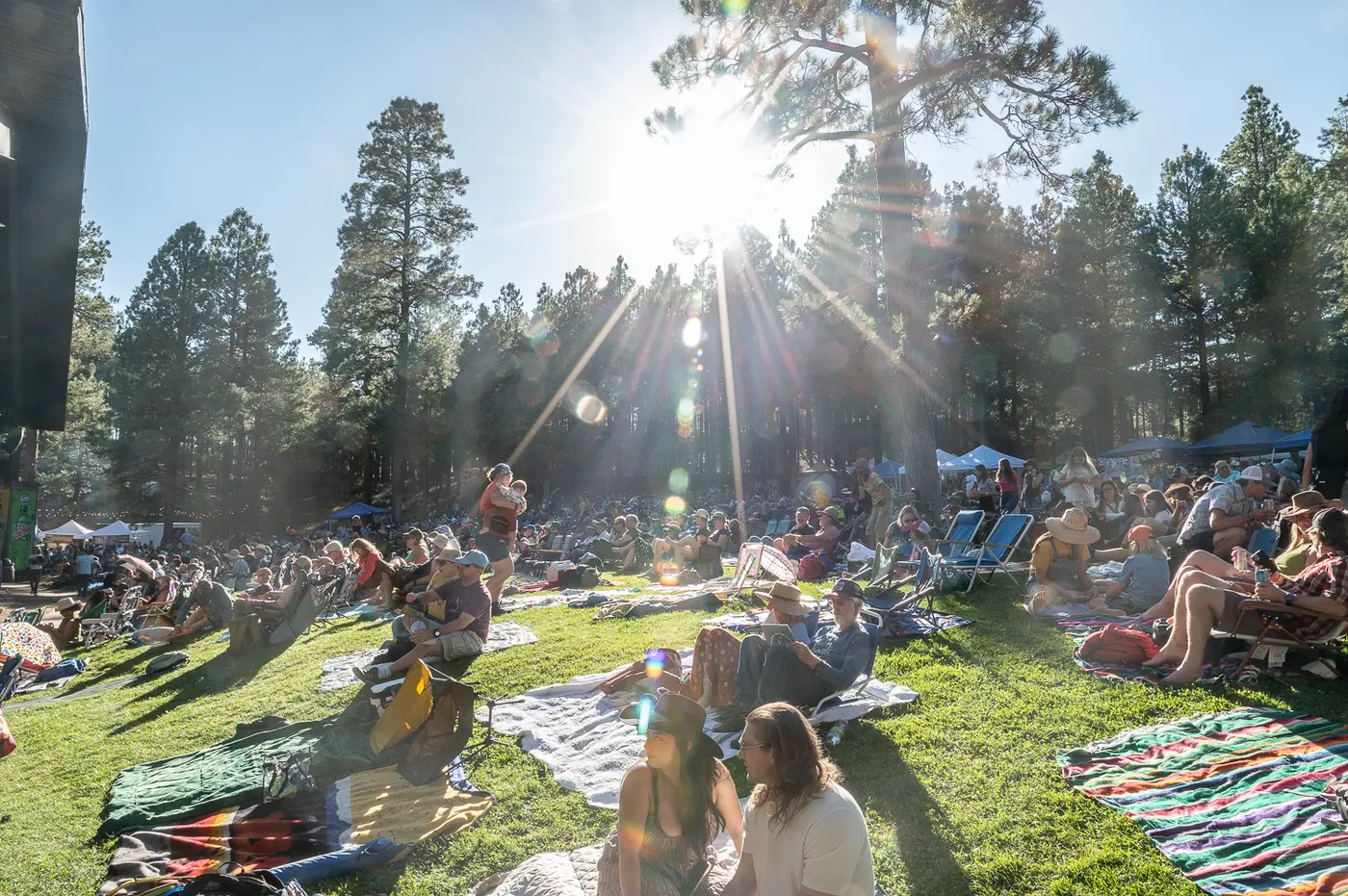
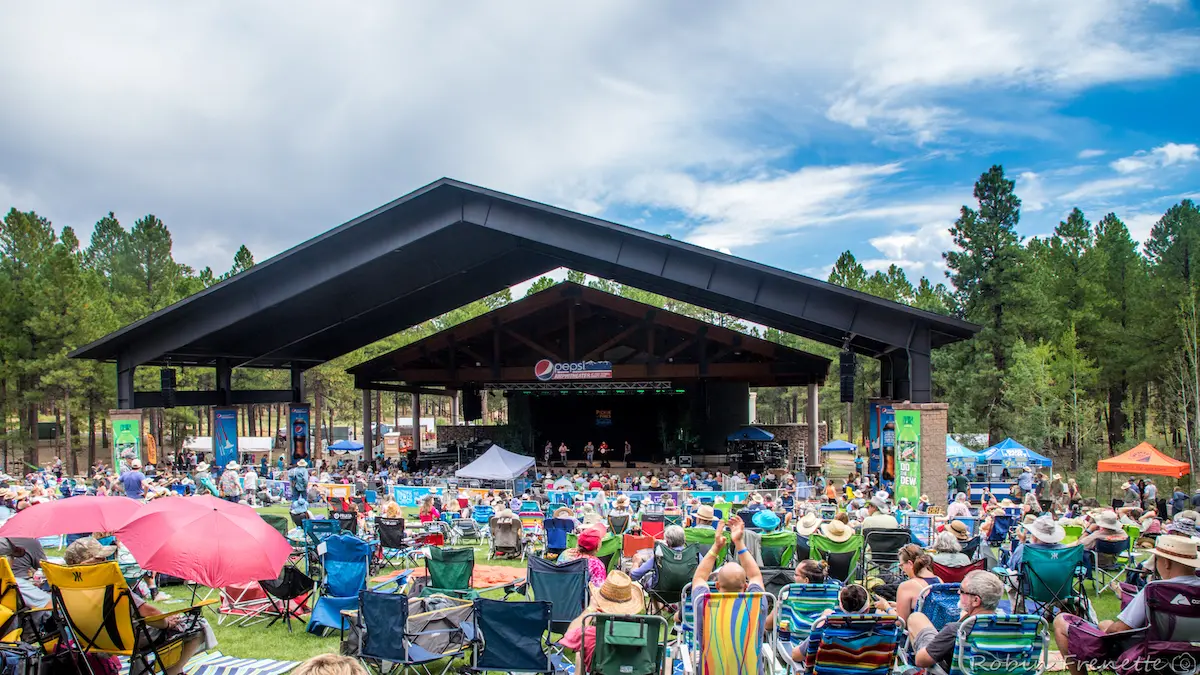
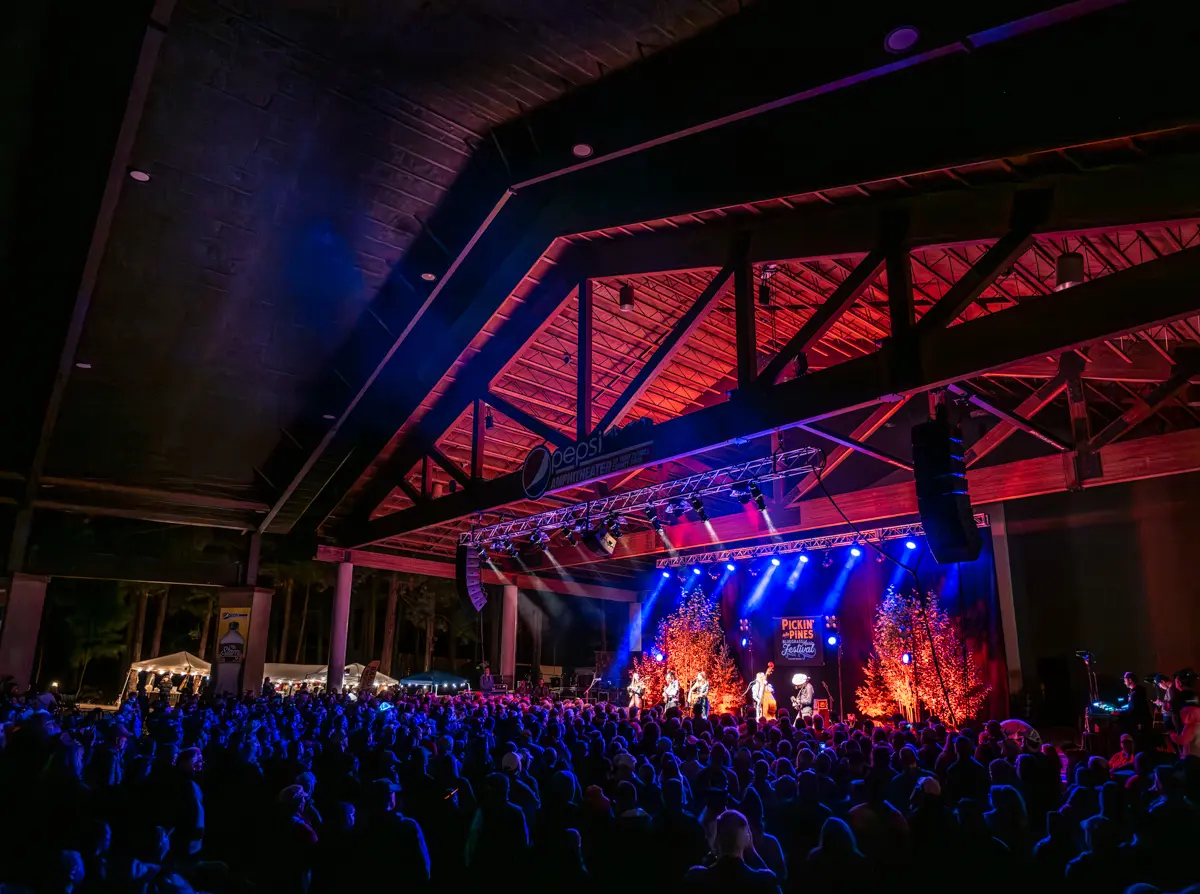
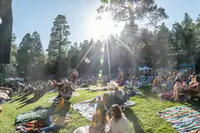
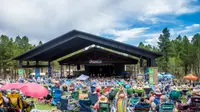
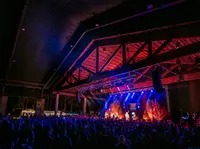
The main stage of Pickin’ in the Pines faces a grassy lawn in the Ponderosa pine forest of Fort Tuthill County Park, 3 miles south of Flagstaff off Exit 337 of Interstate 17, the same exit used for Flagstaff Pulliam Airport. Coconino County lists the park at 621 acres; the festival’s venue page gives 413. The Pepsi Amphitheater holds up to 3,500 people by the festival’s count, on the lawn and in more than 500 built-in seats. Folding chairs and stadium-style seating fill a shade canopy in front of the stage, which the festival designates a listening area where conversation is kept to a minimum.
A line of signs divides the lawn. Only low-profile chairs may sit in the half nearest the stage, and the rules give the test: “If we can roll a basketball under it, it is a high-profile chair.” Sunshades go in a single row around the back edge, held down with weights because stakes would damage the sprinkler system. Chairs left overnight are moved outside the gate by morning.
The festival runs three days in September, on the second weekend after Labor Day according to Flagstaff Friends of Traditional Music, the nonprofit that presents it. Gates open at 9 each morning. Vendors sell food with vegetarian and gluten-free choices, along with beer, wine, coffee, and soda. Drinking fountains stand inside the amphitheater, and Coconino County bars glass throughout the park. The festival calls itself taper-friendly: recorders are welcome as long as they stay clear of the sound booth, unless an artist asks otherwise. The festival’s own forecast for that season is daytime highs in the high 70s and nights in the mid-40s.
The twentieth, September 2026
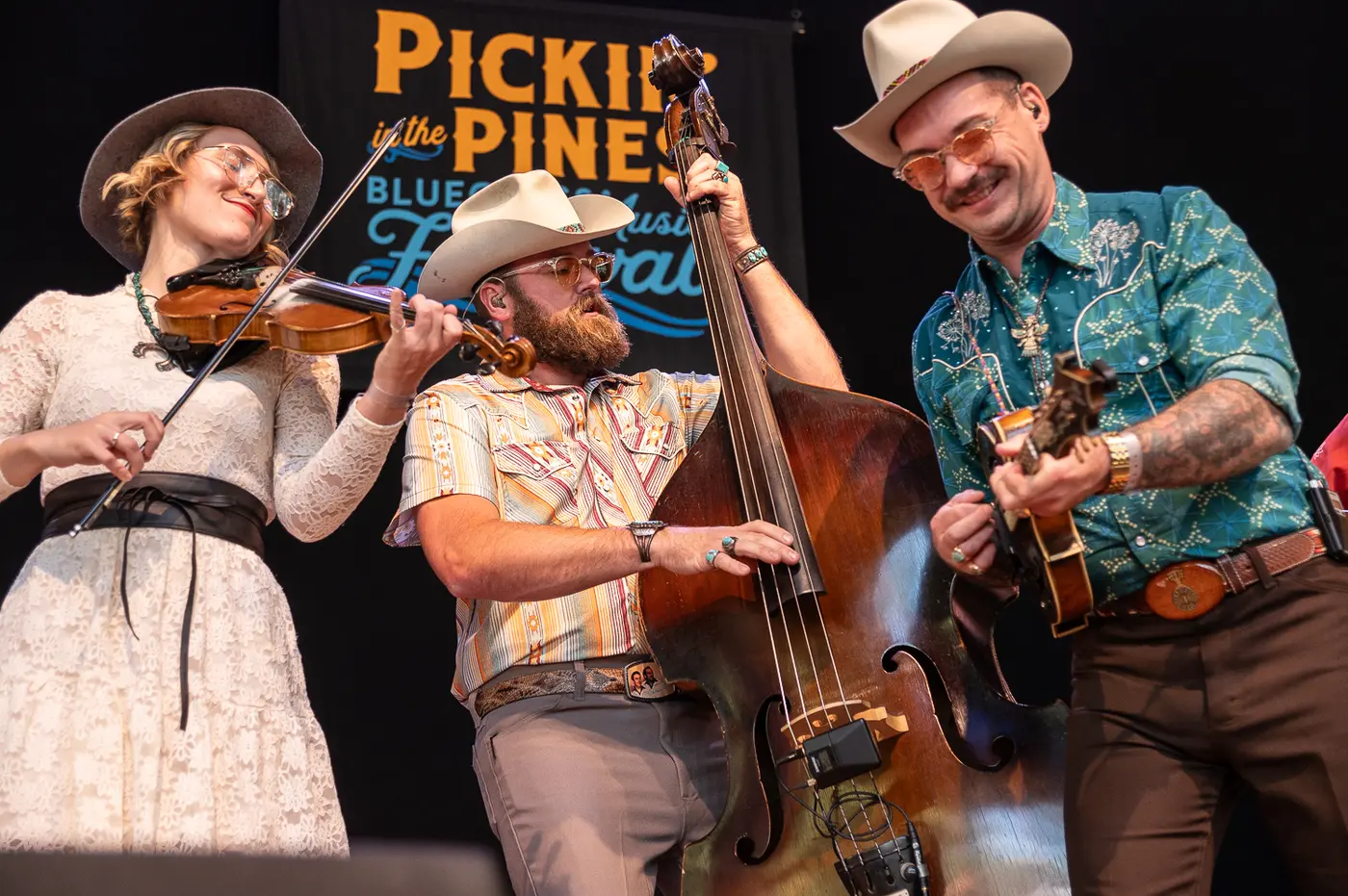
The 2026 festival, the twentieth, ran Sept. 18–20 and opened with a free kickoff the evening before. At 7 p.m. on Thursday, Sept. 17, Catch & Chords played the Workshop Stage. The duo is the husband-and-wife team of Joe and Brianna Baxter, of the Matheson Music Foundation. They were followed by the Honey Buckets, a Southern California band, and after the showcase the stage was given over to open jamming. Friday’s main stage began at 10 a.m. with Chris Brashear & Peter McLaughlin and ran through East Nash Grass and Mountain Grass Unit to the Kitchen Dwellers, who played until 9.
At 9 the program moved outdoors to the Rooftop Solar Workshop Stage beside the Commercial Building for the Old Time Community Dance, which the festival calls “everyone’s favorite Friday night festival tradition.” Lonesome Ace Stringband played fiddle, clawhammer banjo, and bass until 10:30. Deb Comly called the dances. Admission was free, and no experience was required.
Saturday night the Infamous Stringdusters headlined from 8 to 9:30. Away from the amphitheater, hour-long workshops ran at the Workshop Stage, in the Fine Arts Wing, and under the Navajo and Yavapai ramadas. Flagstaff Friends of Traditional Music says these sessions are free to the public. Tony Trischka, billed on the schedule as “the father of modern bluegrass,” led a banjo workshop and later told the story of the Earl Scruggs/John Hartford “lost tapes.” Michael Daves gave explorations on the acoustic guitar, and John Reischman held what the schedule called “an intimate session” as a mandolin player and composer. Ryan Elewaut of Solstice Guitars hosted a luthier showcase. On Sunday, three Arizona State University professors, Athena Aktipis, Tamera Schneider, and Deborah Wu, led “Your Brain on Bluegrass,” a session on the science of being in sync.
The band contest runs beneath the weekend. Up to ten acoustic bands play preliminaries at the Workshop Stage on Saturday morning. Each band has about ten minutes on a single microphone for a slow vocal song, a fast vocal song, and an instrumental. Bluegrass, old-time, Celtic, western, swing, and gospel all qualify. The top three replay on the main stage at 9:30 Sunday morning for prizes of $1,000, $750, and $500. Roll Me Home won in 2026. The 2025 winners, Forest Thurman & Breakline, returned as hired performers: they opened Saturday’s main stage and gave a Friday workshop on how to win a band contest.
Sunday’s main stage carried Dom Flemons & The Traveling Wildfires, John Reischman & The Jaybirds, Tony Trischka’s Earl Jam featuring Michael Daves, Bronwyn, and Blue Highway. For the anniversary the festival extended the day past its usual Sunday schedule with a second Stringdusters set at 6:15.
Children have their own program. The KidZone runs along the amphitheater’s back fence from 10 to 3 on Saturday and Sunday, with crafts, face painting, and festival T-shirts for ages 5 to 12 to color while the shirts last. At the Instrument Petting Zoo in the Fine Arts Wing, children try guitars, banjos, and fiddles, then perform on the Kids Sound Stage. The Young Jammers workshop on Sunday afternoon lends ukuleles to anyone without an instrument.
Adults new to jamming have the Wernick Method class at the Navajo Ramada, from 9 to noon both mornings. The method was devised by Pete Wernick, “Dr. Banjo.” The only requirements are tuning an instrument and changing smoothly between G, C, D, and A, and the class page states, “Fast playing is not expected, nor is the ability to solo required.”
Six campgrounds and four fire rings
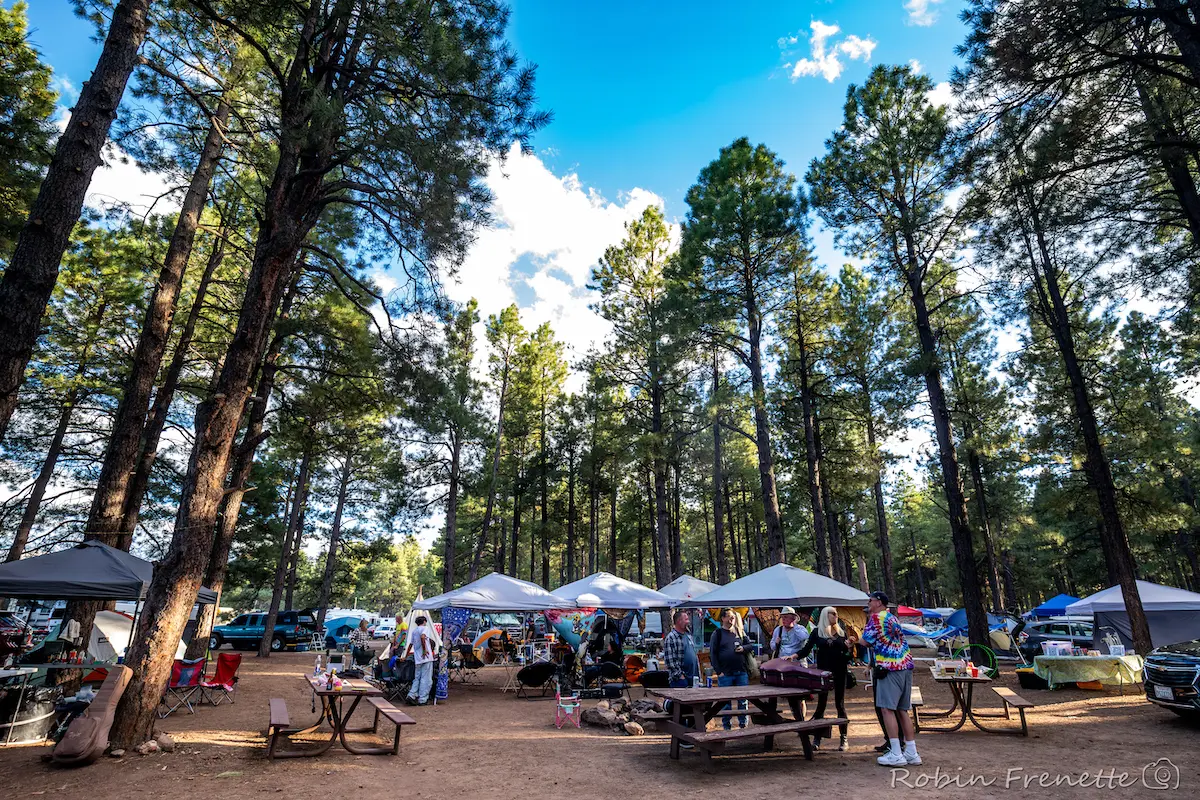
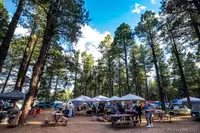
The festival campground opens at noon on Thursday and closes at 11 a.m. on Monday. The festival’s organizers describe this as “four glorious nights of camping under the stars.” There are six areas: South Group, North Group, Main, RV, West, and Brigade. The two group camps are sold per person, with sites claimed first come.
South Group sits in the tall pines, with picnic tables, porta-potties, water, and four large fire rings shared among neighbors. Its south fence adjoins the Luke Air Force Base campground and is designated a quiet area. Ground fires are banned in North Group, West, and Brigade, and the rules invite campers there to join their neighbors at the South Group rings. Where elevated propane fire pits are allowed, campers rake away pine needles beneath them first; the festival provides the rakes.
Dogs are barred from both group camps, including on walks to visit a jam. Generators run only in the RV, Main, and Brigade areas, from 7 to 9 in the morning and 6 to 8 at night. A shower trailer serves the grounds, and the festival warns that bees are active in the campground that time of year.
Every camping area sits an eighth to a quarter mile from the amphitheater. A free shuttle runs about every 15 minutes, starting half an hour before the main stage opens and ending half an hour after it closes. The campgrounds also connect to the Flagstaff Urban Trail System, which can be ridden by bicycle from town to bike racks near the box office.
Bill Vernieu named the festival. Its organizers’ history notes that the name proved apt, since “pickin’” is what many campers enjoy most about the campground.
A meeting at the Braces’ house
Vernieu belonged to Flagstaff Friends of Traditional Music, a member group formed in Flagstaff in 1988 that became a 501(c)(3) nonprofit in 2000. By the group’s account, several people wanted a festival at the same time. Brian Burnett of the Burnett Family Bluegrass Band wanted one in Flagstaff, as did members Julie Sullivan Brace, Roger Brace, Mike Falk, Jessica Pope, and Vernieu. Meanwhile Todd Graeff, director of Coconino County Parks & Recreation, and County Supervisor Bruce Mason saw a new amphitheater at Fort Tuthill as the place for one. They all met first in the home of Julie and Roger Brace, joined by business consultant Ginger Buckendahl. In the history’s words, “a spark ignited, and the festival was born.”
The amphitheater was completed in 2005 as the Pine Mountain Amphitheater. County voters made its construction possible, and it was funded through the Coconino Parks and Open Space Program, Arizona State Parks Heritage Fund grants, and the county. The festival leases it. The organizers’ own history puts its capacity at over 3,000, with lawn seating in the sun and a separate shaded section.
The first festival came in 2006, headlined by Laurie Lewis & the Right Hands and the John Reischman Band, with local and regional bands filling out the bill. “Much to the surprise of the organizers,” more than 800 people came, and the event finished in the black. David Grisman headlined the second year. In the early years volunteers managed programs, wrote grants, and cooked backstage meals for the musicians. City, county, and state grants later paid for bigger acts.
The Del McCoury Band headlined in 2008, and Hot Rize in 2012. Ricky Skaggs & Kentucky Thunder played in 2015 and 2021, and Béla Fleck in 2018. Burnett Family Bluegrass appeared on every lineup from 2006 through 2015 and again in 2017. Some names from the first year have kept coming back: Laurie Lewis played in 2025, and both John Reischman and the pair of Chris Brashear and Peter McLaughlin were on the 2026 bill. The Whistle Stop Bluegrass Band won the band contest in 2006, 2007, and 2010; under current rules, past winners may not enter again.
The Flagstaff Arts Council gave the festival its Viola Award for Outstanding Arts Event in 2010. Readers of the Arizona Daily Sun voted it Flagstaff’s Best Festival in 2017, 2018, 2019, 2021, 2022, 2023, 2024, and 2025, and the International Bluegrass Music Association nominated it for Best Event in 2023. The festival now has a small paid staff: executive directors Linda Mack and Teresa Wayne and marketing director Lara Gomora. More than 200 volunteers, known as “Team Bluegrass,” do the rest of the work.
The 21st annual festival is set for Sept. 17–19, 2027.
Notable Events
- 2005The festival's future home in Ft. Tuthill County Park, Pepsi Amphitheater, originally known as Pine Mountain Amphitheater, was completed. ffotm.org
- 2006The first festival was held at the amphitheater; first-year headliners were Laurie Lewis & the Right Hands and The John Reischman Band, and over 800 attendees put the event in the black. ffotm.org
- 2006First started in 2006, Pickin' in the Pines is well on its way to becoming one of the most renowned and beloved music festivals in the Southwest. pickininthepines.org
- 2010The Flagstaff Arts Council named the festival Outstanding Arts Event winner at its Viola Awards. ffotm.org
- 2017Readers of the Arizona Daily Sun voted the festival Flagstaff's Best Festival in 2017, 2018, 2019, 2021, 2022, 2023, 2024, and 2025. ffotm.org
- 2023The International Bluegrass Music Association nominated the festival for Best Event. ffotm.org
- 2026The 20th annual festival is set for Sept. 18-20, 2026. ffotm.org
People
- Bill Vernieu, FFOTM member who named the festival Pickin' in the Pines.
- Brian Burnett, Burnett Family Bluegrass Band member who wanted to start a festival in Flagstaff.
- Bruce Mason, County Supervisor who envisioned the new amphitheater at Ft. Tuthill as the festival's place.
- Ginger Buckendahl, Business consultant who joined the first meeting where the festival was born.
- Jessica Pope, FFOTM member who shared the festival idea.
- John Reischman, First-year headliner with The John Reischman Band.
- Julie Sullivan Brace, FFOTM member who shared the festival idea and in whose home the group first met.
- Laurie Lewis, First-year headliner with Laurie Lewis & the Right Hands.
- Mike Falk, FFOTM member who shared the festival idea.
- Roger Brace, FFOTM member who shared the festival idea and in whose home the group first met.
- Todd Graeff, Director of Coconino County Parks & Recreation who envisioned the new amphitheater at Ft. Tuthill as the festival's place.
Sources
- pickininthepines.org/general-inquiries
- azdailysun.com/flaglive/play-me-some-mountain-melodies-pickin-in-the-pines-bluegrass-festival-marks-20-years-in/article_4852f290-94bc-4b62-8505-07e004d34dda.html
- pickininthepines.org
- pickininthepines.org/main-stage-schedule
- pickininthepines.org/workshops
- pickininthepines.org/band-contest
- pickininthepines.org/kids-activities
- pickininthepines.org/dance
- ffotm.org/pickin-in-the-pines-festival
- pickininthepines.org/past-lineups