Oregon Hatchery Research Center
Alsea, Benton County, Oregon. Research center; year-round.
Details

- Where
- 2457 East Fall Creek Road, Alsea, OR. Directions
- When
- OHRC Board meetings, posted 2025 schedule: February 3 at 10:00am online; March 18, June 17, September 3, and December 2 at 9:00am at OSU and by online/teleconference.
- Getting there
- On Fall Creek, 27 miles east of Waldport.
- Access
- ODFW closed the center after a 2020 landslide on Weyerhaeuser property upriver kept silt in its raceways, ponds and research work.
- Phone
- 541-487-5510
- Website
- dfw.state.or.us
- Managed by
- Oregon Department of Fish and Wildlife and Oregon State University Department of Fisheries, Wildlife and Conservation Sciences.
- Established
- Reopened as a research center eight years and $7.5 million after the state coho hatchery on the site closed in 1997.
East Fall Creek Road leaves Highway 34 twelve miles west of the town of Alsea and runs north two and a half miles up Fall Creek to the Oregon Hatchery Research Center, 2457 East Fall Creek Road. The state’s visitors’ guide still sends travelers to a main parking lot in front of the large research and office building, and still lists tours and classroom visits year-round. The center’s own pages say the Fall Creek facility is closed to the public and that no research is done there.
In September 2024 the Lincoln Chronicle reported that the grounds were shuttered except for a volunteer caretaker living out of a travel trailer. Around the trailer stand houses for three employees, laboratories, offices, an exhibit area and a large conference area. The Oregon Department of Fish and Wildlife had not decided what to do with any of it.
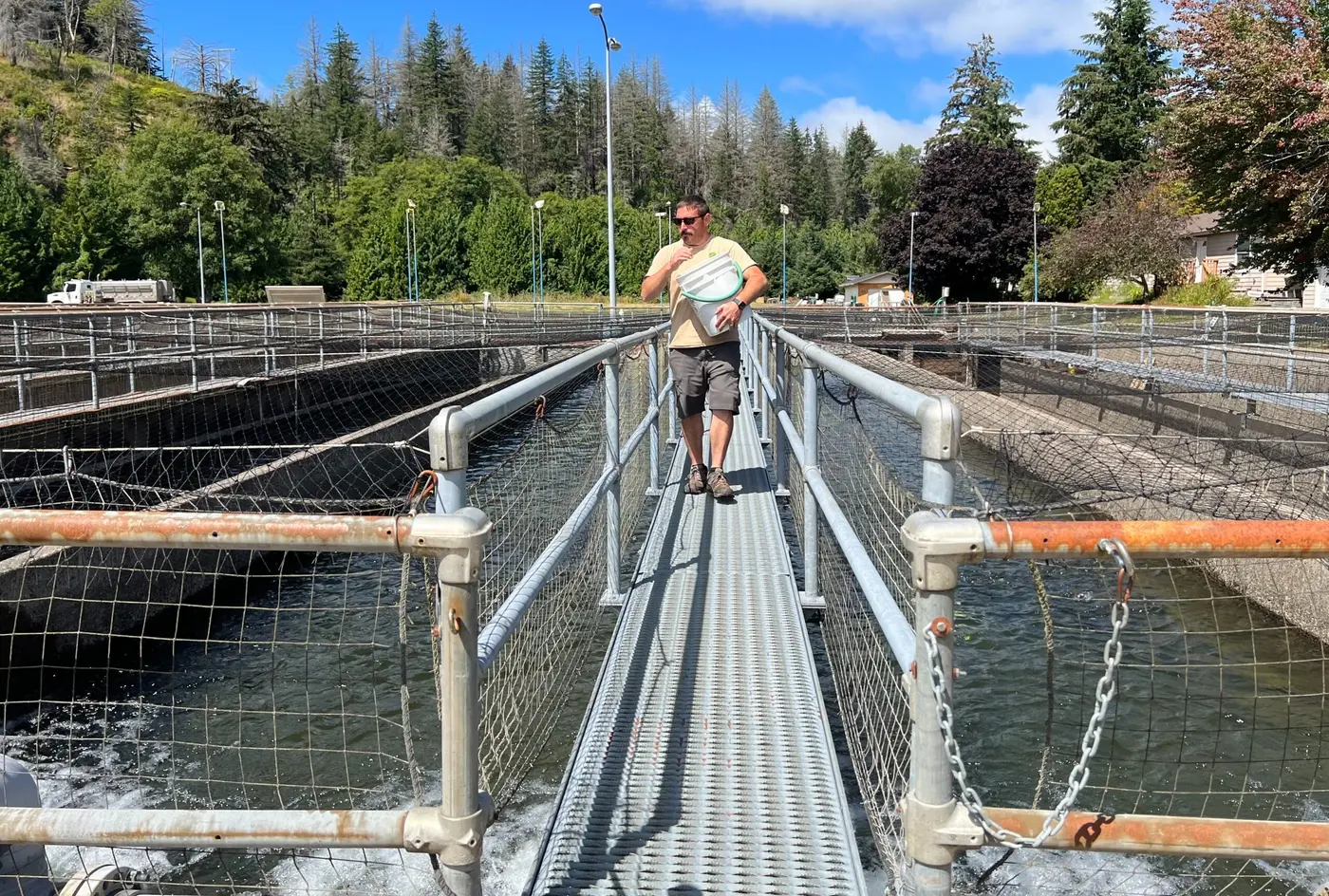
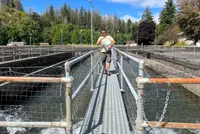
The center’s self-guided tour map numbers eleven stops. Fall Creek itself is the first. After it come the host site, the research building, the interpretive center and interpretive trail, the fish raceways and fish tanks, a floating fish trap, the artificial streams, the fish ladder and the water intake structure. The ladder gave controlled passage to the upper basin of Fall Creek. The creek joins the Alsea River about two miles below the buildings. The Oregon Encyclopedia counts Fall Creek among the major tributaries of the Alsea, whose watershed covers 470 square miles. The river takes its name from the Alsi, or Alseya, villagers who lived around its estuary.
The slide above the intake
The department’s account is brief. In 2023 the facility closed because of “an on-going, massive upstream landslide that impacts water quality.” The slide made the place unreliable for keeping fish alive and running experiments, and it threatened human safety. The Lincoln Chronicle added particulars. The slide came down in 2020 on Weyerhaeuser property upriver. In December, the department decided it could no longer keep the silt out of its raceways, ponds and research work. The Oregon Encyclopedia’s entry on the river records that all hatchery and testing work at the center was “indefinitely suspended.”
The center’s board met at the Alsea site through September 12, 2023. Its next meeting, on December 12 of that year, was held at Oregon State University in Corvallis, and the meetings have stayed there since. The fish went to the university’s Aquatic Animal Health Lab just outside Corvallis, where all of the center’s rearing and lab work is now done. The research staff work on the OSU campus. A department memo reported by the Chronicle in 2024, written to close an $8 million budget gap, estimated that closing the center and cutting 11 fish-monitoring positions would save $3.3 million.
Four questions in Corvallis
Dr. Seth White directs the center. He is an associate professor in OSU’s Department of Fisheries, Wildlife, and Conservation Sciences and spent 13 years as a senior fisheries scientist at the Columbia River Inter-Tribal Fish Commission. The center’s work is funded through a surcharge on angling licenses that the Legislature passed in 2015 as House Bill 3012, which provides $2 million per biennium. The center’s page states that the dedicated funds sunset on December 31, 2026.
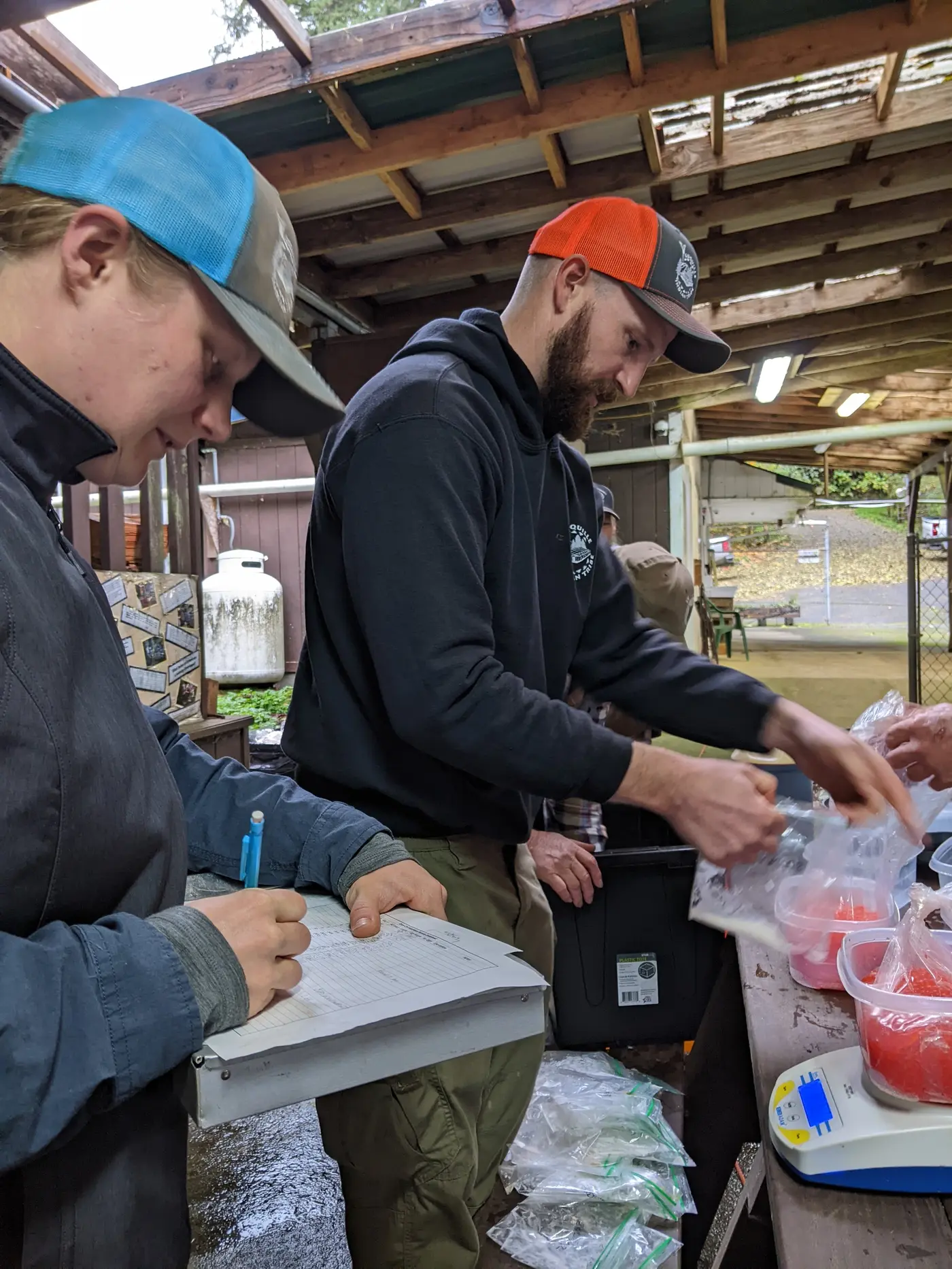
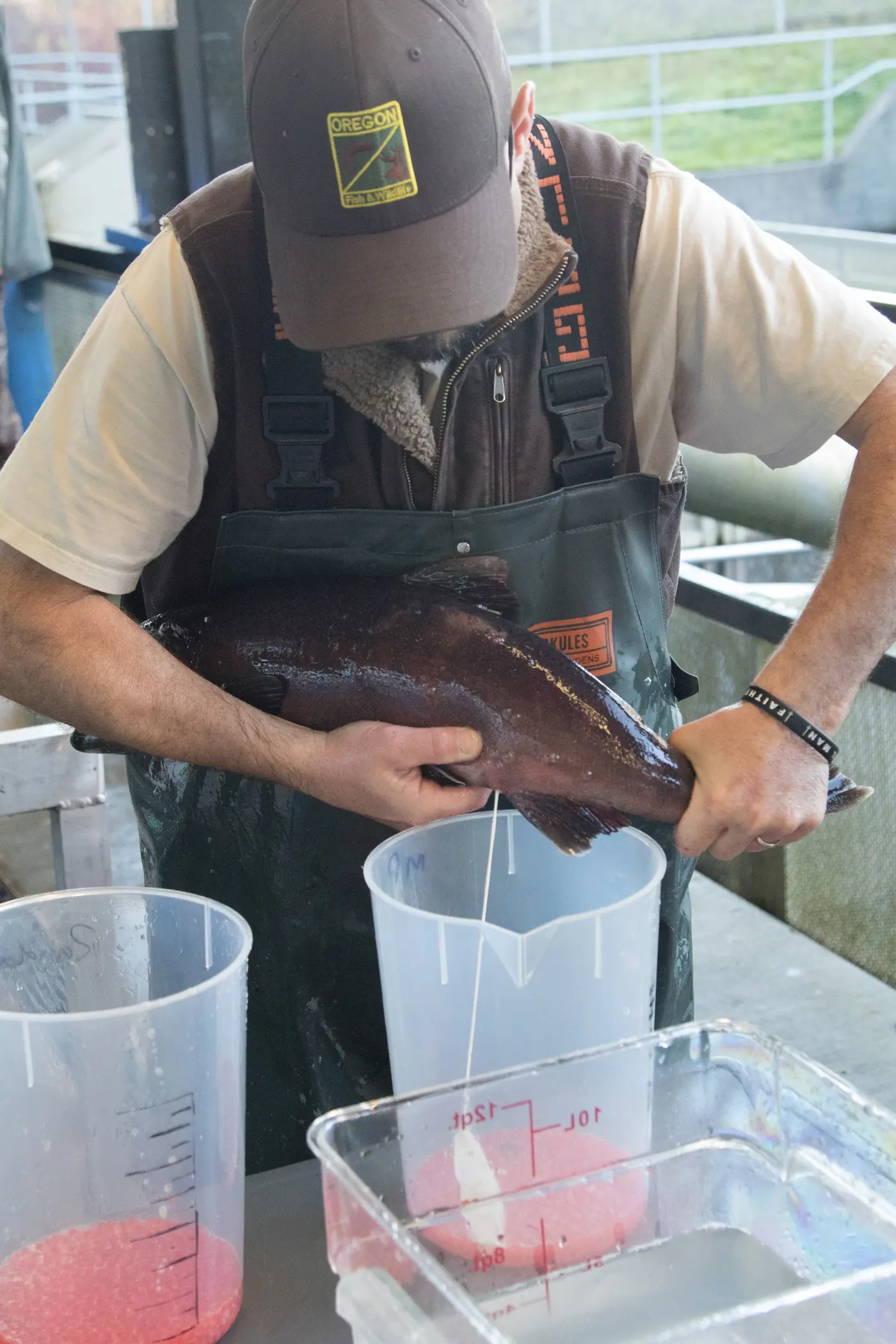
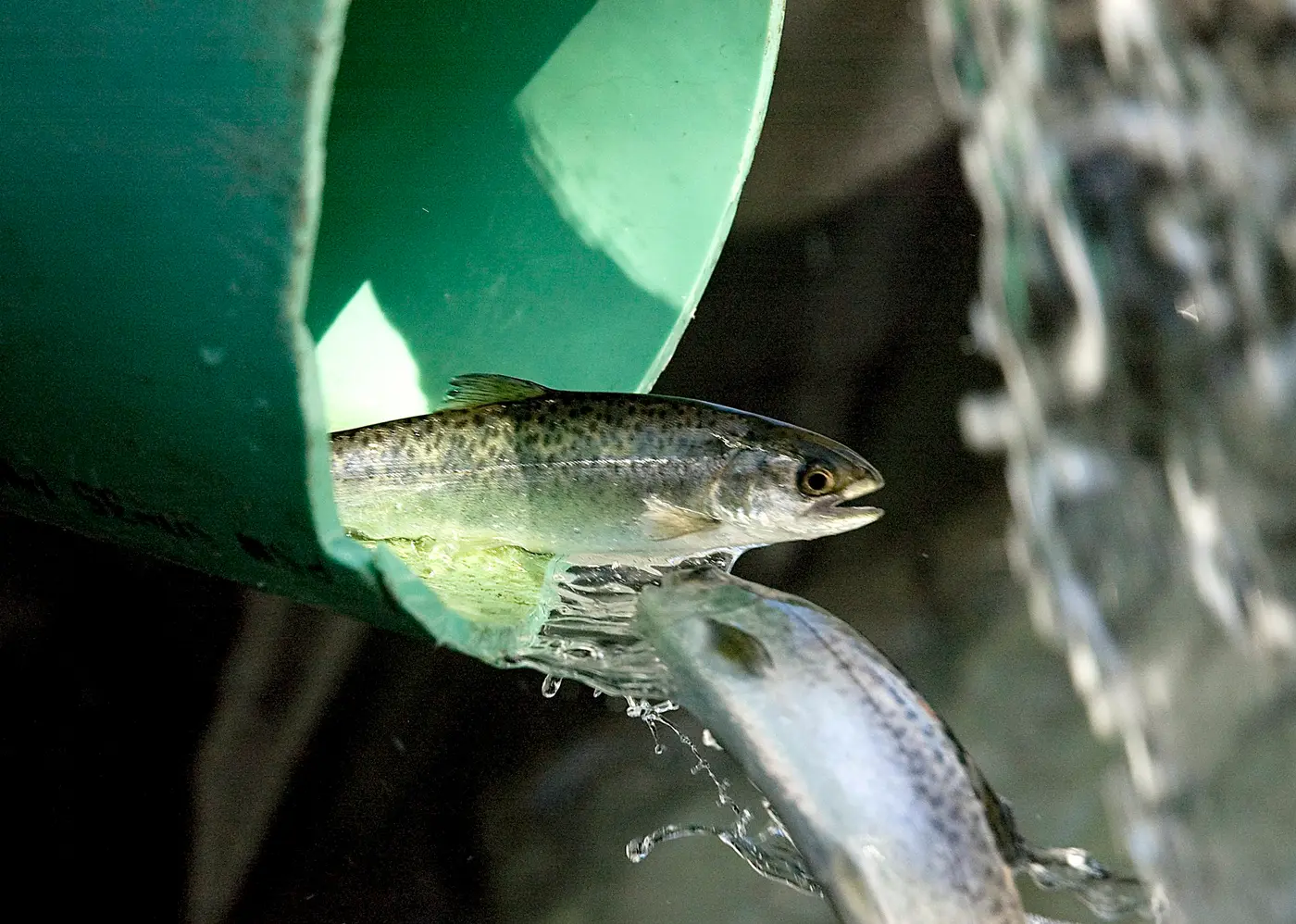
That money supports four research projects, each framed as a question. Can hatchery managers mimic wild mate selection in coho salmon? Can hatcheries reduce straying by imprinting young fish with a natural odor? What do different user groups think about hatcheries and hatchery fish? Does releasing hatchery salmon at the fry stage improve adult survival? The center also works on joint projects. On the North Umpqua, two hundred adult spring Chinook were fitted with gastric radio tags at Winchester Dam. On the upper Coos River, Coquille Tribe biologists planned to release nearly a million unfed fall Chinook fry from streamside incubators in 2024. The center counts more than 100 peer-reviewed papers, technical reports and theses.
A board has advised the director since August 2013. It has 15 members, 12 of them voting, appointed by the department’s director, and each seat stands for an interest. The chair, Scott Starkey, holds the forest products seat. Other seats represent wild fish advocates, Columbia River gillnetters, the Oregon Salmon Commission, agriculture and Oregon’s Indian tribes. The vice chair, Chuck Pavlik, represents coastal ports. He is a port commissioner for the Port of Alsea and a founding member of the Alsea Sportsman Association.
Silver salmon and a videotape
A state hatchery stood on Fall Creek long before the research center. The Fish Commission’s 1953 biennial report records a contract for a new state-financed coastal hatchery there. It replaced a station near Tidewater that had been abandoned because of a diminished water supply. The commission called the Fall Creek site ideally situated, “with ample water supply and with suitable water temperatures.” Its plans called for ten ponds holding 500,000 fourteen-month-old fish and a hatching house for 10 million eggs. The work was to be finished in time to receive silver salmon eggs in November 1952.
The accounts of its end differ. The Lincoln Chronicle says the coho hatchery closed in 1997. Bill Monroe, writing in The Oregonian in 2005, says budget cuts mothballed it in 1998. He wrote that the old Fall Creek Hatchery became infamous the same year, after a visitor videotaped workers clubbing unwanted salmon that could not be left in the Alsea system to compete with wild fish. The practice was standard at many production hatcheries, Monroe noted, but the tape incited the public, spawned lawsuits, and aroused and angered the Legislature. Another press account places the videotaped clubbing in 1999. It records that Governor John Kitzhaber vetoed a bill for a moratorium on destroying hatchery salmon and that a state judge upheld the department’s right to club fish. MidCurrent described the hatchery as the hotspot of the debate over wild salmon in the late 1990s. It reported that the dispute led to a federal court ruling that grouped wild and hatchery salmon together for protection under the Endangered Species Act.
The 2003 Legislature appropriated the money for a research center at the department’s request. “There were questions we don’t know about fish, and it turned out legislators had the same kinds of questions,” said Lindsay Ball, the department’s director. The department and The Oregonian give the cost as $7.8 million. The Lincoln Chronicle gives it as $7.5 million.
Twenty-four steelhead, October 14, 2005
Hundreds of Oregonians came to the grand opening. Governor Theodore Kulongoski cut the ribbon. “Today represents a new step forward for Oregon’s economy and in protecting and restoring threatened and endangered fish,” he said.
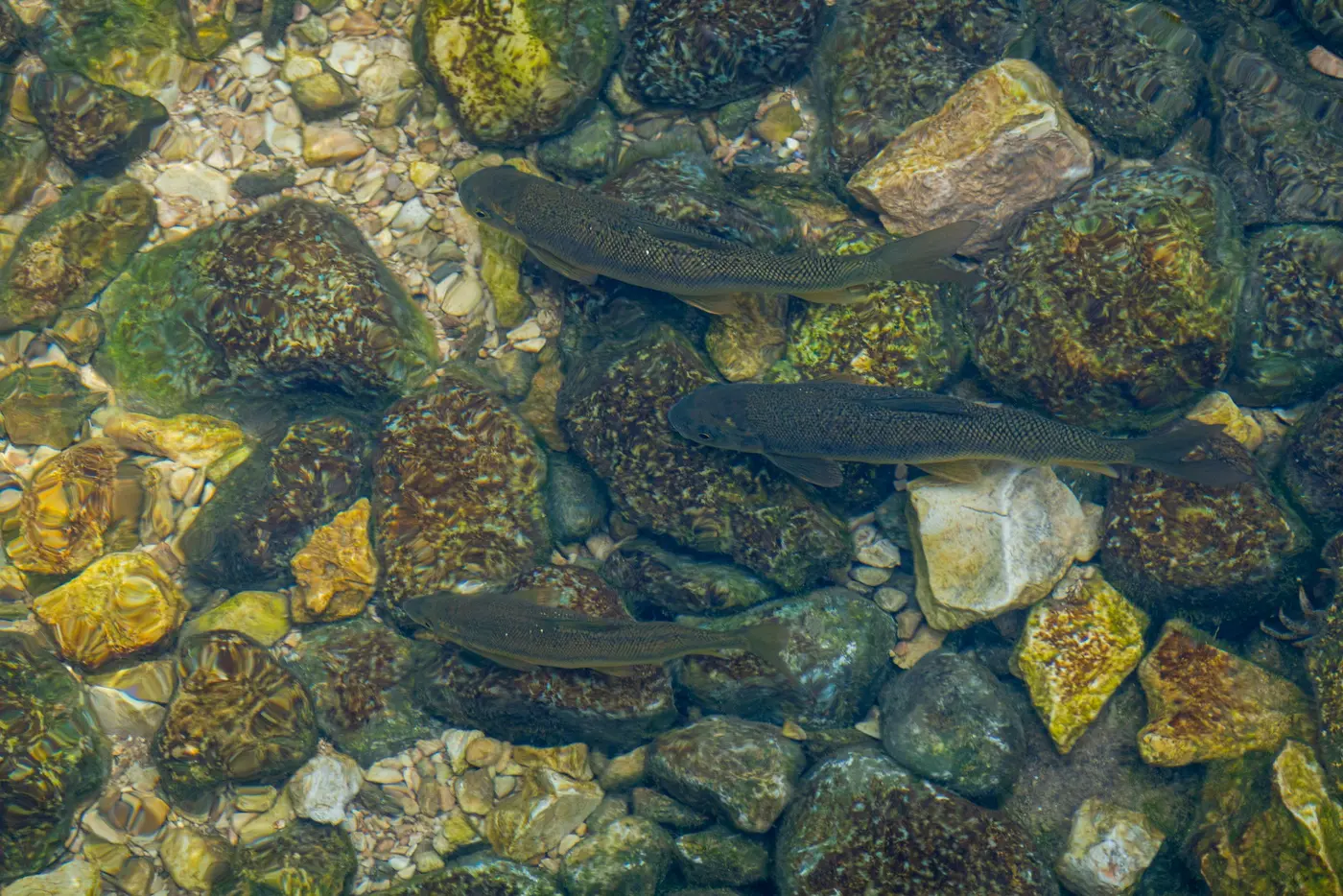
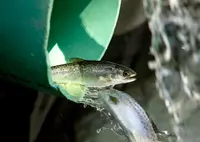
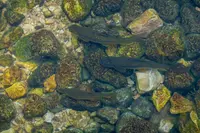
Several days earlier, crews had trapped two dozen summer steelhead at a ladder on the Siletz River for the occasion. They divided the fish among four artificial streams. Monroe described each stream as a 25-by-200-foot concrete bin, all laid with the same round river rock and all winding in the same pattern. Equal-length logs rested on nearly identical boulders. Alder stumps had been picked for similar root patterns and cut to the same lengths. In less than a week the four groups of six fish, none able to see or sense the others, settled in the same places beneath the same stumps in the deepest holes. Visitors could walk from stream to stream and find fish in matching spots. Then the fish began pairing up to spawn. “I think we were all pretty surprised and pleased,” said Ryan Couture, who managed the center for the department. “We got them out of there, though, before they could go too far.”
Couture, an assistant and a technician lived on site. The scientific lead was David L.G. Noakes, 63, who came from the University of Guelph in Ontario after being chosen over 20 applicants from every continent. He kept a small furnished apartment on the researchers’ dormitory floor and commuted from his OSU office. Before this, Noakes said, everything had been hypothetical. The new center “is a real place, in a real environment. It’s a real watershed.” Of the fish researchers who came to look it over, he said, “They all leave drooling.”
The water in the four streams could be raised and lowered at will. The staff stacked piles of dirt and leaves to stage anything from low summer flows to floods of chocolate-colored water, and they called themselves “mudslingers.” “You want mud, we got mud,” Couture said. His assistant manager, Joseph O’Neil, said, “The only limit is the imagination.” Four of the old hatchery’s raceways were kept for comparison, next to wet and dry laboratories and a 44-unit tank farm.
Spawning channels and helicopter trees
Over the following year the channels held a formal experiment. Each received five male and five female steelhead. Two channels held Alsea Hatchery stock and two held first-generation fish bred from wild parents. Staff recorded the date, time and place of every spawning. Noakes reported in the center’s spring 2007 newsletter that every fish in every channel spawned out, and that timing, location and the number of young looked comparable across all four. In the same issue he answered a question he said he heard from graduate students, colleagues and visiting schoolchildren alike: “We do science. Everything we do is science.”
In October 2006 a heavy-lift helicopter set 15 whole trees into Fall Creek. The trees were donated by the U.S. Forest Service, and each was 120 feet long and up to 36 inches through. The Army Corps of Engineers had required the habitat work as a condition of the center’s construction permit, and the department paid $17,375 for it. “Man-made facilities such as the Hatchery Research Center do not function in isolation from the watershed in which they are situated,” said James Ray, a department biologist. The trees were arranged to hold gravel for spawning salmon and steelhead and to form deep pools where young salmon and trout spend the winter and summer.
Notable Events
- 1952This hatchery will be completed in time to receive silver salmon eggs in November, 1952. nrimp.dfw.state.or.us
- 1997The center sits on the site of a state coho salmon hatchery that closed in 1997. Eight years and $7.5 million later it reopened as a place for scientists from around the Northwest and the world to conduct research on hatchery salmon and steelhead. philomathnews.com
- 1998The old Fall Creek Hatchery became infamous the same year after a visitor videotaped workers clubbing unwanted salmon they couldn't leave in the Alsea system to compete with wild fish; the videotape incited the public, spawned lawsuits and aroused and angered the Oregon Legislature. ifish.net
- 1999Home videos of state hatchery workers clubbing salmon in 1999 at the Fall Creek Hatchery near Alsea spawned lawsuits and criticism that still reverberated in the state capital this spring. latimes.com
- 2001Gov. John Kitzhaber vetoed a bill that would have placed a moratorium on destroying hatchery salmon, and a state judge upheld the department's right to club fish. latimes.com
- 2005State officials and hundreds of Oregonians gathered near Alsea for the grand opening of the Oregon Hatchery Research Center. aquafeed.com
- 2006The October 2006 project used a heavy lift helicopter to place 15 whole trees, 120 feet in length and up to 36 inches in diameter into Fall Creek. dfw.state.or.us
- 2013The OHRC Director is advised by the OHRC Board, which was established in August 2013. dfw.state.or.us
- 2020In December, ODFW closed its Oregon Hatchery Research Center that sits along Fall Creek 27 miles east of Waldport after it determined a big 2020 landslide on Weyerhaeuser property upriver continues to make it too hard to keep silt out of its raceways, ponds and research work. philomathnews.com
- 2023In 2023 that facility was closed due to an on-going, massive upstream landslide that impacts water quality, makes the facility unreliable for keeping fish alive and conducting experiments, and is a threat to human safety. dfw.state.or.us
- Reopening on the site of Fall Creek Fish Hatchery, which polarized conservationists and government officials in the late 90s, the new $7.8 million Oregon Hatchery Research Center is avoiding controversy in its public statements. midcurrent.com
People
- Dr. David Noakes, Hired by OSU to head the facility.
- Theodore Kulongoski, Governor who led the ribbon-cutting ceremony.
- Dr. Seth White, OHRC Director.
- Carl B. Schreck, Oregon State University representative on the OHRC Board; a Senior Scientist with the Biological Resources Division, U.S. Geological Survey and a Full Professor in the Department of Fisheries and Wildlife at OSU.
- Chuck Pavlik, Vice Chair of the OHRC Board, coastal ports representative; a founding board member of the Alsea Sportsman Association and a port commissioner for the Port of Alsea.
- Derek Wall, Columbia River gillnet salmon fishery representative on the OHRC Board.
- Dwight Collins, Oregon Salmon Commission representative on the OHRC Board.
- Peter Gruendike, Fish habitat restoration representative on the OHRC Board.
- Scott Starkey, Board Chair of the Oregon Hatchery Research Center Board, forest products industry representative.
- Steve Jacobs, Independent scientific community representative on the OHRC Board.
- Ted Simon, Agriculture industry representative on the OHRC Board.
- Tom Alkire, Wild fish advocacy representative on the OHRC Board.
- Travis Mackie, Oregon Indian tribes representative on the OHRC Board.
- Yancy Lind, Wild fish advocacy representative on the OHRC Board.
- Benjamin B. Stout, Chair of the OHRC advisory committee, representing science-at-large (chaired the advisory committee since 2006).
- Dennis Richey, Succeeded Ben Stout as chair of the OHRC advisory committee at the May 18 meeting in Corvallis at the ODFW South Willamette Watershed District Office.
- Joyce Mahr, OHRC employee; sampled fry collected in the stream using the electro-fisher.
- Seth White, Director of the Oregon Hatchery Research Center; Associate Professor in the Department of Fisheries, Wildlife, and Conservation Sciences, Oregon State University.
- David L.G. Noakes, Senior scientist at the center, guiding its science and research; commuting from his office at Oregon State University's Department of Fisheries and Wildlife; selected over 20 applicants from every continent.
- Joseph O'Neil, Assistant manager at the center under Ryan Couture.
- Lindsay Ball, Department of Fish and Wildlife director when the Legislature funded the center, described as at the hub of turning Fall Creek's fish-clubbing legacy into a research center.
- Ryan Couture, Manages the center for the Oregon Department of Fish and Wildlife; lives on site with an assistant and a technician.
- John Kitzhaber, Oregon governor who vetoed a bill that would have placed a moratorium on destroying hatchery salmon, amid the criticism that began at the Fall Creek Hatchery.
Sources
- myodfw.com/oregon-hatchery-research-center-visitors-guide
- dfw.state.or.us/fish/ohrc
- fishbehaviorscapeslab.com/ohrc-about
- dfw.state.or.us/fish/OHRC/minutes.asp
- philomathnews.com/central-coast-salmon-steelhead-hatchery-on-closure-list-as-odfw-examines-facilities-proposes-cuts
- dfw.state.or.us/resources/visitors/docs/OHRC_TourGuideMap.pdf
- dfw.state.or.us/fish/ohrc/scientists.asp
- nrimp.dfw.state.or.us/DataClearinghouse/default.aspx?att=ODFW%2FODFW_5432_2_BiennialReport1953.pdf&pn=ViewFile
- dfw.state.or.us/fish/HGMP/docs/2023/Alsea%20HPMP%202023.pdf
- guides.library.oregonstate.edu/localhistory/alsea
- ncph.org/phc/2018-annual-meeting-topic-proposals/salmon-design-oregons-heritage-fish-hatcheries
- heritagedata.prd.state.or.us/historic
- latimes.com/archives/la-xpm-2001-sep-27-mn-50582-story.html
- ifish.net/threads/fall-creek-hatchery-research-center.96489
- dfw.state.or.us/fish/ohrc/staff.asp
- dfw.state.or.us/fish/ohrc/board.asp
- dfw.state.or.us/fish/OHRC/docs/2007/OHRC_Newsletter_Spring_2007.pdf
- oregonencyclopedia.org/articles/alsea_river
- midcurrent.com/2005-10-19/controversial-oregon-hatchery