
Old Mill Days
Oakesdale, Whitman County, Washington. Annual celebration.
Details

- Where
- Oakesdale Flour Mill, 1st St, Oakesdale, WA 99158. Directions
- When
- Last held July 10–11, 2026; next year’s date not yet stated.
- Hours
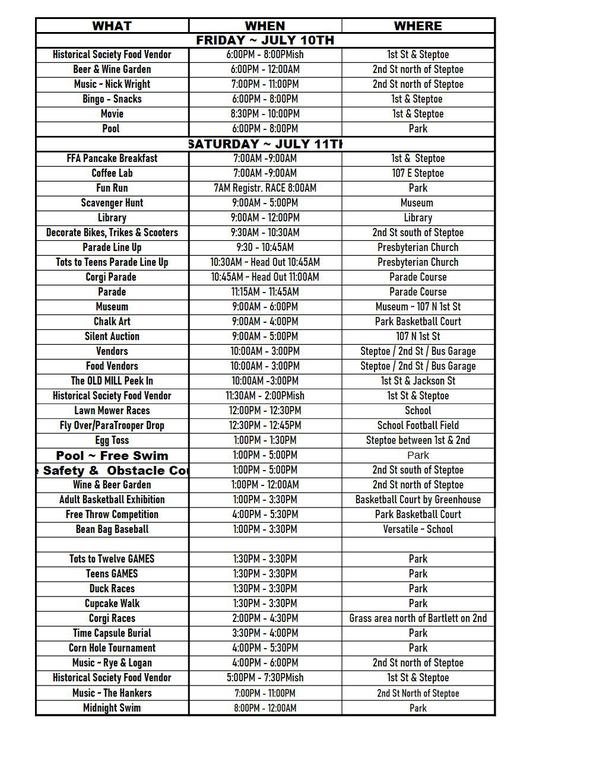
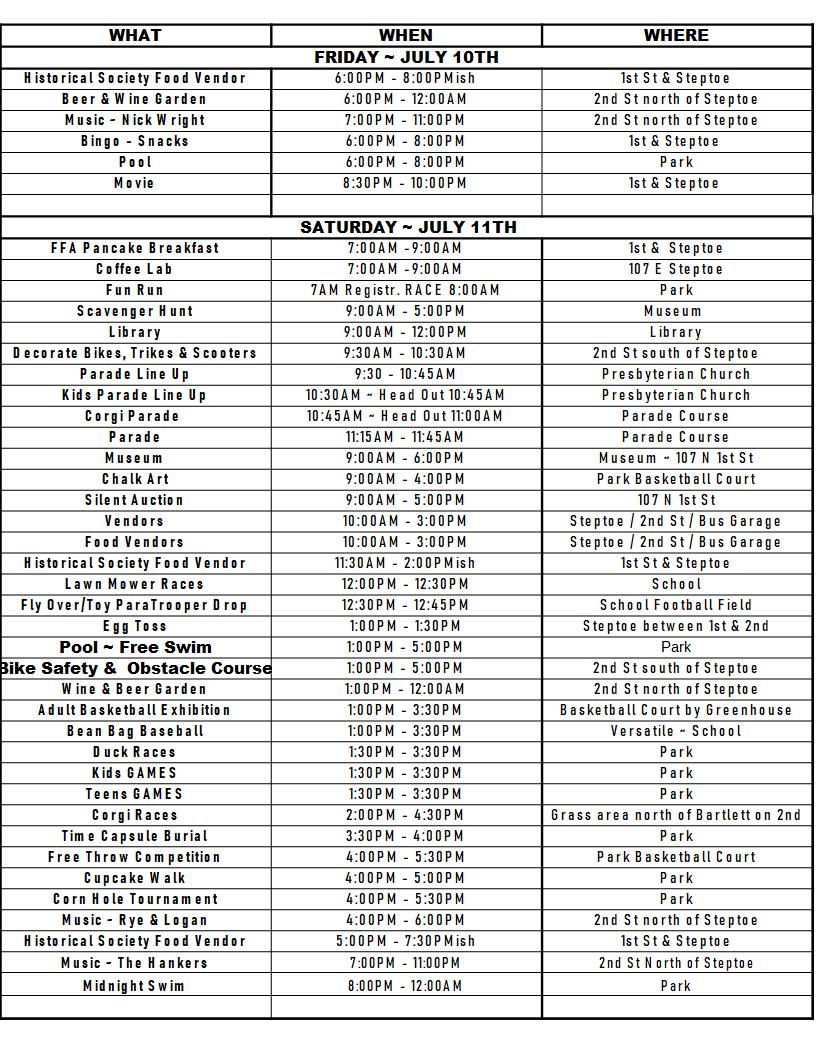
- Friday evening: historical society food vendors 6 to 8 p.m.; beer and wine garden opens 6 p.m.; live music 7 to 11 p.m.; outdoor movie 8:30 p.m.; swimming 6 to 8 p.m.
- Access
- Bring ID to the Beer/Wine Garden.
- Website
- oakesdalemuseum.com
- Managed by
- Oakesdale Historical Society and the McCoy Valley Museum.
Old Mill Days falls on the Friday and Saturday after the Fourth of July in Oakesdale, a farming town in Whitman County on the Palouse, about 40 miles south of Spokane. The 2026 festival ran July 10 and 11. Friday began at 6 p.m.: historical society food vendors served until 8, a beer and wine garden opened, the pool was open for evening swimming, and there was bingo. Tone Sober played from 7 to 11, and an outdoor movie started at 8:30. On the morning of the 11th the festival’s page reminded people to bring ID to the beer and wine garden.
Corgis, lawn mowers, and a paratrooper drop
Saturday starts with the FFA pancake breakfast, which ran from 7 to 9 in 2026. That morning the historical society posted that the breakfast crew was “set up and ready to go.” The parade comes in stages. The tots-to-teens group lined up at 10:30 and stepped off at 10:45. The Corgi Parade lined up at 10:45 and went out at 11. The main parade ran from 11:15 to 11:45, with Mike Crossett and his wife, Debbie, as grand marshals. The annual egg toss follows the parade directly.
The rest of the 2026 Saturday held lawn mower races at noon, a flyover and paratrooper drop at 12:30, and free swimming from 1 to 5. There were also chalk art, duck races, a cupcake walk, youth games, activities at the museum, and more than 30 vendors besides the food stands. A fun run and a corn hole tournament are part of the program as well. Corgi races ran from 2 to 4:30 in heats and ended in what the society’s post called a “Championship Corgi heat!!” Rye and Logan played from 4 to 6 and The Hankers from 7 to 11. The festival closed with a midnight swim from 8 p.m. to midnight.
Earlier editions ran somewhat differently. In 2024 the Spokane-based Innovia Foundation sponsored the festival as part of its own 50th anniversary. That Saturday program held the 5th Annual Car Show, free swimming at the Oakesdale Pool, and a free ice cream sandwich for children at Crossett’s Food Market. Visitors could also take a sneak preview of the old mill, which the community was then acquiring.
A time capsule and a silent auction
Old Mill Days is run by the Oakesdale Historical Society and the McCoy Valley Museum. Kim Anderson, the society’s president, co-chaired the 2026 festival with Leta Palmer. “This would not be happening this year if it wasn’t for Leta Palmer, my co-chair,” Anderson told the Whitman County Gazette. “There are a lot of great people coming to support the town. It’s going to be wonderful.”
The Gazette reported that the 2026 festival marked the 150th anniversary of the town’s founding. “We have a big focus on the kids,” Anderson said, and there were more games for them than before. At 3:30 Saturday afternoon a ceremony at the park dedicated and buried the town’s 150th anniversary time capsule, which is scheduled to be opened in 25 years. A silent auction offered about 40 to 50 items. “Last year we made about $3,000 on the silent auction,” Anderson said. “All the proceeds support our museum.”
The museum is at 107 North First Street. The historical society founded it in 1988 to celebrate the town’s 100th anniversary. Everything in it was donated or loaned by local residents: antiques and artifacts from the early railroad years and from the businesses and people who started the town, along with books, journals, and pictorials of Oakesdale and of Steptoe Butte State Park. Oakesdale was once the junction of three railroads, the Great Northern, the Northern Pacific, and the Union Pacific. Through the year the society serves Sunday meals at the museum by donation. In 2026 these included a spaghetti dinner in January and a taco bar of beef and chicken in March.
The mill at First and Jackson
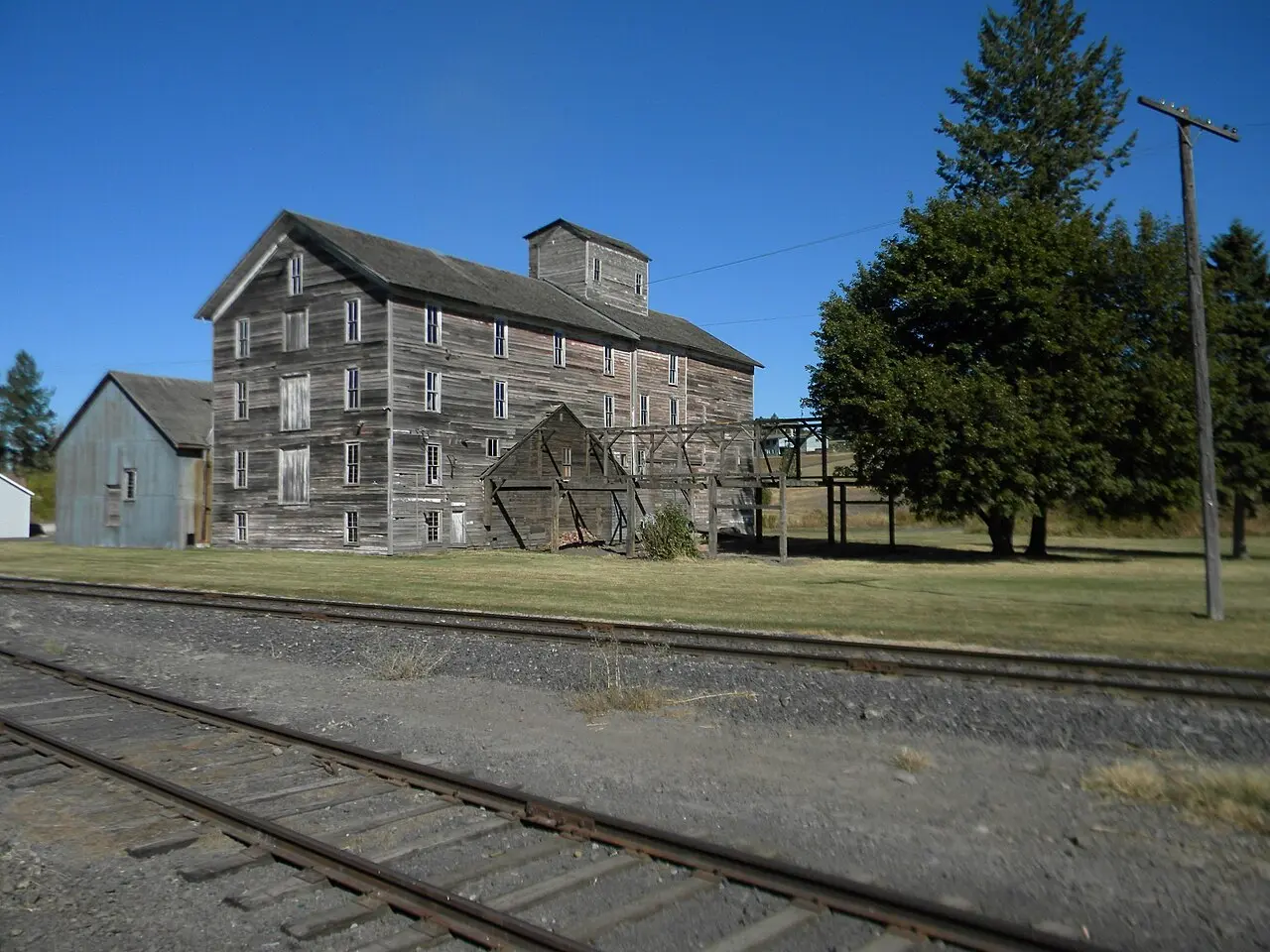
The festival is named for the J.C. Barron Flour Mill, known today as the Oakesdale Mill. It stands at the corner of First and Jackson Streets, directly east of the former Northern Pacific tracks. The Port of Whitman County, which owns it, describes the wooden building towering four stories over the center of town. The National Register nomination gives its height as three and one-half stories. McCoy Creek runs east of the site. To the west are Highway 27 and the railroad, which still carries two or three trains a week. The Port and the town call it the last surviving mill of its kind in Whitman County. Aside from occasional tours by former owners, its doors have been shut since 1960.
The nomination was prepared by Nicholas J. Manring for the Whitman County Historical Society, and it describes the mill from the inside. The building is a composite of four semi-detached timber-framed structures:
- the mill proper, built in 1890
- the steam plant, built in 1890
- a grain and flour warehouse, built about 1890
- the crib elevator, built in 1898
The mill proper rests on brick made in Oakesdale. Its original paint was red with white trim, later covered over in white. A beam projects above the uppermost door on the west face, with a pulley for hoisting machinery in and out.
The first floor held sacking machines and four double stands of roller mills, which were among the first to use ball bearings, about 1909. It also held a small stone buhr mill dated 1871. The buhr was built for graham flour, and when the nomination was written it was the one machine still in use, occasionally grinding corn. The mill office in the southeast corner kept its original furniture. Upstairs stood reel sifters, a purifier, a bran duster, a flour bleaching device, and a plan sifter fitted with small porcelain knobs. Square chutes of clear-grained fir, lined with metal and finished with shellac, carried grain from machine to machine by gravity.
Porter, Barron, and the fire of 1892
According to the nomination, James McCoy established Oakesdale in the mid-1880’s, and for several years it was little more than a farming village. That date sits uneasily with the others. The Gazette counted 2026 as the town’s 150th year, while the museum dated the town’s 100th anniversary to 1988. J. G. Porter built the mill in the late summer and autumn of 1890. A Northern Pacific spur reached it in early December, and the mill began producing flour on contract for local farmers and merchants. On July 5, 1892, fire razed virtually every other frame commercial building in Oakesdale. The mill, in the nomination’s word, “miraculously” escaped unscathed.
By the mid-1890’s the Oakesdale Milling Company, as it was then called, had a reputation for producing one of the Pacific Northwest’s finest flours. In December 1895, with J. A. Henry as miller, it ran 24 hours a day on wheat brought from as far away as Genesee, Idaho. Output was still kept small, at 80 barrels a day of 196 pounds each. The crib elevator was added to the east face in 1898, with four wooden bins holding 20,000 bushels.
The finances were unsteady through those years. There was a sheriff’s sale in 1897, a temporary closing early in 1898, a string of liens and mortgages, and frequent changes of owner. That pattern ended with the February 1907 sale to Joseph C. Barron.
Barron (1866–1955) was a second-generation miller whose father had run a water-driven grist mill in Somerset County, Pennsylvania. He studied for the ministry but fell back on milling in the late 1880’s. Before coming to Oakesdale he ran flouring operations in Crawfordsville, Indiana, and Asotin, Washington.
The mill’s power had changed from steam to electricity just before Barron bought it. He converted the old steam plant into a residence, which stayed in use until 1974. He also laid a concrete foundation under the elevator. In the 1920’s he expanded into coal, and sheds from that business stand east of the mill. Barron ran the mill for more than 30 years. In 1939 it went out of business, one of the last operating flour mills in Whitman County, unable to compete with larger interstate mills.
From MaryJane Butters to the Port
The mill’s last private owner was MaryJane Butters, an organic farmer in Moscow, Idaho, who put it on the market at $217,000. With help from community donors, the Innovia Foundation bought it in May 2024. In December 2024 the foundation transferred it to the Port of Whitman County.
In 2025 the Port ran a feasibility study on uses for the building, with stakeholder interviews, an open house, and a public survey. In early 2026 the Port won $1 million from the Washington State Community Economic Revitalization Board for Phase 1. That work covers a new roof, a stabilized exterior, and water, sewer, and fiber lines extended to the site. Construction was slated to begin in summer 2026.
Notable Events
- 1890J. G. Porter built the flour mill during the late summer and autumn of 1890; with a Northern Pacific Railroad spur completed in early December, the mill was running and producing flour on contract to local farmers and merchants. npgallery.nps.gov
- 1892Virtually every other frame commercial building in Oakesdale was razed in the fire of July 5, 1892; the flour mill escaped unscathed. npgallery.nps.gov
- 1898A crib elevator was appended to the east face of the mill to store grain for flour production. npgallery.nps.gov
- 1907The February 1907 sale of the mill to Joseph C. Barron ended the mill's trend of frequent ownership changes and financial problems. npgallery.nps.gov
- 1939One of the last operating flour mills in Whitman County, the J.C. Barron Flour Mill went out of business, unable to compete with larger, interstate mills. npgallery.nps.gov
- 1960Aside from occasional tours by former owners, the mill's doors have been shut since 1960. oakesdale.org
- 2024With help from community donors, the Spokane-based Innovia Foundation bought the property from MaryJane Butters in May of 2024 and transferred ownership to the Port of Whitman County in December of 2024. portwhitman.com
- 2026In early 2026 the Port was awarded $1 million from the Washington State Community Economic Revitalization Board for Phase 1 construction, including replacing the roof and stabilizing the building's exterior, slated to begin in Summer 2026. portwhitman.com
People
- J.A. Henry, miller when the operation ran 24 hours per day (December of 1895).
- J.G. Porter, built the Oakesdale flour mill (late summer and autumn of 1890).
- James McCoy, established the town of Oakesdale (mid-1880's).
- Joseph C. Barron, second generation miller who ran the Oakesdale flour mill for over 30 years; previously operated flouring operations in Crawfordsville, Indiana and Asotin, Washington (1866-1955).
- MaryJane Butters, former owner of the mill; organic farmer in Moscow, Idaho who sold the property to the Innovia Foundation.
Sources
- oakesdalemuseum.com/Old-Mill-Days.html
- oakesdalemuseum.com/index.html
- facebook.com/OakesdaleMuseum
- facebook.com/OakesdaleHistoricalSociety
- innovia.org/communityevent/oakesdale-old-mill-days
- wcgazette.com/story/2026/07/09/people/oakesdale-old-mill-days-this-weekend/46509.html
- oakesdalemuseum.com/2026_OMD_schedule.jpg
- oakesdalemuseum.com/2026_OMD_Schedule_Poster.jpg
- npgallery.nps.gov/GetAsset/41108fe8-5b71-470c-a63d-fd0d7ba4305a
- oakesdale.org/old-mill-updates
- portwhitman.com/projects/oakesdaleflourmill