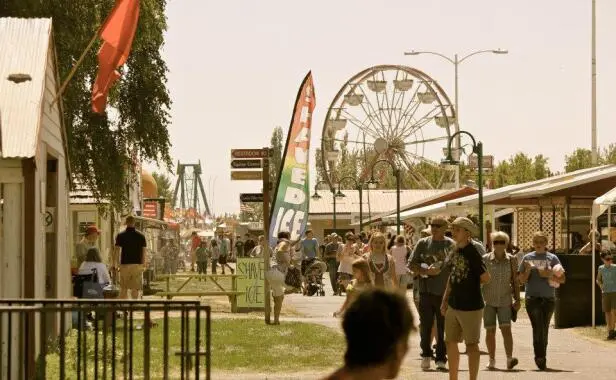
Okanogan County Fair
Okanogan, Okanogan County, Washington. County fair; Annual, September (Sept 10-13).
Details

- Where
- 175 Rodeo Trail Road, Okanogan, WA 98840. Directions
- When
- Last held September 10–13, 2026; next year’s date not yet stated.
- Fees
- Thursday: $12; Friday: $12; Saturday: $12; Sunday: $12; Season Pass (Thursday - Sunday): $40; Children 7 & Under: FREE.
- Hours
- Thursday, 9 am - 10 pm; Friday, 9 am - 12 am (midnight); Saturday, 9 am - 12 am; Sunday, 9 am - 3 pm.
- Access
- Main Gate and North Gate are entrances; the South Gate is a pass-through gate only - not an entrance gate.
- Walk-in or reserve
- Tickets through Ticket Tomato; if tickets are provided at the door, arrive at the venue before the show.
- Phone
- 509-422-1621
- Website
- okanogancountyfair.org
- Managed by
- Fair Advisory Committee and Okanogan County Commissioners.
At nine o’clock on the Thursday of the 2026 Okanogan County Fair, three judging classes opened at once: swine market, horse halter and beef market. Market goats and pet goats followed at ten, with FFA produce judging in the same hour, and the lambs came in at eleven. Outside, youngsters took turns at a utility pole for the PUD youth pole climb while the utility’s crew gave safety demonstrations at a booth table and again on the open grounds. The afternoon brought a little beef barn halter class, a poultry class and a lamb fit-and-show demonstration. At 5:30 came the “Lamb Little People Fit & Show.”
The stage kept its own program. Jeff Evans performed “Simple Magic” at 11 and again at 1:30. Sagebrush Gypsies played at noon, the Raveling Toad Show filled two hours of the afternoon, and the Fair Queen Pageant ran from 5:45 to 7:15. Close Chorders closed the night from 8 to 10, the hour the gates shut on Thursday. In the Kids Zone, mutton bustin’ went off at 2, 4 and 6. The fair ran four days, September 10 through 13, its 79th annual edition, with exhibit barns, a full food court, a circus on the grounds, a livestock market, and two nights of rodeo with horse racing. Fairgoers came in at the Main Gate or the North Gate, wearing a wristband in the color of the day. A band from one day would not work on another, and the South Gate let people pass through but did not admit them.
Rain on the 79th
The weather ran cool, and the rain held off until early Sunday morning. On Saturday a power outage went across the whole fairgrounds and stopped some activities for a while. “The fair went great this year,” Laura Sorenson, chairwoman of the Fair Advisory Committee, said the Monday after. “The amount of exhibits were up in every barn. The circus, magician and mutton bustin’ were big hits. The entertainment on stage was excellent, even with a brief power outage, the band went acoustical and kept on playing.” The Sunday rain, she said, “stopped long enough to have great music and for everyone to get loaded up and headed home without getting soaked.”
Early numbers put the market stock sale at about $879,308.50 and the fur and feather auction at $56,340. County Commissioner Nick Timm called the combined total, with add-ons, a new record. “We got a new Fair Queen Autumn Wiley, attendance was up Friday and Saturday and the barns were packed with produce, exhibits and people having a great time,” he said. He listed what had gone wrong around it: “one of our older wells ran dry, an electrical issue popped up which shut power down all that way to Kartar, fire camps using the fairgrounds until a few days before fair, a massive water line upgrade project for the entire grounds and, rain. I can’t remember a fair I attended with that much rain.”
Fifty-three acres and a budget
The fair and the grounds under it are run separately. The fair belongs to the Fair Advisory Committee, a volunteer group appointed by the county commissioners, and it usually breaks even. The arrangement dates from more than a decade ago. A board used to make the fair’s financial decisions until the state auditor said budget authority lay with the commissioners, and the commissioners then created the advisory committee to make recommendations to them.
The fairgrounds are another matter. The 53-acre site rents out for events, and in a Methow Valley News account people remember weddings and quinceañeras there as well as horse races. Even so, the grounds often stand vacant. For 2026 the county budgeted $186,700 in fairgrounds revenue against $519,755 in expenses. In the spring of 2026, facing a $2.6-million deficit, the commissioners argued over the grounds in open session. Commissioner Jon Neal called reports that he and Commissioner Andy Hover wanted to shut the fair down “complete B.S.” Hover conceded the possibility: “In order to maintain a budget that allows for a police force, that allows for court action, that allows for all the things that we have to do, I am willing to shut that thing down.” Timm answered that the site serves as an emergency gathering point and was used for COVID vaccinations during the pandemic. He said it is a cultural touchstone for the Colville Tribes, Latinos and the farm community.
Others spoke for it too. Suellen White of Twisp has been with the Methow Valley Cascaders 4-H club for almost 50 years, and she said both of her children put themselves through school on money earned at the fair. The 2025 market and fur-and-feather sales had brought in $841,000, more than twice the 2018 figure. Melissa Stevie, also of Twisp, has daughters who run barrel races at the grounds, where the races serve as qualifiers for finals elsewhere. A charitable nonprofit, the Advancement Foundation for the Okanogan County Fairgrounds, formed the previous December. Its founder, Angie Morgan-Chilmonik, said all of her children had shown at the fair. Its treasurer, Dianne Probach, called the grounds “a gorgeous asset that’s tremendously underutilized” and added, “I’m an eternal optimist.” Over the past eight years, county grants have paid to redo the arena and track and upgrade the bleachers, and the county is now working on an automated irrigation system.
Stagecoaches from Riverside
The fair goes back to 1905, to the town of Riverside, then large enough to hold two hotels, a doctor’s office, a bank, a harness shop, a blacksmith and two large department stores. According to the Omak-Okanogan County Chronicle, local farmers and ranchers gathered there that year to show cattle, horses and other livestock. Women brought homemade goods, and grains, vegetables, sheep, chickens and fruit were shown and sold. Okanogan Living puts attendance at an estimated 1,500. The Riverside fair later held horse racing, bucking contests (later saddle bronc), dancing and stick games, and in time it added an exhibition tent. In 1915 four stagecoaches left Riverside for Okanogan, Oroville, Synarep and the county seat at Conconully, and they came back carrying fair judges from all over the county.
Riverside had bid to take the county seat from Conconully on the strength of its fairgrounds. It lost that bid in 1915, and in the same year fire destroyed half the town. That left open the question of where the fair would go.
Oroville had already held a fair in 1912, in the Cumming store. Historic records describe “a large crowd that attended, and many exhibits were on display.” The fair later moved to the site that is now Osoyoos Lake Veteran’s Memorial Park. The sources disagree over 1913. The Chronicle places that year’s county fair at the Oroville Grange Hall, with a record attendance of 2,500. Okanogan Living writes that the Grange organized a fair in Okanogan that year and that it drew 2,500 spectators. By 1916, Frank McLean of the Methow Valley was pressing for an annual countywide fair with larger displays and agricultural features. In 1932 the first 4-H entries arrived, and the fair nearly doubled in size.
The livestock yard, the island, and Rodeo Trail
The last Oroville fair was held in 1946. The next year the fair went to the Methow Valley, and in early September of that same year Okanogan held its first junior fair at the Okanogan Livestock Yard. Several civic groups put it on, the fair president was Ed Coon, and no one paid admission. There were more than 80 livestock exhibits, and the top steer sold for 49 cents a pound. The City of Okanogan offered the fair association an island south of town in 1948, but the island flooded, and the fair went back to the livestock yard for a second year. In 1950 the fair association and the Boots and Saddles Club bought the present property. In 1951 the name became the Okanogan County Fair, 35 years after McLean began pressing for a central annual fair. Okanogan Living dates the grandstands and main exhibit buildings to 1951. The Chronicle says the grandstands went up shortly after 1952.
By the 1960s entries passed 100, and horse racing joined the program. The Grange kitchen was built in 1960, where the annex now stands, and it was the largest permanent food facility on the grounds. The Commercial Building followed in 1961. In 1962 strong winds tore away the outsides of the exhibit booths. In 1963 a fire started ten days before opening day and destroyed eight barns. “Okanogan and Omak firemen had barely won an intense struggle to keep the flames from devouring the entire fairgrounds when county fair officials decided on the spot the exposition would be held anyway,” The Omak Chronicle reported on August 29, 1963. “Volunteers moved in promptly to help clear away the blackened debris. After looking into prospects of renting tents, fair officials by Tuesday had decided tents would not be needed.” Four Quonset huts and new hog, sheep and steer barns went up in 1965, and the arts and crafts building in 1966. By 1968 an administration building, now Jones Hall, stood on the grounds, and a horse barn was added at the north end in 1981.
Water, wind, and fire camps
The fairgrounds flooded in 1989. FEMA money paid for a facelift across the grounds, and work began on the Agriplex, 120 by 200 feet. The country group Restless Heart played in the new building to open the 1989 fair, and its concrete floor, heat and Annex were finished in the mid-1990s. In 1990 the 4-H, Grange and Horticulture buildings got metal siding, and the other 37 buildings were painted to match. In 1992 high winds blew the announcer booth off the top of the grandstands, and a new stand was built elsewhere. In the 2010s a permanent stage was torn down for safety reasons, and new bathrooms went in north of the poultry barn.
In 2015 the Okanogan Complex wildfire pushed the fair back two weeks. The commissioners had agreed to let a Type 1 incident management team use the fairgrounds as a fire camp for up to 4,500 personnel for 14 days. In 2019 a new rodeo arena, 150 by 300 feet, was installed along with new race rails and a new announcer stand.
In 2020 the fair did not happen. The advisory committee met on June 29 and heard a proposal from Tonasket agriculture teacher Matt Deebach for a two-day livestock show and auction. By then youngsters had registered 162 pigs, 65 steers and 68 sheep. “Realistically, we will not be in Phase 4,” said committee chairman Mike Egerton. “We want to do it (have a fair) and we can’t do it,” Hover said. The commissioners announced the cancellation “with a heavy heart.” The 74th fair went ahead in September 2021 with masks, hand-washing stations and extra bleachers at the livestock auction. “We’re asking people to help us out and make things work and avoid an outbreak,” said County Emergency Manager Maurice Goodall. After that fair the Commercial Building was condemned. In 2022 the grandstands were condemned too and replaced with aluminum seating in time for the 75th anniversary. Eddie Montgomery of Montgomery Gentry christened them with a concert at the 2022 fair.
Notable Events
- 1905The first known county fair was held in Riverside with an estimated attendance of 1,500. oklivingmagazine.com
- 1905The first gathering of local farmers and ranchers took place in Riverside; residents showed cattle, horses and other livestock. omakchronicle.com
- 1912In the City of Oroville a fair was held in the Cumming store. omakchronicle.com
- 1913The Grange organized a fair in Okanogan, which saw 2,500 spectators. oklivingmagazine.com
- 1915Riverside lost the bid for the county seat and half of the town was destroyed by fire, leaving the question of where to hold the county fair. omakchronicle.com
- 1916Methow Valley resident Frank McLean was pushing for an annual county fair; his vision of a centrally located annual fair became a reality 35 years later. oklivingmagazine.com
- 1932The fair had almost doubled in size with the addition of 4-H competitions. omakchronicle.com
- 1946A fair was held in Oroville and kept growing; the following year it moved to the Methow Valley, and the City of Okanogan held its first Okanogan County Junior Fair. oklivingmagazine.com
- 1948The City of Okanogan planned to give the fair association an island on the south end of town, but the island flooded. oklivingmagazine.com
- 1950The fair association, with help from the Boots and Saddles Club, purchased the property where the fair is presently located. oklivingmagazine.com
- 1951Grandstands and main exhibit buildings were constructed, and the name was officially changed to Okanogan County Fair. oklivingmagazine.com
- 1960The Grange kitchen was built and was the largest permanent food facility on the grounds at that time. oklivingmagazine.com
- 1961The Commercial Building was added; it was condemned following the 2021 fair. oklivingmagazine.com
- 1962Strong winds demolished the outside of exhibit booths. oklivingmagazine.com
- 1963The fair was almost canceled after a fire began 10 days before opening day; eight barns were destroyed. oklivingmagazine.com
- 1965Four Quonset huts and hog, sheep and steer barns were built. oklivingmagazine.com
- 1966The arts and crafts building followed the new huts and livestock barns. oklivingmagazine.com
- 1968An administration building, now Jones Hall, was added. oklivingmagazine.com
- 1981A new horse barn was built on the north end of the grounds. oklivingmagazine.com
- 1989The fairgrounds flooded and FEMA funds were used to start a major facelift; construction on the 120-foot-by-200-foot Agriplex began. oklivingmagazine.com
- 1990Metal siding was added to the 4-H, Grange and Horticulture buildings; the remaining 37 buildings received matching paint. oklivingmagazine.com
- 1990sThe second phase of the Agriplex project, including concrete floor, heat and Annex, was completed. oklivingmagazine.com
- 1992High winds blew the announcer booth off the grandstands, leading to a replacement in another location. Grounds expanded and the parking layout was revised. oklivingmagazine.com
- 2010sA permanent stage was demolished for safety concerns and new bathrooms were added north of the poultry barn. oklivingmagazine.com
- 2015The fair was delayed by two weeks because of the Okanogan Complex wildfire. oklivingmagazine.com
- 2019A new 150-foot-by-300-foot rodeo arena was installed along with new race rails and a new announcer stand. oklivingmagazine.com
- 2021The Commercial Building was condemned following the fair. oklivingmagazine.com
- 2022The grandstands were condemned and replaced with new aluminum seating, just in time for the 75th anniversary. oklivingmagazine.com
- The County Board of Commissioners announced cancellation of the fall fair 'with a heavy heart'. grandcoulee.com
- The previous year's fair had to be canceled because of COVID-19. methowvalleynews.com
- A charitable nonprofit, the Advancement Foundation for the Okanogan County Fairgrounds, formed to support the grounds. methowvalleynews.com
- Restrooms and show facilities were renovated following the siding and painting work. oklivingmagazine.com
People
- Lauri Jones, Community Health Director who told county commissioners she believed a safe, successful fair was possible.
- Maurice Goodall, Okanogan County Emergency Manager describing pandemic cleaning and safety precautions at the fair.
- Andy Hover, County commissioner participating in the fair cancellation discussions.
- Angie Morgan-Chilmonik, Founder of the foundation supporting the fairgrounds; her children participated in the fair.
- Dianne Probach, Foundation treasurer who presented the group's progress and preliminary survey results to commissioners.
- Emily Sisson, Methow Valley resident and Okanogan County Watch volunteer who questioned proposed budget cuts.
- Jon Neal, County commissioner denying reports that he and Hover wanted to shut down the fair and grounds.
- Melissa Stevie, Twisp resident supporting the fairgrounds, where her daughters regularly compete in horse-barrel qualifying races.
- Nick Timm, County commissioner and liaison to the foundation supporting the grounds.
- Suellen White, Twisp resident with a long fair and fairgrounds history through the Methow Valley Cascaders 4-H club (almost 50 years).
- Eddie Montgomery, Country artist whose concert christened the new grandstands (2022).
- Frank McLean, advocate for an annual county fair (by 1916).
- Chris Branch, County commissioner whom Hover planned to consult about the fair decision.
- Jim DeTro, County commissioner whom Hover planned to consult about the fair decision.
- Lori Caswell, Livestock coordinator reporting youngsters' animal registrations.
- Matt Deebach, Tonasket High School agriculture teacher who presented the livestock committee's proposed alternate livestock show and auction.
- Mike Egerton, Fair committee chairman who said the county would not realistically reach the required reopening phase.
- Natasha Moffitt-Hemmer, Okanogan County program coordinator for Washington State University Extension explaining restrictions on 4-H participation.
- Ed Coon, Fair president at the time of the first Okanogan junior fair.
Sources
- tickettomato.com/event/9936/2026-okanogan-county-fair
- okanogancountyfair.com
- okanogancounty.gov/313/County-Fair
- okanogancounty.gov/401/Fair-Admission
- okanogancounty.gov/395/Food-Vendors
- cdn.saffire.com/files.ashx?t=fg&rid=WSFA&f=WA_Fair_Dates_with_Contacts.pdf&cb=de1ce54b
- oklivingmagazine.com/post/okanogan-county-fair-history-dates-back-more-than-100-years
- historylink.org/file/9592
- omakchronicle.com/free/exploring-the-early-years-of-the-okanogan-county-fair/article_97c8c342-a726-11ed-9ad8-d3996c1fcb2a.html
- omakchronicle.com/lifestyle/okanogan-county-fair-had-many-locations-in-early-days/article_b75992dc-c7ff-11ed-9c04-7fd3871b084e.html