
Deutschesfest
Odessa, Lincoln County, Washington. Festival.
Details

- Where
- 21 E 1st Ave, Odessa, WA 99159. Directions
- When
- Last held September 17–20, 2026; next year’s date not yet stated.
- Season
- Third full weekend in September (Saturday-Sunday).
- Getting there
- Take I-90 West to Exit 206 onto State Highway 21 northbound; Odessa is 18 miles north.
- Fees
- Fun run: $25.00 with T-shirt or $15.00 without by August 31st; late registration after 8/31 is $15.00 with no shirt.
- Hours
- Biergarten: Thursday 7 PM-11 PM; Friday 12 PM-1 AM; Saturday 11 AM-1 AM; Sunday 12 PM-10 PM.
- Access
- IDs required for Biergarten entry regardless of age; IDs may be rechecked at either bar.
- Walk-in or reserve
- Fun-run day-of registration at the park, 7:45-8:15 A.M.; run starts 8:30.
- Phone
- (509) 982-0049
- Website
- deutschesfest.net
- Managed by
- Odessa Chamber of Commerce.
- Established
- 1971.
Deutschesfest opens on a Thursday evening, when Odessa closes its main stretch and First Avenue is given over to children on tricycles. At 5 p.m. the youngest chalk the sidewalk outside Wheatland Bank. At 6 the trike races begin, ages 2 to 10 in four age groups, on trikes the racers bring themselves. Then come the bed races down the same avenue, run under a theme; the 2025 theme was the Mattel Toy Company. When the last bed is done, the Biergarten opens for its first night. For the 55th festival, in 2026, that Thursday was September 17, and the weekend ran through Sunday the 20th.
Odessa lies in east-central Washington where Highways 28 and 21 cross, 18 miles north of Interstate 90. The Columbia Basin Herald put the town’s population just short of 900 at the last census. Matt Roberson, president of the Odessa Chamber of Commerce, which sponsors the festival, estimated attendance at “probably 7,500, 10,000 (attendees), somewhere in there” in 2023. The festival’s pages say as many as 600 RVs begin rolling in up to a week ahead, creating “Motor Home City.” They fill Reiman Park and the Tourist Park, which charge no fee and take no reservations, and the Finney Field ball fields on the west end of town. There the school district parks motor homes on the outfield grass as a fundraiser, and early arrivals rope off space for friends coming later. The festival states that no one has ever been turned away for lack of room. La Collage Inn, the town’s one motel, is most likely booked a year in advance.
Tokens, sausage, and the Chicken Dance
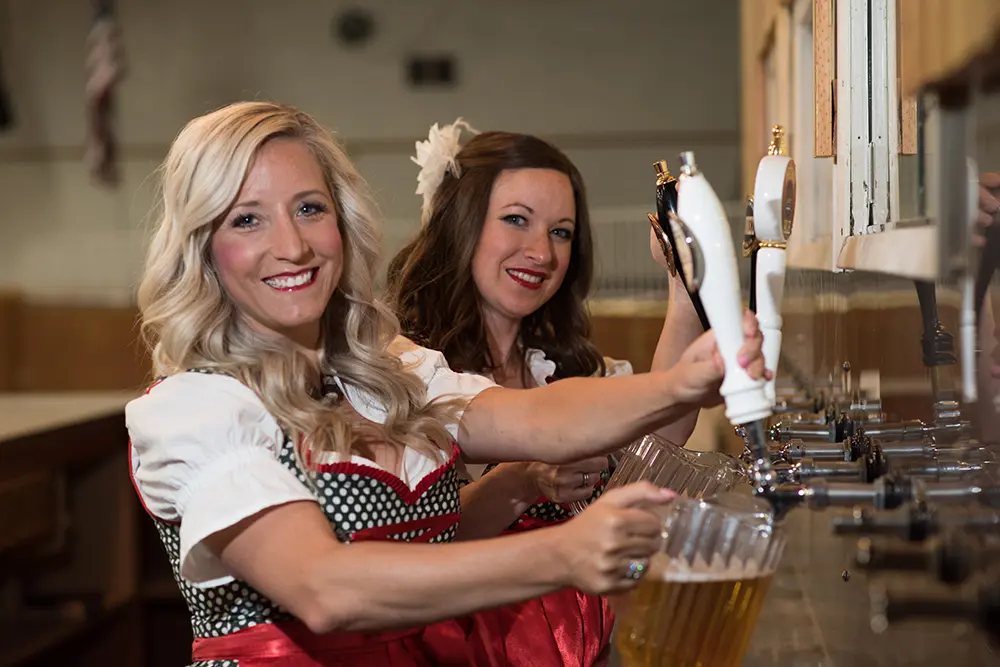
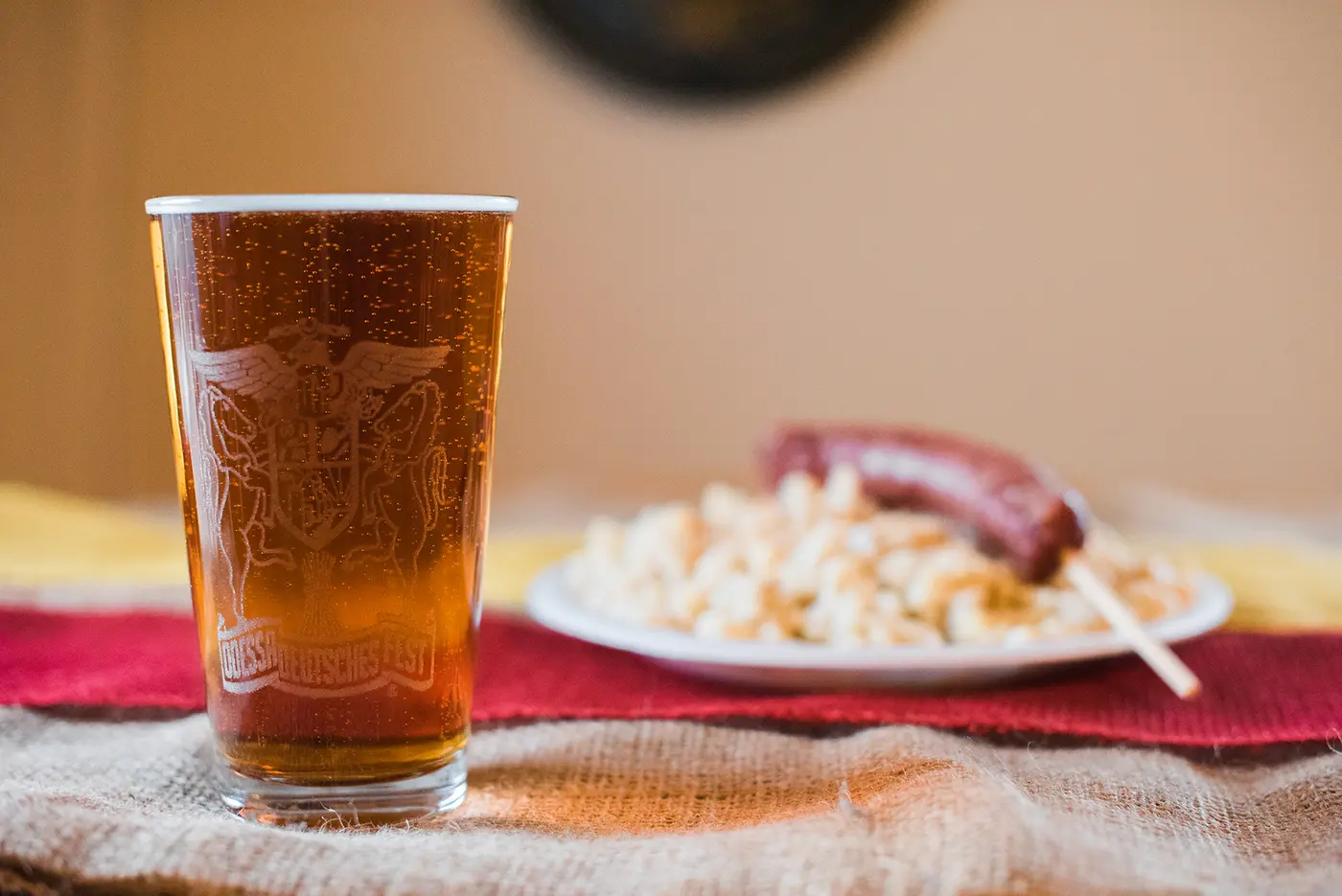
The Biergarten occupies the Odessa Community Center and spills through fencing into outdoor seating, a space the festival calls “city-block-big.” Entry is for those 21 and over. Minors are admitted with a paid adult until 5 p.m. Friday through Sunday. IDs are checked at the door regardless of age and may be checked again at either bar. Drinks are bought with tokens from the token booths, and every bartender and booth worker is a volunteer. Rocky Coulee Brewing Company, just up the street, supplies German-style beers, Fireweed and Dunkle among them, alongside domestic taps and personal-size bottles of wine. No bagged peanuts are sold inside; there are pretzels instead.
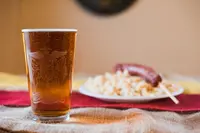
The Biergarten sausage booth sells bratwurst made by the Chamber and community members from a recipe handed down through the generations. It comes on a stick, in a boat with barbecue sauce, or on a plate with homemade sauerkraut, a homemade pickle, and pretzels. For years the busy Saturday evening shift at that booth has been worked by Megan Schlimmer and her husband, Ted Bruya, who staff it with their children and friends. Schlimmer, a lifelong Odessa resident who works at Odessa Drug and the golf clubhouse, chaired the Biergarten in 2024.
Music runs from midday to 1 a.m. on Friday and Saturday. Between rock and cover bands, the local polka band, the Oom Pas & Mas, returns to the stage again and again. On the 2026 Friday it played three Biergarten sets, between acts running from Kyle Richard at noon to The Real McCoy after 11:30. The festival says the band “will have you Chicken Dancing before you know it.” A Herald photograph from 2024 shows Ellen Holman leading the Chicken Dance, and whoever catches one of the rubber chickens during it may, by the festival’s account, consider themselves royalty for the weekend. On Sunday there is no cover charge, and the 2026 festival closed its Biergarten with karaoke and DJ music until 10.
Church booths and the Sausage Bowl
Mornings begin in the same hall. From 7 a.m. each day a community group serves breakfast in the Biergarten. In 2026 the Odessa FFA cooked sausage, eggs, and pancakes on Friday, the Lions Club served sausage or bacon breakfast burritos on Saturday, and the high school FBLA served pancakes, sausage, and potatoes on Sunday.
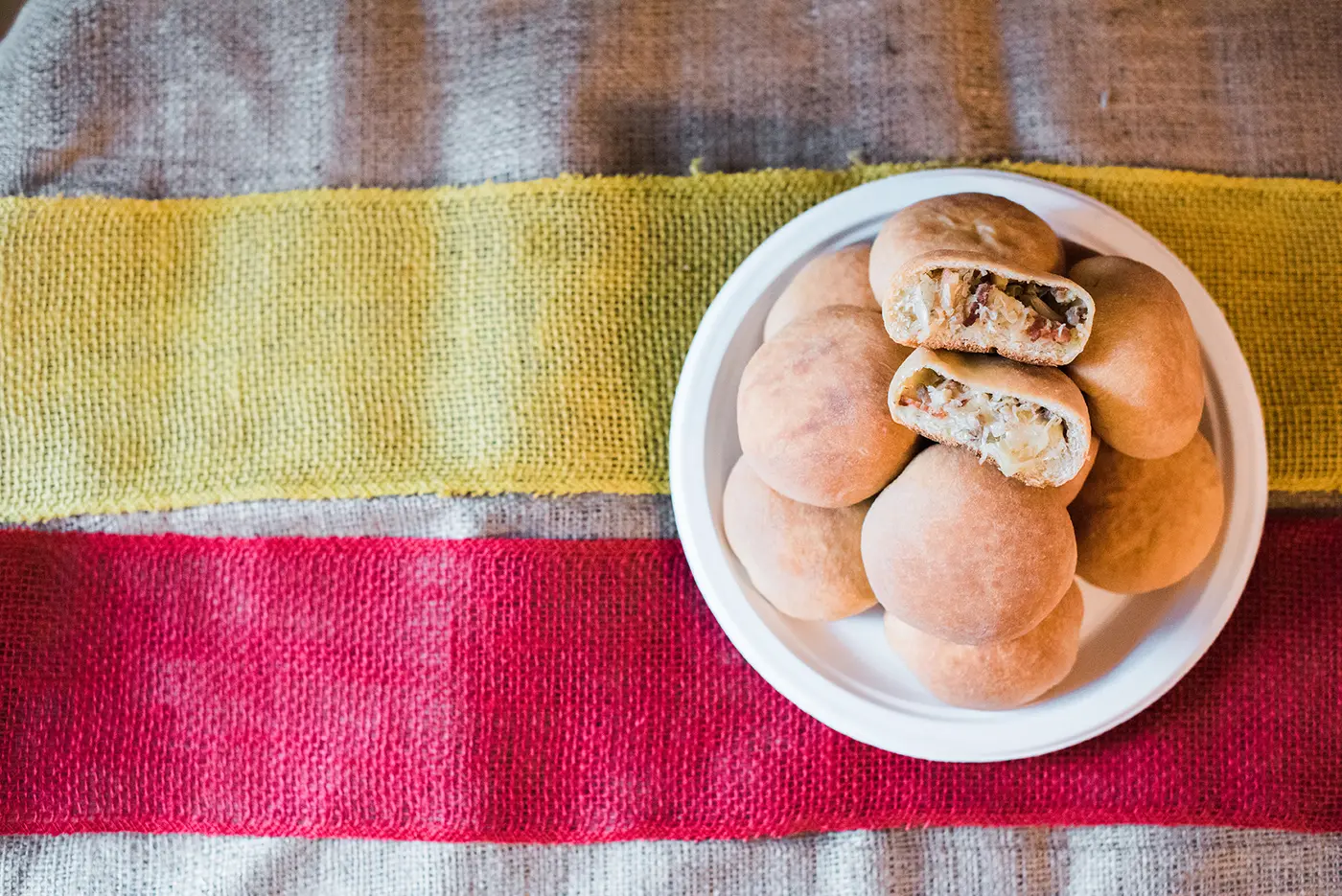
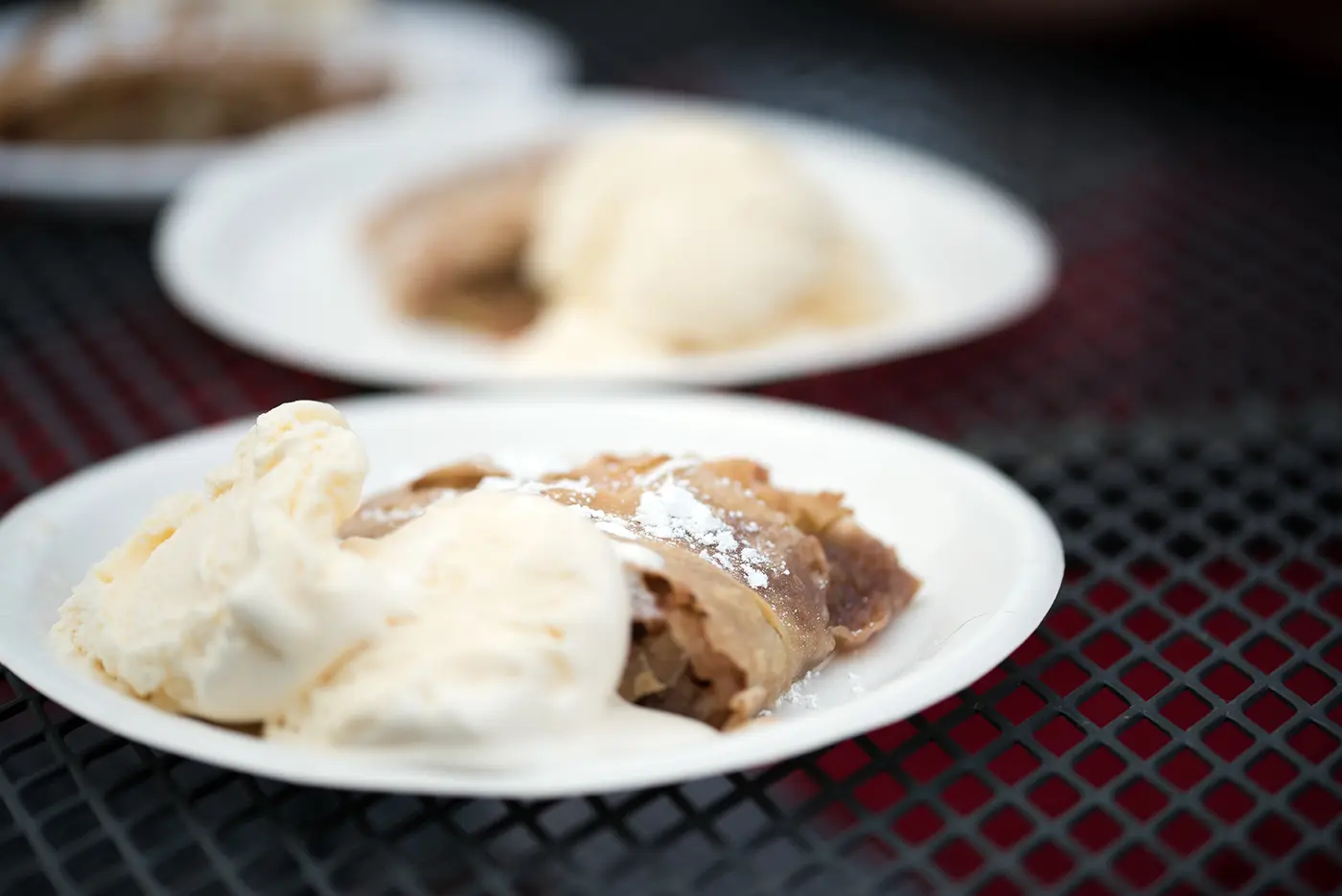
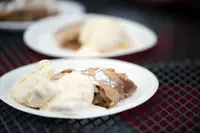
By 11 the German Food Court is open at the Fest Platz on Main Street, which is First Avenue. Each church and club keeps its own booth. In 2024 Heritage Church sold cabbage rolls and pies and kuchen, and Christ Lutheran sold apple strudel with vanilla ice cream. St. Joseph’s Catholic Church sold kraut runzas, the FFA sold caramel apples and hot buttered corn, and the FFA Alumni sold Reuben sandwiches. Das Kraut Haus served Kartoffel und Klöss with hot mustard. “They all do their own booths, so no one’s stepping on anybody’s toes,” Roberson told the Herald. “So, if you want a sausage, you get it from this booth. If you want a kraut runza or cabbage roll, you go to different booths.” The schedule warns that on Sunday the food court’s supply is limited and “food runs out quickly.” An old-fashioned German bake sale opens Friday at 10 in Old Town Hall.
The Street Fair fills Division Street from Friday morning to Sunday afternoon. It is run by the Odessa High School chapter of Future Business Leaders of America, which also keeps a petting zoo of goats, sheep, pigs, rabbits, chickens, and ducks. Yard sales open around town, and the Friends of the Library hold a used book sale at 17 West First Avenue. The Outdoor Stage, free and open to all ages, hosts local bands, an open mic, and contests. The 2026 program had a talent show, a hot dog eating contest, and a Best Beard Contest in five classes: Long, Short, Crazy, Ugly, Unique.
Friday night the Odessa High School Tigers play the Sausage Bowl on Finney Field. “That is the most attended football game we have here, and that’s saying something because we’ve won state countless times,” Roberson said. “But everyone comes back to Odessa for Fest. So, all the people that have left Odessa, they come back, and they go to the football game. It’s just like they were here 40 years ago, when they were in high school and walking up and down the sidelines.”
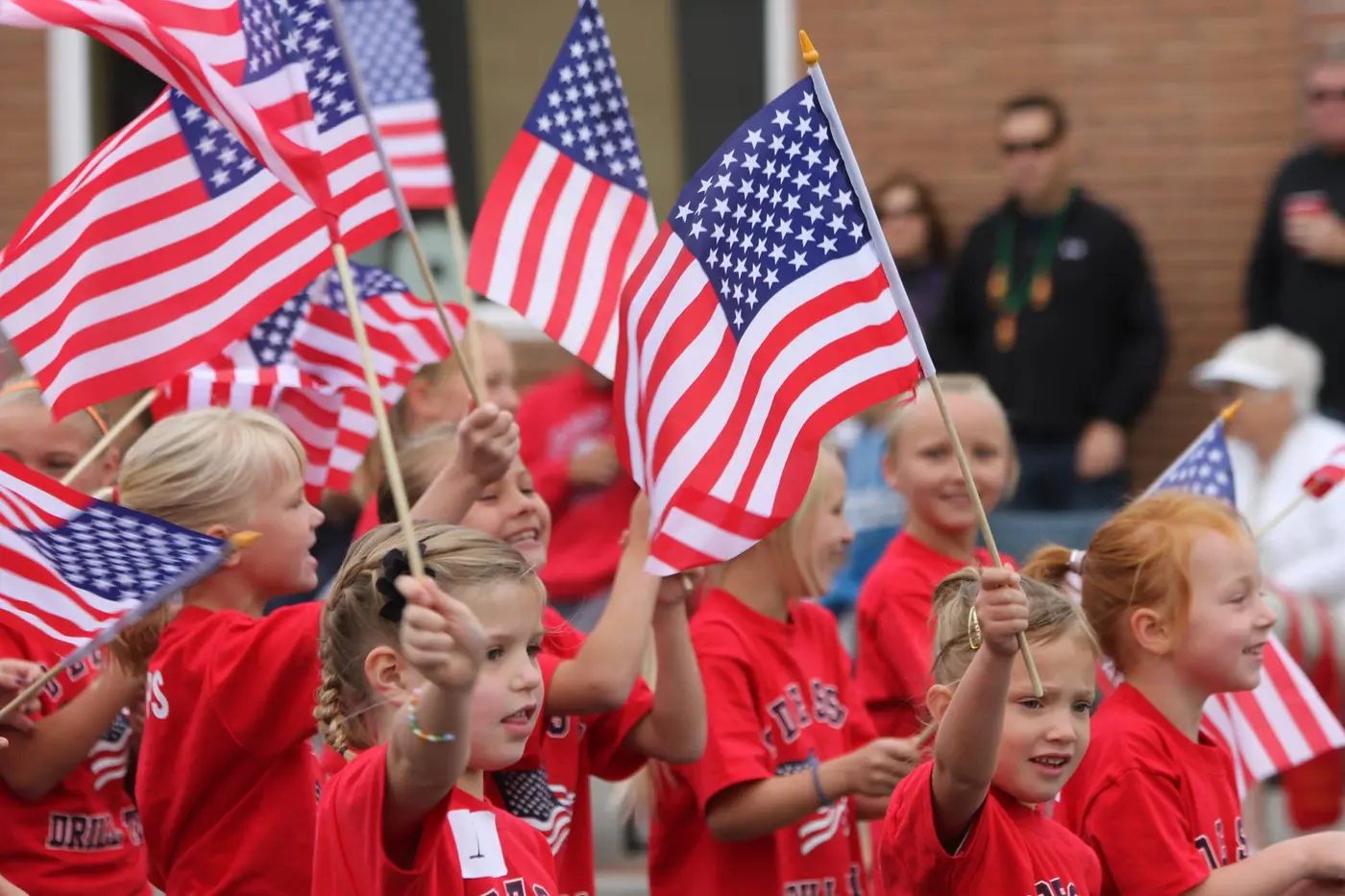
Saturday at 10 a.m., after an 8:30 fun run, the parade runs west to east on First Avenue, which is State Route 28. The kiddie parade leads, and floats, bands, horses, and visiting royalty follow. The Historisches Museum at Fourth and Elm sets out farm machinery Saturday afternoon. St. Matthew’s Church, at Alder and Fourth, shows vintage textiles and dolls. Sunday opens with Mass at St. Joseph’s at 8, an outdoor service on the stage at 10 led by the Odessa Ministerial Association, and the service at Zion Emmanuel Lutheran at 10:30.
A Chamber meeting at the bowling alley
The festival’s 2024 newspaper supplement greets visitors with “Willkommen, dobro pozhalovat,” calling it German-Russian pidgin for welcome. The festival’s own pages say the German-Russians settled Odessa at the beginning of the 20th century and that nearly 80 percent of the inhabitants are of German-Russian descent. Other accounts put the settlement earlier. The Washington Trust’s Revisiting Washington tour gives 1886, by German immigrants chiefly from southern Russia, where their forebears had been settled in the time of Catherine the Great. The Herald says the founders had been driven out of their settlements in the Volga River valley. By the Trust’s account, Great Northern Railroad officials named the town after Odessa on the Black Sea. In 1941 it was a wheat town shipping some 2,000,000 bushels a year, and on Saturday afternoons automobiles and trucks lined the curb.
The festival began in 1971, and its origin has two tellings. A 1993 edition of The Odessa Record credited a young man named John DuPree with the idea. Jim Walter, interviewed by his granddaughter Kaci King for a history by Sara Dirks, said the idea came up at a Chamber of Commerce meeting at the Odessa bowling alley, that he raised it himself, and that “it just steamrolled from there.” The organizers made research trips to the Oktoberfests at Leavenworth, Washington, and Mount Angel, Oregon. “We even tried to get people to do their buildings in Bavarian style, like they did in Leavenworth, but that didn’t get very far,” Walter said.
Paul Hopp, the first Biergarten chairman, explained the timing. “In Germany they had a beer garden thing so we thought why can’t we? They had theirs in October but we decided to do ours in September because October is so cold – we wanted it warmer.” The Odessa Historisches Museum’s history gives the same reasoning: a committee was planning a festival patterned after Munich’s, with the added qualities of a harvest fair, and chose September for its weather. The museum itself, founded by Dr. John F. Gahringer, a physician who wanted to preserve the settlement stories his patients told him, opened with that first festival. Hopp built four Willkommen signs for the early celebrations. The name in those years was Deutsches Fest; Hopp recalls it officially became Deutschesfest in 1991.
The first festival opened Friday, September 17, 1971. The festival’s history says no one knew how many visitors would come, and by Saturday the food booths were sold out and the Biergarten was out of beer. Walter remembered it this way: “I think it was the first year and we had to guess how much beer we’d need. But at 10pm one of the men came up to me and said, ‘Jim, we’re running out of beer.’ You don’t run out of beer with those guys. That’s a no-no. We sent people to Moses Lake and Ritzville with money in their pockets to get what they could.”
A building for the Biergarten
The first beer hall, Walter said, “was plumb full, but it was about the size of one half of the Old Town Hall.” After a stretch in a few old parking garages, the community center went up in 1973 as the Biergarten’s home. “Somehow or another, we got to drinking beer and next thing you know we were gonna build a new place for the city clerk’s office and Deutschesfest,” Hopp said. “There were a couple of buildings there and we tore everything down and built the new building.” Years of overflow tents followed, then an annex on the north side. Hopp recalled that Ralph Heimbigner was “so involved that when we added onto the building it was named for him.”
In those years, Walter said, “The parade used to be huge. The Spokane Lilac Festival and the Wenatchee Apple Blossom Festival would send their floats and there would be what seemed like 30 floats. It went on forever.” Attendance may have peaked in 1978 at 20,000. In 1981 the museum was set on fire by a drugged felon on parole, and 95 percent of its collections, artifacts, and records were lost. Its members broke ground for a new building on May 30, 1983, and dedicated it in May 1984. In 1994 Esther Schlimmer’s family gave the Historical Society St. Matthews Congregational Church, built in 1916, the same church where textiles hang during the festival.
For the 25th festival, in 1995, Laurence Libsack said, “Most of the Fest’s institutions have been a part of the celebration since its inception. The Biergarten, of course, has always been the central attraction.” That year’s Odessa Record wrote that he “could qualify for the title of Mr. Deutschesfest.” Walter credited Evelyn Weber, who ran the food: “Church ladies did their things and we kept others from horning in on their (the church ladies) specialties.”
In 2020 the traditional festivities were canceled because of the coronavirus, and in June the Chamber board postponed the 50th anniversary. That September, Laura Estes wrote in The Odessa Record that in a normal year “the enticing smell of apple strudel, baking in the community center kitchen would waft through the air this week,” and workers setting up the Biergarten would smell pickles and sauerkraut fermenting.
The chairmanship passes through families. Ed Deife chaired the Biergarten in 1975 and 1976, by Dirks’s count, and three times by the 2024 supplement’s. His daughter Tami Smith chaired it in 2004, 2007, and 2017, and her daughter, Shelby (Smith) Whitman, held it when the festival entered its 51st year. In 2024 Ed and Dee Deife, married in the spring of 1984 at the Old Odessa Town Hall, rode as parade grand marshals. “I’m looking forward to seeing the parade from a different view point,” Ed said. A 1976 photograph in The Odessa Record shows Larry Libsack taking down the Community Center cover sign to uncover the one beneath it, reading Bier Garten. That sign now stays up year-round.
Notable Events
- 1971At the first Deutschesfest in 1971 the beer ran out much too early. deutschesfest.net
- 1973After using old parking garages, a community center was built as a new home for the Deutschesfest Biergarten. deutschesfest.net
- 1978Attendance may have peaked in 1978 at 20,000 attendees. deutschesfest.net
- 1991Paul Hopp recalls the original name Deutsches Fest officially becoming Deutschesfest in 1991. deutschesfest.net
- 2020Traditional Deutschesfest festivities were canceled due to the corona virus. odessarecord.com
- 2020Under JUNE, the year review reports that the Chamber board announced the 50th anniversary of Deutschesfest would be postponed. odessarecord.com
People
- Ellen Holman, Leads the Chicken Dance in the Biergarten.
- Matt Roberson, Odessa Chamber of Commerce President speaking about festival attendance and community input.
- Ed Deife, Parade Grand Marshal (2024).
- Evelyn Weber, In charge of food; kept it local, controlled and organized.
- Jim Walter, Biergarten Chairman who recalled dispatching people with cash to get beer from Moses Lake and Ritzville (1972).
- June, Jim's wife; recalled being picked as a Parade Marshal when granddaughter Katie appeared on the Ritzville float.
- Katie, Granddaughter of Jim and June; appeared in the parade on the Ritzville float.
- Larry Libsack, Uncovered the Bier Garten sign by removing its off-season Community Center cover in preparation for the Fest (1976).
- Laurence Libsack, A cited newspaper said he very well 'could qualify for the title of Mr. Deutschesfest.'.
- Paul Hopp, First Biergarten Chairman; served again in 1974 (1971; 1974).
- Ralph Heimbigner, Heavily involved in the chamber-centered founding group.
- Shelby (Smith) Whitman, Biergarten Chairman, part of a multigenerational volunteer family.
- Tami Smith, Biergarten Chairman; mother of Shelby (Smith) Whitman (2004; 2007; 2017).
- Deanna Lobe, Previous year's Biergarten chairman.
- Dee Deife, Parade Grand Marshal (2024).
- Megan Schlimmer, Biergarten chairman and lifelong Odessa resident (2024).
- Ted Bruya, Worked the busy Saturday evening sausage-booth shift for years with Megan and their children and friends.
Sources
- deutschesfest.net/accomodations-1
- deutschesfest.net/accomodations
- deutschesfest.net/biergarten-band-line-up
- deutschesfest.net/contact
- facebook.com/odessafest
- deutschesfest.net/faqs
- deutschesfest.net/forms-registrations
- deutschesfest.net/history-1
- deutschesfest.net/deutschesfest-then-now
- deutschesfest.net
- instagram.com/deutschesfest.odessa
- deutschesfest.net/outdoor-stage-line-up
- deutschesfest.net/s/ODESSA-DEUTSCHESFEST-PARADE-ENTRY-FORM-2026-Coded.pdf
- deutschesfest.net/s/RV-Parking-Rules.pdf
- deutschesfest.net/s/DFest-Fun-Run-Registration-2026.pdf
- deutschesfest.net/schedule-1
- deutschesfest.net/swag
- deutschesfest.net/history-1
- deutschesfest.net/deutschesfest-then-now
- odessawamuseum.com/history.php