
OCC Swap Meet
Costa Mesa, Orange County, California. Flea Market.
Details

- Where
- 2701 Fairview Rd, Costa Mesa, CA 92626. Directions
- When
- Every weekend (Saturdays & Sundays), 8 a.m.-3 p.m.
- Getting there
- OCC Parking Lot H, the campus lot off Adams and Pinecreek.
- Fees
- Free admission.
- Hours
- 8am - 3pm.
- Access
- Parking and entrance are free; cars parked in the Harbour Student Housing lot will be cited.
- Phone
- (714) 432-0202
- Website
- orangecoastcollege.edu
- Managed by
- Orange Coast College.
- Established
- early 1980s.
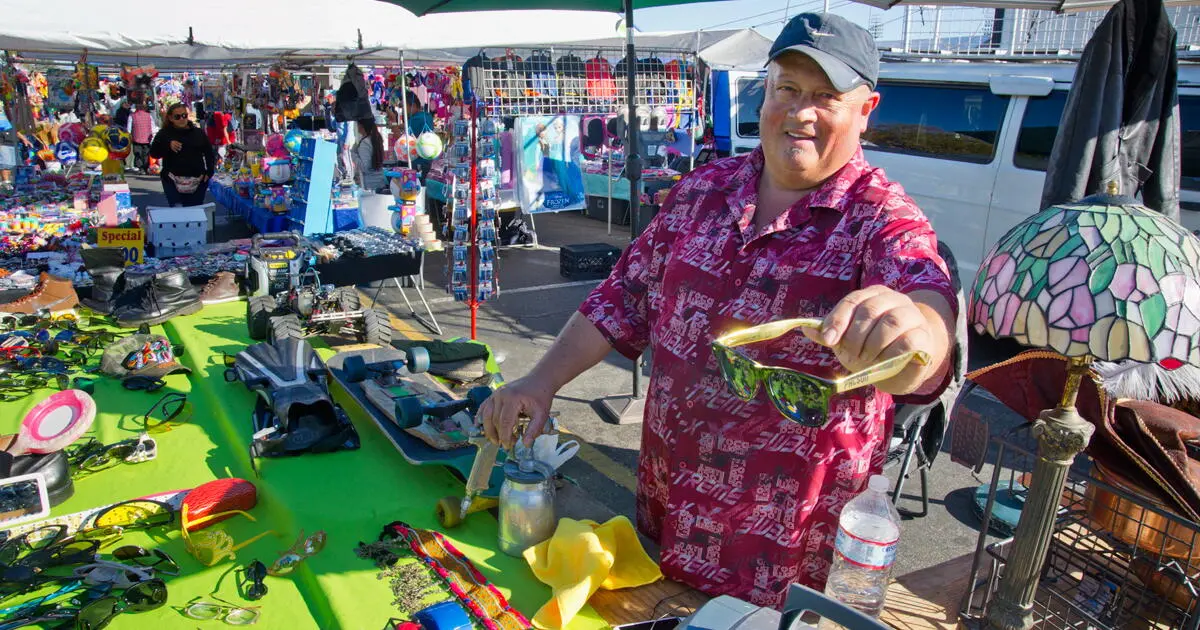
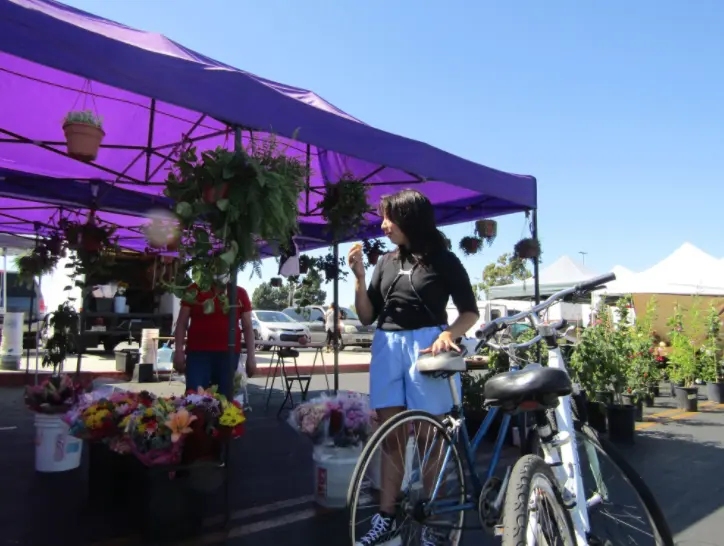
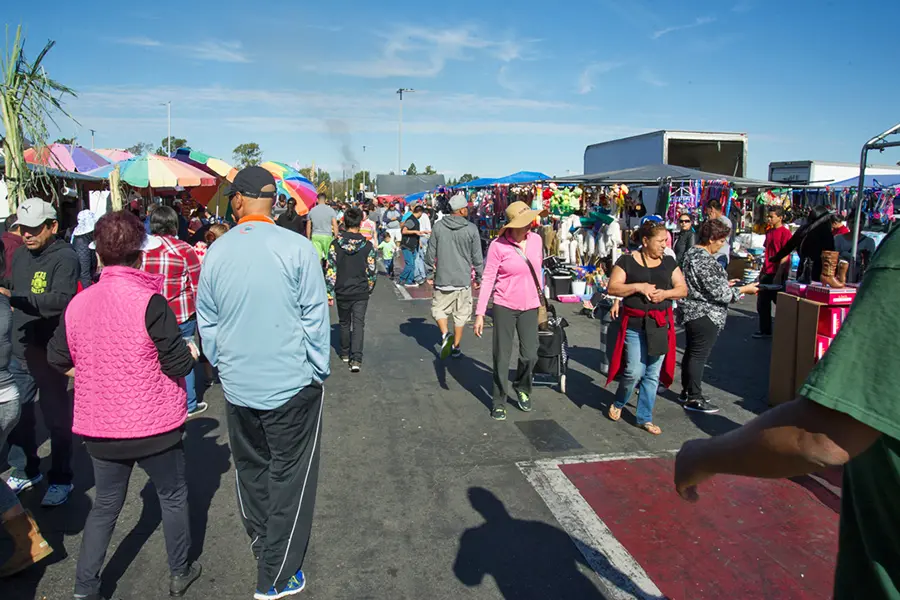
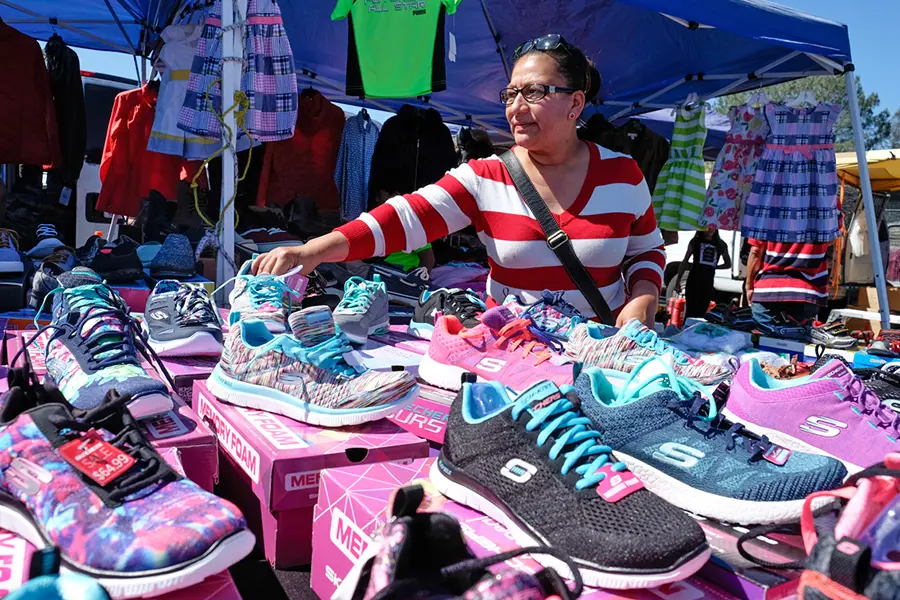
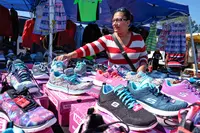
Lot H, the Adams lot on the northern edge of the Orange Coast College campus off Adams and Pinecreek, fills with canopies, tables and parked vans on Saturdays and Sundays from 8 a.m. to 3 p.m. Admission and parking are free. The rows hold fresh produce and potted plants, new keychains and earrings, used sneakers and household appliances, vintage pieces, collectibles, clothing and home goods. Tacos, frozen yogurt, churros and other food made to order sell at the entrance near The Harbour, the student housing, and cars left in the Harbour lot are cited. In early October 2026 the meet’s own account listed what a shopper could buy to cool off: raspados, aguas frescas, soft serve, popsicles, fresh coconut, fruit with yogurt, tostilocos, chicharrones and iced coffee.
In 2021 the college paper, the Coast Report, described a mariachi band playing in the lot and Chinelos dancers performing on select weekends. The meet posts their dates on Instagram. The college runs the meet. Ruben Barriga, who has overseen it since 2017, said that year that space fees pay for swap meet wages, utilities, campus safety and maintenance, among other college costs.
Before the gates open on Adams
Cynthia Rebolledo of OC Weekly recorded a weekend at the meet in January 2017. At 5:30 on a Saturday morning it was 50 degrees and sunrise was an hour off. A line of old pickups, new Rams, U-Hauls, loncheras and overpacked cars backed up on Fairview Road, turned onto Adams and waited for the gates to open at 6. A guard checked each driver’s credentials. Over the next two hours more than 600 vendors set up to the clink of metal.
Jose Cruz pulled up on the north side of the lot. With his son, his in-laws, his nieces and a compa named Manuel, he unloaded six stalls of produce in minutes. He had been selling there for 26 years. “We’ve been up since 4 in the morning, and we don’t finish breaking down until 8 p.m.,” he said. At 8 the first customers lifted his fruit to their noses and haggled. Others walked past toward $5 hoodies and $10 bikes. Charlie, a retired Marine who had shopped there for 20 years, gave his reason for coming: “It provides a place where people can come to find stuff without going to the store. A lot of people nowadays can’t afford those high prices.”
By noon on Sundays, the writer found, crowds arrived dressed in their church clothes. The layout ran like a labyrinth. Food stalls sat at the edges and gave way to branches of new and used clothes, electronics, furniture, CDs, antiques, shoes and beauty products.
Pupusas, menudo, and the Bird Man
The food court filled in early afternoon. Jaime Macias drew lines at Taco Time for tacos de papa and menudo. “You can spend $25 and feed your family and eat good food,” he said. Cambujas’s Comida Centro America sold Guatemalan and Salvadoran pupusas and caldo de res. A Vietnamese family sold corn on the cob and esquites. H’s Chinese Food, twelve years on the lot, sold combo plates of chow mein and orange chicken. Miguel Ocampo, at the meet for 28 years, cooked Mexican food in a school bus he had fitted with a kitchen.
Before the meet, William Pezzullo sold specialized mining equipment and his wife, Sevgi, worked as a tailor. They had sold dried fruit and nuts under a banner reading “Go Nuts” for 20 years. In that time they grew from one space to three and from a few products to more than 100 kinds. Their chile-covered mangoes use three types of chiles, lemon flavoring, one particular mango variety and a process they keep secret. They hired local high school and college students. One, William said, went on to work for homeland security in Washington, D.C.
A vendor called the Bird Man, Rocky by name, had sold finches, cockatiels, parakeets and larger birds for more than 20 years. The paper likened his beard to Hagrid’s. He had taken children from the meet to Knott’s Berry Farm’s Halloween Haunt and to the snow at Big Bear. “Some of the kids who have worked with me over the years, I met them as little kids shopping here, and they grew up in my booth,” he said. College rules now bar the sale of animals, except by two approved bird vendors who were selling before the ban.
At the Salazar chicharrones stall, Sylvia Salazar greeted each customer and said “Gracias” however long the line. Her father, Jose, started the business. At first customers did not know what chicharrones were. “We’d literally only sell two bags,” said her sister Maricela. He also suggested the organizers move second-hand goods to the back, “because a lot of people would come in looking for used items and antiques, and then leave,” Maricela said. “Putting them in the back, it forced people to have to walk through all the aisles.”
Their mother died of a stroke in 1999. In 2008 their father was killed in an accident on his way to the meet, and the truck carrying everything for his booth was lost. Maricela had just finished a degree in English literature at Cal State Los Angeles, and law school lay ahead. The sisters kept the stall. Maricela pointed to a spot near the booth where her parents ate a quick breakfast together each weekend. “My dad always told us, ‘I might not leave you with an actual inheritance of money, but I’m going to teach you how to earn a living, and you’ll never go hungry because you’ll know how to sell something.’”
A monthly meet in the Merrimac lot
The meet began in the early 1980s. OC Weekly calls those years a golden era for Orange County flea markets. Drive-ins such as the Orange Drive-In, the Anaheim Drive-In next to the 91 freeway and the Hi-Way 39 in Westminster rented their lots to sellers by day. According to the college and to OC Weekly, the Lions Club of Costa Mesa founded the OCC meet as a monthly gathering in the campus Merrimac Lot, off Merrimac Way and Fairview Road. The crowds overwhelmed the club, and it offered control to George Blanc, head of the college’s community education department. Blanc accepted in 1982. He was looking for money for community education classes and the performing-arts program. Julie Clevenger, a later director at the college, said his staff kept getting calls asking whether the meet would run every weekend. “’Just tell them yes,’ he said.”
The city permits tell it differently. Jim Carnett, the college’s director of community relations, wrote in 2002 that OCC’s 1982 conditional use permit allowed a Sunday-only meet at Fairview and Merrimac with 205 selling spaces. A 1984 permit moved it, still Sunday-only, to the larger Adams lot with 275 spaces. Saturdays were added more than 15 years before 2002, he wrote. The Daily Pilot reported that the Saturday expansion came without city approval. In 2021 Barriga gave yet another sequence: once a month, then every Saturday with 50 to 100 spaces at most, then the Adams lot, which he said held more than 600 vendor spaces.
OC Weekly says the meet stayed relatively small until 1991, when Santa Ana outlawed all swap meets to preserve “the character of the city’s neighborhoods.” Cruz had sold produce from a truck in Santa Ana neighborhoods and helped an uncle at the Rancho Santiago swap meet. He had come to OCC a couple of months earlier with a small pushcart. “It initially started with about 50 stalls,” he said. “But after the closure of Santa Ana [Stadium] and Rancho Santiago College, everyone started coming here.” Vendors handed out fliers through Santa Ana and nearby cities to bring in more sellers and buyers.
Richard Bagley, a Costa Mesa school janitor, first came because a roommate brought him. From the mid-1980s he went to the meet more than 1,000 times, buying old photograph albums at about $30 apiece. Eventually he rented three storage lockers to hold them. The Costa Mesa Historical Society found in his albums a record of families who moved west between the 1920s and the 1950s. In 2015, forty of the prints hung in the college’s Art Center in an exhibition called “Gems From a Shoebox.”
Sundays only, 2002
By 2002, Carnett wrote, the meet drew about 400 vendors on Saturday and 500 on Sunday. It grossed between $1.5 and $2 million a year and netted the college about $750,000. That money paid for community education, scholarships and College for Kids. It also paid for a performing-arts season that in 2001-02 brought Debbie Reynolds, the Kingston Trio, the Peking Acrobats and Red Buttons to the campus. OC Weekly put stall fees at $3 million a year in 2017.
In February 2002, Mayor Linda Dixon and Councilwoman Libby Cowan wrote to college president Margaret Gratton that the meet had been allowed to “overrun the surrounding streets and neighborhoods.” A city study found it running more than 200 vendors over its permit, and on a day the city had not approved. The college met with city officials on March 22 and agreed to cut back. From the weekend of May 4 the meet ran on Sundays only, with 275 vendors. Blanc said many permanent vendors quit rather than sell one day a week. By October he counted $575,000 in lost potential revenue. “We have been losing a lot, and each week it’s getting worse and worse,” he said.
Vendors and shoppers filled City Council meetings to describe the bargains they found and the livelihoods they stood to lose. At the end of October the Planning Commission voted unanimously to reopen Saturdays. The terms were an average of 260 vendors a day and no customer parking in the district lot across the street. Resident Paul Weber objected: “I live in Mesa North, and on weekends you can hardly get around town.” Then resident Paul Wilbur appealed, and in December the council took the matter up again. Cowan wanted a traffic management plan. Councilman Chris Steel demanded that the college verify vendors’ legal residence and state tax numbers. Councilman Allan Mansoor asked the city to keep open the option of turning the meet into a farmers’ market or art fair. Blanc told the Orange County Register that the meet was “a scapegoat during slow economic times.” The meet now runs on both weekend days.
A rainy day in March 2020
The last meet before the pandemic closure was held on March 7, 2020. “It was a very somber day,” Barriga recalled. “It was a rainy day. We had to shut it down and literally had to turn away vendors at the door.”
The lot stayed empty for more than a year. The meet reopened on July 3, 2021, with music from the youth ensemble Mariachi Juvenil Herencia Michoacana. Organizers expected up to 400 vendors that Saturday and 600 on Sunday. Barriga counted 220 permanent vendors for whom the meet was a livelihood. William Pezzullo said before the reopening: “I’ve made a lot of friends and acquaintances over the last 25 years.”
That September, a 13-year-old named Guadalupe was setting out accessories, stuffed animals and lanyards with her family every Saturday and Sunday. Their cloth bracelets hung high in the shade under the solar panels. “We’ve been doing this for about five years,” she said. “It helps us pay our monthly rent.”
Notable Events
- 1982Seeking support for community education classes and the performing-arts program, Blanc accepted the Lions' offer and OCC officially took over. ocweekly.com
- 1984After outgrowing the original location, OCC applied for a 275-space permit to move the Sunday-only event to the larger Adams Parking Lot. latimes.com
- 1984The open market moved to the Adams Avenue parking lot. ocweekly.com
- 1991The market had been relatively small until Santa Ana outlawed swap meets; displaced vendors needed new selling places. ocweekly.com
- 1999The vendor sisters lost their mother to a stroke, a loss they were still dealing with when their father died. ocweekly.com
- 2000The city issued a formal written notice of compliance and extended the permit for two additional years. latimes.com
- 2002OCC's vice president of administrative services met city officials on March 22; the meeting determined that the swap meet was out of compliance with its conditional use permit. latimes.com
- 2002The mayor and a councilwoman wrote to the OCC president about increased weekend traffic and parking congestion near the college. latimes.com
- 2002In May, after discussion, the city told OCC to revert to Sunday-only operation with a maximum of 275 vendors; many permanent vendors abandoned the shortened meet, according to Blanc. latimes.com
- 2002The commission unanimously approved reopening on Saturdays with an average of 260 vendors per day, improved reservations, no customer parking in the district lot across the street and a six-month review. latimes.com
- 2002An eleventh-hour appeal by resident Paul Wilbur brought the approved revised swap meet before the City Council for further scrutiny. latimes.com
- 2002A council member proposed cutting Sunday vendors from 450 to 275 and banning temporary vendors; officials claimed that the college violated its earlier permit. ocweekly.com
- 2008The sisters were left with the business after their father died in an accident while traveling to the swap meet; the family also lost the booth's truck. ocweekly.com
- 2009The recession put the family into bank debt, prompting Daniel to help full-time. ocweekly.com
- 2020Ruben Barriga still remembers the last swap meet event held before the pandemic closure, on March 7, 2020. latimes.com
- 2021The swap meet reopened July 3 after over a year-long closure due to COVID-19. coastreportonline.com
- 2021The meet was scheduled to return July 3 and 4; organizers anticipated up to 400 vendors Saturday and 600 Sunday. latimes.com
People
- Guadalupe, Young seller assisting her family with accessories and other goods (about five years).
- Ruben Barriga, OCC director of college and community support overseeing the swap meet (past four years).
- Juan Gutierrez, College spokesman discussing news of the reopening.
- William Pezzullo, Part of a husband-and-wife team selling dried fruits and nuts after leaving previous careers (started 20 years ago).
- Richard Bagley, Photo-album collector whose purchases at the OCC swap meet built a large historical collection (Since the mid-1980s).
- Jim Carnett, OCC director of community relations; author of the college's explanatory commentary.
- Jim McIlwain, OCC vice president of administrative services who met city officials about the swap meet's future.
- Libby Cowan, Councilwoman who joined the mayor's letter to OCC's president.
- Linda Dixon, Costa Mesa mayor who sent the letter to OCC's president.
- Margaret Gratton, OCC president who received the city's letter about the swap meet.
- Bruce Garlich, Planning commissioner who said the staff report offered options for a solution.
- George Blanc, Ran OCC's community education department when the Lions Club offered the college control of the swap meet.
- Mel Lee, City associate planner describing the recommended smaller vendor area.
- Anthony Beaumon, Agent for the college who pledged control over the meet's operation.
- Bill Perkins, Commissioner and neighboring resident who supported the operational changes.
- Katrina Foley, Planning Commission chairwoman who thanked the college for its cooperation on the revised meet.
- Paul Weber, Mesa North resident who opposed the meet because of neighborhood congestion.
- Trissa Allen, Engineering consultant who analyzed parking, vendors, pedestrian counts and congestion associated with the swap meet.
- Allan Mansoor, Councilman who asked officials to retain the possibility of changing the swap meet to a farmer's market or art fair.
- Chris Steel, Councilman who demanded verification of vendors' legal residence and state tax numbers, suspecting they undercut local businesses.
- Mike Barrie, Resident who questioned why the swap meet was treated differently from city businesses paying trip fees and taxes.
- Paul Wilbur, Resident whose appeal brought the revised swap meet before the City Council.
- Charlie, Retired Marine and regular customer (past 20 years).
- Daniel, Jose Cruz's son who grew up spending weekends at the family stall (Since he was just a 1-year-old).
- Jaime Macias, Operator of the Taco Time stall.
- Joel Faris, Then-planning commissioner who publicly disapproved of the OCC swap meet.
- Jose Cruz, Longtime produce vendor working with his family (26 years selling here).
- Jose Salazar, Chicharrones vendor whose early sales were very small.
- Julie Clevenger, OCC director of college and community support recounting how Blanc expanded the meet to weekends.
- Manuel, Compa helping Jose Cruz's family unload the produce stall.
- Maricela Salazar, Jose Salazar's daughter, helping run the family stall with her sister.
- Miguel Ocampo, Operator of Ocampo's Catering, selling Mexican food at the swap meet (28 years).
- Rocky, Bird vendor known as the Bird Man (more than 20 years).
- Sevgi Pezzullo, Former tailor, part of the husband-and-wife dried-fruit and nut business (started 20 years ago).
- Shari Breton, New vendor buying unclaimed storage units and reselling the best finds.
- Sylvia Salazar, Salazar family stall vendor who greets customers individually.
Sources
- orangecoastcollege.edu/community/swap-meet
- orangecoastcollege.edu/community/swap-meet/about.html
- orangecoastcollege.edu/community/swap-meet/vendor-guidelines.html
- facebook.com/occswapmeet
- instagram.com/occswapmeet
- coastreportonline.com/features/article_d591778e-1747-11ec-ac69-433981b67df1.html
- latimes.com/socal/daily-pilot/news/story/2021-07-01/orange-coast-college-swap-meet-returns-to-costa-mesa-this-weekend
- latimes.com/socal/daily-pilot/news/tn-dpt-xpm-2002-05-02-export37277-story.html
- latimes.com/socal/daily-pilot/news/tn-dpt-xpm-2002-10-27-export31180-story.html
- latimes.com/socal/daily-pilot/news/tn-dpt-xpm-2002-10-30-export31099-story.html
- latimes.com/socal/daily-pilot/news/tn-dpt-xpm-2002-12-12-export29506-story.html
- latimes.com/socal/daily-pilot/news/tn-dpt-me-0313-historical-society-exhibit-20150312-story.html
- ocregister.com/2015/04/03/how-an-obsessive-photo-collector-unwittingly-accumulated-three-storage-lockers-full-of-priceless-oc-history
- ocweekly.com/a-weekend-in-the-life-of-the-orange-coast-college-swap-meet-7848429
- orangecoastcollege.edu/community/swap-meet