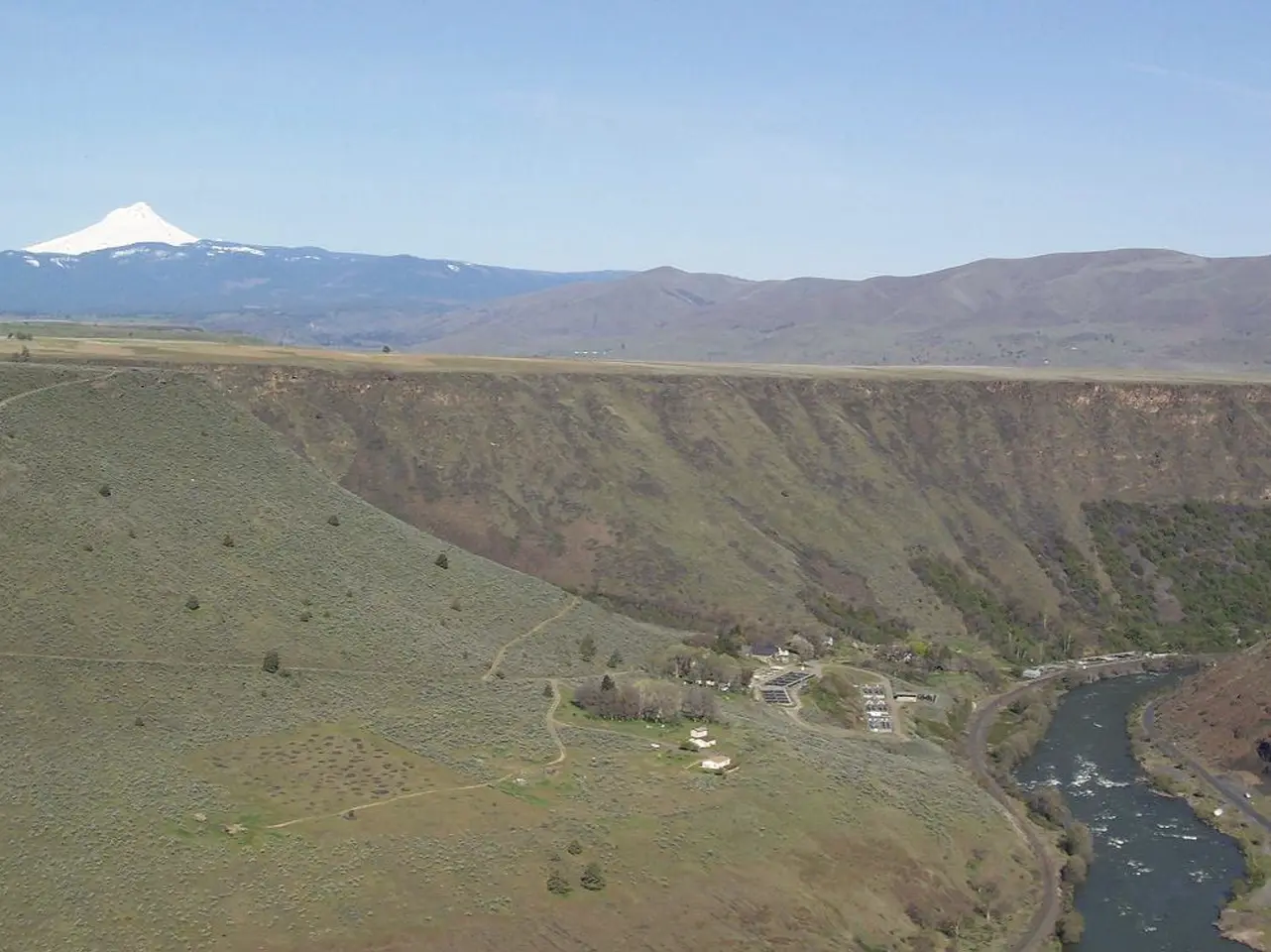
Oak Springs Hatchery
Maupin, Wasco County, Oregon. Fish hatchery.
Details

- Where
- 85001 Oak Springs Road, Maupin, OR 85001. Directions
- When
- Office hours 7:30 a.m. to 4 p.m. daily.
- Season
- Best time to visit June – October; trout spawning occurs September – October.
- Getting there
- From 1-84 turn onto Hwy. 197 at the Dufur exit and travel 37 miles through Tygh Valley. Continue to the top of the grade on Hwy. 197. Turn left at the hatchery sign and continue three miles into the canyon to the hatchery.
- Access
- Facilities: camp host, picnic area, hunting, restroom.
- Walk-in or reserve
- Egg incubation room viewable by appointment October through March; group tours to view and participate in trout spawning by appointment September through October.
- Phone
- 541-395-2546
- Managed by
- Oregon Department of Fish & Wildlife.
- Established
- 1922, last major construction 1996.
- Coordinates
- 45.2196, -121.0805.
The road to Oak Springs Hatchery leaves Highway 197 at a sign near the top of the grade north of Maupin and drops three miles into the Deschutes River canyon. At the bottom, 850 feet above sea level, the Oregon Department of Fish and Wildlife works a 203-acre site of concrete ponds, raceways, and incubation rooms beside the river. Boaters know the place from the water. The Bureau of Land Management’s river map marks it at river mile 47.7, “visible on river left” as a large patch of oak trees fed by numerous springs. The hatchery takes its name from those springs.
The grounds have a picnic area, a fountain, and a show pond, along with a camp host and a restroom. ODFW gives June through October as the best months to come.
Water out of the rock
All the water the hatchery uses comes from a series of large springs in the steep canyon wall, according to a 2021 federal environmental assessment, which counts it as spring water and not surface water. It runs to the ponds by gravity. The hatchery’s 2023 management plan says the delivery system can carry about 22,400 gallons a minute, though the springs were then supplying only 9,700. A pipeline that reuses water from one pond series to the next raises the usable flow to 13,965 gallons. In 1997 the system could deliver about 11,670.
The Maupin Area Chamber of Commerce describes this part of the Columbia plateau as a country of rocky ridges, deep canyons, and numerous perennial springs that feed the desert creeks and, in the end, the Deschutes.
Ponds of six decades
The rearing units date from different decades, and the 2023 plan lists each one. The two concrete brood ponds, each 140 feet long, were poured in 1939 and still hold trout broodstock. The plan rates them in fair condition. The seven lower ponds, also from 1939, are rated poor. Nine upper ponds followed in 1957, the Burrows and circular ponds in 1970, twelve raceways and 192 plastic vertical incubator trays in 1992, and sixteen fiberglass Canadian troughs in 1996, the last major construction.
ODFW’s visitor guide lists rainbow trout, cutthroat trout, and summer and winter steelhead, with one resident rainbow and one resident cutthroat broodstock kept on site. The 2023 plan instead names two resident rainbow broodstocks. It also describes a West Virginia rainbow stock being developed from eggs received from Mantua Hatchery in Utah, which is being tested for resistance to bacterial cold-water disease.
The visitor guide places trout spawning in September and October. The plan gives September through November. In those weeks groups may book a tour to watch the spawning and take part in it. The fish are spawned one male to one female, and for some lots the eggs are pressure-shocked shortly after fertilization to make them triploid. From October through March the egg incubation room can be seen by appointment.
Most of what is raised here leaves by truck. Under the 2023 plan, rainbow fingerlings go to Ochoco and Prineville reservoirs in May, and summer steelhead go to Haystack Reservoir in mid-April. One trout stock is to produce 13,000 trophy fish weighing 26,000 pounds altogether. Eggs and young fish are shipped to the Wizard Falls, Klamath, Irrigon, Wallowa, Leaburg, Rock Creek, and Bonneville hatcheries. Clackamas River winter steelhead are adipose-clipped and sent to Bonneville and Clackamas hatcheries. A 2013 plan describes eyed eggs arriving each May from Sandy Hatchery, being hatched and reared here, and leaving for Bonneville Hatchery as fingerlings in October. The chamber of commerce puts the hatchery’s output at 1.5 million steelhead, 4.5 million rainbow fingerlings, and 250,000 legal-size rainbow trout.
The 2023 plan lists 5.75 full-time staff and draws three-quarters of the funding from federal sources and the rest from license fees. Managers’ names appear in the documents now and then: Randy Robart in 1997 and Lyle Curtis in 2013. On March 10, 1997, auditors working for the Bonneville Power Administration visited the site. Their report found the summer steelhead program in general compliance with most performance measures. It also called for alarms, double screens on the raceways, foot baths, and better predation control.
Golden eagles and a Class IV rapid
ODFW reports good birdwatching in spring and summer: finches, grosbeaks, orioles, kingbirds, wrens, and woodpeckers. Kingfishers and herons work the water, and a pair of golden eagles nests here in season. Deer are a common sight. Hunting is allowed.
Below the hatchery the river runs into Oak Springs Rapids, Class IV on the BLM map, where a lava rock island splits the Deschutes into two channels. Both channels have shallow rocks and turbulent currents. The left one also has large standing waves and a large hole during high spring flows, and the right one a large hole and very sharp rocks. Half a mile upstream, at river mile 48.2, the BLM runs a fee campground also named Oak Springs.
The power plant operator and his guest
The lower Deschutes was fished long before the ponds were dug. The chamber identifies the Tenino, or Warm Springs Sahaptin, as the people of this stretch in historic times, with salmon, especially chinook, as their chief food. The chamber dates the hatchery to the 1920s, when it was a single pond that raised fish and released them into the river. ODFW gives 1922 as the year construction began. In a 2012 comment on a History Museum of Hood River County page, a reader signing “l.e.” wrote that Oak Springs also had a hydroelectric facility generating electricity for Maupin in 1902.
A power plant was certainly running by 1928, when the Maupin Times reported on its operator, E. C. Marks. A man came to him looking for work. Marks took him to the fish hatchery, but no one was needed there, so the two went back to the plant. Marks gave the traveler an extra cot in the plant house. Before bed the stranger showed his army discharge, and Marks saw on it the word “lunatic.” He resolved to stay awake but fell asleep. About midnight he woke to find his guest had rolled up the bedding and was peering into a wardrobe. When the man came out of the closet, Marks knocked him out and tied him up. Once the man came to, he begged to be let go and said he was not responsible for his actions. Marks believed him and untied the ropes. The last Marks saw of him was “a blur up the track heading for Maupin.”
The same year, the record notes, Andy Smith’s family lived in the hatchery residence while it was enlarged with a bathroom and other conveniences. On January 2, 1929, the Times reported, Smith and his wife braved the elements and came up from the fish hatchery at Oak Springs to do their weekly trading.
Notable Events
- 1902A reader of the History Museum of Hood River County page states that the Oak Springs hatchery also had a hydro electric facility for generating electricity for the town of Maupin in 1902. hoodriverhistorymuseum.org
- 1922The hatchery was constructed in several phases beginning in 1922. dfw.state.or.us
- 1939The plan's rearing-facilities table dates the concrete Brood Ponds and Lower Ponds to 1939 construction. dfw.state.or.us
- 1957Nine concrete upper ponds were added in 1957, rated good. dfw.state.or.us
- 1970Concrete burrow ponds were built in 1970, rated good. dfw.state.or.us
- 1992Twelve concrete raceways were built in 1992, rated good. dfw.state.or.us
- 1996The last major construction at the hatchery was in 1996, when sixteen fiberglass Canadian troughs were added. dfw.state.or.us
- 1997An independent audit of the Oak Springs Hatchery summer steelhead program found the program in general compliance with most of the performance measures. fpc.org
People
- Randy Robart, hatchery manager named on the independent federal hatchery audit (1997).
- Andy Smith, came with his wife into Maupin from the fish hatchery at Oak Springs to do their weekly trading.
- E. C. Marks, operator at the Oak Springs power plant, who took a traveling job-seeker up to the fish hatchery (1928).
- Lyle Curtis, hatchery manager at Oak Springs Hatchery named in the state hatchery and genetic management plan (2013).
Sources
- myodfw.com/oak-springs-hatchery-visitors-guide
- dfw.state.or.us/fish/HGMP/docs/2023/Oak%20Springs%20HPMP%202023.pdf
- traveloregon.com/things-to-do/destinations/parks-forests-wildlife-areas/oak-springs-fish-hatchery
- maupinoregon.com/fishingce614249
- nativefishsociety.org/news-media/deschutes-diaries-dec-2025-hatcheries
- oregonlive.com/travel/2014/07/oak_springs_vs_boxcar_which_is.html
- media.fisheries.noaa.gov/dam-migration/hgmpdeschutesriver-smrstlhd7-9-2020.pdf
- columbiainsight.org/a-tribute-to-wild-and-scenic-rivers-the-deschutes-part-1
- energy.gov/sites/default/files/2022-04/final-ea-2132-columbia-river-basin-hatcheries-2022-03.pdf
- s3-us-west-2.amazonaws.com/nativefishsocietyauction/Save+Sandy+Salmon+Documents/Sandy-STW-HGMP-10-18-13-Comparison-to-Current.pdf
- maupinoregon.com/sheep
- blm.gov/fr/sites/default/files/prog_rec_permits_deschutes_map5.pdf
- fpc.org/hatchery/IHOT_HatcheryAudits/oakspringshatchery1-1997.pdf
- oregonnews.uoregon.edu/lccn/sn96088123/1929-01-03/ed-1/seq-3/ocr
- hoodriverhistorymuseum.org/fish-stocking-1933-3
- oregonnews.uoregon.edu/lccn/sn96088123/1928-11-01/ed-1/seq-1/ocr