


Oregon City Municipal Elevator
Oregon City, Clackamas County, Oregon. Structure.
Details

- Where
- 300 7th St, Oregon City, OR 97045. Directions
- When
- Sunday 10 am to 7 pm; Monday and Tuesday 7 am to 7 pm; Wednesday through Saturday 7 am to 9:30 pm.
- Getting there
- From downtown, the elevator is accessed through a tunnel aligned with the intersection of 7th Street and Railroad Avenue or via a tunnel that runs east under the Union Pacific railroad tracks at the base of Singer Hill.
- Fees
- Free.
- Access
- Official address is 610 Bluff Street but main street entrance is on 7th; also known as "Elevator Street".
- Phone
- (503) 657-0891
- Website
- orcity.org
- Managed by
- City of Oregon City - Public Works, Street (Transportation) Division.
- Established
- 1955.
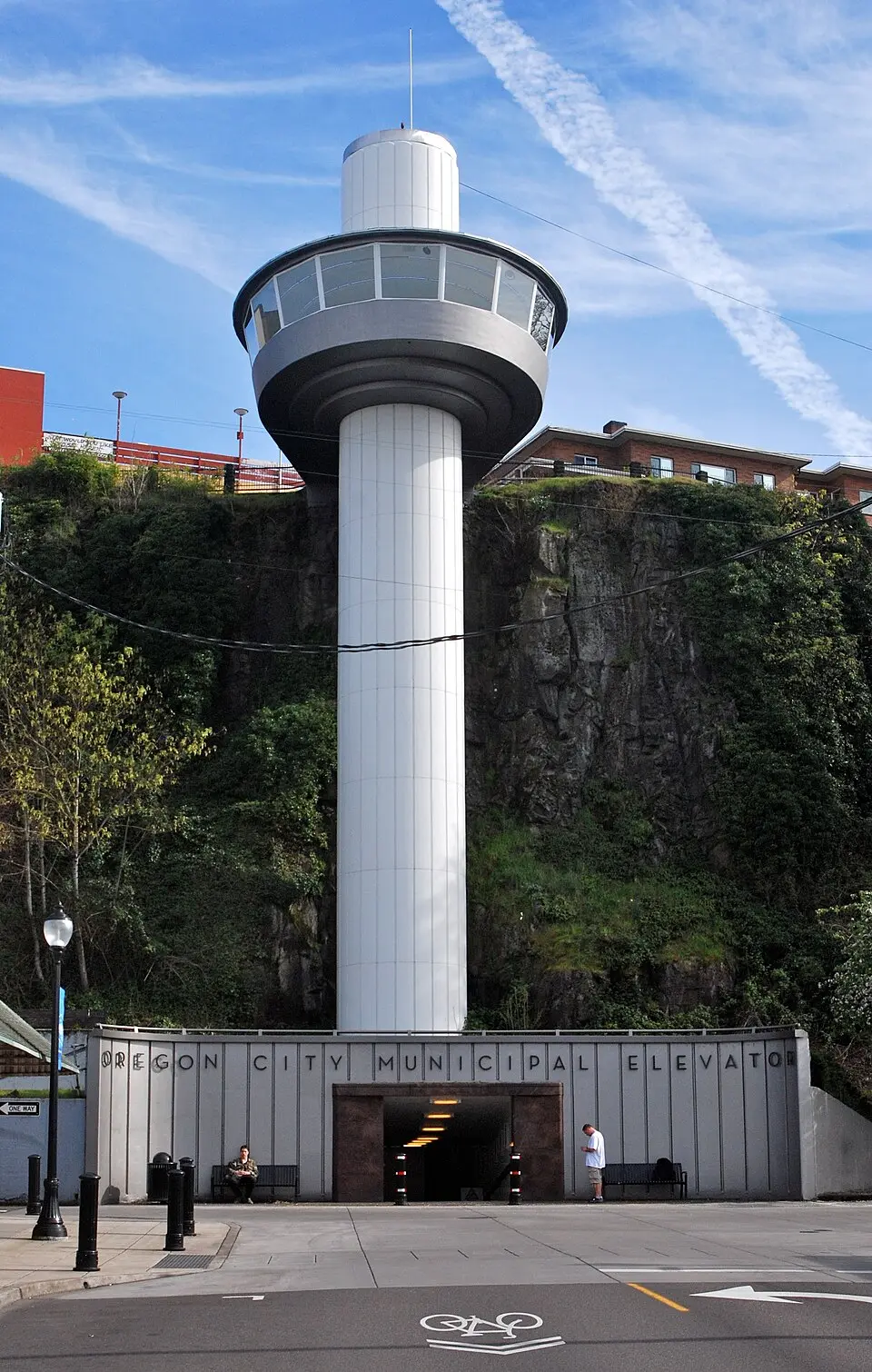
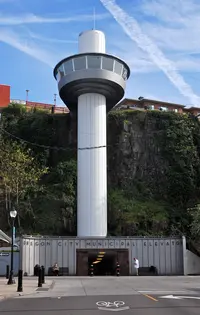
At the foot of Seventh Street in Oregon City, where it meets Railroad Avenue, a tunnel runs 35 feet east under the Union Pacific tracks. A second tunnel reaches it from the base of Singer Hill. Metal doors are set in the tunnel’s eastern wall. Behind them an Otis car climbs a narrow cylindrical shaft of reinforced lightweight concrete, 130 feet high, backed by the brush and basalt outcroppings of the bluff. The city puts the trip at 15 seconds; the public library’s history says 9 to 15. The National Register nomination describes the car as staffed. Finn J.D. John, writing in the Oregon City News in October 2025, reports that an attendant ran it until the COVID-19 outbreak and that it has been self-service since.
The deck above the falls
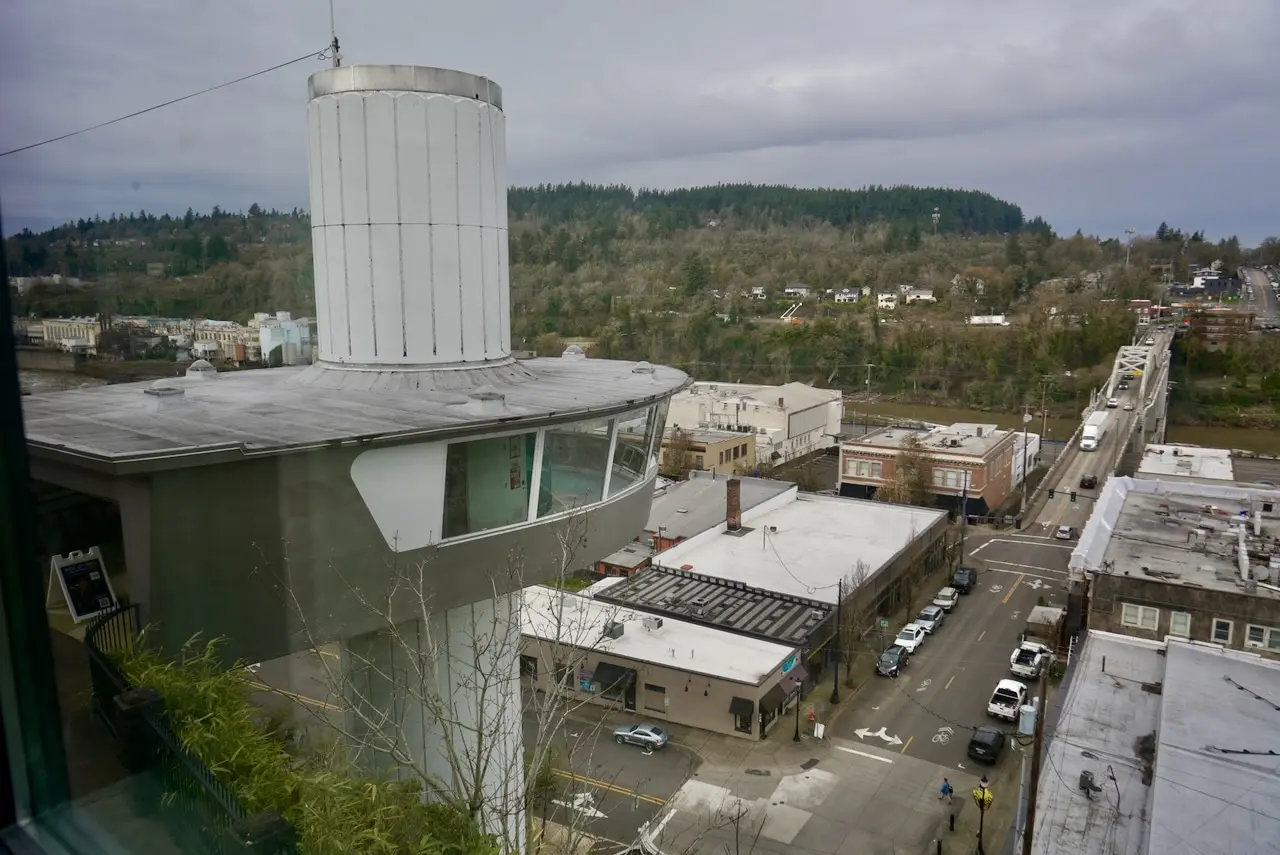
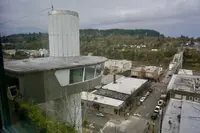
The car rises into the center of a horseshoe-shaped observatory. Its walls are canted so that a rider can lean against the large windows and look straight down at the town. To the south is Willamette Falls. Below and around are the commercial downtown, the bridges over the Willamette River, and the industrial district that the nomination says has supplied the town with goods and jobs since the early 1800s. Its designer used lightweight concrete to make the observatory appear to hover. John describes the tower as “a flying saucer docked on top of a thick lollipop stick.” A marker the city erected in 1954 stands inside the top floor near the gift shop. The ride is free. The city counts more than 120,000 riders a year, and John wrote that up to 1,300 a day ride at the height of the tourist season.
The walls carry “Elevations in Transition,” three series of lenticular photographs by Michael Asbill, an artist from upstate New York. The prints are mounted under the windows, on the elevator housing, and in the tunnel. Each print changes as the viewer moves, showing downtown then and now, Oregon City people past and present, and the elevator going up from start to finish. Asbill also designed images etched into the deck floor; the Register nomination describes the floor as painted with a map of the city. Mayor Norris appointed a steering committee in early 2006 after officials saw that “time had left its mark” on the elevator. The committee raised $27,500 by May 2007 and chose Asbill unanimously from 32 applicants. The work was dedicated on September 27, 2008.
The tower itself has served as a canvas. In June 2013 the Oregonian reported that Tiffany Carbonneau, an assistant art professor at Bellarmine University in Louisville, would project a four-hour nightly video of city scenes onto the column. The project, called Illuminate Oregon City, was budgeted at about $240,000, was partly paid for by a National Endowment for the Arts “Our Town” grant, and was scheduled to start in early 2014. “There’s nothing typical about this project,” said Lloyd Purdy, Main Street Oregon City’s director. A 2017 comment on Docomomo Oregon’s page reports that the project turned the elevator into a massive video screen.
Out onto the promenade
Riders leave the deck to the east and step onto the McLoughlin Promenade. It is a 2,300-foot path of basalt stone and concrete along the edge of the bluff, on a strip of land that John McLoughlin gave the city in the 1840s. The Works Progress Administration built the stonework in the 1930s, partly from rock taken off the adjoining land. The promenade also includes a Grand Staircase down the bluff and Singer Falls, a man-made cascade of five tiers that carries Singer Creek down the cliff face to downtown.
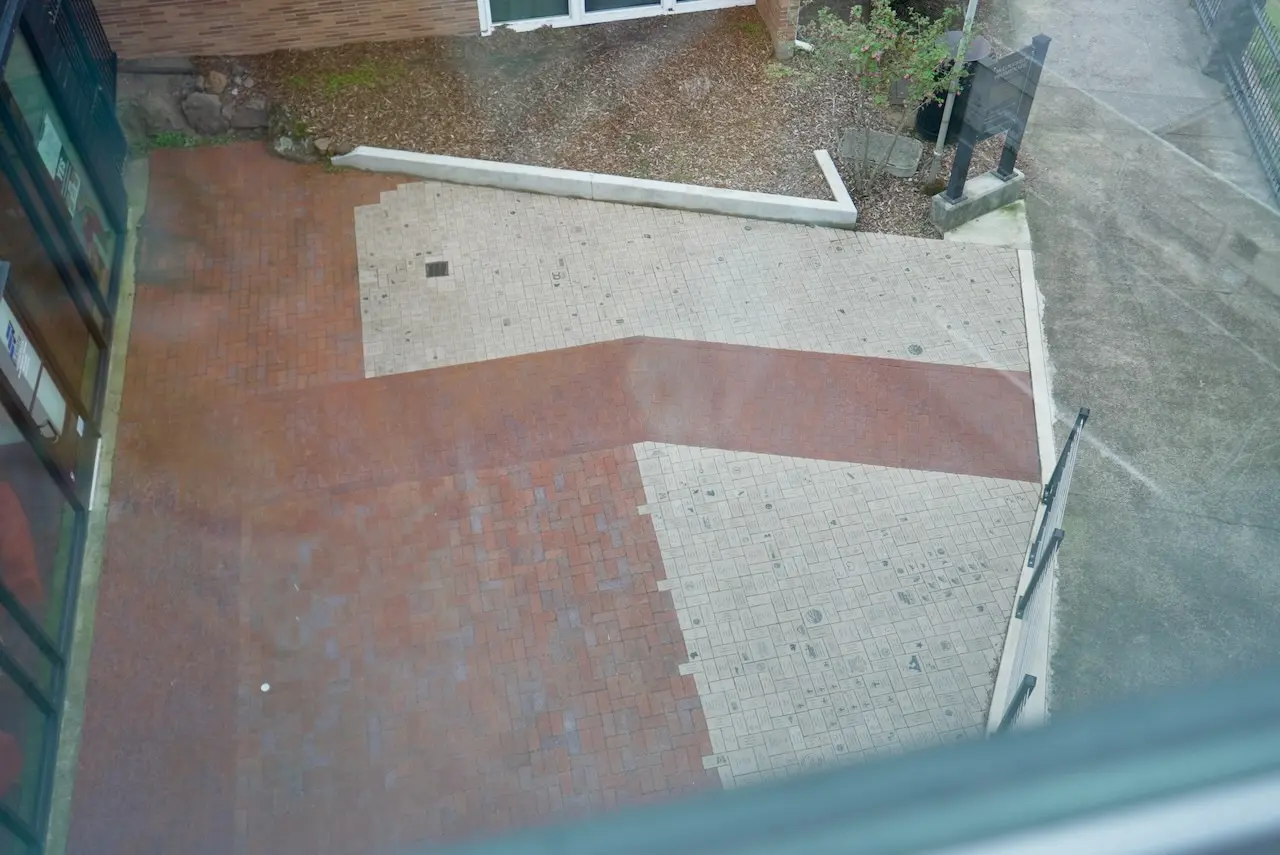
Across from the upper entrance, at 615 High Street, stands a 1961 building that was once a branch of Citizens Bank of Oregon. Ben James, a local investment planner, bought it in foreclosure in 2015 and named it Elevate Plaza. He turned its elevator-facing courtyard into a public space paved with engraved bricks, which riders see as they step out. As of April 2026, about 1,500 bricks had been sold, with room for about 1,500 more. “If that’s the living room for Portland, this is kind of the balcony for Oregon City,” James said, comparing it to Pioneer Courthouse Square. That spring he was looking for a coffee shop or café to rent the ground floor. The bank was built on the site of the Chase House, a 19th-century residence whose owner contested the elevator from the beginning.
Seven hundred steps and a vote
Dr. John McLoughlin of the Hudson’s Bay Company chose the riverbank site in 1829 for the power of the falls. The town soon filled the narrow shelf above the river and climbed onto a series of three bluffs. A sheer basalt cliff separates the first level from the second, and a railroad track runs along its base. By 1867, steps had been built up the bluff to add to Native American trails that residents were using. The city’s history says the preferred route ran 722 feet from the base of the cliff to the top. The city’s brochure counts 722 steps, and the library says about 700. Residents who did not want to climb could hitch a buggy and go around by Singer Hill.
The marker says an elevator was first proposed in 1899. On May 10, 1912, the City Commission put “A Public Elevator at the Bluff” on the ballot. Voters defeated it on July 8, 1912. On December 2 they approved $12,000 in bonds “to construct and operate an elevator from the lower to the upper town at some point to be selected.” John writes that the town also felt pressure from rival cities such as Gladstone, Milwaukie, and Portland.
Mrs. Chase and Elevator Street
According to the city, most residents favored an elevator, but none of the wealthy families on the bluff wanted it near their own property. Negotiations for access between Sixth and Seventh streets began by March 1913. The landowner there was Sarah A. Chase. She objected to an elevator in front of her house and refused to sell. On November 5, 1913, the council adopted a report on benefits and damages and appropriated land for a curving street on the bluff. On May 22, 1914, it moved to offer her $1,600. On June 17, 1914, a resolution recorded that she had been awarded $1,651.20 for excess damages and costs. The resolution declared the land “to be known as Elevator Street” and directed the engineer to stake it out and begin work at once. Councilman E.C. Hackett asked to have his vote against starting the work entered in the record.
The case went to the State Supreme Court, which ruled for the city. The city says she remained opposed and never rode the elevator. John writes that she “fought like a tiger.” The Oregonian, reporting in 2026, called her refusal local lore and added: “Some say her ghost still haunts the site.”
A second dispute concerned power. Water was cheaper than electricity, but the city’s Water Board refused to connect the elevator because it feared damage to the water system. The commission removed the board and appointed a new one made up of its own members. The matter went to court, and the elevator committee was instructed to get water from the board.
A wheezing ride and a catwalk
The Oregon Bridge and Construction Company built the first tower of steel and wood. According to the marker, it stood on the west side of the tracks. Sources give different dates for it. The marker says it was built in 1913, and Oregonian stories from 2013 and 2014 say 1912. The city’s history page says it opened November 27, 1915; the city brochure and the library give December 3, 1915. On opening day nearly the whole town rode it: 3,869 people by the city’s count, an estimated 3,850 by the library’s.
The ride covered 89 feet and took, in the city’s words, “a wheezing, jerking 3 to 5 minutes.” At the top, passengers crossed a 35-foot catwalk over the tracks to the cliff. When the elevator ran, water pressure dropped in the surrounding neighborhood; the marker says it used 200,000 gallons a day. When it stalled, riders climbed out through a trap door and down a narrow ladder. Mill workers used it to get home to the bluff without climbing the stairs. The “Free Oregon City Elevator” sign that hung on this tower is now in the media room on the main floor of the Oregon City Public Library.
By 1924 electricity had replaced water power, and the ride took 30 seconds. The library notes that most of the wooden staircases had been removed by then. By the 1950s the elevator was breaking down more often, and the city decided to replace it.
As plain as possible
The commission spent $7,000 on planning and asked for a structure “as plain as possible without adornment.” The library suggests that this instruction helped produce the tower’s spare midcentury modern form. Voters approved $175,000 in bonds in May 1952. When bids came in during November 1953, the lowest was over $200,000, and all were rejected. In January 1954 the Portland firm Stevens and Thompson submitted a new design by Gordon E. Trapp (1915–2009) that fit within the bond. James & Yost won the contract with a bid of $116,000 and built the tower from 751 tons of concrete and steel. A tunnel under the tracks replaced the catwalk. John writes that the change also let the tower be anchored to the bluff instead of standing free. The tower was listed individually on the National Register of Historic Places on May 15, 2014.
The new elevator was dedicated on May 5, 1955, and the commission accepted it on July 13. For the occasion the city printed 2,000 elevator passes, although the ride has always been free. The city still hands out passes as keepsakes.
Notable Events
- 1867Steps were built up the bluff to supplement early Native American trails used by residents. orcity.org
- 1899The original wood-and-steel structure was first advocated. hmdb.org
- 1912Voters authorized $12,000 in bonds to construct and operate an elevator between the lower and upper town. orcity.org
- 1912The first vote on funding a public elevator was defeated. orcity.org
- 1912The first structure was built and heavily used by mill workers traveling from bluff homes to riverfront factories. oregonlive.com
- 1913The original tower had an unprotected high-level footbridge over the tracks; its water-powered elevator consumed 200,000 gallons per day. hmdb.org
- 1913Negotiations started to acquire upper elevator access between 6th and 7th Streets. orcity.org
- 1913The bid of Morris Brothers for the elevator bonds was referred to the Finance Committee. orcity.org
- 1914The council deemed the property appropriated for a street to be known as Elevator Street and established it. orcity.org
- 1914The council moved to tender Mrs. S.A. Chase $1600 for condemnation of part of the block for the bluff street. orcity.org
- 1915The first municipal elevator was constructed here; it had deteriorated by 1954 and needed replacement. heritagedata.prd.state.or.us
- 1915The city's history page gives November 27, 1915 as the date the steel-and-wood elevator was placed into service, with almost the entire population (3,869 persons) riding that day. orcity.org
- 1915After three years of discussion and some legal conflict, the original wooden elevator was completed and opened. orcity.org
- 1915The first public elevator opened, improving access to the river-level business district. oregonencyclopedia.org
- 1924Electric power was utilized. hmdb.org
- 1924The city electrified the old elevator. oregoncitynewsonline.com
- 1950sFrequent breakdowns led to a determination that a new elevator was needed. orcity.org
- 1952A special election authorized $175,000 in bonds for a new elevator. orcity.org
- 1953All bids were rejected because the low bid exceeded $200,000. orcity.org
- 1954Oregon City erected the marker. hmdb.org
- 1954Stevens and Thompson submitted a new design within the bond amount; the low bid of $116,000 went to James and Yost, Inc. orcity.org
- 1955The Portland engineering firm James & Yost constructed the current structure. heritagedata.prd.state.or.us
- 1955The City Commission accepted the replacement elevator. orcity.org
- 1955The replacement was finished in time for tourist season after a low bid of $116,000. oregoncitynewsonline.com
- 1955Unreliability led to an electrically powered concrete-and-steel replacement. oregonencyclopedia.org
- 2006Officials recognized wear on the elevator; Mayor Norris appointed a committee to review challenges and recommend solutions. orcity.org
- 2007The committee secured $27,500 to commission new elevator art. orcity.org
- 2008The city installed a permanent, non-contributing art exhibit by Michael Asbill. heritagedata.prd.state.or.us
- 2008A ceremony dedicated the elevator art. orcity.org
- 2012The National Endowment for the Arts awarded a $100,000 Our Town grant supporting Carbonneau's installation; it was one of 80 nationally and two in Oregon. oregonlive.com
- 2014The Oregon City Municipal Elevator was individually listed on the National Register. heritagedata.prd.state.or.us
- 2014The yearlong display was scheduled to start; this report describes the plan, not proof of a completed launch. oregonlive.com
- 2019The city worked with Rotator Creative on promotions including a scavenger hunt visible from the top of the elevator. oregonlive.com
- 2019Visitors could collect field guides from an elevator operator and win an Oregon City pennant by returning with enough stamps or sketches. oregonlive.com
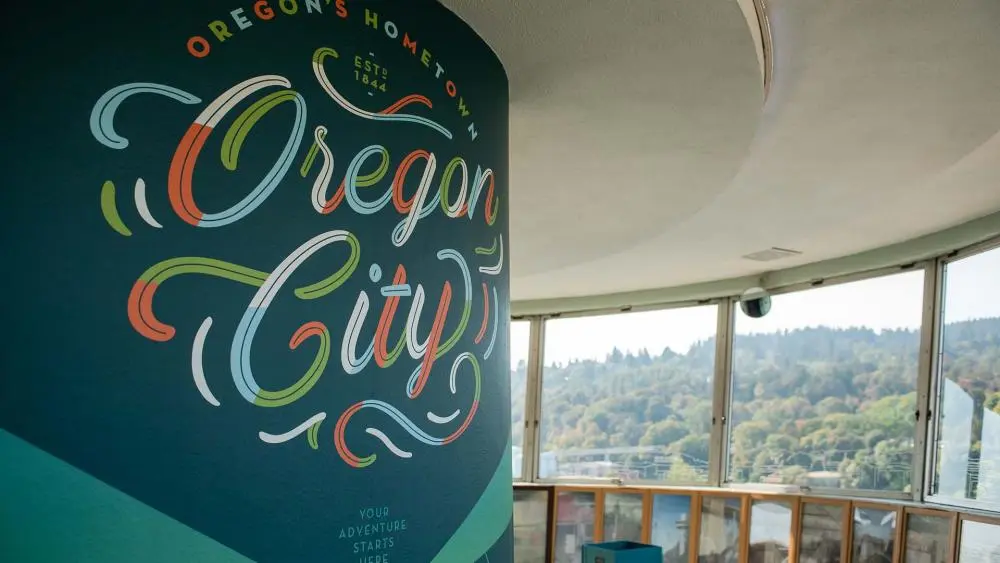
- 2019The anniversary campaign installed the mural in the elevator observation area and vinyl window graphics marking downtown points of interest. oregonlive.com
- The announced launch included an artist reception and party at the elevator base; the page does not give the event year in this sentence. oregonlive.com
People
- Gordon E. Trapp, Architect of the 1955 elevator, of the engineering firm Stevens & Thompson of Portland, Oregon (1915-2009).
- Michael Asbill, Artist who designed the permanent art exhibit installed in 2008 (2008).
- Anne J. Paris, Artist/Writer.
- Cheryl Snow, Executive Director of the Clackamas County Arts Alliance, which coordinated the art project.
- Chuck Clemans, Arts Advocate.
- Eli Jimenez, Artist.
- John Lewis, Public Works Operations Manager.
- Mayor Norris, Appointed the Municipal Elevator Art Steering Committee (early 2006).
- Nancy Kraushaar, Public Works Director and City Engineer.
- Pat Averill, Artist.
- Paula Lewis, Artist.
- Sarrah Torres, Business Owner/Winestock.
- E.C.Hackett, Requested recording his vote against starting the Elevator Street work (June 17th,1914).
- Sarah A. Chase, Awarded excess damages and costs for appropriation of the street property (June 17th,1914).
- Carrie Crook, Former elevator manager for the Downtown Oregon City Association.
- John McLoughlin, Oregon City's founder, portrayed in an image visible from the elevator observation deck.
- Kendon Shaw, Rotator Creative partner describing the observation-deck binoculars used in the campaign.
- Barry Johnson, Editor of Oregon Arts Watch, commenting on elevator art.
- Lloyd Purdy, Main Street Oregon City director and project manager.
- Tiffany Carbonneau, Artist selected nationally to create the installation with an Our Town grant.
- Jonathan Stone, Main Street Oregon City executive director associated with the Illuminate elevator installation.
Sources
- orcity.org/1235/Municipal-Elevator
- orcity.org/1244/Elevator-Operating-Hours
- orcity.org/1245/Elevator-Updates
- orcity.org/DocumentCenter/View/3956/Brochure-on-Municipal-Elevator-PDF
- heritagedata.prd.state.or.us/historic/index.cfm?do=v.dsp_siteSummary&resultDisplay=655390
- oregonlive.com/clackamascounty/2026/04/a-big-renovation-at-the-top-of-oregon-citys-iconic-elevator-is-nearly-complete-what-it-needs-is-a-coffee-shop.html
- commons.wikimedia.org/wiki/Category:Oregon_City_Municipal_Elevator
- oregonlive.com/clackamascounty/2026/09/how-many-of-these-hidden-oregon-city-elevator-easter-eggs-can-you-find.html
- orcity.org/DocumentCenter/View/9616/1913-11-05-City-Commission-Minutes-elevator-condemnationpdf
- orcity.org/DocumentCenter/View/9621/1914-05-22-City-Commission-Minutes-Condemnation-paymentpdf
- orcity.org/DocumentCenter/View/9619/1914-06-17-City-Commission-Minutes-elevator-streetpdf
- orcity.org/1243/Elevator-Art-Dedication-September-2008
- oregonlive.com/oregon-city/2013/06/oregon_citys_130-foot_elevator.html
- oregonlive.com/oregon-city/2014/01/illuminate_oregon_city_street.html
- hmdb.org/m.asp?m=296934
- oregonencyclopedia.org/articles/oregon-city
- oregoncitynewsonline.com/2025/10/30/offbeat-oregon-worlds-steepest-street-goes-straight-up
- oregonlive.com/oregon-city/2014/06/oregon_citys_mcloughlin_promen.html
- docomomo-oregon.org/resources/oregon-city-municipal-elevator
- orcity.org/356/The-Free-Oregon-City-Elevator-Sign