Mt. Shavano Hatchery
Salida, Chaffee County, Colorado. State fish hatchery.
Details

- Where
- 7725 County Road 154, Salida, CO. Directions
- When
- Guided tours are given, daily, 10am to 4pm, Memorial Day through Labor Day.
- Season
- Guided tours daily Memorial Day through Labor Day; self-guided tours year-round.
- Hours
- Daily, 8 a.m. to 3:30 p.m.
- Access
- Visitors are welcome every day of the week with either host-guided or self-guided tour.
- Walk-in or reserve
- For large groups, please contact the hatchery.
- Phone
- (719) 539-6877
- Website
- cpw.state.co.us
- Managed by
- Colorado Parks and Wildlife.
- Established
- 1956.
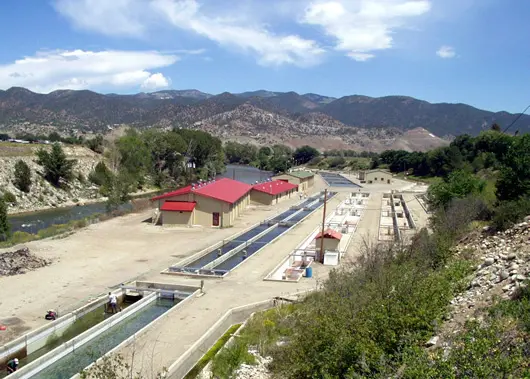
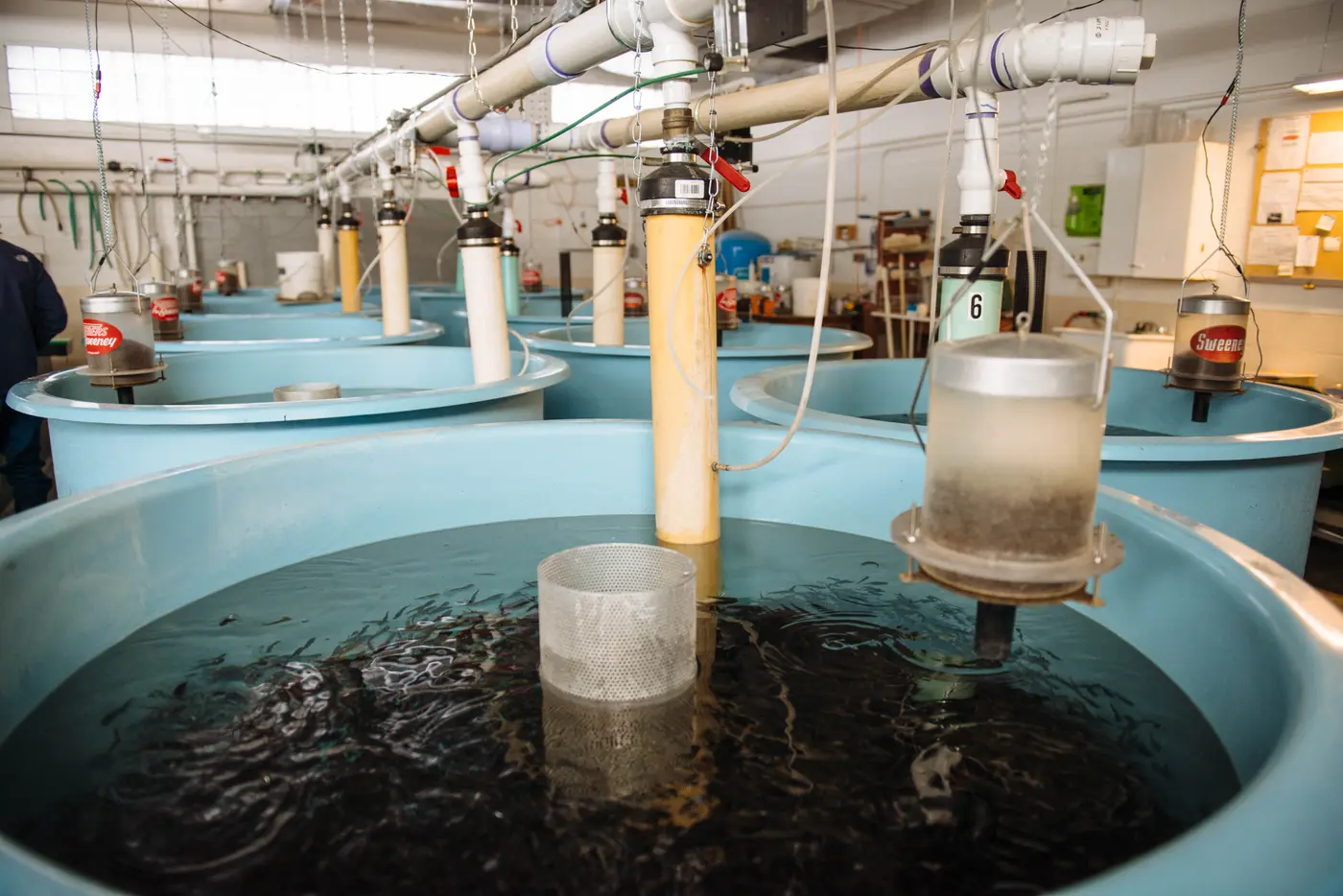
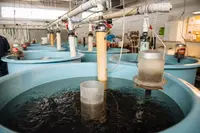
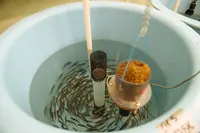
The water in the raceways at Mt. Shavano State Fish Hatchery rises from large underground springs. Its temperature varies little, with a seasonal average of 50 degrees Fahrenheit. In that water grow rainbow trout, Snake River cutthroat, cutthroat-rainbow crosses called cutbows, and kokanee salmon, in outdoor raceways and ponds and in indoor rearing tanks and troughs at 7725 County Road 154, just north of Salida in Chaffee County. Colorado Parks and Wildlife runs the place. Visitors may walk it on their own any day of the year. From Memorial Day through Labor Day, guides lead free tours daily between 10 a.m. and 4 p.m. Dispensers marked “Feed the Fish” give out food for the trout. A visitor center holds exhibits on local fish and wildlife and racks of free brochures, and staff will stamp the free Colorado Parks and Wildlife passport, which counts fifteen hatcheries among its 57 stops.
Many of the ponds and raceways stand empty, and the hatchery’s own brochure takes up the question. As part of a cleanup of whirling disease, a parasite that attacks the cartilage of young trout and causes deformities and a “tail chasing” behavior, the hatchery switched from river and spring water to spring water alone, and lost flow. The same brochure explains that there are no big fish on view. Mt. Shavano once kept a show fish pond, but larger fish are more likely to carry disease, and hatcheries are no longer allowed to keep them.
Springs at fifty degrees
The agency calls Mt. Shavano one of the largest trout units in the state. Its web page puts annual output at about 520,000 catchable trout, 10 inches long and free of whirling disease, and about 2.5 million subcatchables of 2 to 5 inches. The hatchery brochure, and another passage on the same web page, give about 500,000 and 2 million. Most eggs come from the state’s brood hatcheries, Crystal River Hatchery and the Poudre Rearing Unit. Some come from private and federal hatcheries as far away as West Virginia, and some from wild spawns.
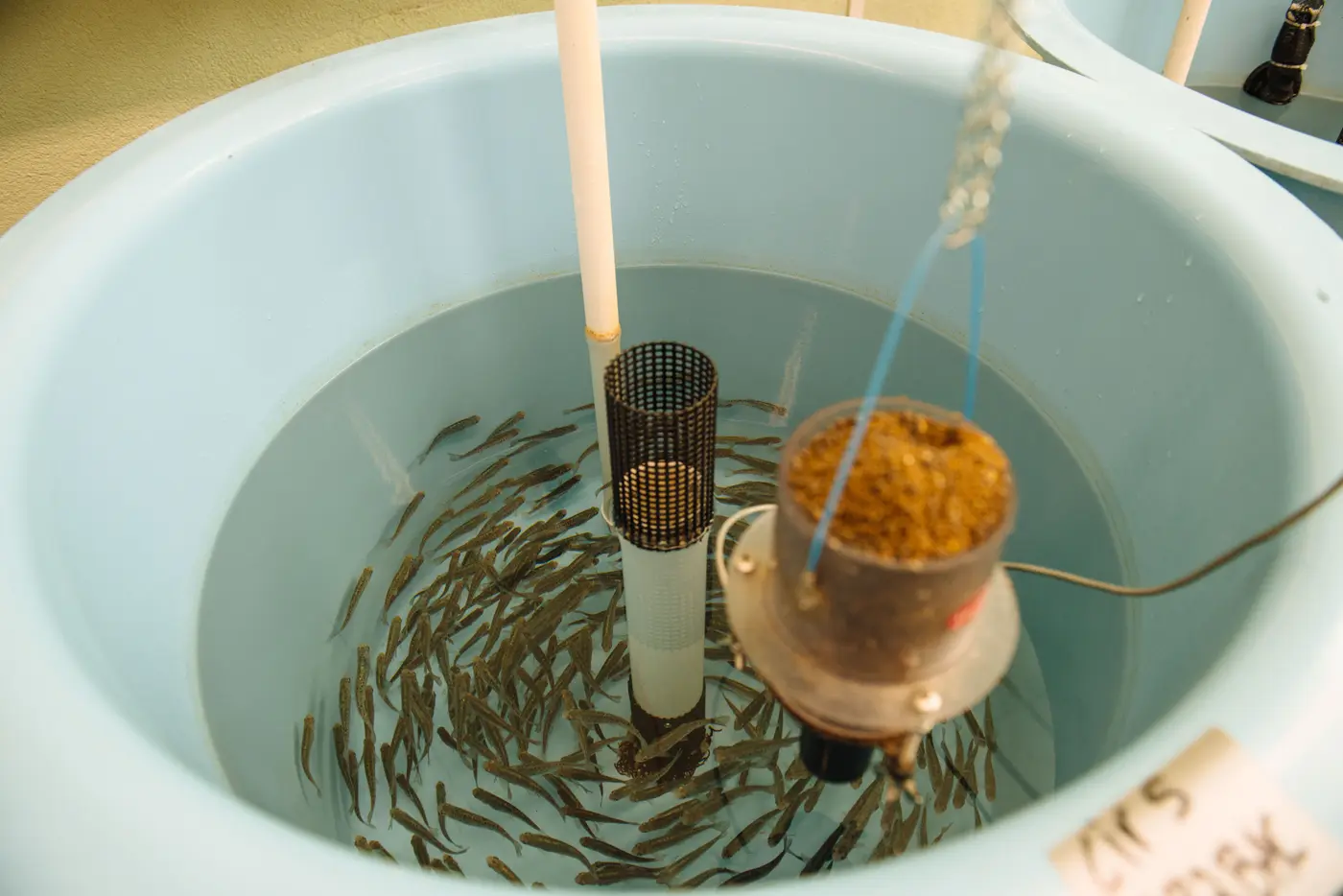
The brochure follows a fish through its names. A fry has just hatched, is less than an inch long, and carries a yolk sack. At about one month it becomes a swim-up fry, rising to the surface to eat mashed feed. A fingerling is two or three inches long and three or four months old. A subcatchable runs three to eight inches and four to ten months. A catchable is 10 to 12 inches or more and 12 to 14 months old. The fish are fed a high-protein, vitamin-rich pellet two to ten times a day, depending on size, and the hatchery goes through 500 to 900 pounds of feed daily. Grown fish are loaded into 1,000-gallon tanks on flatbed diesel trucks and planted in lakes, reservoirs and rivers across Colorado.
Bryan Johnson manages the hatchery with a seven-person team. On a July 13, he watched an assistant wildlife manager release rainbow trout from a truck-mounted tank into Monarch Park Ponds, fifteen miles west of Salida in the San Isabel National Forest, newly restored with an accessible fishing pier. The 300 catchable trout stocked that month had been raised at Mt. Shavano from eggs, nearly a year’s work. “This is probably the best part of my job,” Johnson told KOAA. “Seeing people use these lakes and watching a child reel in a trout that our team spent the past year raising is what all of this work is about.”
Greenbacks by foot, horseback and airplane
The same staff run two other units. The Mt. Ouray Hatchery, acquired in 1990, has 24 troughs and six small raceways and produces about 700,000 subcatchable rainbow trout and kokanee salmon a year. The Salida Isolation Unit, built in 2002, has four rooms of troughs and circular tanks. Its water is used once, then passed through an ultraviolet filter before release, which is why it is classified as an isolation building.
The isolation unit raises the greenback cutthroat trout, Colorado’s state fish. In 2008, sixty-six adult greenbacks were taken from Bear Creek and brought to Salida to start a broodstock for returning the subspecies to its native waters. Broodstocks now exist at several state hatcheries, at Leadville National Fish Hatchery and at Zimmerman Lake. Each year fertilized eggs from them come to the Salida unit to hatch. In the fall the young cutthroat, one to two inches long, are carried by foot, by horseback and by airplane into high mountain lakes within their native range, about 200 lakes and streams a year.
Fresh trout on ice, two trains each way
Before the state, the ponds belonged to the Frantz family. Horace Frantz Jr., interviewed by The Mountain Mail in 2012 at 89, said that about 1924 someone who owed his father, Horace Sr., money offered him some lakes at Colorado Springs in payment. Horace Sr. took the lakes, built a trout farm there, ran it until 1928, then bought the Salida property that became known as Frantzhurst. The sources disagree on the start. The Colorado Encyclopedia says a “Horace Frantzhurst” built the Frantzhurst Fish Hatchery just north of Salida in 1925 and ran it until 1953. A Chaffee County timeline on salida.com dates the project to 1926. T. Rex Rhodes, a Salida man who worked summers on the farm as a boy, told an oral-history interviewer in 2006 that Mr. Frantz started it about 1928.
Rhodes also explained the name. “It was the Frantz family that had it. They were Germans. Hurst is tree, I believe, in German.” He remembered the grounds as “just so gorgeous, I mean down all the around the ponds.” By his account Frantz came from a wealthy eastern family, “was a great promoter and had huge events here,” and kept an airstrip on the land. The family’s big log house, built as a summer lodge, had a living room three floors high, and each Christmas a tree reached to its top. Frantz Lake, Rhodes said, took its name from the family.
In 1928 Horace G. Frantz told the Salida Chamber of Commerce he would enlarge and beautify the farm even if no stock was subscribed locally, wanting it to be the biggest attraction in that section of the state. In 1929 the Salida Mail reported that one and a quarter million rainbow trout would be hatched there that year for the 1930 market, expected to yield 600,000 pounds of fish worth half a million dollars.
Frantz Jr. described the farm at its height. “The trout farm was advertised as one of the two top tourist attractions in this part of Colorado,” he said. “The Royal Gorge was the other one. We had up to 10 cars at the trout farm all summer long as tourists came to see the fish and beautiful landscaped grounds.” Dressed trout went out on ice every day on four trains, two east and two west, to restaurants and hotels including the Harvey Houses of the Santa Fe Railroad and the Brown Derby in Los Angeles. Ice was cut from Frantz Lake each winter and stored in an icehouse on the farm, and the Railway Express Agency re-iced the fish along the route. In 1948 the Saturday Evening Post ran an eight-page color spread on the operation, and the next year the Ford Motor Company featured the farm in a truck ad that ran in nearly every magazine in the country.
The publicity reached Hollywood. On a visit to Fox Studio the Frantzes arranged a dinner at Earl Carroll’s Theatre Restaurant, where the chef would demonstrate how the trout were prepared. The room had a dance floor, and someone suggested a starlet. “I was 18 years old at the time and the studio arranged a date with Norma Jean Baker,” Frantz Jr. said. “Norma Jean was 15 then and later became known as Marilyn Monroe.”
After World War II, frozen trout arrived from Denmark and other countries at prices the restaurants preferred, and the market for fresh trout disappeared. In June 1953 the Frantzhurst Rainbow Trout Co., advertised as the largest trout farm in the world, went under the sheriff’s hammer for a bid of $130,000 to the Reconstruction Finance Corporation. The property represented an estimated investment of more than three quarters of a million dollars. A fish culture expert, C.E. McMath, was managing the farm in 1954.
The dam upstream and the hospital ground
The state bought the farm in 1956. The Colorado Encyclopedia says the Division of Wildlife renamed it the Mt. Shavano Fish Hatchery and Rearing Unit and used it to restock streams and rivers that overfishing had thinned. Around 1956 a low-head dam was built on the Arkansas River, about 1.5 miles upstream, to divert water to the hatchery. It was rebuilt in 1988 with a boat ramp beside it. Whirling disease was found in the Arkansas a few years before 2000, and from that year the hatchery took no river water, relying on ground water alone. After the cleanup the hatchery was certified free of the disease. At one point Parks and Wildlife officials said the dam would stay in the river because of the value of its water rights to the hatchery. Crews began removing it on October 23, 2023, with money from the agency and the Chaffee County commissioners.
The state’s land served the town in another way. In 2003 the City of Salida tried to trade its abandoned gun club property for state land suited to a new hospital, but decades of shooting had left the gun club ground contaminated with lead shot and other metals. After a cleanup led by GARNA, the land was declared safe in 2004, and the hatchery accepted the exchange. The regional medical center moved to its new building on Salida’s western edge in 2008. Rhodes, speaking two years earlier, recalled the site of the new hospital as Frantz property.
In March 2025 Colorado Parks and Wildlife put out to bid a modernization of the hatchery, with engineering by Schnabel Engineering. The contract covered an aeration and degassing tower, a new office building, a production building, a water treatment plant, cold storage, a parking garage and an effluent pond, with an automated feed system and solar panels offered as alternates.
A trout in a fur coat
The hatchery’s oddest holding came from the Salida chamber of commerce. Wilbur Foshay, a Minneapolis utilities magnate whose empire collapsed in 1929 and who served time in Leavenworth for mail fraud, came back to Salida in the 1930s to run the chamber. The Salida Museum says he blanketed roadsides for thousands of miles with yellow signs reading “Follow the Hearts to Salida,” and that his promotion drew the journalist Ernie Pyle to town to look into the fur-bearing trout, “another Foshay ‘discovery.’” Pyle wrote: “If you haven’t heard of Salida, you better keep it good and quiet. There’s a man here who eats people who haven’t heard of Salida.” Governor Ralph Carr made the trip to examine the fish himself.
The Mountain Mail gives the particulars, hedged as the town tells them. Supposedly there were three original fur-bearing trout, made in the 1930s by a local rancher, Cecil Kaess, to get publicity for Salida. The fur is believed to have been rabbit. According to the legend, the Arkansas ran so cold that its trout grew coats. The original hung for years in the chamber office at Third and F streets. About 2011 the Travel Channel featured it in an episode about museums, and the Salida Museum borrowed it from the hatchery for the filming. The fish at the museum is a re-creation donated by a local taxidermist. When a Denver artist asked in 2020 to see the original, the museum board sent him photographs of the one at Mount Shavano Fish Hatchery, and the 2021 newspaper account placed it on display in the hatchery’s visitor center.
Notable Events
- 1920sA privately built Frantzhurst Fish Hatchery arose north of Salida; the timeline says the Colorado Division of Wildlife took over in the 1950s, when it became Mount Shavano Fish Hatchery. salida.com
- 1925Horace Frantzhurst built the Frantzhurst Fish Hatchery just north of Salida as part of the county's shift from mining to new industries. web.archive.org
- 1928The interviewee recalls that the enterprise was started about 1928 by Mr. Frantz, who came from a wealthy eastern family and was a great promoter who held huge events in Salida. digital.salidalibrary.org
- 1928Horace G. Frantz told the Salida Chamber of Commerce he would go on with his plans to enlarge and beautify the trout farm even if no stock was subscribed locally, wanting the farm to be the biggest attraction in that section of the state. salida.com
- 1929The Salida Mail reported that one and a quarter million rainbow trout would be hatched at the Frantzhurst Trout Farm that year to supply the market in 1930, expected to yield 600,000 pounds of fish worth a half million dollars. salida.com
- 1948The Saturday Evening Post published an eight-page spread with colored pictures describing the entire trout farm operation. themountainmail.com
- 1953The Frantzhurst Rainbow Trout Co., advertised as the largest trout farm in the world, went under the sheriff's auction hammer for a bid of $130,000 to the Reconstruction Finance Corporation; the property represented an estimated investment of over three quarters of a million dollars. salida.com
- 1953The hatchery raised trout and operated from 1925 to 1953. web.archive.org
- 1956A low-head dam was first built around 1956 to collect water for the hatchery downstream. coloradotu.org
- 1956The state purchased the hatchery, which became one of the largest trout units in the state. cpw.state.co.us
- 1956The Colorado Division of Wildlife bought the hatchery and renamed it the Mt. Shavano Fish Hatchery and Rearing Unit, to supply Colorado's streams and rivers with fish that had dwindled from overfishing. web.archive.org
- 1988The dam was rebuilt in 1988 with an adjacent boat ramp. coloradotu.org
- 1990Acquired in 1990, the Mt. Ouray Hatchery is an extension and supplement to the Mt. Shavano Hatchery and is operated by the Mt. Shavano staff. cpw.state.co.us
- 2000After whirling disease was detected in the Arkansas River a few years earlier, the dam has not been used as a water supply for the fish hatchery since 2000. coloradotu.org
- 2002Built in 2002, the Salida Isolation Unit on the hatchery's site consists of four rooms with troughs and circular tanks for raising fish; it is classified as an isolation building because the water is not reused and must be treated through an ultra-violet filter before release. cpw.state.co.us
- 2003The City of Salida sought to trade its abandoned Salida Gun Club property for state-owned land suited for a modern hospital, but decades of gun club use had left the land contaminated with lead shot and other toxic metals, making it ineligible for exchange. stage-rail.com
- 2004After GARNA-led cleanup, the land was deemed safe for transfer, clearing the way for the State's Shavano Fish Hatchery to accept the exchange that later carried the regional medical center. stage-rail.com
- 2008In 2008 adult greenback cutthroat trout were removed from Bear Creek and brought into the Salida Isolation Unit with the goal of developing a broodstock for the cutthroat's recovery. cpw.state.co.us
- 2023Colorado Parks and Wildlife closed a short segment of the Arkansas River beginning Oct. 23 to facilitate removal of a low-head dam located 1.5 miles upstream from the Mount Shavano State Fish Hatchery. coloradotu.org
- 2025Colorado Parks and Wildlife initiated the Mt. Shavano SFU hatchery modernization project, aimed at renovating the existing hatchery facilities located at 7725 Co Rd 154, Salida, and the state posted the construction bid that year. highergov.com
- After internal discussion, Colorado Parks and Wildlife officials indicated the lowhead dam north of Salida would remain a feature of the river at that time because of the value of its water rights to the Mount Shavano Fish Hatchery. themountainmail.com
- Frozen trout imported at low prices ended the market for fresh trout, and following the interest of the Colorado fisherman the hatchery was sold to the State of Colorado. themountainmail.com
- The year after the Saturday Evening Post spread, the Ford Motor Company ran a truck ad featuring the trout farm in nearly every magazine in the United States. themountainmail.com
People
- Bryan Johnson, The contact named for the hatchery on the agency's facility page (not stated).
- T. Rex Rhodes, Salida resident who worked at the FrantzHurst's Rainbow Trout Farm in the summertime and said the farm's family gave Frantz Lake its name (interviewed April 4, 2006).
- C.E. McMath, Fish culture expert managing the Frantzhurst Fish Farm, quoted on the farm's low fish death rate (managing the farm in 1954).
- Horace G. Frantz, Sr., Started the 1926 project that became the Frantzhurst Rainbow Trout Co. property (project started in 1926).
- Matt Schehrer, Manager of the Mount Shavano Fish Hatchery, quoted on its annual fish production (named as manager in the July 8 report).
- Wilbur Foshay, Manager of Salida's chamber of commerce whose publicity produced the fur-bearing trout story; the museum board told the artist the original fish was at the Mount Shavano Fish Hatchery (the 1930s).
- Horace Frantz Jr., Son of the founder who grew up on the trout farm in Salida and recounted its history (moved to Salida at age 4; 89 at the time of the article).
- Horace Frantz Sr., Established the private Frantzhurst Trout Farm on the site and ran it until the hatchery was sold to the State of Colorado (operated a trout farm in Colorado Springs from 1924 until 1928, when he bought the Salida property).
- Horace Frantzhurst, Named by the Colorado Encyclopedia as the builder of the Frantzhurst Fish Hatchery just north of Salida (built it in 1925; the encyclopedia says the hatchery operated 1925 to 1953).
Sources
- cpw.state.co.us/hatchery/mt-shavano
- salidachamber.org/business/government/mt-shavano-hatchery
- facebook.com/MtShavanoHatchery
- cpw.state.co.us/fish-hatcheries
- koaa.com/news/environment/colorado-parks-and-wildlife-restore-and-stock-monarch-park-ponds
- highergov.com/sl/contract-opportunity/co-replace-mt-shavano-sfu-hatchery-mode-45927454
- cpw.state.co.us/sites/default/files/dam/yzsibvecrz/mt.pdf
- digital.salidalibrary.org/wp-content/uploads/2022/10/T.-Rex-Rhodes-transcript.pdf
- salida.com/information-guide/salida-history
- themountainmail.com/news/arts_entertainment/article_261f8b84-fee6-11eb-90e8-f389996ca7fa.html
- salidamuseum.org/history/wibur-foshay
- coloradoencyclopedia.org/article/chaffee-county
- stage-rail.com/online-brochure
- durangoherald.com/articles/regional-news/river-dam-near-salida-removed-after-years-of-rescues-drownings-and-environmental-impacts
- themountainmail.com/free_content/2014-year-in-review-july-through-september/article_1793f15a-90fb-11e4-a77b-2b2de1101b66.html
- themountainmail.com/news/frantz-tells-tales-of-world-s-largest-trout-farm/article_2ca0f146-12f0-11e2-839f-0019bb30f31a.html
- coloradotu.org/blog/2023/10/colorado-parks-and-wildlife-announces-closure-on-arkansas-river-near-salida