
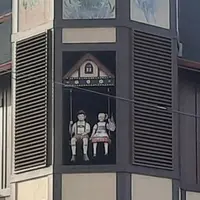
Glockenspiel
Mount Angel, Marion County, Oregon. Glockenspiel; Every day of the year.
Details

- Where
- 190 E. Charles St., Mount Angel, OR 97362. Directions
- When
- Figures come out at 11, 1, 4, and 7 daily.
- Getting there
- Northwest corner of Garfield and Charles Sts, one block east of Main St.
- Phone
- 503-845-6222
- Website
- oktoberfest.org
- Established
- 2006.
Four times a day at Garfield and Charles
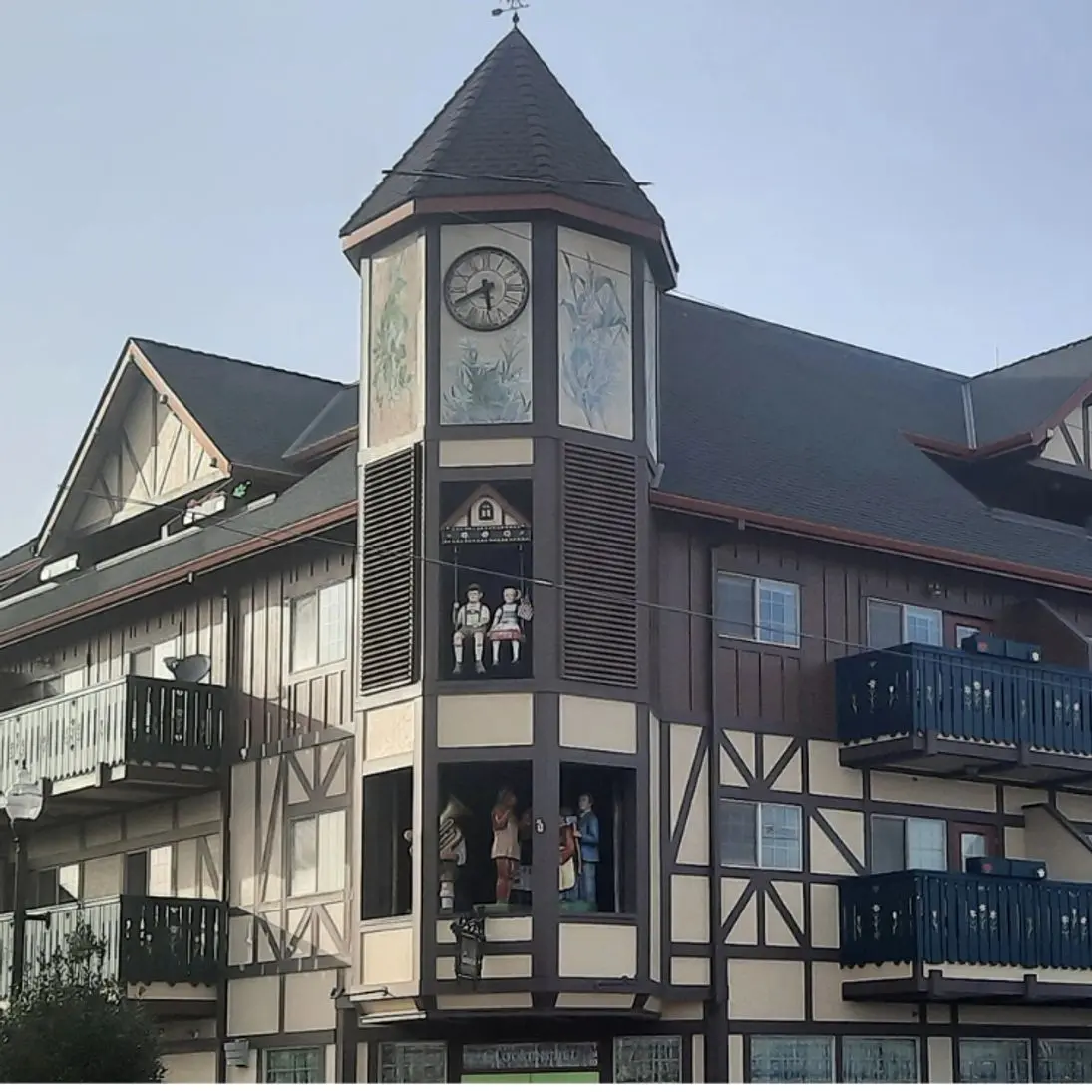
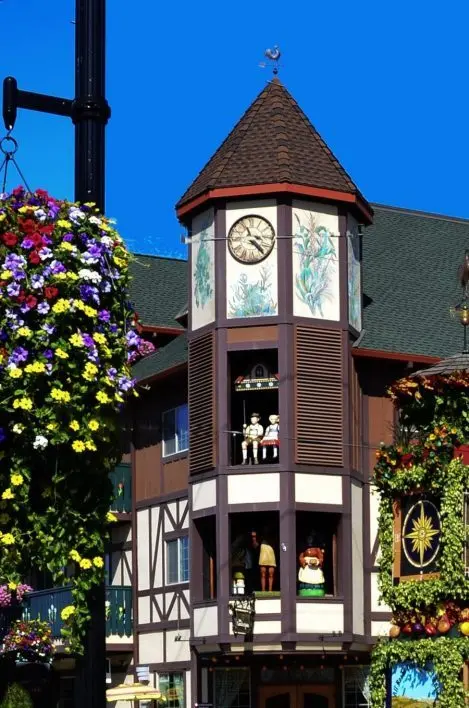
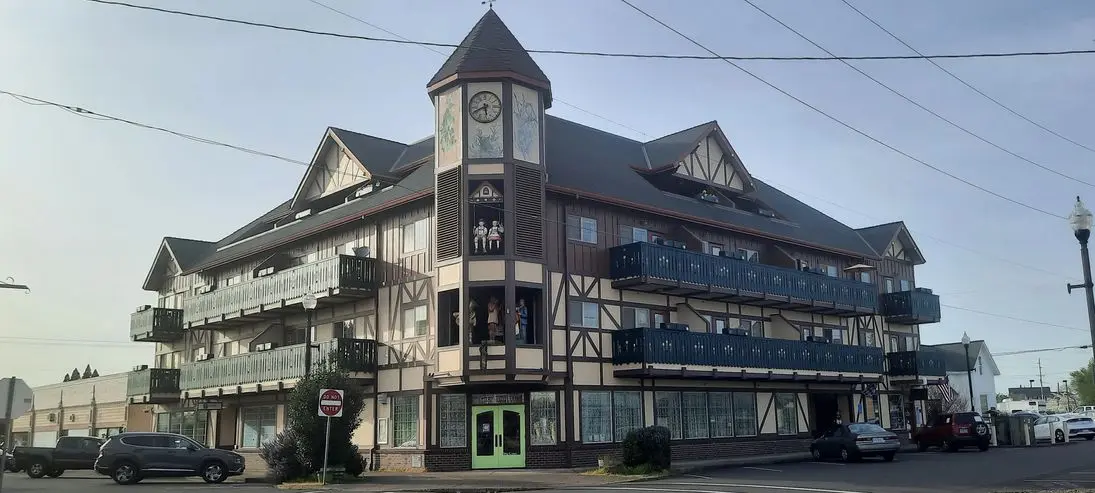
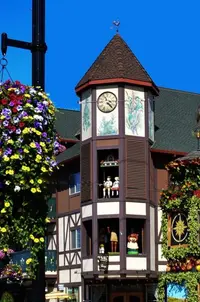
At the northwest corner of Garfield and Charles streets, one block east of Main, a tower of stucco and half-timbering rises 49 feet over downtown Mount Angel. A large clock is set high on its face. At 11 a.m. and at 1, 4 and 7 p.m., every day of the year, the bells ring, shutters open, and people on the sidewalk stop to watch.
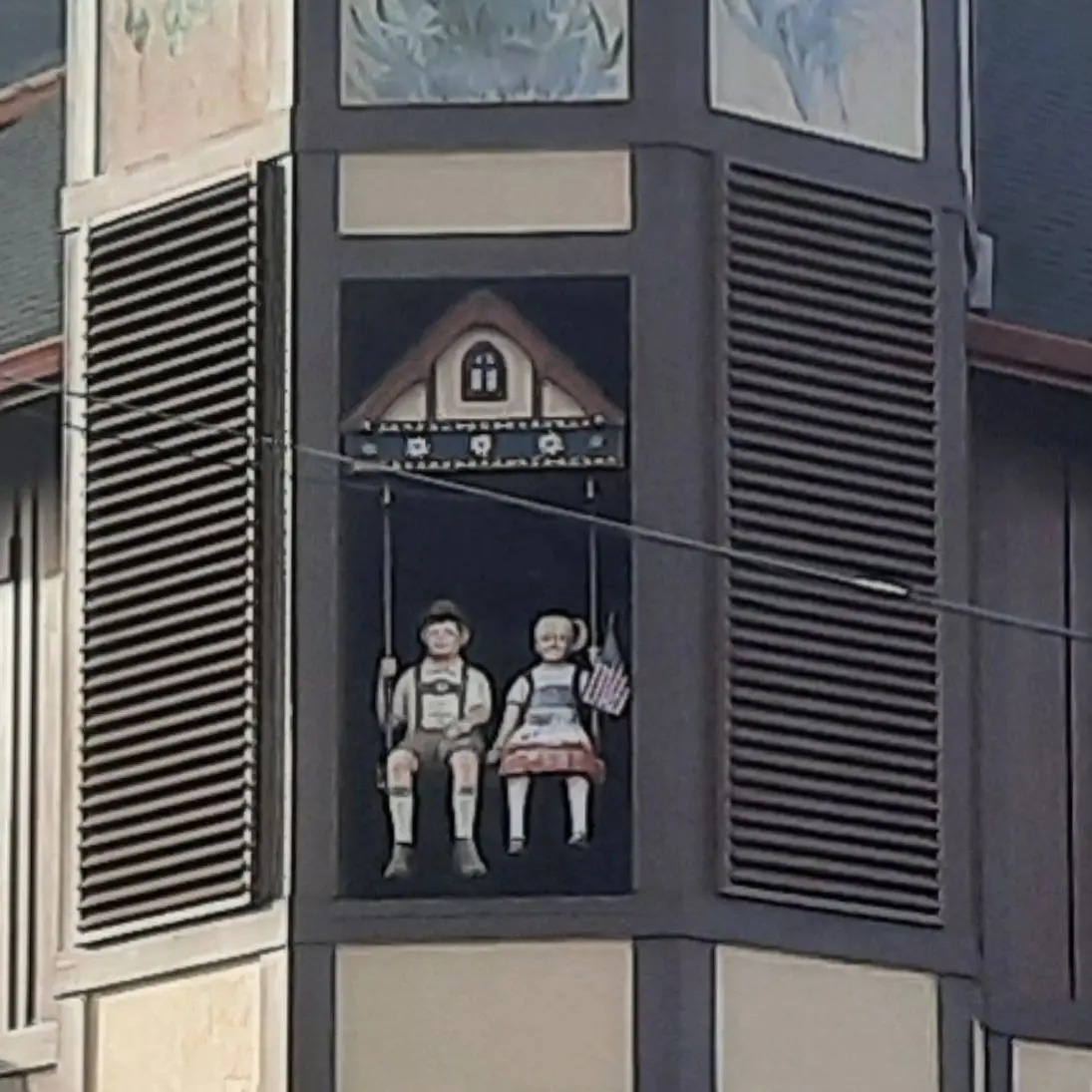
On the lower stage, six life-size wooden figures carved by local carvers make their rounds. Each comes front and center in turn to its own recorded music. The sources place this stage differently. The Oktoberfest organization puts it on the first floor above street level. The Salem Statesman Journal calls it the second floor of a four-story tower. Our Town described the whole structure as a three-story timepiece. An Associated Press report from 2006 gave the statues as five feet tall, carved of basswood, moving on a platform. At the end of each show the shutters at the top open. A boy and a girl in Bavarian costume swing on a garden swing while “Edelweiss” plays, sung on the recording by local schoolchildren. The AP named them as grade-schoolers from “Mary’s Public School.”
The tower was built to resemble an Alpine chalet. It forms one corner of the Edelweiss Building, which in its first years held a bank, a German gift shop, a restaurant, and three floors of senior housing. Sound barriers were built into the walls for the residents. Plans in 2006 called for the last song to end before sunset, except during Oktoberfest, when the clock might run until midnight. That festival fills the same intersection for four days each September, beginning on the second Thursday after Labor Day, and draws about 350,000 people to a town of some 3,500. In festival week the Fruchtsäule, a harvest monument raised every year since 1969, stands in the street at Charles and Garfield beside the tower.
In April 2018 the Glockenspiel was named one of the first ten stops on the Mount Angel Heritage Trail. Its plaque carries a picture etched into metal, with text that the Mt. Angel Historical Society helped research.
The story on the platform
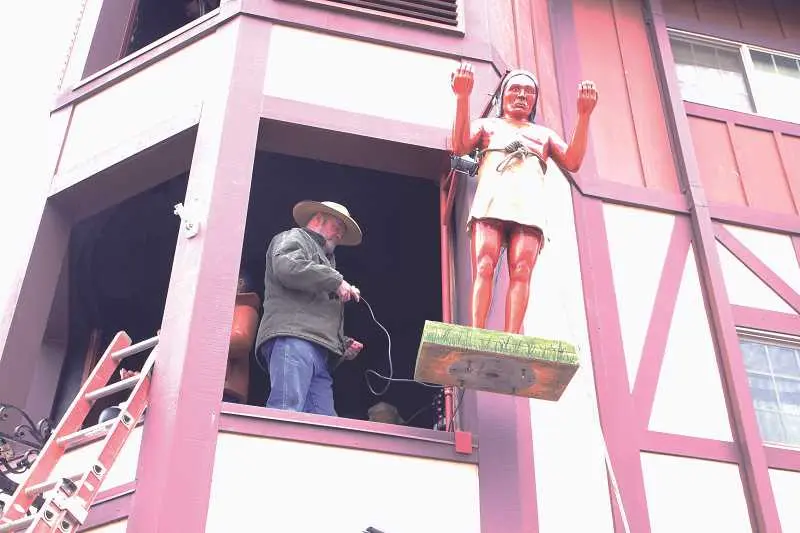
The figures tell the town’s history in order. The first is a Kalapuya brave at prayer. According to the clock’s narrative, T.W. Davenport, the original surveyor of the area, recorded that Indians traveling through the valley climbed the butte above town to pray to the Great Spirit. They told him the practice came from their ancestors and called the place Tapalamaho, the Mount of Communion.
Next comes a double statue of the first German settlers in this part of the valley, who arrived in 1867 from Rathenberg in the Kingdom of Bavaria. The Oktoberfest page names them Mr. and Mrs. Robert Zollner. A 2016 Pamplin Media report names them Robert and Kathrina Zauner.
Mathias Butsch (Pamplin spells it Matthias) came in the fall of 1878 and led the Catholic community. He helped build the first church, a community store, and the railroad station, and he brought the Benedictine monks. He is still called the “Father of Mount Angel.” Prior Adelhelm Odermatt came from Engelberg, Switzerland, founded the Benedictine monastery in 1881 by the clock’s account, served as the first pastor, and proposed the name Mount Angel, an anglicized Engelberg. Sister Bernadine Wachter came with the Benedictine Sisters from the Convent of Maria Rickenbach in Switzerland in 1882. She was the first prioress of the convent and its new school.
The sixth figure stands for 1966 and the first Oktoberfest. Papa Oom Pah is the festival’s mascot: rosy cheeks, a flowing mustache, lederhosen, and a large tuba. Oktoberfest paid for him, and Mike Reifel of Silverton carved him.
Where Engelberg Antiks stood
The tower stands on the site of an antique store. Henrietta Ruef Dill, called Henri, was born in 1943. A 2007 Oregonian feature reported that she was born without femurs and had both feet amputated at age 12. Her daughter, Lori Lathrop, recalled that doctors told the family “she shouldn’t take her home.” Henri’s parents brought her back to Mount Angel anyway. She later earned a journalism degree from Seattle University, ran a publishing company called the Angel Press, and married Ernie Dill at St. Mary’s in Mount Angel in 1964. Ernie was an Air Force man. His obituary gives a 20-year career; Our Town reported 22 years. The couple raised five children.
After Ernie retired in 1984, the family opened Engelberg Antiks in Mount Angel that October. By Lori’s account it was the first antique collective in Oregon. A second store opened in Salem the next year. In the early 2000s the Dills found the Mount Angel building in such disrepair that it had to come down. Henri planned a replacement, Edelweiss Village, which combined low-income housing with commercial space. The town had long required new or substantially remodeled downtown commercial buildings to include Bavarian features.
Raising the glockenspiel took five years of community fundraising and work with Marion County officials. The Mt. Angel Community Foundation helped raise the money and now uses its funds to maintain the clock. Mayor Tom Bauman said the town hoped it would draw tourists the way the glockenspiels of Europe do. Its promoters said it would take the title of tallest in the United States from New Ulm, Minnesota. Roadside America, noting how few glockenspiels the country has, calls it “supposedly” the tallest. The original six figures debuted at Oktoberfest in September 2006.
The restaurant under the tower opened just before that festival, according to The Oregonian; another account gives 2007. It was co-owned by Mike and Mary Grant and served pork schnitzel and apple strudel à la mode until December 30, 2019, when the Dills and the Grants retired. The 2007 feature said Henri “never took no for an answer.” She oversaw Edelweiss Village for about 18 years. Ernie died on July 26, 2023, and Our Town reported that Henri died of pneumonia six months later.
Six branches of service
Henri Dill had another set of figures in mind from the start. “When we first constructed the Glockenspiel we knew we wanted to do a salute to the military,” she told Pamplin Media. “The community here is very patriotic. This tiny town sent over 200 men to war in World War II.”
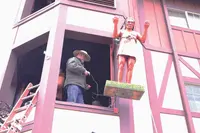
Grants and donations raised $30,000 for the carving, painting, and coating. The Wurst Run’s race director, Matt Bauman, and the Chamber director, Pete Wall, announced matching donations. Three carvers worked in wood from Salem Wood Products. Terry Kramer of Salem carved the Marine. He researched the uniform at the VFW in Salem and fitted the figure with real Marine uniform buttons. “I really wanted to carve the Marine for my carving partner, who passed away about eight years ago,” Kramer said. Reifel took the Merchant Marine and the Coast Guard. Carol Duree of Salem carved the Navy figure and an Army Nurse, the nurse in honor of friends who had served as nurses in wartime. The work took her 123 hours. “What was astounding to me was how emotional it was to carve the figures and hear people’s stories,” she said. Shari Watkins of Salem painted all six.
Each branch got its own song, compiled under Dave Chartrey and recorded by the Z Musikmakers of Mount Angel. On the top swing, “God Bless America” replaced “Edelweiss.” It was sung by children from St. Mary’s Elementary School under music teacher Monica Lewin and recorded by Stu Rasmussen at the Mt. Angel Performing Arts Center. “Hearing the children sing brought tears to my eyes,” Dill said.
The military figures were unveiled after the Fourth of July parade in 2016. That December, volunteers from GEM Equipment and The Grant Company moved them out. Randy Lathrop and Will Hartenstein, both electrical engineers, rewired the mechanics and switched the music back to the originals. The plan then was for the military set to return before each Memorial Day and come down again before Oktoberfest. For the winter, the figures went to posts around town: the Air Force to City Hall, the Navy to GEM Equipment, the Coast Guard to The Grant Company, the Merchant Marine to Mount Angel Telephone, the Army Nurse to Columbia Bank, and the Marine to the Glockenspiel Restaurant, under the tower.
Notable Events
- 1984After retiring from the military, Ernie brought his family back to Oregon and opened Engelberg Antiks in Mount Angel that October. statesmanjournal.com
- 2000sThe Dills discovered that the Mount Angel antique-store building was in such disrepair that it needed to be torn down. ourtownlive.com
- 2006After five years of community fundraising and collaboration with Marion County officials, the forty-nine-foot Glockenspiel was built at Garfield and Charles Streets. oregonencyclopedia.org
- 2006The restaurant opened as part of the mixed-use building project spearheaded by Henri Ruef Dill; this is the restaurant's opening, not a separate clock founding date. oregonlive.com
- 2006The former Engelberg Antiks site became Edelweiss Village with the Glockenspiel. statesmanjournal.com
- 2006The Glockenspiel's original six figures debuted at Oktoberfest in September 2006. web.archive.org
- 2007The owners opened the restaurant hoping to create a gathering place; this source gives a different restaurant-opening year. ourtownlive.com
- 2016Six military statues were unveiled at Mount Angel's Fourth of July celebration after funds were raised through grants and donations for carving, painting and coating. web.archive.org
- 2016The Glockenspiel welcomed back its original hand-carved wooden statues in December, with the military figurines to return before Memorial Day and be replaced again before Oktoberfest. web.archive.org
- 2018Glockenspiel was among the first sites chosen for the Heritage Trail; the Historical Society helped research the plaque text and supplied most pictures. mtangelhistory.org
- 2019According to the Salem Statesman Journal, as reported by The Oregonian, the Glockenspiel restaurant served its last meal; this does not state that the clock closed. oregonlive.com
People
- Tom Bauman, Mayor who said the community hoped the planned Glockenspiel would become a tourist draw like those in Europe.
- Mathias Butsch, Community leader in the clock's historical narrative, instrumental in the first church, community store and railroad station, and in bringing Benedictine monks; widely known as the Father of Mount Angel (fall of 1878).
- Mrs. Robert Zollner, German settler included with her husband in the Glockenspiel's town-history narrative; migrated from Rathenberg in Bavaria (1867).
- Prior Adelhelm Odermatt, Figure in the clock's historical narrative: established the Benedictine Monastery, first pastor, and suggested the town's name as an anglicized Engelberg (1881 (monastery establishment, as stated)).
- Robert Zollner, German settler included in the Glockenspiel's town-history narrative; migrated from Rathenberg in Bavaria with his wife (1867).
- Sister Bernadine Wachter, Figure in the clock's historical narrative; first Prioress of the convent and new school (1882 (the Sisters' arrival)).
- T.W. Davenport, Surveyor cited in the Glockenspiel's account of Native American prayer traditions on the butte; not a clock builder.
- Henri Ruef Dill, Native Mount Angel resident who spearheaded the community-revival multi-use project (2006).
- Henrietta Dill, Envisioned the Glockenspiel's military-figure theme for many years.
- Lori Lathrop, Henri's daughter; managed the Mount Angel Engelberg Antiks predecessor business with Henri.
- Don Robinson, Started the Chamber subcommittee behind the Heritage Trail, whose planned stops included the Glockenspiel.
- Eileen Stein, City Manager and Heritage Trail committee member pursuing grants for the project that included the Glockenspiel.
- Justin Hogue, City Manager's assistant pursuing grants for the Heritage Trail project that included the Glockenspiel.
- Paula Mabry, Started the Chamber subcommittee behind the Heritage Trail, whose planned stops included the Glockenspiel.
- Susan Gallagher, Started the Chamber subcommittee behind the Heritage Trail, whose planned stops included the Glockenspiel.
- Carol Duree, Carver of the Glockenspiel's military-branch figurines, working in wood from Salem Wood Products.
- Dave Chartrey, Directed compilation of the service-branch songs recorded by Mount Angel's Z Musikmakers.
- Mike Reifel, Carver of the Glockenspiel's military-branch figurines, working in wood from Salem Wood Products.
- Monica Lewin, Music teacher who directed St. Mary's Elementary School children singing God Bless America for the display.
- Shari Watkins, Painter of the Glockenspiel's military-branch figurines.
- Stu Rasmussen, Recorded the children's God Bless America performance in the neighboring Mount Angel Performing Arts Center.
- Terry Kramer, Carver of the Glockenspiel's military-branch figurines, working in wood from Salem Wood Products.
- Ernest "Ernie" John Dill, Opened Engelberg Antiks in Mount Angel, the predecessor business on the Edelweiss Village and Glockenspiel site (Nov 13th, 1942–July 26th, 2023).
- Henri Dill, Edelweiss Building developer and business owner involved in the military-figure project.
- Matt Bauman, Wurst Run race director announcing matching donations to the Glockenspiel.
- Pete Wall, Chamber director announcing matching funds for the Glockenspiel military-figure project.
- Dave Keckes-Chartrey, Of Z Musikmakers; designated to handle music production for the military display.
- Robert and Kathrina Zauner, German settlers depicted among the Glockenspiel's original six heritage figures.
- Kathrina Zauner, German settler represented among the original Glockenspiel figures, as this newspaper spells the name.
- Matthias Butsch, Early community leader represented among the original Glockenspiel figures, as this newspaper spells the name.
- Randy Lathrop, Volunteered electrical-engineering expertise for the statues' mechanics and switching music.
- Robert Zauner, German settler represented among the original Glockenspiel figures, as this newspaper spells the name.
- Will Hartenstein, Volunteered electrical-engineering expertise for the statues' mechanics and switching music.
Sources
- oktoberfest.org/glockenspiel
- traveloregon.com/things-to-do/culture-history/historic-sites-oregon-trail/mt-angel-glockenspiel
- explorenorthmarion.org/mt-angel
- roadsideamerica.com/tip/13522
- centraloregondaily.com/destination-oregon/mount-angel-tallest-glockenspiel-clock-tower-oregon/article_80575ef8-f761-458d-b7c5-11576cfe0380.html
- web.archive.org/web/20201029061509/https://pamplinmedia.com/wbi/152-news/334762-214556-glockenspiel-figurines-swapped-out-for-originalsfor-now
- discovermtangel.org/explore
- mtangelcommunityfoundation.org/currentprojects
- ourtownlive.com/ourtown/?p=16159
- ourtownlive.com/ourtown/?p=7136
- statesmanjournal.com/story/news/local/heritage/2017/08/02/mt-angel-history-tour/518875001
- statesmanjournal.com/obituaries/ssj066468
- post-gazette.com/life/travel/2006/03/25/the-tallest-glockenspiel/stories/200603250123
- oregonencyclopedia.org/articles/mt_angel_oktoberfest
- mtangelhistory.org/newsletter/2018-apr_newsletter.pdf
- statesmanjournal.com/story/news/local/silverton/2016/01/27/mt-angel-prepares-wurstfest/79155222
- web.archive.org/web/20201029021515/https://pamplinmedia.com/wbi/152-news/307143-185380-veterans-to-be-honored-atop-mount-angel-glockenspiel-on-fourth-of-july
- heraldnet.com/2006/03/25/travel-briefs-119
- oregonlive.com/dining/2020/02/glockenspiel-restaurant-mount-angels-german-destination-has-closed.html