Molalla Buckeroo and July 4th Celebration
Molalla, Clackamas County, Oregon. 4th of July Rodeo Tradition.
Details

- Where
- 815 Shirley Street, Molalla, OR 97038. Directions
- When
- July 1st - 4th.
- Getting there
- Merge onto OR-213 S to S Molalla Ave; turn left onto S Molalla Ave, then left onto Shirley St; destination on the left.
- Fees
- tickets required for rodeo.
- Access
- Event parking is $10, staffed by Molalla High School students and clubs as a fundraiser; look for the pink safety vests.
- Walk-in or reserve
- Rodeo tickets sold online through Afton; only tickets purchased through Afton or the website are valid.
- Phone
- 503-829-8388
- Website
- molallabuckeroo.com
- Managed by
- Molalla Buckeroo.
- Established
- over 100 years.
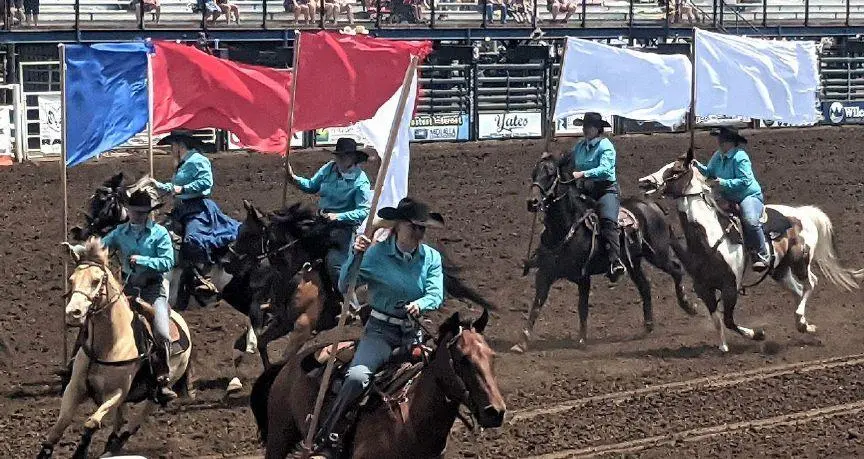
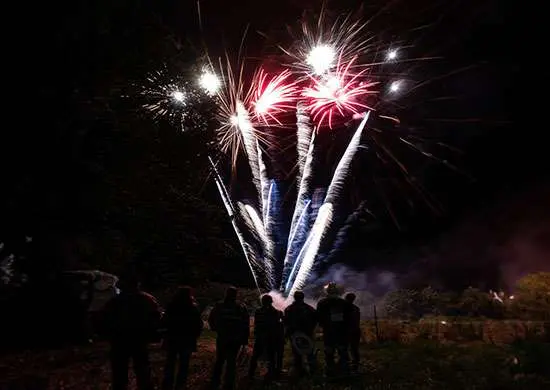
On Molalla Buckeroo evenings, the traffic directors on Shirley Street wear pink safety vests. They are Molalla High School students, coaches and club leaders. The $10 parking fee they collect pays down student fees for sports and activities or goes into club accounts for supplies. The Buckeroo, the high school and the City of Molalla set up the arrangement together, and the Buckeroo takes extra donations as well. Past the lots, at 815 Shirley Street in the Clackamas County town of Molalla, gates open at 5:00 p.m. The rodeo starts at 7:30 and ends each evening with fireworks and live music.
Five performances in four days
The 2026 Buckeroo ran July 1 through 4, with five sessions over the four days, according to the Herald Pioneer. Every session began at 7:30 p.m. On July 4 a matinee was added at 1:30, with doors at 11:00 a.m. The Buckeroo’s listings promised “non-stop rodeo action, great food, vendors.” The music after the performance was for those 21 and over. Children 6 and under got in free with a paid general admission ticket, though not in reserved seating.
The Buckeroo’s “Rodeo 101” sets out what happens in the arena. In bareback riding, saddle bronc riding and bull riding, a cowboy must stay aboard a bucking horse or bull for eight seconds using one hand. If he touches the animal, himself or his equipment with the free hand, he is disqualified. Bronc and bareback riders must also “mark out”: they leave the chute with spurs set above the horse’s shoulders and hold them there until the horse’s front feet hit the ground after the first jump. Rider and animal are each scored, up to 50 points apiece.
In steer wrestling and the roping events, the calf or steer gets a head start. The rider waits in a three-sided fenced box. A rope barrier crosses its open side and is tied to the animal with a breakaway loop. When the animal reaches a head-start point set by the size of the arena, the barrier releases.
The competitors come off the professional circuit. The Buckeroo’s history notes that the Fourth of July holiday is known as Cowboy Christmas in rodeo circles. The many rodeos across Oregon, Washington, Idaho and Northern California let contestants rack up points and purse money in a short span. They stay in town only long enough to complete their rides, “and then they’re off to the next town, the next rodeo, and the next purse.” In 2006 the Molalla Area Chamber of Commerce called the Buckeroo a sanctioned PRCA rodeo that drew many of the top cowboys from around the country.
Parades, a footrace and barbecued chicken
The town’s own celebration runs alongside the arena.
- Kiddie’s Parade. It opened the 2026 holiday on Wednesday, July 1, at 6 p.m. Children checked in from 3:45 at Bohlander Field, across from the Buckeroo entrance, and taking part was free.
- Firecracker 5K. The race on the morning of July 4 traces the parade route. Sources give different start details: - The Herald Pioneer gave a 9 a.m. start at Molalla Nazarene Church. - The Buckeroo’s schedule listed the race at 8 a.m. - The city’s description starts runners on the track at Heckard Field. They run three-quarters of a lap, head north to Highway 211 and up Cole Street onto the parade route, and finish back on the track through a gravel lot.
- Giant Street Parade. Once called the Fourth of July Parade, it followed at 9:30 a.m. on Saturday, July 4, under the 2026 theme “Cheers to 250 years.”
- St. James Church chicken dinner. The church grills chicken on the Fourth. In 2026 the full dinner of chicken, baked potato, coleslaw, roll and dessert was served from 9 a.m. to 2 p.m. A half-chicken drive-thru ran until 3.
A rodeo for the first train
Molalla takes its name from the Molalla River, which was named for the Molala people who lived in the area. The Molalla Area Historical Society says legend has it that the settlement grew up where two Indian trails crossed. That crossing is now the intersection of Molalla Avenue and Main Street.
The settlement became a city in the summer of 1913. Voters approved incorporation 77 to 20 in a special election on August 15, and the Clackamas County Court proclaimed it on August 23. The same year the town’s first bank opened and its first newspaper, The Pioneer, began publication.
The town was growing with its timber and farming, and its people had grown anxious for a railroad. A Molalla Pioneer history, reprinted by the Buckeroo, gives the date: on September 9, 1913, the Portland, Eugene and Eastern came to Molalla. The historical society calls it the first steam train connecting the city to Portland. The town celebrated with a rodeo, known then as the Buckeroo Roundup. By the Pioneer’s account it was the third established rodeo in Oregon. It was held at first in fields near town, and local firefighters sponsored it to raise money for firefighting equipment. As it grew, the date was moved to the first week of July to celebrate the birth of the nation.
The association and the Shirley Street arena
In 1923 the Molalla Buckeroo Association was formed and took over the rodeo. It began building an arena soon afterward, and in 1925 the rodeo had its first permanent home. The Chamber of Commerce wrote in 2006 that the rodeo had been held every year since 1913 except during the wars.
When Molalla marked its centennial, Mr. Schrader introduced a House resolution on July 30, 2013. It recorded the 1913 rodeo among the town’s founding events. It also noted that people from throughout the region take part in the Buckeroo and in the Ross Coleman Invitational Professional Bull Riding event.
The association is a nonprofit charitable corporation of more than 40 active members, all volunteers. They supply the management, production and labor, and a nine-member executive committee oversees the committees beneath them. The mission statement lists supporting community charitable causes, promoting tourism in Clackamas County, and the aim to “Preserve the oldest form of American Heritage, the Rodeo.”
The Molalla Area Historical Society keeps the Buckeroo Rodeo among the research subjects of the Dibble House Museum Complex. Its Dibble House stands at 620 South Molalla Avenue. Built in 1859, it is the oldest surviving structure in south Clackamas County.
Notable Events
- 1848Settlers attacked a group of Molallas and Klamaths encamped where Abiqua Creek emerges from the foothills of the Cascades, the most serious recorded clash involving Molallas and American settlers. oregonencyclopedia.org
- 1859The Dibble House was built in 1859 and is the oldest surviving structure in south Clackamas county. dibblehouse.org
- 1913The Portland, Eugene and Eastern railway came to Molalla and gave Molalla a vital link to the outside world; the rodeo was born to celebrate it. molallabuckeroo.com
- 1923The Molalla Buckeroo Association was formed and took over operation of the rodeo. molallabuckeroo.com
People
- Crooked Finger, Molalla chief who tried to raise a multi-tribal force against the Willamette Valley settlements.
- Dee Wright, Molalla-born outdoorsman, Forest Service packer, and raconteur (1872).
- Fred Yelkes Sr., Last person known to have spoken Molalla from childhood; provided linguistic data to Jacobs (Lived until 1958).
- Henry Yelkes, Son of Northern Molalla treaty chief Yelkas, well known to settlers in and around the town of Molalla (c. 1843-1913).
- Kootsta, Principal Molalla chief involved in the Battle of the Abiqua incident.