Mokelumne River Hatchery
Clements, California. Hatchery.
Details
- Where
- 25800 North McIntire Road, Clements, CA 25800. Directions
- When
- Chinook salmon spawning viewing mid-October to late December; steelhead trout spawning December to March.
- Season
- Chinook salmon spawning mid-October to late December; steelhead trout spawning December to March.
- Getting there
- Located about 2 miles east of Clements. From Highway 12, turn north on McIntire Road. At the end of McIntire Road, turn right and follow the road straight until entering the Hatchery's parking lot located at the base of Camanche Dam at 25800 North McIntire Road, Clements, CA 95227.
- Hours
- Open 7:00 a.m. to 3:00 p.m.
- Access
- Picnic tables and restrooms are available.
- Walk-in or reserve
- Walk-in visitors are welcome during open hours; no reservation is stated for the self-guided tour; group tours are scheduled by phone.
- Phone
- (209) 759-3383
- Website
- wildlife.ca.gov
- Managed by
- Funded by East Bay Municipal Utility District; operated below Camanche Dam in partnership with the California Department of Fish and Wildlife.
- Established
- 1963.
The fish trail below Camanche Dam
McIntire Road ends at a parking lot at the base of Camanche Dam, about 2 miles east of Clements. From the lot a self-guided route the California Department of Fish and Wildlife calls the fish trail passes the Mokelumne River, the fish ladder, the hatchery building, and the raceways. At the raceways, fish food is set out for visitors to throw to the salmon and steelhead. Picnic tables and restrooms stand in the riparian strip along the river. Two News-Sentinel men put kayaks in here at 6:30 one morning in 2007, a few feet from the fish ladder. The water churning out of the dam tumbled over yellow stones in the shallow riverbed, and the air, the reporter wrote, was “scented with oak.”
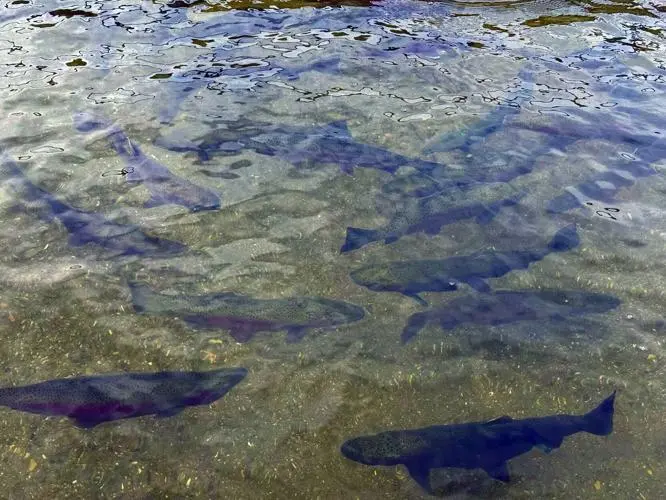
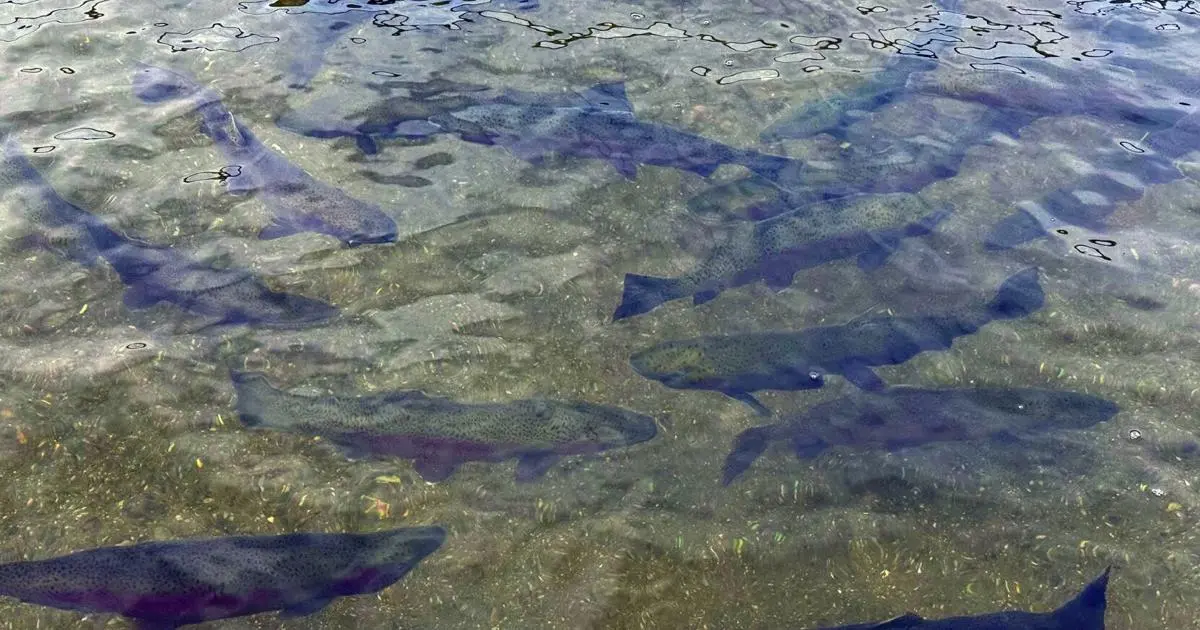
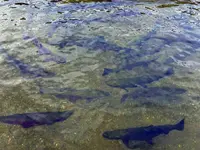
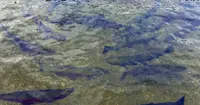
The hatchery draws its water from Camanche Reservoir and discharges it into the river. The dam marks the upper limit of anadromous fish migration on the Mokelumne. According to a state fisheries bulletin of 1929, fall-run Chinook is the only salmon run known to occur naturally in the river. The fish spend two to five years maturing in the Pacific and come back to these waters to spawn and die. Chinook spawning can be seen from mid-October to late December, and steelhead spawning from December to March. During those months visitors watch the artificial spawning through a viewing window. The department asks that they call ahead to be sure it is a spawning day.
The work at the window is done by department crews. In the 2017 season Brian Rodman worked the egg take, Kevin Fujimoto worked the spawning, and Joshua Deanfipps measured returned salmon. Another season found Sarah Sanders, a scientific aid, cutting coded wire tags from salmon heads. A 2019 News-Sentinel caption shows Jessica Wolff taking scale samples from returned Chinook. The hatchery’s annual production goal is 6,400,000 fall-run smolts. The East Bay Municipal Utility District of Oakland pays for the operation, and the state runs it. Schools, clubs, and scouts can book formal tours. Everyone else walks the trail alone.
The river takes its name from the Miwok, and the name is said to mean “people of the fishnet.”
A spawning channel in place of a hatchery
Before Camanche Dam, salmon and steelhead ran up from the Delta as far as Pardee Dam. Frederick H. Groh wrote the installation’s first annual report for the Department of Fish and Game. In it he dates the dam’s completion to 1963 and puts the spawning ground lost behind it at about 12 miles. The district’s own milestone list gives 1964 for the dam. The district built the fish facility to compensate for the loss. The state’s history page says it was built in 1963. Other accounts, including the CalFish hatchery page and the Lodi News-Sentinel, give 1964. Groh records that the installation, then called the Mokelumne River Fish Installation, first operated January 1, 1964.
The design came from a trial. In the fall of 1960 the district and the department built an experimental salmon spawning channel upstream of the present site. It worked well enough that the district built a permanent spawning channel instead of a standard salmon hatchery. A hatchery with six concrete rearing ponds was added for steelhead. The channel ran in two loops with resting pools spaced 500 feet apart. A later state report gives its length as 6,800 feet and its bottom width as 20 feet. Salmon climbed the ladder to a sorting tank, where a mechanical sweep and lift dropped them into an anesthetic tank for counting before release into the gravel. Groh called it “among the largest artificial spawning channels in the world.”
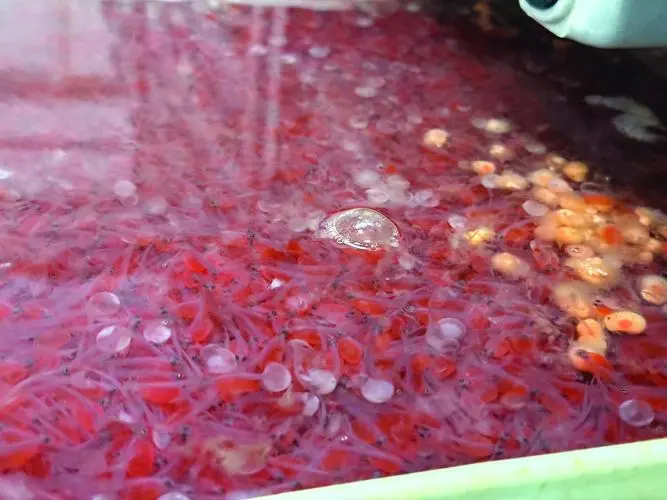
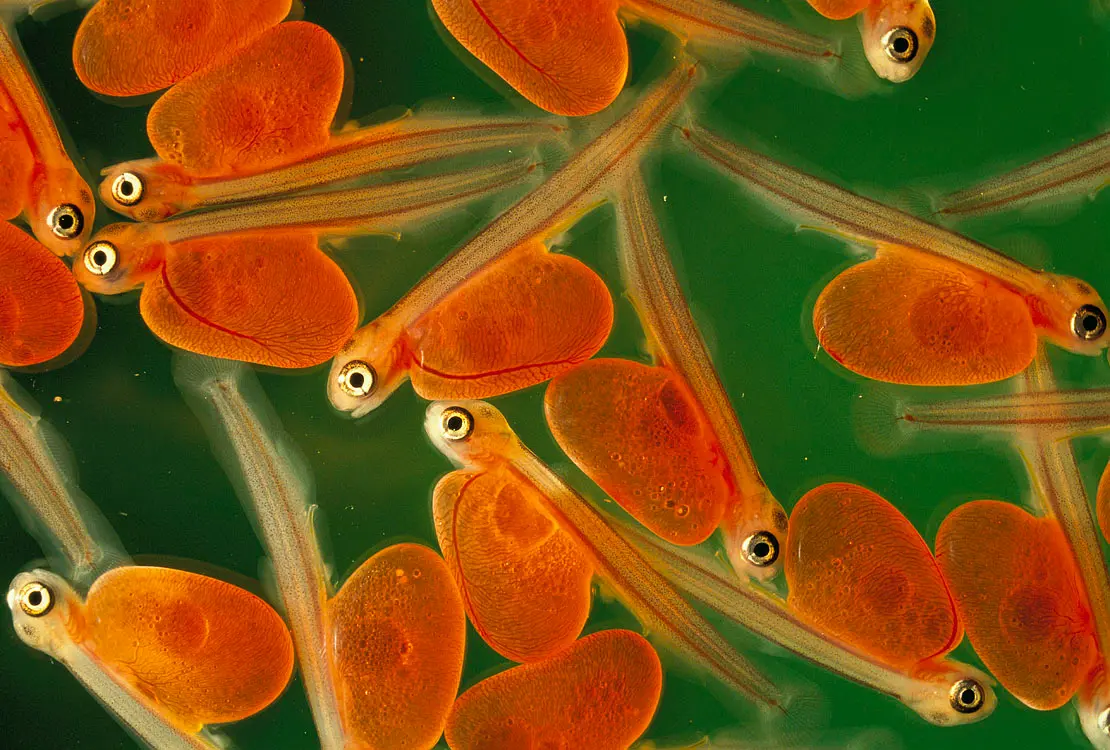
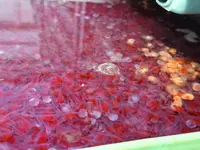
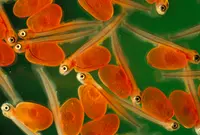
The first season was a short one. The reservoir held too little water for the planned 60 cubic feet per second, and on October 9, 1964, the channel opened at 38. The first king salmon came up the ladder on October 17 and the last on December 5. The run counted 184 males and 178 females, 362 fish in all. Of these, 120 were hauled by tank truck from the Woodbridge counting station between November 24 and 28. Eggs lay in the gravel about 50 days before hatching. A trap at the outlet caught 73,540 fry heading downstream. Groh doubted the figure. Algae had forced crews to bypass part of the flow, and 5,100 yearling steelhead had slipped into the channel with the adult salmon. When crews cut the steelhead open, almost every stomach held salmon fry. Groh promised a fish rack for the next year. A 300-foot observation area was fenced along one channel, and 25,220 people visited between January 1964 and June 1965.
Zinc, drought, and new raceways
In the seasons that followed, gravel berms a foot high and 150 feet apart were built across the channel, first for the 1968-69 season, to keep spawning females from digging over one another’s redds. Philo F. Jewett’s report for 1972-73 counts an estimated 16,000 visitors that year. The same season brought only 353 salmon, too few to use more than one loop. That January and February, for the first time since 1967, copper and zinc in the water killed 40,800 steelhead fry and 5,400 yearlings. “We now have no way to control the concentrations of these metals in our pond water,” Jewett wrote, “but we do monitor them.”
From 1987 to 1992 drought hit the river. The state history notes that low flows and a series of fish kills had already reduced the Mokelumne steelhead run during the 1980s. The district responded with programs for water quality, flows, and habitat. Since the late 1990s some 70,000 cubic yards of gravel, about 300 dump-truck loads, have been added each year to the river near the hatchery to widen spawning room.
By 2000 the department office had long been outgrown by manager Rich Bryant and his staff. A plan first drawn in 1996 was trimmed to $12.5 million. It called for a 6,000-square-foot office, a freezer building for salmon feed, sixty 100-foot raceways, and a 150,000-square-foot bird exclosure. “We pay the bills,” said district spokesman Charles Hardy. Bryant explained the cuts: “We had to choose between the fish and us, so we cut storage space that the original plan included.” Construction went on while the hatchery kept raising about 3 million salmon smolts, though no yearling steelhead were raised in 2001. A dedication was held at the hatchery on October 4, 2002. The Commercial Salmon Stamp Fund paid for another building that year.
Counting the runs
In 2008 the Central Valley salmon stock collapsed, and very few fish came back to the valley. The district’s fisheries manager called it an eye-opener. Managers began timing pulse flows to cue the fish to move. The hatchery had already stopped trucking young fish to the river and dumping them through a pipe. Instead it held them an hour or two in a net pen to acclimate. In 2011 the hatchery recorded a return of 18,000 salmon. In 2017 more than 19,650 came back. The district reported record runs again in 2023 and 2024 and credited them in part to the closure of ocean commercial and recreational fishing.
The river supplies only about 3 percent of the fresh water entering the Delta. The district says its salmon have made up as much as 50 percent of the commercial catch off the California coast. More than 10,500 Chinook returned in the 2025 fall run, and the hatchery collected and fertilized its goal of 7.5 million eggs. Over 730 steelhead came into the hatchery that year. “We had limited water available for pulse flows to attract migrating fish due to the drier year,” said Michelle Workman, the district’s manager of natural resources, “but our management strategies and hatchery investments to support Chinook on the Mokelumne have proven to be resilient.”
Notable Events
- 1949The district's own milestone list records that in 1949 the second Mokelumne Aqueduct was completed and EBMUD acquired Camanche water rights to the Mokelumne River. ebmud.com
- 1963Camanche Dam was completed in 1963 and blocked upstream passage of chinook salmon and steelhead to much of the available historical spawning habitat in the Mokelumne River. ebmud.com
- 1964EBMUD initiated construction of Camanche Reservoir in 1963 and, as mitigation for blocking access to spawning grounds for salmonids, provided funding for the original construction of the hatchery in 1964. calfish.org
- 1964The dam and dikes were completed in 1964 to develop an additional 125 MGD of supply for EBMUD by providing additional streamflow regulation, flood-control space, and capacity to meet downstream needs. ebmud.com
- 1964The Mokelumne River Fish Hatchery was constructed in 1964 to mitigate for spawning habitat lost during construction of Camanche Dam, and receives approximately 57% of the total run per year. ebmud.com
- 1964The original hatchery consisted of one mile of artificial spawning channel for Chinook salmon and six concrete raceways for steelhead; over the decades the facilities have been expanded and remodeled, and the California Department of Fish and Game manages and operates the hatchery. lodinews.com
- 1964The Installation was first operated January 1, 1964. nrm.dfg.ca.gov
- 1964The utility district, with the cooperation of the Department of Fish and Game, had built an experimental salmon spawning channel upstream from the present installation, and the success of that experiment resulted in the construction of the present spawning channel in lieu of a standard salmon hatchery. nrm.dfg.ca.gov
- 1964The run consisted of 184 males and 178 females, for a total of 362 fish, and 120 of them were hauled from the Woodbridge counting station to the channels by tank truck. nrm.dfg.ca.gov
- 1968Gravel berms, first constructed for the 1968-69 season, were rebuilt before the first fish was received; they stand 0.3 m (1 ft) above the channel bottom, 5 m (15 ft) wide and 46 m (150 ft) apart, and their purpose is to curtail superimposition of redds. nrm.dfg.ca.gov
- 1972During the 1972-73 fiscal year an estimated 16,000 people visited the Installation; tours were conducted for many special interest groups and talks given to sportsman clubs and civic organizations. nrm.dfg.ca.gov
- 1973For the first time since 1967 there were heavy mortalities attributed to copper and zinc concentrations in the river; during January and February 1973 the Installation lost 40,800 steelhead fry and 5,400 yearling steelhead. nrm.dfg.ca.gov
- 1987From 1987 to 1992, there was a drought in the area. Low flows and a series of fish kills reduced the Mokelumne River steelhead run during the 1980s. wildlife.ca.gov
- 1990sSome 70,000 cubic yards of gravel, or about 300 dump-truck loads every year, have been added to the river near the hatchery since the late 1990s to widen the channel and create more space and better conditions for spawning. sfchronicle.com
- 1996The original 1996 concept plan called for more funding, so some projects had to be scrapped to keep costs at $12 million. lodinews.com
- 1998EBMUD, the U.S. Fish and Wildlife Service and the California Department of Fish and Game agreed on the March 23, 1998 Joint Settlement Agreement, the deal whose flow and hatchery measures the district reports on to FERC. ebmud.com
- 2000In 2000, EBMUD awarded a contract for construction of the hatchery upgrade project. Fish production at the facility continued during the construction period. ebmud.com
- 2001The hatchery kept raising its normal level of salmon smolts, about 3 million, but did not raise yearling steelhead and other yearlings during the 2001 season while construction was underway. lodinews.com
- 2002The Commercial Salmon Stamp Fund provided funding for an additional building built in 2002 and continues to financially support the hatchery. calfish.org
- 2002EBMUD's milestone list marks 2002 as the year of the completed upgrade of the Mokelumne River Fish Hatchery. ebmud.com
- 2002The hatchery reconstruction was completed in fall 2002, and a dedication ceremony was held at the hatchery on October 4, 2002. ebmud.com
- 2002The hatchery was remodeled in July 2002, enlarging the rearing space to promote fish health and fish survival rates while also making hatchery operations more efficient. wildlife.ca.gov
- 2008In 2008 Central Valley salmon stock collapsed and very few fish returned to the valley, which the district's fisheries and wildlife manager calls an eye-opener for river managers; the hatchery had already moved off the old method of driving a truck to the water and dumping the fish through a pipe. hatcheryinternational.com
- 2011The record of 18,000 salmon was set in 2011. sfchronicle.com
- 2017Over 19,650 salmon returned to the hatchery, breaking the previous record of 18,000 set in 2011. hatcheryinternational.com
- 2023The Mokelumne River experienced record runs of salmon returning to spawn, due in part to the closure of the ocean commercial and recreational fisheries. ebmud.com
- 2025More than 10,500 Chinook salmon returned to the Mokelumne River to spawn during the 2025 fall run, and those returns allowed the district's fish hatchery to reach its goal of collecting and fertilizing 7.5 million salmon eggs in coordination with CDFW. ebmud.com
- 2025In addition to the strong Chinook run, the year supported a run of over 730 steelhead in the hatchery, which the district attributes to management and release strategies for this federally threatened species. ebmud.com
People
- Michelle Workman, EBMUD Manager of Natural Resources, speaks for the hatchery's in-river spawning targets and egg goals (2026).
- Charles Hardy, EBMUD spokesman, quoted on the hatchery modernization.
- Rich Bryant, Mokelumne River Fish Hatchery manager.
- Luz Gómez, District Board President for the East Bay Municipal Utility District, quoted on the hatchery operations and river management behind the returns.
- Sarah Sanders, CDFW scientific aid at the hatchery, taking coded wire tags from salmon heads.
- William Smith, Mokelumne River Fish Hatchery manager.
- Casey Del Real, Fish biologist for the East Bay Municipal Utility District on Mokelumne water temperature and spawning.
- Jason Julienne, Environmental scientist at the California Department of Fish and Wildlife on the hatchery's flow-dependent run.
- Jessica Wolff, named in a News-Sentinel picture caption taking scale samples from returned Chinook at the hatchery (2019).
- Shane Smithhart, named in a News-Sentinel picture caption working salmon at the hatchery during the 2019 spawning season (2019).
- Frederick H. Groh, author of the facility's first annual report, cited by the later state reports as the detailed description of the facility (January 1, 1964 to June 30, 1965).
- Philo F. Jewett, author of the Department of Fish and Game annual report of the Mokelumne River Fish Installation, Region 2, Inland Fisheries, Anadromous Fisheries Branch (1974).
- Groh, author of the facility's first annual report, cited for its detailed description (1965).
- Brian Rodman, California Department of Fish and Wildlife employee working the egg take at the hatchery (2017).
- Ed Rible, Fisheries biologist for the East Bay Municipal Utility District.
- Jose Setka, Manager of fisheries and wildlife for the East Bay Municipal Utility District.
- Joshua Deanfipps, California Department of Fish and Wildlife staff measuring returned salmon at the hatchery (2017).
- Kevin Fujimoto, California Department of Fish and Wildlife staff working the artificial spawning process at the hatchery (2017).
Sources
- wildlife.ca.gov/Fishing/Hatcheries/Mokelumne-River
- wildlife.ca.gov/Fishing/Hatcheries/Mokelumne-River/History
- ebmud.com/about-us/news/press-releases/mokelumne-river-salmon-returns-highlight-hatchery-program-success
- lodinews.com/news/article_d524721f-4ebe-43b2-8d07-1d1d340c9f3c.html
- lodinews.com/search/?q=%22Salmon+spawning+season+keeps+Mokelumne+hatchery+busy%22
- lodinews.com/news/article_a626f2e2-e613-4b8e-ba53-0c3f95f8b439.html
- hatcheryinternational.com/the-right-stuff-3104
- nrm.dfg.ca.gov/FileHandler.ashx?DocumentID=32438
- nrm.dfg.ca.gov/FileHandler.ashx?DocumentID=32429
- nrm.dfg.ca.gov/FileHandler.ashx?DocumentID=32430
- lodinews.com/article_ce94b1ce-3131-51b2-85f0-b5491090f5b2.html
- calfish.org/ProgramsData/ConservationandManagement/CentralValleyMonitoring/SacramentoValleyTributaryMonitoring/MokelumneRiverFishHatchery.aspx
- ebmud.com/download_file/force/1899/568?lower-mokelumne-river-salmonid-redd-survey-report-october-2009-through-march-2010.pdf=
- ebmud.com/application/files/2217/7368/4793/1998-06_Bay_Delta_Hearing_CiC_Exhibit_2.pdf
- ebmud.com/about-us/who-we-are/mission-and-history
- sfchronicle.com/news/article/Salmon-population-booms-on-state-s-Mokelumne-12364274.php
- lodinews.com/news/article_88f7e2a2-28b6-5c4a-bb2f-5ed0cb1e70a9.html
- ebmud.com/download_file/force/1908/568?WQRMP_STATUS_REPORT_6-year_review_1.pdf=