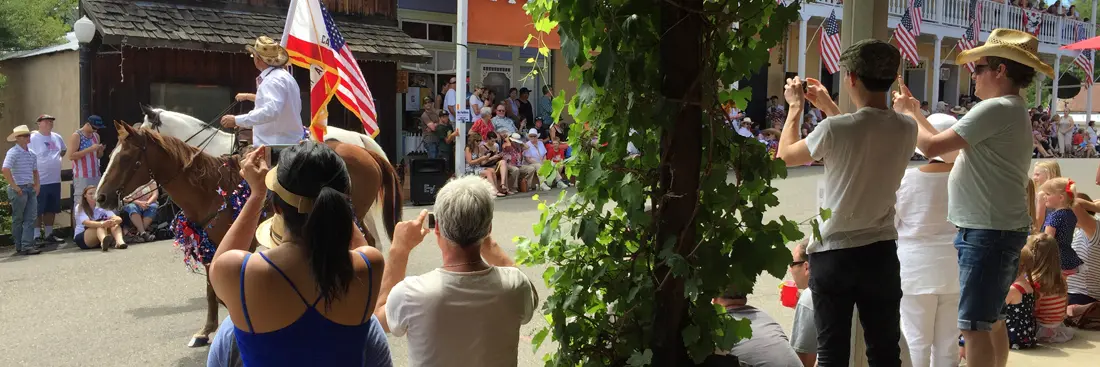
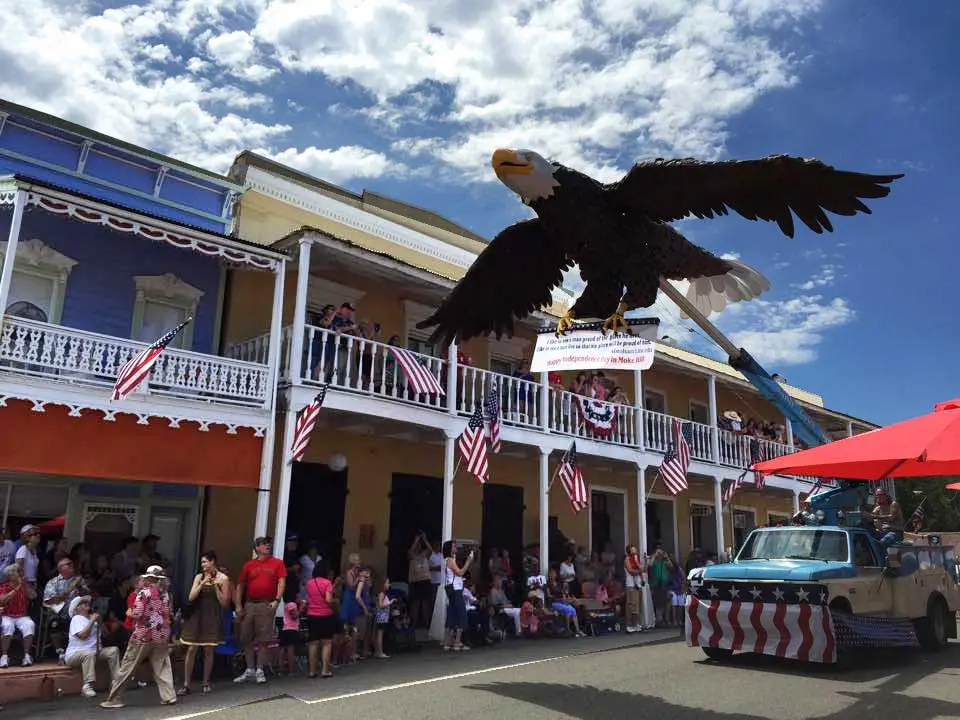


Moke Hill Fourth of July Parade
Mokelumne Hill, Calaveras County, California. Annual 4th of July Independence Day Celebration; Annual, July 4.
Details

- Where
- 8304 Main Street, Mokelumne Hill, CA 95245. Directions
- When
- Annual 4th of July Pancake Breakfast.
- Hours
- Parade starts at 11:00 a.m.
- Access
- Free parking and shuttle.
- Phone
- 209.405.0652
- Website
- mokehill.org
- Managed by
- Mokelumne Hill Community Historical Trust.
On the morning of the Fourth, folding chairs go out along Main Street in Mokelumne Hill. The editor of mokehill.org, answering a reader in 2023, described the custom: “Historically, people have placed chairs out early morning the day of the parade.” Visitors from out of town park free at Wendall’s, at the corner of West Center Street and Highway 49, and ride a free shuttle to Main Street. In 2019 the editor gave the shuttle’s starting time as 9:30 a.m. The parade steps off at 11:00 a.m., with live music along the route and the town’s restaurants and stores open behind the crowd.
Pancakes at the Town Hall
The day begins earlier, at the Town Hall, where pancakes are served from 7:30 a.m. The Mokelumne Hill Community Historical Trust’s site gives the closing time as 11:00 a.m. The county visitors bureau and the Calaveras Enterprise list 10:30. The breakfast belongs to the Veterans Memorial District, which also puts on a Crab Feed each year in early December and again at the end of March. The Calaveras County Board of Supervisors formed the district in 1960. Its five-member board, chaired by TJ Ringlein, meets in the same hall on the second Tuesday of each month. The district is responsible for the Town Hall, the Shutter Tree Town Park, Barry’s Tennis Courts, C.B. Hobbs Field, Marredda Gardens, and the DK Horse Arena. Breakfast money goes toward the district’s work to “maintain and improve our town hall and parks,” as the Trust’s announcement puts it.
Main Street at eleven
The Trust’s notice calls it “the world-famous parade” and asks onlookers to consider something more: “Better yet — be part of the celebration by entering the parade.” For children there are a watermelon eating contest and a water relay race. Vendors set up in the park, where there is also a corn hole game.
The 2026 celebration marked the 250th anniversary of the country, and July 4 fell on a Saturday. The Enterprise listing named the Mokelumne Hill Lions Club as presenter and set out the weekend. A street dance ran on Main Street from 7 to 9 on Friday night, followed by pancakes Saturday morning and the parade at 11. The Cool Shifters played by the Hotel Leger pool. That same Fourth, Petroglyphe Gallery at 8317 Main Street closed its doors. In May the gallery had written to its neighbors that it “will be retiring on July 4th,” with thanks for “these past 15 years.”
Stone after the fire
The Hotel Leger stands at the corner of Main and Lafayette Streets. The historian Larry Cenotto wrote that “the Leger and its predecessors have provided room, board, brandy and more since circa 1851.” It is one of the stone buildings put up after the fire of 1854. That fire burned everything on Main Street except Gregoire’s Store and everything on Center Street except Sturges’ Store. The town rebuilt in rhyolite, a volcanic stone quarried on the hill behind the Mokelumne Hill Brewery, a hill Highway 49 now cuts through. The new buildings had iron shutters. Among them were the I.O.O.F. Hall, the Mayer Building, the Courthouse, the Leger, the Levinson & Bros. Store, and Biebrich’s and Gebhardt’s breweries. In 1861 the I.O.O.F. added a third story to the old Adams Express Company building. That made it among the earliest three-story buildings in the county, although the Calaveras Heritage Council notes it was not the first in the California interior.
More fires followed. The Heritage Council dates them to 1865 and 1874. The state landmark text gives 1864 and 1874. After the 1874 fire, many commercial buildings were never rebuilt, because the boom years were over. Gas lights had come to the streets in 1857 and electric ones in 1897. Judith Marvin, writing for the Heritage Council, observed: “One cannot find a guide to the Mother Lode without a photograph of the I.O.O.F. Hall or the Hotel Leger.”
A trading tent in 1848
The Miwok lived along the Mokelumne River, in Happy Valley, and in Chili Gulch before anyone else came. Father Narcisco Duran recorded the name as Muquelumnes in 1817. According to A.L. Kroeber, it comes from Mokelumni, “people of Mokel.” The name is also listed as a corruption of the Indian word for big river. French trappers are reputed to have settled in Happy Valley in the 1830s.
Gold brought the town. In the autumn of 1848 Captain Charles M. Weber’s company mined along the river between Big Bar and Lower Bar. Oregon miners at Big Bar persuaded a provision wagon to drive in, and it did well enough that Mr. Syree opened a store on the Hill that November. In the same year Samuel Pearsall, of Colonel Jonathan D. Stevenson’s Regiment of New York Volunteers, found gold on the north side of Stockton Hill. Stevenson later claimed to have been the town’s first alcalde. By November 1848 twenty men were mining. Syree kept his trading tent, G.B. Dickenson and his family ran a boarding tent, and the Fourcade brothers had settled. The Hill became the trading center for Chili Gulch, Lancha Plana, Big Bar, Sandy Bar, Poverty Bar, Rich Gulch, Mosquito Gulch, and Happy Valley.
According to the state’s landmark text, a claim was sixteen feet square, and Corral Flat produced over thirty millions in gold. Disputes over claims led to the so-called French War on French Hill in 1851. That year also brought a post office, the Catholic church founded by Father John Bobard in a canvas structure, and the Calaveras Chronicle, the county’s first newspaper. The Heritage Council dates the paper to October 1851, the state to 1850. The first school met in a tent, taught by the wife of the Reverend J.F. Fish, with five pupils.
The Hill was dry most of the year. In 1852 the Mokelumne Hill Canal and Mining Company spent $180,000 on a canal running 16 miles from the South Fork of the Mokelumne River. Water arrived in 1853, and the area boomed. The county courthouse moved from Jackson in 1852, by the Heritage Council’s account; the state gives 1853 as the start of the county seat years. Lawyers, judges, and clerks settled on the Hill, and soda works, breweries, billiard halls, and livery stables opened to serve them. The town’s people were American, French, German, Italian, Jewish, English, Irish, Spanish, Mexican, Chilean, Chinese, and Black. Chinatown ran along East Center Street, with its own stores, saloons, and two Joss Houses. Shutter Tree Park takes its name from an iron shutter off the stone store of the merchant Chung Kee, which survived the fire of 1898.
In 1866 the courthouse went to San Andreas, and newspapers filled with notices of businesses and homes for sale. By the 1860s the free placer gold was gone, and the town lived by farming. Cattle ranching later took first place. Hard-rock mining raised incomes around 1900 and helped the region through the 1930s. The Mokelumne Hill History Society writes that the family cattle ranches still surrounding the town “stave off development.”
The state registered Mokelumne Hill as a California Historical Landmark in 1937 and placed the marker at the southwest corner of Main and Center Streets. Among the facts it records: “Fights between grizzly bears and bulls amused early residents.”
Notable Events
- 1817The name Mokelumne was first recorded by Father Narcisco Duran as Muquelumnes in 1817; according to A.L. Kroeber it is named from the Indian Mokelumni, or is also listed as a corruption of the Indian name for big river. calaverashistory.org
- 1848Colonel Jonathan D. Stevenson's Regiment of New York Volunteers reached Mokelumne Hill in 1848 and Samuel Pearsall of the Regiment was the first to discover gold in Mokelumne Hill on the north side of Stockton Hill. calaverashistory.org
- 1848A provision wagon driven to the area proved so successful that Mr. Syree opened a store in Mokelumne Hill in November 1848. calaverashistory.org
- 1850The Calaveras Chronicle was established in 1850. ohp.parks.ca.gov
- 1851The first newspaper in Calaveras County was started in October of 1851 by the Calaveras Chronicle in a building located just west of the present I.O.O.F. Hall. calaverashistory.org
- 1851The so-called French and American War occurred in 1851 on French Hill in a conflict over mining claims. calaverashistory.org
- 1851On its site at the corner of Main and Lafayette Streets, the Leger and its predecessors have provided room, board, brandy and more since circa 1851, as historian Larry Cenotto noted. calaverashistory.org
- 1852The Mokelumne Hill Canal and Mining Company was organized in 1852 and built a 16-mile canal from the South Fork of the Mokelumne River for $180,000. calaverashistory.org
- 1852Due to its importance as a commercial center, Mokelumne Hill was chosen as the site of the Calaveras County Courthouse in 1852, after its removal from Jackson. calaverashistory.org
- 1854There were major fires in Mokelumne Hill in 1854, 1865, and 1874. calaverashistory.org
- 1854A devastating fire in 1854 prompted more construction in rhyolite, the distinctive volcanic stone quarried nearby. mokehill.org
- 1854The town was destroyed by fires in 1854, 1864, and 1874. ohp.parks.ca.gov
- 1857Gas lights illuminated the streets in 1857, electrical in 1897. calaverashistory.org
- 1860sWith the decline of free placer gold by the 1860s, the town declined, subsisting on an agricultural economy. mokehill.org
- 1866The stone courthouse remained the seat of County government until 1866 when the Courthouse was moved to San Andreas. calaverashistory.org
- 1937Landmark registration date 9/3/1937 for Mokelumne Hill. ohp.parks.ca.gov
People
- Captain Charles M. Weber, Led the first known company mining along the Mokelumne River between Big Bar and Lower Bar (1848).
- Colonel Jonathan D. Stevenson, Commanded the Regiment of New York Volunteers that reached Mokelumne Hill; later claimed to have been the town's first alcalde (1848).
- Father John Bobard, Founded the Catholic Church in 1851 (1851).
- Father Narcisco Duran, First recorded the name Mokelumne, as Muquelumnes (1817).
- Frederick Mayer, Early vineyardist.
- Madam Cataia, Early vineyardist.
- Mr. Syree, Opened a trading store in Mokelumne Hill in November 1848 (1848).
- Reverend J.F. Fish, Methodist Episcopal minister whose wife taught the town's first school in a tent.
- Samuel Pearsall, Member of Stevenson's Regiment first to discover gold in Mokelumne Hill, on the north side of Stockton Hill (1848).
Sources
- mokehill.org/2026/06/moke-hill-july-4th-parade
- mokehill.org
- mokehill.org/calendar
- mokehill.org/non-profits-and-groups/veterans-memorial-district-2
- gocalaveras.com/business/festivals-events/moke-hill-july-4th-parade
- mokehill.org/2013/07/history-of-mokelumne-hill
- gocalaveras.com/itinerary/itineraries/mokelumne-hill-california
- ohp.parks.ca.gov/ListedResources/Detail/269
- calaverashistory.org/mokelumne-hill