Mojave River Hatchery
Victorville, San Bernardino County, California. State fish hatchery.
Details

- Where
- 12550 Jacaranda Avenue, Victorville, CA 12550. Directions
- When
- Open 8:00 a.m. to 3:00 p.m.
- Getting there
- On the lower campus of Victor Valley College, at 12550 Jacaranda Avenue in Victorville.
- Fees
- No entrance fee; parking is easy.
- Access
- Restrooms available.
- Walk-in or reserve
- Self-guided tours welcome during normal business hours.
- Phone
- (760) 245-9981
- Managed by
- California Department of Fish and Wildlife.
- Established
- 1947.
On the lower campus of Victor Valley College, at 12550 Jacaranda Avenue in Victorville, a gum-style vending machine stands among the trout. Twenty-five cents buys a handful of fish food pellets to throw on the water. In 2015 Starr Crayk-Bonde told Victor Valley News that her father brought her there when she was 8 or 9, and that she had since brought both of her children. “Used to be a nickle for food from the machine…(you would get more than a cup), now it’s a quarter and you get a handful. But that’s ok.”
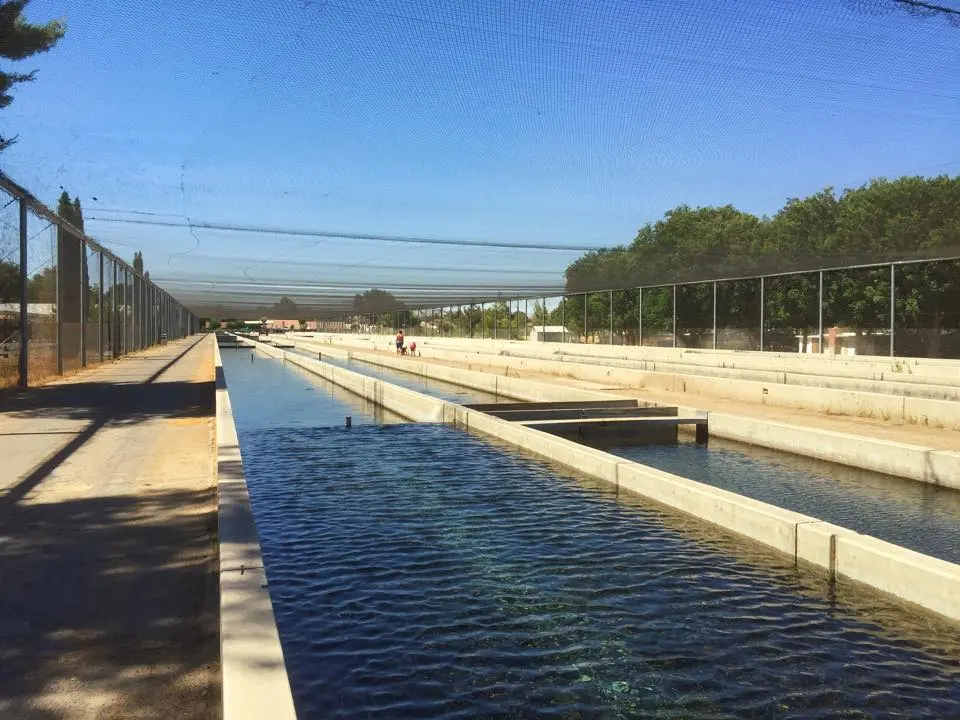
The Mojave River Hatchery is run by the California Department of Fish and Wildlife, which calls it a major producer and supplier of trout for Southern California. There is no entrance fee, and parking is easy. Visitors walk the grounds on their own during business hours, with no guide, and there are restrooms. The fish run every size, from small young fish to full-sized adult trout. They are raised in stages and then carried off to stock the lakes of the region. The species is rainbow trout, and the department states that those raised for recreational angling are now sterile triploids.
The water comes from below the desert, out of the Mojave River aquifer. What leaves the hatchery sinks back into that aquifer. On the way it spreads into a wetland, which the department keeps open for wildlife viewing.
Four ponds and an aeration tower
Construction began in 1947 on land owned by the State of California, paid for through a legislative appropriation. The hatchery started with four ponds. It drew on wells, and the first experiments found nitrogen in the well water at levels lethal to trout. Aeration towers went in to remove the nitrogen and add oxygen. Sixteen more ponds followed in 1949 and twenty more in 1952. In 1974 and 1975 the earthen ponds were rebuilt as cement raceways.
Bubbles under the skin, April 2020
By 2020 the hatchery held about 860,000 rainbow trout and supplied most of the waterways in Southern California. That April, employees noticed bubbles forming under the trouts’ skin. Eyes bulged, and abdomens swelled. The signs first suggested gas bubble disease, which is common in hatcheries. They were odd enough, though, that Mark Adkison, the state’s senior fish pathologist, sent a pathologist to run tests. Within a week the answer came back: Lactococcus garvieae, a bacterium similar to streptococcus that had never before been found in California.
The last fish planted from Mojave River went out on May 1. The department’s account says the hatchery was quarantined immediately on discovery in late April. A UC Berkeley Journalism report gives May 4 as the date the state quarantined the entire hatchery. “It rarely, rarely comes to that,” said Jay Rowan, who had been the department’s hatchery production manager for less than a month.
Staff spread the fish out to ease crowding, fed them an immune-boosting diet, and gave them several rounds of antibiotics. According to a department statement, one antibiotic feed alone cost more than $75,000. The bacterium resisted most of the antibiotics the federal government approves for food fish, and it showed only moderate susceptibility to the one that worked at all. It also lived in a biofilm on raceway walls, where it could reinfect any fish that recovered. The Sheet reported that ten of the sixteen groups holding most of Mojave’s fish were infected. Berkeley counted more than 50,000 trout dead from the infection. The Press Democrat, citing the Victorville Daily Press, put the toll at up to 60,000. Warm water made the difference. Above 59 degrees the bacterium turns pathogenic for rainbow trout, and the two cooler hatcheries in the Owens Valley where it also turned up saw almost no deaths.
Those two hatcheries, Fish Springs and Black Rock, tested positive on June 25 and were quarantined. By July 21 it was clear the outbreak could not be contained. On July 29 state officials began euthanizing the trout, exposing them in groups to high concentrations of carbon dioxide. The department later counted 3.1 million trout killed across the three hatcheries. Western Outdoor News gave the figure as 3.2 million. The contamination made the fish unfit for animal feed, fertilizer, or food banks, so they were buried in secure sanitary landfills.
“We got into this line of work because we love fish,” Rowan said. “It sucks.”
No one has established how the bacterium reached the desert. According to Berkeley, it was first found at a Spanish trout hatchery in 1988. DNA analysis showed the California strain did not come from the Columbia River Basin. The department’s working belief is that birds carried it into the hatchery from somewhere in the environment.
Hydrogen peroxide on the raceways
Paco Cabral, the hatchery manager in charge of cleaning Mojave River, called the work “lots of work.” Everything that had touched hatchery water had to be disinfected. That included tanks, raceways, settling ponds, and pipes, along with screens, nets, planting trucks, and the staff’s waders and boots. Crews cleaned 6,000 feet of concrete raceway, scouring off algae and dirt with a 250-gallon high-pressure spray washer. Then they walked the channels with backpack sprayers of water and hydrogen peroxide. At the settling pond, workers removed several yards of debris by hand so they would not tear the rubber liner that protects the local groundwater. A gas-powered high-pressure drain cleaner carried the peroxide through the plumbing. The department reported the work finished in December. Its January 2021 question-and-answer sheet gave the end of January as the date for completion.
The commercial vaccines then available would most likely not have protected fish against the California strain. Adkison and Dr. Esteban Soto of the UC Davis Aquatic Animal Health Lab therefore developed an autogenous vaccine made from the local bacterium. Mount Shasta Hatchery was to ship eggs to the three emptied hatcheries from the end of January 2021 through March, and every fish hatched from them was to be vaccinated once it reached the proper size. The department states that a trout takes about 9 to 18 months to reach half a pound, the target size for planting. By October 2021, Western Outdoor News reported, all three hatcheries had been cleaned and disinfected and were raising fish once again.
Notable Events
- 1947Construction began with funds supplied through California legislative appropriation. wildlife.ca.gov
- 1949The hatchery expanded by adding sixteen more ponds. wildlife.ca.gov
- 1952The hatchery expanded by adding twenty more ponds. wildlife.ca.gov
- 1974The hatchery was modernized from earthen ponds to cement raceways. nrm.dfg.ca.gov
- 2020The bacteria was discovered at Mojave River Hatchery in late April 2020, and the hatchery was immediately placed on quarantine. nrm.dfg.ca.gov
- 2020Testing also found the bacteria at Fish Springs and Black Rock; all three hatcheries were quarantined and ultimately 3.1 million trout were euthanized after treatment failed. wildlife.ca.gov
- Typical treatments and probiotic feed failed; the remaining options were watching fish die slowly or euthanizing all three million. journalism.berkeley.edu
- State officials began euthanization by exposing groups of trout to high concentrations of carbon dioxide. journalism.berkeley.edu
- The state quarantined the entire hatchery on May 4. journalism.berkeley.edu
- The last fish plants from Mojave River Hatchery were on May 1. nrm.dfg.ca.gov
- Surfaces and equipment were cleaned and disinfected with hydrogen peroxide to remove biofilms and inactivate the bacteria; these measures were completed in December. wildlife.ca.gov
People
- Anthony Holland, Fillmore Hatchery manager whose staff planted and held incoming northern-hatchery fish to provide Southern California angling opportunities during recovery.
- Dr. Esteban Soto, UC Davis Aquatic Animal Health Lab scientist coordinating with Dr. Mark Adkison in the state's vaccine efforts.
- Dr. Mark Adkison, CDFW Fish Health Laboratory scientist leading the state's vaccine efforts in coordination with Dr. Esteban Soto.
- Jay Rowan, CDFW Statewide Hatchery Program Manager involved in finding or developing an effective vaccine.
- Justin Kroeze, Moccasin Creek Hatchery manager whose staff planted east-side waters during the stocking-relief effort.
- Paco Cabral, CDFW Fish Hatchery Manager in charge of the cleaning regimen to remove bacteria from Mojave River Hatchery.
Sources
- wildlife.ca.gov/Fishing/Hatcheries/Mojave-River
- wildlife.ca.gov/Fishing/Hatcheries/Mojave-River/History
- wildlife.ca.gov/Fishing/Hatcheries/Mojave-River/Species-Raised
- vvng.com/mojave-river-fish-hatchery-where-it-all-begins
- nrm.dfg.ca.gov/FileHandler.ashx?DocumentID=15303
- wildlife.ca.gov/Science-Institute/News/state-fisheries-biologists-continue-efforts-to-eradicate-deadly-fish-bacteria2
- nrm.dfg.ca.gov/FileHandler.ashx?DocumentID=180707
- journalism.berkeley.edu/projects/acteria-attacking-californias-trout
- pressdemocrat.com/2020/07/09/never-before-seen-bacteria-kills-60000-fish-at-the-mojave-river-hatchery
- wonews.com/anglers-get-a-hatchery-back-lose-another-again
- thesheetnews.com/2020/07/03/one-fish-two-fish-red-fish-dead-fish