Moccasin Creek Hatchery
Moccasin, Tuolumne County, California. Trout hatchery.
Details
- Where
- 15300 Highway 49, Moccasin, CA 15300. Directions
- When
- Summer: 7:30 a.m. - 2:30 p.m.; Fall - Spring: 7:30 a.m. - 3:30 p.m.
- Getting there
- The entrance road is on Highway 49, near the junction of Highway 120, 20 miles south of Sonora.
- Access
- See the Emergency Closures page before visiting a CDFW office, facility or property.
- Phone
- (209) 989-2312
- Website
- wildlife.ca.gov
- Managed by
- State of California Department of Fish and Wildlife.
- Established
- 1954.
The raceways below Priest Grade
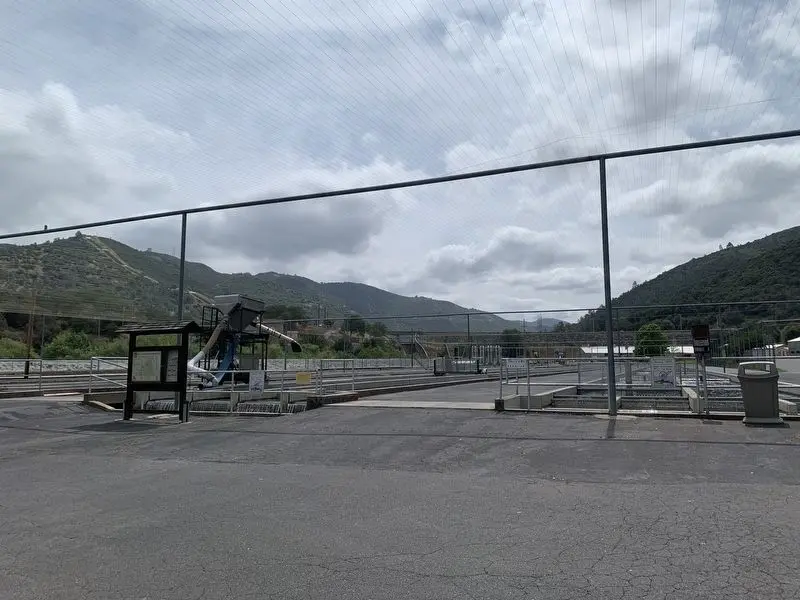
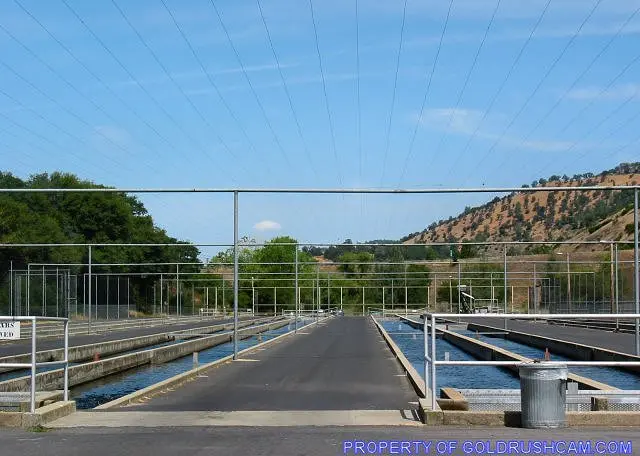
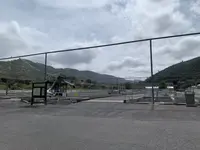
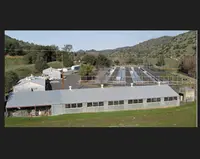
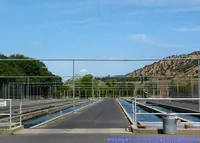
The entrance road leaves Highway 49 near its junction with Highway 120, 20 miles south of Sonora, and ends at a parking lot beside the raceways. There are 48 of them, concrete, each 100 feet long. In them the California Department of Fish and Wildlife raises trout for the waters of the Mother Lode foothills and the western Sierra Nevada. An interpretive panel headed “MCH History” stands in the main lot, with a map of the grounds to its left. Its reverse side carries a stocking map and the species raised here. Don Pedro Reservoir and the Red Hills Interpretive Trail, with its bald eagle viewing, are minutes away. Yosemite National Park is about an hour east.
The myMotherLode community guide calls Moccasin a company town, entirely owned by the City and County of San Francisco. Its houses are for employees of the city or the state, and it has no stores and no gas station. Its largest feature is a set of water pipes. They carry water from the reservoir behind O’Shaughnessy Dam in Yosemite over and down Priest Grade to the turbines at Moccasin. East of town, Highway 120 climbs New Priest Grade from about 910 feet to 2,450 feet in six miles. Old Priest Grade makes the same climb in about 2.7 miles, and vehicles descending it with smoking brakes are a common sight.
The hatchery runs on the same system. San Francisco holds the long-term land and water lease. Gravity brings water from the afterbay of the Moccasin Creek Powerhouse through the raceways and into a settling pond. From there it returns to Moccasin Creek, which carries it on to Don Pedro Reservoir. The marker sets out the arrangement: Hetch Hetchy supplies low-cost water and power, and the hatchery supplies angling to California’s recreational users. In a 2012 letter to The Union Democrat, Tom Grove, Fish Hatchery Manager II, added that fishing license dollars pay for the operation.
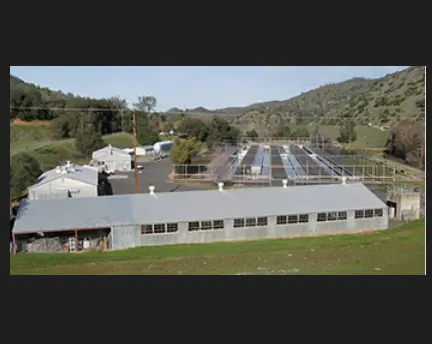
The hatchery building holds deep tanks for the earliest life stages and fiberglass round tanks. Most of the fish raised here are rainbow trout, in several strains. Those stocked for anglers are sterile triploids. So are the brown trout, which the state’s page describes as native to Eastern Europe and historically planted in many California waters.
The Eagle Lake strain of rainbow is known for its resistance to highly alkaline water. It is native to Eagle Lake and its Pine Creek tributary, and the state began a program in the 1950s to preserve it as Pine Creek’s flows diminished. It is now found in waters throughout the state. The hatchery also rears the Pilot Peak strain of Lahontan cutthroat trout for release to selected waters in the Lake Tahoe drainage. It is a federally listed native fish, named for the red markings on its lower jaw.
Golden trout by airplane
The California golden trout is the state fish, bright red and gold, usually found in high mountain lakes. Its year at Moccasin begins far from the hatchery. Each spring, according to the marker, hatchery staff from around the state travel to the Golden Trout Wilderness and spawn golden trout at the lakeside. The eggs come back to Moccasin Creek to hatch in the cold Sierra water. In the fall, most of the goldens raised here are planted in their historic range in Eastern California by plane, and some by vehicle.
The other planting goes on all year. The marker gives an annual output of about 800,000 to 1.2 million fish, or 300,000 to 500,000 pounds. Seventy-five percent of the fish are planted between April and September, in selected rivers, streams and lakes in nine counties.
In 2018 the department put the figure at about 700,000 fish a year. That came to some 50,000 a month on average and often more than 100,000 in April, when waters are stocked ahead of California’s trout opener on the last Saturday of the month. Grove’s 2012 letter counted 89 waters in nine counties. In season, five or six employees driving five vehicles planted 20 to 30 of them each week.
That letter answered a complaint. A reader named Joe Fedor had charged the hatchery with favoring Kennedy Meadows Resort. “We are a state agency with absolutely no financial compensation from any resort,” Grove wrote. He said Kennedy Meadows received only 1 percent of the year’s fish. His supervisor had invited Fedor to come to the hatchery and help plant, and Fedor had refused. “Mr. Fedor - I too have enjoyed the outdoors for over 50 years. Thirty-three of those have been spent working for Department of Fish and Game.”
The public has fished here too. On April 8, 2017, the hatchery held a free Trout Fest for youths 15 and under. Children learned to tie knots, rig a pole, cast, handle trout, and clean and cook them, with all equipment provided, rain or shine.
Five hatcheries into one
The ground had a use before the trout. In their 1955 history, The Big Oak Flat Road, Irene Paden and Margaret Schlichtmann place the Hughes Ranch of the ‘60s at the site marked by a fish hatchery. There, Thomas Hughes recalled, his family served supper and breakfast to stage drivers and passengers.
The hatchery’s own record begins in the mid-1940s. After an extensive search for a site between Lake Tahoe and Yosemite Valley, the state began plans for a new, state-of-the-art facility. In the 1950s the Department of Fish and Game closed its smaller and older hatcheries and moved the work to larger ones. Basin Creek in Tuolumne County, Yosemite, Bass Lake in Madera County, Kings River and Visalia gave way to the new San Joaquin Hatchery and to Moccasin Creek.
The department’s history page gives dates for several of the closed hatcheries. Kings River ran from 1928 to 1954, stocking the upper San Joaquin and Kings rivers and High Sierra lakes. The Madera hatchery, built in 1930 for Madera County anglers, was abandoned during World War II. The Sequoia Hatchery near Visalia had ten round redwood tanks and one pond 8 feet by 200. It turned out about 200,000 catchable fish a year until it was discontinued after Moccasin Creek was built. The marker, for its part, names only Basin Creek, Yosemite and Bass Lake as the hatcheries Moccasin Creek replaced.
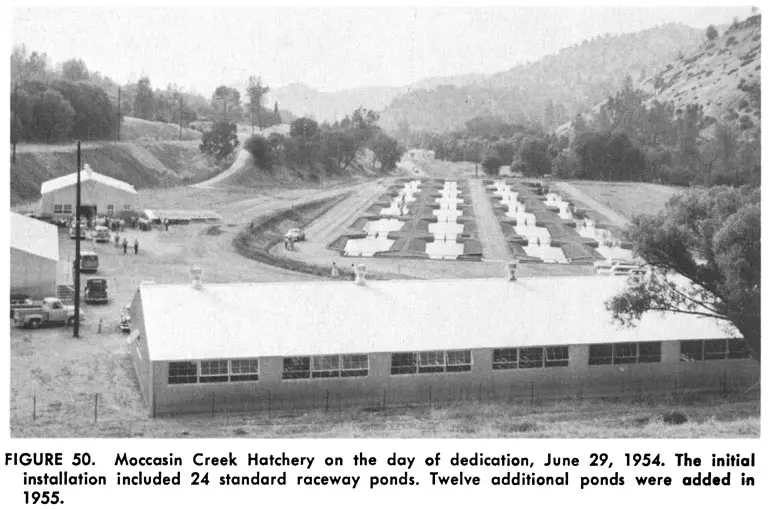
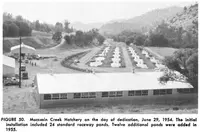
Moccasin Creek was completed in 1954 on a 25.5-acre parcel. It opened with 24 dirt ponds, 88 hatchery troughs and six redwood round tanks. The predecessors left more than their work. When Fish and Game transferred title to the Yosemite hatchery’s buildings, tanks and equipment to the federal government on March 1, 1957, some of that equipment went to Moccasin Creek.
Bill Donovan came in 1955. He had joined the department at Basin Creek the year before, after work at Pickering Lumber and the Sunbeam Bread Company. He and his wife, Delma, a former Navy nurse, lived at the hatchery until 1962, when he became a Fish and Game warden in Yolo County. He also served on the Moccasin School District board.
Over the decades the dirt ponds became the 48 concrete raceways. In 2011, ten deep tanks replaced twenty of the troughs. In 2012, six deep fiberglass round tanks replaced the redwood ones.
The night of March 22, 2018
Moccasin Creek Reservoir sits immediately upstream of the hatchery. On March 22, 2018, storm-swollen, it overflowed and flooded the grounds. At the time the hatchery held about 1.6 million fish, mostly rainbow trout but some brook, brown and golden. They ranged from just-hatched eggs to fish of 1 to 2 pounds.
The department was given a small window to return to the evacuated hatchery. Staff, wildlife officers and fisheries biologists worked into the early morning hours of March 24, netting about 40,000 pounds of trout, some 150,000 rainbows and brook trout. They released them into Don Pedro Reservoir, which the department had not planted with trout since 2016. Days later, crews found thousands more hatchery trout alive in ponds and pools the water had left behind. They rescued about 10,000 of these and released them into Moccasin Creek. San Francisco Public Utilities Commission crews brought equipment to clear the mud, debris and dead fish.
The accounts differ on the toll. The department reported in April 2018 the loss of more than 1 million fish and damage estimated at $3.2 million. It expected the hatchery back in operation no sooner than the fall of 2018 and at full production in 18 to 24 months. Hatchery International, citing The Union Democrat, reported that most of the 1.6 million died. The marker in the parking lot says the dam “breeched,” that “All the trout in the hatchery was lost,” and that staff “worked relentlessly to restore the hatchery.” An undated myMotherLode guide, which gives the hatchery 36 ponds, says it remains closed.
A reservoir under repair
By May 8, 2025, the hatchery was producing rainbow, brown and a small number of golden trout. That day, Governor Gavin Newsom named it among 21 California hatcheries to be upgraded. A study for the project put the annual production goal at 400,000 pounds of fish. Ongoing maintenance of Moccasin Reservoir, the hatchery’s water supply, had cut that goal to 200,000 pounds.
The study listed the hatchery’s troubles. They included a leaking intake structure, untreated incoming water, exposed HDPE piping, low oxygen in the raceways, predation, deteriorating concrete and limited backup power. “The Climate Induced Hatcheries Upgrade Project is a roadmap to ensure that our state-operated hatcheries can meet the challenges of the future,” said Charlton H. Bonham, the department’s director. The preferred plan, priced at $49 million, would replace the intake structure, bury the exposed pipe, add water reuse and treatment, increase backup power, and build covers over the concrete raceways.
Notable Events
- 1940sAfter an extensive site search between Lake Tahoe and Yosemite Valley, CDFW began plans for a new state-of-the-art hatchery facility. hmdb.org
- 1954Completed in 1954, the hatchery replaced the Basin Creek, Yosemite, and Bass Lake hatcheries; on a 25.5 acre parcel it opened with 24 dirt ponds, 88 hatchery troughs and six redwood round tanks. hmdb.org
- 1955Bill Donovan moved to the Moccasin Creek Fish Hatchery and lived there until 1962. stchsgenealogy.com
- 1957Fish and Game transferred title to the Yosemite hatchery buildings, tanks and equipment to the federal government. Some equipment went to Moccasin Creek; the passage does not separately date its arrival there. yosemite.ca.us
- 1962Donovan's residence at the hatchery ended when he became a Fish and Game warden in Yolo County. stchsgenealogy.com
- 201110 deep tanks replaced 20 of the hatchery building's troughs. wildlife.ca.gov
- 2012The original 6 redwood round tanks were replaced by 6 deep fiber-glass round tanks. wildlife.ca.gov
- 2018The hatchery was flooded by a storm-swollen, overflowing Moccasin Creek Reservoir; it lost more than 1 million fish and suffered extensive damage estimated at $3.2 million, and CDFW did not expect it to be operational until the fall of 2018 at the earliest. goldrushcam.com
- 2018The marker says the dam breached, floodwater inundated the hatchery, all trout were lost, and staff worked to restore the hatchery. hmdb.org
- 2018The dam was overwhelmed with water and the hatchery flooded. mymotherlode.com
- The report describes $3.2-million in damage and about 1.6 million fish held at the hatchery, most of which died; it attributes the fish-loss report to The Union Democrat. hatcheryinternational.com
- The report says final preparation plans were completed by the state in February for hatchery projects including Moccasin; its request for clarification of project timelines had not yet received a response. mymotherlode.com
People
- Charlton H. Bonham, CDFW director commenting on the Climate Induced Hatcheries Upgrade Project, which the article says includes Moccasin.
- Gavin Newsom, Governor announcing planned California hatchery updates that include Moccasin Creek Hatchery.
- William (Bill) Donovan, Department of Fish and Game employee who moved from Basin Creek to live at the Moccasin Creek Fish Hatchery, later becoming a Yolo County warden (1955–1962).
- Joe Fedor, Critic who had complained that the hatchery favored Kennedy Meadows Resort, as described in Tom Grove's response.
- Larry Stewart, Hatchery supporter thanked for kind comments about the hatchery and its employees.
- Tom Grove, Fish Hatchery Manager II; author of the hatchery's letter defending impartial fish planting.
- Thomas Hughes, Historical witness in the Hughes Ranch account who recalled his family serving supper and breakfast to stage drivers and passengers in the '60s.
Sources
- wildlife.ca.gov/Fishing/Hatcheries/Moccasin-Creek
- wildlife.ca.gov/Fishing/Hatcheries/Moccasin-Creek/History
- wildlife.ca.gov/Fishing/Hatcheries/Moccasin-Creek/Species-Raised
- hmdb.org/m.asp?m=301060
- mymotherlode.com/news/local/3858194/moccasin-among-fish-hatcheries-receiving-upgrades.html
- mymotherlode.com/community/event/locations/moccasin-creek-hatchery
- goldrushcam.com/sierrasuntimes/index.php/news/local-news/9440-cdfw-announces-trout-fest-at-the-moccasin-creek-hatchery-on-saturday-april-8-2017
- stchsgenealogy.com/p50.htm
- uniondemocrat.com/news/article_b3cc9e41-c791-5b5b-aa3d-21659ae18c11.html
- yosemite.ca.us/library/big_oak_flat_road/jacksonville.html
- yosemite.ca.us/library/yosemite_resources/recent_years.html
- hatcheryinternational.com/storm-inflicts-32m-damage-on-hatchery-3134
- mymotherlode.com/community/guide/tuolumne/moccasin
- goldrushcam.com/sierrasuntimes/index.php/news/local-news/13641-opportunities-abound-for-trout-anglers-despite-flooding-of-moccasin-creek-hatchery-in-tuolumne-county-says-cdfw