Michael Anthony, Bootmaker
Sebastopol, Sonoma County, California. One-man custom boot shop.
Details

- Where
- 227 North Main Street, Sebastopol, CA 95472. Directions
- When
- Monday — Sunday By Appointment or Happenstance.
- Access
- You may drop in and inquire and learn what leathers are available or you may set up an appointment by calling Michael.
- Phone
- 707 823-7204
- Website
- michaelanthonybootmaker.com
- Managed by
- Michael Anthony Carnacchi.
- Established
- 1994.
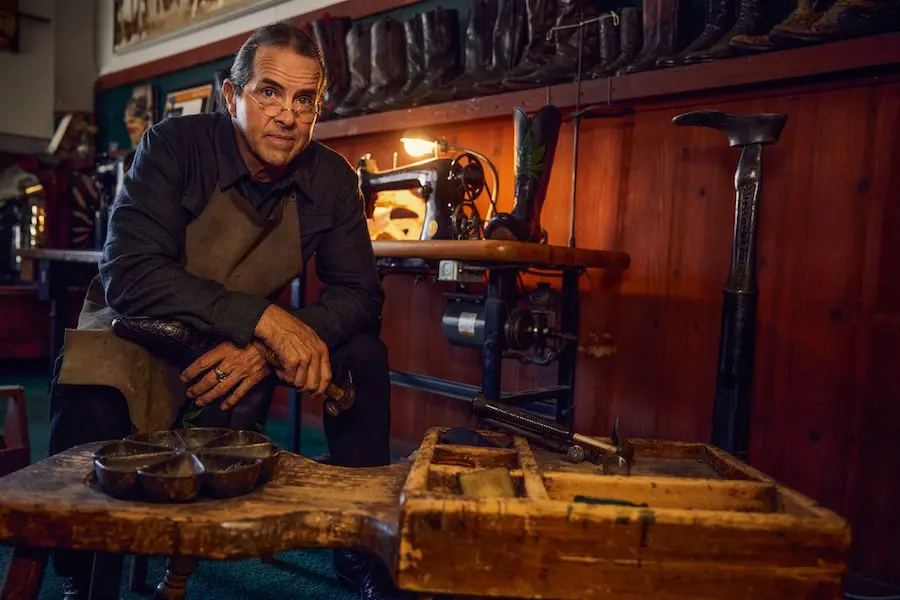
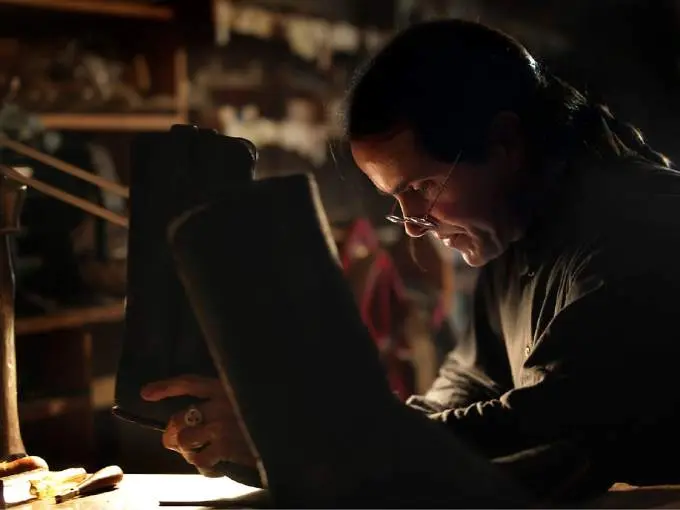
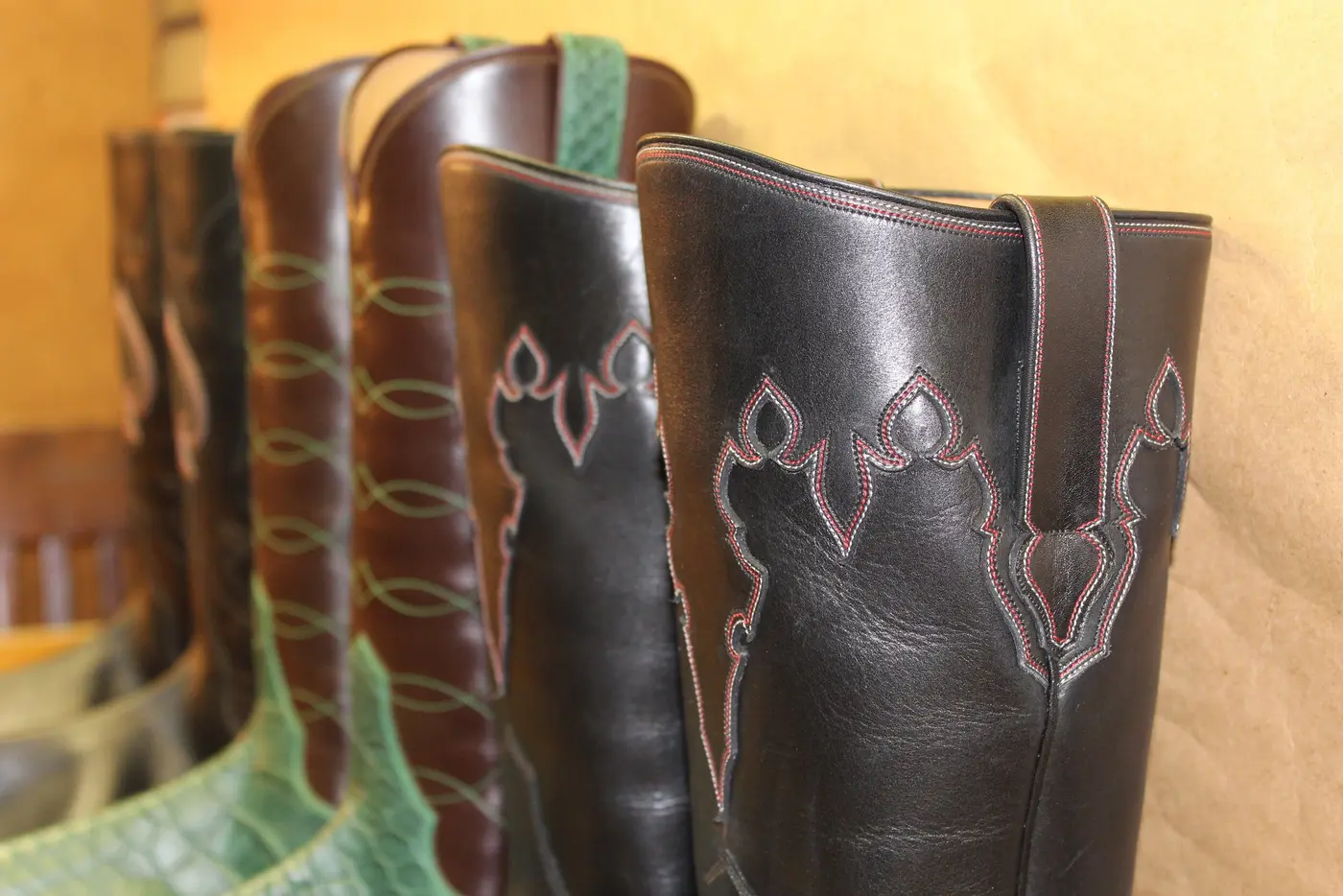
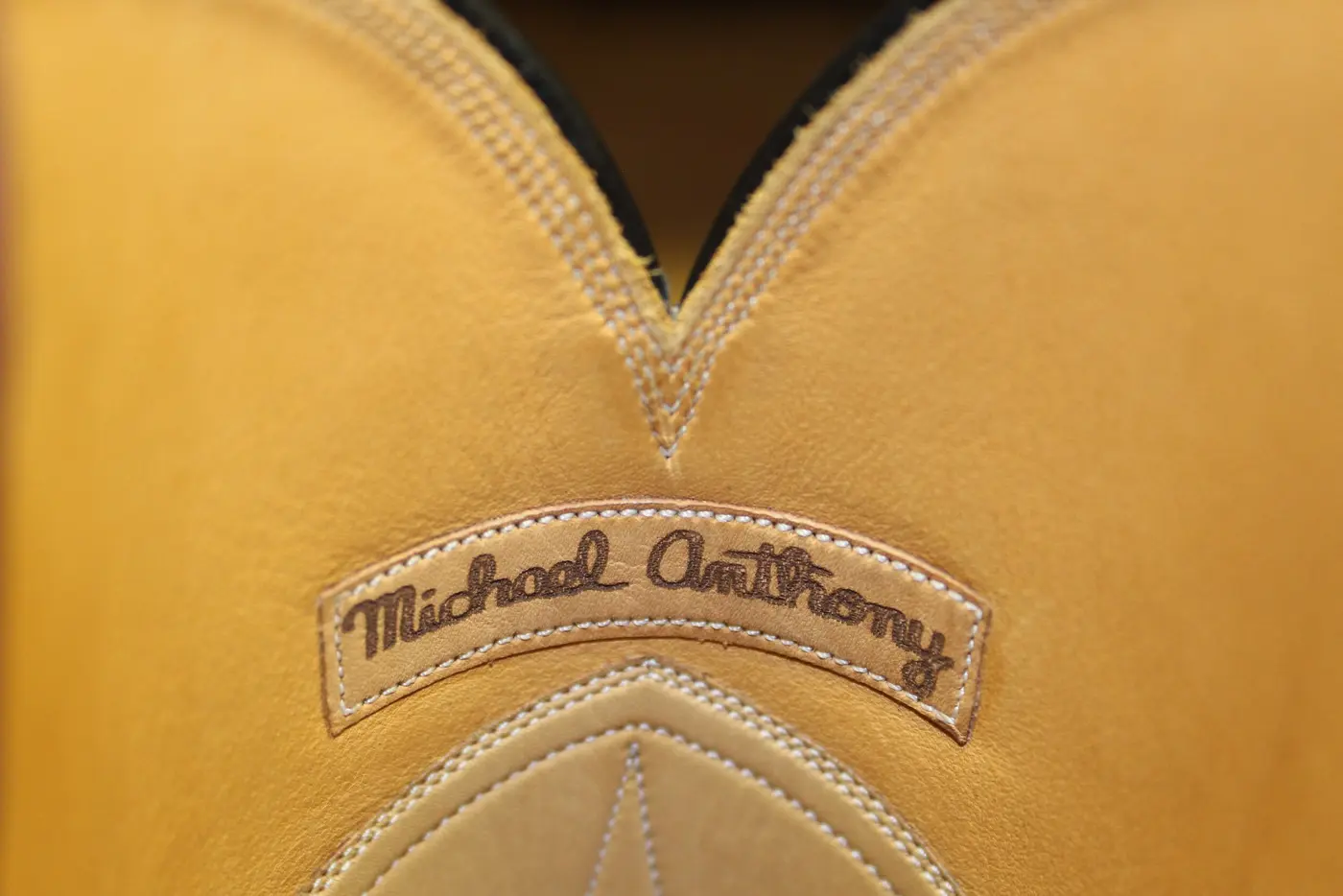
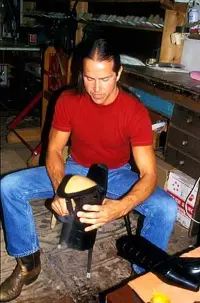
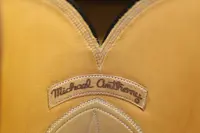
The shop at 227 North Main Street in downtown Sebastopol goes by Apple Cobbler. Its hours are posted as “Monday — Sunday By Appointment or Happenstance.” In a small workroom there, Michael Anthony Carnacchi makes custom Western boots one pair at a time. He does the stitching and every other part of the boot himself, under a label that reads simply Michael Anthony.
A drop-in can learn what leathers are on hand. For most boots he prefers French or German calf, ostrich and alligator. He will also work in deer, emu, mule, snake or lizard. “I will make a pair of boots from any hide that is not an endangered species,” he says. He takes eight to ten measurements on each foot. When he spoke to the Sebastopol Rotary in 2016, the club put the measuring at over an hour. Then the count begins. “There are 372 steps to making a pair of custom Western boots and I do every one of them. It’s just me.”
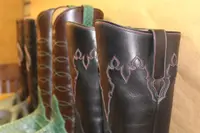
The customer chooses toe style, heel height, shaft height, stitch pattern, color and leather, plain or fancy. Heels run up to three inches. In 2003 the San Francisco Chronicle counted 60 colors of crocodile alone. His website gives a basic pair at $3,500, with at least 50 hours of labor and $400 in leather. The most expensive pairs run to $10,000. “I’m not getting rich doing this,” he says, “but bootmaking is a dying art that I love and want to preserve.” He also teaches bootmaking courses by reservation.
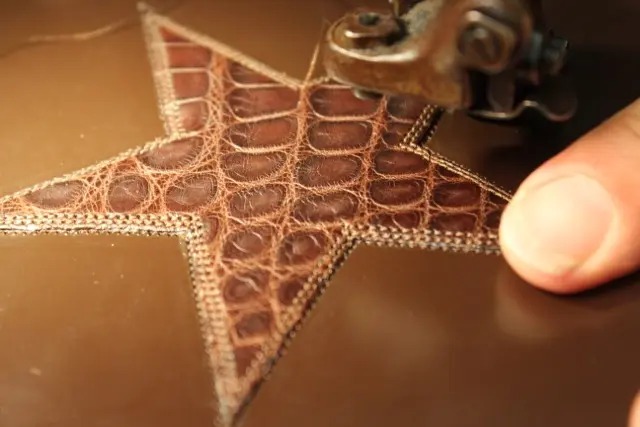
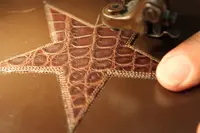
His own posts show the machines. In August 2026 he showed a Singer 31-21, which he sets as a rule at sixteen stitches per inch, sewing Horween bison. In September he posted outsole stitching from a Landis Model 12-K: ten stitches per inch, a No. 21 awl, a No. 20 needle, four-cord Barbour’s flax on top and five-cord in the bobbin. He has collected old boot photographs for decades. One August post was a tintype of two aproned bootmakers at their benches, with a third man holding scissors behind them. He wrote that it was the first such photograph he had found in which the lasts show clearly inside the boots. “The last comes first,” he told a West County correspondent in 2012. He shapes the last to the foot, shapes the insole to the last, then sews insole, welt and upper together.
In 2004 Robb Report described the shop as the “size of a shoe box.” It said he often worked at a sidewalk workbench, lasting or welting shoes while he talked with passersby. “It’s a lot of fun because most people have never seen a shoe being made,” he said. He liked to tell Tolstoy’s story What Men Live By, in which royalty lays a hide before a shoemaker who happens to be named Michael. Asked how he came to the trade, he said he had been reincarnated as a shoemaker for mistreating one in a previous life. “Let’s face it, who in their right mind would say, ‘Dad, I want to be a shoemaker’?”
Twenty-eight days on a Harley
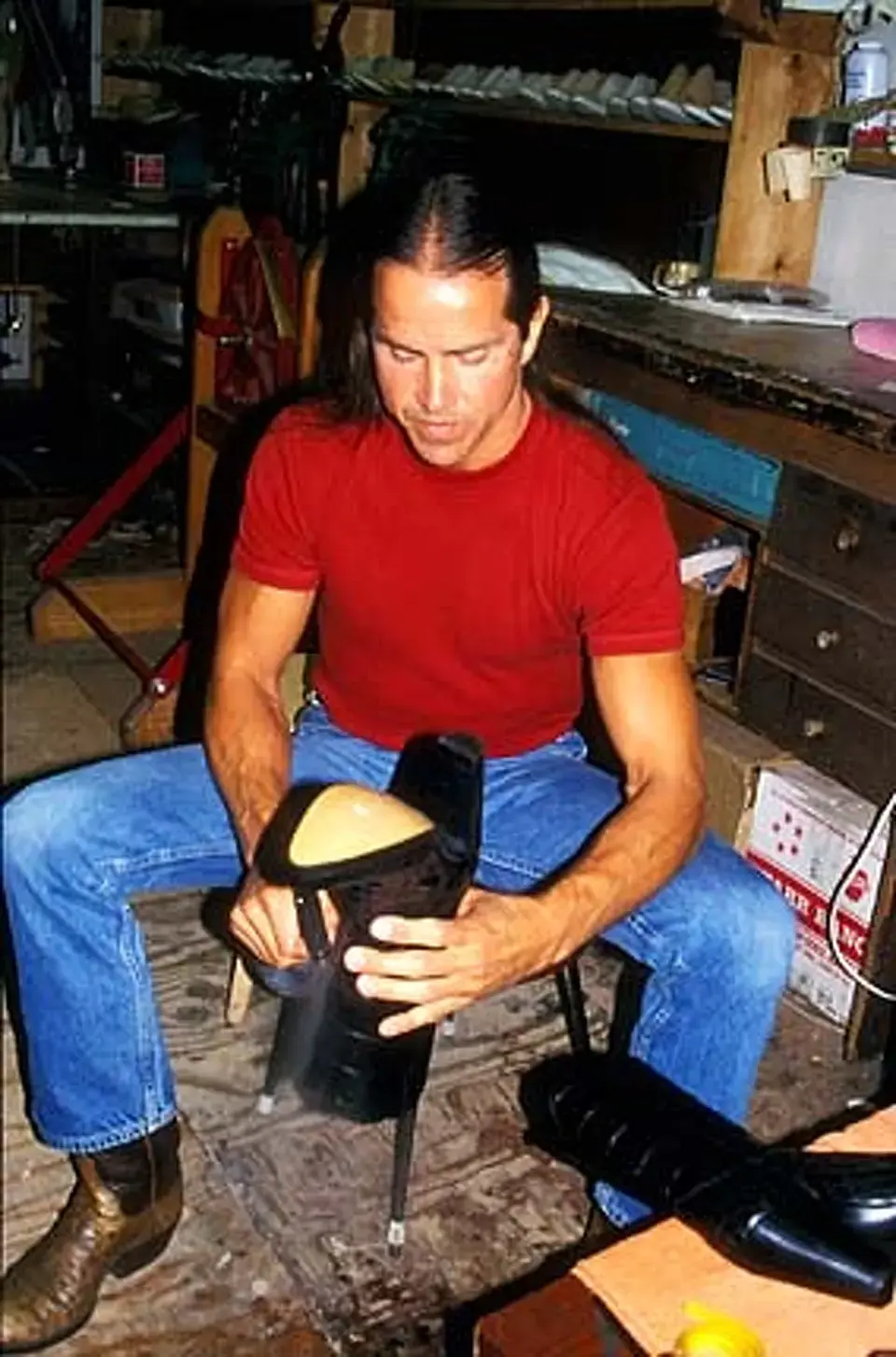
In 1987 Carnacchi left his hometown of Detroit on a Harley, his ponytail in the wind, meaning to become a working artist somewhere in the West. “Twenty-eight days later, I hit Tomales Bay and realized that I was not only out of land,” he told the Chronicle, “but also out of money.” Robb Report says he worked as an oyster rancher and then as a feed-store clerk. After that he went into shoe repair. The Chronicle places him at Schuman Brothers Shoe & Boot Repair in Cotati. Robb Report names his teacher there as a local cobbler, Joseph Schuman. “He used to refer to us as Mr. and Mrs. Schuman because we fought so much,” Carnacchi recalled.
He went on to Marelli Bros. Shoe Repair in San Rafael, a business then nearly 80 years old. David Marelli, grandson of the founder, remembered him riding in on his motorcycle from the town of Sonoma, even when the shop could only offer half days. He also remembered him as always friendly and “always with a cause, such as remaining rankled over the requirement that motorcyclists had to wear helmets.” Marelli said, “We’re pretty assembly line here, but his artistry showed through.”
There are two accounts of how he came to the Sebastopol shop in 1994. The Chronicle and the Rotary say it simply became available and he went out on his own. Robb Report tells it another way. He was turned down for a state job making shoes for the developmentally disabled. “I made it to the top three candidates, and one of those men owned this shop. He got the job I wanted, and I got the job he didn’t.”
Repairing factory boots, he said, he kept seeing the quality decline, and he figured some people would always pay for the best. In 1996 he wrote to Jack Reed, a bootmaker in Burnet, Texas, and asked to be taken on as a student. Reed politely declined. Carnacchi persisted, rode the Harley to Burnet and stayed two weeks. The Chronicle says he kept returning until Reed retired, about 2000. Robb Report puts his Texas years at five. “Boots take top-notch precision work,” Reed told the Chronicle. “Everything has to be exact. And you have to be an artist, too, to be able to visualize what the customer envisions and make it all work together. Michael could do all that.”
In its June 2002 issue, Robb Report named him the “Best of the Best” Western bootmaker in the United States. The magazine said he was the only American bootmaker licensed with the U.S. Fish & Wildlife Service to sell skins such as kangaroo, saltwater crocodile and python. It also said he bought them through Gordon Choisy, the Hermès-owned French leather supplier. The Chronicle reported in 2003 that he had stopped resoling saddle shoes and reheeling pumps four years earlier, and was averaging 36 pairs of boots a year. By his own figuring he made about $11 an hour. “Unfortunately,” he said, “most cowboys can’t afford my boots.” To protect his clients’ privacy, he often went to them instead.
One of those clients was Fred Furth, a San Francisco attorney and owner of the Chalk Hill winery in Healdsburg. By 2003 Furth had ordered his twentieth pair. “You don’t ask him to hurry anymore than you’d ask Van Gogh to get the painting ready by next Tuesday,” Furth said. One pair he ordered was modeled on a brown-trimmed white spectator shoe, made in brown kangaroo and Italian white leather, and he wore it with white suits after May 1. Carnacchi’s longest job, at 250 hours, was a pair inlaid with Sobek, the Egyptian crocodile goddess. He made them to his own fit for a photograph in Tyler Beard’s book The Art of the Boot.
Four days late
Trouble came by mail. According to the North Bay Bohemian, Carnacchi had a credit card through U.S. Bancorp with a balance of about $14,000, most of it borrowed for the business. The Bohemian’s 2015 account says he paid four days late in December 2007. Its 2011 account dates the start of the fight to January 2007. Either way, his interest rate went from about 3 percent to 31 percent, and his monthly payment from about $213 to $1,224. He refused to pay. He taught himself law, followed the case from county to state to federal court, and turned down four settlement offers. On March 11, 2011, Judge Mark Tansil ruled against his first cause of action. “I’ve aged and lost a lot of sleep over it,” he said then.
When the Bohemian named him Best North Bay Citizen in 2015, he was eating bacon from a mess cup in the shop. He said he had once had two or three orders a month and was now down to one every other month. George Lucas was among his customers. While the reporter was there, a young woman came in for a pair of moccasins he had made her. The price was $50, which she did not have on her. She left wearing them and carrying her sandals. On March 20, 2015, the Supreme Court had 276 petitions before it and agreed to hear two. Carnacchi v. U.S. Bank was not one of them.
Pixar and the shelf with the lathe
Also in 2015, he received what he called a weirdly nonspecific email. A documentary company then asked to film his shop. Neither mentioned Pixar. Three weeks after the crew left, Pixar’s legal department called. ABC7 reported that six animators came, put a microphone on him and asked questions for about two hours. His apprentice had guessed they were coming to steal his Luxo lamps. The visit stayed secret for nearly two years.
The film was Coco, whose hero, Miguel, comes from a family of shoemakers. Carnacchi, elected to the Sebastopol City Council in 2016, was at the first area screening. He and his girlfriend each spotted parts of the shop the other missed. “That’s my shelf with the lathe on it, that’s cool!” he said. He also saw his bench and his stool. The Bohemian wrote that the shop appears several times in the film. Carnacchi called it “maybe just two minutes really, two minutes of fame.” His name ran under “Additional Thanks” in the credits. “I just let out a whoop when I saw it.” In 2018, his Benjamin Franklin spectacles halfway down his nose, he told ABC7, “I’ve been animated! Hah! As if I’m not animated enough already!”
Room 22, Landover
In 2009, the bicentennial of Lincoln’s birth, Carnacchi examined Lincoln’s boots for the National Park Service. The Washington Post reported that he asked the Park Service for permission. A 2012 account on his own website tells it differently. Moved by Barack Obama’s inauguration, he wrote offering to make the president boots like Lincoln’s. Obama did not accept, but the Park Service heard of him and invited him in.
He arrived on a Monday at the Park Service’s Museum Resource Center in Landover, Maryland. He carried calipers, a large dental mirror, a flashlight, a magnifying glass, hide samples and a kind of carbon paper for tracing. In Room 22 the square-toed, shin-high boots lay on acid-free paper. Park Service curator Gloria Swift and other staff watched as his flashlight found the shiny hollow left by Lincoln’s heel. When the beam hit a maroon patch inside, he whispered, “Aha. There’s your original color.”
He judged the boots closer to a size 12½ than the 14 on the catalogue card. He thought parts of the tops were bookbinding-grade Moroccan goatskin. He found a cross-hatched pattern on the heel that had not been noticed before. A crease on the left boot suggested a poor fit. “This boot was a little short on him.” He confirmed that 14 numbers on a tracing of Lincoln’s feet were a bootmaker’s standard measurements, said to have been taken in the White House by Peter Kahler in 1864. On a second trip the Park Service asked him to look at John Wilkes Booth’s boots as well. “Booth was literally down at his heels when he killed Lincoln,” he said. “He couldn’t afford to have his heels replaced.”
From his research, Carnacchi said Lincoln ordered the boots on February 16, 1859, from the Springfield bootmaker Conrad Loch. They cost $19.50, and Loch’s busy shop took ten months to make them. In 2012 he spoke of a numbered edition of Lincoln boots in a leather close to the original Russian calf, and of a play about the night at Ford’s Theatre. By 2016 the Rotary reported that he had made an exact replica, down to the leather fancywork, woven bootstraps and hand stitching.
The heels of the originals were six layers deep and set with hobnails. On a wooden floor, Carnacchi told the Post, “You would have known when the president walked in the room.”
Notable Events
- 1987Carnacchi came west from Detroit on his Harley. michaelanthonybootmaker.com
- 1994He started his signature business after being turned down for a state job making shoes for the developmentally disabled. robbreport.com
- 1994The little Sebastopol shop became available and Michael went out on his own. sebastopolrotary.com
- 1996He contacted legendary Texas boot maker Jack Reed to see if he would take on a student; turned down, he persisted and rode his Harley to Burnet, Texas. sfgate.com
- 2002Robb Report magazine named him the "Best of the Best" western boot maker in the United States. sfgate.com
- 2007Carnacchi was four days late with a payment during difficult times for small businessmen and banks. bohemian.com
- 2007The fight began when Carnacchi missed one credit-card payment; the bank raised his interest rate and monthly payment and refused a workable payment plan. bohemian.com
- 2009Moved by Obama's inauguration, Carnacchi wrote offering to make boots like those Lincoln wore. michaelanthonybootmaker.com
- 2015After keeping the visit a secret for nearly two years, the movie they were researching turned out to be the Oscar nominated animated film Coco. abc7news.com
- 2015A Pixar team requested to research the shop for a movie; Carnacchi recalled six animators recording him and asking questions. abc7news.com
- 2015Carnacchi says a nonspecific email was followed by a documentary company's request to film his shop; neither mentioned Pixar. bohemian.com
- 2015Carnacchi v. U.S. Bank was not among the cases the Supreme Court agreed to hear in its conference. bohemian.com
- Judge Mark Tansil ruled against Carnacchi's first cause of action in the credit-card case. bohemian.com
- Carnacchi asked permission to examine Lincoln's boots and the Park Service agreed. michaelanthonybootmaker.com
- Carnacchi stopped taking in worn saddle shoes and women's pumps needing new heels and became a full-time bootmaker. sfgate.com
People
- Michael Carnacchi, Proprietor of Apple Cobbler in Sebastopol.
- George Lucas, Boot customer.
- Michael Anthony Carnacchi, Creator of custom Western-style boots at Apple Cobbler; went out on his own when the Sebastopol shop became available (1994).
- Jack Reed, Texas bootmaker whom Carnacchi contacted for instruction; Carnacchi called him his mentor (1996).
- Barack Obama, President to whom Carnacchi offered a pair of boots like Lincoln's; the president did not take up the offer.
- Gloria Swift, Park Service museum curator who examined the boots with Carnacchi and other Park Service experts.
- Joseph Schuman, Local cobbler with whom Anthony undertook a shoemaking apprenticeship.
- Michael Anthony, Cobbler who started his signature business after being turned down for a state shoemaking job (1994).
- David Marelli, Grandson of the original owner of Marelli Bros. Shoe Repair, where Carnacchi went to learn more.
- Fred Furth, San Francisco attorney, Chalk Hill winery owner and repeat boot customer.
- Tyler Beard, Author of The Art of the Boot, for which Carnacchi made Sobek-inlaid boots for a featured photograph.
Sources
- michaelanthonybootmaker.com
- instagram.com/sebastopolbootmaker
- abc7news.com/post/bay-area-boot-shop-used-as-inspiration-for-oscar-nominated-coco/3151088
- sfgate.com/bayarea/article/sebastopol-cobbler-s-boots-are-made-for-gawking-2615247.php
- robbreport.com/style/fashion/feature-independent-thinkers-240692
- sebastopolrotary.com/bulletin/viewsent/7c11bcf6-a977-42f9-92ee-a5b494f0d15b/953886be-5455-4ea6-a9e6-3d380aae365a?mid=VCV4EyLjFcdk5VKwIiFglg%3D%3D&type=m
- michaelanthonybootmaker.com/news-bootmaker-michael-anthony-sebastopol-california/tracing-lincoln-footsteps-michael-anthony-carnacchi-smithsonian
- michaelanthonybootmaker.com/news-bootmaker-michael-anthony-sebastopol-california/robb-report-michael-anthony-carnacchi
- michaelanthonybootmaker.com/news-bootmaker-michael-anthony-sebastopol-california/lincoln-boots
- pressdemocrat.com/2012/11/18/on-theheels-of-history
- bohemian.com/coco-carnacchi-1
- bohemian.com/best-citizen-1
- bohemian.com/unite-to-fight-1
- bohemian.com/round-12-tko-1