





Meadows Valley Days
New Meadows, Adams County, Idaho. Annual celebration; Labor Day weekend.
Details

- Where
- 101 Virginia Avenue, New Meadows, ID 83638. Directions
- When
- Labor Day Weekend - September 5th- September 6th.
- Fees
- Log Burling: Adults $7, juniors free.
- Hours
- Parade and Car Show 11am.
- Access
- Periodic patrols by local law enforcement; no on-site 24 hour security.
- Phone
- (208) 347-2171
- Website
- meadowsvalleydays.com
- Managed by
- Meadows Valley Days Committee.
- Established
- 61 years.
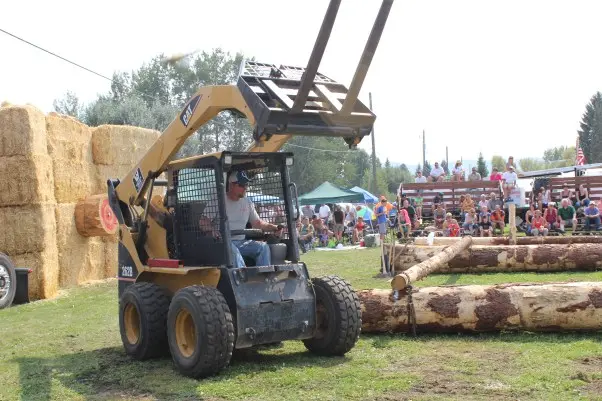
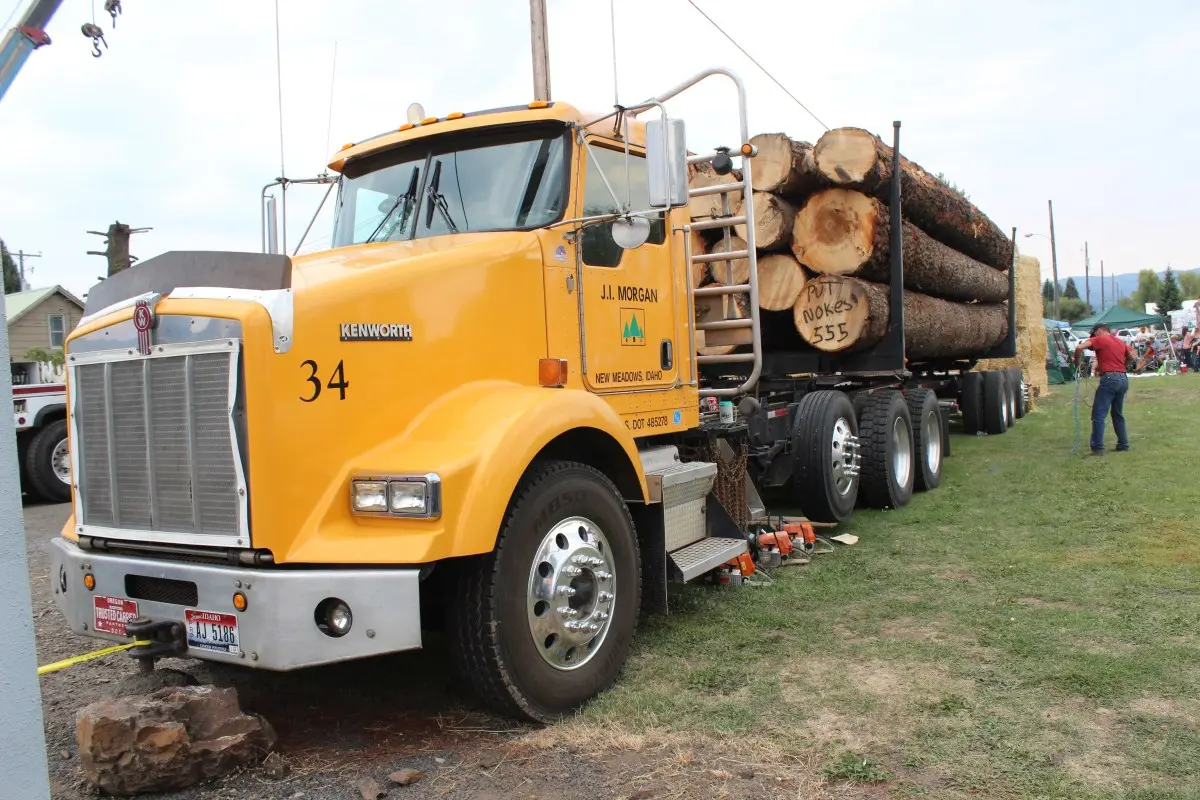
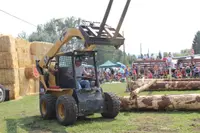
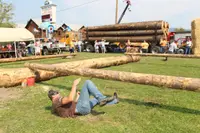
On the Thursday before Labor Day weekend in 2026, skid steers and cranes were at work in Dorsey Warr Memorial Park in New Meadows, Idaho. They set logs and hay bales into a competition stage and a pool for log burling. The bleachers went up under new sunshade tents. By Saturday morning the front of the park was lined with vendors selling crocheted pieces, T-shirts, holsters, fire starters, and massage pillows, which Rachel Reynaga, New Meadows correspondent for the Record Reporter, called “very popular.” Hand-dipped ice cream, lemonades, the Taco Queen food truck, Buck & Sassy’s overstuffed burritos, and a tamale booth fed the crowd. The Friends of the Library held a book sale, the historic depot held a rummage sale, and the community center sold pies to raise funds.
The 2026 edition was the 61st Meadows Valley Days, which the Record Reporter calls “Meadows Valley’s annual amateur lumberjack competition and community celebration.” The Meadows Valley Days Committee runs it. The town sits at the southern and upper end of the Meadows Valley, on the Little Salmon River, and had 517 residents at the 2020 census. State Highway 55, the Payette River Scenic Byway, ends there at U.S. Route 95. Some of the Saturday log burlers in 2026 were people passing through, who saw the festivities from the road and stopped to join in.
The round at the axe line
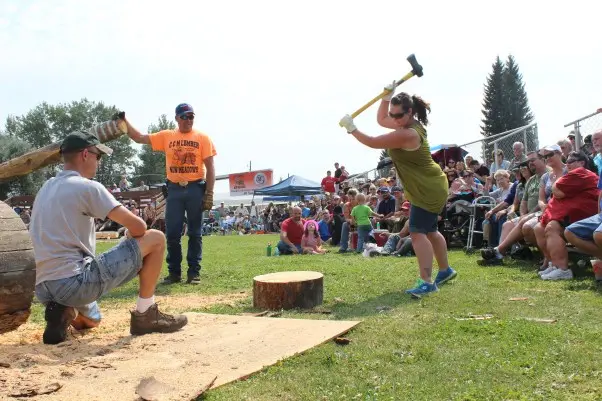
Clouds covered both mornings of the 2026 show, and Sunday brought a few light showers. By Reynaga’s account the sky was blue and the sun out by the time the first axes were thrown each day. The target is a giant round of wood. “A couple people told me the axe target was made by Leonard Wallace about 40 years ago,” she wrote. She added that the round “tells the story of competitions many years past.” At its center is a beer can, and the crowd erupted each time a thrower hit it. The Saturday qualifying round at noon sends the top ten throwers on to Sunday. That year a 71-year-old woman threw for the first time, Reynaga reported, after years of watching from the sidelines and thinking about it.
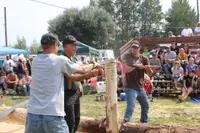
Log burling followed at 1:30 Saturday afternoon. Adults paid $7 to enter, and junior burlers went free and competed after the adults. Over the years some burlers have taken to costumes: bananas in 2025, colorful shower caps in 2026. Fisher Gerke won the youth competition by out-running his cousin on the log. Rumor has it, the paper said, that he has been competing since he was a toddler.
Eight events and an all-around
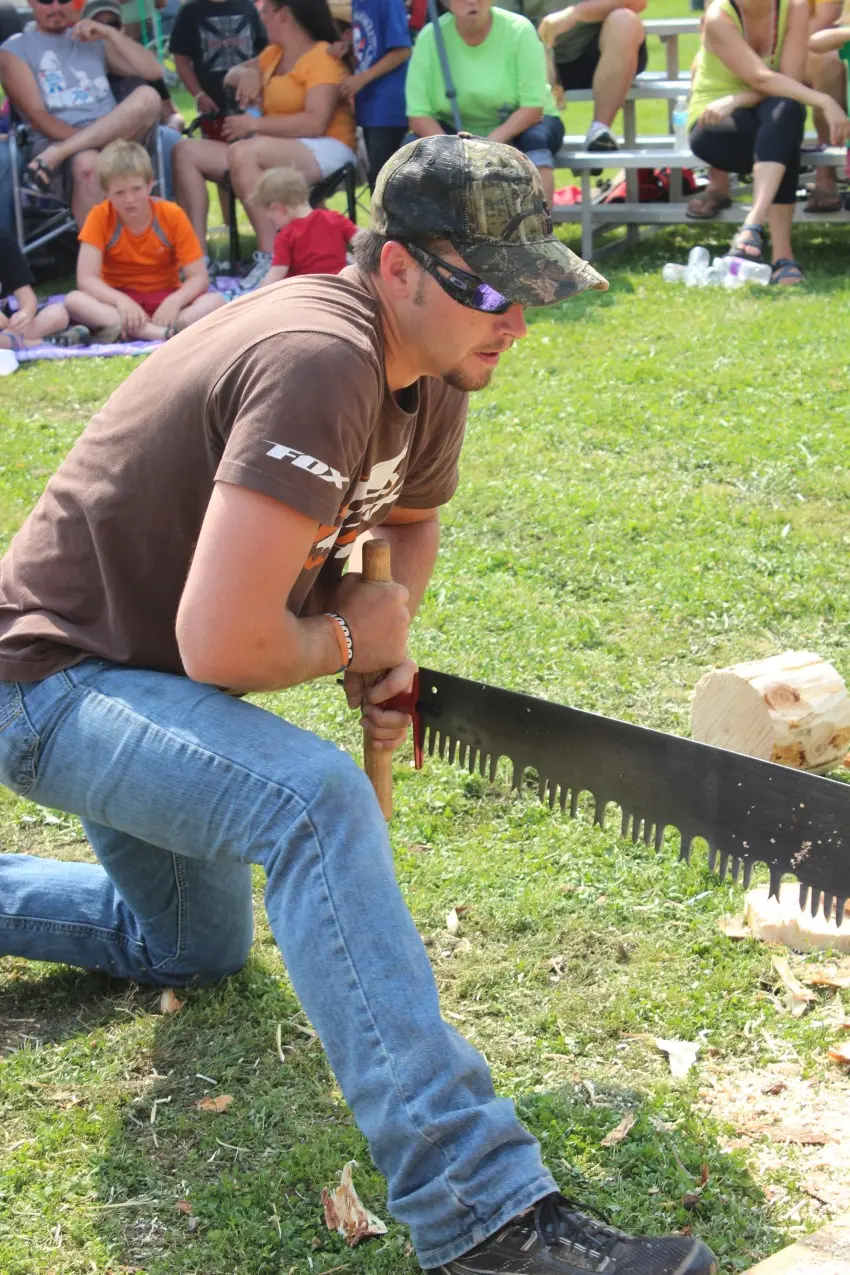
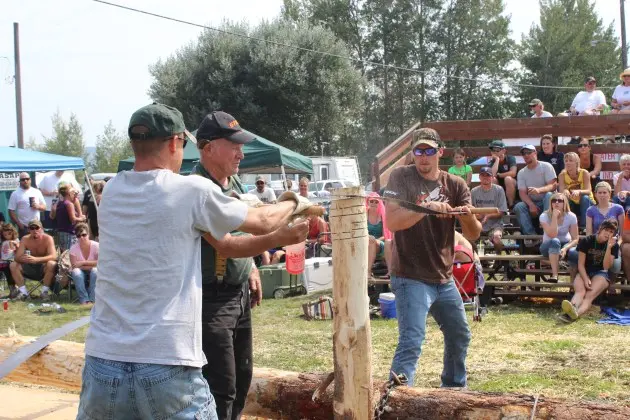
The logging show runs Sunday afternoon. Its events are axe throwing, log burling, mixed pair crosscut saw, the Fiasco, Jack & Jill woodchop, the obstacle buck, choker set, and wrapper toss. All except the axe throwing and the burling are timed. Each event earns points toward an all-around score, and the top men and women overall take the big prizes. In 2026 Logan Logan of New Meadows won the choker set in 15.87 seconds.
The obstacle buck is the event the crowd fears most, in Reynaga’s estimation. A competitor starts at the foot of a vaulted log. When the timer starts, he or she grabs a chainsaw, climbs onto the log, starts the saw, and walks up to the high tip. There the competitor saws off a section, walks back down, and runs around to the start. Of six who tried in 2026, two finished the course.
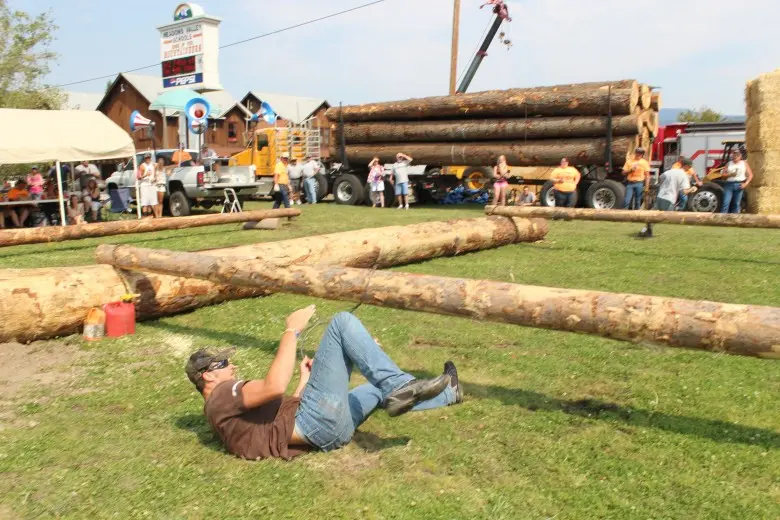
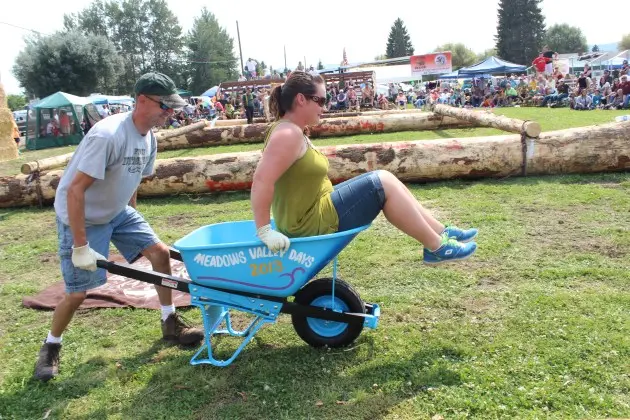
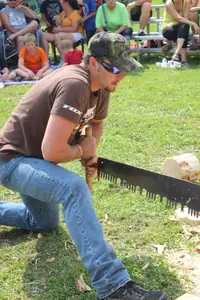
The Fiasco is the loudest event. A team is one woman and two men. The “couple” lie on the ground and jump up when the “alarm” goes off, which starts the timer. The woman pulls on a pair of boots, jumps into a wheelbarrow, and is pushed to the saw and chop area. The man saws off a round and runs on, while the woman chops the wood, loads it into the wheelbarrow, and pushes it back “home.” The man then joins the third teammate on the crosscut saw. When the round drops, the two run across parallel beams, secure a choker to a log, and touch the finish line. A runner who falls off a beam goes back to the start and runs it again. Once both have touched, the woman throws the axe until it stays in the target. In 2026 Amanda Branstetter, Lucas Nicholson, and Devin Buys won the Fiasco by more than 30 seconds.
Branstetter and Steven Shivers took the all-around titles that year. Both were long-time competitors who had placed near the top before, both were involved in producing the event, and neither had won the all-around until then. Their awards were wooden. Rachael Melad, agriculture teacher and FFA chapter advisor at the Meadows Valley school, designed them and built them with her FFA and agriculture students, with help from Theodore Shipman. Tyler Power, the FFA and agriculture teacher at Council, helped cut the large saw shapes for the all-around prizes on the school’s plasma table. The 2026 show also added age-group tug of war contests, held between logging events along with auctions of prizes and competition items.
Sunday from the depot to the car show
Sunday began at nine with a community worship service outside the historic depot. Parade entries lined up at ten, south of the Subway, and anyone throwing candy brought their own. At eleven traffic was held while car clubs, local groups, and businesses rolled past families lined along the road. The FFA had a float.
After the parade the cars parked in the park, and spectators voted for a people’s choice award. In 2026 the oldest car was a 1911 Sears Motor Buggy and the newest a 2024 Chevy Corvette. Trophies were presented at three. From noon to two the Meadows Valley Fire Department served pit-roasted beef with sides. Members of the Meadows Valley FFA served it, wearing custom MV Days aprons. According to the committee, the profits support projects within Meadows Valley and the next year’s show.
The depot at the end of the line
The depot stands at Commercial and Virginia streets. It is a two-story brick building in the Italianate style, with a bracketed hipped roof and a round arched entry on the south side. A one-story freight office extends to the west. A small roofed platform runs along the north side, parallel to where the tracks lay, and a triangular dormer breaks the roof at the center of the north and south faces. The National Register nomination, prepared by architectural historian Don Hibbard of the Idaho State Historical Society, credits the design to H. W. Bond, “Weiser’s foremost architect.” Bond also designed a residence and a hotel at New Meadows for the railroad’s president.
The Pacific and Idaho Northern left the Oregon Short Line at Weiser, ninety miles to the southwest. It reached Cambridge in 1899 and Council in 1901. Colonel E. M. Heigho became its general manager in 1904 and its president in 1909, and he pushed the tracks north, to Evergreen in 1906 and New Meadows in 1911. The company meant to go on to Grangeville, Lewiston, or Missoula and give Idaho a north–south railway. That never happened, and New Meadows remained the end of the line. The sources give different dates for the depot. The nomination form says it was constructed in 1911, with specific dates of 1911–1912. The Idaho Heritage Trust gives 1911–12. Wikipedia says 1910. According to the Trust, the building was larger than a town the size of New Meadows needed because it was designed to house the railroad’s general offices.
The railroad made the town. Before it came, the settlement was Meadows, about two miles to the east. New Meadows was founded in 1911 at the railroad’s end, and the old town was replaced. According to Wikipedia, the line served as a farm-to-market railroad until 1940 and then hauled for local timber outfits. Union Pacific acquired it in 1936. The depot operated until 1972, and in 1979 the northern end of the line, from the Tamarack sawmill site north of Council to New Meadows, was abandoned.
The nomination form, with a photograph taken by Arthur A. Hart in 1977, describes the building as vacant and fallen into disrepair, and says the town had bought it to become the local historical society’s museum. The depot was placed on the National Register in 1978. The Adams County Historical Society was formed the same year for the sole purpose of preserving it. Wikipedia says the society acquired title then. Since 2000 the foundation has been restored and a new roof put on. In 2005 the depot hosted the Smithsonian Institution’s traveling exhibition Barn Again!. By 2025 the historical society had transferred ownership of the depot to the City of New Meadows.
Notable Events
- 1911The Pacific and Idaho Northern (PIN) Railroad ran from Weiser to an area about two miles (3 km) west of Meadows, the site of modern-day New Meadows founded in 1911. The city of New Meadows hosts the last surviving remnants of the PIN; without the railroad, New Meadows would arguably not have existed. en.wikipedia.org
- 1978The Adams County Historical Society was formed in 1978 for the sole purpose of preserving the New Meadows Train Depot. idahoheritagetrust.org
- 2026Meadows Valley's annual amateur lumberjack competition and community celebration held its 61st anniversary show over Labor Day weekend in signature style. A few clouds and raindrops did nothing to spoil the mood of Meadows Valley Days as crowds descended on Dorsey Warr Memorial Park. therecordreporter.com
People
- Amanda Branstetter, Long-time participant in the Meadows Valley Days logging competition and a first-time winner of the all around lumberjack competition; she was notably involved in the event production.
- Fisher Gerke, Youth competition winner at Meadows Valley Days who out-ran his cousin to take first place. Rumor has it he's been competing since he was just a toddler making him one to watch out for in coming years.
- Leonard Wallace, Local craftsman who made the axe target used in the Meadows Valley Days axe throwing competition; the giant round tells the story of competitions many years past, community fun, and helps to represent the hard-working labor of many local lumberjacks (about 40 years ago).
- Rachael Melad, MV School Ag teacher and FFA Chapter Advisor who designed and created this year's awards for Meadows Valley Days, making the wooden awards with her FFA and Ag students and help from Theodore Shipman.
- Steven Shivers, Long-time participant in the Meadows Valley Days logging competition and a first-time winner of the all around lumberjack competition; he was notably involved in the event production.