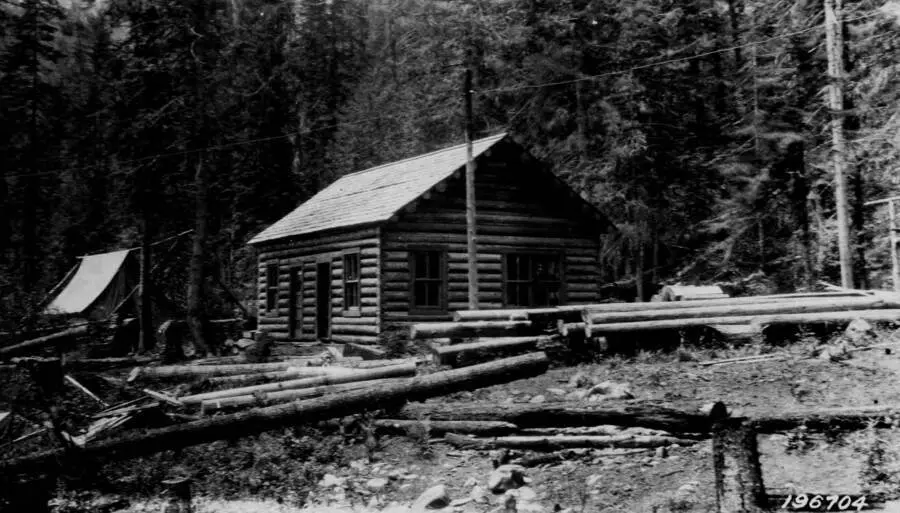
Meadow Creek Cabin
Kooskia, Idaho County, Idaho. Former guard station; May 1 to September 15.
Details

- Where
- 831 Selway Road, Kooskia, ID 83539. Directions
- Getting there
- Travel to Lowell, Idaho, located approximately midway between Lewiston, Idaho and Missoula, Montana on Highway 12, milepost 97 at the confluence of the Lochsa and Selway Rivers. Cross the bridge and drive 20 miles up the Selway River. Cross the Selway Falls Bridge on the right. Travel about a mile to the trailhead at Slim's Camp.
- Access
- You must hike or ride stock approximately 15 miles to access this site.
- Walk-in or reserve
- Guests must pick up door key at Moose Creek Ranger Station before hiking or riding to the cabin.
- Phone
- 208-926-4258
- Website
- recreation.gov
- Managed by
- Nez Perce-Clearwater National Forests.
- Established
- Early 1920s.
The Meadow Creek Guard Station stands among pines in a steep-sided canyon along Meadow Creek, a major tributary of the Selway River, fifteen miles from the nearest road. It is five buildings. The main cabin holds the office, a sleeping area and the kitchen, and the bunkhouse has a main room and a loft. A tack shed, a woodshed and an outhouse complete the set, and a post-and-pole corral holds stock. The Forest Service built the station in the early 1920s. The Nez Perce-Clearwater National Forests now rent it to parties of up to six from May 1 to September 15, for no more than seven nights. The station is eligible for nomination to the National Register of Historic Places.
Fifteen miles on Trail 726
The usual way in begins at Lowell, at milepost 97 on Highway 12, where the Lochsa and Selway rivers meet. A road runs 20 miles up the Selway and crosses the Selway Falls Bridge. About a mile beyond is the trailhead at Slim’s Camp, where National Recreation Trail #726 starts up Meadow Creek for the fifteen miles to the cabin.
A district brochure calls it the most heavily used trail in the area after the Selway River Trail into the Selway-Bitterroot Wilderness. The first three miles are open to bicycles and motorbikes. Beyond that the trail is for hikers and horseback riders, with rustic camping and picnic spots along the way. The Forest Service recommends experienced livestock on the rugged trail. Before setting out, renters stop at the Moose Creek Ranger Station for the door key.
A second route comes in from Elk City. It follows Kirk’s Fork Trail #830 to Anderson Butte, then Butte Creek Trail #809 to the Meadow Creek Trail. From there a right turn leads about a quarter mile to the cabin. The route runs some 14 miles in all and is open to motorcycles the whole way. Anderson Butte, on that route, was where the district kept its headquarters before Meadow Creek Station was built.
Six beds and a wood cook stove
The cabin has six beds with mattresses, a living room heated with wood, and a kitchen with a wood cook stove. A propane refrigerator runs from a tank on the back porch. Dishes, cookware, utensils, a Coleman lantern, a mop, a bucket and a broom are on hand. There is no electricity, and no bedding, matches, flashlights, first aid supplies or lantern fuel. An indoor water system runs from June 15 to September 15, drawing from a small creek. The water is untested and must be filtered or boiled for five minutes. Grazing is kept beyond the grassy area in front of the cabins, and stock eat weed-free feed packed in. The Forest Service warns of a risk of hantavirus in remote cabins.
Meadow Creek is known for clean, cold water, and trout may be taken on the fly after July 1. Black bear, elk, moose, mule deer, whitetail deer and cougar live in the country, and beaver, mink and otter may be seen. The Coeur d’Alene salamander lives in spring seeps, waterfall spray zones and small cascading streams. It is found only along the Selway River and Meadow Creek on the Nez Perce National Forest. It has no lungs and breathes through its skin, and adults measure about four inches. Indian Hill Lookout stands near the cabin, just outside the wilderness boundary. Its present tower dates from 1951, and staff occupy its cabin in summer.
From Anderson Butte to Meadow Creek
Records of the early districts are thin. The old Selway Forest, under which Meadow Creek appears, was broken up in 1934, and the Nezperce National Forest’s history says it holds few of the early records. By that account the district may also have been known as Anderson Butte, since its headquarters stood there until the early 1920s.
S. I. McPherson, called Rene, was ranger at Anderson Butte from 1914 to 1917. He had built the Tahoe Ranger Station in 1908 and the South Fork Trail from near Harpster to Johns Creek. Chas. Loitued followed in 1918. John Rice, ranger from 1921 to 1923, was in charge when headquarters moved to the new Meadow Creek Station. A black-and-white photograph credited to F. J. Jefferson shows “Meadow Creek Ranger Station, Selway National Forest” in 1925. It is now held by the University of Idaho’s Selway-Bitterroot Wilderness History Project.
Albert C. Campbell held the district from 1924 to 1932. In the late twenties Tom Mattison, the alternate at the station, was riding a mile or two below it when his horse spooked. The horse jumped or rolled into Meadow Creek, which was swollen with flood, and Mattison was killed or drowned. The district was discontinued in 1932. Since then the station has served as a workstation, and field crews use the bunkhouse now and then.
A key cut from a meat can
In January 1936 a man fitting the description of William Clyde Morland, or Moreland, robbed Frank Lantz’s place on the upper Salmon River. He took food and a rifle. Lantz and another man pressed him so close that he abandoned the gun and his packsack to get away. Moreland, born in Kentucky in 1900 and five feet two inches tall, was known in the backcountry as the Ridgerunner. From the Salmon he crossed to the old Meadow Creek Ranger Station and wintered in and around it. Ralph Space, writing in The Clearwater Story, judged the January crossing proof of “this man’s ability to survive in the severest weather with little food or shelter.”
Later in 1936, in the upper Selway country, Moreland found a Forest Service key in one of the buildings he entered. He took impressions of it in soap and worked a long while before he had a copy that turned. He cut his keys from the tin of meat cans and braced them with a jackknife blade filed thin. With key and blade together in a lock, he could open any Forest Service door, and from then on he never broke in.
Forest officers later pieced together his habits. He dripped candle wax over floors and tables and never washed the dishes. He had a special liking for jam and left the opened cans scattered about. In 1944, frightened by a manhunt farther north, he drifted south as far as Meadow Creek again. There he stole food and clothes from a trail maintenance camp on Rhoda Creek. He was captured in 1945.
Most stories written about him, Space notes, picture a crafty woodsman who outwitted the Forest Service for years. “The Ridgerunner was an unusual character,” Space wrote, “but he was not the hero pictured.”
Notable Events
- 1920sThe Meadow Creek District headquarters was at Anderson Butte until the early 1920's, when the Meadow Creek Station was built. npshistory.com
- 1932The Meadow Creek District, whose last listed ranger served 1924-1932, was discontinued at that time. npshistory.com
- 1932Since 1932, Meadow Creek has served as a workstation, with field crews occasionally using the bunkhouse. recreation.gov
- 1936Ralph Space recounts that Bill crossed from the Salmon River to the old Meadow Creek Ranger Station in January and wintered in and around it. npshistory.com
- Tom Mattison, the alternate at Meadow Creek Ranger Station, was killed or drowned when his horse spooked a mile or two below the station and jumped or rolled into the flood-swollen Meadow Creek. npshistory.com
People
- William Clyde Morland or Moreland, The Ridgerunner, who wintered in and around the old Meadow Creek Ranger Station after crossing from the Salmon River.
- Albert C. Campbell, Meadow Creek District ranger (1924-1932).
- Chas. Loitued, Meadow Creek District ranger (1918).
- John Rice, district ranger when the headquarters moved to the new Meadow Creek Station (1921-1923).
- S. I. McPherson, ranger at Anderson Butte, which later became the Meadow Creek District (1914-1917).
- Tom Mattison, alternate at Meadow Creek Ranger Station (late twenties).