Shenandoah-Dives Mill
Silverton, San Juan County, Colorado. Gold mill; May to mid-October.
Details

- Where
- 135 County Road 2, Silverton, CO 81433. Directions
- When
- noon to 4:30pm daily from May to mid-October.
- Getting there
- Two miles northeast of the Silverton town limits on Highway 110, 100 feet north of the highway.
- Fees
- Admission $8.00; $7.50 seniors (62+); kids 12 and under free.
- Hours
- Noon to 4:30pm daily.
- Access
- Parking on site.
- Walk-in or reserve
- Guided tours for groups available by reservation only.
- Phone
- 970-508-0214
- Managed by
- San Juan County Historical Society.
- Established
- 1929.
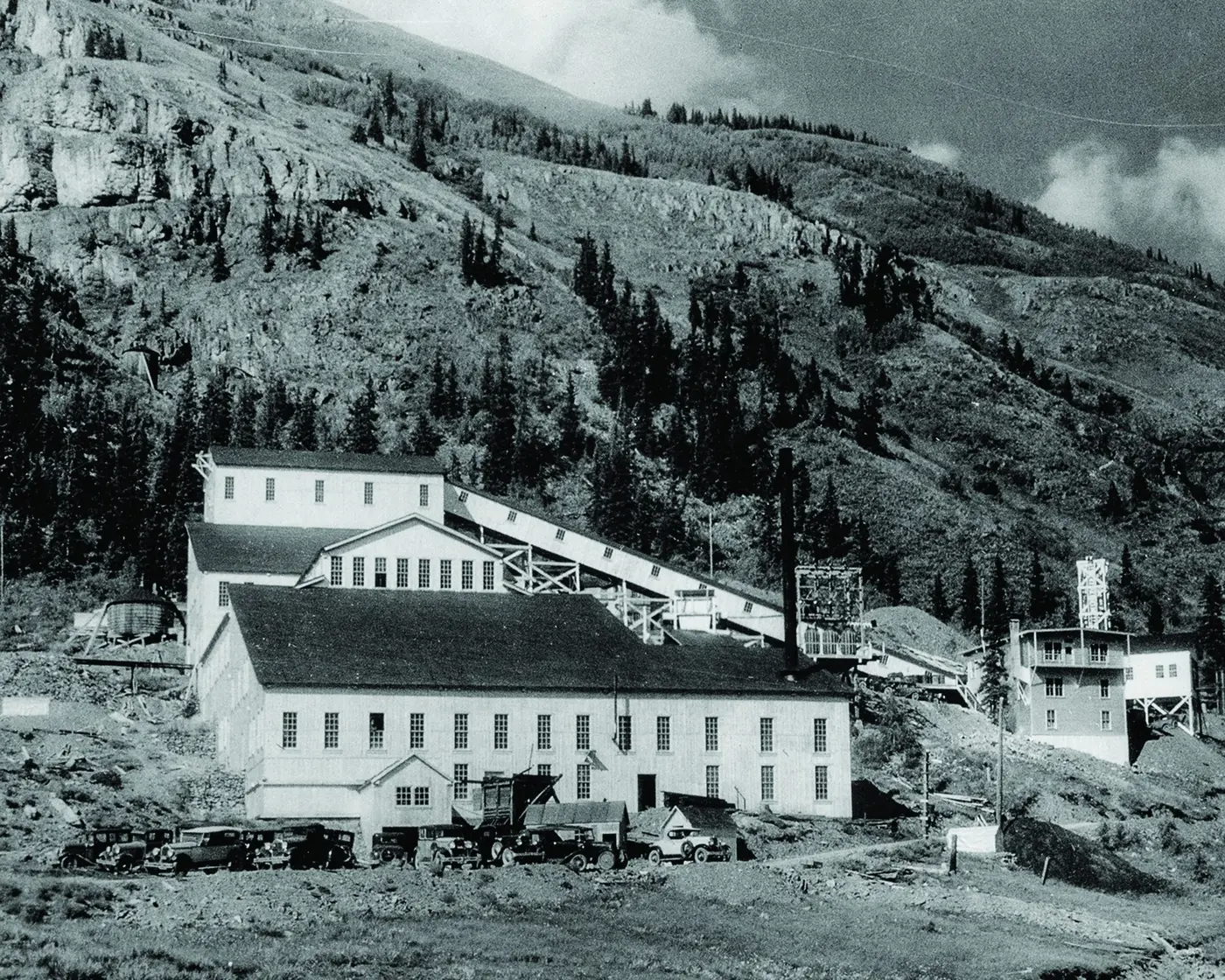
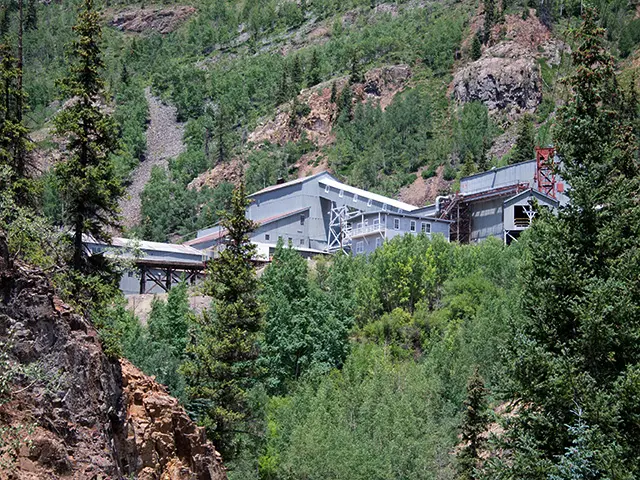
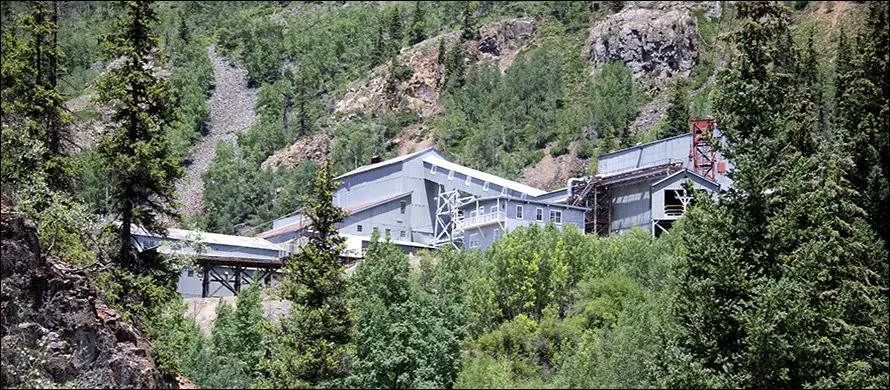
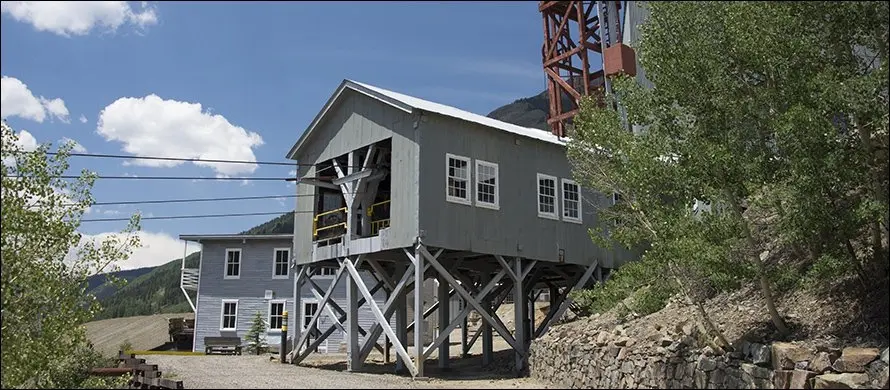
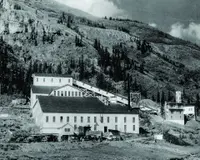
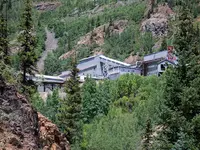
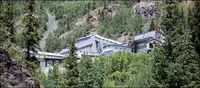
A small parking lot on the south side of County Road 2, two miles northeast of Silverton, holds four historical markers. One is for the Mayflower Mill. Two are for its tailing ponds. The mill stands at the foot of Arrastra Gulch in Baker’s Park, with the Animas River just to the east and fourteen-thousand-foot peaks above. It is a long L of trussed timber under corrugated metal. Its east-west wing runs 345 feet and its north-south wing 262 feet, and the building steps down a slope that falls to the south. The National Historic Landmark nomination gives its elevation as 9,700 feet. The San Juan County Historical Society, which owns it, gives 9,360.
The building’s formal name is the Shenandoah-Dives Mill. Locals have always called it the Mayflower Mill, after the Mayflower portal of the mine it served. Over the years it was also the Standard Metals Mill, the Echo Bay Mill and the Sunnyside Gold Mill. The society staffs an information and gift shop at the site under the Mayflower name. Through the summer season visitors walk through the plant on their own.
Inside the flotation mill
The Historic American Engineering Record, which recorded the mill in 2005, found that it “appears almost exactly as it did when operations closed in 1991.” Inside, the walls and ceilings are open to the trusses. The lower floors are concrete, and catwalks of wood and metal grating climb to the upper levels. Ore entered at the east end by aerial tram and moved downhill by gravity. It passed through the fine ore bin, the rod mill and the crushing plant in the east-west wing, then turned into the north-south wing. That wing holds the fine-grind circuit, the reagent deck, the flotation and amalgamation circuits, and, at the bottom, the thickeners, filter deck, boiler room and concentrate bins. A dry room for the laborers adjoins the southwest corner.
A marker explains one step in the chain. The rod mill ground ore to less than a tenth of an inch, and the muddy “pulp” entered the foot of an inclined spiral classifier. The turning spiral pulled the coarse particles up and sent them down a launder to the ball mill for a “regrind.” The fines washed down to the gold jigs and then into flotation. There, reagents in a water bath floated off gold, copper, lead, iron and zinc in separate products, each shipped to its own smelter.
The ball mill is a Marcy No. 86 driven by a General Electric 250-horsepower synchronous motor. The nomination states that only three such motors were made and that this is the only one still in existence. The society says the original equipment is still in working order and calls the plant the only intact and functional mill of its kind in Colorado. A 1998 National Park Service survey found only four flotation mills of this size left in the United States. It judged this one the only one still intact and operational.
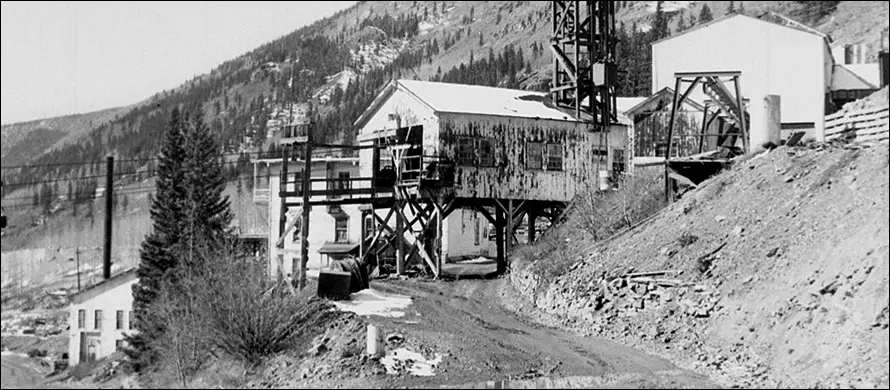
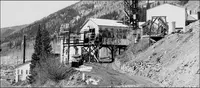
Along the east side of the fine-grind circuit is a workshop where machinery was repaired and parts were made for the mine. Small hand-pushed flatcars run on tracks set into its floor. Finished pieces went up the mountain by tram. In the Aerial Tram House the ore buckets and the tram system remain in place. So does the cam-like “camel” that clamped each bucket onto the traction cable, though the camel that released them is gone. A repaired wood floor in the ore conveyor now lets visitors walk through it.
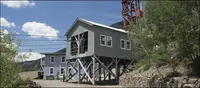
The mill once had more than eighty windows. Corrugated siding went on in 1981, according to the nomination and the engineering record, and only a few windows were left open. The marker gives a different account: rough pine siding painted aluminum in 1932 and covered with steel in the 1970s. One building the engineering record could not explain is the custom-ore sampling plant of the 1930s. No drawing or close photograph of it has turned up. At the center of the complex stands the three-story frame Assay Office. Its lowest floor is dug into the mountain and holds a kitchen. Concrete vaults sit in the corners above, and Charles A. Chase kept his office here. The society rehabilitated the building with a $154,000 State Historical Fund award in 2011 and a further $183,965 grant in 2018.
Charles Chase at Arrastra Gulch
The mill began, in the society’s words, in the summer of 1925 as Chase’s dream. Jonathan Thompson, in his book River of Lost Souls, describes him as “a dapper man,” the son of a mining engineer and a trained metallurgist. Chase had managed the Liberty Bell Mine near Telluride until it closed in 1921. He searched the Silverton caldera for a prospect for Kansas City investors. The syndicate bought claims covering 316 acres and consolidated the Shenandoah, the Dives and other mines, among them the North Star, the Terrible and the old Mayflower. Until it had a mill of its own, the company sent its ore by a small tram to the rented Iowa Tiger Mill in Arrastra Gulch.
In 1928 Chase proposed a tunnel, a tramway and a mill. The syndicate accepted, incorporated in Colorado in June 1929 with James W. Oldham as president, and began construction that month. Chase hired Arthur J. Weinig, a former colleague from the Colorado School of Mines, to design the metallurgy. Stearns-Roger of Denver took a $375,000 contract for the building, which was to be of pre-framed Oregon fir. The heavy equipment came in by train, and Weinig directed where each piece went. Boilers, synchronous motors and two-ton ball mills were hoisted into place. The building arrived as a pre-numbered kit, and carpenters fitted it together like a puzzle around the machinery. A marker photograph shows the mill nearly half complete in early August 1929, six weeks into the work. The nomination says the mill went up in eighteen weeks. The society says it took six months and began processing ore the following February.
Fred Carstarphen designed the tramway. It ran 9,526 feet, according to the nomination, from the Mayflower portal at 11,200 feet on Little Giant Mountain. Its towers were tall and made of steel, unlike the short wooden towers of earlier San Juan trams. Mules hauled the numbered pieces to each site, and riggers raised them by hand with a gin-pole. The loaded buckets ran downhill, so gravity did most of the work. Miners often rode the buckets up to their shifts. Retired miners recall the wind swinging the buckets to and fro on the line, and they say they never feared for their lives.
By 1930 the company had put $1.25 million into Silverton, and its payroll was the largest single industrial payroll in the Four Corners region. During the Depression, mining companies across the West were demolishing their mills to cut tax and insurance costs. Chase kept his running. He bet that lead, copper and zinc would pay for the operation and that gold and silver would bring the profit. In August 1936 he added a custom crushing and sampling plant, and fourteen local mines sent ore to it that year. A second ball mill in 1937 raised capacity to 700 tons a day.
Ponds, a strike and a war
Until then, mill tailings went onto piles or were sluiced into the Animas. Chase visited J. T. Shimmin in Butte, Montana, studied Shimmin’s tailings ponds, and adapted the design to a triangle of land just south of the mill. Water was drawn off the surface, filtered and returned to the mill. The sources date the ponds differently. The nomination dates Chase’s decision to 1934. The Colorado Encyclopedia says the ponds took shape in 1935 after early trouble with freezing and thawing. Thompson puts the work in 1936, after a state supreme court ruling ordered mining companies to stop dumping waste into streams. All agree the operation was among the first in the region to use tailing ponds.
In 1938 Congress passed the Wage-Hour Law, which required overtime pay after 44 hours a week. Thompson writes that Chase paid the overtime but first cut every employee’s hourly wage, so the men kept working sixty-hour weeks for about the same pay. The engineering record adds that the company required an eight-hour day and overturned an earlier portal-to-portal six-hour agreement. It dates the walkout to July 1938. Thompson and the historical society place it in 1939, after the union of Local No. 26 voted 175 to 48 to strike. The mill was the picket site.
Thompson describes a July night of that strike. Men stood around a bonfire beneath a tram tower, listening for the whir of cable against wheel, to make sure no workers went up to the mine and no ore came down. Among them was Joe Todeschi, twenty-four years old, who had helped the Italian stonemason Carlo Palone build a stone-and-concrete “slide-splitter” to shield the tram towers from avalanches.
On August 22 Chase gave a speech. “The present situation started,” he said, “when an avowed communist came into the mining camp and preached class hatred and other principles of communism.” On the evening of August 28 a crowd gathered outside the Miners Union Hall on Silverton’s main street. Frank “Corky” Scheer, an anti-union miner, was there, along with mine foreman William Hughes. When the meeting let out at about eight, a fight broke out. A witness later told the National Labor Relations Board: “Frank Scheer initiated the hostilities by kicking Embree … eight to ten others then closed in.” A. S. Embree was the union’s organizer. The sheriff and police chief escorted Embree and other union leaders out of town “for their own safety.” The crowd then dissolved the local and formed a new union with Scheer at its head. Thompson writes that Scheer was later revealed to have been hired by the company. Within days the new union ended the strike and signed a contract with the company. The engineering record says the men went back to work on September 7.
“The town was split in two,” Todeschi told Thompson in 1996. “Either you were for or you were against the company union.” According to the society, the company was convicted of unfair labor practices after ten years in the courts. The marker at the parking lot gives a different picture. It praises Chase’s “humanistic labor policy” and says the men knew him as “Papa Chase.”
In 1942 the federal government declared non-essential every mine that drew more than 30 percent of its dollar value from gold and silver. The mill’s by-product gold and silver exceeded that limit, and the operation was shut down. Chase mounted a letter-writing campaign to the War Department, which agreed that his base metals mattered to national security, and the mill reopened. During the war years more than forty small mines shipped ore to it.
Night Passage and the owners after Chase
Low metal prices closed the operation in 1953, with Chase still in charge in his seventies. By then the mill had processed 11 percent of all the gold, silver, copper, lead and zinc produced in Colorado, with a total assayed value of $32 million. The syndicate fired Chase and kept a caretaker on the property. Chase could not find investors to restart the operation, and he died in Denver on August 31, 1955, after a long illness.
The mill ran on and off under a series of owners. In the fall of 1957 Universal Studios filmed parts of Night Passage there, with James Stewart and Audie Murphy. The crew staged a gunfight at the mill, and the heroine escaped by riding a tram bucket to safety.
Standard Metals took over around 1960. Both of the mines that fed the mill closed in January 1961, and ore then came through the new American Tunnel from the Sunnyside Mine. Standard Metals went bankrupt in 1971. In 1974 Tailing Pond No. 1 failed and spilled waste into the Animas, and the company paid a heavy fine. On June 7, 1978, Lake Emma broke through into the Sunnyside workings. During the six months it took to pump the mine dry, mill manager L. R. Bird replaced the concrete Fagergen flotation cells with Gallagher cells. Standard Metals closed the plant in April 1985. That November it sold the property to Sunnyside Gold Corporation, a subsidiary of Echo Bay Mining of Edmonton, which applied the Mayflower name to the whole operation.
The society says the final whistle sounded in August 1991. The nomination dates the final closure to 1992, the year Sunnyside announced it would close the mine and mill for good because of falling zinc prices and exhausted gold reserves. The marker notes that at its closing it was the second-oldest operating gold mill in the United States. By the society’s count, the mill was shut for only twelve of its sixty-one years. It milled an estimated 9,700,500 tons of rock and produced 1,940,100 ounces of gold and 30 million ounces of silver. After the closure, Silverton’s population fell by half.
Water from Arrastra Creek
The mining permit’s reclamation plan required that the mill be torn down. The historical society asked Sunnyside to donate it instead. In 1995 the society voted to accept the mill, judging it important enough to San Juan County to be worth the risk. After four years of negotiation the deed was recorded in 1996. Silverton marked the occasion that June with tours, the Silverton Brass Band and a barbecue. The Mayflower Gold Mill Tour opened on May 15, 1997. Interior Secretary Bruce Babbitt designated the mill a National Historic Landmark in February 2000. The reclaimed tailing ponds are now grass knolls beside the mill. When the Environmental Protection Agency proposed the Bonita Peak Mining District for the Superfund list, the Mayflower Mill #4 tailings repository outside Silverton was named another likely candidate, since it appeared to be leaching metals into the Animas.
The donation included water rights on Arrastra Creek. A pipeline first laid in 1929 runs down the gulch and crosses the Animas on a bridge to a water treatment plant at the mill. The society installed an 8-kilowatt micro-hydro turbine on that line. Federal permitting then required the same steps as a major dam. The society’s case helped pass the Hydropower Regulatory Efficiency Act, which cleared the House 422 to 0, and the society filed the first exemption application in Colorado under the new law. In its own words, “Now the plant is up and running and making power which we are getting credit for every time we get our bill.”
Notable Events
- 1925A syndicate from Kansas City, Missouri, bought mining claims covering 316 acres near Silverton and started the Shenandoah-Dives Mining Company. coloradoencyclopedia.org
- 1925Chase saw potential in Arrastra Gulch just outside Silverton, and he and his investors bought and consolidated a handful of mines, including the Shenandoah, the Dives, and others; the new Shenandoah-Dives complex soon sent as much as one hundred tons of ore per day to the Mayflower Mill. coloradosun.com
- 1925Investors from Kansas City funded Chase's vision of the most modern and up-to-date mining and milling operation in the business and hired Chase as general manager in 1925. npgallery.nps.gov
- 1925The Mill began to take shape in the summer of 1925 as the dream of Charles A. Chase, who had made a reputation as a successful mine manager at the Liberty Bell near Telluride, Colorado. sanjuancountyhistoricalsociety.org
- 1928The company was profiting from the use of the Iowa Tiger Mill, a rented mill in Arrastra Gulch below the mineshaft, with a modified small aerial tramway running from the Mayflower Mine to it until the company built a new tramway and mill. cdn.loc.gov
- 1928In 1928 Chase presented a proposal to the syndicate outlining plans for a tunnel, tramway, and mill; the syndicate accepted the plan, and construction began in June 1929. web.archive.org
- 1929The Kansas City syndicate incorporated in Colorado as the Shenandoah-Dives Mining Company with James W. Oldham as president, general offices in Kansas City, Missouri, and mine operations near Silverton. cdn.loc.gov
- 1929In 1929 the Denver-based Company of Steams-Roger Engineering designed and oversaw the erection of the gravity-flow mill and its equipment, and the mill was built in eighteen weeks from a prefabricated kit. npgallery.nps.gov
- 1929An inventory of the buildings in 1929 listed the mill, tram terminal with aerial tramway, sampling plant, office and assay building, electrical transformer, and two stave water storage tanks. npgallery.nps.gov
- 1929The society dates operation of the Mill by the Shenandoah Mining Company to 1929-1952, among the number of owners over the years. sanjuancountyhistoricalsociety.org
- 1929The mill building itself arrived as a pre-numbered kit, and carpenters pieced it together like a puzzle around the innards of the mill, which sat at the base of Arrastra Gulch looking up toward the mine. web.archive.org
- 1930By 1930 the company had invested $1,250,000 in its Silverton operations, and between 1930 and 1932 the mill processed 461,826 tons of ore. cdn.loc.gov
- 1930In its 61 year milling career from 1930 to 1991, it was shut down only a total of 12 years, resulting in 49 years of actual milling. sanjuancountyhistoricalsociety.org
- 1930sDue to the depression most mining companies throughout the West were demolishing mills and other mine structures to reduce tax and insurance liabilities, while Chase gambled that the base metals lead, copper and zinc could carry the costs of operation, with a bit of profit coming from gold and silver. web.archive.org
- 1934Mill Superintendent Charles A. Chase decided to use an innovative tailings pond method perfected and utilized by J. T. Shimmin in Butte, Montana; until then the final tailings were pumped to tailings piles or slurried into the Animas River. npgallery.nps.gov
- 1935After a trial period with mishaps from freeze and thaw, the mill's tailing ponds took shape in 1935; the operation was the first in the region to use tailing ponds. coloradoencyclopedia.org
- 1935Chase visited J. T. Shimmin's site in Montana, returned and adapted Shimmin's design to a triangular chunk of land just south of the Shenandoah-Dives Mill where tailings were deposited. web.archive.org
- 1936Reacting to a state supreme court ruling that ordered mining companies to stop dumping waste into streams, Chase became one of the first managers in the region to build rudimentary containment systems for mill tailings. coloradosun.com
- 1936In August of 1936, five years after the construction of the mill, Chase ordered a custom ore crushing and sampling plant built adjacent to the mill to process ore from other mines in and around Silverton; in the year it was built, fourteen local mines sent their ore to the mill. npgallery.nps.gov
- 1937A 6-foot x 5-foot ball mill was added, making a total of two ball mills, and the plant processing capacity was then 700 tons. npgallery.nps.gov
- 1938In late August the members became the San Juan Federation of Mines, Mills, and Smelter Workers, a separate organization; the old local's remaining assets were turned over, negotiations resumed, and the miners went back to work on the seventh of September. cdn.loc.gov
- 1938The company lowered the base wage rate to counter the Hours-Wages Law, required an eight-hour workday and overturned the earlier portal-to-portal six-hour agreement, and the unconsulted miners struck. cdn.loc.gov
- 1938Congress passed the Wage-Hour Law, requiring overtime pay beyond 44 hours a week, setting the stage for conflict between labor and the only big mine still running, the Shenandoah-Dives. coloradosun.com
- 1939After a mob attacked union leaders outside the Miners Union Hall, the crowd dissolved the local union, formed a new union with Frank Scheer at the helm, and in the coming days that union ended the strike and signed a contract with Shenandoah-Dives. coloradosun.com
- 1939Negotiations over the Wage-Hour overtime pay dragged on for months and collapsed in July 1939, when the union voted 175-48 in favor of striking. coloradosun.com
- 1942After a letter-writing campaign to the War Department the government was convinced the operation's base-metal production was essential to national security, and the mill was granted permission to continue operations. cdn.loc.gov
- 1942The government declared all mines with more than 30 percent of their dollar value in gold and silver non-essential and suspended them; the mill's by-product gold and silver exceeded the limit and the operation was shut down. cdn.loc.gov
- 1943The Historic American Engineering Record lists 1943-1945 as a period of subsequent work on the mill structure. web.archive.org
- 1947Despite the design changes tried during the early trials, the tailing ponds failed twice, in 1947 and 1974, when extreme temperature swings and freeze-thaw cycles opened gaps in the containment structures. cdn.loc.gov
- 1953After the 1953 shutdown the syndicate fired Chase as general manager and then retained a caretaker for the property. cdn.loc.gov
- 1953In 1953 the only major operator remaining in the Silverton caldera, the Shenandoah-Dives, also went quiet. hcn.org
- 1953Chase ran the mine and mill until well into his 70s until low metals prices forced closure in 1953. hmdb.org
- 1955After a lengthy illness Chase died in Denver, having failed to find investors to restart the operation. cdn.loc.gov
- 1957That fall the mill became the setting for an unusual, new endeavor: Universal Studios filmed portions of the movie Night Passage at the mill, using the tramway in one memorable sequence. cdn.loc.gov
- 1957In 1957 the mill reopened on a more permanent basis. coloradoencyclopedia.org
- 1957The mill became the movie set for James Stewart and Audie Murphy in a classic western film; a big gunfight was staged at the mill and the heroine escaped harm by riding the tram bucket to safety. hmdb.org
- 1960Standard Uranium Corporation changed its name to Standard Metals Corporation and Marcy-Shenandoah accepted a buy-out offer; the mill then processed ore from the Silver Lake and Shenandoah-Dives mines. cdn.loc.gov
- 1960The Historic American Engineering Record lists 1960-1962 as a period of subsequent work on the mill structure. web.archive.org
- 1961Both mines closed in January 1961 on declining base metal prices, but the new American Tunnel into the Sunnyside Mine opened and its ore, with custom ore, was processed at the mill. cdn.loc.gov
- 1961Standard Metals Corporation, the owners at the time, removed the mill's frame sampling plant behind the mill and conveyor and replaced it with a new crushing plant whose large coarse ore bin let truck-hauled ore from other mines be processed at the mill. npgallery.nps.gov
- 1971Continued decline in metal prices, unwarranted acquisitions and poor investments caused the Standard Metals Company to file for bankruptcy in 1971. cdn.loc.gov
- 1972The Historic American Engineering Record lists 1972-1978 as a period of subsequent work on the mill structure. web.archive.org
- 1974A failure of Tailing Pond Number 1 released waste material into the Animas River and cost the company a significant fine; the pond was repaired to prevent future discharges and closed, and new ponds were added. cdn.loc.gov
- 1975A steel rod mill which could grind a finer product was added to the southwest corner of the mill; with a finer grind the mill now processed 1,000 tons-per-day. npgallery.nps.gov
- 1978Lake Emma broke through into the mine; during the six-month shutdown to de-water it, Mill Manager Bird improved the electrical control equipment, replaced the concrete Fagergen cells with Gallagher Cells and added lead cells. cdn.loc.gov
- 1981Corrugated-metal siding was placed over the mill's banks of windows, at which time electrical lighting systems were enhanced to supply the needed light. npgallery.nps.gov
- 1982Gold recovery equipment installed in 1982 included a Diester Model 6 concentrating table, where a thin film of water passing over the slightly sloped, vibrating table let heavy gold particles collect on the rifling. cdn.loc.gov
- 1985Non-mining subsidiary losses caused Standard Metals Corporation to file for bankruptcy protection in 1984, and when conditions failed to improve the company was forced to close the plant in April 1985. cdn.loc.gov
- 1985Standard Metals sold its mothballed Shenandoah-Dives holdings to the Sunnyside Gold Corporation, a subsidiary of the Echo Bay Mining Company of Edmonton, and Sunnyside adopted the Mayflower name for the entire operation. cdn.loc.gov
- 1990By 1990 Sunnyside Gold was the sole owner of the property, after its joint venture partners had acquired influence through their investments. cdn.loc.gov
- 1991When the Mayflower Mill closed in 1991, it was the second oldest operating gold mill in the United States. hmdb.org
- 1991The mill closed in 1991 and sat vacant until Sunnyside Gold Corporation donated it, its out-buildings and acreage to the San Juan County Historical Society. sanjuancountyhistoricalsociety.org
- 1992In 1992 Sunnyside announced permanent closure of the mine and mill because of declining zinc prices and a lack of gold reserves. coloradoencyclopedia.org
- 1992Chase's era ended in 1953, but operation of the mill continued intermittently until its final closure in 1992. npgallery.nps.gov
- 1994In 1994, the Mill and the ponds were placed on the National Register of Historic Places. sanjuancountyhistoricalsociety.org
- 1995The society made the motion to accept the Mayflower Mill, confident it had explored every avenue and that the building mattered enough to San Juan County's history to be worth the risk of saving. sanjuancountyhistoricalsociety.org
- 1996In 1996 the Sunnyside Gold Company donated the Shenandoah-Dives Mill complex to the San Juan County Historical Society to preserve Silverton's mining heritage. npgallery.nps.gov
- 1996Silverton commemorated the donation with a gala celebration featuring tours, the Silverton Brass Band and a barbecue. sanjuancountyhistoricalsociety.org
- 1996By 1996 surface reclamation of the tailing ponds and mine site was substantially complete. web.archive.org
- 1997Through the work of local preservationists and the historical society, the mill reopened in 1997 as a museum. coloradoencyclopedia.org
- 2000In 2000 the mill was designated a National Historic Landmark. coloradoencyclopedia.org
- 2009The assessment of all the buildings at the site and the award winning H.A.E.R documentation with the National Park Service in 2009 started the society toward success. sanjuancountyhistoricalsociety.org
- 2010The historical society received a State Historical Fund Special Initiatives grant to build hydroelectric power into the mill to offset the mill's large electricity bill and improve the supply of drinking water in the area. web.archive.org
- 2011The Society was awarded $154,000 in 2011 from the State Historical Fund, with a $70,000 match, for the rehabilitation of the Assay Office building. sanjuancountyhistoricalsociety.org
- 2018The San Juan County Historical Society, Inc. was awarded $183,965 under grant number 18-02-006 from the Acquisition and Development fund to pay for rehabilitation of much of the interior of the Assay Office Building. web.archive.org
- The Environmental Protection Agency proposed adding the Bonita Peak Mining District to the National Priorities List, and the Mayflower Mill #4 tailings repository just outside Silverton was named another likely candidate, as it appeared to be leaching large quantities of metals into the Animas River. hcn.org
- During the war years, over 40 small mines shipped ore to the Mayflower Mill. hmdb.org
- Charges were filed with the National Labor Relations Board against Shenandoah and, after 10 years in the courts, the company was convicted of unfair labor practices. sanjuancountyhistoricalsociety.org
People
- A. S. Embree, Union negotiator in the bargaining with the company and local officers during the strike at the Shenandoah-Dives.
- Barney Darnton, One of the three mill superintendents Sunnyside Gold employed over the six years it owned the operation.
- Bird, Mill Manager who used the shutdown to de-water the mine to improve the electrical controls and change the flotation cells (1978).
- Bruce Babbitt, Secretary of the Interior who designated the mill a National Historic Landmark representing the nation's mining heritage (February 2000).
- Clifford Histed, Syndicate member, with James Oldham, to whom Chase proposed buying and consolidating the Shenandoah-Dives, North Star, Terrible and old Mayflower mines (1925).
- James McKay, Hired by Charles A. Chase as foreman in the mine while the syndicate developed its Colorado holdings (1925 to 1927).
- James W. Oldham, President of the Shenandoah-Dives Mining Company as incorporated in Colorado in June 1929 (1929).
- L. R. Bird, Mill Manager who used the shutdown to de-water the mine to improve the electrical controls, replace the concrete Fagergen flotation cells with Gallagher cells and add lead cells (1978).
- Thatcher R. Hunt, Hired by Chase as mill superintendent, while Chase kept overall charge of the site and the general layout of the mill (1929).
- William Banning, One of the three mill superintendents Sunnyside Gold employed over the six years it owned the operation.
- Arthur J. Weinig, Former colleague of Chase from the Colorado School of Mines, hired as consulting metallurgist and engineer for the mill; he directed the positioning of the heavy equipment (1929).
- Charles A. Chase, Metallurgist and successful mining man whose last major accomplishment was the Mayflower Mill; he pioneered holding, or tailings ponds, instead of dumping waste rock into the rivers.
- J. T. Shimmin, Devised the method of creating ponds of tailings at mills in Butte, Montana, which Chase consulted on and adapted to the land south of the Shenandoah-Dives Mill (1935).
- Carlo Palone, Italian stone mason whose shop built the slide-splitter protecting the tram towers and other infrastructure at the Shenandoah-Dives (1939).
- Frank "Corky" Scheer, Miner, ardently anti-union, who headed the new company union that ended the strike; later revealed as hired by the company to break the strike (1939).
- Frank Cerniway, Shenandoah-Dives employee and union member who refused to join the new company union (1939).
- Joe Todeschi, Mill and mine worker at the Shenandoah-Dives who built the slide-splitter over the tram towers and stayed out on strike against the company (1939).
- William Hughes, Mine foreman at the Shenandoah-Dives, among the middle management at the clash outside the Miners Union Hall (1939).
- Fred Carstarphen, Designed the aerial tramway and the tram terminuses, and directed the twelve-man crew that constructed the tram terminal.
- William Jones, Vice-President of Shenandoah Mining Company, Inc. of Montrose, holder of the Charles A. Chase collection and a source for the nomination on how the mill was built and ran (1995).
- Beverly Rich, Chairman of the San Juan County Historical Society, whose report of the society's first fifty years counts rescuing the mill from scheduled demolition and reclamation as one of its accomplishments (2014).
Sources
- sanjuancountyhistoricalsociety.org/mayflower-mill.html
- silvertoncolorado.com/business/mayflower-gold-mill-tour
- colorado.com/silverton/mayflower-gold-mill
- facebook.com/pages/San-Juan-County-Historical-Society-Museum/320902954597517
- durangomagazine.com/mayflower-mill
- npgallery.nps.gov/NRHP/GetAsset/NHLS/00000262_text
- sanjuancountyhistoricalsociety.org/2014Courier.pdf
- cdn.loc.gov/master/pnp/habshaer/co/co0900/co0922/data/co0922data.pdf
- hcn.org/issues/48-7/silvertons-gold-king-reckoning
- sanjuancountyhistoricalsociety.org/historic-preservation.html
- historycolorado.org/location/mayflower-mill-shenandoah-dives-mill-assay-office-building
- historycolorado.org/location/shenandoah-dives-mill
- loc.gov/pictures/item/co0922
- coloradoencyclopedia.org/article/shenandoah-dives-mill
- hmdb.org/m.asp?m=177656
- coloradopreservation.org/endangered-place/shenandoah-dives-mill
- coloradosun.com/2019/04/19/river-of-lost-souls-excerpt