

Lytton Reaction Ferry
Lytton, British Columbia. Reaction ferry.
Details
- Where
- Lytton, BC. No street address stated. Directions
- When
- On demand 6:30 am to 8:45 am, 9:00 am to 10:30 am, 11:00 am to 12:45 pm, 1:00 pm to 4:30 pm, 4:45 pm to 6:30 pm, 7:00 pm to 8:45 pm, 9:00 pm to 12:30 am, 12:45 am to 2:30 am, 3:00 am to 4:45 am, 5:00 am to 6:30 am.
- Getting there
- Across the Fraser River, about 2.4 km north of Lytton.
- Access
- Maximum carrying capacity 9 tonnes, approximately 2 passenger vehicles; vehicle combination cannot exceed 12m.
- Walk-in or reserve
- On demand; drive up and cross.
- Phone
- 1-888-899-9854
- Website
- www2.gov.bc.ca
- Managed by
- Yellowhead Road & Bridge (Nicola) Ltd.
- Coordinates
- 50.24727932, -121.59198444.
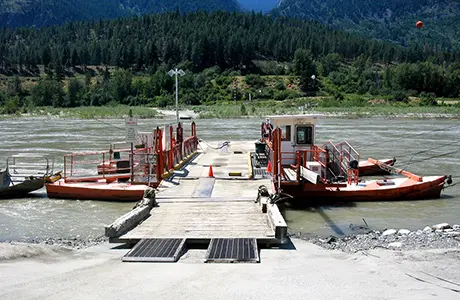
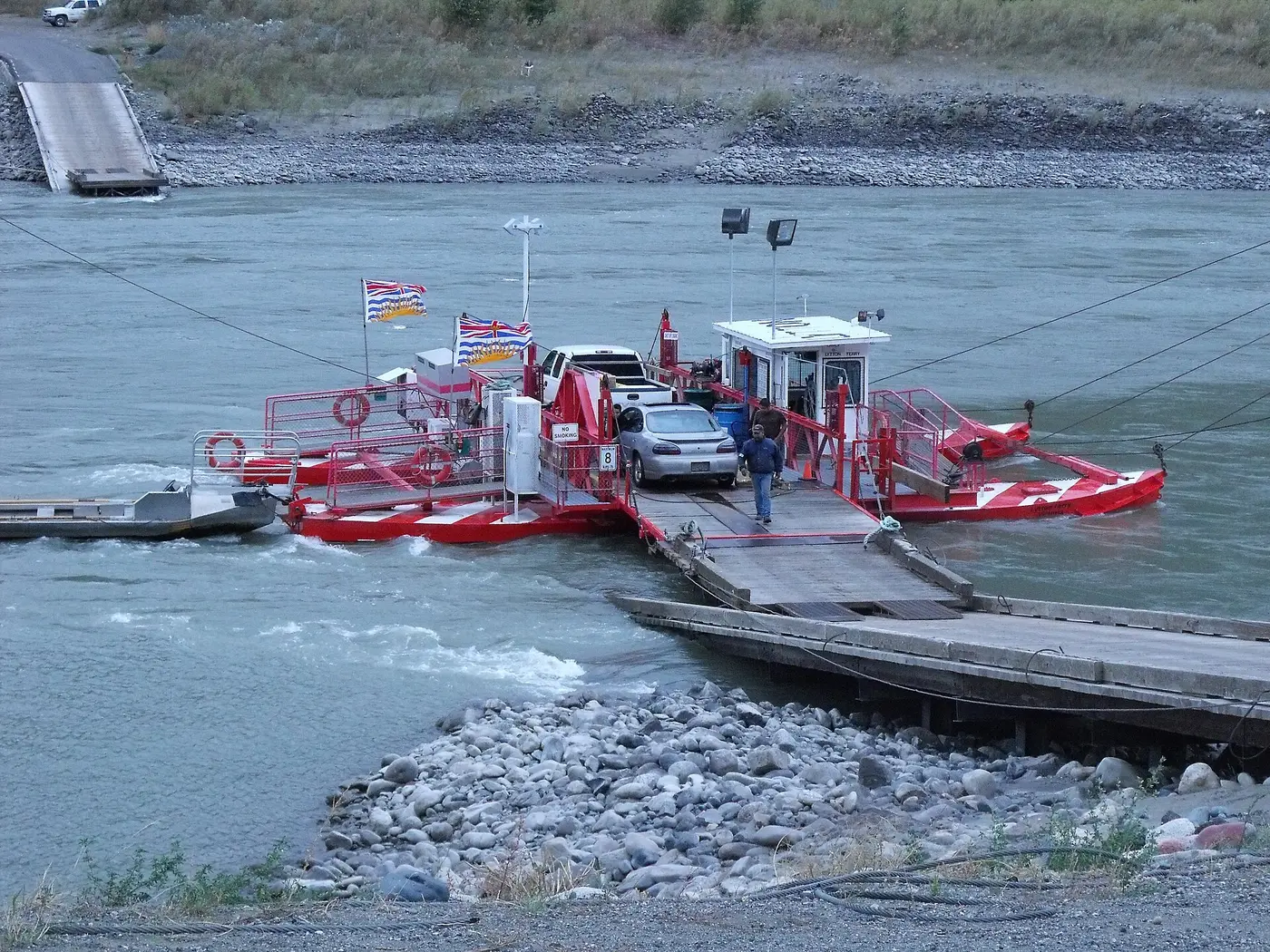
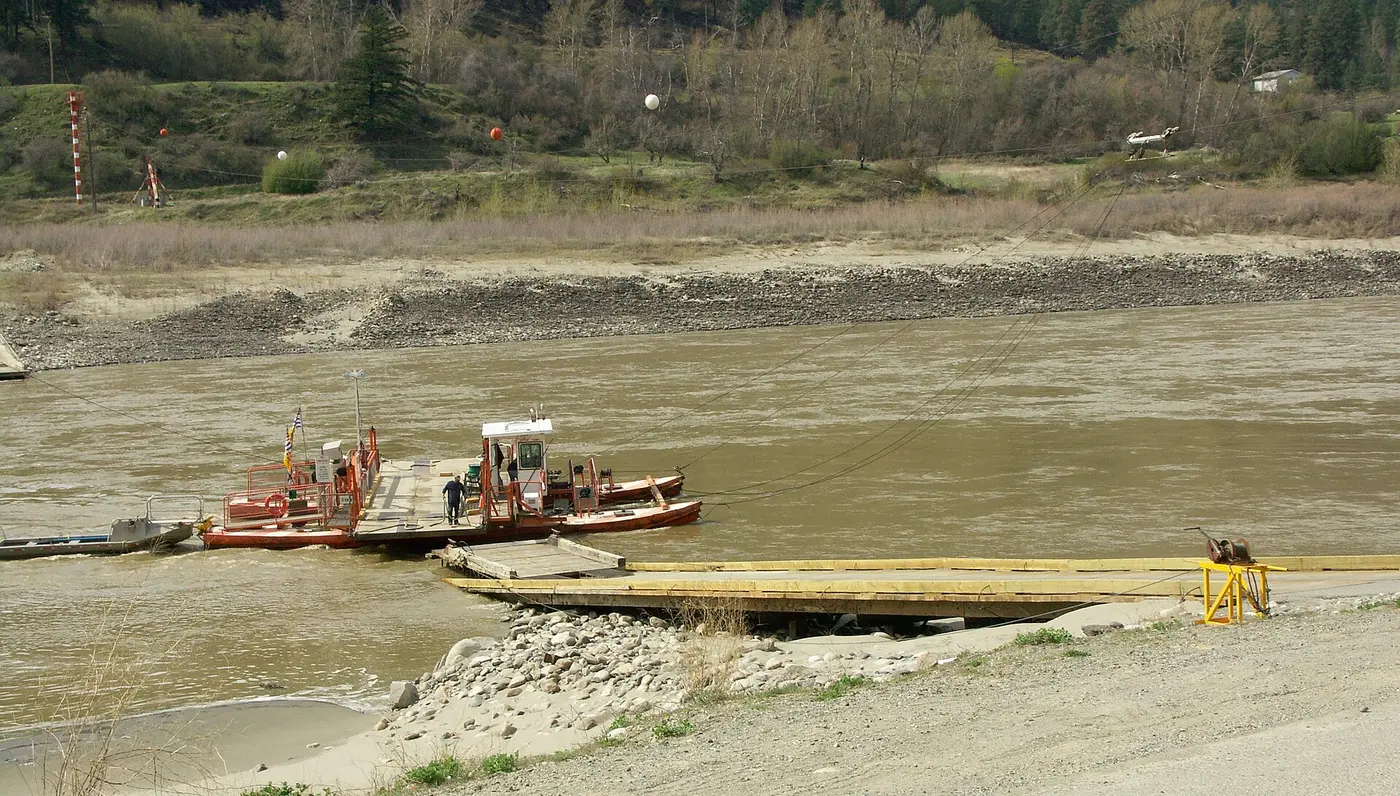
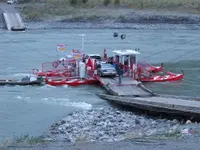
Two cars at a time, or one rig no longer than 12 metres, roll onto the Lytton Reaction Ferry about 2.4 kilometres north of Lytton, and the Fraser River carries them across. The province’s inland ferry brochure lists it among the reaction ferries, “propelled by the current of the river.” An EMCON information article of 1994 called it a “water-flow powered craft on cables.” By EMCON’s figure the river at the crossing is 300 metres wide, and the trip takes five minutes.
The vessel is a twin 17 metre steel pontoon ferry. It carries 9,000 kg gross vehicle weight and 18 people, drivers included. There are no reservations: a driver pulls up and crosses on demand. The provincial page, last updated August 21, 2026, lists service windows through the day and night with short breaks between them. The province’s 2023 brochure gave 6:30 a.m. to 10:15 p.m. Yellowhead Road & Bridge (Nicola) Ltd. operates the run. The Lytton Museum’s newsletter of August 2004 noted that the ferry usually closes in spring for high water and debris, and sometimes for ice coming down the river. The province states that there is no service during high water.
The landing on the far side is on the west bank of the Fraser. According to the Lytton Museum and Archives, this is the only crossing at Lytton still made by ferry, and it has become “a favourite of tourists” bound for the west side and for Stein Valley Nlaka’pamux Heritage Provincial Park. The 2004 newsletter added that it “does not use any fuel, so there is no pollution.” By EMCON’s account in 1994, the daily service and extended hours took the work of nine employees based at the Lytton yard.
Earnshaw’s ferry and the toll on the ice
The museum records that the Thompson Indians of the area crossed the Fraser by canoe or rowboat for many years before any ferry was documented. The first documented ferry was a private one and dates to 1863. Byron Earnshaw, an Englishman, had come to British Columbia in the gold rush of 1858 and mined at Texas Bar below Yale. He came to Lytton in 1862, married a local girl, Amy Raphael, and built his ferry and a small supply store.
In 1867 Earnshaw made an agreement with the constable at Lytton, who represented the B.C. government. It gave him “the exclusive right of ferrying passengers and freight for hire across the Fraser River at a point opposite the Town of Lytton.” His stretch ran from the mouth of the Thompson down a mile and a half of bank. A passenger with personal baggage paid 50 cents, and each hundred pounds of goods paid 25 cents. Government officers on business rode free. People who crossed on the winter ice, or by swimming or wading, still owed Earnshaw half the toll.
That same year a partnership of three Lytton businessmen, James S. Anderson, William McWha and Patrick Kilroy, took the lease on a ferry across the mouth of the Thompson. Its rights were measured from the boundary lines of the Earnshaw ferry. It ran six years, until the first Thompson River bridge was built in 1873/4.
Earnshaw sold his interest to Robert Irvine in 1870. Others operated the ferry after Irvine, and in 1894 it became publicly owned. In 1904 it was moved from its original site to the present location. A reaction scow, a flat-bottomed vessel with square ends, served for a time. Ten metre boats working on the reaction principle did most of the ferrying until 1942, when a five-ton wooden boat went into use. Larger ferries replaced it in turn, down to the present steel pontoons. From 1989 until 2004 the road maintenance contractor EMCON managed the ferry.
A broken cable and the year 1967
In the 1960s the main cable broke at its anchor on the west side. Clamps on the cable kept the ferry from going downriver. It banged against the east shore, was caught, and was pulled aground with the Highways grader. Aboard were Justice and Mary Williams and Tony Logan. They were unhurt, but the museum newsletter reports that “poor old Tony Logan would not use the ferry for nearly five years!”
Parents and schools protested to the government. The school buses crossed twice a day, carrying about 40 children morning and night. The newsletter records “a great deal of ‘talk’ but not much action for years.”
In 1967 a car with four people in it rolled off the end of the ferry into the river, and all four were killed. There was no telephone at the ferry and no vehicle for emergencies, so one of the operators rode his bicycle into town to report it. It took five weeks to find the car and its passengers.
In September 1967 two men were found shot to death aboard the drifting ferry. One was the operator who had ridden for help months before, and two of those killed in the car had been his grandparents. A 1967 article in the Province newspaper said no manhunt was attempted because no one knew where to start. The newsletter’s editor added: “I do not know how true that was, but there is nothing further on this subject in print.”
Loose on the Fraser, May 1979
In May 1979 the main cable snapped, minutes after the foot passengers had gone ashore. Two employees, Fred Earl and Lester Charlie, and a passenger, Ralph Williams, were still aboard. They climbed into the attached safety boat and beached it where the Thompson joins the Fraser. From there, in the newsletter’s words, they watched while “the ferry and Mr. Williams car went gaily on their way!”
A logging tug caught the ferry near the mouth of the Kwoiek River and towed it to Boston Bar. Williams retrieved his car. The ferry had to be dismantled and trucked back to Lytton, and it was out of service for weeks.
The District Manager of Highways told the News: “Although the accident has created a significant inconvenience, the users of the ferry are not stranded. They can drive out through Lillooet ... or make use of the railway bridge at Lytton. It’s a fairly long walk, but with nice weather it won’t be too bad.” The newsletter answered that the west-side road to Lillooet “is no picnic at the best of times,” and that the CNR had threatened to fine anyone walking the bridge.
The museum credits Lester Charlie’s eyewitness account of the ferry escapes as a source for its history. After these incidents the pontoons were extended by two feet and a motorized lifeboat was added. Cable specialists, civil engineering consultants for new towers, and naval architects were all brought in.
Locals and government officials have discussed a bridge over the years, but no consensus has ever been reached. In 2004 the newsletter wrote, “some are for and some are against. So, we have our ferry.”
Notable Events
- 1862Earnshaw, an Englishman who joined the 1858 gold rush to British Columbia and mined for gold at Texas Bar below Yale, came to Lytton in 1862, married a local girl and proceeded to build his ferry and a small supply store. communitystories.ca
- 1942For a time a reaction scow was used, but large boats of 10m using the reaction principle did most of the ferrying until 1942, when a five-ton capacity wooden boat was put into use. communitystories.ca
- 1967A car with passengers rolled off the end of the ferry, into the river, killing all four. botaniecreek.com
- 1979In May of that year, the ferry actually broke loose! The ferry was caught near the mouth of the Kwoiek river by a logging tug boat and towed to Boston Bar. botaniecreek.com
People
- Fred Earl, one of two ferry employees aboard the Lytton Ferry when its main cable snapped and the ferry broke loose (1979).
- Justice Williams, a passenger on the Lytton Ferry when its main cable broke at the west anchor; unhurt.
- Lester Charlie, Ferry employee aboard when the ferry broke loose; eyewitness to the ferry escapes.
- Mary Williams, a passenger on the Lytton Ferry when its main cable broke at the west anchor; unhurt.
- Ralph Williams, the passenger aboard the Lytton Ferry when it broke loose, who reached shore with the crew in the attached safety boat (1979).
- Robert Irvine, Bought Earnshaw's interest and operated the ferry.
- Tony Logan, a passenger on the Lytton Ferry when its main cable broke at the west anchor; unhurt, he would not use the ferry for nearly five years afterwards.
- Amy Raphael, the Lytton local girl who married Byron Earnshaw, builder of the first documented ferry across the Fraser River at Lytton.
- Byron Earnshaw, Englishman and gold-rush miner who built the first documented ferry across the Fraser at Lytton, and a small supply store (came to Lytton in 1862).