
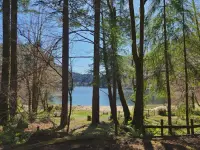
Loon Lake Recreation Site (BLM), Douglas County, OR
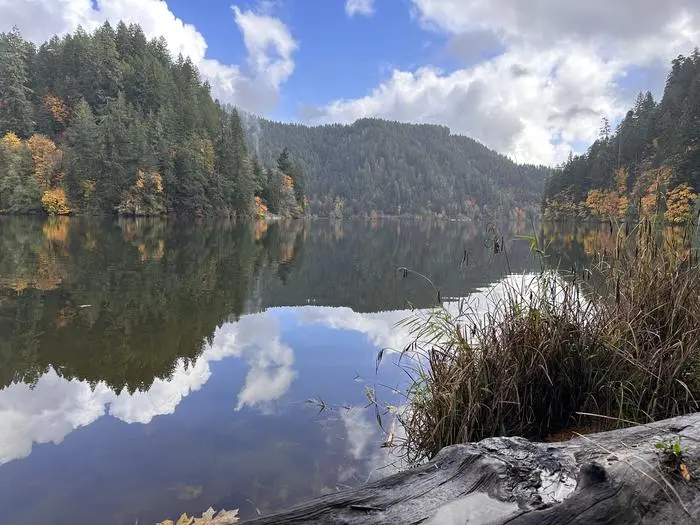
Reedsport, Douglas County, Oregon. BLM lakeside recreation site with a warm, sandy swim beach; Memorial Day weekend to September 30th.
Details

- Where
- 7273 Loon Lake Road, Reedsport, OR 97467. Directions
- When
- Day use open 8:00 am to 8:00 pm; no overnight parking in the day use area.
- Getting there
- From US 101 in Reedsport, 13 miles east on OR-38 to Loon Lake Road, watch for the sign between mileposts 13 and 14, then 7 miles south to the site.
- Fees
- Day use $5.00 per vehicle, $3.00 walk-in, $3.00 boat launch; camping $18.00 single site, $36.00 double site, $7.00 additional vehicle.
- Access
- No cell phone coverage at the site; paved day-use paths and accessible restrooms, picnic sites, and fishing pier.
- Walk-in or reserve
- Day use paid at on-site stations, self-service kiosk, or Scan & Pay in the Recreation.gov app; exact change required, no bills larger than $20.
- Phone
- (541) 756-0100
- Managed by
- Bureau of Land Management, Coos Bay District Office.
- Coordinates
- 43.5972222, -123.8402778.
Loon Lake Road leaves Oregon Route 38 between mileposts 13 and 14, thirteen miles east of the coast highway at Reedsport, and runs seven miles south through the timber. Where the Loon Lake Recreation Site sign stands on the left, the entrance opens to the right between large boulders. The Bureau of Land Management’s Coos Bay District runs the site from an office in North Bend. The site sits at 392 feet in the Coast Range, and there is no cell phone coverage.
The beach and the campground loop
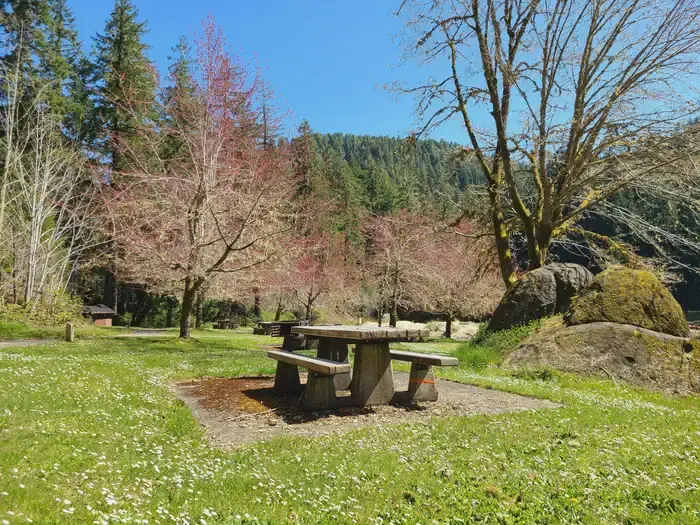
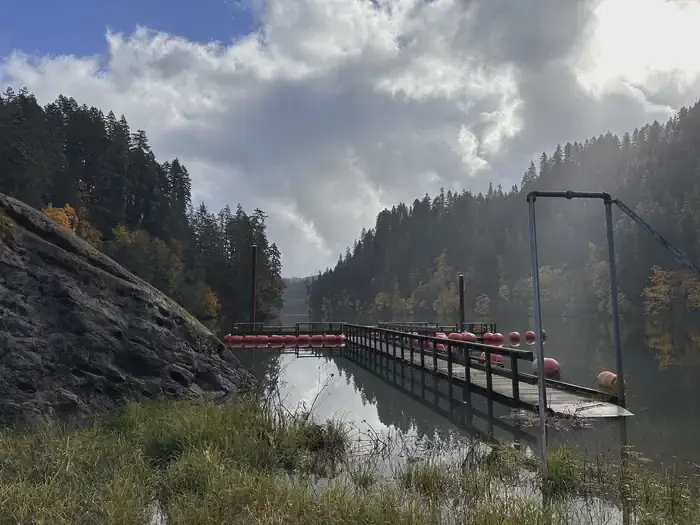
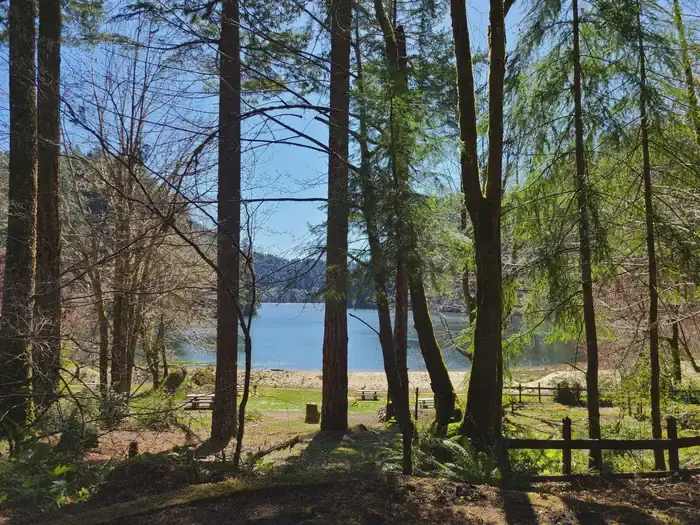
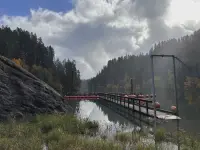
Past the entrance booth the road reaches a pay station and divides. Straight ahead is the day-use area: thirty picnic sites border a sand beach, with barbecue grills, a swim area, and a boat launch. Paved paths run from the tables down to the sand. The BLM calls the site one of the Coast Range’s few recreation areas with a warm, sandy beach. In the northeast corner a paved path leads to a T-shaped fishing pier with wooden railings. Along the approach road, shaded kiosks carry interpretive panels on the plants and animals of the place. People swim, paddle kayaks and paddleboards, run motorboats and jet skis, toss horseshoes, and cook at the grills. Leashed dogs are allowed everywhere but the swim area.
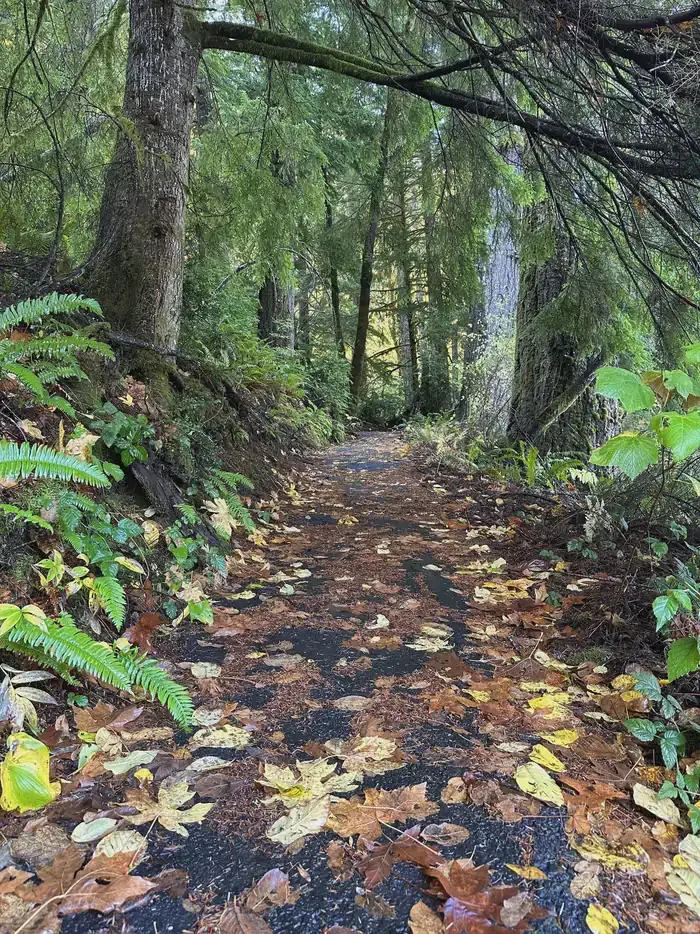
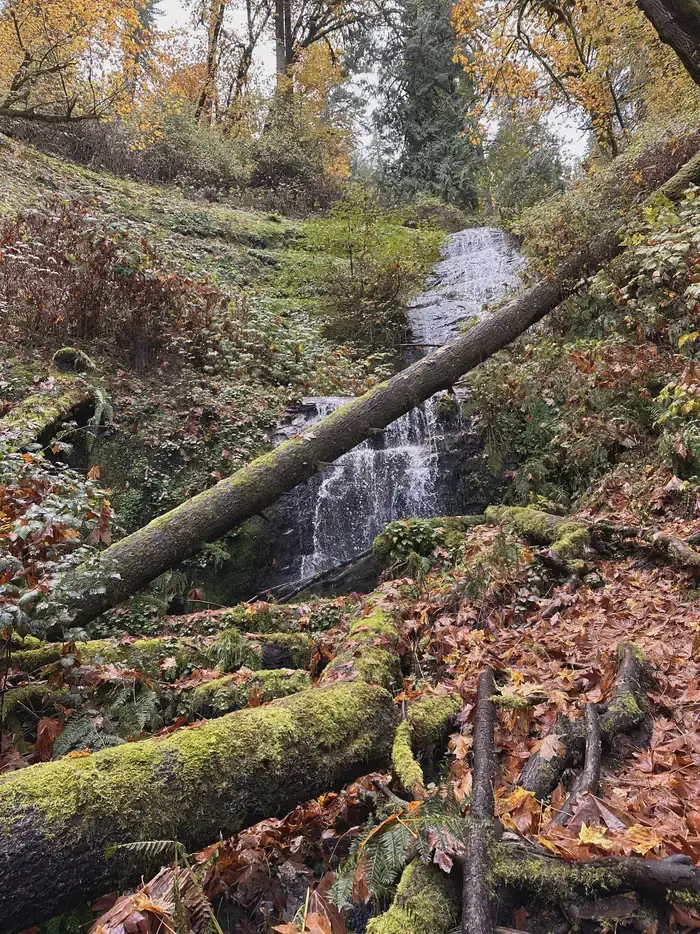
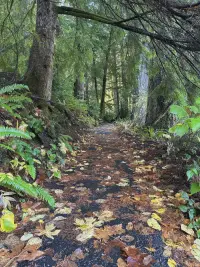
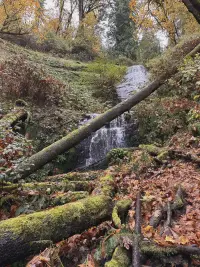
From the south end of the day-use area, a paved trail a quarter mile long climbs through old-growth forest to a waterfall on Elliott State Forest land. Douglas-fir, western hemlock, red alder, and bigleaf maple shade the grounds. Rhododendron, salal, salmonberry, thimbleberry, vine maple, trailing blackberry, and ferns fill the understory. Steller’s jays and ospreys are always about. The marbled murrelet and the spotted owl are seldom seen. Raccoon, bear, elk, deer, and bobcat leave signs.
Turning right at the pay station puts a driver on the one-way campground loop. Its 53 sites have paved parking pads, fire rings, and picnic tables under old-growth shade, and a tent meadow with walk-in sites lies along the northern edge. An amphitheater hosts evening programs, and rangers lead interpretive walks. There are no hookups, showers, or laundry. Firewood is not sold, which the agency attributes to “staffing and funding limitations.” Quiet hours run from 10 p.m. to 7 a.m.
The BLM season runs from Memorial Day weekend to September 30. The Oregon Coast Visitors Association says the campground opens the Thursday before. A mile away, the BLM’s East Shore Day-Use Area stays open year-round but has no boat launch.
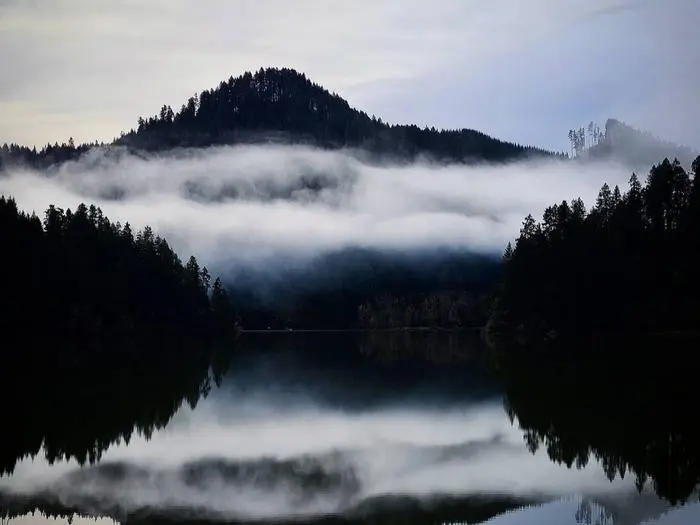
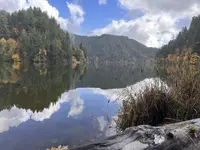
By the BLM’s figures the lake covers 260 acres and is 2 miles long and 190 feet deep. A 2018 Oregon State University news release gives its maximum depth as just over 100 feet.
A mountainside across Lake Creek
The lake is held in by its own wreckage. Ewart M. Baldwin, professor of geology at the University of Oregon, reported that a large mass of Tyee sandstone slipped from the western slope of the valley of Lake Creek. The slide formed a dam, and water quickly filled in behind it. The BLM describes the dam as large sandstone blocks and boulders. Loon Lake Lodge and RV Resort, a private resort on the lake, tells of “a mountainside of debris and house-size boulders” falling into a narrow canyon about 1,400 years ago. In its account and in an RV Life feature it reprints, the creek is Mill Creek. At the outlet, the lodge says, Mill Creek drops more than 120 feet in less than a quarter mile of waterfalls and pools.
The date came from a tree. Harriet Ward, who lived on the shore, saw that a tree still standing in the lake had died when the water rose. Dating the outer wood would therefore date the lake. Wood from that tree went to Dr. Willard Libby for carbon-14 testing, and in 1961 the result came back at 1,460 years, plus or minus 80.
In 2013 Oregon State researchers drew a 23-foot core of sediment from the deepest part of the lake. The lake’s steep sides and deep channel concentrate what washes in, and in the recent period the layers turned out to be annual. “It’s unusual to find this kind of annual resolution in lakes at this latitude, elevation and climate in North America,” said Kristin Richardson, then a master’s student in water resources science and the study’s lead author.
The core records earthquakes, regional climate cycles, and the fires and storms of the 1700s and 1800s. A thick band of sand and woody debris dated near the year 670 matches a large Cascadia subduction zone earthquake. It appears a debris flow off the hillsides carried trees into the water. “This layer caused us the most grief,” Richardson said. “We had difficulties coring through it the first time, and on the second deepest core, we also had difficulty. We decided to not go deeper for fear of getting the equipment stuck and not being able to retrieve the core at all.” Thinner layers near 1700 mark the last major Cascadia earthquake. The core is kept in the Oregon State University core repository.
Huckleberries, loons, and logs
The lodge’s history says the first people at the lake came on foot several hundred years ago, from the coast and from inland valleys. They camped mostly in Ash Valley, gathered huckleberries, and hunted elk. In 1850, as Scottsburg was becoming a trading center on the Umpqua, two men following Indian trails came on the lake. They named it for “the common Loon duck” they had seen nesting. Settlers took up Ash Valley, where they farmed, trapped, hunted, and traded.
In the 1930s the lake became a log pond. Timber was stored on the water and trucked to the mill at Gardiner on the coast. The logging road into the north end of the lake brought the first automobiles. The cores record the change: human work such as land clearing, logging, and road building replaced natural events as the main source of sediment. From 1939 the sediment washing in rose steadily, possibly from roads, logging, and storms in a wet phase of the Pacific Decadal Oscillation. About forty years later it fell off sharply, after logging adopted erosion controls in the 1970s. “We think part of the reason for the reduced sediment loads is that Oregon’s forest management law was having an impact,” said Jeff Hatten, a co-author and associate professor in the College of Forestry.
By the lodge’s account, the place where logs had been loaded onto trucks had become a family recreation area by the early 1960s.
Otters at Duckett’s Resort
Lloyd Keeland, a Marine machine gunner in World War II and a gypo logger with the Umca Logging Company, ran Duckett’s Resort at Loon Lake for nearly thirty years with his second wife, Althea. The resort drew loggers, dairymen, locals, and vacationers. It had nine cabins, a floathouse, a back bar, and a store selling fishing and picnic supplies. A couple named the Horns always took the floathouse in the mid-1960s. Lloyd’s pet otters, Humpy and Dumpy, would climb aboard and get onto their bed. Mr. Horn would roll both otters up in the bedspread and dump them back in the lake. “It got to be a game with them,” Lloyd remembered.
Every summer, by Lloyd’s account, the owner of the Ralston Purina company came from San Diego for a week of fishing. He fished for largemouth bass with a fly rod and lures he made from bottle corks, while his chauffeur, William, rowed him around the lake. Back at the lodge over cocktails, they watched the otters wrestle in front of the fireplace. In the early 1970s a customer balked at 75 cents for a bag of ice and asked where it came from. The part-time help told him a shipment had come in that morning “all the way from England.”
Ellen Keeland, Lloyd’s fourth wife, listened to these stories for nearly a decade before she began writing them in a notebook. She followed him around with a pencil and clipboard. In 2001 the couple self-published The Lusty Life of Loon Lake Lloyd, 400 pages with 207 tales in his words and about 250 of her pen-and-ink drawings. One of the stories comes from the store, where customers kept asking the same question: “Any loons? Where’s the loons?”
“Well,” Lloyd would answer, “some of them are sitting there in the back bar and some of them are over there in the campground.”
Notable Events
- 1930sLoon Lake was used for storing logs for transporting them by truck to the mill in Gardiner on the coast of Oregon. loonlakerv.com
- 1939Starting in 1939 the cores reveal a steady increase in sediment washing into the lake, a possible result of road building, logging and storms in a wet period of the Pacific Decadal Oscillation. news.oregonstate.edu
- 1961Wood taken from a standing tree in Loon Lake, Douglas County, sent to Dr Willard Libby for age determination by the carbon-14 method, was found to be 1,460 years plus or minus 80. d3itl75cn7661p.cloudfront.net
- 2013A 23-foot-long core taken from the deepest part of the lake in 2013 documented earthquakes, regional climate cycles, fires and storms that swept through the watershed in the 1700s and 1800s. news.oregonstate.edu
People
- Ewart M. Baldwin, professor of geology at the University of Oregon who reported the Tyee sandstone landslide that dammed Lake Creek to form Loon Lake.
- Harriet Ward, resident on the shore of Loon Lake who had the lake timber dated, recognizing that a dating of the outer part of the tree would give the date the lake was formed.
- Ellen Keeland, Lloyd Keeland's wife, who began to scribble his Loon Lake stories in a notebook after nearly a decade of listening to them.
- Lloyd Keeland, owner and operator of Duckett's Resort at Loon Lake, a popular rendezvous spot for loggers, dairymen, locals and vacationers (three decades).