Lookingglass Hatchery
Elgin, Union County, Oregon. Fish hatchery; June – September.
Details

- Where
- 76657 Lookingglass Road, Elgin, OR 76657. Directions
- When
- Open daily 7:30 to 4:30.
- Getting there
- From I-84 take exit 261, right at the stop sign, left at the third stop light onto Hwy 82 toward Elgin (about 10 miles to Imbler, eight more to Elgin); in Elgin, turn left on Division Street (Hwy 204 – Tollgate Hwy).
- Access
- ADA accessible, restrooms; the access road becomes a gravel road for its final two miles.
- Phone
- (541) 437-9723
- Website
- myodfw.com
- Managed by
- Oregon Department of Fish & Wildlife.
- Established
- 1982.
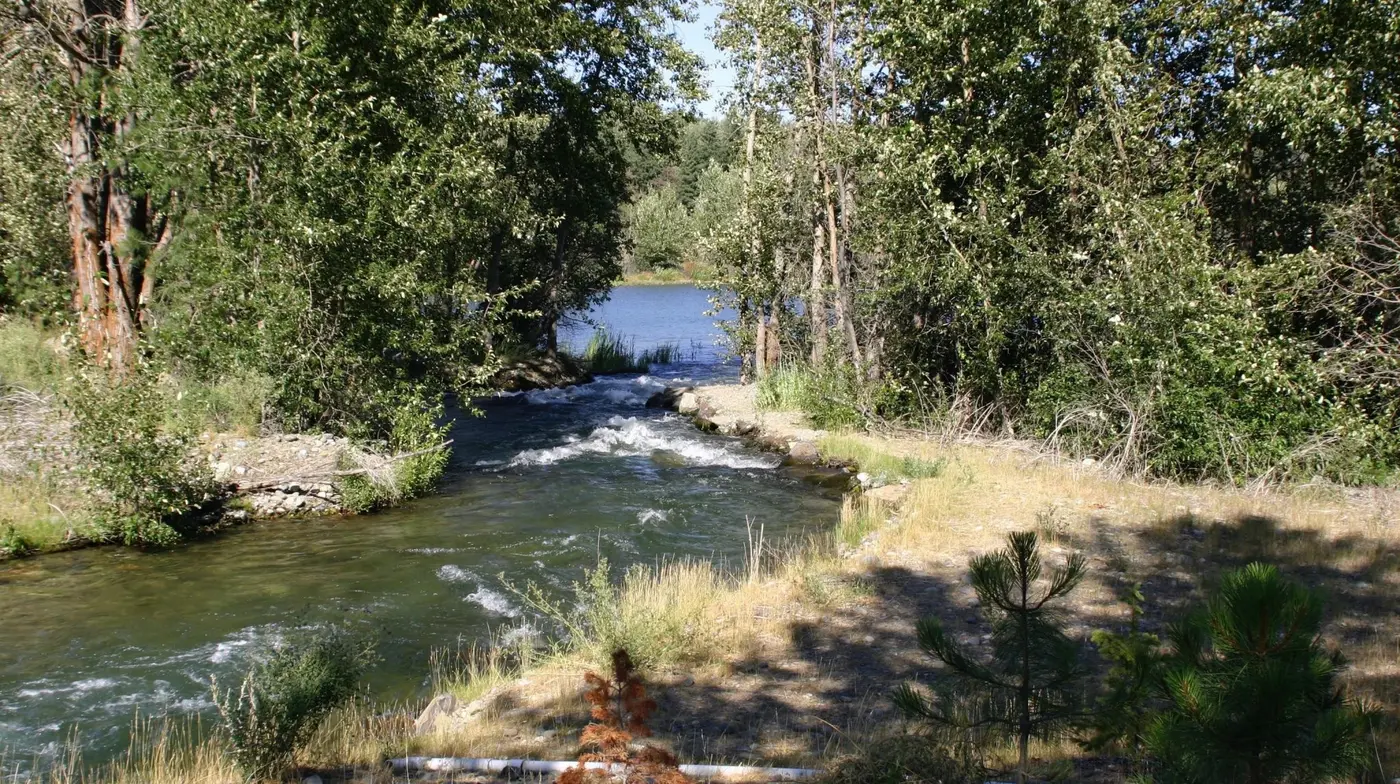
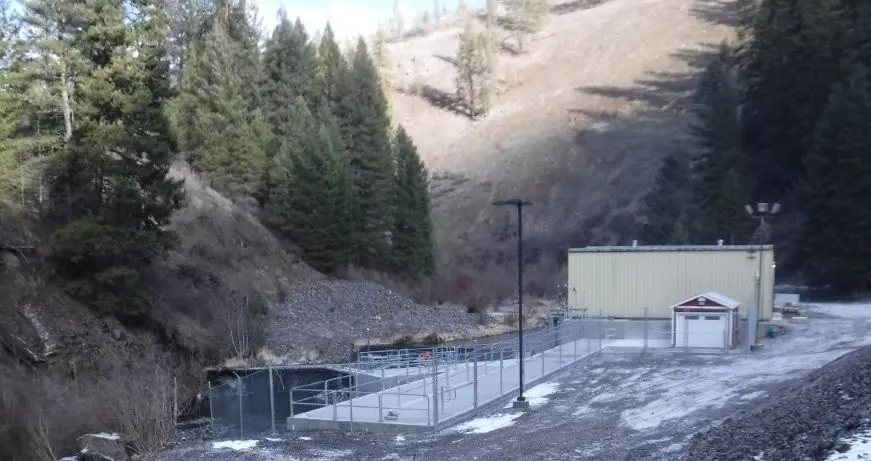
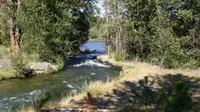
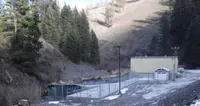
The last two miles to Lookingglass Hatchery are gravel. The turn comes at a sign on Palmer Junction Road, in Union County, and the road ends at concrete ponds and staff residences on Lookingglass Creek, shaded by lodgepole and ponderosa pine. The Oregon Department of Fish and Wildlife runs the hatchery on 22.5 acres owned by the U.S. Fish and Wildlife Service, at 2,520 feet above sea level, with seven full-time employees and two seasonal ones. Inside the visitor building is a small display area with a viewing window. Outside, information signs mark the grounds: holding ponds, a settling pond, a fish ladder, and eighteen concrete raceways, each 100 feet long. Adult Chinook salmon are present for most of the summer, and the department names June through September as the best time to come. Birds of prey, wading birds, freshwater mammals, and hoofed animals use the creek and the woods around it.
Eighteen raceways under the pines
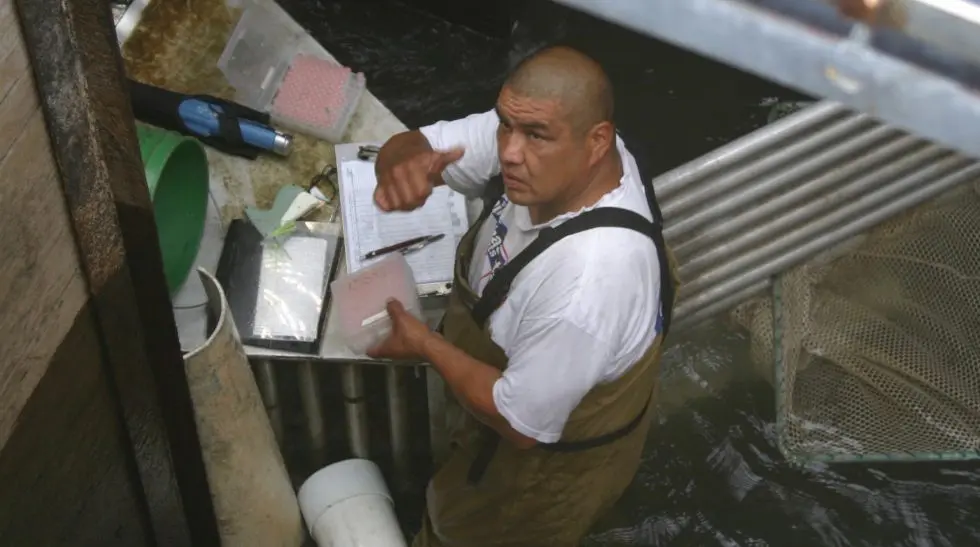
In 2022 a Columbia Insight reporter watched Rick Zollman stand at the edge of one raceway while tens of thousands of juvenile Chinook rushed toward him. Zollman works for Nez Perce fisheries, though he is not a tribal member himself. The fish leapt from the water when he waved, conditioned to expect food. Each raceway held roughly 65,000 juveniles that year, nearly 1.5 million fish in all.
Their parents came from five streams. Adults are trapped at weirs on Catherine Creek, the Upper Grande Ronde, the Lostine River, and the Imnaha, then trucked here. Lookingglass Creek’s own returns are caught at the hatchery weir and held on site. Collection for spawning begins in August, and spawning runs through August and September. A U.S. Fish and Wildlife Service brochure follows what happens next. The eggs “eye up,” showing tiny visible backbones, and staff must “shock, pick, and enumerate” more than 1.5 million of them. The fry are reared in fiberglass containers called double-deep Canadian troughs until they are 2.5-inch fingerlings, then moved to the raceways for another year. According to Columbia Insight, the young fish are kept apart by the river their parents came from.
At eighteen months the smolts are pumped onto trucks and hauled to acclimation pens on their parents’ home waters, where they spend their last weeks before release. By then, the 2022 account says, they no longer swim toward people expecting food. Lookingglass Creek fish skip the trip and go straight into the creek from the hatchery. Winter is the hard season. The intake and raceways can fill with slush ice, and staff mix well water into the creek water to hold it off.
The weirs also decide which fish reach the spawning grounds. Under what managers call the sliding scale, the number of wild fish returning in a given year sets how many hatchery fish are let upstream, and how many wild adults are kept for broodstock. Hatchery fish are marked by a clipped adipose fin. “The weirs allow everything to be controlled,” Zollman told the reporter. “We don’t inundate the natural fish, but we don’t leave the spawning grounds empty.”
The hatchery runs two kinds of programs. The Grande Ronde work is conservation, meant to keep three wild populations from going extinct and to reintroduce Chinook to Lookingglass Creek. The Imnaha program serves harvest. Its adults are trapped at a satellite facility built in 1988, thirty miles up the Imnaha River from the town of Imnaha. Surplus Imnaha adults go to charitable food banks and to tribal entities for ceremonial and subsistence use. Under the Lower Snake River Compensation Plan, the hatchery’s yearly goals are 1,390,000 smolts released and 9,068 adults returning.
Old and Young Looking Glass
The hatchery is named for Young Looking Glass, a Nez Perce leader. The Fish and Wildlife Service brochure tells the story of his father. Old Looking Glass was 70 when he arrived late to the 1855 treaty council and found that others had already signed. “My people, what have you done?” he said. “While I was gone, you have sold my country. I have come home, and there is not left for me a place to pitch my lodge.” The brochure says he felt betrayed by his son and by Chief Joseph, who had signed. The treaty did guarantee the tribes continued access to traditional hunting and fishing grounds, including sites inside the 45,000 square miles ceded to the United States.
That guarantee shapes the hatchery today. The Nez Perce Tribe and the Confederated Tribes of the Umatilla Indian Reservation act as co-managers of Grande Ronde and Imnaha salmon. The accounts describe the creek’s management differently. The Columbia River Inter-Tribal Fish Commission credits the Umatilla tribes with reintroducing Chinook to Lookingglass Creek. A tribal brochure lists the creek as co-managed by the Umatilla tribes, the Nez Perce, and the state. Columbia Insight reports that the Nez Perce hold exclusive fishing rights to the creek, one of their traditional fishing places.
Four dams and the early broodstock
Congress authorized the Lower Snake River Compensation Plan in 1976 to make up for the fish lost to four lower Snake River dams. Its Grande Ronde spring Chinook program was set up in the late 1970s, after the basin’s runs collapsed in the middle of that decade and sport fishing closed. Managers believed too few native fish were left to supply broodstock. In 1978 they released smolts of Rapid River stock from Idaho into Lookingglass Creek. The hatchery was completed and dedicated in 1982, and its original intake screens date to 1980.
The early years went by stock and brood year. Disease and short supply stopped the use of Rapid River fish from 1980 through 1984, and Carson stock from the Willamette River hatchery program filled in. Rapid River fish came back in 1985 and stayed through the 1999 brood year. The hatchery met its goal of 900,000 smolts in most years from 1983 to 1992, but adult returns stayed well short. Between 1987 and 2001 the best year reached 42 percent of the goal. Lookingglass strays made up a majority of the spawners in the Minam and Wenaha rivers for many years, streams that were meant to stay wild. The state adopted a Wild Fish Management Policy in 1990, and in 1992 the basin’s natural spring Chinook were listed under the Endangered Species Act. Starting in 1995 the program was reworked. Managers began captive broodstock from Catherine Creek, the Upper Grande Ronde, and the Lostine. They started supplementation with local wild adults on the Lostine in 1997 and on the other two streams in 2001, and they made significant changes to the hatchery itself.
A creek emptied and refilled
Lookingglass Creek’s own run had already gone. Redd counts from the 1950s through the 1970s show more than 1,000 adults in a typical year. The Inter-Tribal Fish Commission holds that the completion of the lower Snake dams in the 1970s, together with the building of the hatchery and its weir in 1982, led to the extirpation of the native fish. The Fish and Wildlife Service brochure says only that by 1992 the native population “vanished despite good habitat.”
That year the Umatilla tribes began a reintroduction with Rapid River fish. Their returning adults matched the old native stock on every measure biologists tracked. After objections from NOAA Fisheries and rules against the non-local stock, stocking stopped in 1999. For several years the tribe had to block every returning adult at the weir, and the upstream population went extinct again. Columbia Insight puts the creek’s returns in the single digits when the conservation program began in 1997.
In 2001 the tribe released juveniles of the new Catherine Creek stock, raised from a neighboring Grande Ronde tributary. Their adults first came back in 2004, and fish were again passed upstream. In 2007 the first adults from fish that had spawned naturally in the creek returned. In spring 2011 and 2012 the runs were large enough to open tribal and sport fisheries for the first time in decades, and the 2012 run was estimated at 1,700 fish, about the historical size.
The run is still uncertain from year to year. In June 2025, after early projections made a season look impossible, a late push of Lookingglass fish crossed Bonneville Dam, and the state opened the creek to spring Chinook fishing from June 18 to June 29, from the mouth to Jarboe Creek. “This has been a unique year for predicting the run to Lookingglass,” said Ethan Brandt, district fish biologist in La Grande.
A tanker on the corner, a ladder in the creek
On March 29, 2024, a 53-foot hatchery tanker carrying about 102,000 smolts bound for the Imnaha took a sharp corner near the hatchery. It rolled onto its side, skidded on the pavement, went over a rocky embankment, and came to rest on its roof beside Lookingglass Creek. The driver, a department employee, had minor injuries. About 77,000 smolts spilled alive into the creek, and 25,529 died. Nez Perce staff helped collect and count the dead fish and scan them for tags. Managers expected 500 to 900 fewer adults in the Imnaha in 2026 and 2027, and 350 to 700 extra adults returning to Lookingglass Creek, where the survivors had landed. “This should not impact our ability to collect future brood stock or maintain full production goals in the future,” said Andrew Gibbs, the department’s hatchery coordinator for eastern Oregon.
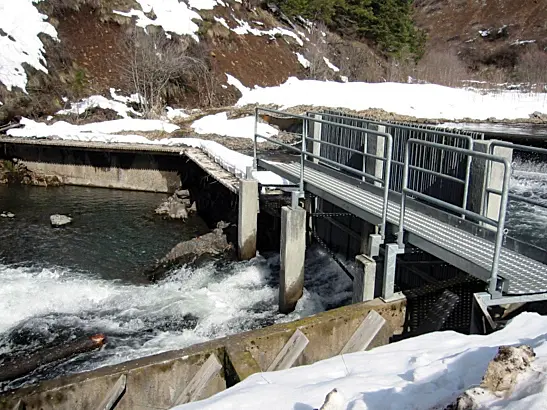
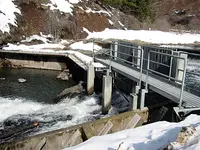
In the summer of 2025 the hatchery finished a new fish ladder and new intake screens, according to a January 2026 report to the Oregon Fish and Wildlife Commission. The old passage was hemmed in by a diversion dam and a historic waterfall. The new ladder gives fish passage up the creek all year, for Chinook, steelhead, lamprey, bull trout, resident rainbow trout, and coho salmon, which were recently documented in the creek. The project was expected to stay under $5 million, half the original estimate.
Joe Oatman, a Nez Perce tribal member who directs the Harvest Division of the tribe’s fisheries program, told Columbia Insight what the returning fish are for: “It’s more than just catching a few fish to bring home. It’s about finding a place where we can pass on these traditions that have been there for countless generations.”
Notable Events
- 1970sThe basin's LSRCP spring Chinook program was established in response to severe declines and depressed populations. fws.gov
- 1978Rapid River stock smolts were released into Lookingglass Creek to initiate broodstock development. fws.gov
- 1980Rapid River stock use was discontinued because of disease and availability; Carson stock was used in the interim. fws.gov
- 1980The Commission report dates the hatchery's original intake screens to this year. myodfw.com
- 1982CRITFC attributes extirpation of the watershed's native spring Chinook population to lower Snake River dam completion as well as hatchery and weir construction. critfc.org
- 1982ODFW completed and dedicated Lookingglass Fish Hatchery on Lookingglass Creek, eighteen miles from Elgin. dfw.state.or.us
- 1984A comprehensive research, monitoring, and evaluation program began to assess hatchery practice, rearing and release strategies, adult production, and wild-stock genetic integrity. fws.gov
- 1985Rapid River stock returned to use after the interim use of Carson stock imported from the Willamette River hatchery program. fws.gov
- 1988The Imnaha satellite of Lookingglass Hatchery was built with an acclimation pond and adult ladder and trap. dfw.state.or.us
- 1990ODFW adopted criteria limiting non-local hatchery spawners in natural populations, influencing the hatchery program's direction. fws.gov
- 1992The Confederated Tribes of the Umatilla Indian Reservation began a reintroduction program using non-local Rapid River stock. critfc.org
- 1992The USFWS brochure states that the native spring Chinook population vanished despite good habitat. fws.gov
- 1992The review states that natural spring Chinook populations were listed initially as endangered and later as threatened under the ESA, influencing the hatchery program. fws.gov
- 1995Reform actions included starting captive broodstock collection of parr from Catherine Creek and the Upper Grande Ronde and Lostine rivers. fws.gov
- 1995Reform actions included new acclimation and adult-capture facilities on tributaries and significant modifications to Lookingglass Fish Hatchery. fws.gov
- 1997The review dates the Lostine River's natural-adult-broodstock supplementation program, using sliding-scale management, to this year. fws.gov
- 1997The newspaper reports that Lookingglass began its conservation program when each area's watershed had only a few dozen returning spawners; Lookingglass Creek numbers were in single digits. underscore.news
- 1999Rapid River juvenile stocking stopped, and returning adults were blocked from passage for several years while the program shifted to in-basin stock. critfc.org
- 1999Rapid River stock was used through this brood year, when it was phased out. fws.gov
- 2001The tribe reintroduced juveniles from a newly established in-basin Catherine Creek stock. critfc.org
- 2001The review dates conventional natural-adult-broodstock supplementation programs on Catherine Creek and the Upper Grande Ronde to this year. fws.gov
- 2004Adults from the new Catherine Creek stock returned for the first time, and upstream passage was allowed again. critfc.org
- 2007The first adult progeny of fish that spawned naturally in 2004 returned. critfc.org
- 2011For the first time in decades, returns were strong enough to allow tribal and sport fisheries. critfc.org
- 2012The run was estimated at 1,700 fish, roughly the same as historically seen. critfc.org
- 2024A tanker carrying about 102,000 spring Chinook smolts from the hatchery for release in the Imnaha River crashed near Lookingglass Hatchery. dfw.state.or.us
- A tanker transporting approximately 102,000 spring Chinook smolts for Imnaha River release was involved in an accident near Lookingglass Hatchery. dfw.state.or.us
- Major fish-ladder and intake-screen upgrades were completed to improve native fish passage and operational reliability, according to the January Commission report. myodfw.com
People
- Doug Hatch, CRITFC information contact listed on the Lookingglass spring Chinook restoration page.
- Andrew Gibbs, ODFW fish hatchery coordinator for Eastern Oregon, quoted about the smolt-tanker accident and future production.
- Ethan Brandt, ODFW District Fish Biologist in La Grande, quoted assessing Lookingglass Creek Chinook return timing.
- Old Looking Glass, Father of Young Looking Glass, the hatchery namesake.
- Young Looking Glass, Nez Perce tribal leader and the hatchery's namesake.
- Joe Oatman, Nez Perce Tribe member and director of its fisheries program's Harvest Division, commenting on salmon restoration.
- Rick Zollman, Nez Perce fisheries worker and caretaker of fish at Lookingglass; not himself a tribal member.
Sources
- fws.gov/sites/default/files/documents/2025-03/012224-lookingglass-fh.pdf
- digitalcollections.library.oregon.gov/nodes/view/316402
- bakercityherald.com/2026/05/11/salmon-fishing-starts-may-15-on-lookingglass-creek-north-of-elgin
- myodfw.com/lookingglass-hatchery-visitors-guide
- dfw.state.or.us/news/2024/04_Apr/040224.asp
- critfc.org/2012/11/09/lookingglass-cr-spring-chinook
- dfw.state.or.us/agency/history.asp
- fws.gov/sites/default/files/documents/7%20GrandeRondeBasinSpringChinook%20Salmon%20HatcheryReview.pdf