Little White Salmon National Fish Hatchery
Cook, Skamania County, Washington. National fish hatchery.
Details
- Where
- 56961 State Road 14, Cook, WA 56961. Directions
- When
- Open to the public Monday through Friday 8:00 am - 3:00 pm; weekends in April through June.
- Season
- Adult spring Chinook salmon May through August; fall Chinook October through November.
- Getting there
- On the Little White Salmon River about one mile upstream from the Columbia; the river joins the Columbia at river mile 162; Drano Lake is at the river mouth.
- Fees
- Free.
- Access
- Call the hatchery for exact fall Chinook viewing days and times.
- Walk-in or reserve
- Walk-in during open hours; weekday tours scheduled by phone.
- Phone
- (509) 538-2755
- Website
- fws.gov
- Managed by
- U.S. Fish & Wildlife Service.
- Established
- 1898.
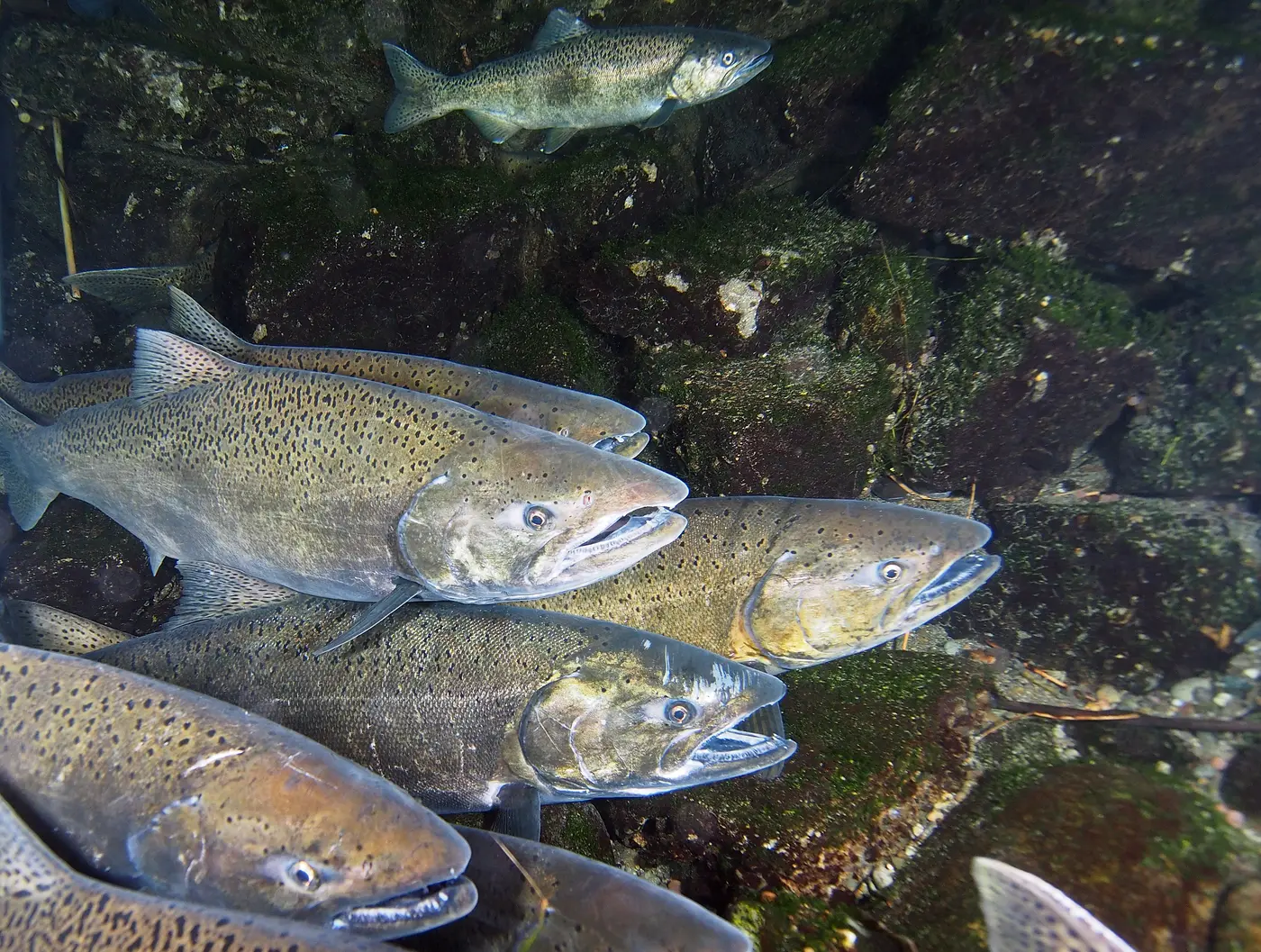
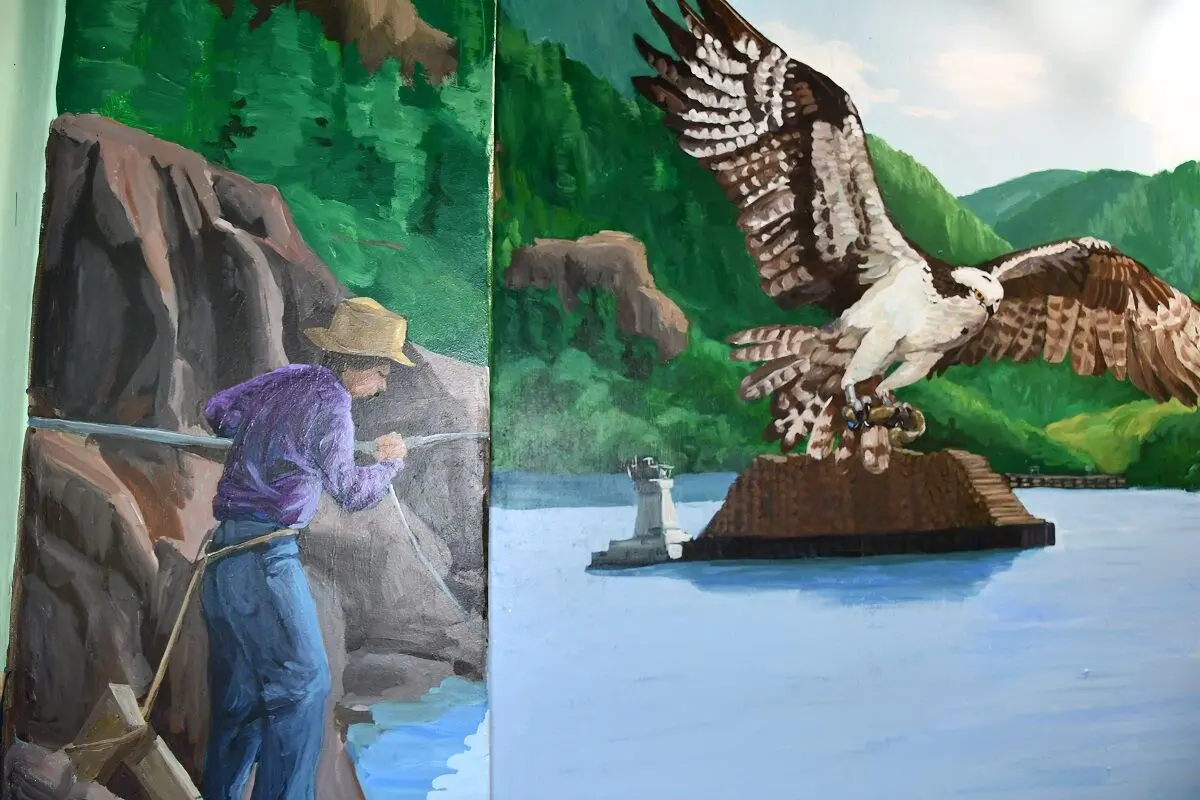
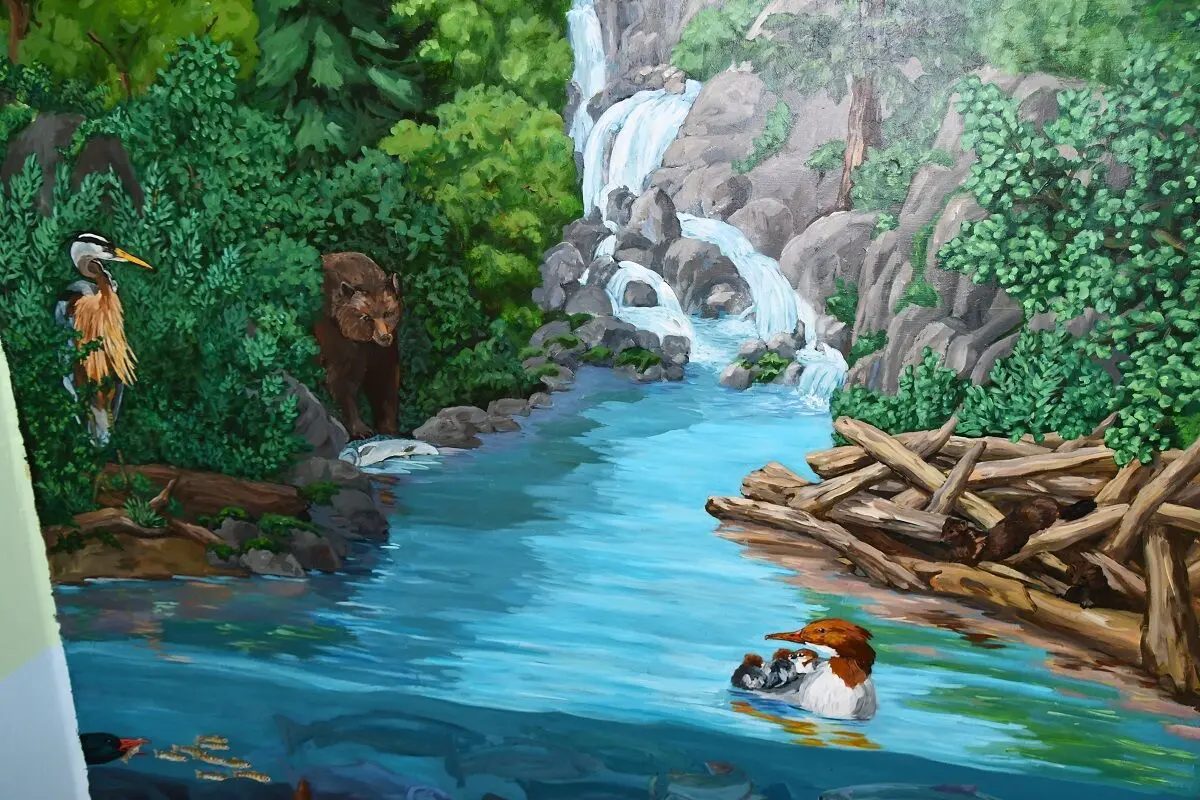
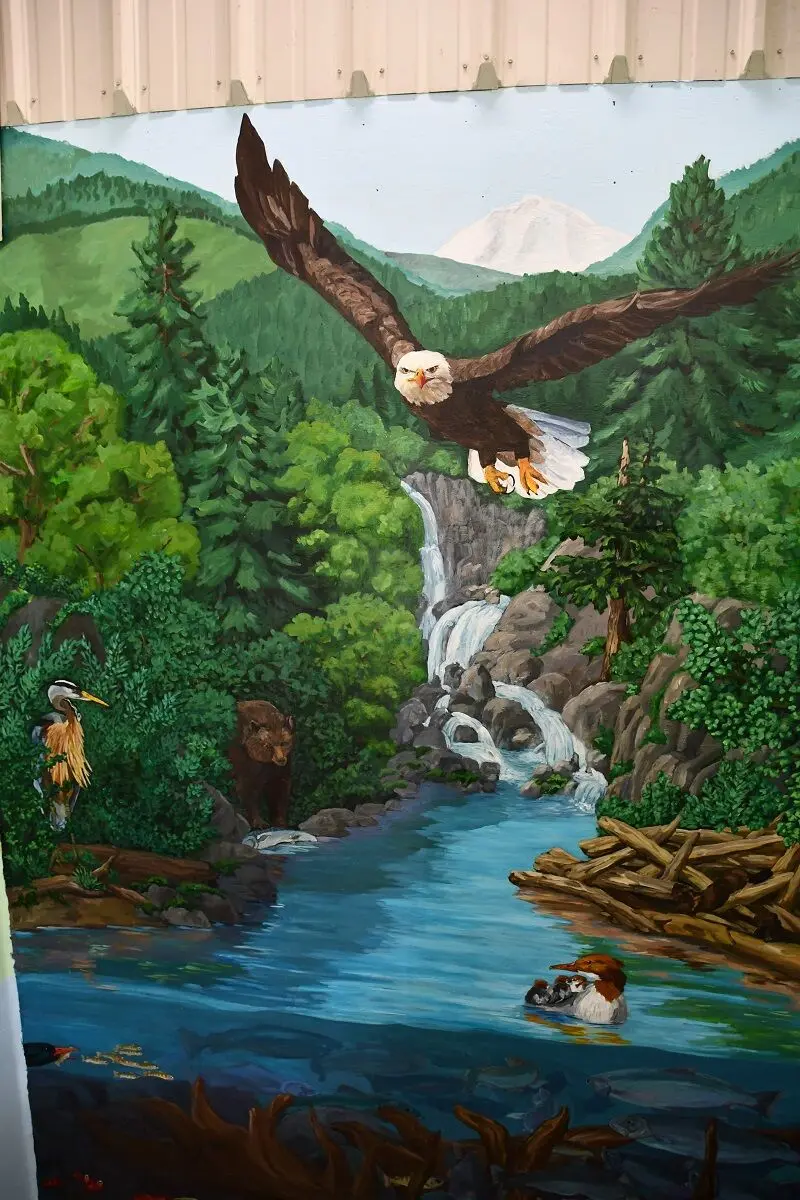
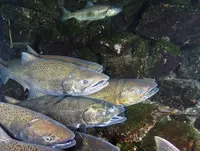
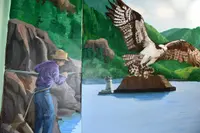
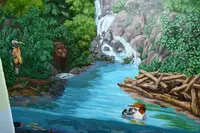
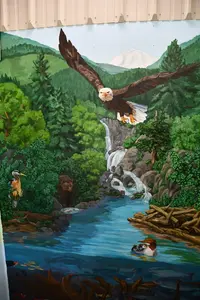
At the upper end of the Little White Salmon National Fish Hatchery, visitors go downstairs from the Visitor Center into an underwater viewing room. Adult salmon are held there before spawning. Spring Chinook fill it in summer, and on August 8, 2022, a U.S. Fish and Wildlife Service camera recorded “hundreds of spring Chinook salmon, if not more” moving past the window. Upriver bright fall Chinook follow from mid-October. The walls carry murals by Janet Essley, an artist from White Salmon, completed in July 2022. Cheri Anderson, information and education specialist for the Columbia River Gorge National Fish Hatchery Complex, said the hatchery “has that great salmon viewing room and now a colorful mural that tells a story to visitors.” Upstairs, the entrance has art, educational displays, and literature.
The road from Drano Lake to the upper hatchery
The hatchery sits in Skamania County on the Little White Salmon River, about one mile above the Columbia. The river enters the Columbia at river mile 162, and Drano Lake, a natural lake, lies at its mouth. The U.S. Fish and Wildlife Service runs the station as one of six in the Gorge complex, with Carson, Eagle Creek, Spring Creek, Warm Springs, and Willard.
Anglers fish along the entrance road. The Service counts Drano Lake among the most popular salmon fishing sites in the Gorge, used by both sport and tribal fishers. Spring Chinook enter the lake from late March through May. Fall Chinook arrive as early as August and hold there until they push upstream to the hatchery in late October. The lake has a wheelchair-accessible fishing ramp and platform and a boat ramp.
An interpretive walking trail follows the hatchery road from the lower hatchery to the upper, and a brochure for it is kept at the Information Kiosk at the entrance. Along the way, walkers can look into the river for returning salmon and for salmon spawning naturally beside the hatchery grounds. Two outdoor viewing decks overlook the water. Juvenile salmon fill the outdoor raceway banks at both ends of the station, and staff answer questions there.
The station’s staff report black bears, mink, otter, and the occasional mountain lion in the canyon. Bald and golden eagles, osprey, great blue heron, belted kingfisher, and the American dipper also feed here, with birds of prey taking the returning salmon. The Little White Salmon is a Wild and Scenic river, and the Service notes kayakers running it past waterfalls. Picnic tables stand along the entrance road and inside the hatchery. West of Cook-Underwood Road, about 144 acres of hatchery land are open to hunting in Washington’s seasons, with shotgun or bow only.
Springers, brights, and sixteen million eggs
The year at the hatchery runs in a set order. In fall the brights return, and spawning begins in mid-October and runs into mid-November. More than 16 million eggs are taken in that season for this station, for Willard, and for other programs. Over winter the eggs eye up and hatch, and the fry are moved to raceways to be fed. Yearling spring Chinook go out in mid-April. In spring the young brights have their adipose fins clipped and coded-wire tags implanted, which lets the marine fisheries report detailed information on them. The fish ladder opens to adult springers about May 1, and in summer the brights are released.
Annual production is 1.4 million spring Chinook and 4.5 million upriver brights for release on site. Another 1.1 million brights are marked and trucked to the Yakama Nation’s Prosser Hatchery. The Service’s hunting page gives the spring Chinook figure as 1 million. As of November 14, 2024, 15,441 upriver bright adults had returned to the hatchery that season.
Most of the money comes through the Mitchell Act, administered by NOAA Fisheries. More comes from the U.S. Army Corps of Engineers for dam mitigation and through the Pacific Salmon Treaty, which pays for salmon meant to feed southern resident killer whales. Surplus fish go to the tribes for ceremonial and subsistence use. “So not only are we giving them our surplus fish,” Anderson said, “we’re providing a good amount of the fish that are swimming up the river and they’re catching them, whether it’s with a hoop net or the gill net fishery.”
A rack across the river, 1896
The hatchery traces back to the decline of the salmon runs. Commercial chinook landings on the Columbia fell from about 19.5 million kilograms in 1883 to 8.2 million in 1889. A 1990 Service history by William R. Nelson and Jack Bodle dates the first salmon hatchery in the basin to 1876. It was built on the Clackamas River in Oregon by the Oregon and Washington Fish Propagating Company, and the U.S. Commission of Fish and Fisheries bought it in 1888 for $5,155.60. Anderson dates that hatchery to 1877 and credits cannery workers with starting it. She says the federal government looked for new sites because the Clackamas water was not ideal for fish.
In summer 1896, Professor B. W. Evermann and W. F. Hubbard, superintendent of the Clackamas hatchery, examined Columbia tributaries for a federal site. They wanted plentiful salmon, pure water at the right temperature, ground where water would reach the troughs by gravity, and building materials and railroad service close by. They chose the Little White Salmon because they believed it was one of the principal spawning grounds of the quinnat, or chinook. Construction of a hatchery, a mess house, and a rack across the river began on September 5, 1896. Egg collection began on September 26 and ended October 14, with 2,179,000 eggs taken. Assistant U.S. Fish Commissioner William Ravenel wrote that “the salmon appeared in such large numbers below the rack that the Indians often speared two and three at one cast of the spear.”
Ravenel described the first building as “a rough wooden structure without a floor, lighted by skylights above and unglazed windows in the sides and ends,” with 50 troughs. Because the ground was subject to floods, at season’s end the hatchery was weighted down with stone and left with a watchman. The first season of building and operating cost $2,288.27. When crews reopened the hatchery on July 20, 1897, they found that the Columbia had floated it off its foundation. They repaired it and added a second building, 42 by 80 feet, with a floor terraced in four steps so that every trough stood at the same height above the floor. A third building followed in 1898.
The dates of the founding vary by source. The Nelson and Bodle report and the Service’s hunting page give 1896. The Service’s main pages and Anderson give 1898. Other Service accounts reconcile the two by calling 1896 the start of experimental production and 1898 the date of establishment.
Ravenel also recorded how the fish were taken. A slatted trap about 20 feet long was anchored midstream, with a rack running out from its sides. Once enough salmon had gathered upstream, crews drew a seine rapidly downstream. The frightened fish turned with the current and stranded “high and dry upon the lower end of the trap.” Most of this fishing was done at night, and the best hauls came about an hour after dark. Spawning began in the morning. Men carried the eggs to the hatchery in buckets holding about 15,000 each, two buckets to a man on a yoke.
Floods, a dam, and a change of stock
Until 1908 every fish was released as unfed fry. That year some were kept longer and fed ground beef liver, then salmon or eulachon. Juvenile releases peaked at nearly 24 million in 1914, and the fall chinook egg take passed 40 million in 1917. Eggs went abroad: 250,000 to New Zealand in 1899, about 16,700 to Madagascar in 1955, and 770,790 coho eggs to Korea in 1975. Twenty concrete rearing ponds went in in 1916, the original buildings came down in 1922, and electricity arrived in June 1931.
In 1938 the closure of Bonneville Dam backed the Columbia over the hatchery. A new hatchery building went up in 1939, but rearing facilities were unavailable for another eight years. A fish ladder, an adult holding pond, and six ponds were built in 1947. The fall chinook egg take fell to about 1.7 million in 1944 and recovered to nearly 30 million in 1958. Beginning in the 1930s, Mitchell Act funds charged the station with offsetting habitat the dam had cost.
Some programs did not last. Sockeye from Yes Bay, Alaska, first came in 1918. Their production was almost entirely lost in 1952 to a disease the report identifies as IHN, and the program was abandoned in 1955. The native chum run began to fail in 1934, and chum work ended after a few adults returned between 1959 and 1963. Coho from the Toutle River stock had established a dependable run by 1965. The 1990 report calls coho the only species besides the original chinook to do so. In 1967, spring chinook of unknown origin returned to the river and were spawned for the first time.
The native tule fall chinook continued to decline. By 1985 that run was so depressed that the hatchery abandoned rearing the stock and decided to switch to bright fall chinook. In May 1987 an IHN outbreak destroyed the entire year’s production. The upriver bright program was established in 1988, using broodstock first developed in the late 1970s from natural-origin adults trapped at Bonneville Dam. Nelson and Bodle blamed the dam, imported stocks, and longer rearing for the decline. They closed their account by noting that the native fish had once been described as “so abundant that the spawners filled the river for a month.”
Notable Events
- 1890By 1890, scientists predicted the collapse of the chinook fishery and suggested hatcheries as one solution to the problem. govinfo.gov
- 1896Construction of the hatchery, mess house and river rack began on 5 September; egg collection began on 26 September. archive.org
- 1896Hatchery records indicate an average 16.5 million eggs were taken annually between 1896-1915, incubated in baskets and released as fry. fws.gov
- 1896The hatchery was a pioneer in the fledgling science of salmon propagation when it began rearing salmon in 1896. fws.gov
- 1897On reopening, the hatchery was found floated off its foundation by Columbia River flooding. Damage was repaired and another hatchery building constructed. archive.org
- 1898Assistant U.S. Fish Commissioner William Ravenel noted that during the season the salmon appeared in such large numbers below the rock that the Indians often speared two and three at one cast of the spear. fws.gov
- 1908Previously released as unfed fry, increasing numbers of fish were reared for later release. archive.org
- 1914The report's abstract dates a juvenile-release peak of nearly 24 million to 1914. archive.org
- 1916Chum salmon production began. archive.org
- 1916Construction of 20 concrete rearing ponds greatly increased juvenile rearing potential. archive.org
- 1917Fall chinook egg take peaked at over 40 million. archive.org
- 1918Attempts to establish a sockeye run began with eggs received from Yes Bay, Alaska. archive.org
- 1919Initial attempts used the native late-running coho stock. archive.org
- 1921Four earthen ponds were constructed, increasing juvenile rearing potential. archive.org
- 1922The original hatchery buildings were torn down and a new building constructed. archive.org
- 1928The daily log recorded floodwaters inundating two rearing ponds, allowing an unknown number of fish to escape. archive.org
- 1929A cold storage building was constructed. archive.org
- 1930Under the Mitchell Act the hatchery's role expanded to mitigate habitat loss due to completion of Bonneville Dam. fws.gov
- 1934Native chum were used for broodstock until the run began to fail. archive.org
- 1935Live eggs were placed on trays rather than returned to baskets. archive.org
- 1936The daily log reported fish dying in ponds and intermittent salt-bath treatment until 25 June; fish were released on 29 June. archive.org
- 1936The first large release elsewhere was made in the Wind River. archive.org
- 1938Closure of Bonneville Dam resulted in the Columbia River inundating the hatchery facilities. archive.org
- 1939Another hatchery building was constructed; rearing facilities were unavailable for another 8 years. archive.org
- 1942Daily logs repeatedly reported sediment on eggs from turbid floodwaters and poor hatching success. archive.org
- 1944The fall chinook egg take fell to about 1.7 million before recovering to nearly 30 million in 1958. archive.org
- 1947Attempts to reestablish a chum run used eggs and fry imported from the Quilcene River. archive.org
- 1947Six ponds, a fish ladder and an adult holding pond were constructed. archive.org
- 1950Additional rearing ponds were built and the fish ladder and adult holding pond were extended and modified to increase efficiency and capacity. archive.org
- 1952Loss of fry from coagulated yolk disease was reported as the first specific disease problem. archive.org
- 1952Production was almost totally lost to what was then believed to be a viral disease; the report identifies it as undoubtedly IHN. archive.org
- 1955About 16,700 eggs were shipped to Madagascar. archive.org
- 1955Poor adult return and disease problems led to abandonment; remaining juveniles transferred to Carson NFH all died. archive.org
- 1956The Toutle River stock was considered responsible for establishing a successful coho run. archive.org
- 1958Bacterial kidney disease was diagnosed after first appearing in coho two years earlier. archive.org
- 1958Egg take recovered to nearly 30 million after the earlier low. archive.org
- 1959A few adults returned during this period, but chum production was then abandoned. archive.org
- 1960Mid-June was selected for releasing most annual production to coincide with expected maximum river flows. archive.org
- 1960A power crowder and lifts were installed to facilitate handling adults. archive.org
- 1962Oregon Moist Pellet diet was fed to coho on a trial basis after fish were started on the wet production diet. archive.org
- 1963Adults were anesthetized with tricaine methanesulfonate to facilitate handling. archive.org
- 1963The OMP diet was determined adequate for coho and chinook across the entire feeding range. archive.org
- 1964All fish were fed commercial diets by this year. archive.org
- 1965By this year a dependable Toutle River coho stock run was established. archive.org
- 1965Conversion began with purchase of four vertical Heath incubators. archive.org
- 1967Spring chinook of unknown origin returned to the river and were first spawned. archive.org
- 1967A water reuse system and heating system were installed and used for egg incubation. archive.org
- 1970sEggs began to be handled and incubated differently, although spawning techniques did not change. archive.org
- 1970The URB fall Chinook broodstock was originally developed from natural-origin adults trapped at Bonneville Dam. fws.gov
- 1974The fish ladder and barrier dam were modified and a flood wall constructed. archive.org
- 1975770,790 coho eggs were shipped to Korea. archive.org
- 1975The two hatcheries were administratively combined as the Little White Salmon/Willard NFH Complex. fws.gov
- 1976Conversion to Heath incubators was completed. archive.org
- 1982Adults began being held indoors and exposed to advanced photoperiod to induce earlier spawning. archive.org
- 1985The native tule run was so depressed that rearing the stock was abandoned. archive.org
- 1985A decision was made to switch to bright fall chinook stock. archive.org
- 1987The entire year's production was destroyed because of an IHN outbreak, setting back the bright-stock switch. archive.org
- 1988The URB fall Chinook program was established at the LWS/Willard Complex. fws.gov
- 2004The Willard program using broodstock collected at Little White Salmon was discontinued because of Mitchell Act funding shortfalls and shifting priorities. fws.gov
- New murals by Janet Essley in the salmon viewing room were completed in July. columbiagorgenews.com
- State hatchery division manager Eric Kinne reported a collective loss of 12 employees, about 32% of staff, at five Gorge hatcheries including Little White Salmon. spokesman.com
People
- A. Kemmerich, Columbia River Program Director who reviewed the hatchery history (1938-60).
- B. Cox, Little White Salmon NFH manager (1947-60).
- B. W. Evermann, Professor who surveyed Columbia River tributaries with Hubbard intending to establish a Federal salmon hatchery (summer 1896).
- H. Johnson, Little White Salmon NFH biologist (1953-72).
- W. F. Hubbard, Clackamas State Fish Hatchery superintendent who surveyed tributaries with Evermann intending to establish a Federal salmon hatchery (summer 1896).
- Cheri Anderson, Information and education specialist for the six-station Columbia River Gorge National Fish Hatchery complex.
- Janet Essley, White Salmon artist who created the new mural at the Little White Salmon visitor center in Cook.
- William Ravenel, Assistant U.S. Fish Commissioner who described the significance and salmon abundance of the hatchery site (1898).
Sources
- fws.gov/fish-hatchery/little-white-salmon
- facebook.com/LittleWhiteSalmonNFH
- skamania.org/fish-hatcheries-and-wildlife-refuges-in-skamania-county
- columbiagorgenews.com/news/gorge-hatcheries-have-long-history-part-2-of-2/article_0477e2dc-1d95-11ed-aaaf-23e7c79722a2.html
- fws.gov/fish-hatchery/little-white-salmon/visit-us
- fws.gov/fish-hatchery/little-white-salmon
- fws.gov/fish-hatchery/little-white-salmon/about-us
- govinfo.gov/content/pkg/GOVPUB-I49-PURL-gpo133590/pdf/GOVPUB-I49-PURL-gpo133590.pdf
- npshistory.com/brochures/nwr/little-white-salmon-fishing.pdf
- fws.gov/story/hatchery-road-trip-little-white-salmon
- dtic.minsky.ai/index/ADA323519