Lincoln County Logger Days
Libby, Lincoln County, Montana. Festival.
Details

- Where
- J. Neils Memorial Park, MT Hwy. 37 N., Libby, MT. Directions
- When
- June 25-27, 2027.
- Getting there
- J. Neils Memorial County Park, just north of the river from the town of Libby.
- Fees
- Admission $10 pre-sale or $15 at the gate; kids 9 and younger do not need a button.
- Access
- County park managed by a seasonal park attendant; water on from approximately April 1st until mid to end of October.
- Phone
- 406-300-8896
- Website
- libbyrotary.org
- Managed by
- The Rotary Club of Kootenai Valley.
- Established
- 1960.
At noon on Friday, June 19, 2026, the gates opened at J. Neils Memorial Park, the county park just north of the river from Libby, and at two o’clock the first lumberjack show began. The performers were DLW TimberWorks, which The Western News identified as a Wisconsin outfit. The Montanian reported that they came from across the United States. Three times that afternoon they climbed 45-foot speed poles, chopped from springboards, threw axes, set chokers, and ran crosscut and hot saws through logs in a few seconds. In the log-rolling round a roller named Jordan went into the water twice before Nick was declared the winner. Jordan also carved a bunny, and then a stool. When the show ended, the crew signed autographs.
Between shows the stage held open mike or karaoke, alternating with a talk on the history of logging. Entry to the grounds was by button, a three-day pass sold ahead of time at places such as Fix Coffee, Rocky Mountain Music, and Cohenour Trucking. Children nine and under needed none. Much of the selling is done by the festival’s royalty candidates, who spend months promoting the event and earn scholarships for their trouble. At seven o’clock they came into the main arena for the coronation. Jaycee Thompson was crowned Queen, Xavier Sweet was named King, and Alexandra Durbin and Zoey Bernall were made Princesses. The crowning goes back to 1962, when Linda (Swinson) Schikora became the first Logger Days Queen.
The park is built for this kind of weekend. It has a rodeo arena that was named the best in Montana in 2008, a covered band stand and dance area, ball fields, an 18-hole Frisbee golf course, and a paved path that leads to the Heritage Museum. On the 2026 Friday, Jay Snow and the Tone Keepers played at nine and drew people onto the dance floor. The beer garden stayed open until midnight. On the ball fields the Loggertown Baseball Club held its second annual Border Brawl the same weekend, with teams from Montana, Idaho, Washington, and Canada.
Huckleberry pancakes and Mineral Avenue
Saturday began at eight with the Spring Up Libby 5K, which started at the Memorial Center. At the same hour American Legion Post 97 and its Ladies Auxiliary served a huckleberry pancake breakfast. The Knights of Columbus served their own breakfast from nine to ten at the historic high school park next to the Memorial Center.
At eleven the parade moved down Mineral Avenue in downtown Libby. People waited along the curb with bags for the candy thrown from the floats. The Heritage Museum sent its vintage fire truck and its Model T. David Thompson Search and Rescue marched, along with the Kootenai National Forest, the American Legion, and the new King and Queen. Behind them came a Dodge business coupe, a 1931 Ford, custom lawnmowers, a grader, a big loader, and a harvester. The working rigs of Martin Logging, Cohenour Trucking, Hilliard Trucking, and Noble Excavating followed, and a crew swept the street afterward. “I thought this was the best parade I’ve seen in many years. Great job,” Sandra Barnes told The Montanian.
Back at the park the lumberjack shows ran through the afternoon. The food row sold barbecue, Korean barbecue, pizza, ice cream, and specialty drinks, and The Montanian reported that many vendors sold out every evening. A dunk tank raised money for the Step of Faith dance team, and children lined up for face painting. The Adventure Zone set up a giant slide, inflatables called Wipeout, Wild Rapids, and Arctic Plunge, and carnival games. A notice before the festival said adults could play there for free.
The log in the J. Neils Arena
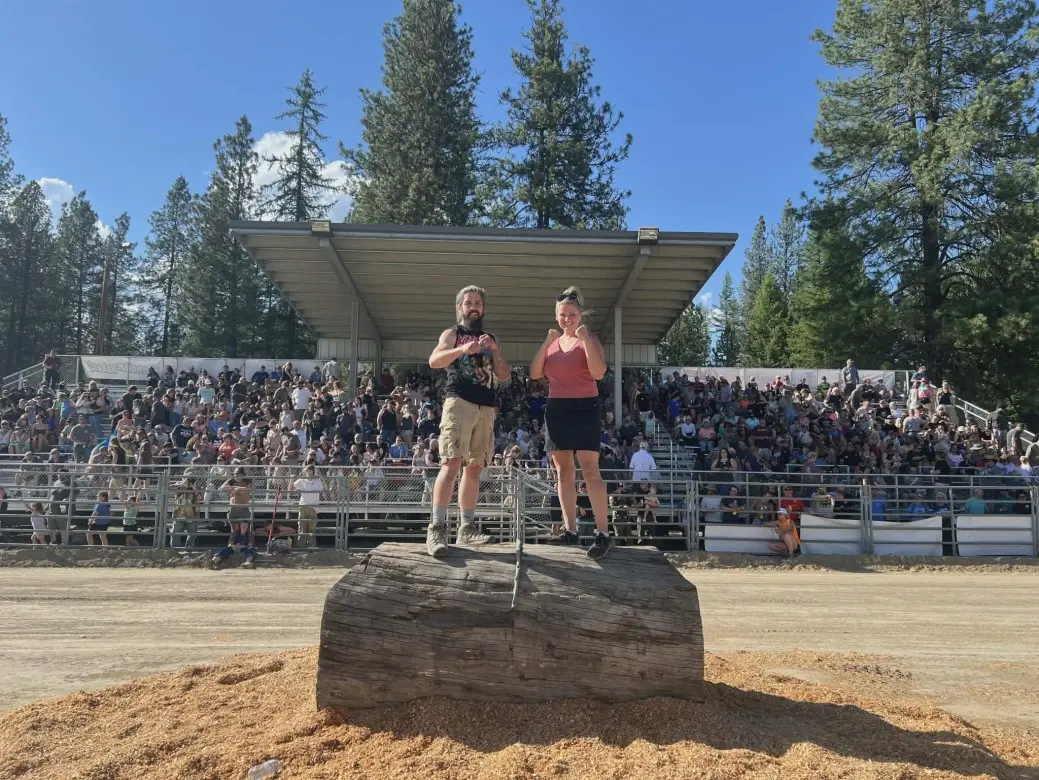
At six o’clock on Saturday a large crowd filled the J. Neils Arena for the Bull and Bulette of the Woods. Competitors balance on top of the historic log and try to stay there. The Flathead Beacon described the 2016 bout as two people fighting each other off a massive log. In 2026 Patrick Wood won the title of Bull of the Woods and Jessica Selle won Bulette. At seven came the lawn mower races, which had long been missed. The Never Too Old to Be Famous Band played the evening, and people danced late.
Sunday was Family Fun Day, and admission was free. The CARD Clinic Kids Rally ran from ten to two. Between live logging demonstrations, children walked around a processor, a log loader, and what LibbyMT.com called “the really big skidder.” The Lincoln County SnoKat Club sponsored a sawdust dig in three age groups, from toddlers up to twelve-year-olds. After that came tug-of-war, crosscut sawing, Jack and Jill races, and a miniature Bull and Bulette of the Woods fought with pillows. At three o’clock children set out along the park walkway for the Julius Neils Lost Loot Treasure Hunt.
The Neils mill and the tree planters
The treasure hunt is named for the man the park is named for. Libby’s first sawmill was built by the first townsite company in the winter of 1891–1892, near the present bridge over the Kootenai River, to supply lumber for the new town. In 1906 the Dawson Lumber Company built a modern sawmill, and workers and their families came in greater numbers. In 1911 J. Neils and Associates bought the Dawson mill, which was later named the Libby Lumber Company. Its owners believed reforestation was a necessary part of the trade, and the company ran an active tree-planting program.
In 2012 Jeff Gruber, a history teacher at Libby High School, was assembling a pictorial history of the town. He told the Flathead Beacon that in the 1950s northwest Montana, Libby included, was a testing ground for sustainable logging, meaning planting more than was cut. He said the town was led in that work by “the J. Niels Lumber Company,” as the Beacon spelled it. “A community and industry worked in concert with the land,” Gruber said.
From 1960, or the 1950s, to the revival
Most accounts date Logger Days to 1960. The Flathead Beacon wrote in 2016 that the festival “first started in the 1950s.” Lincoln County’s festival listing says it was founded as a series of educational events to teach people about forest management. In 2013 NBC Montana reported that it was originally created for the men who “worked hard and played harder.” By then it held a logging competition for both men and women. “Chopping and sawing events — they all have historical value because this is how they used to log and used to process lumber,” spectator Kyle O’Brien told the station. “To come and watch these guys do it the way that my great-grandfather did back in the day.”
The program grew as the years went on. In 2011 Kathrine Spencer and Adam LaSalle won the Jack and Jill double-buck. The 54th annual festival, in June 2012, ran four days. It had a carnival, fireworks on Friday night, and a 10-kilometer run. Its events included springboard chop, double buck, single buck, donut stacking, axe throwing, the Ma & Pa relay, the PeeVee roll, and choker setting. The 2016 festival opened on Thursday with a boxing smoker and ran a softball tournament through the weekend.
Most sources say the last Libby Logger Days was held in 2019. The Montanian’s June 4, 2026, notice said instead that the festival wrapped up in 2018 and gave the gap as eight years. According to LibbyMT.com, the pandemic forced a shutdown in 2020, and a lack of volunteers kept the festival closed in the years after. In March 2026 the LOR Foundation granted $10,000 to the Libby Schools Foundation, after one of its members asked for help reviving the festival. With the money, the foundation and the Rotary Club of the Kootenai Valley bought sawhorses, crosscut saws, safety gear, arena barriers, and a water tank. The Rotary club took over the festival as a fundraiser for community projects and for scholarships for students in Libby and Troy, and renamed it Lincoln County Logger Days. Tabitha Viergutz, McKenzie Williams, Toni-Lynn Backen, Matthew Obermayer, Breeanna Runyan, and Kaylee Cohenour led the volunteers. “This revival is all about family, community, and tradition,” Williams said before the 2026 festival.
Organizers say the festival will be held every year again. The club has posted dates for the next one, June 25 to 27, 2027, and has opened a contest to design its button.
Notable Events
- 1891The first saw mill was built by the first townsite company in the winter of 1891-1892 near the present day bridge across the Kootenai River and was used to supply lumber to build the growing town. libbymt.com
- 1906In 1906 the Dawson Lumber Company built a modern sawmill plant bringing workers and their families to the town in greater number. libbymt.com
- 1911In 1911, J. Neils and Associates bought the Dawson Lumber Mill and it was later named the Libby Lumber Company. Familiar with the timber industry, the owners believed that reforestation was a necessary part of the industry, and they implemented an active tree-planting program through the company. libbymt.com
- 1962The royalty tradition dates back to 1962, when Linda (Swinson) Schikora became the first Logger Days Queen. montanian.com
- 1971Community members began imagining a museum in 1971 to display the paintings and extensive artifact collection of Libby landscape artist and collector Roy Porter. historicmt.org
- 1976The building's shell was completed as planned by the July 4, 1976, bicentennial. historicmt.org
- 2018The annual Logger Days event, which began in 1960, wrapped up in 2018. montanian.com
- 2019The previous Libby Logger Days was held in 2019. libbymt.com
- 2020The pandemic forced a shutdown in 2020, and then a lack of volunteers in the intervening years shuttered the annual celebration of Libby's timber heritage. libbymt.com
- 2026Libby Logger Days was resurrected and renamed as Lincoln County Logger Days with a new sponsor, the Rotary Club of the Kootenai Valley, held over the weekend of June 19-21 at J. Neils Park. libbymt.com
People
- J. Niels Lumber Company, early adopter of sustainable logging practices in the Libby area.
- Jeff Gruber, Libby High School history teacher working on a pictorial history of Libby (five years).
- Floyd Lucas, structural engineer who designed the Neotraditional Rustic style Heritage Museum.
- Roy Porter, Libby landscape artist and collector whose paintings and artifact collection prompted the 1971 museum idea.
- Wayne Tlusty, National Forest landscape architect who created the Heritage Museum site plan.
- Dawson Lumber Company, operator of the 1906 modern sawmill that brought workers to Libby.
- J. Neils, head of J. Neils and Associates which bought the Libby Lumber Company in 1911 and the namesake of J. Neils Memorial Park.
- Linda (Swinson) Schikora, first Logger Days Queen (1962).
- McKenzie Williams, event organizer with the Rotary Club of the Kootenai Valley.