Lincoln County Fair
Capitan, Lincoln County, New Mexico. County fair; August.
Details

- Where
- 101 Fifth Street, Capitan, NM 88316. Directions
- When
- Last held August 4–8, 2026; next year’s date not yet stated.
- Access
- No livestock on the grounds before 7 AM Tuesday of fair week; no camping or trailer parking in the asphalt lot west of Fletcher Hall; curfew is 10 PM Tuesday-Thursday and 11 PM Friday.
- Walk-in or reserve
- Livestock entries due online through Fair Entry between July 1 and July 15.
- Phone
- (575) 648-2311
- Website
- lcfairnm.com
- Managed by
- Lincoln County Fair Association.
- Established
- 1953.
The Lincoln County Fair opens with baking. At 1 p.m. on the Monday of fair week the 4-H and FFA Pie and Cake Contest is judged, and the next morning, from seven until eleven, trucks and trailers pull up to the entry gate at the fairgrounds on Fifth Street in Capitan. Exhibitors stop there, show their papers, and get their animals checked in before unloading. Late arrivals are not accepted. The 2026 fair ran August 4 through 8, with the pie and cake contest on Monday, August 3. The Ruidoso News reported children “from all over Lincoln County, adorned in jeans and cowboy boots,” showing their animals that week.
Five days in August at Capitan
The exhibitors are 4-H members and FFA students who live or go to school in the county. The fairbook for 2026 lists FFA instructors at Hondo, Carrizozo, Corona and Capitan, and 4-H leaders for clubs at Mal Pais, Chaparral, Hondo, Coalora and Ruidoso. Each animal arrives wearing an approved fair tag in its ear. A superintendent checks every head for ringworm, and lambs and market goats must come in unblanketed for the inspection. Lambs are shorn to under a quarter inch before they reach the grounds, and no clippers are allowed in the blue barn. A tent is set up for body clipping and fitting. Anyone may help an exhibitor there, on the condition that they also help anyone else who asks.
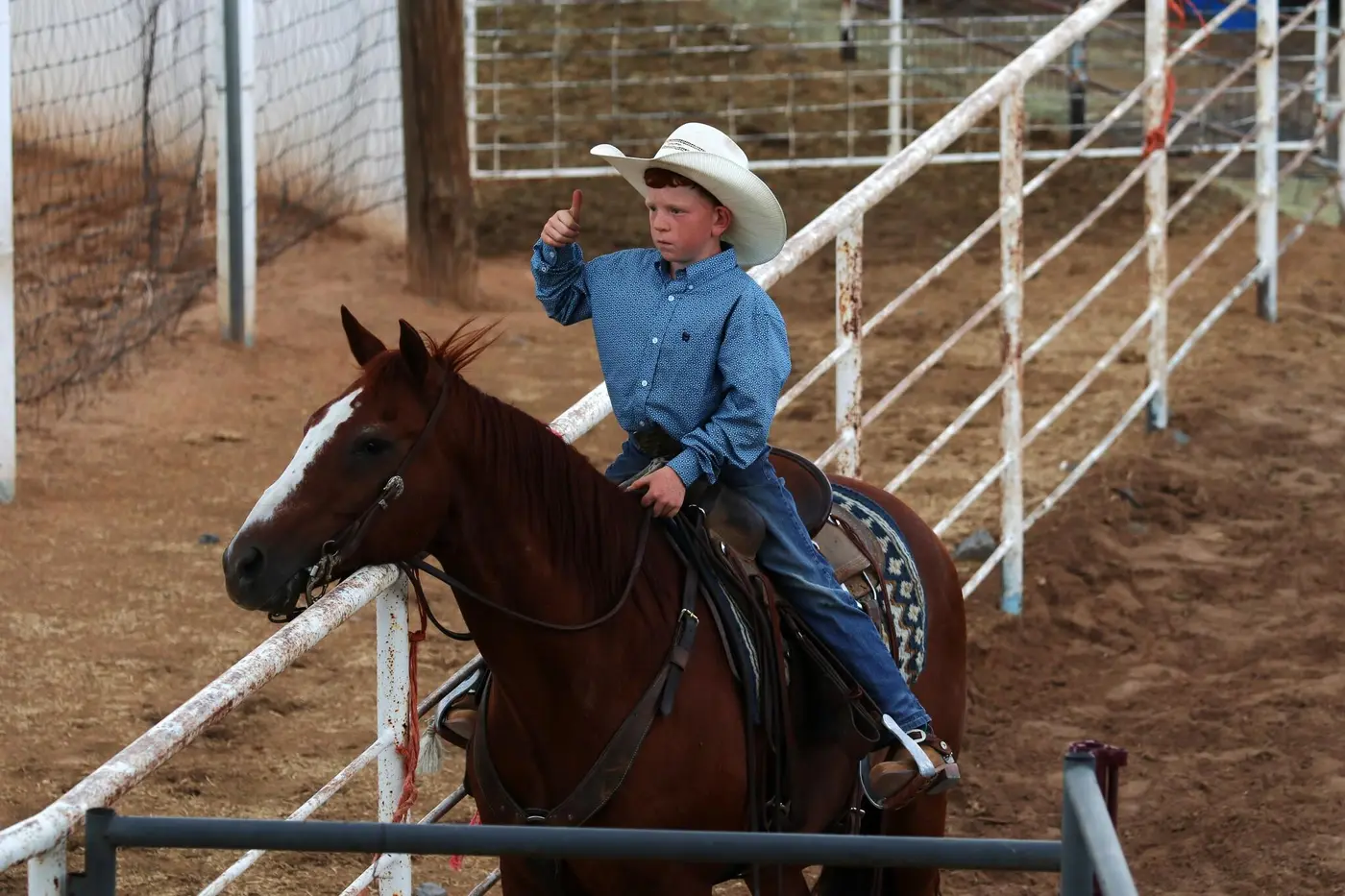
Tuesday belongs to the indoor exhibits, judged at noon, and to the small stock. Animals are weighed and classified at one o’clock, the rabbit show follows at two, and the dairy goats come into the ring at six. Wednesday runs from the swine show at 8 a.m. through market goats, poultry and, at six in the evening, the lambs. County Bred classes are judged during the main goat and lamb shows. Thursday brings out the cattle and horses: dairy heifers at nine, ranch steers and then market beef, the Yearling Prospect and two-year-old Futurity horse show at noon, then the 4-H horse show with its Booster classes for the youngest riders. The cattle classes are a “blow and go” show. Steers go into the ring with their hair in its natural state, with no glues, paints, adhesives or soap residue. A lead class follows at four and a pet show at five. Beef, swine and dairy heifers in 2026 were judged by Jason Miller, and the horses by Kyla Jones.
Hot dogs Wednesday, pizza Thursday
Supper is part of the program. Wednesday at six is Otero County Electric Hot Dog Night, and Thursday at six is Lincoln County Mercantile Pizza Night, followed at seven by the Exhibitors Dance. On Friday morning the exhibitors eat breakfast at nine, sponsored by OSO Grill and the board of the Lincoln County Fair Association, and the awards program follows at ten. Curfew on the grounds is ten o’clock Tuesday through Thursday and eleven on Friday. Bicycles and hoverboards are not allowed, and dogs are kept out of the barns. A county rental sheet for the fairgrounds states that alcoholic beverages are prohibited at the facility.
Friday evening goes to the sale. Exhibitors gather at 5:30 in front of the LCFA Board house for the six o’clock Parade of Champions, and special awards are recognized at 6:30. At seven the Junior Livestock Sale begins, with Tom Brown listed as auctioneer in 2026. The rules allow up to $20 to be deducted from each sale lot and pooled to buy a sale animal outright, and everyone who contributed is photographed with the animal and its young owner. Animals bought at the sale cannot be resold until the sale has closed. On Saturday morning the exhibitors tear down the sale ring and clean their pens, and at eleven the livestock are released.
The association that runs the fair in 2026 was headed by Billy Bob Shafer, with Shad Cox as vice president and Renee Montes as secretary-treasurer. Shafers appear again among the superintendents and as sale coordinator. The county’s Fair Board manages the fairground property and organizes both the fair and the Smokey Bear Stampede over the Fourth of July, which the county calls “The Nations Largest Open Rodeo Weekend.” The fairbook’s rules ban camping and trailer parking during fair week in the asphalt lot west of Fletcher Hall.
Achievement Day and the Rescue Race
Fletcher Hall was also the name of the man who chaired a meeting of the Capitan Chamber of Commerce in early 1953, the meeting at which, according to the published history, the fair was started. Mary Werner, Archie Fuchs and Charlie Jones were present. The event was first called Achievement Day. On March 11, 1956, its founders met, renamed it the Lincoln County Fair and formed a Fair Board. Charles Jones was elected president and Eleanor Jones secretary-treasurer, and both kept those positions until 1985. The history was later compiled from information given by Eleanor Jones and by Ralph Dunlap of Lincoln, a former county Cooperative Extension agent and another of the founders. Dunlap was inducted into the New Mexico 4-H Hall of Fame in December 2003.
The early fair was small. Exhibits went up on Friday, and some were judged that day and the rest on Saturday. In the afternoons there were rodeo events for local cowboys. Fletcher Hall was responsible for these, among them the Rescue Race. He usually won it by rescuing Emma Gene, who often had bruises to show for it and later became his wife. Another timed event was the Modern Cowboy Race. A contestant drove into the arena with a horse in his pickup or trailer, unloaded the horse, roped and tied a calf, loaded the horse again and drove across the finish line. One cowboy left his trailer gate open for a faster start. When he made his U-turn in the middle of the arena, the horse’s hind feet fell out, and it pedaled with its back legs to keep up. When the trailer stopped, the horse jumped back in and refused to come out, “much to the cowboy’s chagrin and the crowd’s amusement.”
The grandstands from the rodeo grounds east of Capitan were hauled to the old school grounds on Truman Spencer’s semi, and the early fair buildings were all put up with donated labor. To pay for the fair, the founders organized the Smokey Bear Stampede. Troy Lane was the stock contractor and the Aggie Ramblers played for the dance. At first a free barbecue preceded the rodeo on the afternoon of the Fourth of July. Charles Jones donated the beef and Clint Sultemeier cooked it, and other ranchers gave beef in later years. The history’s narrator ran the concession stand with Geneva Walker that first year: “after paying all the bills, we cleared $3.46.” The Stampede soon grew into a three-day event with a dance on the Fourth. The rodeo usually covered the expenses, and the dance made the profit.
The fire year, 1969
The fair was incorporated in 1960. In 1961 the arena got lights, and land bought from Frank Pino enlarged the parking lot. In the early 1960s the Junior Livestock Sale was added after Lamoyne Carpenter offered to find buyers if the fair would hold one. He kept at it for many years. The history credits the sale with drawing more interest to the fair, and extra days were added to fit the events. In 2017 a framed print donated by Maria Hamilton was offered at the sale.
The history calls 1969 “a very bad year.” The Fair building burned to the ground just before the Stampede. A trailer was rented for an office, and school superintendent Bud Darling lent the gym for the dances. Then the animal barn burned just before the fair, and Darling opened the school for the inside exhibits. After a number of meetings the board decided to borrow money for a new building and barn. The history credits Johnson Stearns, the Lincoln County Commissioners, the Capitan Village Council and the American Legion with making it possible.
In 1971 the board set out to raise money for a meeting room, a storeroom and restrooms. A gift from Jackie Spencer paid for all three, and they were built in time for the 1972 Stampede and Fair. The barn and sale rings were finished, the pens put up, and several sets of bleachers added. The history notes that there was very little paid labor in any of it: “folks from all over the County just came on, pitched in, and worked.”
Notable Events
- 1953The Lincoln County Fair was started at a meeting of the Capitan Chamber of Commerce in early 1953. lincolnextension.nmsu.edu
- 1956The founders of Achievement Day met and renamed the event The Lincoln County Fair, and a Fair Board was formed. lincolnextension.nmsu.edu
- 1960The Fair was incorporated in 1960. lincolnextension.nmsu.edu
- 1961The arena was lighted in 1961 and land was purchased from Frank Pino to enlarge the parking lot. lincolnextension.nmsu.edu
- 1969The Fair building burned to the ground just before the Stampede, and the animal barn burned just before the Fair; exhibits moved into the school. lincolnextension.nmsu.edu
- 1971Plans were made to raise money for the meeting room, storeroom and restrooms; Jackie Spencer's gift allowed construction in time for the following Stampede and Fair. lincolnextension.nmsu.edu
- The Junior Livestock Sale was added in the early 60s; it created more interest in the Fair and extra days were added. lincolnextension.nmsu.edu
People
- Archie Fuchs, Present at the 1953 founding meeting (1953).
- Bud Darling, school superintendent who lent the gym for dances and the school for inside exhibits after the 1969 fire (1969).
- Charles Jones, Fair Board president (1956 until 1985).
- Charlie Jones, Present at the 1953 founding meeting (1953).
- Clint Sultemeier, cook of the free barbecue that preceded the first Stampede rodeo.
- Eleanor Jones, elected Fair Board secretary-treasurer; retained the position until 1985; co-compiler of the fair's published history (1956-1985).
- Emma Gene, the rider rescued in Fletcher Hall's Rescue Race wins, who later became his wife.
- Fletcher Hall, chairman of the 1953 founding meeting (1953).
- Frank Pino, sold land to enlarge the fair's parking lot (1961).
- Geneva Walker, ran the concession stand the Stampede's first year (that first year).
- Jackie Spencer, gave the generous gift that built the meeting room, storeroom, and restrooms (1971-1972).
- Johnson Stearns, Helped with rebuilding after the Fair building and animal barn fires (1969).
- Lamoyne Carpenter, volunteered to get buyers for the new Junior Livestock Sale and helped for many years (early 60s).
- Maria Hamilton, Donated artwork for auction at the Junior Livestock Sale (8/11/17).
- Mary Werner, present at the 1953 founding meeting (1953).
- Ralph Dunlap, former Lincoln County Cooperative Extension Agent and fair founder whose information, with Eleanor Jones's, compiled the fair's published history (inducted December 2003).
- Troy Lane, stock contractor for the Smokey Bear Stampede.
- Truman Spencer, moved the grandstands from the rodeo grounds east of Capitan to the old school grounds using his semi.
Sources
- lcfairnm.com
- lincolncountynm.gov/government/elected_officials/board_of_county_commissioners/boards,_committees,___commissions/fair_board.php
- img1.wsimg.com/blobby/go/dea5d5a8-2ddf-4cb3-a59b-ffb992f8f9af/downloads/b6d3950c-4d32-43c5-96ba-4a45a1babe39/2026%20Schedule%20of%20Events.pdf?ver=1784002004137
- img1.wsimg.com/blobby/go/dea5d5a8-2ddf-4cb3-a59b-ffb992f8f9af/downloads/9fef5299-4dbe-4171-931a-a355faf1bbe1/2026%20-Outdoor%20Fairbook.pdf?ver=1784002004137
- lincolncountynm.gov/Document_Center/Government/Elected%20Officials/Boards,%20Committees,%20%26%20Commissions/Fair%20Board/Fairground_facility_rentals_102013.pdf
- ruidosonews.com/horses-cows-and-sheep-oh-my-2026-lincoln-county-fair-trots-into-capitan
- lincolnextension.nmsu.edu/fair.html